



Abstract
School middle leaders (MLs) play a pivotal role in improving student outcomes through leading teaching and learning. However, MLs face considerable challenges in driving school improvement, including comparatively few opportunities for targeted professional development (PD). In this paper, we explore the impact of a pedagogy-focused, collaborative approach to PD, known as Quality Teaching Rounds (QTR), for middle leading practice. Twenty-two post-QTR interviews with MLs, principals and classroom teachers at nine primary schools in NSW, Australia, were thematically analysed using Kemmis's theory of practice architectures. We found that QTR positively impacted middle leading by: (1) building agreement about good pedagogical practice; (2) enhancing pedagogy through a process of reciprocal lesson observation; and (3) building collegial culture by flattening power hierarchies. We argue that it is critical to offer MLs powerful forms of collaborative PD if they are to enact the transformative potential of their role in driving pedagogical improvement.
Middle leadership in schools – A crucial and complex role
The importance of middle leaders (MLs) in driving school improvement has been increasingly recognised in educational leadership research and practice (Lipscombe et al., 2023). Senior leaders, although crucial for the effective functioning of schools, are typically removed from the ‘critical site’ of the classroom (Rönnerman et al., 2017). By contrast, MLs who we are defining as those working in formal leadership positions while also occupying a classroom role (Harris et al., 2019) are uniquely positioned to influence both school strategic direction and the day-to-day teaching practice of their colleagues (Edwards-Groves et al., 2019; Grootenboer and Edwards-Groves, 2020). Despite the expectation that MLs can effectively influence improvements in classroom practice and, by extension, student outcomes, MLs frequently struggle to fulfil the transformative aspects of their role due to unclear expectations and a lack of targeted professional development (PD) support (De Nobile, 2018; Gurr and Drysdale, 2013).
The definition of middle leadership in schools is imprecise and highly contested within the research literature (Gurr and Drysdale, 2013; Lipscombe et al., 2023). The field of middle leadership research has emerged relatively recently and initially drew heavily on studies of educational leadership, which have primarily focused on the role of school principals and teacher leadership (Lipscombe et al., 2023). Numerous scholars have argued, however, that the positionality and practices of MLs are distinctive from both senior leadership and teacher leadership, which requires specific research attention and targeted forms of PD (De Nobile, 2018; Gurr and Drysdale, 2013; Lipscombe et al., 2020a, 2020b, 2020c). Middle leaders in schools do not hold the positional power of executive leaders and frequently balance responsibilities for both leadership and teaching (Edwards-Groves et al., 2016; Grootenboer et al., 2015; Lipscombe et al., 2023). While the distinctions between MLs and teacher leaders is ‘blurred’ (Lipscombe et al., 2023, p. 276), one defining feature of MLs is that they generally hold a formalised leadership position with accountability for leading initiatives to improve teaching and learning (Gurr, 2019). A recent systematic review of middle leadership studies has indicated that Australian researchers broadly define MLs as those who have significant responsibility for leading an area within a school and significant teaching responsibilities (Lipscombe et al., 2023). A report on middle leadership in NSW also notes the diversity of ML roles, recommending that system authorities provide a clear role definition to enable a deeper understanding of middle leadership positions and practices within schools and the professional learning needs of those within these roles (Lipscombe et al., 2020a).
Recently, the Department of Education in New South Wales, Australia, has sought to clarify middle leadership by developing a role definition statement for MLs who are either Assistant Principals at the primary (elementary) school level or Head Teachers at the secondary level and occupy positions within the school executive structure (NSW Department of Education, 2022). Middle leader expectations include both high levels of expertise in effective teaching practice and leadership in implementing school change processes and developing the capacities of colleagues (NSW Department of Education, 2022). Middle leaders are differentiated from teacher leaders – who lead within and beyond their own classrooms – by virtue of holding a formal leadership position (Nguyen et al., 2020). While there is conceptual overlap between such roles, MLs face greater accountability as part of their position within executive structures.
The complexity and diversity of middle leading roles results in multiple challenges that can mitigate success in the role (Grootenboer et al., 2019), including inadequate role clarity, unclear policy guidelines, limited authority to influence others and difficult power dynamics (Bassett, 2016; Fluckiger et al., 2015; Grootenboer et al., 2017; Jarvis, 2008; Struyve et al., 2014). Lipscombe et al.'s (2023) review of middle leading policies in Australia, where our study was conducted, found disparate descriptions of responsibilities and little clarity on what is expected. In this context, it is no surprise that MLs frequently report feeling overwhelmed, uncertain and unprepared as they attempt to cope with the complex demands of their role (Bassett, 2016; Harris et al., 2019).
Despite holding a position of authority, MLs frequently struggle to influence the practice of their classroom-based peers (Edwards-Groves et al., 2019; Hammersley-Fletcher and Strain, 2011; Lipscombe et al., 2020c) as they face competing demands from ‘above’ and ‘below’ (Fluckiger et al., 2015) to both respond to executive decisions and support their teaching colleagues to drive pedagogical improvement (De Nobile, 2018; Hammersley-Fletcher and Strain, 2011; Lipscombe et al., 2023).
The absence of targeted PD
While MLs are expected to facilitate the professional learning of their colleagues (Edwards-Groves et al., 2016), it has been widely reported that they have limited access to PD that is designed specifically to support them in this complex role (Bassett and Shaw, 2018; Gurr and Drysdale, 2013; Lipscombe et al., 2020b, 2023). Within Australian and New Zealand schooling, no additional qualifications are required for teachers to take on ML positions (Gurr and Drysdale, 2013). Appointments to ML roles tend to be made on the basis of teachers’ classroom expertise (Bassett and Shaw, 2018; Lipscombe et al., 2023). In a large-scale survey of MLs in NSW, 33% of respondents indicated that they had had limited to no formal PD on leadership, citing a dearth of targeted opportunities for MLs (Lipscombe et al., 2020a). The lack of role-specific PD has left many MLs to learn about leading while in the role, relying on others within their schools to support them through an apprenticeship or mentoring model (Bassett and Shaw, 2018; Gurr and Drysdale, 2013).
Middle leaders frequently supplement this learning ‘on the job’ by engaging in a patchwork of PD, each of which addresses specific aspects of their complex roles. Most commonly, MLs choose to participate in PD that focuses on building leadership skills, developing content knowledge, understanding of specific interventions and improving teaching and learning (Lipscombe et al., 2020a). In their survey of more than 2000 MLs in NSW schools, Lipscombe et al. (2020a) identified that 43% of respondents had engaged in formal PD with a broad focus on leadership skills or educational leadership. The majority of these professional learning opportunities, however, were focused on developing the requisite skills for senior leadership roles, such as the principalship. As such, these approaches to PD have been critiqued as ‘not yet sufficient to equip school MLs for the complexity of their roles’ (Lipscombe et al., 2023: 283).
The complexity of these roles is further evidenced in MLs’ engagement in PD with a focus on specific programs or content areas (Lipscombe et al., 2020a). These programs provide MLs with deeper understanding of the subject areas and interventions that they are tasked with leading in their schools. Such forms of PD are crucial for building content knowledge but do not adequately prepare MLs to facilitate the professional learning of their teaching colleagues (Edwards-Groves et al., 2016; Grootenboer et al., 2015; Lipscombe et al., 2020b). Furthermore, it has been argued that pedagogy-focused PD that is relevant across grade levels and subject areas plays an important role in improving teaching and learning within schools (Gore and Rosser, 2022). This suggestion aligns with findings from a systematic review of research on middle leadership which concluded that effective PD for MLs needs to address:
[1] leading teaching, learning and curriculum; [2] management (e.g., crisis management, legalities, resource management); and [3] capacity building in the individual, professional, organisational and community domains (Lipscombe et al., 2023).
In this paper, we investigate how one form of PD, although not specifically designed for MLs, addressed the PD needs identified by Lipscombe et al. (2023). Research into the approach, known as Quality Teaching Rounds (QTR), includes three mixed-method randomised controlled trials (RCTs). These trials have demonstrated positive effects on the quality of teaching, teacher morale (Gore et al., 2017), teacher efficacy and student achievement (Gore et al., 2021; Povey et al., 2023). Qualitative studies have also shown increased collegiality and enhanced school culture (Gore and Rickards, 2021; Gore and Rosser, 2022). These effects align closely to the professional learning needs of MLs, who require an understanding of the complex interplay of factors for leading improvement in teaching and learning (Gurr and Drysdale, 2013). In what follows, we draw on the theory of practice architectures (Kemmis and Grootenboer, 2008) to investigate the mechanisms through which this approach supported a small cohort of MLs, with the aim of identifying fresh insights into building effective PD for MLs more broadly.
Driving pedagogical improvement through QTR
Quality Teaching Round is a collaborative PD program designed to combine the benefits of participating in professional learning communities (PLCs) and engaging in a form of teaching ‘rounds,’ with a pedagogical framework known as the Quality Teaching (QT) Model (Gore et al., 2017; NSW Department of Education, 2020). Quality Teaching Round enables teachers to work with colleagues in their school to collectively analyse and refine their pedagogical practice, using the QT Model as a lens.
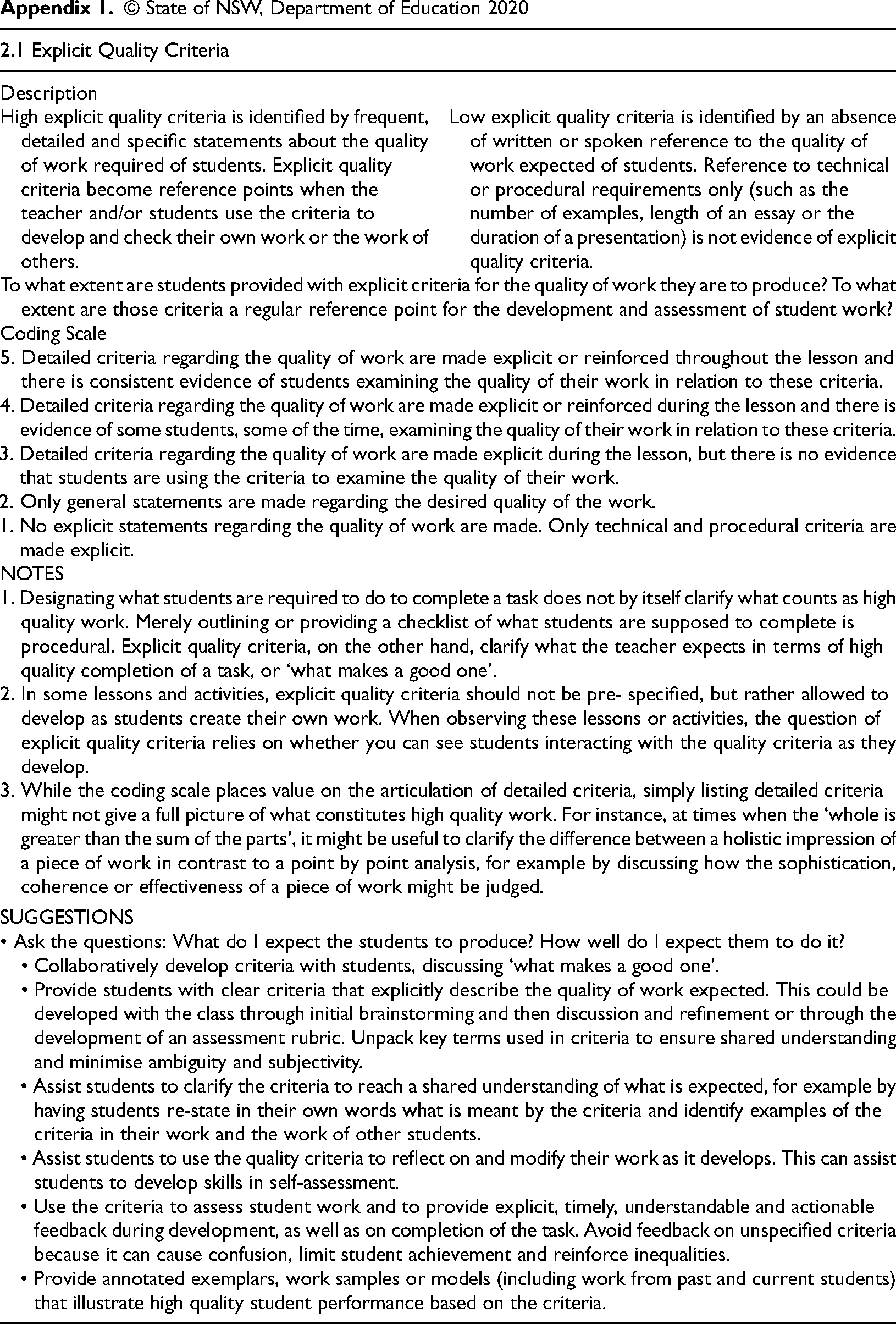
The QT Model is derived from research on Authentic Pedagogy (Newmann, 1991, 1996) and incorporates an extensive synthesis of research on pedagogy that improves student achievement (Ladwig and King, 2003). (For more details on the 18 elements of the Model, see: NSW Department of Education, 2020). Fundamentally, the QT Model provides a pedagogical framework for analysing teaching. The associated 1-to-5 coding scale and descriptors (see Appendix 1 for an example) provide a shared language with which to talk about teaching at a high level of specificity. The aim is to focus on teaching, rather than the teacher, in a non-threatening, professional space. As teachers analyse the quality of teaching that occurred during a lesson, they also share insights about refinements to teaching in general.
The PD involves a two-day (10-h) in-service workshop that introduces the QT Model and simulates the QTR process. Ideally, at least two staff members, including one with leadership responsibilities, attend the workshop before implementing the process in their own school. Following the workshop, they join with other staff members to form a PLC of four educators who undertake a set of Rounds. Each Round is conducted over a single day and involves the following:
Reading discussion (approximately 1 h): Professional reading chosen by one PLC member. Observation (approximately 30–80 min): One PLC member teaches a lesson, which is observed in its entirety by the remaining PLC members. Coding and discussion: All PLC members, including the observed teacher, individually code the lesson using the QT Model. Each element is coded on a scale from 1 to 5 using detailed descriptors. An extended discussion follows in which the lesson, and pedagogy more broadly, is analysed as the group seeks to reach consensus about the coding as a means to specific insights on improving teaching.
A set of Rounds is complete when every PLC member has taught a lesson observed by their peers. The PLC stays together for the entire set of Rounds (usually four days spread over multiple weeks), but the process can then be repeated as the initial PLC members work with other teachers in newly formed PLCs. Middle leaders are well positioned to both participate in and drive this activity within their schools.
Practice architectures as an analytic lens
In this paper, we use the theory of practice architectures (Kemmis and Grootenboer, 2008) to examine how participation in QTR can support middle leading (Lipscombe et al., 2020c).
The theoretical frame views middle leading as a social practice, comprised of characteristic sayings (the cognitive dimension), doings (the psychomotor dimension) and relatings (the affective dimension) (Kemmis et al., 2014). These saying, doings and relatings are enabled and constrained by the ‘practice architectures’ of a particular school site or intervention, such as QTR. Practice architectures consist of three types of arrangements, namely:
cultural-discursive arrangements, in the medium of language, that makes the sayings of the practice possible; material-economic arrangements, in the medium of physical space-time, that makes the doings of the practice possible; and, socio-political arrangements, in the medium of power, solidarity and agency, that makes relationships between people possible (Kemmis et al., 2014).
These three arrangements work together to establish a specific type of practice, also referred to as a project, for those involved. In other words, teachers and school leaders engage in specific practices, involving specialised language, actions and relationships, to accomplish the project of school education. Similarly, the project of QTR involves new specialist language, actions and relationships that can shape and be shaped by the practice architectures of the school.
The theory of practice architectures has been used as a theoretical and analytical resource to examine how middle leading practice is shaped and mediated by cultural, political and material conditions in situ (Edwards-Groves and Grootenboer, 2021; Grootenboer and Edwards-Groves, 2020; Lipscombe et al., 2020c; Mahon et al., 2017). This paper, however, examines its potential as a transformational resource, used to identify how the practice architectures of PD like QTR can be used to enhance the sayings, doings and relatings of MLs in schools. Our particular interest here is how QTR can work to enhance the collective social-relational project of improving pedagogy. That is, how does its practice architectures enable or constrain new kinds of sayings, doings and relatings, and what are the residual effects for MLs, their colleagues and school culture more broadly? In using this lens, our aim is to make explicit how participating in QTR can create new arrangements that support the work of MLs. Kemmis et al. (2014) succinctly summarise how engaging with new practice architectures such as QTR can support change: A practice takes up sayings, doings and relatings already to be found in the site, orchestrates and engages with them, and leaves behind in the setting particular kinds of discursive, physical and social residues of what happened through the unfolding of the practice… Some of the residues become part of the practice architectures of the setting and are newly encountered by those who subsequently inhabit it. (p. 34)
We use the theory of practice architectures to examine the extent to which MLs’ participation in PD can shape and reshape their practices and, thus, the contexts in which the practices are produced. While critics suggest that practice-focused approaches are unsuitable for examining macro-social structures, such as social order, power and identity (Nicolini, 2016), we argue that the micro-analysis of practice can provide a window into how these structures produce and reproduce culture-in-action (Harris, 2018). The examination of MLs’ sayings, doings and relatings offers a useful analytical lens that leaves space for understanding the fluid and evolving nature of arrangements that constitute existing practice architectures (Gibbs et al., 2022). Our analysis further uncovers the potential of the theory of practice architectures as a transformational resource. We demonstrate how a PD approach designed to drive improvement in pedagogical quality influences participants’ sayings, doings and relatings, leaving residues that support middle leading practice. In so doing, we gain important insights into our research question: ‘In what ways can participation in QTR support middle leading practice?’
Methods
Background
This study draws on interview data collected during 2019 as part of a larger mixed-method RCT designed to investigate the impact of QTR on primary school student outcomes (see published RCT protocol paper; Miller et al., 2019). The research design and instruments were approved by the University Human Research Ethics Committee prior to participant recruitment. Educators (n = 497) from 125 primary schools were recruited to be part of the RCT. Of the 63 schools (50%) assigned to the QTR intervention, nine schools were selected at random for participation in pre- and post-intervention interviews about their experience. Our current analysis draws on data from the 22 participants in these schools who were interviewed at the post-QTR timepoint. The semi-structured interviews lasted approximately 30 min, during which participants were asked about their experiences with PD in general, and QTR in particular. The interview schedule is attached to provide detail on the types of questions asked (see Appendix 2).
Sample
Each of the nine schools was asked to identify two educators who had participated in QTR and a school leader willing to participate in follow-up interviews. As anticipated, MLs filled both sampling categories – school leaders and teachers – highlighting the dual responsibilities of their role. In total, 22 interviews were conducted; five with MLs – those whose formal role included a combination of classroom teaching and a leadership position – and 17 with classroom teachers and senior leaders. The latter group provided views on how QTR impacted MLs and ML practice, based on the participation of MLs in QTR PLCs in all but one school. The MLs who engaged in Rounds were assistant principals or acting/relieving assistant principals; the exception was a teaching deputy principal.
We are aware limitations of this study include that it was not designed to investigate middle leading and that no questions focused specifically on middle leadership (see Appendix 2 for the teacher interview schedule). However, MLs and middle leading practices were frequently discussed, without prompting, as playing an important role in the PLCs. Preliminary thematic coding impelled our deeper interrogation of ML practice and the impact of engaging in QTR on middle leading and MLs.
The participating schools in which interviewees worked (Table 1) show considerable diversity in socio-educational advantage (ICSEA 1 ), location and student profile. The number of interviews conducted in each school is also provided.
Sample of schools in which interviews were conducted.
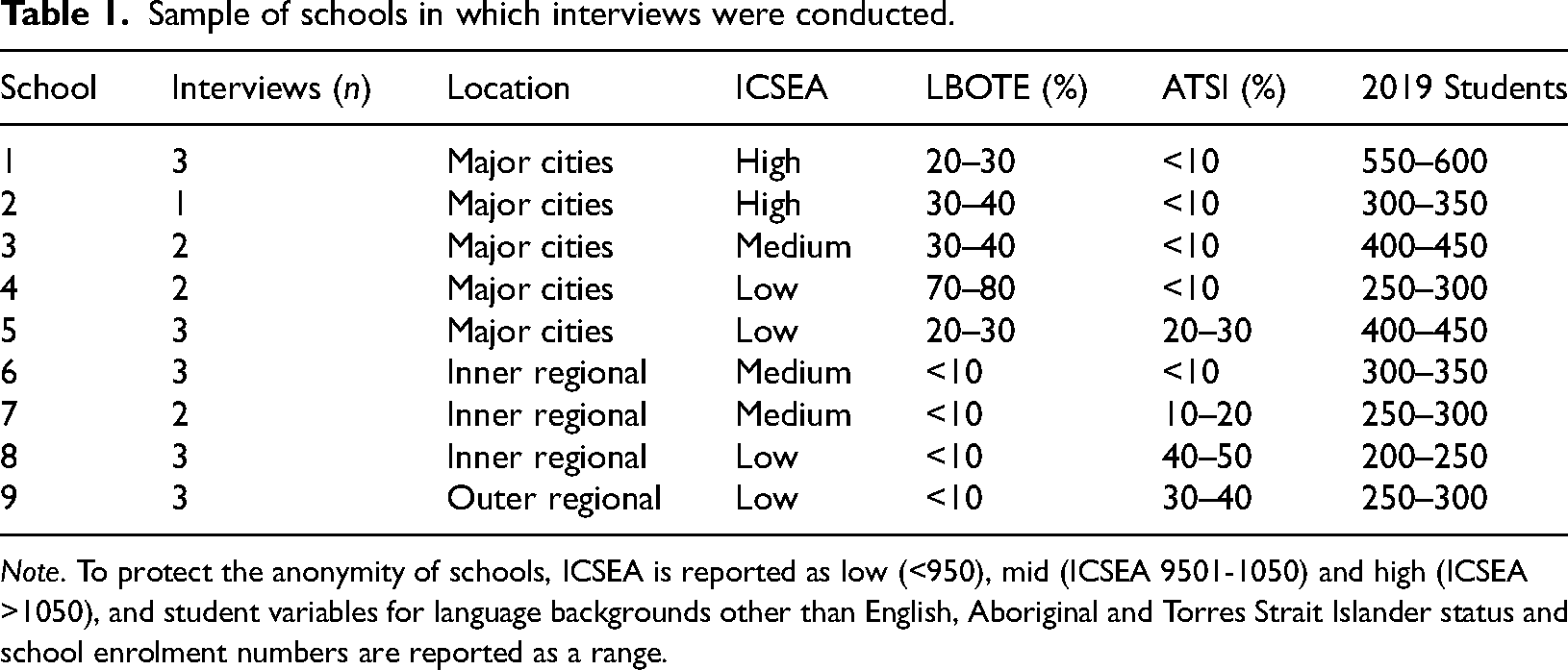
Note. To protect the anonymity of schools, ICSEA is reported as low (<950), mid (ICSEA 9501-1050) and high (ICSEA >1050), and student variables for language backgrounds other than English, Aboriginal and Torres Strait Islander status and school enrolment numbers are reported as a range.
Analysis
All interviews were audio-recorded, professionally transcribed and read by at least two members of the research team. During this initial phase, interview transcripts were de-identified with names of participants and schools replaced with pseudonyms. Coding of interview data was undertaken using the NVivo™ software program. First-level inductive coding was conducted to identify emerging ideas and preliminary themes in the data (Creswell, 2013). These initial explorations identified middle leading as an important theme and, thus, a focus for subsequent analysis (Creswell, 2013).
For the deductive analysis, the theory of practice architectures (Kemmis et al., 2014) was used to explore how the practice of QTR influenced the work of MLs. Interview data were coded into themes of sayings, doings and relatings to examine how QTR unfolded for MLs and the residues ‘left behind’ in relation to middle leading (Kemmis et al., 2014). One critique of the theory of practice architectures is that the approach does not provide adequate definitions for identifying and analysing these structural arrangements (Bacchi and Goodwin, 2016; Gibbs et al., 2022). To address this potential limitation, data were coded independently by two researchers to provide investigator triangulation (Archibald, 2016). Following the independent coding, a process of reflection and discussion between coders was used to ensure consistent definitions of themes and their application throughout the analysis (Harry et al., 2005).
Results
Our deductive analysis of interviews identified how the arrangements of QTR influenced the practices of participating MLs. We examined the interviews with the goal of identifying and examining changes in MLs’ sayings, doings and relatings that were attributed to this PD in the interviews. In the following sections, we examine these practices and the ‘residues’ of participation in QTR that reshaped the ways in which MLs used pedagogical language, engaged in classroom observations and collaborated with their colleagues.
Sayings: establishing a shared language
Interviews with MLs suggested that the pedagogical model underpinning QTR provided them with new shared understandings of good pedagogical practice and engaged them in a new cultural-discursive arrangement: This is my 29th year of teaching… but [doing QTR] there were things that I went, ‘Oh, I don’t think about that.’… I thought the Model worked really well. The discussion after [the lesson observation] was very helpful. That was probably where the greatest amount of discussion and suggestion and growth came…. It really made us think about… what makes up a good lesson. (Nicole, School 3, Assistant Principal, Female)
The cultural-discursive and socio-political arrangements of QTR require participants to reach a consensus about the codes assigned to each element of the pedagogical model. The process of working towards agreement on the codes enabled MLs to practise important and often underdeveloped leadership skills (Fluckiger et al., 2015) in the PLCs: We had a wide range of personalities [among the] people who undertook [QTR] … and that's why [my] stepping in [was important], sort of helping to moderate a bit so that people didn’t talk over the top of each other, but also just to make sure that we were doing it correctly. So, you know, we were able to go back and watch a video about specific areas like ‘Significance’ [one of the three dimensions in QT] and go, ‘Oh yeah, so that's actually what we need to look for,’ and then look at the code and see, ‘Oh, does that match?’ And then, making sure that it does and then agreeing on it. (Mary, School 5, Acting Assistant Principal, Female)
The formal documents associated with QTR, that describe each element of the QT model and the coding scales, provided teachers and MLs with a new shared language for discussing pedagogy. The elements and descriptors represent specific ‘sayings’ associated with QTR that were adopted by teachers and MLs alike. In this way, the language of QTR has shaped the practices of participants both in the ways they talk about pedagogy and in the ‘doings’ of classroom observations. Melissa, a classroom teacher, describes how these sayings and doings have shaped the process of observations conducted by her ML supervisor: Observations by my supervisor [in the past have been] … short, brief; they fill out a template and you have a little quick discussion about the lesson. But this [QTR] is like, making sure you’re on the right path, you’re actually teaching, you’re doing the right thing, and this is what you could do better. (Melissa, School 3, Classroom Teacher, Female)
Other MLs also provided telling examples of the residues, or sayings, that came from engagement in QTR: It just makes you stop and think about the things that you’re doing. Just teaching, standing up the front of a classroom is a major conflation of so many different elements. … And so, we’ve changed things this year. We’re doing peer observations and things like that. So, [QTR has] changed things for us. … As an exec, we’ve been working on that… we’re going to be doing it [QTR] in alignment with our strategic directions and our school goals, our goals for the year. (Courtney, School 7, Relieving Assistant Principal, Female)
In our analysis of the interview data, we specifically sought counterarguments to demonstrate the range of opinions held about participation in QTR. Despite our search, there was an overwhelming consensus about the program, which has been reflected in previous studies. One potential reason for this consensus is that all teachers and MLs who participated in QTR volunteered to do so. It is possible that this cohort was motivated to view this PD positively after they had committed their time to participating in it. In a lone exception to the overwhelmingly positive accounts of their QTR experience, one ML expressed the view that QT is already the norm in the school. Nonetheless, even she described the language of the QT Model as valuable: It's valuable information and something that I think we do already, but we just don’t necessarily have an awareness around that language at the time. (Courtney, School 7, Relieving Assistant Principal, Female)
Doings: the power of observing and being observed
The material-economic arrangements of QTR, particularly the four days of teaching release from the classroom to engage in the PD process, provided MLs with new opportunities to reciprocally influence classroom pedagogy. While the experience of being observed by peers can be threatening, the practice architectures of QTR enabled a clear and incisive focus on actions or the ‘doings’ of teaching, rather than the teachers themselves: It's been really, really great just to get into other peoples’ classrooms and see how they work. And then also, you know, figure out… what good teaching looks like across different settings as well, because what works for one person doesn’t necessarily work for the next one. I’ve picked up lots of [great ideas] from my colleagues here … being able to go into their classrooms and see what they do … ‘Significance’ was a really difficult area for our kids a lot of the time, I found, and so we started making a more concerted attempt to actually deal with ‘significance.’ (Mary, School 5, Acting Assistant Principal, Female)
The contrast between the one-way observations traditionally undertaken by MLs in their role as supervisors and the QTR version is stark and was commented on by teachers and MLs alike: Because I’m an Assistant Principal, I do observations on my K-2 team, so I’ve been involved as an observer, and then I’ve also had my principal observe me teaching lessons. … I actually found QTR less daunting – I guess, more comfortable – because I suppose each teacher in the group knew that we’re all going to have a turn of being observed and observing each other, and we were all really respectful of each other. Not to say that my supervisors are not but, I don’t know, it was more comfortable doing it the QTR way than, ‘Okay, the boss is coming in today to look at you.’ (Kaye, School 9, Assistant Principal, Female) In terms of how I … interact with the teachers that I supervise, it's helped me with feeling more confident about doing observations in classrooms, in a respectful way, without feeling like I’m intruding …. I guess it's changed some of the conversations I have with my teachers about planning and that sort of thing. I definitely talk more to the teachers in the group, in regards to how to go about something. (Kaye, School 9, Assistant Principal, Female)
Kaye's commentary suggests that participation in QTR has left residues in the school's practice architectures (Kemmis et al., 2014), changing ‘doings’ in her middle leading practice. Built on a shared understanding of QT, her conversations with teachers have become more collegial, building a shared vision or direction, rather than telling teachers what to do.
Relatings: flattening power hierarchies through collaboration
The carefully designed socio-political practice architectures of QTR also provided many opportunities for MLs to collaborate as peers seeking a common goal of pedagogical improvement in a non-judgemental context. In fact, MLs frequently commented that there was no power stuff that negatively impacted the Rounds process because norms for the conduct of QTR provide structure for participants’ relatings: I’m an executive and … we didn’t have … any power stuff in any way. It was like, we’re all colleagues and we’re all working together…. I did my lesson first to reassure people, and I think just the way that hopefully I conducted myself gave the example…. I purposely went first because the others were a bit nervous, but it was just to show that this is how it went.… I know I was as nervous as anyone else. (Nicole, School 3, Assistant Principal, Female)
In our interviews with teachers, they often spoke of increased levels of admiration for and respect towards MLs, fostered by the new ways of relating promoted by QTR: Our Assistant Principal's been teaching for 30 years. She was fantastic. She's like, ‘I could do this better, and I saw you guys do this. I might try and do that in my classroom.’ And I think we all took a little bit from each other, and I know that I’m using some things that the Assistant Principal did, and I think the Assistant Principal did some things that my colleague did, you know? And it sort of creates that collegial consistency, I suppose. (Vince, School 1, Classroom Teacher, Male)
Collegial consistency is a powerful phrase that speaks to the importance of seeing experienced MLs teach and demonstrate a willingness to learn. In Vince's account, the ML positions herself as a colleague and co-learner, seeking to improve pedagogy collaboratively and thus demonstrating how her peers might change their own classroom practice. The socio-political arrangement of co-influence is challenging to establish and maintain, yet necessary if MLs are to drive school improvement (Lipscombe et al., 2020c). Here, QTR appears to have both enhanced the credibility of MLs and smoothed the path for their instructional leadership practice.
Numerous other positive changes to the relationships between MLs and PLC members were highlighted in teacher interviews through the levelling of pre-existing power hierarchies: So, [in my PLC] two of those teachers were APs and then another teacher was much more experienced than me. So, my relationship, I suppose, was like … very hierarchical … in a way… [although] I wasn’t scared of them or anything like that. What sort of changed [after QTR] was that it went to a more of a collegial [relationship], where I’d email [one of the Assistant Principals] and he’d send me really great maths resources; so, that kind of thing. And I think that was a result of the conversations and relationships that were built within … QTR. (David, School 2, Classroom Teacher, Male)
In turn, our interviews with principals also indicated positive changes in the relatings among MLs and teachers, even when they were not involved in the Rounds themselves: My AP who was [involved] … got a lot more out of the younger staff than she thought she would have. They’re coming with fresh enthusiasm and fresh ideas, …and the fact that she was able to build relationships with the teachers on her stage [the grade levels she leads], in a different context, was really good. … Definitely, the teachers involved in [QTR], their collegiality improved significantly. [There's now greater] … mutual respect between the executive and her staff which has been good. (Matthew, School 1, Principal, Male)
Discussion
While it is widely acknowledged that MLs play an important role in school improvement because they work ‘alongside teachers’ in the classroom (Edwards-Groves et al., 2019; Grootenboer and Edwards-Groves, 2020), the lack of targeted PD can limit their knowledge for, and skills in, driving instructional improvement, a key component of their role (De Nobile, 2018; Hammersley-Fletcher and Strain, 2011). Addressing recent calls for empirical research on the conditions that support middle leading work (Lipscombe et al., 2020a, 2020b, 2020c), this article has demonstrated that QTR is a form of PD that supports middle leading practice, despite not being specifically designed for MLs. The approach we used in this paper also illustrates how the theory of practice architectures can provide a transformational resource in understanding how practice can be changed.
Within our analysis, we found that participation in QTR addressed each of the key areas of PD for MLs outlined in Lipscombe et al.'s (2023) systematic review – namely: (a) driving improvements in teaching and learning, (b) facilitating people management and (c) building staff capacity. Furthermore, bringing together the practice architectures of the schools and QTR left positive residues (Kemmis et al., 2014) across the cultural-discursive, material-economic and socio-political arrangements. Quality Teaching Round provided new ‘sayings’ in the form of shared language for describing QT, new ‘doings’ through the development of new structures for conducting observations of lesson quality and new ‘relatings’ as evident in the increased collegiality and respect between MLs and teachers.
One aspect of QTR that was highlighted as building ML practice was the opportunity to engage in observation, analysis and refinement of practice in their school site. This aligns with, and extends, prior research that has demonstrated that well-planned peer-to-peer observations can be a transformative form of PD for MLs in both their classroom and middle leading work (Lipscombe et al., 2020b; Visone, 2022). Quality Teaching Round's focus on pedagogy and its deliberate use of the QT Model were overwhelmingly seen by teachers and MLs alike as transformative. While it is acknowledged that existing school material-economic arrangements, such as time constraints, can challenge the implementation and sustainability of such PD (Admiraal et al., 2021), there is clear evidence that it leaves a positive residue for MLs.
Positioning oneself as a co-learner is a critical strategy which assists MLs to influence and lead their colleagues (Lipscombe et al., 2020a, 2020b, 2020c). Middle leaders in this study were able to deepen their leadership skills by modelling specific forms of behaviour. Volunteering to be observed first, built relational trust, calmed anxiety and modelled the non-judgemental nature of the PD. In the lesson discussions, MLs exercised leadership by drawing on the authority of the QT Model, rather than asserting personal or idiosyncratic views on good teaching. While rapport and trust between MLs and classroom teachers is fundamental to any school change, it is an aspect of leading with which MLs may struggle (Edwards-Groves et al., 2016); QTR helped create such conditions for school improvement.
The aim of this paper was to explore how QTR supported MLs, given limited PD opportunities that specifically address middle leading practices (Fluckiger et al., 2015). A key limitation of the study is that (as noted in the methodology section) ML practice was not a specific focus of the interview questions or the project design. Furthermore, our data represented reports of practice, rather than observational data that is more commonly used in studies of practice. The paper, however, confirms Mahon et al.'s (2017) description of the theory of practice architectures as being a theoretical, analytical and transformative resource. As an analytical resource, this approach enabled the examination of how QTR can shape middle leading practice and illustrated how the theory of practice architectures provide a detailed account of how participation in QTR developed new sayings, doings and relatings for MLs in their own school contexts. This analysis signals the potential of applying this approach to identify how QTR and other forms of PD can transform middle leading practice in the future.
Nevertheless, when we think of the kind of ML PD that facilitates change, five aspects of QTR stand out: (1) observing teachers, and being observed by others (particularly those who work directly with the ML); (2) focusing on development rather than evaluation; (3) carefully structuring processes for lesson observations and discussions to ensure respectful engagement; (4) building a common understanding of QT by using evidence-derived research as an external source of authority; and (5) evening out power imbalances by positioning MLs as co-learners seeking to develop pedagogy alongside teachers. In sum, altering cultural-discursive, material-economic and socio-political arrangements is significant not only to the success of QTR but also to the design any form of PD that seeks to support the critical role of MLs in schools. While there have been repeated calls for the development of PD that is specifically tailored to MLs (Lipscombe et al., 2020a), our analysis has demonstrated that existing forms of PD, such as QTR, can also offer substantial benefits for MLs in fulfilling their role.
As the field of scholarship on middle leading around the world grows, we contend that further research on PD – whether designed specifically for MLs or not – would benefit from systematic consideration of how the sayings, doings and relatings built into the PD help MLs achieve greater success in leading teaching and building capacity in others. The aspects of the QTR approach to PD highlighted in our analysis hold powerful benefits for middle leading practice, by increasing role clarity and helping to manage relationships, underpinned by resources (the QT Model) and processes (QTR) that not only leave positive traces but can readily be embedded in schools, driven by MLs.
Footnotes
Acknowledgements
The authors wish to thank all teachers and schools who took part, as well as all project staff. The authors would like to give particular acknowledgement to Wendy Taggart who project managed the RCT.
Declaration of conflicting interests
The authors declared no potential conflicts of interest with respect to the research, authorship, and/or publication of this article.
Funding
The authors disclosed receipt of the following financial support for the research, authorship, and/or publication of this article: This work was supported by the Paul Ramsay Foundation, Australian Research Council, (grant number DP180100285), and the NSW Department of Education.

Notes
Author Biographies
© State of NSW, Department of Education 2020
| 2.1 Explicit Quality Criteria | |
|---|---|
| Description | |
| High explicit quality criteria is identified by frequent, detailed and specific statements about the quality of work required of students. Explicit quality criteria become reference points when the teacher and/or students use the criteria to develop and check their own work or the work of others. | Low explicit quality criteria is identified by an absence of written or spoken reference to the quality of work expected of students. Reference to technical or procedural requirements only (such as the number of examples, length of an essay or the duration of a presentation) is not evidence of explicit quality criteria. |
| To what extent are students provided with explicit criteria for the quality of work they are to produce? To what extent are those criteria a regular reference point for the development and assessment of student work? | |
| Coding Scale | |
| 5. Detailed criteria regarding the quality of work are made explicit or reinforced throughout the lesson and there is consistent evidence of students examining the quality of their work in relation to these criteria. |
|
| NOTES | |
| 1. Designating what students are required to do to complete a task does not by itself clarify what counts as high quality work. Merely outlining or providing a checklist of what students are supposed to complete is procedural. Explicit quality criteria, on the other hand, clarify what the teacher expects in terms of high quality completion of a task, or ‘what makes a good one’. |
|
| SUGGESTIONS | |
| • Ask the questions: What do I expect the students to produce? How well do I expect them to do it? |
|