




Abstract
This qualitative study explores the lived experiences of study programme leadership in development processes in higher education (HE). Study programme leaders are considered crucial in enhancing high-quality study programmes. Using a phenomenological hermeneutic approach, we analysed data from 18 interviews representing study programme leaders from six distinct health profession bachelor programmes at two Norwegian multi-campus institutions. Our findings paint a metaphorical picture of study programme leadership, likening it to leading as in alternating currents where signals flow and change direction. These leaders adeptly navigate an ever-evolving educational landscape filled with horizontal and vertical signals, tensions, and expectations. However, some express a lack of motivation and preparation to enter this field of tension. Our analysis identifies three aspects of study programme leadership: transforming, bridging, and balancing. Through their leadership, study programme leaders serve as vital antennas in development processes, capturing signals, coordinating activities, and fostering connections. Furthermore, they are a pivotal nexus through their transformative and bridging efforts. Balancing various leadership approaches enables them to navigate the changing currents. This study's implications are relevant to the HE field, offering valuable insights into study programme leadership. By emphasising the pivotal role of study programme leaders, it contributes to advancing HE development processes, underscoring the need for heightened awareness and further development of these leadership roles.
Keywords
Introduction
Higher education (HE) institutions that succeed in developing high-quality study programmes tend to have leadership at all levels that prioritise educational quality (Gibbs et al., 2008; Helseth et al., 2019), as well as a culture characterised by strong academic collaboration between leaders, teachers, students, and the work environment (Elken and Stensaker, 2020; Mårtensson and Roxå, 2016).
While previous research has emphasised senior leadership practices in HE (Bryman, 2007; Gibbs et al., 2008), less attention has been paid to local leadership (Irving, 2015; Mårtensson and Roxå, 2016; Stensaker et al., 2018), particularly in health education (Haugen et al., 2023; Jooste et al., 2018). Therefore, this study focuses on health profession study programme leaders who operate at the level closest to the practising teachers and the students. The position of study programme leaders is described as challenging, referring to unclear mandates, conflicting responsibilities, and insufficient power and autonomy (Haugen et al., 2023; Van Veggel and Howlett, 2018). Moreover, ‘a lack of recognition’ and support has been noted for these leaders (Frisk et al., 2021: 1; Johansen, 2020; Murphy and Curtis, 2013). Nonetheless, study programme leaders play a vital role in a rapidly evolving HE environment (Van Veggel and Howlett, 2018). They are positioned at ‘the heart of the educational activities’ (Frisk et al., 2021: 1), serving as the driving forces for development and change (Haugen et al., 2023: 6). Their responsibilities include facilitating teaching and learning processes (Frisk et al., 2021; Mårtensson and Roxå, 2016), as well as ensuring the delivery of high-quality study programmes that equip students with the necessary knowledge, skills, and competencies (Van Veggel and Howlett, 2018). They are also expected to strengthen coherence within the programme by implementing ‘constructive alignment’, which refers to establishing a strong connection between predetermined learning outcomes, teaching and learning activities, and assessment types (Biggs and Tang, 2011: 98; Stensaker et al., 2019: 95). Nevertheless, there is limited knowledge regarding how study programme leaders actually perform leadership that contributes to such development processes in their daily practice.
Academic fellowships, centred on scientific and pedagogical debates, are vital for developing high-quality education (Gibbs et al., 2008; Helseth et al., 2019). Study programme leaders are expected to play a key role in fostering professional discussions to drive programme development and establish a collective sense of ownership (Haugen et al., 2023). A Swedish document analysis revealed that study programme leaders are crucial in shaping the local teaching and learning culture. However, the study uncovered variations in their leadership practices in relation to educational development processes, emphasising the need for more research (Mårtensson and Roxå, 2016: 44).
The current study seeks to contribute to the literature by exploring how health profession study programme leaders describe lived experiences of leadership related to development processes. These leaders’ perspectives are essential for comprehending study programme leadership as a phenomenon (Cahill et al., 2015). The knowledge gained from our study can be valuable for study programme leadership in general, as health profession study programmes adhere to the standard European HE guidelines that apply to all study programmes (EHEA, 2015). Moreover, a recent study has shown that HE institutions have a joint mandate for study programme leadership across all professions, disciplines, and student cohorts (Haugen et al., 2023).
Our study aims to provide an understanding of study programme leadership in development processes within higher education study programmes. The research question is as follows: How do study programme leaders describe lived experiences of leadership in development processes within health profession study programmes?
Theoretical approaches of the study
Study programme leadership aims to facilitate the development of high-quality education at the study programme level (Aamodt et al., 2020: 43; Van Veggel and Howlett, 2018). All European countries have implemented national external quality assurance systems to ensure educational quality (EHEA, 2015). However, several studies conclude that these systems are primarily utilised for quality control rather than focusing on quality development (Aamodt et al., 2020; Borch, 2020). Previous research acknowledges the engagement of various stakeholders – teachers, administrative staff, students, advisory boards, and practitioners – in study programme operations and development processes (Aamodt et al., 2020; Bolander Laksov and Tomson, 2017; Van Veggel and Howlett, 2018). This study focuses on study programme leadership within the context of development processes since study programme leaders are given a distinct responsibility in fostering stakeholder collaboration and driving developmental processes (Haugen et al., 2023). We perceive development processes as actions aimed at developing complete, coherent, and relevant study programmes (Aamodt et al., 2020; Stensaker et al., 2018). Furthermore, we emphasise that development processes encompass various activities, including curriculum design; learning outcome descriptions; the development of teaching, learning, and assessment methods; engagement in pedagogical projects; and any other activities to fostering improvement and change in the programme. A study programme consists of a set of courses aimed at providing a comprehensive learning experience and professional qualifications in a specific field. However, study programmes have often been characterised by fragmentation and inadequate progression (Solbrekke and Stensaker, 2016). Therefore, most HE institutions appoint a study programme leader, a widespread title in Norway, also referred to as a programme director, coordinator, or manager nationally and internationally (Mårtensson and Roxå, 2016; Solbrekke and Stensaker, 2016). The study programme leaders are faculty employees responsible for the daily planning, operation, and development of one or more programmes, operating at the level closest to the frontline teachers and the students (Haugen et al., 2023: 2). To comprehend study programme leadership, we draw upon the perspective of Alvesson et al. (2017: 3) on leadership, which characterises it as the process of influencing the meanings, norms, thinking, values, and identities of voluntary followers within an unequal relational context. Alvesson (2011b: 153) states that leadership is about relationships and is closely interconnected with culture, following Geertz's (2000: 145) definition of culture as ‘the fabric of meaning in terms of which human beings interpret their experience and guide their action’. From this perspective, a leader is someone who understands the meaning of culture, local conditions, and context (Alvesson, 2011b). This study also relies on Rasmussen (2014), which emphasises the unique nature of leadership in HE institutions. Thus, study programme leaders operate in a context characterised by frontline academic experts with considerable professional autonomy and where collegial processes traditionally drive decision-making. Consequently, study programme leadership entails leading passionate academics while aligning their contributions to strategic goals. Rasmussen (2014: 96–99) introduces the concept of ‘potential leadership’, which occurs within the space between steering and autonomy. Potential leadership is neither about traditional strong hierarchical management nor about leaving professional communities to their devices. Instead, the leader's role is to find the balance between steering and allowing autonomy. Rasmussen (2014: 97) refers to this balance as the ‘optimal level of stretch’, which involves leaders taking actions to promote collaboration, personal growth, and the realisation of teachers’ full potential.
The outlined theoretical approaches set the stage for understanding study programme leadership in development processes within HE health profession programmes. In the upcoming methods section, we will elaborate on the distinctive characteristics of the study context and strategies employed to capture the lived experiences of study programme leaders.
Methods
Research design
To explore the phenomenon of study programme leaders’ lived experiences of leadership in development processes, we utilised a qualitative design and a phenomenological hermeneutic approach (Lindseth and Norberg, 2004, 2022). This approach, suitable for conducting a descriptive exploration of participants’ experiences, involves interpreting interview text. According to Lindseth and Norberg (2022: 884), phenomenology involves exploring and describing the inherent meaning of lived experiences from the perspective of those who have lived them. At the same time, hermeneutics emphasises the interpretation and understanding of these meanings. Furthermore, lived experience is described as the direct encounter with the world around us without overthinking it. Meaning that lived experience is more felt than known and gains elevated meaning and clarity when we express it through words or actions. Lindseth and Norberg (2022) draw inspiration from Ricoeur (1974: 265; 1991: 25–52), who labels the process of ‘telling and retelling as concrete reflection’, a transformative process that turns lived experiences into something concrete, viewable, and touchable. Consequently, narrating and documenting lived experiences generates autonomous texts that reveal unique meanings and insights into being in the world. Thus, employing a phenomenological hermeneutic approach enables us to provide an understanding of study programme leadership in development processes. This approach is further enhanced by drawing methodological inspiration from Alvesson and Sköldberg's (2018: 155), allowing for the incorporation of metaphors in hermeneutic interpretation and analysis.
Study context; Norwegian higher education in health professions
Norwegian HE is internationally relevant, having undergone quality reforms as part of the Bologna Process, similar to other European countries (Stensaker et al., 2018). All study programmes in Norwegian HE conform to the general European quality assurance principles and credit measurement systems (EHEA, 2015; Tellmann et al., 2021). National structural reforms have been implemented to enhance the academic environment and educational quality of study programmes (Ministry of Education and Research, 2015). Consequently, university colleges and universities merged into multi-campus institutions with two or more geographically dispersed campuses (Huisman et al., 2022: 2). A new National Health and Welfare Education curriculum has recently been implemented; setting expected learning outcomes nationally. Additionally, specific national guidelines are developed for each health profession study programme (The Norwegian Government, 2020). Thus, institutions are creating a unified curriculum to be implemented across multiple campuses for each study programme.
Health profession study programmes typically have a significant number of students (Offerdal et al., 2023); further, they are also some of the most extensive regarding other actors, such as teachers, administrative staff, and partners from the field of practice (Tellmann et al., 2021). These study programmes aim to prepare candidates for professional performance in the healthcare system by providing them with academic knowledge, practical skills, and clinical experience (Abrahamsen et al., 2016). Clinical studies are mandatory and integral to health profession study programmes (Bakken et al., 2019).
The health profession study programme leaders participating in this study operate within the described context. They are developing new health profession curricula aligned with European and national guidelines and merging professional fellowships across geographic campuses.
Recruitment and participants
This study encompasses a multi-campus University and University College from various regions of Norway. Each institution offers a minimum of three health profession bachelor's programmes. The recruitment of study programme leaders was facilitated with the assistance of the HE institutions’ department heads. Haugen et al.'s (2023) definition of a study programme leader 1 was communicated orally and in writing during the selection process. The inclusion criteria required participants to work as a study programme leader of a health profession bachelor's programme for at least six months at one of these institutions and hold that position at the time of the interview.
A total of 20 health profession study programme leaders were identified and invited to participate. They were informed about the study's purpose through email. Interested participants were requested to contact the first author via email or telephone. All 20 initially registered, but one participant withdrew due to illness. Thus, 19 study programme leaders were interviewed. Due to poor audio quality, one interview was excluded, resulting in 18 interviews (n = 18) being included in the analysis. The participants included comprise 12 women and 6 men with varying work experience, ranging from 6 months to 13 years, and time allocated to the study programme leader function ranging from 20% to 100%. Furthermore, they collectively represent six distinct health profession bachelor programmes: Bioengineering, Learning Disability Nursing, Nursing, Occupational Therapy, Physiotherapy, and Radiography. The bachelor's degree study programmes encompass both full time (3 years) and part time (4 years), providing 180 ECT each, with student populations ranging from 30 to 320.
Data collection
Data were collected through individual interviews, a qualitative research method that allows for an in-depth exploration of study programme leaders’ lived experiences (Brinkmann and Kvale, 2015; Lindseth and Norberg, 2004). The first author conducted digital interviews from May to July 2021, lasting 60–75 min each, using Microsoft Teams, an external microphone, and a tape recorder due to COVID-19. A pilot interview confirmed technology and sound quality. The research group collaborated to develop the interview questions, which remained unchanged post-pilot.
To establish a relationship and encourage study programme leaders to share their experiences, interviews began with an icebreaker question about the programme and leadership structure. Open-ended questions followed, such as asking to describe how they worked on the development of the study programme. Follow-up questions were used to prompt further elaboration and provide examples (Brinkmann and Kvale, 2015; Lindseth and Norberg, 2022).
Data analysis
The tape-recorded interviews were transcribed verbatim in Norwegian and de-identified. The author group, proficient in both Norwegian and English, translated citations. To preserve the meaningful content of the quotations and ensure accuracy in the English translation, we also conferred with a native English speaker during the process.
The interview texts were analysed thematically, guided by Lindseth and Norberg's (2004, 2022) phenomenological hermeneutic method. The analysis followed the hermeneutic circle in three phases: naive reading, structural analysis, and comprehensive understanding (Lindseth and Norberg, 2004: 147). The first author primarily conducted the data analysis with contributions from the entire research group. In the naïve reading, interviews were read openly and repeatedly to gain an initial understanding of the content. This process generated immediate interpretations noted as keywords or short sentences. These guided us into the structural analysis, which aimed to identify and formulate themes by sorting out essential structures in the text and dividing it into ‘meaning units’ (Lindseth and Norberg, 2004: 149) using NVivo12 (QSR International, 2020). The analytical procedure involved several repetitions of naive reading and structural analysis and was intentionally flexible to achieve a ‘valid interpretation’ and formulate themes (Lindseth and Norberg, 2004: 150). Table 1 presents an example of our thematic structural analysis.
An example of thematic structural analysis.

Finally, the research group formulated a comprehensive understanding by comparing the condensed texts, identifying similarities and differences, and generating subthemes. Thereafter, we developed abstract main themes. Verbs play a crucial role in this naming as they reflect the actions of the study programme leaders. The themes were discussed in relation to the research question, study context, and literature. We adopted Alvesson and Sköldberg's (2018) reflexive approach, using a metaphor to create a comprehensive theme encompassing all main themes and subthemes, as Lindseth and Norberg's (2004) method lacks this inclusiveness. In the final phase of the analysis, we selected theoretical perspectives as recommended (Lindseth and Norberg, 2004: 150).
Ethics
Ethical guidelines were followed regarding participant confidentiality, data integrity, and voluntariness (World Medical Association, 2008). Approval for data collection, storage, and sharing was obtained from the Norwegian Centre for Research Data (NSD, 2020: reference number 733507). The local institutional top-level leadership granted permission to conduct the study and access the research field. The study's objectives were communicated orally and in writing to the participants, who provided voluntary consent and had the option to withdraw at any time. Additionally, they were informed about the data-handling procedures associated with the use of the technology. Anonymity and confidentiality were maintained by providing a general description of participants’ characteristics and withholding specific information about programme or institutional affiliation.
Findings
The analysis identified the comprehensive theme of Leading as in alternating currents derived from three main themes: transforming, bridging, and balancing, each containing two to three sub-themes. An overview of the findings is provided in Table 2. Throughout the article, we refer to the participants as ‘study programme leaders’ or ‘informants’ and use the terms ‘development processes’ and ‘development work’ interchangeably.
An overview of the findings.
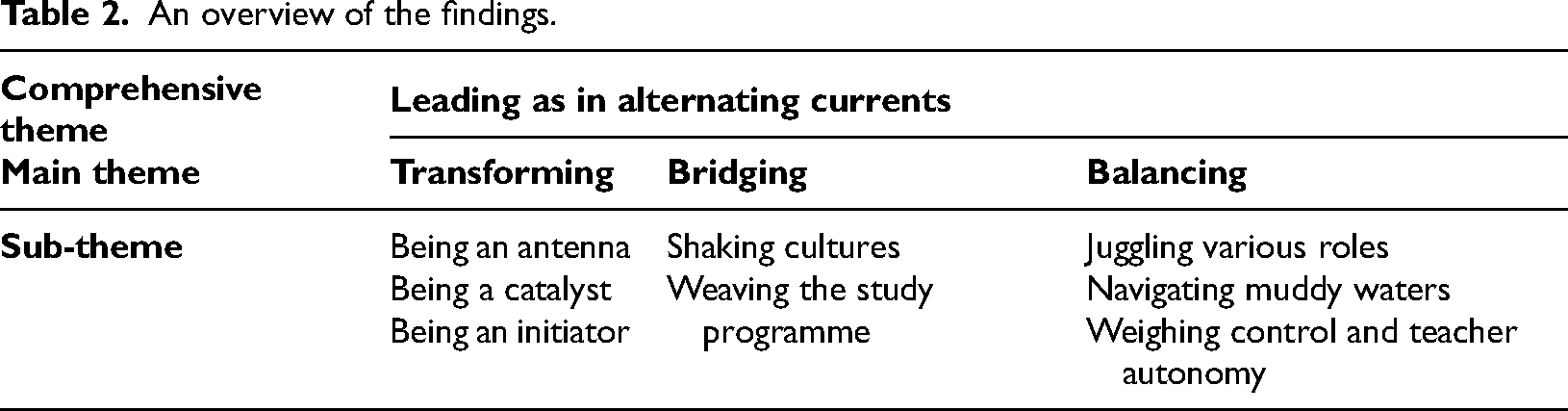
Leading as in alternating currents
This comprehensive theme metaphorically reflects the lived experiences of study programme leadership in development processes. Just as in alternating currents, where electric signals flow and periodically change direction, study programme leaders navigate an ever-changing educational context filled with horizontal and vertical signals, conflicting demands, and expectations. Thus, study programme leadership is exercised in a field of tension. Notably, informants express a lack of preparation to enter this complex context; some share their experience of ‘being thrown into study programme leadership’ (n5) without training, and support. Additionally, a finding is the motivation or sense of obligation to assume the position of a study programme leader and step into this field of tension. Motivated study programme leaders are driven by the chance to enhance the programme and find satisfaction in influencing change, stating, ‘I like my job … especially because I can influence change and development’ (n14). Furthermore, they convey a sense of satisfaction in leading in this field of tension through expressions like: ‘I like to ‘stand in the storm’… and be the one who can chart a path forward.’ (n7). In contrast, some see the role as a duty imposed on them, mentioning the lack of interest: ‘(…) there's not exactly a queue to step into the job as a study programme leader’ (n5) and ‘The function just rotates in the teaching group’ (n16). Some prioritise immediate obligations over developmental work, stating: ‘I’m not motivated to be a leader, so I only do what I have to do during this period’ (n18). Furthermore, the study programme leader position has lower status compared to other leadership roles, affecting motivation and performance: ‘Being a study programme leader is not always acknowledged … not in the same way as being a research leader … this affects my motivation and my effort to do a good job’ (n14). Informants note factors like insufficient training and a lack of leadership support contributing to low motivation.
These findings on motivation and preparation for this pivotal role are emphasised because they seem to shape how study programme leaders exercise leadership in this field of tension. According to our findings, study programme leaders describe that they perform three main actions when leading as in alternating currents: transforming, bridging, and balancing. Detailed descriptions of the main themes are provided in the following section.
Transforming
The first main theme consists of three subthemes: Being an antenna
Being an antenna
Study programme leaders describe themselves as a sort of hub for information, receiving and transmitting signals in development processes: ‘(…) to gather information and have an overview… so I can be an antenna to say it that way’ (n8). They have been involved in developing new curricula for health professional programmes nationally and institutionally, which has been time consuming over the past two years. They describe these processes as follows: ‘(…) in curricula work, one must have all antennae out to pick up good input and observe what is going on’ (n14).
Signals about development work come from various sources within the organisation, flowing both horizontally and vertically. Instructions from upper-level leadership or political directives serve as signals. For example, reporting requirements ensure alignment with quality development goals and update higher-level authorities. Implementing national guidelines, such as the National Guidelines for Health and Welfare Education curriculum, is considered a political directive.
Signals from course coordinators are emphasised. They have close contact with teaching staff and students, providing valuable insights: ‘(…) In my opinion, course coordinators play a key role in the development processes since they deeply understand the courses they lead and can provide feedback and insights for improvement’ (n17). Further, informants recognise these passionate teachers as driving forces for programme development, often eager to experiment with new pedagogical methods. Informants sense these signals and say that they prioritise supporting engaged teachers.
Informants also act as receivers of student signals, acknowledging their importance: ‘(…) Ultimately, we work here because of the students … and then, I have to be open to signals from the students all the way.’ (n15). They ensure that the programme is responsive to student considerations and confirm that signals from students during development projects provide essential feedback. They used the phrase ‘practicing an open door’ (n11, n14) when discussing accessibility for students, appreciating the opportunity for physical availability and informal contact after the COVID-19 pandemic and lockdowns.
Gathering input from partners in the field of practice is underlined in the design and delivery of relevant education that prepares students for careers in various health professions. Developing partnerships with specialists and municipal health services is necessary to create a good learning environment for clinical studies. Some informants mention picking up signals on collaborative projects in the field of practice, such as enhancing supervision competencies in healthcare services and improving students’ learning outcomes. Advisory boards, such as programme committees and field representatives provide valuable signals for developing relevant programmes.
Further, being an antenna involves receiving negative signals, including teacher dissatisfaction, because of changes or collaboration issues, disagreements regarding pedagogical decisions, and divergent perspectives on student involvement.
Being a catalyst
In addition to being antennas and picking up signals for change, study programme leaders serve as catalysts, expressed as: ‘taking action’ (n14) and ‘speeding up a process (3)’. They use the received information to facilitate collaboration among the course coordinator team, teaching staff, student groups, and field representatives. As catalysts, they motivate teaching staff: ‘I think I become a kind of facilitator and motivator to make things happen and get things started’ (2). Informants say that some teachers need leadership support to sign up as contributors as they do not necessarily take the initiative first: ‘… luckily, there are always some driving forces … but then there's the matter of connecting people and getting everyone on board…’ (n9). As catalysts, they assess the type of information they transmit and to whom. It involves prioritisation to determine which development processes they can support simultaneously. Further, they stagger initiatives to ensure optimal resource utilisation. They have an advisory role in the decision-making processes led by upper-level leadership.
Being a catalyst can be challenging as it involves catalysing decisions they disagree with, carrying out orders, and having limited authority over higher authorities’ instructions. Statements like ‘I just have to comply’ (n10, n16) reflect resignation and powerlessness. One informant states: ‘We are obliged to implement mandatory courses and adhere to a standardised number of credits for all courses… suddenly, 15 credits are eliminated… I call it being forced into course implementation’ (n9).
Study programme leaders strive to create awareness of change among teachers but face difficulties. Resistance to change can hinder development: ‘I need to get as many people on board as possible, but some teachers prefer to stick to their own teaching methods being used for years, which are not positive for development (…)’ (n11).
Being an initiator
As the initiators of the development processes, study programme leaders drive change and improvement. One informant stated: ‘(…) I identified a need to update course content to improve student knowledge about technologies. Therefore, I initiated a process to update two courses to cover this topic better (…)’ (n14). Further, the informants are actively seeking funding and assuming the role of project leaders in educational development projects.
The informants describe their roles in connecting research and education. They highlight the importance of academic staff teaching in their area of expertise or research, and they initiate the design of curricula and courses that integrate up-to-date research. Further, they prioritise engaging students in research activities as it provides a deeper understanding of the research process and opportunities.
Study programme leaders lead the implementation of quality assurance processes within their study programmes. They ensure that their programmes meet the required quality standards, and they collaborate with course coordinators, teaching staff, students, and programme committees. They express that they initiate the necessary work when evaluations highlight a need for improvement, for example, in specific courses to ensure programme coherence or introduce variations in teaching methods.
Bridging
The second main theme contains two subthemes: Shaking cultures and Weaving the study programme, reflecting how study programme leaders connect diverse cultures and how they work to integrate different elements within the programme.
Shaking cultures
‘Shaking cultures’ refers to the process of bringing people from diverse cultures together in development processes: ‘(…) one of the important things is to unite professional cultures across campuses … I call it shaking cultures’ (n7). Statements such as ‘merging cultures’ (n2, n19), ‘developing a good culture’ (n8, n10, n15), and ‘being a cultural builder’ (n1, n3, n14) are used. The ‘shaking’ process is challenging for study programme leaders as it requires flexibility and collaboration across diverse cultures. One informant explains the following: ‘… different perspectives on pedagogic thinking, learning, and ways of working. My job is to facilitate the merging of these cultures … it is not easy (…)’ (n1). The informants aim to create a new culture while preserving local distinctions and professional strengths. Thus, the ‘shaking’ does not necessarily entail striving for complete uniformity in all aspects. They emphasise collaboration, dialogue, openness, and involvement as key aspects of the ‘shaking process’ and communicate that building culture is an ongoing effort that requires continuous work.
Various meeting arenas, both physical and online, are used to bridge cultures, foster community building, and address challenges. Formal physical meetings for teachers are viewed as important spaces for discussing programme improvement and teamwork. While physical meetings and informal dialogues with frontline teachers remain crucial, challenges arise when dealing with relatively large programmes and distant campuses. Consequently, the recent reorganisation of study programmes across multiple campuses has necessitated the adoption of technology to enable communication and collaboration; however, it can create a sense of distance. One informant explained this shift: ‘Before, I had the teachers around me in the corridor, just dropping-in when needed. I feel Teams or Skype creates a distance… now they only get in touch if they really must’ (n16). Some study programme leaders prioritise travelling between campuses to be physically present and accessible, despite the potential benefits of technology.
Weaving the study programme
The study programme leaders focus on improving the study programme's quality. They consider it important to integrate the different components of the programme with its overall structure, intending to create a cohesive learning experience for the students. They explain that this primarily involves interconnecting the study programme’s elements and structural design, describing it by using metaphors such as ‘develop running themes’ (n1, n16), ‘weave the study programme together’ (n2, n7, n14) and ensure a common thread’ (n7, n18). An informant elaborates: ‘(…) to ensure there is a common thread, or many threads woven together as a kind of broader belt that ties everything together’ (n7). They also describe their practical actions to ensure programme coherence and quality, as shown in the following quote: ‘(…) I have to lay all the course descriptions out on the table, almost figuratively, and go from course to course, ensuring that they align with the curriculum and national regulations (…)’ (n1).
Study programme leaders are also crucial in ‘weaving the programme’ by fostering collaboration among course coordinators. They position themselves as a nexus that coordinates the efforts of course coordinators, motivating them to collaborate on aligning course content, consistent themes and exploring various teaching and assessment methods. They recognise the pivotal responsibilities of course coordinators and the importance of teamwork. However, course coordinators retain autonomy and decision-making authority within their courses. Thus, study programme leaders are not empowered to make decisions, even when necessary, and instead choose to participate in discussions and negotiations with course coordinators.
Balancing
The third main theme comprises three subthemes: Juggling various roles, Navigating muddy waters, and Weighing control and teacher autonomy. Study programme leadership in development processes is a balancing act that involves juggling various roles. Their mandates and decision-making processes can be vague. Furthermore, weighing control and teacher autonomy is a daily challenge in these processes.
Juggling various roles
Consistently, being a study programme leader is combined with one or more obligations, such as being a research leader, project manager, course coordinator, teacher, supervisor in clinical studies, division manager, or deputy Head of Education. This multifaceted nature of their position and the diverse tasks and responsibilities they handle leads some informants to liken themselves to ‘janitors’ (n12) or ‘jack-of-all-trades’ (n11). Despite sometimes feeling overwhelmed by tasks outside their designated responsibilities, study programme leaders highlight the importance of balancing various roles. This balancing act contributes to developing personal skills such as flexibility, adaptability, and multitasking. Further, they recognise the benefits of influencing development processes from different positions and engaging with diverse stakeholders. For example, being an active teacher allows them to understand students’ needs and collaborate closely with colleagues to enhance their teaching and learning methods. Thus, study programme leaders describe that they balance these diverse tasks and responsibilities with the aim of enhancing the quality of the study programmes.
However, distinguishing the study programme leader role from other responsibilities can be challenging, particularly when time is limited. Further, teaching staff faces difficulties in discerning their roles as study programme leaders from their other functions. As one study programme leader explained, ‘I get inquiries as a study programme leader all the time, even if I have research time or time to plan lectures’ (n3). The finding that study programme leadership involves juggling various roles highlights a balancing act that these leaders experience in their everyday lives while working to enhance the quality of the study programmes.
Navigating muddy waters
‘Muddy water’ describes the experience of study programme leaders facing unclear guidelines and mandates, leading to ambiguity in decision-making authority and responsibilities during development processes. The role of study programme leadership describes a ‘silent theme’ (n3, n1, n8, n7), which lacks clear communication about its significance for improvement. One informant said ‘…we actually talk very little about what it means to be a study programme leader’ (1).
Some study programme leaders have formal personnel responsibilities, enabling them to allocate resources based on developmental needs. They emphasise the importance of involving skilled teachers, setting clear expectations, and holding teachers accountable: ‘(…) you need a certain degree of autonomy and authority to make it work … including formal personnel responsibility’ (n8). Conversely, others lack formal personnel responsibility and primarily serve as coordinators overseeing teaching staff. Their effectiveness in study programme leadership depends on close collaboration with upper-level leaders who hold the decision-making power. Challenges faced by these informants include unclear lines of responsibility, limited control over resources, and a lack of opportunities for quick decisions and changes. Despite not having direct authority over the personnel, they perceived that they could influence the development process through dialogue, negotiations, and advice. Opinions on personnel responsibility vary, with some considering it crucial for driving development, whereas others prefer focusing solely on professional responsibility: ‘Separating academic and personnel aspects is convenient since my responsibility stops at a certain point… The course coordinators and I can initially think about what's best for the students. However, others have the responsibility to put the brakes on.’ (n11).
Navigating through these challenges and responsibilities, study programme leaders encounter variability in their obligations and time allocations. Full-time study programme leaders often have multiple managerial responsibilities, including positions such as division managers or deputy heads of education. The appointment of study programme leaders can be contractual or permanent, and they are positioned at different levels within the organisational hierarchy. However, collectively, they occupy a mid-level position situated between students, frontline teaching staff, and senior leadership, describing themselves as ‘an intermediate paper in the middle of a stack’ (n10). In developmental work, they sometimes struggle to address the multitude of intersecting expectations.
Our findings reveal the presence of different models of organising study programme leadership, including informants responsible for multiple campuses or local study programme leaders collaborating as teams. Informants experience that the organisational model can influence development processes because it affects the number of actors involved, communication lines, and decision-making procedures. For instance, collaboration in development work becomes challenging when study programme leaders function as a team but have varying mandates and responsibilities across campuses. Some informants expressed a sense of distance or disconnection from upper leadership, encountering difficulties in receiving timely responses and experiencing indecisiveness: ‘Upper leadership often respond to our questions with more questions. They don’t seem to realise that we need quick answers … we keep going in circles without progress.’ (n7).
Weighing control and teacher autonomy
Study programme leaders describe weighing control and teacher autonomy as a daily challenge. They explain that it is about finding the fine line between maintaining a cohesive programme structure while giving teachers freedom and independence in their teaching methods and decisions. Furthermore, resistance within a teaching group can arise when comprehensive and cohesive programmes are to be developed. As one quote highlights: ‘Teachers want the freedom to decide on course content and teaching methods, but they may not always consider the programme as a whole’ (n16). Furthermore, that resistance can be difficult because they are responsible for following specific standards to maintain the quality and structure of the programme.
Implementing student feedback while respecting teacher autonomy presents another challenge for study programme leaders. An informant shared an experience where a team of senior teachers had taught a course for years. Despite student evaluations indicating challenges and suggestions for change, the teachers disagreed with the feedback and resisted discussing potential changes. Overall, the informants stressed the importance of leadership in steering study programme development to meet educational standards and institutional requirements. However, they also emphasise the need to respect teachers’ professional expertise and autonomy, as they possess valuable insights into their teaching.
Discussion
This study aims to provide an understanding of study programme leadership in development processes in health profession study programmes. Our findings reveal a metaphorical portrayal of study program leadership, likening it to leading as in alternating currents. This underscores the parallel between signal shifts in alternating currents and the multifaceted expectations faced by programme leaders in development processes. Study programme leaders describe themselves as antennas that relate to signals flowing vertically and horizontally. Horizontally signals represent collaborative initiatives from stakeholders like teachers, peers, and practitioners, shaping the programme's development. Vertical signals denote hierarchical impacts that flow down from upper-level leadership, guidelines, policies, and educational objectives. Alternating currents refer to a mechanical system in real-life terms. However, in this study, the metaphor is employed to understand study programme leadership within a human system. Adopting Alvesson et al. (2017: 19) perspective, we recognise that leadership is fundamentally relational. It goes beyond people mechanically following the leader's visions or actions as it involves relating to and influencing people's hearts, minds, and meanings.
As Rasmussen (2014) points out, leadership within HE presents unique challenges when compared to other organisational contexts. Therefore, performing study programme leadership requires understanding HE's inherent nature and its occurrence within a field of tension. Considerable expectations are placed upon the study programme leaders regarding responsibilities and tasks (Haugen et al., 2023; Van Veggel and Howlett, 2018). From a political and institutional perspective, directives emphasise the need for study programme leaders to prioritise developmental initiatives, not just quality control (Aamodt et al., 2016; Mårtensson and Roxå, 2016). Consequently, it becomes crucial for individuals undertaking this position to possess motivation and preparedness to navigate the interplay of tensions inherent to study programme leadership. Due to this, an interesting finding of our study is that the selection of study programme leaders appears to be random. Motivated informants are optimistic and actively seek opportunities to contribute to and influence programme development. By contrast, others express low motivation, taking on the role simply because it was their turn, with a primary focus on fulfilling immediate obligations and adhering to procedures. Some likely exhibit instrumental and mechanical management skills (Alvesson et al., 2017), showing less initiative in engaging in developmental work. These findings emphasise that motivation can influence study programme leadership practices in general and in development processes in particular. Moreover, our study highlights a minimal discussion of the nature of the study programme leadership and its performance. Consequently, we interpret study programme leadership as a self-created practice requiring leaders to navigate muddy waters independently. Holding this position can be stressful, and some informants feel lonely.
Weighing control and teacher autonomy is an everyday tension for study programme leaders. They state that teachers require freedom within their teaching areas while steering them towards collaboration, openness to change, and exchange of experience. Alvesson et al. (2017) argue that horizontal organisational modes, like collegial processes and teamwork, better suit HE due to its academic culture being grounded in Humboldt's values of freedom and independence, contrasting with vertical leadership or management approaches. Indeed, the authors claim that fostering creativity and development requires less traditional leadership and followership. However, our findings underscore the necessity of leadership in driving development processes, particularly in resolving disagreements. This corresponds with literature stating that teachers value relational and meaning-making leadership and that this kind of study programme leadership contributes to educational development (Mårtensson and Roxå, 2016; Rasmussen, 2014). Additionally, our study uncovers that study programme leaders play a transformative role by actively communicating with and addressing the signals of various stakeholders. They acknowledge the importance of dialogue, support, and inspirational communication in alignment with Alvesson et al.'s (2017: 18) leadership thinking.
Our findings reveal that study programme leaders act as connectors, which is akin to previous studies that highlighted their role as a ‘nexus’ (Haugen et al., 2023: 9), or a ‘connection point’ between pedagogical activities and the organisational environment (Stensaker et al., 2019: 92), and between administrative and academic elements (Aamodt et al., 2020: 43). However, our study contributes to a deeper understanding of their practical actions as nexuses, a crucial position for weaving the study programme together. When they function as antennas, they transform information, connect people, promote collaboration, facilitate growth, and contribute to ongoing programme improvements. Informants emphasise course coordinators’ pivotal responsibility and competence in the development processes but highlight the importance of having a nexus that weaves their activities together to maintain coherence in the programme.
An important finding of our study is the perceived disconnect in the flow of communication, decision-making, and support from upper-level leadership. Leading as in alternating currents entails a continuous flow of signals that periodically change direction. However, this intermittent shift creates a gap, which in turn disrupts the flow of information and communication between the two levels of leadership. The informants explained that this disconnection could lead to limited responsiveness, inadequate feedback, and a sense that their concerns or requests were not adequately addressed. Thus, the lack of timely and meaningful flow and responses can contribute to the perception of unclear guidance or direction, resulting in frustration, indecisiveness, and a lack of development.
The challenges study programme leaders face when ‘shaking’ diverse cultures in multi-campus settings are prominent in our findings. The findings underscore how study programme leaders must challenge existing norms, shift to new ways of thinking, and foster cooperation across different cultures and professional communities. This process demands adaptability to local conditions and cultures, as each local culture is influenced by its perception of reality and the need for change (Alvesson, 2011b). Previous studies (Gibbs et al., 2008; Middlehurst, 2008; Cahill et al., 2015) confirm that leadership in HE varies based on the local context. However, supporting and engaging study programme leadership can influence the teaching and learning culture, thereby promoting educational development (Mårtensson and Roxå, 2016). In our study, informants faced resistance from teachers in the ‘shaking process’, including a lack of alignment with development initiatives or opposition to the vision for a joint future study programme. Alvesson (2002, 2011b) states that culture and leadership mutually influence each other, as leadership occurs within pre-existing patterns of perceiving reality shaped by the local cultural context. Moreover, leadership contributions are formed by expectations, demands, and resistance. A leader's ability to initiate and influence a process depends on how followers interpret and respond to their actions. Therefore, study programme leaders must listen sensitively to the actors involved and possess cultural awareness, since successful implementation of new ideas and change significantly occurs when aligned with prevailing values and perceptions (Alvesson, 2011b). Our findings suggest that study programme leaders demonstrate sensitivity in specific instances. For example, during the ‘shaking’ process, they acknowledge the value of leveraging local campuses’ unique academic strengths. Thus, the goal of the ‘shaking’ is not necessarily to become completely identical. Additionally, as antennas, study programme leaders actively listen to and assess incoming information and calls. Establishing common meeting arenas exemplifies their active efforts to foster relationships and facilitate open communication, critical reflection, and a culture of experiencing sharing among teachers.
According to our findings, the exercise of power, defined by Alvesson et al. (2017: 18) as having authority and mobilising pressure, is necessary for the development of study programmes. Informants state that private teaching practices can prevail without steering and exercising power, potentially resulting in isolation and limited collaboration. Rasmussen (2014: 99) describes the risks of professional communities operating in familiar silos without leadership, stating that this impedes collaboration and hinders development. Furthermore, he raises the question of how teachers can be led while maintaining autonomy Our study found that study programme leaders navigate muddy waters, including unclear mandates and limited decision-making authority, as identified in previous research on study programme leadership (e.g. Murphy and Curtis, 2013; Stensaker et al., 2018). Limited decision-making authority creates dilemmas for study programme leaders, such that they lack the power to make decisions that they believe are crucial for a coherent programme. Another example is the resistance from senior teachers to changing teaching methods despite receiving clear student feedback over time. Alvesson et al. (2017: 20) describe the potential of utilising power to exert pressure on ‘conservative groups or individuals’ for the benefit of the community. However, our findings revealed diverse perceptions of the desired and necessary types of power, particularly in line management. Hence, further exploration of the power dynamics involved in the study programme leadership is of interest.
A noteworthy finding of our study is that some study programme leaders practice a form of potential leadership similar to Rasmussen's (2014) proposal. They prioritise unlocking the potential of those they lead, by attentively observing signals, fostering connections, and catalysing the optimal flow and potential within the teaching group. However, our findings also note that management thinking, which typically involves planning, organising, monitoring, and controlling, is sometimes required in study programme leadership, particularly in quality assurance work. Overall, they must navigate between ‘direction and control based’ management (Alvesson et al., 2017: 18) and enabling teachers to make autonomous decisions, described as ‘self-directed work processes’ (Alvesson et al., 2017: 18). This suggests that study programme leadership in development processes is not a rigid, one-size-fits-all concept; however, it is a dynamic, responsive, and relational approach. It seems that study programme leaders alternate between different leadership approaches to adapt to the changing direction of the flow within alternating currents.
Finally, our findings reveal that study programme leaders have diverse obligations and positions that enable them to influence development processes. They leverage their positions within the organisational structure to drive and shape study programme development. However, juggling multiple obligations can pose challenges in dedicating sufficient time and attention to developmental initiatives. Therefore, a study programme leader does not have a singular function. Their influence extends beyond their designated obligation, making it difficult to isolate the specific impact of their study programme leadership function.
Methodologic considerations
When conducting a phenomenological hermeneutical interpretation, we aim to uncover essential truths about the meaning of existence in the living world (Alvesson and Sköldberg, 2018; Lindseth and Norberg, 2004). According to Lindseth and Norberg (2022: 884) phenomenological hermeneutical studies cannot achieve validity through generalisation; however, they can possess universally recognisable validity for readers, and this kind of knowledge is called ‘understanding’.
The research group responsible for this study has a broad academic background. The first author, who conducted the interviews, has first-hand experience as an academic leader in HE but no experience as a study programme leader. During the interviews, this experience provided insider knowledge and a contextual understanding (Brinkmann and Kvale, 2015). The first author experienced the informants speaking openly and saying that they felt comfortable sharing their experiences with someone who had walked a similar path. Further, they expressed that sharing their stories was meaningful to them. However, it is crucial to acknowledge that the first author's experience can lead to a pre-understanding of the phenomena being studied (Alvesson, 2011a). To mitigate this limitation, we adopted a reflexive approach to acknowledge how prior knowledge and personal experience may introduce bias (Alvesson and Sköldberg, 2018). Transparency was prioritised when describing the analysis process. Moreover, the co-authors (research group) had diverse backgrounds and experiences, ensuring reflexivity throughout the process. To enhance the credibility of our findings, we shared our data analysis process and findings in faculty research seminars in which peers from various backgrounds were invited to offer their perspectives (Lindseth and Norberg, 2004). These seminars enriched our understanding and the trustworthiness of our findings.
Interviews were conducted via Teams because of the COVID-19 pandemic, thereby limiting the observation of non-verbal cues and the participants’ natural context (Alvesson, 2011a). However, the interviewer established good communication as the participants were familiar with the technology due to increased digital communication during the pandemic. Flexibility in scheduling and connecting, regardless of the geographical location, was also observed. Our experiences with online interviews are consistent with those of previous studies (Lobe et al., 2022).
Study programme leaders lack a clearly defined population (Aamodt et al., 2020), leading to specific participant selection criteria. This may limit inclusion to those meeting these criteria, but we interviewed current programme leaders. While our study focused on Norwegian health profession education, it offers insights relevant to study programme leadership generally, aligning with overarching mandates (Haugen et al., 2023; Ministry of Education and Research, 2017). Our findings may extend beyond Norway, given adherence to European HE guidelines.
Finally, informants emphasise that continuous change is inherent in HE's development and not unique to this study.
Conclusion
This study provides valuable insights into how study programme leaders describe lived experiences of leadership in development processes within health profession study programmes. Our findings metaphorically depict study programme leadership as akin to leading as in alternating currents, symbolising the dynamic nature of this type of leadership. Within the context of HE, study programme leaders are confronted with the task of understanding the inherent nature of the educational landscape and managing the tension that arises from horizontal and vertical signals and expectations. Despite occasional unpreparedness to navigate this field of tension, our analysis identifies three aspects of study programme leadership: transforming, bridging, and balancing. Through their leadership, study programme leaders play a crucial role in development processes by serving as vital antennas, capturing signals, coordinating activities, and fostering connections. Furthermore, they are a pivotal nexus and weave through transformative and bridging efforts.
Leading as in alternating currents requires flexibility in adopting different leadership logic to adjust their approaches to varying conditions. Management and exercising power are necessary to ensure educational quality and programme coherence. However, relational and meaning-making leadership are emphasised in the development processes. Weighing control and teachers’ autonomy pose an ongoing challenge for study programme leaders. Nevertheless, potential leadership offers a pathway to unlock the full potential of the participating teachers within development processes.
This study has implications for the HE field by focusing on the often-overlooked importance of experienced study programme leadership. These leaders bear considerable expectations in driving development and initiating change. Therefore, one notable finding is the apparent randomness in selecting study programme leaders, where motivations vary among individuals, influencing their commitment to development initiatives. Moreover, the role of study programme leadership describes a ‘silent theme’. Consequently, our research highlights the necessity for increased awareness and advancement of study programme leadership, particularly if they are to play a pivotal role in development processes. We underscore creating spaces for reflection and dialogue on how diverse leadership logic can shape study programme leadership in various situations. Implications extend to understanding and practising study programme leadership, benefiting HE development processes.
Finally, further research is encouraged, exploring the lived experiences of study programme leaders beyond health professional programmes. Conclusively, our study emphasises the crucial role of study programme leaders as nexus and weavers. Future research should also explore how various actors in development processes perceive their partnerships with these leaders, specifically focusing on the perspectives of course coordinators and students.
Footnotes
Acknowledgements
The authors gratefully acknowledge the participating HE institutions for generously granting access to the research field. Additionally, we sincerely appreciate the study programme leaders sharing invaluable insights about their lived experiences that were crucial for conducting this study.
Data availability statement
The dataset in this study is not publicly available, following a license from NSD (2020: ref. 733507) permit only sharing within the research group, and the data are in Norwegian. Contact the corresponding author for dataset questions.
Declaration of conflicting interests
The author(s) declared no potential conflicts of interest with respect to the research, authorship, and/or publication of this article.
Funding
The author(s) received no financial support for the research, authorship, and/or publication of this article.
