



Abstract
Workplace incivility, a subtle yet pervasive violation of respect norms, has emerged as a defining feature of toxic organizational cultures with significant consequences for well-being, performance, and retention. Academic institutions provide a distinctive context for understanding incivility's persistence, given decentralized governance, tenure protections, and reward systems that privilege individual achievement over collegiality. This qualitative study draws on interviews with thirteen academic leaders from Canadian business schools to examine the antecedents and mechanisms through which incivility emerges, is experienced, and becomes entrenched. Findings revealed that incivility is sustained through interconnected dynamics across individual, team, organizational, and systemic levels, with power asymmetries serving as the central driver. The Power-Asymmetry Incivility Model developed in this study illustrates how deficits in self-awareness, limited leadership capacity, organizational structures and expectations, alongside entrenched cultural norms, interact to normalize toxic behaviors. The analysis highlights that incivility in academia is a structural and cultural phenomenon requiring coordinated interventions. Implications include the need for context-specific leadership training, reforms to accountability mechanisms, and the alignment of reward structures with values of collegiality and respect.
Keywords
Introduction
Toxic workplace culture is increasingly cited as a contributing force behind the “Great Resignation,” demanding urgent attention from leaders and policymakers (Sull et al., 2022; Varavallo et al., 2023; Watermeyer et al., 2024). Among its most nuanced yet pervasive expressions is workplace incivility, a low-intensity, ambiguous violation of respect norms (Andersson and Pearson, 1999). Though subtle, incivility undermines employee well-being, erodes team performance, and damages organizational culture (Agarwal et al., 2023; Schilpzand et al., 2016; Stawnychko et al., 2025; Yoon and Farmer, 2018).
Despite growing awareness of its harmful effects, important questions remain about the antecedents and mechanisms that allow incivility to persist. Much of the existing literature focuses on individual behaviors, often overlooking the organizational and systemic factors that sustain them (Hershcovis et al., 2020; Robinson and Schabram, 2017). Scholars have called for more research into the antecedents and contexts of these behaviors, particularly the influence of power relations and institutional culture (Cortina et al., 2001; Irwin et al., 2020; Schilpzand et al., 2016).
Academic institutions provide a critical setting for examining these dynamics. Decentralized governance and attenuated authority lines heighten the influence of informal power in shaping workplace interactions (Lawrence and De Lisi, 2021). Faculty autonomy can obscure toxic behaviors, particularly when accountability mechanisms are weak or inconsistently applied (Twale and De Luca, 2008). Such conditions have been linked to what Watermeyer et al. (2024) term a “toxic management culture” in the higher education sector.
Leadership roles in academia are particularly exposed to incivility. While faculty report experiencing incivility at rates of 18% to 55% (Heffernan and Bosetti, 2021; Lane et al., 2020), the prevalence is substantially higher among department chairs (78%) and deans (over 90%) (Cipriano and Buller, 2017; Heffernan and Bosetti, 2021; Stawnychko et al., 2025). These patterns suggest that power asymmetries play a central role in sustaining toxic dynamics in higher education leadership.
This study examines the antecedents and mechanisms through which incivility persists across individual, team, organizational, and systemic levels. Drawing on leaders’ lived experiences, it situates these behaviors within the structural and cultural conditions of academic institutions, with particular attention to the role of power asymmetries. In doing so, the study contributes a multilevel framework that advances understanding of how incivility becomes embedded in academic culture and offers insights for theory development and practical intervention.
Literature review
Workplace toxicity refers to organizational environments where harmful behaviors are tolerated or reinforced, often contradicting an institution's stated values (Sull et al., 2022). It manifests through individual misconduct, dysfunctional leadership practices, and erosion of collegial norms (Fischer et al., 2021; Tepper et al., 2017).
Within this broader category, workplace incivility is frequently conflated with related constructs such as bullying and social undermining. While these behaviors overlap, they differ in intent, frequency, and outcomes. Incivility is defined as low-intensity deviant behavior with ambiguous intent to harm, such as dismissive remarks or ignoring colleagues (Andersson and Pearson, 1999). In contrast, bullying involves repeated, systematic, and hostile actions with a clear intent to harm, such as threats or public humiliation (Einarsen, 2000; Keashly and Neuman, 2013). Social undermining refers to strategic behaviors aimed at impeding another's success, including spreading rumors or withholding key information (Duffy et al., 2002).
Although all three behaviors contribute to toxic cultures, incivility's subtlety and ambiguity make it particularly insidious, allowing it to spread undetected. Its low intensity makes it easy to overlook or dismiss, enabling it to persist and spread within organizations (Han et al., 2022; Pearson et al., 2005). Power dynamics further shape how these behaviors are interpreted, with vulnerability to status imbalances heightening their impact (Nielsen et al., 2022). Together, ambiguous expression, normalized tolerance, and sensitivity to power function as antecedents and mechanisms through which incivility becomes embedded in, and continues to sustain, toxic organizational cultures.
Accordingly, this study adopts a focused definition of incivility, emphasizing its distinctive dynamics in academic settings, while acknowledging conceptual overlap with bullying and social undermining (Hershcovis, 2011; Yao et al., 2022).
Toxic cultures have wide-ranging consequences. At the individual level, they contribute to stress, burnout, and diminished well-being, which erode morale and job satisfaction (Han et al., 2022). At the organizational level, toxicity weakens collaboration, amplifies power imbalances, and undermines overall performance (Hodgins and Mannix McNamara, 2017; Hur et al., 2016). These outcomes fuel disengagement and turnover while also risking reputational damage for institutions, particularly when incivility escalates into more severe patterns of dysfunction (Cortina et al., 2001; Khasawneh et al., 2024).
Beyond individual and organizational costs, institutions themselves face increased operational expenses, heightened risk of litigation, and erosion of public trust when toxicity is left unaddressed (Hollis and Yamada, 2021; Tepper et al., 2008). Within such environments, incivility often operates as a subtle entry point, persistent yet difficult to detect, that both reflects and reinforces deeper structural vulnerabilities, including misaligned incentives and weak accountability mechanisms (Twale, 2017).
Incivility in academia
Incivility is shaped by the structural and cultural power dynamics embedded within organizations (Akella and Eid, 2021). Academic institutions represent a distinctive environment for such forces due to their governance structures, emphasis on intellectual autonomy, and often ambiguous authority lines (Altbach, 2019; Jones, 2014). In the Canadian context, these dynamics are further complicated by institutional features such as tenure protections, decentralized decision-making, and strong union representation. Performance management processes are typically governed by collective agreements, which can constrain formal oversight and enforcement (Altbach, 2019; Jones, 2014; Lawrence and De Lisi, 2021; Metcalfe et al., 2011). While these arrangements protect academic freedom, they also reduce accountability for high-status individuals (Hudgins et al., 2023).
Internationally, similar challenges are reported across higher education in the United States (Stalter et al., 2019), the United Kingdom (Corbett et al., 2024), Europe (Irwin et al., 2020), and Asia (Abas et al., 2021). Status hierarchies, weak policy enforcement, siloed departmental cultures, and leadership inaction consistently act as precursors to incivility (Fontenot et al., 2024). Faculties are often shielded by tenure and peer alliances, which reinforce power imbalances and limit recourse for those targeted (Patel and Chrisman, 2020). In addition, insufficient leadership development opportunities and weak reporting structures contribute to the normalization of incivility (Clark et al., 2013; Sherrod and Lewallen, 2021). Taken together, these cross-national patterns suggest that incivility is not an isolated issue but a systematic phenomenon shaped by organizational structures and cultural norms.
The challenge is compounded by the lower power distance that characterizes academic workplaces, which blurs traditional authority lines between leaders and faculty. The dynamic can generate resistance to leadership directives and, in some cases, foster incivility without repercussions (Cortina et al., 2013; Heffernan and Bosetti, 2021; Lawrence and De Lisi, 2021). Further, many leaders enter their roles without sufficient administrative preparation (Boyko and Jones, 2010; Gmelch and Buller, 2015; Stawnychko, 2024, 2025). Together, these conditions create fertile ground for incivility to take root and persist within academic culture.
The COVID-19 pandemic and subsequent shift to remote and hybrid work further intensified these dynamics by heightening stress, burnout, and emotional strain, while disrupting relational norms and leadership practices (Ghaziri et al., 2021; Giorgi et al., 2020). As academic work became increasingly mediated through digital platforms, opportunities for informal interaction, relational repair, and contextual interpretation diminished (Ezerins and Ludwig, 2022; Torres et al., 2024). Emerging research on cyber incivility highlights how ambiguous digital behaviors, such as curt messages, delayed responses, or exclusion from virtual spaces, can persist and escalate in technology-mediated environments (Niven et al., 2022).
Remote and hybrid work also heightened risks of misinterpretation and relational distancing, increasing the likelihood that perceived slights would escalate into toxic interactions (Agarwal et al., 2023; Nag et al., 2024). Blurred boundaries, emotional exhaustion, and uneven access to support further intensified strain, particularly for women, racialized faculty, and other equity-seeking groups (Kossek et al., 2021; Ozturk and Berber, 2020; Nyangari et al., 2023). At the same time, evolving societal expectations around equity and inclusion have outpaced institutional responses, adding complexity for leaders navigating increasingly polarized environments (Akella and Eid, 2021; Bormann et al., 2022; Jacobson, 2024).
Although multiple structural and cultural factors drive incivility in academia, the post-pandemic context appears to amplify existing power asymmetries, making the dynamics of power the most consistent explanation for how incivility persists and becomes normalized.
The role of power
Workplace incivility can be conceptualized in terms of reciprocal behaviors that escalate into cycles of retribution (Andersson and Pearson, 1999; Wei and Si, 2013). In practice, such interactions create self-reinforcing loops of negativity that erode collegial trust (Hershcovis et al., 2018; Pearson et al., 2000; Rosen et al., 2016). Power asymmetries intensify these cycles. High-status individuals can instigate incivility with relative impunity, leveraging their position to dismiss or undermine colleagues (Agarwal et al., 2023). Those in low-power positions, by contrast, face limited options for open resistance and often rely on covert strategies such as information withholding or passive noncompliance (Li et al., 2023; Zhong and Li, 2024). Over time, these dynamics accelerate incivility spirals and entrench toxic workplace culture (Andersson and Pearson, 1999; Garant, 2023).
In the academy, status incongruence, where leaders are perceived as lacking legitimacy due to misalignment between their scholarly accomplishments and administrative authority, further fuels tensions (Lavigne et al., 2022). Faculties may resist such leaders through behaviors ranging from passive-aggressive noncompliance to overt criticism (Heffernan and Bosetti, 2021). These interactions gradually undermine collegiality and entrench toxic dynamics (Akella and Eid, 2021; Twale, 2017).
Power asymmetry, status incongruence, and ambiguous collegial expectations intersect with governance structures, limiting accountability and reinforcing the persistence of incivility. Short-term leadership appointments can limit leaders’ ability to intervene decisively, fearing retaliation, protracted grievance processes, or damage to professional relationships, thereby allowing cycles of incivility to persist (Akella and Eid, 2021; Bormann et al., 2022; Twale, 2017).
Although the consequences of incivility are well established, much of the research has focused narrowly on interpersonal conflict and power differentials, without examining how institutional structures and cultural norms sustain these asymmetries (Callahan, 2011; Rayner and Keashly, 2005). By integrating multiple levels of analysis, this study positions power not merely as an individual attribute but as a structural and relational force, shaping the antecedents and mechanisms that drive the emergence, experience, and persistence of workplace incivility in academic leadership.
Methods
This study explores the lived experiences of academic leaders, with a focus on how organizational toxicity, manifested through incivility, emerges, is experienced, and persists within academic settings. Drawing on in-depth interviews, the study examines relational, structural, and cultural dynamics shaping leadership experiences across academic contexts.
Participant recruitment
Participants were academic leaders from four Canadian research-intensive universities, all located within business schools. The sample included deans (n = 3), associate deans (n = 5), and department chairs (n = 5). Business schools provide a distinctive context for this study given their cultural features, including intense competition, heightened status consciousness, and ambition for institutional and personal reputation (Gibson and Pohlmann, 2024). These dynamics can normalize uncivil behaviors, while a “customer” mentality among students may create additional pressures on faculty (Gibson and Pohlmann, 2024).
Following ethical clearance from each participating institution, purposeful sampling was used to recruit the participants. To minimize professional risk and encourage candor, only tenured faculty members were eligible to participate. Of the 47 leaders invited, 13 completed semi-structured interviews via video conferencing between March and June 2023, during a period when institutions were navigating early post-pandemic transitions and hybrid work arrangements.
Data collection and analysis
Interviews were audio-recorded, transcribed verbatim, and anonymized. Numerical identifiers were assigned to participants, and gender-neutral pronouns (“they/them”) were applied in transcripts to reduce the possibility of identification through speech patterns.
Data were analyzed using NVivo (Version 14; QSR International, 2023) and guided by multilevel thematic analysis and constant comparative methods (Braun and Clarke, 2022). Thematic analysis identified recurring patterns across interviews, while the comparative method refined these insights through cross-case examination. Multiple transcript readings, inductive coding, and iterative code consolidation were conducted, with particular attention to distinguishing incivility from related constructs such as bullying. The analysis was situated within a constructivist paradigm, recognizing that organizational life and meaning-making are co-constructed through interaction (Merriam and Tisdell, 2015).
Results
This section presents findings across multiple levels of analysis demonstrating how individual behaviors are nested within broader team, organizational, and systemic contexts. Incivility emerged as a deeply embedded and pervasive phenomenon, shaped by interrelated forces operating simultaneously across these four levels. Participants described academic environments characterized by pervasive cultures of incivility with widespread impacts on individuals, teams, and institutions.
Acts of incivility originated from multiple sources, including faculty members, fellow academic leaders, students, and external stakeholders. One participant characterized the behaviors as “absolutely 100% rampant,” highlighting how deeply incivility had become embedded in institutional culture. Examples provided included snarky emails, gaslighting, disruptive behavior, condescension, cutting remarks, belittling colleagues’ ideas, talking over others, and unkind language.
Individual drivers
Academic leaders identified significant gaps in self-awareness as a key antecedent to workplace incivility. This often manifested in behaviors driven by an intense focus on personal goals. Participants noted that prioritizing technical expertise over interpersonal skills and emotional intelligence fostered environments where individuals frequently failed to recognize the impact of their actions on others, inadvertently contributing to incivility. When these behaviors occurred in high-power individuals, their actions were perceived as disproportionately impactful. I wrestle with this because there are people who are intentionally rude or disruptive, and then there are other people who just don’t know any better and don’t realize how their comments impact other people. There's sometimes a lack of self-awareness with a lot of academics. (Associate Dean, P8)
Across all leadership roles including deans, associate deans, and department chairs, participants reported similar deficits in self-awareness among their fellow academic leaders, particularly regarding inconsistent moods and reactions. Such unpredictable behaviors created environments of uncertainty, where colleagues felt they were “walking on eggshells,” unsure how to communicate without triggering conflict. One participant remarked, “If they [administrators] found out this was the way they were perceived, they would seriously be horrified.”
Gaps in self-awareness were compounded by epistemic disadvantages, where individuals lacked the cultural, historical, or social understanding necessary to navigate diverse environments with respect and sensitivity. The deficits contributed to behaviors that were often unintentional but nonetheless experienced as disrespectful, particularly by colleagues from diverse backgrounds.
High self-perceptions of power, stemming from a sense of superiority or entitlement based on research success, also emerged as a significant contributor to incivility. One participant explained, “Obviously, this is not a humble job. Everyone has egos… as you’re more and more successful, your ego is more powerful.”
Inflated self-perceptions, compounded by post-COVID burnout, led individuals to become “more individualistic, thinking about their personal goals and much less about the organization as a whole,” further disengaging from the collective mission. This shift was frequently perceived as eroding a sense of shared purpose and undermining collegial norms. The dynamic was often reinforced by the structural protections of tenure Two weeks into the job, I had a very senior professor book a meeting with me specifically to tell me, “Don’t change anything, don’t try anything. You can have a title, but you’re going to be gone before I am.” I perceived it as threatening. “I’m independent. Don’t mess with me. I got tenure.” (Dean, P1)
Participants explained that tenure was frequently mobilized as a mechanism of dominance and resistance, serving as a protective buffer that emboldened incivility and deterred institutional efforts to promote accountability or change.
The examination of the individual-level drivers revealed a complex interplay among self-awareness deficits, ego-driven behaviors, and the intensifying effects of burnout. While these patterns were observed across leadership levels, deans reported greater exposure to conflicts involving high-status faculty and external stakeholders, underscoring the heightened pressures associated with their positions.
Team drivers
Team dynamics were shaped by informal hierarchies that amplified certain voices and silenced others. Participants described how institutional emphasis on high-impact publishing elevated top performers, enabling them to assert dominance in team settings. One interviewee, reflecting on their privileged position within the team, noted sarcastically, “I am more likely to be the perpetrator rather than the target. What are they going to do? Take away my massive stipend?”
Status-driven environments also devalued colleagues whose contributions were less aligned with institutional reward systems. The “halo effect,” where success in research conferred unearned authority in other domains, frequently distorted perceptions of competence and justified incivility. This reinforced a culture in which research productivity, rather than collegiality, was the primary marker of status. People who are top publishers get the most credit because we are a research institution. They look down on others and sometimes are very aggressive in emails or will outright say [unkind] things…The incentive and reward system is for research. If that is the reward system, then you have nobody incentivized to do the other stuff. It shouldn’t be a surprise that you don’t get people stepping up to help the school and to care about the culture. (Department Chair, P2)
Participants below the dean level consistently expressed hesitation or unwillingness to confront toxic behaviors, particularly when high-status individuals were the perpetrators. Among the reasons offered for this avoidance was the temporary nature of their leadership appointments. An interviewee observed that many academic leaders, including themselves, lacked “the courage to do something,” especially given that they would soon return to peer status within the department. The inaction reinforced the perception that incivility was tolerated. In this context, silence was often interpreted as tacit approval.
Across leadership roles, participants noted that untenured and teaching-stream colleagues often relied on covert behavioral responses such as withholding input during meetings or engaging in behind-the-back disparagement. Tenured faculty just tell [perpetrators] to fuck off. But essentially, untenured faculty become very obsequious and obedient…and when it gets to be too much, they leave. The advice we give, despite it being rather tragic, is that the best way to minimize bullying or incivility once it starts is to leave. (Department Chair, P4)
Leaders described that their limited authority, paired with a desire to preserve collegial relationships, led to calculated non-intervention. As one explained, “They are a much more powerful person, so I’ve tended not to get into any conflict to maintain a good relationship.” This strategic avoidance protected relationships in the short term but allowed toxic behaviors to become normalized over time.
The COVID-19 pandemic introduced new challenges. The shift to remote work altered communication patterns and diminished the informal social checks that might have previously curbed problematic behaviors. Virtual interactions became a primary site of impulsive or dismissive exchanges. As one participant observed, “COVID has made it [incivility] rougher… it empowered people to behave poorly.” Leaders also reported a growing sense of emotional exhaustion that further limited their capacity to address toxic behavior, noting “there is this mental and emotional capacity that we’ve maxed out over these last three years.”
Team-level dynamics were characterized by the convergence of power asymmetries, institutional incentives, leadership inaction, and pandemic-induced strain. Together, these factors functioned as antecedents creating environments where incivility was not only tolerated but, in some cases, functionally rewarded.
Organization drivers
Participants highlighted a persistent lack of leadership capacity as a key antecedent to workplace incivility. Among them, department chairs described feeling especially vulnerable due to the limited preparation and support they received for their roles. Yet across all levels of leadership, these gaps were perceived not only as individual skill deficits but also as reflections of broader cultural priorities that privileged research success over leadership competence. We have a major scarcity of leadership volunteers. You’re just like pulling teeth, encouraging people to become program directors or department chairs… Not too many people want to be academic leaders, and some who want to, want to do it for the wrong reasons. (Associate Dean, P10)
The scarcity of leaders meant that leadership roles were filled without deliberate attention to readiness. Leaders were expected to manage interpersonal conflict, reinforce institutional values, and assert influence, generally without formal authority and with minimal preparation or support. As one participant reflected, “Academics go from a research environment to, ‘Boom, you’ve become a leader,’ and you’re supposed to manage other academics, which is like herding cats.”
Institutional training programs were widely viewed as misaligned with the challenges of academic leadership. Participants described institutional offerings as too generic or overly theoretical, highlighting a systemic tendency to regard leadership development as an afterthought rather than a strategic organizational priority.
Additionally, formal mechanisms for addressing incivility, such as faculty associations, safe disclosure offices, or human resources channels, existed in the institutions but were rarely trusted. Participants described these mechanisms as slow, opaque, and often inconsequential. If you access the resources, you get an email: “Your complaint was substantiated, and action has been taken.” That's all you get….and you’re still working with the person and experiencing the same behaviour, which actually happened to me until I had to go back for the second round. And now, again, I don’t know what happened. (Department Chair, P7)
Many participants expressed frustration with the bureaucratic nature of grievance processes, which were seen as more focused on legal defensibility than on timely or meaningful resolution. This perception was compounded by a lack of transparency, which left faculty feeling exposed and unsupported. Mechanisms available through faculty associations were criticized for prioritizing procedural safeguards over proactive intervention. Escalating concerns to deans, whose roles formally included addressing discipline, was viewed as undesirable, as they were perceived as overextended and uninterested in such matters.
Structural limitations, such as overstretched administrative capacity, insufficient training, and ineffective accountability mechanisms, constrained leaders’ ability to manage toxic behaviors, reinforcing the perception that incivility was a normalized and enduring feature of academic life.
System drivers
At the system level, participants described academia as operating within a uniquely complex framework shaped by government oversight, entrenched bureaucratic structures, and union regulations. Though intended to ensure excellence in research and teaching, these forces often produced inertia. Leaders entering their roles with ambitions to drive innovation were quickly disillusioned by procedural roadblocks. It is the bureaucracy of this place. But universities are like that; you have to understand this is a system where unions and governments are involved. What you could do in private business in two months would take you 2 or 3 years here. People come in [administration] with really good intentions, but it comes down to the system. You soon become painfully aware of what is realistic and what is a pipe dream. (Associate Dean, P5)
Further, the academic culture itself was identified as a systemic enabler of incivility. Participants described environments characterized by intense competitiveness, intellectual elitism, and individualism, traits consistently reinforced by institutional incentives. Phrases like “everyone thinks they’re the smartest person in the room” captured how status and intellectual dominance enabled incivility to masquerade as professional critique. Public dismissiveness, sarcastic remarks, and aggressive feedback were often framed as legitimate forms of scholarly exchange. Academics take themselves way too seriously. They take their research way too seriously, they take their courses way too seriously, and they lose sight of the humanity of what we are trying to do…You’ve been trained, or rather brainwashed, to just do one thing and one thing only, and that's to look after yourself. You don’t require emotional intelligence to get a PhD, and you don’t require emotional intelligence to get tenure. (Department Chair, P9)
Participants traced many of these cultural norms to graduate training, which they described as a crucible where toxic behaviors first take root. Long-standing power imbalances between supervisors and students, compounded by financial precarity, created an environment where incivility was not only tolerated but internalized. This “pay-it-forward” logic, where early-career academics replicate the mistreatment they once endured, was cited as a powerful mechanism of cultural reproduction. You do a PhD, often without a good supervisor or at a good institution where there's a lot of support. Those are five years when you’re broke and struggling and fighting, and then you get into your next academic institution. It could go a couple of different ways, but it's, “Well, I got cheated on, so now it's my time to pay it forward.” It's just part of the process. (Associate Dean, P11)
Despite recognizing this toxic culture, participants indicated that faculty rarely left academia. The reluctance stemmed from commitment to professional identity, institutional loyalty, and personal investment. Participants who had seriously considered leaving their institution indicated that they stayed because of the limited alternatives available to them or the belief that other universities faced similar problems. In this context, maintaining surface harmony took precedence over addressing incivility. As one participant noted, “academic environments have very low turnover. These are long-term relationships.”
Bureaucratic inefficiencies, fragmented governance, and deeply embedded academic norms were identified as key system-level conditions that allowed toxic behaviors to become entrenched and inadequately addressed.
Discussion
Incivility in academia is not an isolated behavioral issue but a patterned organizational phenomenon rooted in institutional incentives, entrenched hierarchies, and cultural structures and norms that are reinforced by system-level conditions. The study demonstrates that these conditions function as antecedents that interact to normalize and entrench toxic dynamics, particularly impacting academic leaders. What is novel in this analysis is how these forces are not separate but mutually reinforcing. Individual deficits in self-awareness are amplified by leadership under-preparation, both of which are shaped by organizational reward systems and broader cultural norms.
To synthesize these findings, the Power-Asymmetry Incivility Model (Figure 1) situates individual behaviors within broader organizational and systemic contexts, highlighting how incivility emerges, persists, and is expressed through relational power dynamics. This integrated perspective suggests that what appears as interpersonal behaviors is, in fact, conditioned by institutional and systemic structures, creating recursive loops that make toxicity self-sustaining.
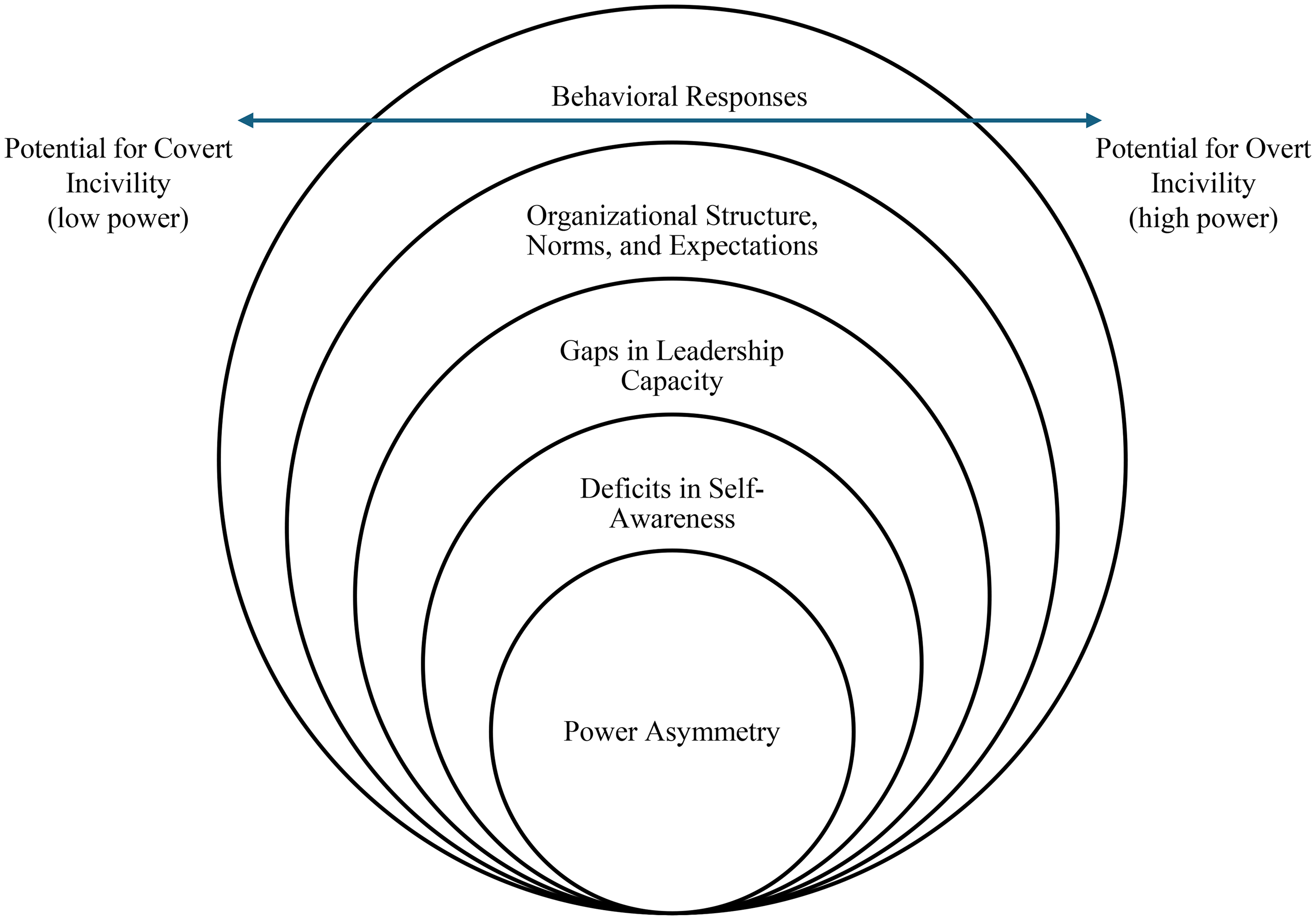
The power-asymmetry incivility model.
The model advances existing scholarship by showing how power asymmetries intersect with self-awareness, leadership capacity, organizational structures, and behavioral responses to sustain incivility as a normalized feature of academic life
Power asymmetry
At the center of the model lies power asymmetry, the foundational mechanism shaping incivility. Prior research conceptualizes incivility as reciprocal cycles of minor transgressions, yet the findings of this study suggest that reciprocity is fundamentally distorted by structural asymmetries (Andersson and Pearson, 1999). High-status individuals, often high-performing research faculty, were described as engaging in overt incivility with relative impunity, shielded by institutional rewards and tenure protections (Agarwal et al., 2023; Pearson et al., 2000). In contrast, those with less power, such as early-career scholars, teaching-stream faculty, or members of equity-seeking groups, relied on covert strategies, including silence, calculated non-intervention, and avoiding direct confrontation. These patterns align with Kabat-Farr and Cortina (2012) and Li et al. (2023), who show that covert resistance functions as a survival strategy where direct confrontation risks reputational or career harm.
Power asymmetry also operates as the connective tissue of the model. It shapes how self-awareness deficits are experienced, how leadership capacity is tested, and how organizational norms reinforce toxicity. Behavioral responses are thus conditioned not only by individual traits but by how power distributes risk and accountability.
Further, hybrid and remote work amplified these asymmetries by reducing leaders’ visibility and weakening informal social checks. As a result, powerful actors became even less accountable, while lower-status actors had fewer avenues for safe resistance. This nuance extends earlier frameworks by showing how evolving work arrangements magnify structural protections for the powerful while limiting agency for others (Hodgins and Mannix McNamara, 2017; Rayner and Keashly, 2005).
Deficits in self-awareness
Surrounding power asymmetry is a deficit in self-awareness. Many participants attributed incivility not to overt hostility but to limited reflective capacity and low emotional intelligence. Faculty focused narrowly on research productivity often failed to recognize the impact that their behavior had on others, echoing the observation of Andersson and Pearson (1999) that ambiguous intent allows incivility to spread unaddressed. Unpredictable moods, insensitive comments, and a lack of cross-cultural understanding created environments where some colleagues felt unsure about how to interact safely.
Hybrid work further exacerbated these deficits by removing non-verbal cues and reducing opportunities for informal clarification. The findings reinforce the research by Schilpzand et al. (2016), suggesting that incivility escalates when ambiguity is left unchallenged and unchecked. By linking gaps in self-awareness to systemic incentives that privilege technical over relational expertise, this study highlights an overlooked mechanism sustaining toxicity in academia.
Critically, these deficits do not operate in isolation. Power asymmetry determines whose lack of self-awareness carries the most weight, organizational incentives legitimize such behavior when it is linked to research productivity, and leadership capacity is tested by whether incivility is challenged or ignored. This shows how an individual-level driver cascades across multiple levels of the model.
Gaps in leadership capacity
The next layer reflects insufficient leadership capacity, a recurring theme across interviews. The finding aligns with prior research showing that many academic leaders assume their roles underprepared, reflecting broader cultural patterns that devalue leadership capacity relative to research performance (Boyko and Jones, 2010; Gmelch and Buller, 2015; Lavigne et al., 2022; Stawnychko, 2024, 2025). The absence of structured preparation leaves leaders ill-equipped to manage conflict, maintain collegiality, or intervene effectively, echoing the observations by Twale (2017).
In hybrid environments, the demands for relational leadership are intensified. Leaders are expected to monitor relationships across fragmented spaces, manage digital incivility, and preserve collegiality without adequate tools or preparation. Institutional training programs were widely described as generic or misaligned with the realities of leadership, echoing Sherrod and Lewallen (2021) on the limits of formal development in higher education. Even participants with extensive leadership experience, such as those in dean positions, struggled without broader institutional support, suggesting that leadership capacity reflects organizational rather than personal deficits. This underscores the importance of targeted, context-specific leadership training that develops self-awareness, emotional intelligence, conflict management, and digital communication skills relevant to the post-pandemic university.
As with self-awareness, leadership capacity cannot be understood in isolation. It is shaped by power asymmetries that constrain who can act, by organizational structures that underprepare and underreward leaders, and by cultural norms that privilege individual research over collective well-being. Limited leadership capacity therefore functions as a critical link between individual behaviors and systemic conditions in the model.
Organizational structure, norms, and expectations
The third layer concerns organizational structures and cultural expectations that shape how incivility is tolerated or addressed. Research-intensive institutions reward research output, privileging individual achievement and prestige over collegiality or leadership roles (Heffernan and Bosetti, 2021; Hodgins and Mannix McNamara, 2017). These systems tacitly incentivize behaviors that prioritize personal gain over collective well-being, reinforcing the description by Twale and De Luca (2008) of academia as a “culture of individualism.” As a result, leadership training may be undervalued and underfunded, despite being critical to addressing the very dynamics these reward systems exacerbate.
Formal mechanisms such as grievance processes or safe disclosure offices were seen as opaque, slow, and overly legalistic. Faculty associations were criticized for prioritizing procedural safeguards over proactive intervention, while deans were often overextended. These perceptions echo Rayner and Keashly (2005), who found that weak accountability structures entrench toxic dynamics by discouraging reporting and eroding trust. In hybrid environments, organizational fragmentation further undermined efforts to build cohesion or address toxicity, allowing incivility to persist as a normalized feature of institutional life.
As the model demonstrates, organizational structures operate as the bridge between observable leadership challenges and system-level cultural norms. Incentive systems that reward individual achievement, paired with weak accountability mechanisms, not only enable power asymmetries to flourish but also shape the behavioral responses observed.
Behavioral responses
The outermost layer of the model captures behavioral responses, as visible expressions of incivility shaped by these underlying forces. High-power individuals often enacted overt behaviors, including gaslighting, snarky emails, and talking over colleagues, while lower-power individuals engaged in covert strategies such as withholding input, remaining silent in meetings, or engaging in behind-the-back disparagement
Crucially, apparent reciprocity in conflict was often distorted, with significant disparities in how it was expressed and experienced. Power asymmetries and perceived legitimacy distort the logic of reciprocity, enabling high-status actors to act with impunity while constraining lower-status actors through fear of retaliation. The findings nuance existing accounts of incivility spirals by showing how they operate differently when institutional protections are unevenly distributed (Andersson and Pearson, 1999).
Integrating across the model, behavioral responses represent the output of interactions among individual deficits, limited leadership capacity, and organizational norms that reward research over collegiality. In other words, the responses observed at the surface level are structurally conditioned expressions of deeper power asymmetries and cultural expectations.
Taken together, the Power-Asymmetry Incivility Model (Figure 1) illustrates that incivility in academia is not driven by isolated behaviors but by the dynamic interplay across levels. Deficits in self-awareness at the individual level become particularly consequential when filtered through power asymmetries, amplified by limited leadership capacity, and reinforced by organizational norms that privilege research over collegiality. These antecedents converge in visible behavioral responses, where high-status faculty act with impunity and lower-status colleagues resort to covert resistance. By demonstrating how these layers interact to condition both the form and impact of incivility, the model moves beyond describing antecedents in isolation and instead offers an integrated framework that connects micro-level behaviors to macro-level structures and cultures.
Future research
Future research could continue to investigate how power asymmetries shape the emergence, expression, and tolerance of incivility in academic settings. In particular, exploring how these power dynamics intersect with organizational norms, governance structures, and institutional cultures across diverse contexts would help clarify the systemic conditions that allow toxic behaviors to persist.
Expanding this study to include a larger and more diverse sample could support a more comprehensive and comparative understanding of how incivility is experienced and managed. Future work could also examine how social identity factors such as gender and race, interact with institutional power structures to shape individuals’ vulnerability to, or impunity from, uncivil behaviors. Longitudinal research designs may be particularly valuable for tracking how these dynamics evolve over time and in response to institutional interventions.
Finally, continued refinement and empirical testing of the Power-Asymmetry Incivility Model (Figure 1) could advance theory building by providing a framework for mapping how organizational structures and cultural norms condition interpersonal behaviors. Such refinement could also generate practical insights for designing interventions that promote respectful engagement and healthier academic environments.
Implications
Addressing incivility requires a commitment to reducing power imbalances and promoting psychological safety. At the individual level, institutions must foster cultures that support self-awareness, emotional regulation, and perspective taking.
At the team level, academic leaders should be expected and actively supported to address toxic behaviors, navigate uneven power dynamics, and reinforce expectations for respectful conduct. This requires targeted leadership training that moves beyond generic management skills to develop emotional intelligence, conflict resolution, and sensitivity to academic status dynamics. Importantly, such training must be formally incentivized and recognized within academic reward structures to counter the cultural devaluation of leadership. Framing leadership development as a strategic investment may help legitimize these programs in academic cultures that privilege research output over service-oriented leadership roles.
At the organizational level, existing mechanisms for managing incivility, such as grievance procedures and reporting pathways, require not only reform but greater legitimacy. Institutions must increase the transparency, timeliness, and perceived fairness of these systems while demonstrating a visible commitment to enforcing norms. In addition to formal processes, informal mediation can play a vital role in resolving issues early, preserving relationships, and restoring trust before tensions escalate. Embedding informal resolution pathways led by competent facilitators could provide more accessible and relationship-centered alternatives that complement formal structures.
Finally, addressing incivility requires institutions to confront the deeper cultural conditions that enable it. Promotion systems that reward only individual research outputs must be recalibrated to value collegiality and recognize leadership as a meaningful dimension of academic work. By elevating leadership development to a strategic priority and aligning promotion criteria, professional development, and cultural change, universities may build a more sustainable pathway for disrupting the conditions that normalize incivility.
Limitations
While this study provides meaningful insight into the persistence of incivility in academic leadership, particularly through its multilevel framework that connects individual behaviors to organizational and systemic dynamics, several limitations should be acknowledged. As a qualitative study, the design emphasizes depth of understanding over breadth, which necessarily limits the generalizability of findings. The relatively small sample, drawn from business school leaders, may not capture the full range of experiences present across other disciplinary or institutional contexts.
The reliance on self-reported data also introduces the possibility of selective recall and impression management. While the study benefits from participants’ reflexive insights, including admissions of their own incivility, self-reporting remains vulnerable to bias, particularly on sensitive topics. In addition, by focusing exclusively on academic leaders, the study excludes the perspectives of other institutional actors, such as professional staff, students, and external stakeholders. As a result, the analysis may not fully reflect how incivility is experienced and interpreted across different roles.
Finally, the study is confined to Canadian research-intensive universities. While this context is characterized by decentralized governance and strong tenure protections, the findings may not be directly transferable to higher education systems with more centralized authority or managerial approaches to governance. As such, caution should be taken in applying these findings to different national or institutional contexts.
Conclusions
This study highlights that workplace incivility in academia is a patterned phenomenon rooted in institutional incentives, power hierarchies, and limited self-awareness. Drawing on the lived experiences of academic leaders, the findings show how power asymmetries, underdeveloped leadership capacity, and organizational structures converge to normalize and entrench incivility across individual, team, institutional, and systemic levels.
The Power-Asymmetry Incivility Model (Figure 1) developed in this study provides a framework for understanding how these dynamics operate in practice. It underscores the importance of viewing incivility not only as a behavioral issue but as a structural and cultural challenge that requires coordinated responses. While individual self-awareness and team-level interventions are necessary, they are unlikely to be effective without institutional commitment to comprehensive leadership development, strengthening accountability mechanisms, and cultural change initiatives.
Ultimately, the findings suggest that addressing incivility requires institutions to critically examine the conditions that sustain toxic dynamics. By aligning leadership development, reward systems, and cultural priorities, universities may be better positioned to foster healthier and more respectful academic environments.
Footnotes
Acknowledgments
The authors wish to thank the Business Schools Association of Canada for their funding support, which facilitated this research. We are also deeply grateful to the academic leaders who participated in the study and generously shared their insights and experiences. Their contributions were invaluable to the success of this project.

Funding
The authors disclosed receipt of the following financial support for the research, authorship, and/or publication of this article: This work was supported by the Business Schools Association of Canada (BSAC) (grant number: 103223).
Declaration of conflicting interests
The authors declared no potential conflicts of interest with respect to the research, authorship, and/or publication of this article.