




Abstract
This article presents the details and findings of a mixed-methods study that explored Scottish primary sector headteachers’ enactment of creativity through a Complexity Leadership Theory lens. Although policymakers emphasise the importance of headteachers and their impact on school improvement, there is a growing need for headteachers to enact and effectively nurture school-wide creativity if they are to overcome complex challenges brought about by today's political, social and economic environments. In response to the research question ‘To what extent do primary headteachers perceive their role as being creative?’, this article reports on 23 surveys and 11 semi-structured interviews undertaken as part of a larger study. Whilst our findings suggest that creativity is enacted to some extent by the headteachers, the evidence goes beyond this and identifies social intrapreneurship emerging. The concept of social intrapreneurship within education appears to be unique to this study. We identify social intrapreneurs as individuals who demonstrate creativity, resourcefulness, collaboration and determination and are growth-oriented within bureaucratic constraints. We conclude by discussing how social intrapreneurship is a valuable concept for headteachers and policymakers alike.
Introduction
Schools across the globe continue to face multiple challenges, including the recent pandemic, economic uncertainty and technological advances alongside the marketisation and competitive nature of educational systems and shifting global socio-political landscapes (Burns and Blanchenay, 2016; Greany, 2018; Mincu, 2022; Wharton-Beck et al., 2022). This has led to headship becoming a crucial feature of policy agendas (Miller, 2018), whereby headteachers are typically viewed as the generators and orchestrators of ‘key pedagogical and equity assumptions’ who directly and indirectly shape school effectiveness through collective school reforms (Mincu, 2022: 240). Yet, it is important to place this within the context of a growing critical discourse which challenges such claims. For example, Evans (2022a, 2022b) provocatively questions leadership causality claims and encourages a leadership-sceptic viewpoint in which the headteacher may be viewed as a more diffused concept incorporating a range of influences. Indeed, complexity theory and complexity leadership theory, which is the focus of this paper, are compatible with, and overlap to some extent, with this critical discourse.
To meet the socio-political challenges and navigate the ongoing policy initiatives driven by local and national governments, creativity must become the modus operandi (Azorin, 2020). We require headteachers to think differently, take risks and embrace environmental complexities (OECD, 2013). In this article, we adopt the following definition of creativity provided by Beresford-Dey et al. (2022: 12) in relation to headteachers: A carefully orchestrated effort to generate novel ideas, processes, and products of value to the school or system, leading to enhanced pupil outcomes and life chances.
There are two key dimensions to the intersection of headship and creativity – the headteachers’ enactment of creativity and the ability of the headteacher to nurture creativity in others. For headteachers, cultivating creativity is a ‘fundamental challenge’ (Stoll and Temperley, 2009: 65). Yet, we cannot ignore the tension that often arises when balancing creativity with accountability (Burns and Blanchenay, 2016; Greany, 2018), primarily because creativity involves risk, resulting in apprehension for many when the stakes are high. That said, rather than taking ethical, financial and health and safety risks, creative headteachers are more likely to take measured social risks through challenging a system's cultural norms. For example, through disagreement with senior colleagues (Tyagi et al., 2017) or taking action that has the potential to cause ‘embarrassment or discomfort in the school community’ (Henriksen et al., 2021: 1). Such risks are intrinsic to change, that is, moving beyond the status quo if a school is to progress in dynamic, uncertain times. Other risks may include pedagogical risk, such as ‘implementing new pedagogical models’ (Howard et al., 2018: 851) through changing the learning and instruction. Therefore, there is space for creativity, including risk, even in high-stakes environments. In this article, we report the findings of a research project undertaken in Scotland that focused on these issues surrounding the intersection of school headship and creativity.
Research context
In line with the terminology used in Scotland, we refer to the headteacher as the individual who is held accountable for a school's performance; this also has similarities to the definition provided by Hammersley-Fletcher and Brundrett (2008). The role of the headteacher has changed and expanded over the years to meet the needs of today's societal complexities (OECD, 2015), attempting to provide a succinct definition is problematic. Ultimately, the headteacher must be flexible, responding quickly to external challenges and demands for accountability (Connolly et al., 2018; Tai and Kareem, 2020; Turnbull, 2012) alongside developing and maintaining internal and external relationships within a broad community (OECD, 2015). In addition to accountability, we also adopt Miller's (2018: 7) definition of headship being ‘a social process that produces commitment, alignment and direction’. This reflects the relational and nurturing aspect to the role.
The devolvement of Scotland's education system from the UK government to the Scottish Parliament locates this article in an educational environment distinct from the rest of the UK. With each of Scotland's state schools governed by one of the 32 local authorities (Draper, 2016), local authorities play a crucial role across the school system. The local authority is responsible for employing the headteacher (OECD, 2015) and supporting them in their day-to-day operations (Murphy, 2016), particularly in leading school improvements and identifying developmental priorities (MacBeath et al., 2009). Alongside local and national government, the General Teaching Council for Scotland (the regulating body) and Education Scotland (a Scottish Government executive agency) are ‘charged with supporting quality and improvement in Scottish education’ (Education Scotland, 2023: About Education Scotland).
Like many school systems, Scotland has undergone a series of educational reforms within the past decade. For example, a new curriculum and headship qualification, the General Teaching Council for Scotland becoming an independent professional-led body, and the development of Regional Improvement Collaboratives which intentionally ‘bring together local authorities and Education Scotland to develop different ways of working, bring together capacity across a region, and add value through collective efforts’ (Scottish Government, 2019: no page). State schools in Scotland operate through a vertical structural system with the national government at its pinnacle (MacBeath et al., 2009; Sibieta and Jerrim, 2021). Here, the ‘broad framework of schooling’ is set and maintained (Murphy, 2016: 38) which filters down to the schools via several directorates, agencies and local governments. Hence, when considered in conjunction with the needs of the communities that the schools and headteachers serve, a complex system is apparent.
Many of the mandatory changes that affected the primary and secondary education system in Scotland were initiated by drivers such as Donaldson's (2011) review of teacher education in Scotland. The 50 recommendations included in the report were significant in professionalising teaching and learning in Scotland. According to Donaldson (2011: 16), promoted school staff will ‘have to be flexible, bold and creative if they are to continue to serve young people well’ as no one can be sure what demands external changes will bring for educators and headteachers. However, it is reportedly the centralised and top-down nature of policy directives which can create a ‘particularly problematic’ context for creativity in Scotland's schools (Forde, 2016: 176).
Since the publication of Donaldson's (2011) review, it can be argued that the Scottish Government have set a precedence for creativity as the system has been, and continues to undergo, extensive national reforms – for example, changes in the curriculum, funding, and headship qualifications and remits. Alongside this, Chapman (2019: 556) highlights the move away from a ‘hierarchical culture’ to an ‘egalitarian culture’ where ‘regional and local actors’ implement the direction set down by the national government. Whilst this may be a welcomed direction, the message needs to be amplified across the system to ensure this rhetoric is valued and enacted throughout if autonomy is to be increased for schools. Especially as Chapman (2019: 558) also highlights that ‘more is needed’ regarding flexibility of structures and individuals – and to close the poverty-related attainment gap (Scottish Parliament, 2023) through the Scottish Attainment Challenge – a specific driver which includes programmes such as the Pupil Equity Funding to tackle inequalities across Scotland's education system.
The Scottish Attainment Challenge is currently the Scottish Government's desire and vision to close the attainment gap between the highest and lowest achievers that is so often driven by poverty. Launched in 2015, the Government identified nine Challenge Authorities determined by the level of deprivation within different communities within each authority. Schools within these communities initially received a share of a £750 million Attainment Scotland Fund via the Pupil Equity Fund up until the end of the parliamentary term in 2021 (Scottish Government, no date). These funds were ‘to be spent at the discretion of the headteacher working in partnership with each other and their local authority’ (ibid., no page). Since then, the Scottish Government has extended the funding to £1bn to be spent from 2021 to 2026 (Scottish Parliament, 2023). While a full and frank discussion about these initiatives is beyond the scope of this article, Mowat (2019) provides a critical analysis concerning this policy initiative. The author argues that the Scottish Government took a reductionist instead of a complexivist view on the attainment gap, whereby reductionism seeks to simplify complex phenomena, by expecting schools to make changes with little consideration of the underlying system and societal level factors.
So, while there are numerous policies and strategies to address issues around poverty (Williams et al., 2018), there remain issues surrounding professional agency and autonomy. For example, in the Attainment Fund Scotland evaluation report, which drew from 12 case study schools and positively noted that Pupil Equity Fund provided autonomy in terms of planning and tailoring resources to local needs (Thornton, 2019: 4), the report found the ‘tracking and evaluation of impact’ challenging in some schools. Mowat (2019) noted that as headteachers obtain greater freedom in some areas such as staffing, this will increase the level of accountability. Similarly, Hamilton et al. (2018) highlight that autonomy and accountability are both supportive and hindering mechanisms for headteachers in Scotland. Consequently, while increased autonomy enables headteachers to meet the needs of their community, questions surround the redress of increased accountability, particularly regarding the current and any future funding initiatives, all of which may impact creativity for headteachers. The next section describes Complexity Leadership Theory, an appropriate framework to explore headteacher's accountability, autonomy, and creativity through a lens which breaks away from dominant headship discourses.
Theoretical framework
To ensure the inherent complexities within Scotland's school system are suitably captured, we draw from Complexity Leadership Theory – a framework initially developed by Uhl-Bien et al. (2007) and revised a decade later by Uhl-Bien and Arena (2017). Complexity Leadership Theory derives from Complexity Theory, where its historical roots are found in the natural sciences by embedding concepts such as adaptation, evolution, and survival (Morrison, 2002). For the past three decades, Complexity Theory has gained ground in the social sciences, albeit in multifaceted forms, with its precursors appearing in systems theory and chaos theory (Cilliers, 2000). Within education, the application of Complexity Theory remains a fledgling concept (Day and Grant-McMahon, 2016; Morrison, 2010). Still, keeping in mind the nature of school systems and the continuously evolving state of flux, we consider complexity as a valuable lens to underpin the research reported in this article below.
In common with critical leadership studies, referred to briefly above, headship, when considered through the lens of Complexity Theory removes itself from leader-centric styles (Marion, 2008) and seeks to reduce the hierarchy found in many systems and organisations. As such, a concept central to complexity is emergence which often materialises through self-organisation rather than top-down command. Emergence occurs when the number and variety of components are sufficient to form clusters and something new comes to existence as a result of working beyond individual agency (Alonso-Yanez et al., 2021; Mason, 2016). Emergence ‘characterises change in complex systems’ where prediction through knowledge of the system or initial conditions cannot be assumed (Stacey, 1996: 303). This co-existence between stability and unpredictability is possible through self-organisation and the ability to adapt, coupled with structure – all of which provides resiliency in a system (Uhl-Bien and Arena, 2017).
Complexity Leadership Theory regards leadership as a collective endeavour working across the following three leadership functions (Gordon and Cleland, 2021; Howden et al., 2021; Uhl-Bien and Arena, 2017; Uhl-Bien et al., 2007):
Operational leadership: Where leaders plan and manage strategies to meet a vision within the formal organisational structures, leads processes to produce results through efficiency and effectively exploiting resources. Enabling leadership: Where leaders cultivate and amplify the adaptive interfacing space between operational and entrepreneurial leadership, catalyse activity by utilising systemic forces through fostering networks and collaboration to encourage the liberation and dissemination of collective knowledge to activate innovative responses. Entrepreneurial leadership: Interaction of dynamic leaders as a collective to generate novelty through ideation and action within cohesive teams alongside working in tandem with the enabling leadership. Organisational constraints and challenges act as the drivers for creating new knowledge and novel outcomes, for example, in the form of processes, products and skills.
In essence, Complexity Leadership Theory is about the balance between formal and informal structures to leverage Complex Adaptive Systems, resulting in creativity, adaptation and knowledge sharing across networks within flattened systems (Uhl-Bien, 2021; Uhl-Bien and Arena, 2017; Uhl-Bien et al., 2007). Although we cannot disregard the hierarchical nature of many public-sector school systems, they are often part of structures where interdependence through networking, collaboration and partnership working is inherent (Beresford-Dey et al., 2022; Leithwood, 2019). Yet, Uhl-Bien (2021: 1400) notes the ‘bad news’ that the public sector ‘lags behind’ because the level of bureaucracy within the system often inhibits adaptive responses even though these responses are required to develop ‘new ways of thinking and operating’ (ibid. p. 1401). These theoretical perspectives, outlined above, underpinned our research in which the findings are discussed below. We begin by outlining the research design and method.
The research project: outline of design and method
Empirical research through a Complexity Leadership Theory lens is limited. However, Complexity Leadership scholars such as De Lia (2010) and Fernsler (2017) demonstrate the use of mixed methods research through the use of questionnaire and interview data – a design approach we have also taken. Our investigation was part of a larger mixed methods study that, whilst considering the national government and wider stakeholders, primarily focused on the headteacher-local authority juncture regarding creativity and the role of headteachers. Although in this article we are concentrating on the headteacher's practices from their own perspectives and in doing so, this could appear simplistic, we do not view their role as separate from the complexities of the school system.
To generate responses to the research question ‘To what extent do primary headteachers perceive their role as being creative?’, and adapting items from published models by Avolio et al. (1999) and Zhou and George (2001), we developed a questionnaire comprising of 19 items relating to creative characteristics such as novelty, failure, mistakes, and risk-taking. As the models did not cover all of the creative characteristics identified in Puccio et al. (2010) and Beresford-Dey et al. (2022), we developed nine additional items to address these associated characteristics, for example, open-mindedness, challenging assumptions, flexible thinking and deferring judgement. Reducing the concept of creativity to its constituent components in this way was important to avoid careless application of what could be considered a ‘vernacular term’, in a similar way to that discussed by Evans (2023: 16) regarding leadership. Using a questionnaire in this way also enabled the respondents to self-assess their practice of creative components that they may not have considered. The questionnaire utilised a 5-point Likert scale, with ‘1’ indicating ‘never’ to ‘5’ showing ‘very often’, with the opportunity for additional explanatory open response.
To complement the questionnaire data, we conducted a total of 337 min of semi-structured interviews. Whilst 9 of the 11 interviews lasted approximately 40–45 min, one interview fell considerably short at 18 min due to a change in the participant's available time and one interview was extended to 63 min due to the interviewee taking additional time in considering their responses. Nevertheless, the nature of the discussions provided a mechanism to obtain rich data to create a coherent picture (Bazeley, 2018). After asking the headteachers to define creativity (reported in Beresford-Dey et al., 2022) we then asked them to give their thoughts on:
their role and creativity and how they would describe this; and, barriers towards their role and creativity
Using IBM SPSS version 25, we analysed the quantitative questionnaire responses in simple descriptive data. The qualitative responses and the semi-structured interviews were analysed using Nvivo version 12, following Bazeley and Jackson's (2013) guidance to identify the key themes. Throughout, we weave together the quantitative and qualitative data. The integration of the data occurred through applying a consistent oscillating movement of back and forth between the two data types (Bazeley, 2018); this reflects Poth's (2018) notion of integrating the data responsively and organically. Finally, as both data types have an equal bearing, the order of presentation does not represent any weighting of one source over another.
We recruited 23 participants for the questionnaire and 11 agreed to participating in an interview. Recruitment occurred opportunistically through approaching local authorities, using our contacts, and via social media. Institutional ethical permission was granted, and all participants provided consent. Due to the open nature of social media recruitment and the varied recruitment strategies, an accurate response rate was unavailable. Table 1 shows the demographic characteristics of the respondents to the questionnaire and Table 2 shows the gender of each interview participant to avoid any uncertainty associated with name and gender.
The characteristics of the questionnaire participants.
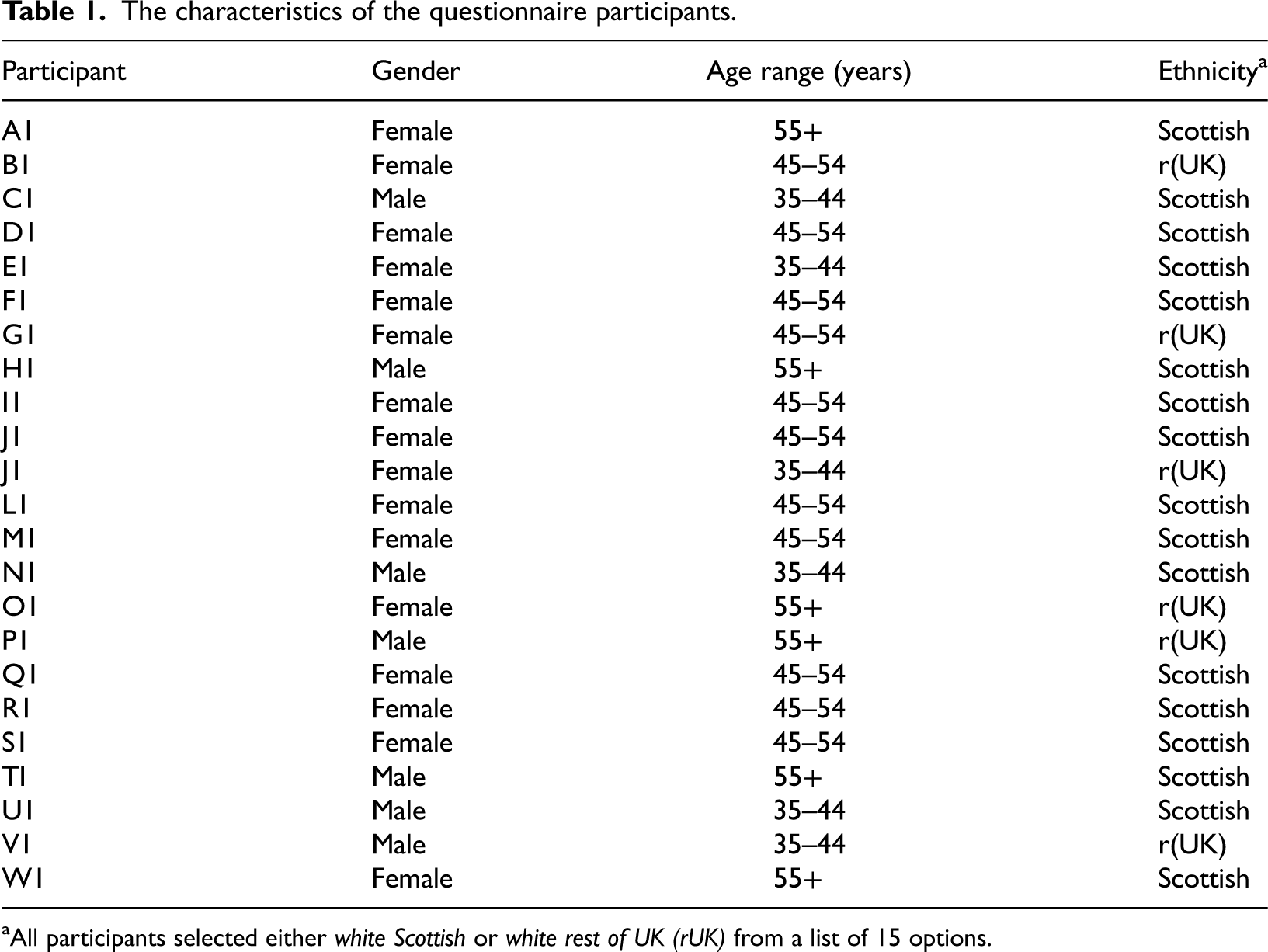
All participants selected either white Scottish or white rest of UK (rUK) from a list of 15 options.
The gender of each interview participant.
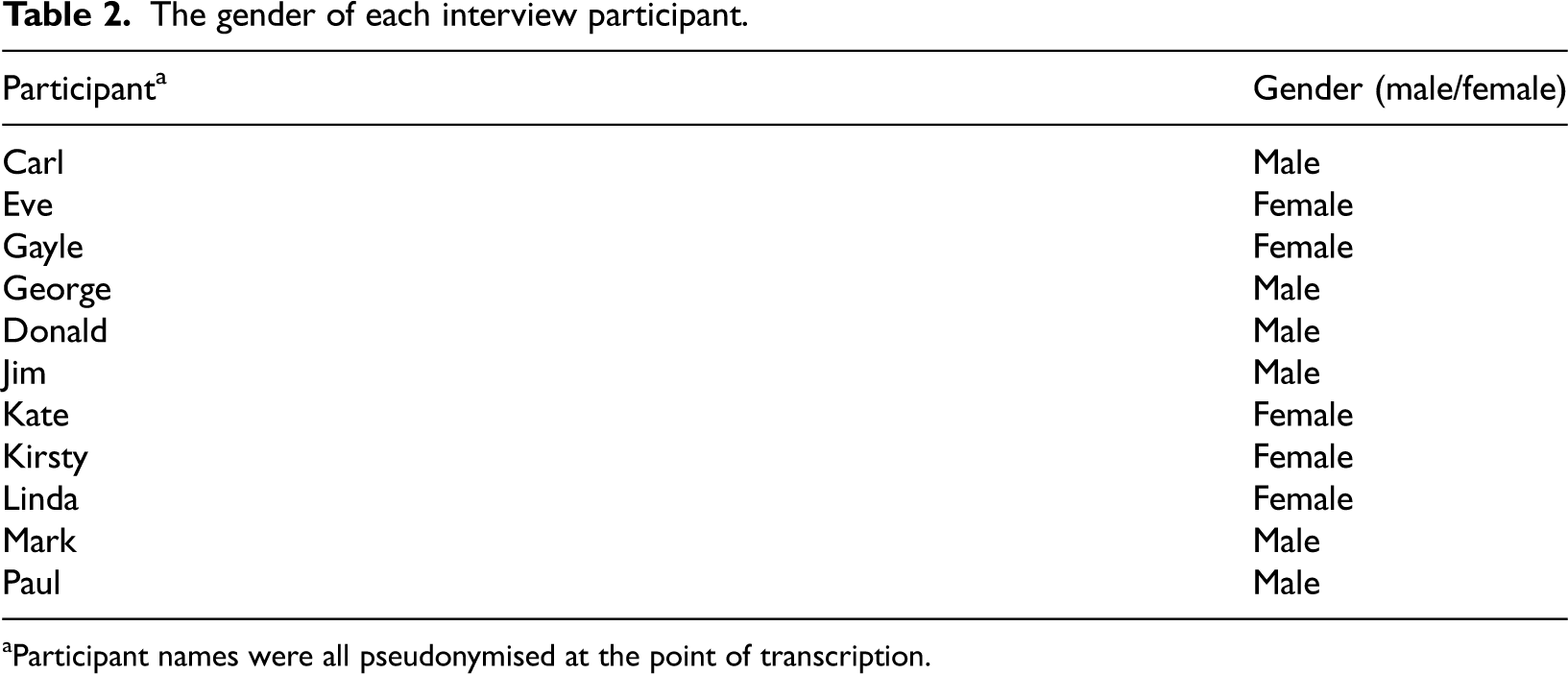
Participant names were all pseudonymised at the point of transcription.
In the following section, we present our findings concerning the headteacher's role and creativity.
Findings
The concept of creativity can be seen as a syndrome (Mumford and Gustafson, 1988), which includes several characteristics. These characteristics include novelty, problem-solving, open-mindedness, risk-taking, and challenging the system. Each of which are associated with Uhl-Bien and Arena's (2017) concept of entrepreneurial leadership. Whilst our questionnaire focused on individual characteristics, our interview questions focused on creativity holistically. For example, ‘please tell me how you would define creativity’ and ‘do you think that certain skills/behaviours/attributes are required to be considered as creative?’. Drawing from the characteristics of creativity identified in Beresford-Dey et al. (2022), alongside the texts reported above in developing the questionnaire, we have structured the reporting of our analysis around the characteristics.
Novelty
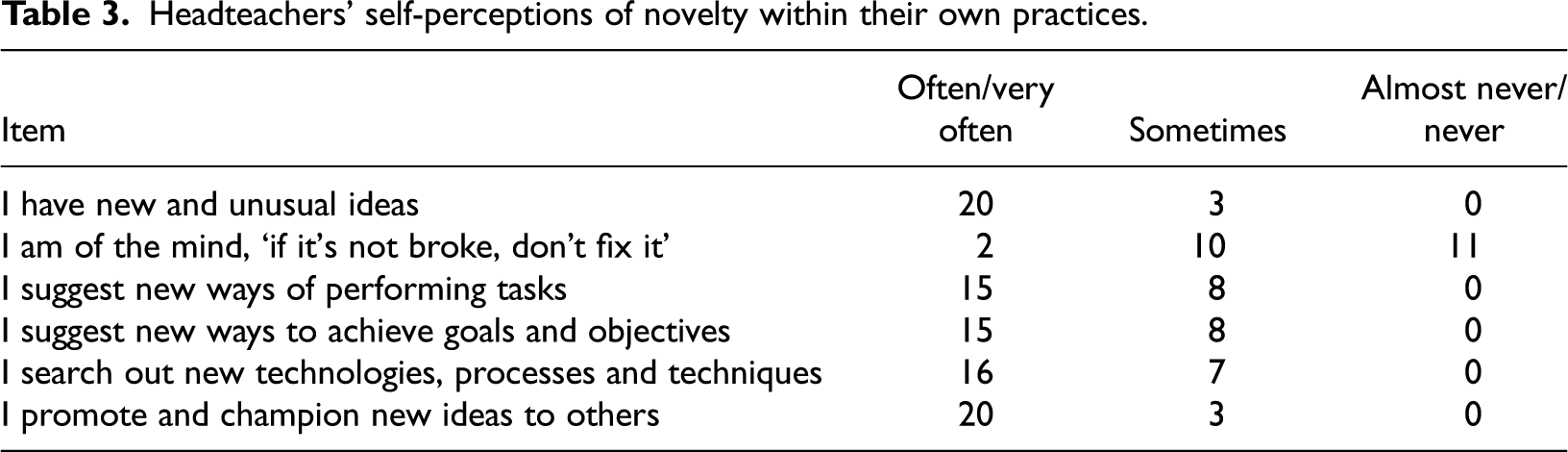
In response to a series of questionnaire items relating to the concept of ‘novelty’ – which, elsewhere, we have incorporated into our conceptualisation of creativity (Beresford-Dey et al., 2022) – for the most part, participants reported multiple engagement with or deployment of what they considered novelty (Table 3).
Headteachers’ self-perceptions of novelty within their own practices.
When asked about creativity in its entirety, the interview responses highlighted several characteristics including novelty – which appeared as primarily new ideas or actions. One headteacher commented on the need for a clear rationale for any new approach that he put forward so that the staff would know that any proposed changes are ‘not a passing fad’. This comment suggests that novelty is perceived by this headteacher as stemming from him.
Other headteachers implied – with their use of ‘us’, ‘our’ and ‘we’ – that they adopt a more consultative approach to injecting novelty into their headship practice which provided a sense of community. Gayle's response highlights this entanglement between the individual and the collective: [I] would be looking for ways to be open to new ideas and looking for new things that we can adapt and change to suit our context … In my particular area we tend to jump on the band wagon though, somebody says its good in one school so we’ll all try it in all the other schools to replicate it … We can’t take something that works in one school and completely replicate it in another because the staff and the pupils and, [so] the context are different. (Gayle)
Whilst highlighting the shift from individual to collective action and language, Gayle then provided an example which moved the collective beyond the school by drawing from system networks to incorporate novel practices within her school: I was looking at how we could enhance the use of digital technologies to enhance learning and make it more than just using technology to replace a written task. In terms of creativity, we explored lots of things that other schools are doing and then we looked at what we had and what we could do and the skills that we had in school … once we’d identified where we wanted to go then I would let the staff […] use their creativity to look at what fits with them, and try out their ideas. (Gayle)
Eve firmly linked novelty to the collective through her use of ‘we’, ‘our’, ‘people’ and ‘the school’: Being open to new ideas and being able to [think] ‘well actually we thought we were going on this track and through our development it's actually going on a different tangent’ because that's what people have either wanted or it's what best fits the school. (Eve)
For Paul, novelty played out in terms of the staff driving new ideas: When I see people having these ideas, I [often] think, ‘oh that's a great idea, quite a simple idea, but I would never have thought of that’ […] I have to say that I’m in a fortunate position here […], the staff are very proactive in coming forward with new ideas. (Paul)
On the other hand, Jim made a specific point of being the facilitator of ideation discussions, associated with novelty, during team meetings to encourage a collective approach. I would hope that a lot of creativity, new ideas, would come from the staff team. So, the way I would approach it would be to put down, some points of reference [such as the local authority priorities or the Scottish Attainment Challenge]… I would facilitate the discussion amongst the staff team, that would be my creative thinking… not necessarily me thinking of creative ideas in a silo on my own. My creative thinking would be ‘how do I get my staff involved in doing that?’ (Jim)
From this data, creativity expands beyond the headteacher, with each headteacher working with staff in generating creative solutions. Gayle takes this further by referring to the schools Quality Improvement Officer (the local authority interfacing officer): Well, my quality improvement officer […] when I was explaining my vision of things, she was really supportive and said that she also liked to try new things, so she was of a similar mindset to me. (Gayle)
Conversely, the interview data provided some constraining features that could account for those who reported novelty occurring ‘sometimes’ and therefore impacting creativity. For example, workload issues where operational activities take priority. Here, Donald described a ‘mundane’ task which stymied his creativity as a headteacher, albeit having novel ideas: I had lots of grand ideas and lots of high hopes and aspirations, but I felt that the amount of time taken with a lot of the logistical, the mundane, and the everyday routine things took away a huge amount from my job to the point that I had meetings around various colours of bins and how many bins were needed, and I suppose it just squeezed the time. (Donald)
Likewise, Paul identified barriers to taking ideas forward alongside a sense of responsibility shouldered by one individual even when the ideation stage is a collective feature: Unfortunately, I immediately think of the constraints placed on us because, as headteachers and leaders of the school, there are a number of protocols, guidelines etc., that we have to follow and so on, and the buck stops with you. There's a lot of times when you try to think, ‘well, what could happen if you did x, y, and z?’ and so on. Unfortunately, that's the kind of hat that I have on a lot with it. (Paul)
These findings indicate that novelty, a characteristic of creativity, was taking place, and headteachers were individually or collectively active in encouraging novel ideas, but operational constraints sometimes dampened the ability to action these ideas. Nevertheless, within these constraints, some headteachers expressed their readiness to foster creativity through novelty. This aligns with the concept of entrepreneurial leadership proposed by Uhl-Bien and Arena (2017), particularly when novelty is developed as a collective process.
Problem-solving
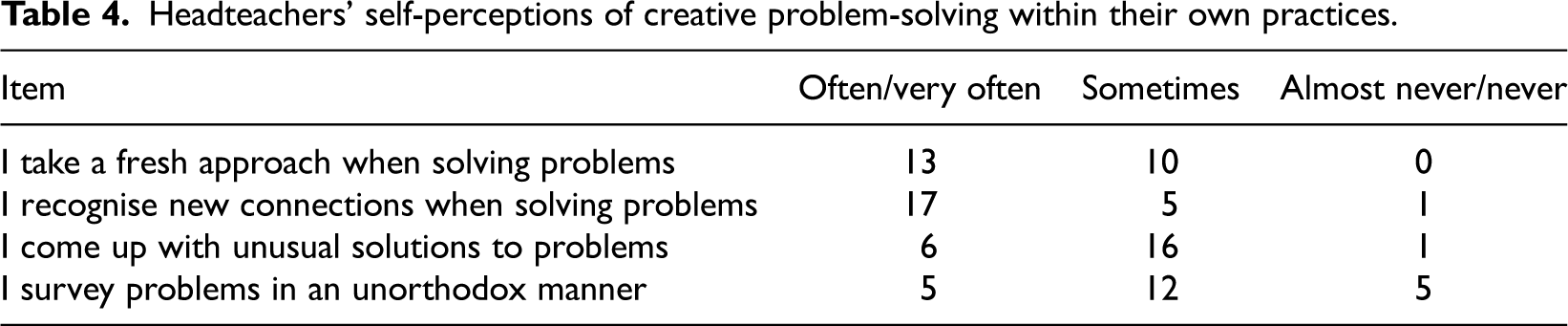
Creative problem-solving is a central component of creativity (Beresford-Dey et al., 2022), where unusual or unconventional ways of approaching problems lead to unique and novel solutions for the context (Amabile, 1998). Accordingly, we sought to explore creative problem-solving through four related items (see Table 4). One participant failed to respond to item four ‘I survey problems in an unorthodox manner’ and did not provide any reasoning for this omission. In the main, the headteachers indicated that they employed creative problem-solving within their own practices.
Headteachers’ self-perceptions of creative problem-solving within their own practices.
One participant who responded with ‘sometimes’ provided additional information ‘I will sometimes use a previously used method to solve problems rather than a fresh approach if I feel that it will work well’. It appears from this qualitative statement alongside the quantitative data that tried and tested methods will be reused in several instances even though it is likely that each problem and situation will be unique. From a complexity theory perspective, one characteristic of complex systems is path-dependence, this common concept explains how the current state of a system, behaviours or processes are influenced by their historical development (Turner and Baker, 2019). Experimenting with novel approaches is not necessarily the ideal solution, but an overreliance on past experiences can result in a system becoming locked into its current state once a particular path is taken – where behaviours and processes become reinforced and institutionalised over time (Smith and Abbott, 2014). In the context of an education system, bureaucracy can exacerbate this. In such cases, the system loses its capacity to adapt to externally driven change. Yet, from the interview data, the need to move away from the norm was evident in Donald's comment: I suppose it's been able to think outside the box a little […] we wouldn’t necessarily stick to templates that have been used and tried, and either thought to be successful or unsuccessful. For example, distributed leadership, which is a very popular approach […] to give, I suppose, a license or a freedom for all staff to be able to feel as if they can make decisions to act, to use their initiative, to engage with pupils and parents, and leaders within the school community. (Donald)
In this example, by using the terms ‘think outside the box’ alongside diverging from templates, Donald encourages increased autonomy for staff to problem-solve in ways that are contrary to the accepted and normal methods which demonstrates an entrepreneurial mindset. Additionally, he highlights the importance of drawing from others, particularly those impacted by any change – the pupils and parents. Likewise, Gayle remains focused to promoting creativity among her staff and encourages creative problem-solving: Creativity is a bit of problem-solving, we’re going try something and if doesn’t work we’re going to change it and we’re going to look at it, we’re going to move forward and we’re going to learn from it. I think the biggest barrier is, what if it's a mistake? What if it doesn’t work? What if this has a detrimental effect? But in fact, we should be thinking, but what if this has a positive effect? (Gayle)
Operating in local contexts, to problem-solve by taking a fresh approach, recognising new connections, and trialling something different within the school environment, suggests that some of the participating headteachers were willing to practice entrepreneurial leadership proffered by Uhl-Bien and Arena (2017). Whilst some participants raised additional comments regarding problem-solving, they oriented towards the solution rather than determining the underlying problem. None of the respondents mentioned the processes they took to seek out the fundamental problems and associated solutions. Albeit respondents reporting they were prepared to make changes and recognise alternative ways, there was little evidence from the interviews to show that respondents had considered this in a more unconventional manner which aligns with the quantitative data surrounding unorthodoxy. Overall, it seems that while there was a willingness to embrace novelty when working to overcome problems, unorthodox approaches were not typical for the participating headteachers.
Open-mindedness
Literature regularly acknowledges open-mindedness as a creative characteristic as it increases the number of ideas generated (Amabile, 1998; Thompson, 2003) which, according to Dawson and Andriopoulos (2014), is less likely to lead to habitual actions. Table 5 reports the responses to four items relating directly or indirectly to being open-minded. The headteachers’ self-assessments of their headship practice indicate frequent adoption and application of perspectives that align with Beresford-Dey et al. (2022) conceptualisation of creativity. The weakest item was deferring judgement on a colleague's ideas, thus potentially stifling the creativity of others.
Headteachers’ self-perceptions of open-mindedness within their own practices.
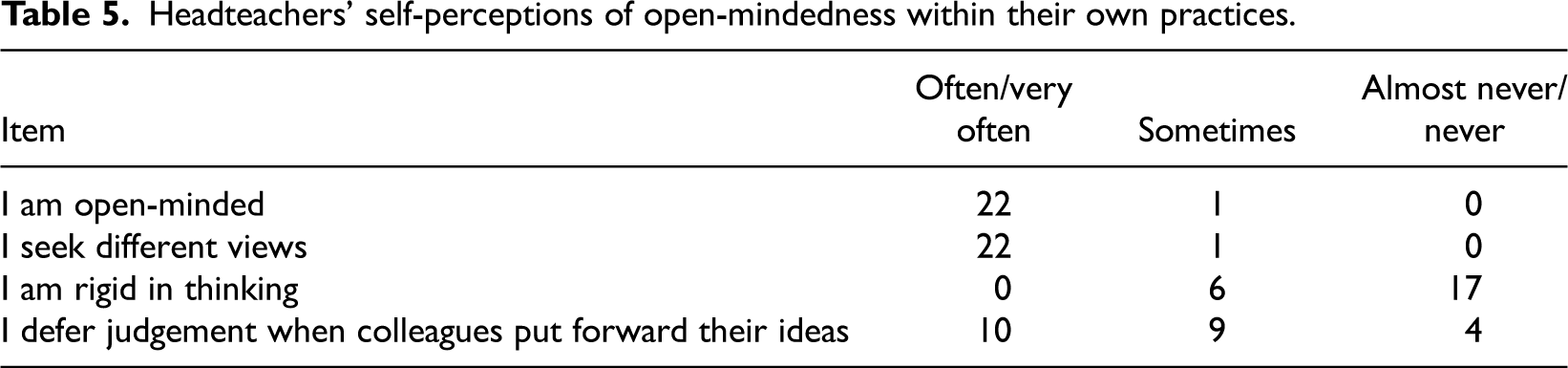
The qualitative data also yielded references concerning the headteacher's open-mindedness. For Carl, creativity meant ‘Just giving things a go’. Other comments explicitly identified being open-minded and flexible, albeit whilst consciously avoiding the need to follow suit. George's comment helps to unpack this statement around flexibility and also identifies possible implications: Sometimes it's the journey that's more important than the product… you might start thinking and that might lead to you having a massive change of thought or it redirects you in a way that you hadn’t anticipated, and I think that it's that open-mindedness and flexibility that is quite key and central for creativity in school leadership. I think everybody is quite flexible because things will pop up that we hadn’t really anticipated. So, we have to be kind of creative in how we manage the time that we’ve got. (George)
Mark provided a specific example of being open-minded when staff raised new initiatives and he deferred judgement to enable staff to take those ideas forward, one such initiative was intergenerational work: With the intergenerational work, the teacher and the staff went down about once a week to the old folk's home; they did a lot of work including a mini-Olympic games with the residents, they played board games, and they discussed history and all sorts of things. It was fabulous work for the older residents and for the children. It was an opportunity for the children to make up the language deficit that may be missing from some of their home backgrounds, so that was very creative. (Mark)
While the evidence suggests open-mindedness, making new connections and flexibility, there was more uncertainty around deferring judgement. Scant resources, such as time, can negatively impact the space for creativity, yet, in line with entrepreneurial leadership (Uhl-Bien and Arena, 2017), they can also provide the impetus to do something different and seek alternative solutions.
Risk-taking
The literature on creativity identifies calculated risk-taking and acknowledging failure as common features of creative practice (Beresford-Dey et al., 2022; Ruggiero, 2010) and is synonymous with entrepreneurs (Carosa, 2020). The questionnaire results in Table 6 indicate that, except for one, all participating headteachers perceived themselves as risk-takers at least sometimes, and in some cases, often. Whether one views this result as positive or negative will likely depend on their perspective concerning compliance or boundary-pushing and their situation.
Headteachers’ self-perceptions of risk-taking within their own practices.

Even though risk-taking was not entirely unusual, the emotion brought about by failure and overcoming errors needs to be resolved to avoid dampening creativity. When asked about barriers to creativity, the responses were sometimes self-imposed through emotions. When several of the headteachers raised the characteristics of risk, failure, and mistakes, their responses also included terms such as fear, blame, bravery, confidence, courage, and resilience. For example: I think you have to be brave to make different choices and be able to justify the choices that you’ve got. […] I suppose the only other things that could hold you back are yourself. Going back to that part of being brave, that could be a barrier in itself if you don’t want to sort of dip the toe in or stick your head above the parapet. (Kate) I think that you have to have resilience in there as well, and I think you need to accept failure, understand failure, learn from failure and look at how you can overcome any barriers that might appear throughout the whole process, and how you overcome them, learn from them, or adapt them. (George)
However, some responses demonstrated a willingness to cautiously take risks even when experiencing these feelings, for example Kirsty: You go off in a different direction and one that you’re not so comfortable with so you might draw back a bit, but the more you do it and it works, the more the children respond to it, or the staff respond, you think […] let's keep going and see what happens. (Kirsty)
In addition to the individual's and school's internal response, there was also considerations to external responses, these included the local authority as the ‘employers’ (Jim) and Education Scotland (George) but also from agents perhaps less considered such as the media. Paul's response brought to the fore his concerns about blame, and his comment in terms of being ‘hung, drawn and quartered’ was a powerful phrase to use: I just feel now as if you are hung, drawn, and quartered by the press who then fuel the parents, who then come in with a bit of a blame culture and rather than actually say ‘do you know what, that's a school thinking a wee bit different, that's them trying to be a bit more creative’ - it's not a great way to think about it, but it's the reality. (Paul)
Paul's example of being blamed was in relation to the children's safety and parental influence, and while we have highlighted the need for risk and an acceptance of failure, it is essential to note the ethical implications here. First and foremost is the health and safety of all involved, and the importance of this was evident in several of the interviews. Second is the consideration of pupil attainment level and the desire to ensure these continue to increase; this was an area which was broached by some respondents concerning local or national government expectations and was often related to the level of system-wide bureaucracy: I don’t think that there's ever been a time where there's been greater bureaucracy within education and more responsibility on headteachers. Yet, at the same time, there is a feeling that we’ve got to do something better, but the safest thing to do is to keep the status quo. (Mark)
Although several responses highlighted extensive bureaucratic practices, Kirsty's response shows concern around the idea of loosening bureaucratic constraints too much: I also think that things in society need to change. Schools cannot do everything, and there's still, I guess, quite a lot of bureaucracy that needs to be taken away from people. That’ll maybe come in time because it is often the red tape that stops you doing things, but at the same time, I think I would worry if it went away too far. (Kirsty)
Overall, although there is evidence of risk-taking, the data suggests a reticence by the majority of the participants to regularly take risks. Some of the barriers included fear of failure, the impact on attainment levels alongside the bureaucratic nature of the role, such as completing extensive risk-assessments.
Challenging the system
Questionnaire participants were asked to gauge their perceptions of whether they challenge assumptions, rules and regulations, along with whether they are prepared to question things such as directives, initiatives and procedures (Table 7).
Headteachers’ self-perceptions of challenging the system within their own practices.
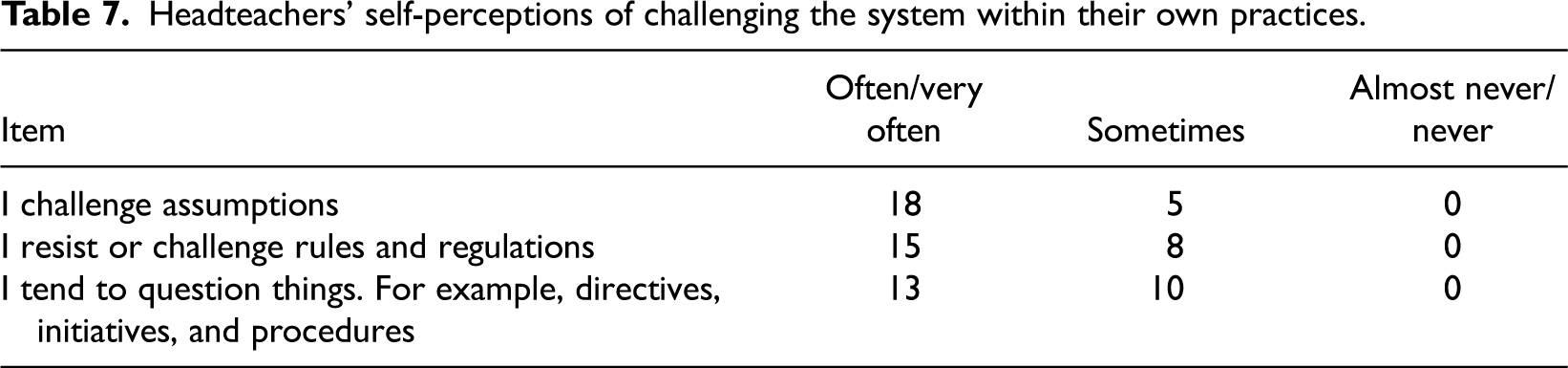
The responses show that headteachers rated themselves as willing to challenge the system. Turning to the qualitative data, although there had been some general comments concerning rules and regulations, particularly in connection with autonomy, there had been no direct discussion of challenge or questioning directives etc. It was only when the headteachers were asked to provide examples of their creativity in their headship practice that resistance to rules (and risk-taking) became evident for some. For instance, Carl demonstrated that he was willing to actively challenge rules and regulations when necessary: An example of this is not going through HR [Human Resources] to obtain supply teaching staff. Instead, teaching students who had gone through their extended placement with the school were interviewed and placed onto the supply list. I got my knuckles rapped for that one, but we needed supply staff, and there wasn’t any available on the supply list, so what was I supposed to do? (Carl)
Carl's example shows he needed to take a calculated risk in response to a problem through taking alternative action which saw him break out from normal procedures – action that demonstrated entrepreneurial leadership, albeit consequences were faced when he did so. Another example of challenging the system was given elsewhere when Linda adapted the curriculum, but it also highlighted two different responses: In my previous post, we had looked at developing the curriculum in quite a different way, and we’d had a visit from Education Scotland … where they were looking for good practice. They had seen the curriculum that we’d developed and had said that I had been very creative and hadn’t seen anything like it before, but it embodied the principles for Curriculum for Excellence [Scotland's national curriculum] and curriculum design. So, when I came here, I replicated something fairly similar but mindful of the context of this school, and my education officer had not liked it at all, it had been too different for her and had warned me against that. (Linda)
Similarly, Donald highlighted different responses to challenging the system depending on the local authority: I think I would put that [challenging the system] down to relationships, your relationship with the local authority is incredibly important […] I don’t think that there is equity when it comes to how that applies to schools across the local authority – and I speak as having been a head in two local authorities. (Donald)
Other examples of challenging the system included – amending the planning system to ‘scrap’ the mid-term planning that teachers had to complete, and instead, focusing on being flexible depending on the pupils needs and interests (Donald), pushing back on reporting and feedback systems (Gayle), pupils leading initiatives such as planning how to spend large pots of funding and actioning those plans (George), and providing hot meals for families one evening a week – ‘the teatime club’ (Jim). Although these examples may be typical for some working in different environments, for these participants, their actions challenged or go beyond the local and national guidance or processes and therefore, to some extent, are considered as entrepreneurial.
Networking and collaboration
Whilst networking and collaboration was not a questionnaire feature regarding headteacher creativity, there was evidence in the interviews to highlight the importance of sharing ideas, knowledge, and experience with colleagues outside of the school to enhance creativity. Some headteachers noted the use of social media and informal connections with colleagues beyond their school which increased their creativity by learning about new practices, others commented on in-service days, improvement partnerships, cluster group meetings and headteacher days as a time for professional dialogue leading to creativity. According to Uhl-Bien and Arena (2017), these relational networks are a prominent feature of entrepreneurial leadership where they view creativity and innovation as a collective process. Mark also mentioned this link between creativity and networking: The first one would be your cluster/local management group, and that would be a very natural place where you’ve maybe got about ten headteachers of primary and secondary working together, so that was a good source of creativity – it was a good source of networking. (Mark)
Gayle took this a step further by commenting on the need to adapt the shared ideas within her own school. At the very local level, there's quite a lot of opportunity to collaborate. It's great to share ideas, we then have to continue be creative in ourselves to adapt those ideas to our own settings. (Gayle)
Eve also discussed the need to adapt practices, but within local authority constraints: We have head teacher days where we get together, and we find out about what the authority wants us to do that year. Within that, there is an element of creativity under the constraints of “well this is what we’re needing you to do, how's it going to be within your own school?”. So yeah, there are elements of creativity under a strict umbrella too. (Eve)
However, Paul provided an example surrounding a new authority-wide programme of study where the local authority collaboration events have helped creative practices: With any [new] programme of study, a lot […] get a bit worried that people won’t just go from page one to page two to page three and not be creative, but the authority got that one right. What they did was put in a support network where every term they got together, and they looked at what was going well and how people are being creative. (Paul)
Whilst there were several positives in the data regarding networking, collaboration and creativity, Donald provided two contrasting experiences of headteacher days across two different local authorities: You would be cramped with about 40-odd headteachers in this very small room, and you were just in rows, and it was listen, listen, listen, and then off you go. In [another local authority identified] the headteacher meetings were quite different. We generally sat in clusters […] to encourage that [creative] dialogue with colleagues that perhaps you didn’t work with on a regular basis. (Donald)
Overall, although the headteachers appeared to view opportunities for networking and collaboration positively regarding creativity, the need for the local authorities to go beyond information giving was highlighted.
Using mixed methods, we combined two sets of results from the questionnaire data and semi-structured interviews to gain a better understanding of creativity concerning primary sector headteachers. In the next section we discuss our findings in relation to Complexity Leadership Theory.
Discussion
In response to the research question ‘To what extent do primary headteachers perceive their role as being creative?’, the data suggests that creativity was evident throughout each of the characteristics of novelty, problem-solving, open mindedness, risk-taking and challenging the system, but the strength of these was not consistent across each. Items related to problem-solving in an unorthodox manner and risk-taking were the weaker features. That said, despite the challenges and internal and external barriers, the participating headteachers demonstrated a will to overcome the challenges and demonstrate creativity within their practice.
Complexity leadership theory
While our paper has focused on the headteachers perspectives, through the need to consider the multiple stakeholders (pupils, parents, staff and different authorities) alongside the everchanging environment (including policies and initiatives), the evidence highlights the complex nature of their role. Within the complex and dynamic system, and in line with Mason (2016), Uhl-Bien and Arena (2017) and Alonso-Yanez et al. (2021), emergence was evident (to greater or lesser degrees). There was a clear need for headteachers to be creative, whilst working within a controlled structure, through self-organisation, networking and collaboration where knowledge and successful interventions were shared.
Defined as the ‘formal design and alignment of systems and processes for efficiently executing ideas and converting them into productive outcomes’ (Uhl-Bien and Arena, 2017: 14), operational leadership is required whilst keeping in mind creativity when balancing bureaucratic needs. From our findings, it is difficult to see who appears to be applying the weighting towards formalities and bureaucracy between external stakeholders or self-administration by the headteachers. Nevertheless, these findings provide some parallels to MacBeath et al.’s (2012) work surrounding the impact of accountability and workload resulting from government policies and the inspection processes. Returning to Uhl-Bien and Arena (2017), they highlight the need for operational leaders to protect against the ‘pull to order’ through a reduction of privileging bureaucracy which has a destructive effect on entrepreneurial behaviours and instead, ways to accommodate creativity need to be developed. It appears from our findings that the pull to order is not unusual, and again, this raises questions surrounding who influences this pull to the greatest extent.
A key area arising from the data is the barriers that the headteachers face, particularly when associated with creative characteristics such as unorthodoxy and risk-taking. For these to occur, enabling leadership is required. Accordingly, to encourage headteachers to make informed and calculated risks, or indeed, to act as catalysts for creativity (Bottery, 2016), they must have the support of stakeholders across all levels of the system to provide protective factors for the headteachers (Anderson-Butcher et al., 2010) and establish a risk-tolerant climate (Moolenaar et al., 2010). Some respondents used phrases such as ‘the safest thing to do is to keep the status quo’, ‘stick your head above the parapet’, ‘hung, drawn, and quartered’, and ‘knuckles rapped’; these do not allude to a psychologically safe climate or enabling leadership. Without regular opportunities to safely challenge the system, the system encourages the propagation of compliant headteachers rather than developing ‘local creative’ headteachers (O’Brien and Murphy, 2016: 197). In turn, this unconsciously or consciously promotes groupthink (Beabout, 2014), where groups or teams can ‘act as a norming device’ where ideas become habitual, resulting in conforming, homogenous members (Thompson, 2003: 99) and therefore limits creativity.
Entrepreneurial leadership
The third feature of Complexity Leadership Theory focuses on entrepreneurial leadership (Uhl-Bien and Arena, 2017). Entrepreneurialism is defined as activities that make creativity effective in the profit-making marketplace (Drucker, 2011). Entrepreneurs purposefully seek out sources and opportunities for change and innovation (ibid.). Similarly, Priestley (2018: 1) notes an entrepreneur as someone who ‘spots an opportunity and acts to make it a commercial success’. Within education, Thomson and Sanders (2010) identify entrepreneurialism as seeking out new initiatives, and Moos (2015: 179) suggests that it is ‘competencies to be flexible and creative when meeting and handling social and economic changes’. There are, therefore, similarities between entrepreneurs within broader contexts and headteachers, with both seeking opportunity, being adaptive, resourceful and acting to turn opportunities into organisational success. Under these properties, the participants demonstrate aspects of entrepreneurialism to some degree. For example, being opportunistic to obtain resources or utilise the wider community to enable new initiatives – such as taking risks to obtain supply staff, providing families with a weekly hot meal, enabling intergenerational work, and each of the participating headteachers utilising and adapting practices from elsewhere in the system. According to Uhl-Bien and Arena (2017), the source of creativity, innovation and organisational growth primarily lie with entrepreneurial leaders. They consider change as normal and healthy for development, although they note that it is not the role of a lone individual to drive change – an aspect which was evident within the data. Scotland's headteachers have and continue to experience reforms prompted by national government demands, and they need to demonstrate being consistently active in creativity whether that is their creativity or enabling creativity across the school community.
Regarding headship, Anderson and White (2011) use the concept of social entrepreneurship, defined as ‘putting social capital to work entrepreneurially’ through the use of relationships and resourcing to ‘counter social disadvantage’ (p.52). Therefore, drawing a difference in that social entrepreneurialism refers to entrepreneurs on a social-profit mission rather than being financially oriented. Nicholls (2006: 5–11) highlights social entrepreneurialism as a ‘driver of significant social change’ rather than generating ‘independent profit streams’ – a valuable concept for public sector innovation. The addition of ‘social’ provides a closer alignment with government-led schools. In terms of the participants, this was particularly evident in their commentary around serving and meeting the needs of their school community; the language used demonstrates a deep-seated focus on social values. This understanding leads us to our final point, where social intrapreneurship is perhaps more relevant to headteachers.
From an educational perspective, we propose that social intrapreneurship is unique to this article in terms of headship, possibly because intrapreneurship itself is a relatively new concept which does not yet feature in many disciplines (Yashin-Shaw, 2018). Yashin-Shaw (2018: 1) defines an intrapreneur as ‘the act of thinking and behaving like an entrepreneur while working within a large organisation’. As one would expect, intrapreneurialism holds similar characteristics to entrepreneurialism, such as creativity, collaboration, growth-oriented, opportunistic, resourceful and determined inter-alia (ibid.). However, according to Myler (2014), intrapreneurs differ from entrepreneurs in four key areas:
The first is cultural, where historical practices and widely shared beliefs are more prevalent for an intrapreneur working within an organisation. Second, unlike entrepreneurs, intrapreneurs have not chosen to venture out as business start-ups. Third, resource attainment is not so easy for intrapreneurs, who are often required to negotiate for scarce resources, unlike entrepreneurs who are in a position to target the resources they need directly. Finally, because of the established or hierarchical policies and procedures, intrapreneurs do not have the same autonomy as entrepreneurs.
The realisation of intrapreneurship came to fruition as several interviewees noted that they are council employees and, therefore, they work within the confines of a larger organisation. Also, whilst creative characteristics were evident, the focus on society and social change was substantial, indicating the emergence of social intrapreneurialism. Hence, social intrapreneurship is apt for primary sector headteachers who have a passion for tackling local societal needs and act as a catalyst for change, combined with an ability to attack the issue with ‘business-like’ discipline, tenacity and creativity towards a community goal.
Nevertheless, this does not mean that the concept of social intrapreneurship is unproblematic. As social intrapreneurship in headship appears unique to this paper, and is typically discussed in the business sector, albeit limited, we draw parallels from social entrepreneurship focussing on headship. Frank and Shockley (2016) identify the direction and source of knowledge as a potential gap, that is, social entrepreneurs (local knowledge, addressing problems within their community – bottom-up) with policymakers (global, broader understanding of external challenges – top-down), thus creating tensions. Our participating headteachers highlight some of these tensions when trying to innovate within formal structures, such as time and personnel limitations and increasing responsibilities. Gupta et al. (2020: 220) highlight multiple challenges for social intrapreneurs, including limited financial resources, institutional regulations and an ever-changing socio-cultural environment. Still, as noted by Uhl-Bien and Arena (2017) and Uhl-Bien (2021), these should act as creative drivers, but the public sector lag created by a range of bureaucratic procedures in a highly hierarchical system, and the potential impact of failure are common, yet inhibiting features. To overcome some of these challenges, enabling leadership should be unleashed, whether this is by the headteacher acting as the enabler within the school or senior personnel at a system level, by cultivating the adaptive interface between operational and entrepreneurial leadership (Uhl-Bien and Arena, 2017).
Although this article has much to offer regarding the role of headteachers as social intrapreneurs who go beyond enacting creativity to benefit academic outcomes and life chances of their pupils (Beresford-Dey et al., 2022) whilst balancing accountability, one limitation was only obtaining primary headteachers’ perspectives consisting of self-reported data. To gain a holistic understanding of the phenomenon, future research could benefit from garnering views across the system. However, commencing with the headteachers perspectives, particularly when many scholars place such emphasis on the headteachers role in shaping the school, has provided useful underpinning insights. Limitations also surround the sample size. A slightly different picture might have emerged from the results by drawing from many headteachers across each local authority in Scotland. Therefore, generalisations to the broader population are limited. Finally, the lack of ethnic diversity may be perceived as another limitation. An increase in this area could have expanded the range of opinions based on broader experiences and knowledge base. Still, as this feature is a Scotland-wide issue, increasing participation overall could have little effect.
Conclusion
Headteachers worldwide are tasked with improving the outcomes for children and young people, and those in Scotland are no different. External challenges, such as economic uncertainty, advances in technology, the recent pandemic, and undoubtedly, unprecedented problems that we are not yet aware of drive the need for creativity. Some steps have been taken to promote creative leadership in Scotland, such as Education Scotland's ‘Creativity in Leadership and Learning’ (2021) and the General Teaching Council for Scotland (2021). Yet, our findings also highlight the need to go beyond creativity.
Through using Complexity Leadership Theory, the potential to consider headteachers as social intrapreneurs emerged as an important feature to understand and develop creativity among headteachers. Employed by a large organisation (such as local and national governments) and working for the greater good of society, there is an opportunity to develop knowledge and skills in this area. Recognising that headteachers work from within organisational structures and constraints, privileges the need to identify opportunities for creativity that sit within established cultures and practices. Whilst at first glance this may seem a more constrained version of entrepreneurship, it provides a realistic and visible platform for enabling creativity in headship whilst acknowledging the need to consider accountability and the history within educational systems. Facilitating such an approach will enable headteachers to fulfil the policymaker's requirements for creativity and adapt to external challenges whilst enhancing pupil outcomes and life chances. In response to the title of the paper ‘Primary Headteachers as Social Intrapreneurs?’, we provide a starting point to suggest they are. However, additional research is required if we are to establish social intrapreneurship into the lexicon and practices of headteachers.
Footnotes
Declaration of conflicting interests
The authors declared no potential conflicts of interest with respect to the research, authorship, and/or publication of this article.
Funding
The authors received no financial support for the research, authorship, and/or publication of this article.
