




Abstract
Global research identifies school leadership as a critical factor in school success and effectiveness, especially in an educational reform environment with an ever-increasing number of schools working within public–private partnerships, a feature that characterises the United Arab Emirates. To aid leadership development and practices in a fast-moving education context and to underpin future empirical research, this scoping review of the literature from across three databases provides practitioners and policymakers with an understanding of school leadership for the public–private sector in the United Arab Emirates. Our search yielded 38 publications for analysis. Findings indicate that over the last 20 years, school leadership research in the United Arab Emirates has mainly focused on four themes: (1) context: leaders’ roles and school reform; (2) competency: hiring and professional development of school leaders; (3) characteristics: leadership styles and (4) capacity building: teacher leadership. We conclude with recommendations for research, including exploring cultural, relational, and compassionate school leadership through indigenous paradigms. We also provide recommendations for policy and practice, including the need to modify recruitment methods, equip school leaders to lead reform through advanced models of leadership to suit the collectivist United Arab Emirates culture, and align professional development with the professional standards.
Keywords
Introduction
Research consistently highlights the importance of school leadership (Bush and Glover, 2014; Leithwood et al., 2020; Pashiardis and Johansson, 2021) as a critical factor in school success. Effective school leadership facilitates teaching and learning and determines the quality of the overall school organisation (Bush and Glover, 2014; Huber and Muijs, 2010; Leithwood et al., 2020) within volatile academic, social, and legislative systems (Beresford-Dey et al., 2022). Concurrent with the growth of research highlighting the importance of school leadership, the education sector has seen the development of contemporary leadership models alongside the re-examination of conventional approaches (Bush and Glover, 2014). The traditional association of leadership through control, power, and dominance is no longer synonymous with today's school leadership entailing collective processes to attain shared goals. According to O’Brien and Murphy (2016), the notion of power and a top-down school leadership approach is becoming increasingly unfashionable, and there is a trend to flatten the hierarchy through democratic decision-making and distributed leadership models. Whether this trend is common in schools across the globe is yet to be determined.
We recognise the newer framings of educational leadership, for example, leaders who incorporate multiple ethical paradigms, including justice and care, when decision-making in turbulent times through ‘fairness, equality and individual freedom’ (Shapiro and Gross, 2013: 6). Despite over 200 definitions regarding school leadership, we adopt Miller's (2018) broad definition of ‘a social process that produces commitment, alignment, and direction’ (p. 7). This definition aligns with Oplatka (2017), who, through responsible leadership, emphasises the shift towards societal common good, care, and relationships and less about education's neoliberalism. We also keep in mind Shapiro and Gross’ (2013) ethical features, and for today's diverse sociocultural contexts, we consider Horsford et al.'s (2011) four-dimensional framework of ‘the political context’, ‘pedagogical approach’, ‘personal journey’ and ‘professional duty’ (p. 582), to enable culturally responsive and responsible school leadership (Khalifa et al., 2016; Lopez, 2016).
Background context
The late Sheikh Zayed Bin Sultan Al Nahyan, the founding president of the United Arab Emirates (UAE) Federation, used oil revenues for the welfare and benefit of citizens and developed the education system (Wheatcroft, 2013). Subsequently, the rapid population growth in the UAE has impacted education (Harold and Stephenson, 2019), coined as the education gold rush (Ashour and Fatima, 2016). As a result, schools have experienced considerable change (Matsumoto, 2019; O'Sullivan, 2015; Warner and Burton, 2017) amidst a worldwide climate of economic dubiety, globalisation, technological breakthroughs, and capricious educational, community-based, and governmental structures (Beresford-Dey et al., 2022). Consequently, the UAE is characterised by an intense and sweeping reform agenda shaped primarily by aspirations of developing a first-rate education system within a competitive knowledge economy (Alfadala, 2015).
In 2020, the UAE government allotted 14.8% of its federal budget, equivalent to US$ 2.8 billion, to develop the education system, deliver quality education services, and boost a knowledge-based economy (Alpen Capital, 2021; UAE Government, 2021a). Andreas Schleicher, director of the Organisation for Economic Co-operation and Development (OECD), stated ‘Skills are infinite – oil is not’ (2015: 3). If the UAE could improve the performance of its lowest-performing students to Level 2 (the minimum level of industrialised economies) in the high-stakes Programme for International Student Achievement (PISA) test, the economic advantage could be over $2000 billion (OECD, 2015). However, ‘students in the UAE scored lower than the OECD average in reading, mathematics and science’ (OECD, 2019: 1) with mean scores of 432, 435, 434, against an average of 487, 489, and 489, respectively. Although the causative association between a country's educational system and economic progress is unclear, particularly in education reform rhetoric, the potential financial gains are a strong incentive to consider education as an essential asset in developing a nation's economy (Verger et al., 2016).
The meteoric economic evolution of the UAE and the dependence on a burgeoning expatriate labour force has resulted in a demographic imbalance where UAE nationals form ∼11.5% of the total population of 9.54 million (Global Media Insights, 2020; Godwin, 2006; Matsumoto, 2019; Ridge et al., 2016). The UAE is home to people from over 200 countries, leading to substantial educational change (UAE Government, 2021b). In contrast to many Western nations, which have a long history of formal education where learning is structured, legitimised, and regulated, ‘the relatively new formal education system’ of the UAE was mainly established because of the school building program of the 1960s and 1970s (Embassy of the United Arab Emirates, 2023: no page). The UAE education system is supported by Emirate-based regulatory bodies such as the Department of Education and Knowledge (ADEK), the Knowledge and Human Development Authority (KHDA), and the Sharjah Private Education Authority (SPEA); the Ministry of Education (MoE) oversees all stages of education at the federal level.
All nationals in the UAE are provided free public education from K-12 to university. Additionally, there is a large grid of private schools following different syllabuses (UAE Government, 2021b) to cater to the sizeable expatriate multicultural society (Godwin, 2006; Ridge et al., 2016). Emirati student enrolment in private schools is increasing as parents believe they offer higher quality teaching and learning, English language training, and school leadership (KHDA, 2013). Whilst the PISA scores typically show better individual student performances across private schools than their public-sector counterparts, this outcome differs for countries with ‘a larger share’ of private schools (OECD, 2011: 1). Amidst this public and private schools’ dichotomy sits the public–private partnership programme – a prescribed association between the UAE government and the private sector. Ongoing since 2006 (Stringer and Blaik Hourani, 2016; UAE Government, 2023), several leading private sector operators have been assigned educational and administrative supervision for select public schools in Abu Dhabi (ADEK, 2019) and Dubai (UAE Government, 2021b). This collaboration aims to utilise the expertise of the private sector to improve the quality of public education (UAE Government, 2021b, 2023). Whilst there are similarities between the private sector and public–private partnership schools, such as high-quality educational goals, accreditation and quality standards, diverse curricula, and well-equipped facilities, there are differences surrounding ownership, funding, and accessibility. Disentangling the research on public–private partnership schools from studies on private schools within the UAE may be challenging due to their underpinning similarities and the limited published research in both arenas.
Though principals in Gulf Cooperation Council countries are responsible for turning their schools into high-performing institutions where student achievement matches international standards, they may not be fully equipped to lead and effectuate the challenging, extensive reforms stipulated by policymakers (Alfadala, 2015). A 2008 assessment of school leadership quality in Abu Dhabi found that ∼ 70% of public school principals did not have the required skills to lead their institutions effectively (Badri and Khaili, 2014). Nonetheless, the UAE has redesigned its national education objectives to focus on the professional development of school leaders (and teachers) within a more student-centric system alongside sustaining the quality of education through educational standards and accountability (Al-Amiri, 2012). Highly effective school leadership in all public schools is one primary objective outlined in the National Agenda (UAE Vision 2021, 2018). Thus, the MoE has introduced school leadership licensure processes for principals and vice principals to improve their competencies. Principals in Abu Dhabi must meet professional standards in five areas of leading: Strategically, Teaching and Learning, Organization, People, and the Community (ADEK, 2011).
According to previous literature reviews, the 22 Arab League countries share common historical Arabic and Islamic cultures (Hallinger and Hammad, 2019) but differ in governance, economics, and society (Oplatka and Arar, 2017). Moreover, education is prioritised as a medium of social change and progress in Arab societies like the UAE, which generates one of the highest levels of scholarship on school leadership in the Arab world (Hallinger and Hammad, 2019). Even so, the emerging literature is characterised by scarcity, newness, and uneven geographical distribution (Atari and Outum, 2019; Hammad et al., 2020). Most of these studies empirically focus on preferred leadership styles and the difficulties in routinely employing Western leadership models for educational reform (Hammad and Hallinger, 2017; Hammad et al., 2020; Oplatka and Arar, 2017). Although educational leadership research is growing across Arab regions (Karami-Akkary and Hammad, 2019), geographically, the UAE represents an area that is generally under-researched. For this reason, and because of the educational developments taking place within an environment of cultural complexities, it is important to assess the research undertaken specifically related to the UAE. Therefore, in answering the research question (RQ) ‘What are the dominant themes found in the literature concerning school leadership in the UAE?’ we provide a literature review of a topic and region that has not been previously addressed. To understand factors underpinning school leadership practices, we identify the leader's role and styles pertinent to the collectivist UAE culture and highlight the need to modify recruitment and development strategies, including teacher leadership. Additionally, as Stringer and Blaik Hourani (2016) pointed out, ADEK's educational reform agenda has emphasised the enhancement of school leadership praxis through alignment with professional performance standards. As a result, the rationale for this scoping review is to inform future research and to serve the operationalisation of leadership praxis amidst fast-paced reforms and the UAE's socio-political dynamics.
Conceptual framework
Consistent with the above narrative, we provide a conceptual framework to guide this review (Figure 1). The framework conceptualises two overarching, mutually dependent themes – context, and school leadership praxis. First, our framework considers the unique educational, geopolitical, and social-cultural domains alongside the regulatory environment that shapes school leadership in the UAE. This includes the significant role of government initiatives in shaping education, including the drive for a knowledge-based economy and the demographic makeup of the UAE, characterised by a significant expatriate population. The influence of private schools and the public–private partnership program are important elements in understanding UAE's educational landscape.
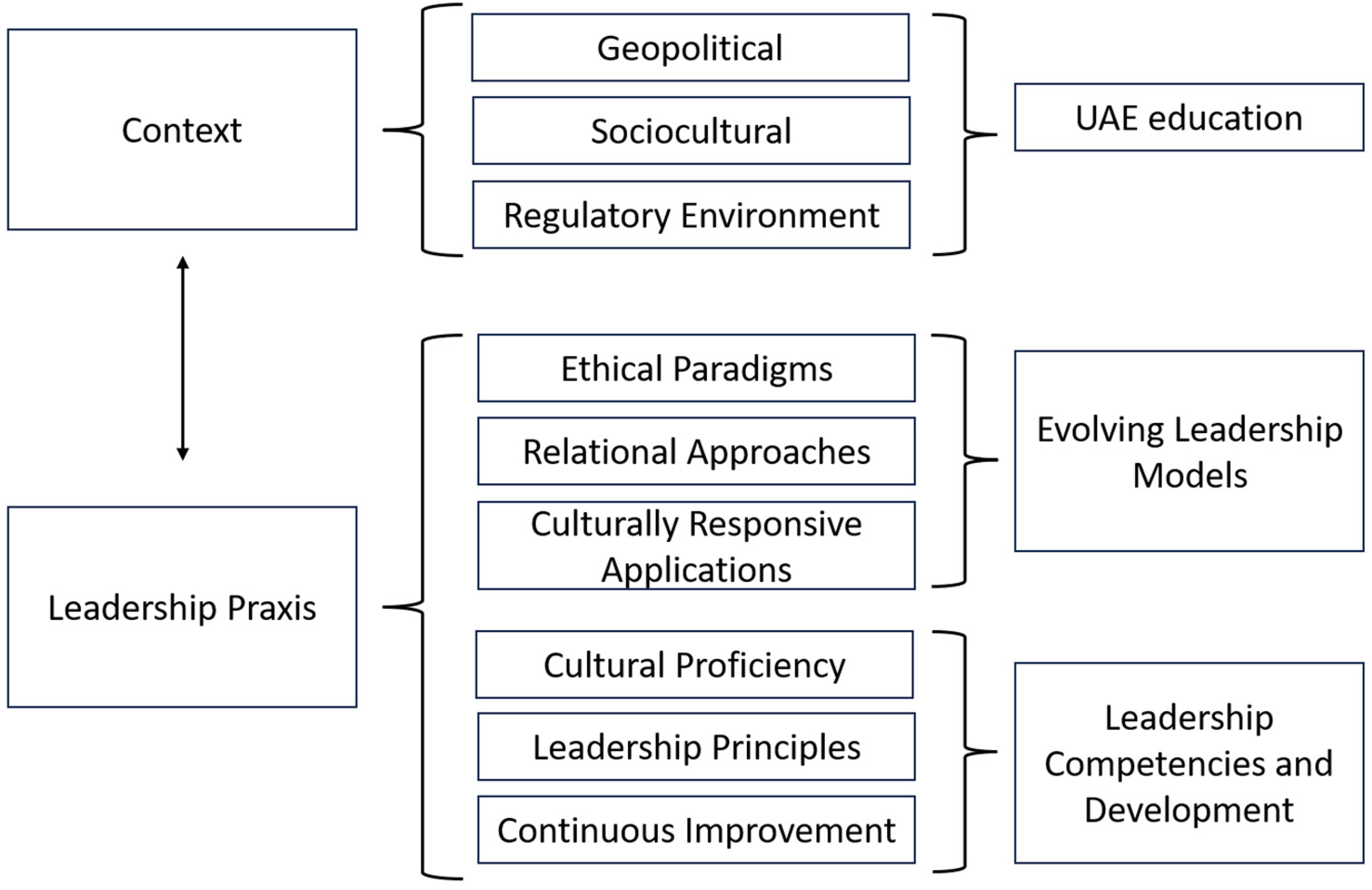
Conceptual framework incorporating the importance of context alongside leadership praxis.
As to leadership praxis, the framework acknowledges the evolution of leadership models in the education sector. This includes shifting from an authoritarian top-down model to the newer framings centred on relational, ethical, culturally responsive, and responsible leadership. In line with these emerging framings, the framework recognises the need for school leaders to possess specific competencies and principles. It also highlights the need for professional development to obtain continuous educational improvements.
By integrating the above elements, the conceptual framework enables a comprehensive review of school leadership in the UAE. It also emphasises the importance of research in this context to further inform educational policies and practices.
Methods
To enable relatable conclusions, we have followed five key steps of the systematic approach outlined by Boland et al. (2017: 25): Identification of Eligible Sources; Data Extraction; and Data Analysis (Figure 2).
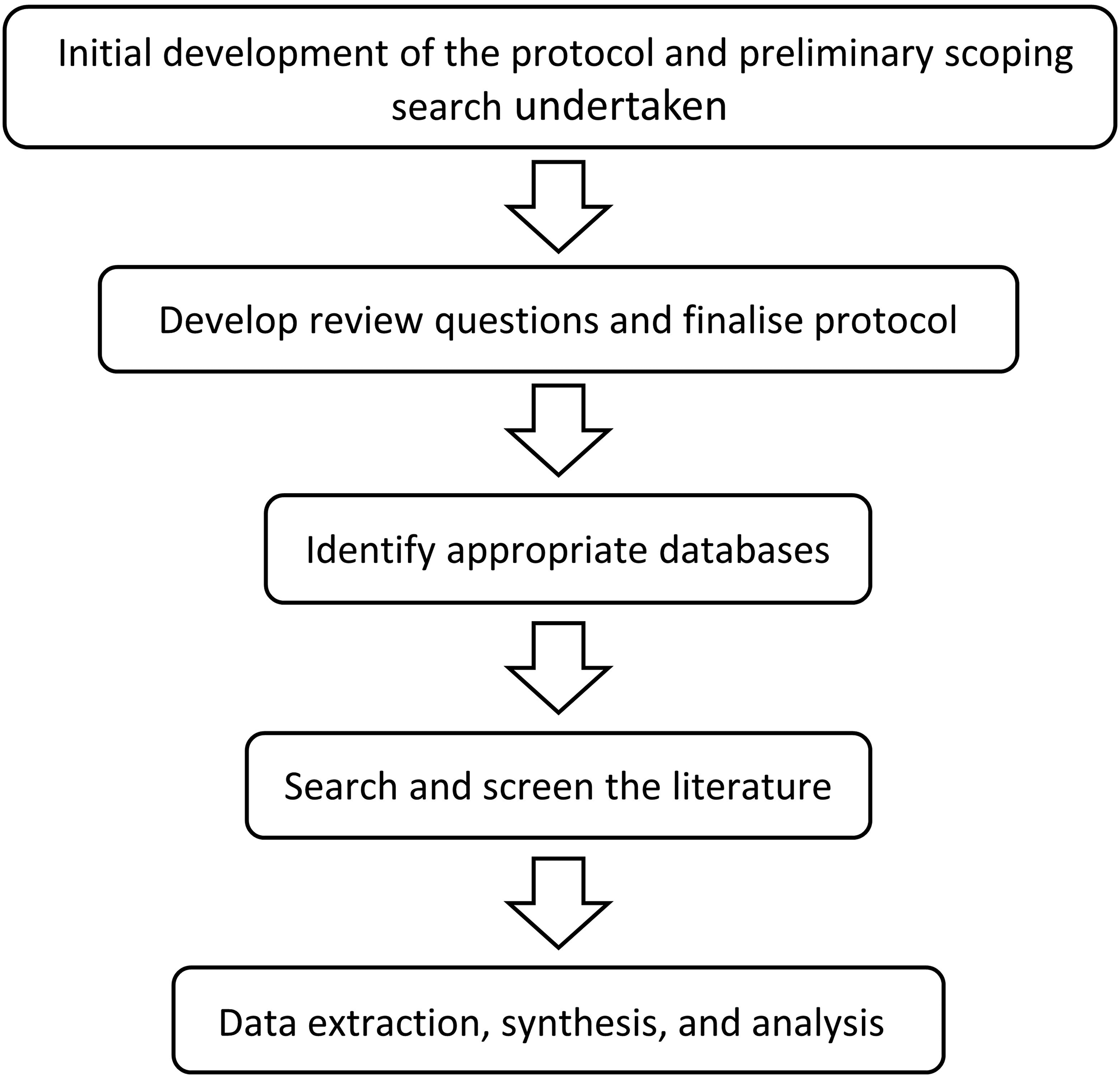
Key steps in the review process.
Identification of eligible sources
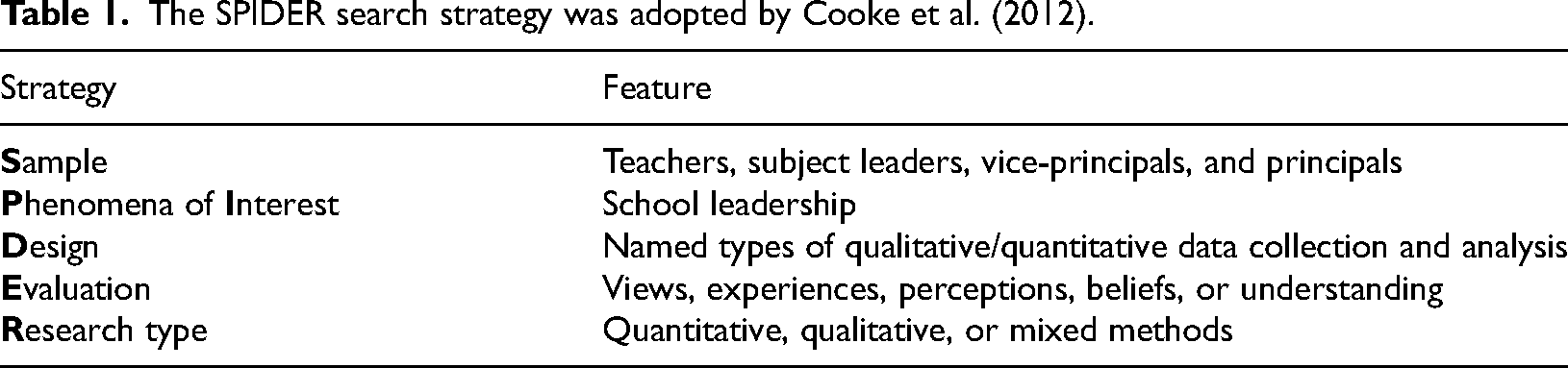
We utilised four multidisciplinary databases: Proquest, JSTOR, ERIC, and Google Scholar. While some aspects of school leadership can be discernible and quantifiable, it is also a subjective human and social construct (Eacott, 2015). Therefore, we adopted the Sample, Phenomenon of Interest, Design, Evaluation, and Research Type (SPIDER) search strategy framework to determine the inclusion criteria (Table 1) as established frameworks like Population/problem, Intervention/exposure, Comparison, and Outcome (PICO) may be more suitable for quantitative research (Cooke et al., 2012). Furthermore, the ‘Research type’ inclusion makes the SPIDER tool suitable for combining the review of quantitative, qualitative, and mixed methods studies “informed by diverse epistemological orientations” (Suri, 2013: 889) where empirical research was utilised.
The SPIDER search strategy was adopted by Cooke et al. (2012).
We only included studies conducted in the UAE and published in English between 2001 and 2021 due to the UAE's increased accountability for school leaders during this period (Warner and Burton, 2017; Winchip, 2021). We utilised the phrase School leadership in the United Arab Emirates to conduct initial explorations and develop the review question. Following this, we used Boolean operators: (school NOT (university or higher education)) AND (leadership or management) AND (United Arab Emirates OR UAE) AND loc (United Arab Emirates). We also applied filters to include books, reports, articles, reviews, and conceptual and theoretical papers but excluded industry reports, news features, and company profiles. Boolean operators could not be used for Google Scholar. Instead, advanced search features such as ‘United Arab Emirates’ and ‘school leadership’ were used, resulting in a large number of results, as shown in Table 2.
Number of results after applying Boolean operators or advanced search features.
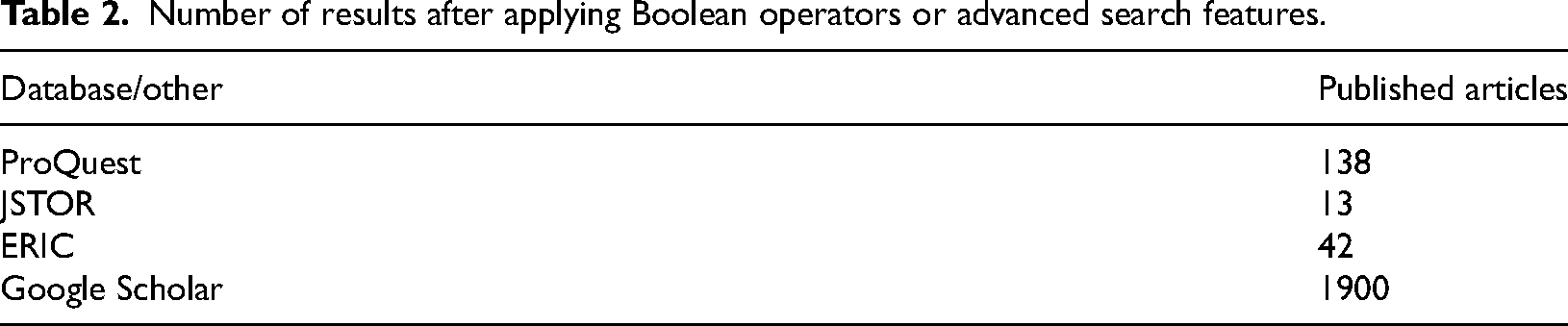
After completing the database searches and removing duplications, we screened each title and abstract for relevance in line with the inclusion and exclusion criteria. Whilst Google Scholar is useful for ascertaining potential papers, its algorithms and database structure result in a substantial amount of research that did not meet the inclusion criteria. Hence the large shift in the number of accepted papers. Finally, we evaluated each resulting text for relevance and robustness using appraisal tools in line with Davies et al. (2013) and Aveyard et al. (2015). We appraised each study's methodological quality using criteria such as – whether the research methods aligned with the research questions, the transparency of the methodologies, and justification of the decisions taken. We adopted an inclusive approach where we considered all 38 studies, including those published in journals not indexed in high-quality databases, as they met our inclusion criteria and appraisal. The Preferred Reporting Items for Systematic Reviews and Meta-Analyses (PRISMA) protocol, adapted from Moher et al. (2009) (Figure 3), was used as a tool to record the results at each stage.
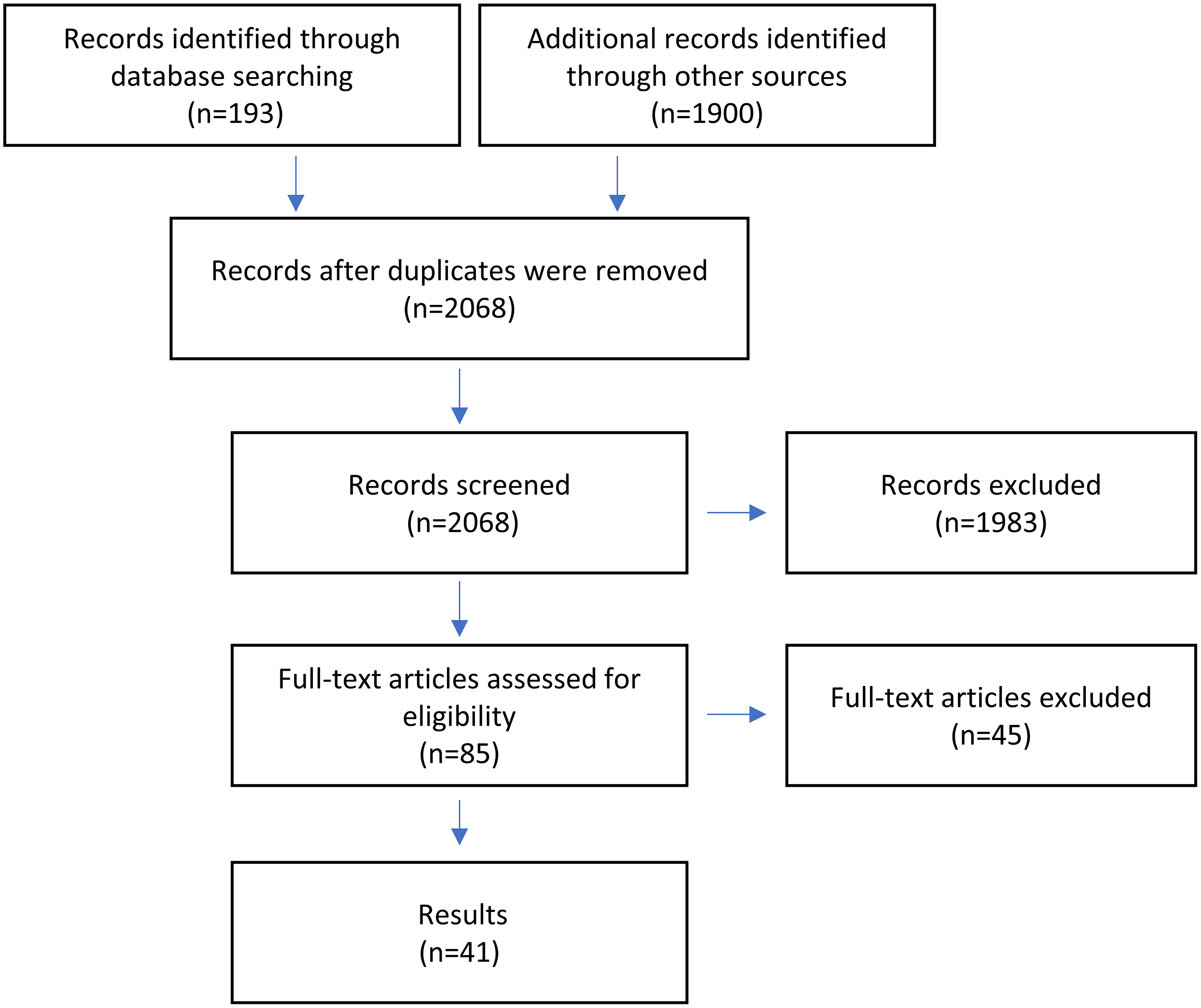
Adapted Preferred Reporting Items for Systematic Reviews and Meta-Analyses (PRISMA) flow diagram from Moher et al. (2009) to show the results at each stage of the search and selection process.
Data extraction and analysis
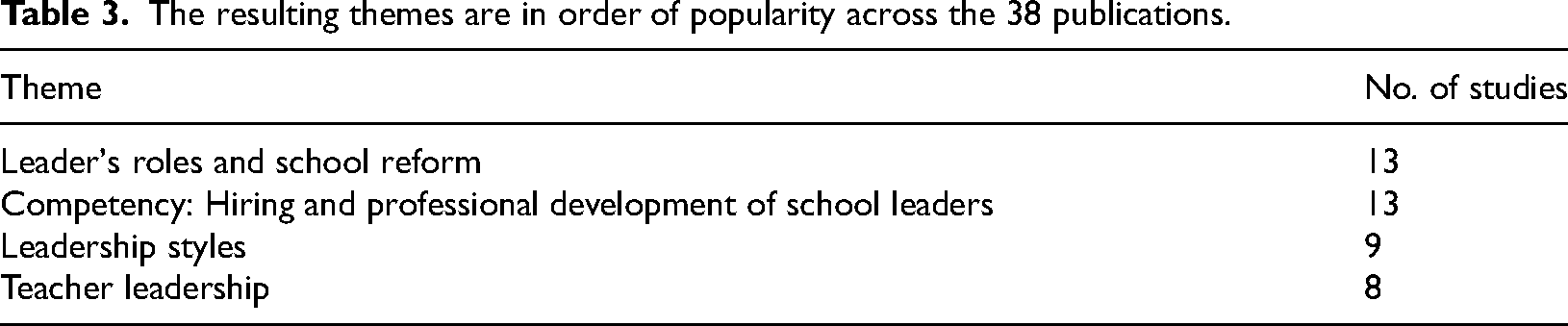
The data extraction process involved identifying and recording descriptive data like the study characteristics, data types, and sources (Boland et al., 2017). The initial coding was carried out by one author and then verified by the co-author. We identified common themes by juxtaposing the studies to highlight novel and associative findings. We then returned to each theme to confirm if each had been aptly categorised; this coding and comparison process continued until the association of one study to another became evident. Our analysis of the 38 published articles (Supplemental Material A) generated four key themes (Table 3). Of these publications, only two studies drew attention to public–private partnership settings: Thorne (2011) and Stringer and Blaik Hourani (2013).
The resulting themes are in order of popularity across the 38 publications.
Findings and discussion
The purpose of this review was to explore the research landscape concerning school leadership in the UAE. We present the findings related to the four dominant themes: (i) Leaders’ Roles and School Reform; (ii) Competency: Hiring and Professional Development of School Leaders; (iii) Leadership Styles; and (iv) Teacher Leadership.
Leaders’ roles and school reform
One of the most notable themes surrounds school reform and the leaders’ role in this process (n = 13). Mainly (i) instructional leadership (Al-Zyoud, 2015; Alhosani et al., 2017; Al Ahbabi, 2019; AlShehhi and Alzouebi, 2020; Stringer and Blaik Hourani, 2016), (ii) advocating the use of technology (Mohebi, 2019; Serhan, 2007), (iii) encouraging parental involvement and developing home–school relationships (Al-Taneiji, 2013; Ibrahim and Al-Mashhadany, 2012; Stringer and Blaik Hourani, 2013) and (iv) supporting student achievement (Alhosani et al., 2017).
Findings show the UAE Ministry of Education encouraging school leaders to move away from managerial tasks and become more involved in leading learning and teaching (AlShehhi and Alzouebi, 2020). Similarly, teachers also perceived this as a crucial role of school leaders (Al-Zyoud, 2015; Al Ahbabi, 2019). External to management tasks, as leaders of learning and teaching, the role included observing and appraising teaching staff, monitoring performance standards, and coordinating professional development (Stringer and Blaik Hourani, 2016). Other duties included developing organisational culture, ensuring a safe learning environment, and communicating the school plans (Ibrahim and Al-Mashhadany, 2012).
Studies also highlighted how intense educational reform had impacted the work of school leaders (Stringer and Blaik Hourani, 2016; Thorne, 2011), whether they understood their roles as successful change agents (Ibrahim and Al-Mashhadany, 2012), and the leadership challenges brought about by change (Zahran et al., 2016). Leaders appeared to understand the rationale for change and their role in strategic leadership before facilitating any change. Nonetheless, apprehensions and discord regarding their ability to fulfil their roles and responsibilities were pervasive (Ibrahim and Al-Mashhadany, 2012; Stringer and Blaik Hourani, 2016). The evidence suggested issues surrounding coordination, concurrence, obligations, and a need for education authorities and operators to work in alignment so that school leaders of public–private partnerships are not caught between conflicting interests (Thorne, 2011).
Similar to leaders elsewhere, evidence showed that UAE school leaders require a vision to lead their schools and garner staff cooperation and dedication to respond to and implement the quick and extensive changes (Al-Zyoud, 2015; Arar and Oplatka, 2022). To enable this, a shared and ambitious vision, a healthy learning environment, participative reflective leadership, high expectations for success, and differentiated instruction were overriding strategies for school improvement (Al Ahbabi, 2019). Additionally, according to Ibrahim et al. (2013), change can only be successful if it is carefully planned to fit the UAE culture and is supported by encouraging principals who provide meaningful professional development opportunities and a fair reward system.
In line with other scholars, such as Pont et al. (2008) and O'Sullivan (2015), for educational reform to succeed, school leaders in the UAE need to embrace change, and take ownership, concur with reform purposes, and involve stakeholders in the changes. Hallinger and Heck (2010) highlighted school principals’ changing roles from managers to instructional leaders, whereby the trajectory and intention of a leader's influence are aimed at students learning through teachers. Instructional leadership is extensively regarded as a central factor of effective schools (Daniëls et al., 2019; Day and Sammons, 2016). Its effect on student academic progress is likely to be four times more than transformational leadership (Day and Sammons, 2013). However, according to Spillane and Louis (2002), all school leaders may not have specialist knowledge in the various spheres of teaching and learning. Hence, teachers should be given a more active role in developing education in UAE schools through distributing leadership.
With a key focus on Bahrain's education system, Bailey et al. (2021: 106) caution against employing ‘global best practices of school leadership’ in the Gulf Cooperation Council, where there are ‘fundamental differences’ between the cultural norms of Western and the Gulf societies. Similarly, Karami-Akkary and Hammad (2019) point out the need for understanding Islamic values, local constraints, and indigenous paradigms, which can pose challenges to scholars and practitioners alike if local priorities and concerns are to be addressed by educational leadership and management. In essence, within the educational leadership praxis serving the UAE, there is a need for culturally responsive leaders where different cultural ‘heritages, experiences, and perspectives’ underpin ethical and compassionate leadership (Arar and Oplatka, 2022).
Competency: Hiring and professional development of school leaders
Another notable theme was competency, particularly when involving hiring and professional development (n = 13). Effective staff recruitment is a crucial element for the success of any school. Yet, according to AlShehhi and Alzouebi (2020), leaders expressed dissatisfaction with the hiring process of public school principals in the UAE. Although there were efforts to align the current selection and development process in most UAE schools to global standards, more emphasis was required on the qualifications, experiences, and knowledge of school leaders, alongside a mentorship approach. Many schools in the UAE conducted emotional intelligence tests before selecting school leaders, suggesting that relationship and behaviour aspects were considered more important than traits, abilities, and skills for new leaders (David and Abukari, 2020).
Conversely, while discussing the hiring process of principals in public schools in the UAE, some principals felt that emotional intelligence was the least essential skill to function as effective school leaders (AlShehhi and Alzouebi, 2020), which leaves us to question the relational aspect of leadership in this context. Still, when considering Alkaabi and Almaamari’s (2020) work, where school leaders reported the receipt of negative or judgmental feedback and minimal, focused professional feedback targeted at improving their leadership practices, the lack of emotional intelligence appeared to expand to those in roles above principalship, that is, supervisors of principals.
Despite the issues surrounding professional feedback, continuous professional development enabled principals to promote communication, collaboration, and fairness (Blaik Hourani and Litz, 2019) and enact their roles and responsibilities related to professional standards, self-evaluation processes, and school inspections (Blaik Hourani and Stringer, 2015a, 2015b). Although principals were apprehensive about how decentralisation would change their roles, rights, and responsibilities (Al-Taneiji and McLeod, 2008), professional development did not include managing finances, resources, and facilities, as these elements were not decentralised (Blaik Hourani and Stringer, 2015a, 2015b). According to Blaik Hourani and Litz (2019), professional development must be concomitant with school demands in times of change and aligned with principals’ professional standards and the school inspection framework.
Blaik Hourani et al. (2020, 2021) reported that school leaders in the UAE are self-aware, reflective, empathic, and socially adept. However, they also note that school leaders could improve their professional emotional intelligence attributes because of the multiple job-related restraints and challenges. As leaders, some found it particularly challenging to regulate their annoyance due to sweeping changes and new policy initiatives requiring abrupt implementation, lack of teachers’ professionalism, lack of communication, widespread disorganisation, cultural misinterpretations, and absence of autonomy. The authors also noted that emotional intelligence could help school leaders deal with people from diverse cultural backgrounds, resolve conflict, collaborate, build team spirit, and de-stress, particularly in an environment of unexpected and continuous change.
Diversity and a multicultural workforce can improve staff innovation and proficiency, but there can also be communication gaps, impaired adaptation behaviours, and obstructions (Al-Jenaibi, 2017). From our findings, Halawah (2005) concluded that UAE school leaders communicate effectively, and Aldhaheri (2017, 2020) reported high cultural intelligence among school leaders. Additionally, due to rich experiences, extensive professional development, annual appraisals, and the Emirati culture (which typically shuns direct criticism and confrontations), leaders were found to be expressive, supportive, fluent, reflective, pleasant, and seldomly act aggressively or moodily to criticise others’ performance (Ibrahim and Mahmoud, 2017). Female principals were found to be more expressive, friendly, supportive, and reflective than male principals, and the school climate in female schools was deemed better than that in male schools (Halawah, 2005). Nonetheless, the high-context UAE culture depends more on nonverbal communication and behaviours where people speak less but consider other means of communication to be sufficiently complete and precise (Halawah, 2005), especially suitable for multicultural settings.
School leadership in the UAE requires expertise in human and relational characteristics, as outlined by Oplatka (2017) and Oplatka and Arar (2017). An increasingly pluralistic, culturally diverse, post-modern, and globalised society like the UAE requires school leaders to respond to, manage, and facilitate the complex economic and sociocultural developments (Huber, 2004; Horsford et al., 2011) as well as addressing the dilemmas that a multicultural society commands (Oplatka, 2017; Oplatka and Arar, 2017), leading to the need for cultural intelligence. Cultural intelligence is a person's competence to operate successfully in multicultural settings by adjusting their leadership styles (Ang et al., 2007; Ang and Inkpen, 2008) and improves productivity, decision-making, team efficiency, and organisational innovation (Ang et al., 2007, 2015; Elenkov and Manev, 2009; Mannor, 2008).
Additionally, Horsford et al. (2011) presented a quadripartite model focusing on four dimensions for school leadership practices that speak directly to those in culturally diverse settings: (i) professional duty – leading for equity; (ii) personal journey – cultural proficiency; (iii) pedagogical approach – culturally relevant and antiracist, set within (iv) the political context – demographics, values, and ideologies. Therefore, it indicates the multiple ways in which leadership needs to be responsive by continuously adapting to the fluidity surrounding culture and responsibility where any form of cultural oppression is challenged (Khalifa et al., 2016; Lopez, 2016). UAE school leaders’ ability to adapt their leadership style within a diverse work environment may be a cultivated and practised necessity (Aldhaheri, 2017, 2020); still, teachers from all backgrounds aspire for more precise communication. Therefore, school leaders can accommodate communication techniques connected with human-oriented and task-oriented leadership styles, as both are significant. As the school climate in female schools was better than that in male schools (Halawah, 2005); it resonated with the notion that women tend to espouse people-oriented leadership styles more than men, while men favour task-oriented leadership styles (Appelbaum et al., 2003).
Our findings found common elements with international research regarding the importance of context and culture, such as Fisher (2021) and Arar and Oplatka (2022), alongside scholars who considered Arab societies. For example, Hammad and Alazmi (2022) who undertook an extensive review of studies focusing on school principals from the Arabian Gulf states, and Karami-Akkary and Hammad (2019) who explored the interplay between leadership and context. Whilst these studies reported the need for school leaders’ praxis to be sensitive to the cultural context, Karami-Akkary and Hammad (2019: 88) also note a need for effective leadership preparation programmes to embrace ‘cultural diversity in the knowledge base’ by collaborating with international research regardless of one's context. Therefore, in serving UAE/Abu Dhabi educational leadership, a delicate balance of local and global understandings is required if school leaders are to serve their community well.
Leadership styles
Unexpectedly, leadership styles did not appear quite as notable as other features. Where these were considered (n = 9), researchers investigated the transformational, transactional, and distributed leadership practices of school leaders specific to the Emirati context (Al Khatib, 2020; Al Nuaimi et al., 2015; Azeem and Mataruna, 2019; Litz and Scott, 2017; Litz et al., 2016; Stephenson et al., 2012). Some leaders believed they practised transformational leadership by modelling the way, inspiring a shared vision, challenging processes, enabling others, and encouraging the heart (Litz and Scott, 2017). However, teachers only occasionally felt enabled, inspired, or challenged and perceived that school leaders depended on their knowledge, skills, and positional authority to maintain control and order (Litz and Scott, 2017). Therefore, questions need to be asked surrounding the teachers’ preferred leadership approaches to gain an understanding of whether the balance between transactional leadership (confined to positions of authority) and transformational, shared leadership is weighted towards the former rather than the latter. Questions also arise surrounding the promotion of a culture of citizenship and focusing on the rebalancing of responsibility across stakeholders for the good of the community, for example, promoting a caring culture (Oplatka, 2017) rather than leading through control and order.
Al Khatib (2020) considers the transactional and transformational leadership dichotomy by exploring gender differences. Here, the author reported that male school principals tended to work according to policies, regulations, planning, and a bureaucratic approach, whereas female school leaders focused on emotional work, teamwork, creating relationships, and maintaining a positive atmosphere. Thus, female leaders displayed more transformational leadership behaviours than their male counterparts, who demonstrated transactional leadership behaviours. Yet, transformational leadership did not appear as widely accepted in UAE schools; instead, transactional, hierarchical approaches remained prevalent (Litz et al., 2016; Litz and Scott, 2017). That said, while being culturally and emotionally more receptive, school leaders typically practised both transactional and transformational leadership.
Additionally, Azeem and Mataruna (2019) suggested that distributed leadership positively impacted student attainment. Although, as reported by Ibrahim (2020), most public schools in the UAE prefer centralised leadership over distributed leadership models, teacher leadership appears in schools where leadership is shared with a sustained emphasis on improving teaching and learning. Within decentralisation, Fullan (2002) highlights the comprehensive role of principals and clarified that principals are viewed as the organisation's leaders. Conversely, within a centralised system, the local and national governments are considered the leaders by imposing systemic requirements and practices. While centralisation can facilitate the fulfilment of a shared vision, few school leaders may perceive that it is their role to develop a vision for their schools (Ibrahim and Al-Mashhadany, 2012). Hence, centralisation can stifle the role of school principals in the UAE. For decentralisation to be successful in the UAE, all stakeholders must be involved in formulating a clear purpose, a strategic plan, and a timeline. A shared ambitious vision is a critical element of school improvement in the UAE (Al Ahbabi, 2019). Alongside ADEK and KHDA, the rulers of the UAE have also modelled ‘a more participatory and transformational model of leadership in the education sector which is supposed to give voice to all stakeholders in a flattened organizational structure’ (Warner and Burton, 2017: 30). Further, the Islamic leadership paradigm comprising social justice, piousness, modesty, personal growth, and dialogue which define an equitable, welfare-oriented society devoid of suppression, pertains to transformational leadership (Mir, 2010).
Successful transformational leaders establish, communicate, and direct the school's beliefs, structures, and endeavours to realise this collective vision (Bush and Glover, 2003). School improvement cannot occur unless all stakeholders collaborate as facilitators for change by shaping the school's vision, environment, and potential for success. The disparity in the perceptions of teachers and principals regarding both distributed and transformational leadership practices can be ascribed to the high power distance of the UAE culture (Hofstede Insights, 2022). Teachers’ cultural value orientation, where school leaders may be expected to be directive rather than consultative, could make it challenging to accept transformational and distributed leadership models. Shapiro and Gross (2013) noted a caveat surrounding distributed leadership, where they point out possible tensions driven by accountability and various legislative policies that lead to decision-making residing with one individual located at the pinnacle of a school's hierarchical system. Oplatka (2017: 519) emphasises the need for responsible leadership from ‘each school member and stakeholder’.
UAE school leaders must be versatile enough to balance and adapt different leadership styles that inculcate the ethical paradigms of justice, care, critique, and ethics of the profession (Shapiro and Gross, 2013) and culturally responsible leadership (Khalifa et al., 2016). Yet, as reported by scholars focussing their research across Arabian societies, school leadership models in these regions are predominantly grounded by a Western cultural lens (Bailey et al., 2021; Hammad and Hallinger, 2017; Hammad et al., 2020; Karami-Akkary and Hammad, 2019; Oplatka and Arar, 2017). Although there are many complementary ideals of leadership styles between Western and non-Western perspectives, practitioners and scholars alike working across the UAE should draw from ‘possible alternatives’ (Samier and ElKaleh, 2019b: v; Arar and Oplatka, 2016) that respect and value the traditional values of indigenous leadership within educational leadership praxis.
Teacher leadership
Whilst much of the literature focused on high-level school leaders, we cannot disregard teacher leadership, particularly when considering the need to involve teachers in decision-making and capacity building. Teacher leadership was a common feature in the literature (n = 8) and showed interdependence with senior leadership. Researchers evaluated teacher leadership's influence on teaching and learning quality (Al Suwaidi and Schoepp, 2015; Al-Taneiji and Ibrahim, 2017; Hefnawi, 2017; Zamani, 2018). Within the findings, teachers in UAE schools were dedicated to the well-being and progress of their students (Goe et al., 2020) and practised servant leadership to positively impact students’ emotional, cognitive, behavioural, and agency aspects of engagement (Zamani, 2018). Teacher leaders were willing to learn, wanted recognition for their work, and believed they had the capability and expertise required for leadership (Al-Taneiji and Ibrahim, 2017). Moreover, they enacted leadership by assisting new colleagues, demonstrating best practices, acting as a bridge between colleagues and the administration, facilitating and achieving reform tasks, participating in school-level decision-making, and engaging with parents and the wider community to construct productive relationships (Al-Taneiji and Ibrahim, 2017; Litz et al., 2016).
Although teacher leadership had the most impact on the quality of teaching and learning, senior leadership was a crucial factor in promoting teacher leadership against the backdrop of growing central policy demands and external factors (Al Suwaidi and Schoepp, 2015; Al-Taneiji and Ibrahim, 2017; Goe et al., 2020; Hefnawi, 2017; Litz et al., 2016). Senior leaders disposed to distributed leadership and focused on shared instructional leadership enabled a much-needed change in culture from independent practice to collaboration (Stephenson et al., 2012). Nonetheless, teachers perceived that only an elite few were assigned leadership activities (Al-Taneiji and Ibrahim, 2017), with senior leaders often preferring to exercise authority instead of encouraging genuine collaboration and shared decision-making (Al Suwaidi and Schoepp, 2015; Litz et al., 2016). This lack of leadership recognition affected teachers’ motivation and increased their workload and stress when burdened with administrative tasks that fell under the purview of school leaders (Goe et al., 2020). Although subject leaders influenced the quality of teaching and learning by supporting their colleagues, the absence of formal responsibilities, unavailability of non-teaching time, and sensitivity in lesson observations limited their impact (Hefnawi, 2017).
School-related factors like time constraints, language divide, leadership styles, or individual factors like teachers’ expectations and disposition to shoulder extra leadership responsibilities were barriers to teacher leadership in UAE schools (Al-Taneiji and Ibrahim, 2017). Contrariwise, when teacher leadership factored in professional development, and teachers led discussions, conducted events, and gave presentations, it influenced their confidence by challenging, motivating, and empowering them (El Afi, 2019). Attempts to develop teacher leadership capacity at the school level facilitated teacher leadership and enabled a change in culture from independent practice to collaboration (Stephenson et al., 2012). Another crucial point highlighted is that female teachers had fewer opportunities to undertake leadership roles than male teachers (Al-Taneiji and Ibrahim, 2017); this may or may not be surprising. Further research is required to understand the underlying issues fully.
According to Hunzicker (2012), teacher leadership is an essential facet of distributed leadership where the authority does not rest on the leader but is distributed among teachers across the school. Distributed leadership positively impacts students’ educational outcomes (Harris, 2008; Leithwood et al., 2007), and UAE school principals appear to concur with distributed forms of leadership as effective school governance (Hallinger, 2003; Harris, 2005; Krüger and Scheerens, 2012). School leaders are in an excellent position to promote and retain UAE teachers who want to be valued and recognised for their efforts and dedication (Goe et al., 2020). Nonetheless, the findings indicated that principals chose to exercise authority instead of sharing leadership, and it remains to be seen if distributed leadership alongside responsible leadership (Oplatka, 2017), which is characterised by informal influence, agency, care, and service, is conducive to the UAE's educational environment that grants leadership and management responsibilities only to those who occupy formal positions in an established hierarchical structure of schooling (Fitzgerald and Gunter, 2008).
Further afield, Hammad et al. (2023) compared teacher perceptions of teacher leadership across three Arab countries – Oman, Egypt, and Qatar. Similarities across these countries were found; their findings suggested teacher leadership is sometimes practised, and where it was practised, much of this related to teachers sharing expertise. This resembles our findings in that teacher leaders are willing to share professional practices while continuing their professional development. Although teacher leadership was a common component within the search literature, the literature across Arab regions on this subject is scarce (Hammad et al., 2023). Additionally, whilst our findings suggested fewer leadership opportunities for female teachers, Hammad et al. (2023) found some inconsistency between male and female teachers as teacher leaders, perhaps due to the multiple contextual determinants recognised by Arar and Oplatka (2016) – such as cultural, political, and societal expectations. On a more positive note, Arar and Oplatka (2016) observed a promising growth of females in educational leadership roles across Arab countries, mirroring the global increase of women in leadership roles. Yet despite these advances, it is important to acknowledge that there remains an underrepresentation of female school leaders in the UAE (Alhammadi, 2019) and a continuation of women encountering barriers when it comes to securing and sustaining educational leadership and management roles (Arar and Oplatka, 2022).
Policy and praxis
Educational policies that work well in the Western world may not work in countries like the UAE with a different cultural and political context (Godwin, 2006). Although a complete evaluation of the UAE's policies for school leadership is beyond the scope of this review, we identify some alignment between our findings and these documents. The guidelines for school principals (ADEK, 2011) and the UAE's School Inspection Framework (Ministry of Education, 2023) incorporate many leadership aspects, such as evaluating school performance, ensuring equality, developing policy and practice, resource management, building leadership capacity, and engaging parents and the community. Professional development (self-development and developing school staff) is also inherent within the standards and framework. However, beyond self-development, there appears to be a lack of focus on the hiring and formal professional development of school principals within these guidelines. Regarding ADEK's policy and guidance for private schools (ADEK, 2013), the responsibility of these latter two aspects is situated with the school's owners and/or board of trustees.
Furthermore, whilst ADEK documentation communicates that schools are expected to promote students’ sensitivity, tolerance, respect, and understanding of cultural diversity and the need for ethical leadership, there is a lack of explicit guidance for cultural and emotional intelligence in leadership to serve the diverse body of staff and students. Similarly, although Blaik Hourani and Litz (2019) highlighted nine key leadership development modules within recent training initiatives, one of which focuses on understanding leadership styles, it appears the concepts are related to transformational and instructional attributes. Again, this indicates a lack of focus on cultural intelligence. However, the authors also argue the lack of – and need to – nurture emotional intelligence-related skills and capabilities. Drawing from Goleman (2007), these attributes include empathy, managing emotions, motivating the self and others, self-awareness, and social skills. According to Blaik Hourani et al. (2020), such attributes align with ADEK's professional standards, specifically leading the community, leading the people, and leading the organization. This endorsement for emotional intelligence in Abu Dhabi and across the UAE for school leaders was also reported on by Blaik Hourani et al. (2021) and Blaik-Hourani et al. (2023), where findings suggested the need for professional development opportunities to enhance emotional intelligence attributes when facilitating change praxis. Given the diversity of the staff, developing emotional and cultural intelligence is crucial if UAE school principals are to establish a culture of trust and respect.
Challenges for Abu Dhabi school leaders
The challenges faced by school leaders in the UAE, particularly in Abu Dhabi, are not uncommon in Arab societies (Karami-Akkary and Hammad, 2019). Although similar issues are found across international communities, school leaders of Arab countries bear additional responsibilities to preserve national identities, values, and beliefs within current socio-political sensitivities, often with a global misrepresentation (Karami-Akkary and Hammad, 2019). Hence, UAE school leaders face the challenge of delicately balancing the endorsement of education reform while safeguarding its Arabic culture and Islamic principles. The need to preserve national identity is evident in ADEK's pioneering National Identity Mark, a system to evaluate the standard of national identity programs offered by Abu Dhabi schools and inform parents (ADEK, 2023). This initiative seeks to ensure that Emirati students are entrenched in their country's culture while being empowered to traverse the diversified global terrain.
Explicitly addressing the concerns that Abu Dhabi school principals working in public-private partnerships face, Thorne (2011) highlighted the complexities the school leaders faced. These leaders find themselves at the intersection of ADEK's sweeping macro-level reforms and the public–private partnership's nuanced micro-level changes. In this challenging position, they grapple with various issues, including navigating conflicting directions, achieving consensus, shouldering responsibilities, managing initiative overload, and coping with pressures from both external and internal sources.
Beyond public–private partnership schools, Blaik Hourani et al. (2020) and Blaik Hourani et al. (2021) identified emotional intelligence as a core leadership competency within the professional standards and reported that Abu Dhabi school leaders found the extensive reforms requiring the immediate enacting of new policies, lack of autonomy, intrinsic motivation and teachers’ professionalism, communication gaps, pervasive disorder, and cultural misinterpretations incredibly challenging. ADEK's professional performance standards for Abu Dhabi school leaders were framed considering their changing obligations during school reform (Blaik Hourani and Litz, 2019). Professional development catalyses school improvement, and although Abu Dhabi school leaders have benefited from it, they reported a knowledge gap in leadership styles, planning strategically, implementing the school vision, appraising teachers, using assessment data, resolving conflict, and solving problems because professional development was not fully aligned with the performance standards. Blaik Hourani and Litz (2019) underscored the need for targeted professional development to strengthen school leaders’ emotional intelligence to regulate their frustration and emotions.
Studies such as those by Blaik Hourani and colleagues over recent years contribute to building an indigenous and contextualised knowledge base, which Karami-Akkary and Hammad (2019) have determined to be an insufficient base to inform school leadership development, praxis, and competencies in the Arab world. In undertaking this literature review and illuminating UAE school leadership and the challenges faced by school leaders across the UAE and, specifically in Abu Dhabi, we enable school leadership preparation and principal enactment ‘to function appropriately in their own countries’ (Samier and ElKaleh, 2019a: 2) to meet the needs of the communities they serve.
Conclusion
The aim of this scoping review was to explore school leadership research undertaken in the UAE. Although we set a time frame between 2001 and 2021 due to the UAE's increased accountability for school leaders during this period (Warner and Burton, 2017; Winchip, 2021), because of the scarcity of research in this region, the earliest paper we could include was that of Halawah (2005). Additionally, we have pinpointed the elements that will improve schools; our review accentuates the importance of adaptable, emotionally intelligent, culturally sensitive leadership that is required in a rapidly changing environment whilst considering the historical yet progressive context and evolving leadership framings.
We have identified four dominant themes: Leaders’ roles and school reform, hiring and professional development of school leaders, leadership styles, and teacher leadership. The key findings suggest that school leaders’ recruitment and development strategies need to be modified to equip them to lead reform. Change cannot be successful without harnessing teachers’ support and leadership, and while leaders’ emotional and cultural intelligence alongside communication skills are considered essential competencies to lead change, leadership styles need to be adapted to suit the collectivist UAE culture. In this respect, our findings align with Karami-Akkary and Hammad (2019) in that ‘developing effective, culturally relevant leadership development requires a solid, contextualised knowledge base’ (p. 85). Furthermore, our findings are in harmony with scholars such as Blaik Hourani et al. (2020, 2021), who advocate the need to enhance the leader's professional development in the realm of emotional intelligence, a crucial facet of leadership during times of rapid change. Finally, with only Thorne (2011) and Stringer and Blaik Hourani (2016) emphasising the private–public partnership scheme, our findings highlight a gap in knowledge surrounding school leadership selection and capabilities in this arena. More generally, whilst recognising school leadership selection and development as problematic, focusing on the uniqueness of the UAE's relatively new education system, its high number of expatriates, and its numerous educational reforms enables us to deepen the contextualisation of the knowledge base.
Although exploring the UAE holistically, most of our findings were Abu Dhabi and Dubai-based studies. Nonetheless, the findings are relevant across the emirates as they represent and reflect the sweeping educational reforms that are a part of the broader UAE vision. A further limitation surrounds studies written in Arabic, which were excluded since the authors do not have a working knowledge of Arabic. However, Oplatka and Arar (2017) question the quality of Arabic journals and the suitability of Arabic as a significant language for research promulgation.
Recommendations
Our review acts as a foundation to facilitate further research while simultaneously providing an opportunity for leaders and policymakers to operationalise the findings as they continue to implement systemic changes. We make the following recommendations:
for research –
undertake empirical research within the domains of leadership praxis pertaining to:
the impact of UAE school reform on education and its economy; school leadership across the UAE regarding a culture of citizenship, including schools working with, and supporting each other; the imbalance of male and female opportunities for teacher leadership opportunities; and, leadership development in private–public schools, and more generally across UAE schools, linking cultural, relational, and compassionate leadership through indigenous paradigms. government authorities and private organisations hire, equip, and develop school leaders who have a sound understanding of UAE culture and who can propel the reform agenda by harnessing the support of teachers and other stakeholders through ethical and transformational approaches such as responsible leadership; to enhance a more equitable and reformative school leadership, UAE school leaders gain an understanding of and prevail over advanced models of leadership such as those underpinned by ethical, servant, relational, community, and cultural paradigms leadership as advocated by Arar and Oplatka (2022) rather than relying on models such as transformational leadership and distributed leadership. align professional development with the professional standards to enhance leadership skills and competencies – such as emotional intelligence and those noted in the above point – alongside cultivating a receptive mindset to support change; provide UAE school leaders with professional development that equips them to lead their schools effectively and to implement the extensive reforms specified by policymakers; education authorities to facilitate better coordination between the operators and principals of public–private partnership schools so that educational programmes are more in alignment with the national agenda; and, teachers are provided with the opportunity to develop as teacher leaders and beyond, regardless of gender.
for policy and practice –
Supplemental Material
sj-docx-1-ema-10.1177_17411432231218129 - Supplemental material for School leadership in the United Arab Emirates: A scoping review
Supplemental material, sj-docx-1-ema-10.1177_17411432231218129 for School leadership in the United Arab Emirates: A scoping review by Joseph Rai and Marie Beresford-Dey in Educational Management Administration & Leadership
Footnotes
Declaration of conflicting interests
The author(s) declared no potential conflicts of interest with respect to the research, authorship, and/or publication of this article.
Funding
The author(s) received no financial support for the research, authorship, and/or publication of this article.

Supplemental material
Supplemental material for this article is available online.
Correction (January 2024):
The article has been updated to correct the year in the reference “Badri and Khaili” as “2014” since its original publication.
Author biographies
References
Supplementary Material
Please find the following supplemental material available below.
For Open Access articles published under a Creative Commons License, all supplemental material carries the same license as the article it is associated with.
For non-Open Access articles published, all supplemental material carries a non-exclusive license, and permission requests for re-use of supplemental material or any part of supplemental material shall be sent directly to the copyright owner as specified in the copyright notice associated with the article.
