




Abstract
Despite the increasing number of studies on educational leadership during COVID-19, little attention has been paid to the intersections of different educational experiences and perspectives of school leaders, students, and their families that occur both inside and outside of schools. Drawing on eight case studies of public primary schools in Hong Kong, this article explores the challenges and strategies of online learning with a focus on effective leadership practices for supporting economically disadvantaged students during COVID-19. To incorporate the perspectives of multiple stakeholders, a series of questionnaires were distributed to principals (n = 8), teachers (n = 150), parents (n = 775), lower primary students (n = 855), and upper primary students (n = 850) and interviews were conducted with principals (n = 8), teachers (n = 37), parents (n = 32), and students (n = 62). Findings indicated that school leaders and teacher teams demonstrated strategic leadership practices prioritising and responding to the needs and constraints of economically disadvantaged students and their families. The present study draws attention to leadership encouraging collaboration among schools, families, and the wider community, which has become necessary during the shift to online learning during COVID-19.
Keywords
Introduction
Schools around the world suspended face-to-face classes due to the COVID-19 pandemic beginning in early 2020. Although many students have been affected, children from low-socioeconomic backgrounds are likely to have suffered more losses in learning (Kuhfeld et al., 2020). In Hong Kong, the context of the present study, in a press release on February 12, 2020, under the title, ‘Suspending Classes without Suspending Learning’, the Education Bureau (EDB) urged local schools to maintain student motivation and interest in learning without exerting undue pressure on students and parents during the pandemic (Yeung, 2020). However, it remains unclear how school leaders sustain the learning of children from poor families when face-to-face classes are suspended (Bates et al., 2021). This question is clearly related to the larger issue of developing leadership for social justice and inclusive education (Bush, 2020; Vassallo, 2021). As a city with an advanced economy and leading digital competitiveness that is concurrently facing an ever-widening wealth gap, the case of Hong Kong is of particular relevance to an empirical investigation into the question. For many years, the Hong Kong government has invested heavily in developing information and communication technology (ICT) for schools and the wider society. However, according to 2019 statistics, despite a very high overall percentage of households with internet access (94%), three out of 10 low-income households (monthly household income below HK$10,000 [US$1300]) had no internet access (Census and Statistics Department [C&SD], 2020). Hong Kong is one of the world's most unequal societies, with a Gini coefficient of 0.539 in 2017 (C&SD, 2017). The city has long been known for its hyper-competitive educational landscape, where children from economically disadvantaged families often struggle to perform well in school. With this backdrop, this article examines school leadership strategies adopted by principals and teachers at different levels working as a team to navigate and respond to online learning challenges experienced by economically disadvantaged students during the pandemic.
Theoretical framing
Theoretically, this article seeks to reorient the discourse from explaining leadership in a specific educational context to an analytical framework which conceptualises school relationships being linked together with families and the wider community as an enabling environment for supporting online learning for children from poor families. Many recent studies seek to explain leadership practices by referencing individual leaders and their interactions, such as resilience in times of uncertainty and situational ambiguity (Beauchamp et al., 2021), the framing and enactment of changing policy (Fotheringham et al., 2022), sensemaking orientations (Longmuir, 2021), instructional leadership practices in crisis (Shaked, 2022), and leadership for enhancing digital instruction (Berkovich and Hassan, 2022). These focuses may reflect the mainstream paradigm in educational leadership literature which is primarily based on the doctrines of methodological individualism, or what Lakomski and Evers (2022) term ‘leader centrism’. In contrast, some other researchers have adopted an alternative focus, sometimes labelled ‘methodological collectivism’, which strongly embraces non-reductionist explanations of educational leadership practices by, for example, considering specific cultures and social structures, rather than the one-sided emphasis on individual actors and actions (Szeto, 2021).
Moving beyond this classic debate of sociological theory regarding the dichotomy, however, is a ‘third way’, i.e., methodological relationalism, which focuses on relations rather than individual or collective entities (Crossley, 2022). While often not explicitly invoking the doctrines of relationism, several leadership studies have closely examined patterns and the content of relations and social networks among school leaders (Díaz-Gibson et al., 2017). For example, Rehm and his colleagues (2021) analysed how relational resources are embedded in school leaders’ informal network structures on social media using data from a nation-wide US sample. Further, there is a long line of sociological research, mainly inspired by Georg Simmel's legacy, which emphasises the analysis of interdependency, intersubjectivity and reciprocity in experience and meaning (Crossley, 2022; Simmel, 2012). In this sociological tradition, society is conceived of as ‘a bundle of partly overlapping, relatively loose clusters or social circles, which intersect each other’ (Mützel and Kressin, 2021: 221). A structural context, at its most fundamental, is a network comprising individual and collective entities and the relations connecting them (Crossley, 2022). Along this line of methodological orientation, school leadership can be understood as evolving from unfolding, ongoing processes of dynamic relations across intersecting social circles of school, home, and the wider community. Particularly during challenging times, such as the COVID-19 pandemic, this relationalist view avoids breaking school leadership experiences into discontinuous fragments (e.g., between home and school; online and offline), and attends to a context co-constructed by intersubjective constructs of various school stakeholders across intersecting social circles.
Scholars have long acknowledged that leadership is context-dependent, and the nature and properties of context are never singular and static (Bush, 2018; Hallinger, 2018). For example, Lakomski and Evers (2022) call attention to the importance of investigating context as sets of constraints in leadership research. However, while studies based on the doctrines of individualism, collectivism, or relationism can equally examine leadership in context, their methodological orientations in doing so are fundamentally distinct. Notably, the relationalist approach is distinct from other approaches because it conceptualises the context of school leadership as relational or interdependent across intersecting social circles. Accordingly, this article sets out a relationalist approach which investigates school leadership practices under sets of constraints that emerged during COVID-19 by connecting diverse educational experiences and perspectives across schools, families, and the wider community.
Leadership in crisis: sets of constraints amid class suspensions
The prolonged school suspension caused by the COVID-19 pandemic presented unprecedented challenges for educational leadership (Longmuir, 2021). Schools across Hong Kong moved classes online using a variety of electronic learning materials, real-time classes, and other online learning methods. Studies in many countries have shown that school disruptions and the abrupt change to online learning have prompted stress and mixed responses from parents who have had to manage their children's education at home (Adams et al., 2021; Bates et al., 2021; Garbe et al., 2020). For example, parents have relied primarily on school materials for their children's learning, such as teaching videos and remote calls (e.g., Bates et al., 2021). According to a recent online survey in Hong Kong involving 6702 respondents conducted in February 2020, nearly 70% of parents of kindergarten children and over 80% of primary school parents found that their children had learning difficulties at home, and they were concerned about their children falling behind (Lau and Lee, 2021).
Although a variety of online resources and support are available, such as through EDB's website and Hong Kong Education City (Yeung, 2020), schools, teachers, students, and parents largely remained at the exploratory stage of online learning and were modifying their expectations amid class suspensions in 2021. Additionally, numerous primary school teachers reportedly conducted online classes for the first time during the class suspensions (Save the Children Hong Kong, 2021). Indeed, teachers’ and students’ lack of readiness for e-learning is not only in Hong Kong but global (Organisation for Economic Co-operation and Development [OECD], 2020a). Moreover, concerns about this issue have long been held during ICT educational development. According to the 2018 OECD Teaching and Learning International Survey (TALIS), fewer than half of the teachers in the 48 participating countries and regions felt well prepared to use ICT in their classrooms (OECD, 2020b).
The prolonged class suspension (two years at this writing) has to some extent exposed inequality in education and threatened to widen the digital divide among students and schools (The University of Hong Kong, 2020). In normal times, students from disadvantaged families, such as those from low-income, single-parent, and migrant families facing multiple challenges to parental involvement, often lag behind in school learning, both online and offline (Lee, 2021; 2022; Vassallo, 2021). During COVID-19, disadvantaged students have thus appeared to be disproportionally affected by school closures. For example, Bol (2020) conducted a study using data from a nationally representative sample of primary and secondary school students collected in April of 2020 in the Netherlands. The preliminary results indicate that school closure had significantly increased the inequality of children's learning. Similarly, Spear and her colleagues (2021) in England found that teachers were aware that parents from disadvantaged families faced multiple challenges in supporting their primary-age children's learning at home amid the COVID-19 school closures. In Hong Kong, the challenges of school closures have placed increasing pressure on struggling families, such as low-income working parents who may not have time to care for their children's learning at home; their children may also lack Internet access (Lau and Lee, 2021).
School-family-community collaboration to support online learning
Given the challenges arising from the COVID-19 crisis, connecting schools with families and the wider community has received increasing attention as the burden of children's education falls increasingly on parents during the prolonged class suspensions (Yang et al., 2022). It is well documented that students and their families can significantly benefit from school-family-community collaboration involving school leaders, teachers, parents, other family members of students, and other stakeholders in the community (Epstein et al., 2011; Epstein and Sheldon, 2016). Studies in Australia and the US show that school leaders’ active support is associated with good quality school-based programs during school-family-community collaboration (Barr and Saltmarsh, 2014; Epstein et al., 2011). In Hong Kong, a deep, empathetic understanding of disadvantaged families is also found to be important to promote inclusive parent-teacher engagement in schools (Lee, 2022). However, less clear is how school-family-community collaboration can support and facilitate students’ online learning. Hasler Waters’ study (2012) on parental support in online elementary and middle school settings divided parental roles for improving student engagement into four categories: organising, motivating, managing, and instructing. Curtis (2013), in a case study of a full-time online high school, identified three parental responsibilities for student learning: mentoring, motivating and monitoring. Borup et al. (2014) used the adolescent community of engagement (ACE) framework as a basis to contend that parents can play multiple roles in providing students’ basic needs: monitoring and motivating students to fully engage in learning activities; volunteering for school activities as role models; organising physical learning spaces and schedules; instructing students on learning skills; and working with students on assignments and sharing their previously obtained knowledge with students.
In Hong Kong, teachers and parents have recognised the importance of school-family-community collaboration for supporting student learning with ICT (Kong and Li, 2009). Yu et al. (2012) identified five components of parental influence on children's ICT use at home among secondary school students: ICT skills, monitoring, control, guidance, and worries. Given that extensive research has consistently shown that family engagement is necessary for effective student learning, a related question concerns what school leaders and teachers can do to engage families in supporting students’ online learning at school and at home (Hasler Waters and Leong, 2014). For example, it has been found that building up school human capital with leadership teams and professional learning communities is indispensable in the planning and implementation of school-based e-learning strategies for enhancing students’ learning (Tam et al., 2018).
Before discussing how school leaders and teachers work together with families and the wider community to support online learning, it is important to generate empirical evidence to systematically document and analyse the sets of constraints incurred and coping strategies adopted across schools, families, and the wider community during COVID-19. Accordingly, this article addresses the following questions:
What are the main challenges of online learning for students from economically disadvantaged backgrounds during the class suspensions? What have schools serving significant numbers of economically disadvantaged students done to improve online learning and maintain educational continuity for students during the class suspensions?
Methodology
The present study takes a multiple case study approach using mixed methods to collect and analyse interview and survey data from eight public primary schools in Hong Kong. The unit of analysis is a school, and the analysis focuses on relations and interactions among multiple school stakeholders (to explore the intersections of their experiences and perspectives in primary schools during the pandemic).
School case selection, participants and procedure
Interview and survey data were collected from March to September 2021. The study was approved by the human research ethics committee (HREC) of a university and conducted in line with the HREC requirements. Informed consent was obtained from the participating schools, teachers, students, and their parents; they were informed of the objectives of the research, data security, confidentiality, and their rights regarding voluntary participation. As a preliminary research strategy to form the basis for case selection, a territory-wide survey involving the principals of public primary schools was conducted to obtain general information on school background and policies regarding online learning. Using this territory-wide survey (n = 141), the eight schools were purposively selected to include a diversity of school characteristics in terms of their geographical district, school socioeconomic status (SES), the extent of home–school collaboration, and the overall scale of school operations in online learning during class suspensions.
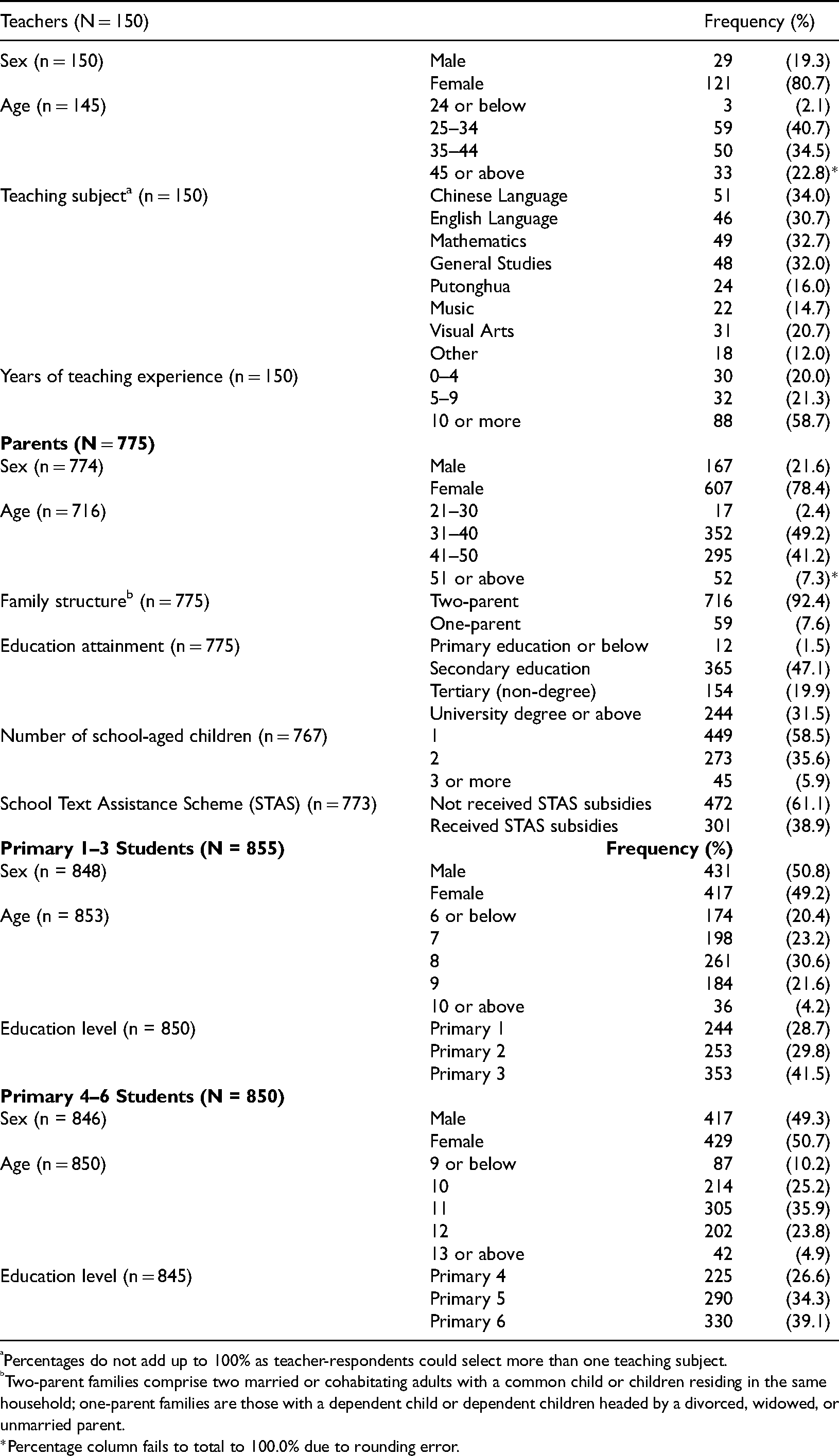
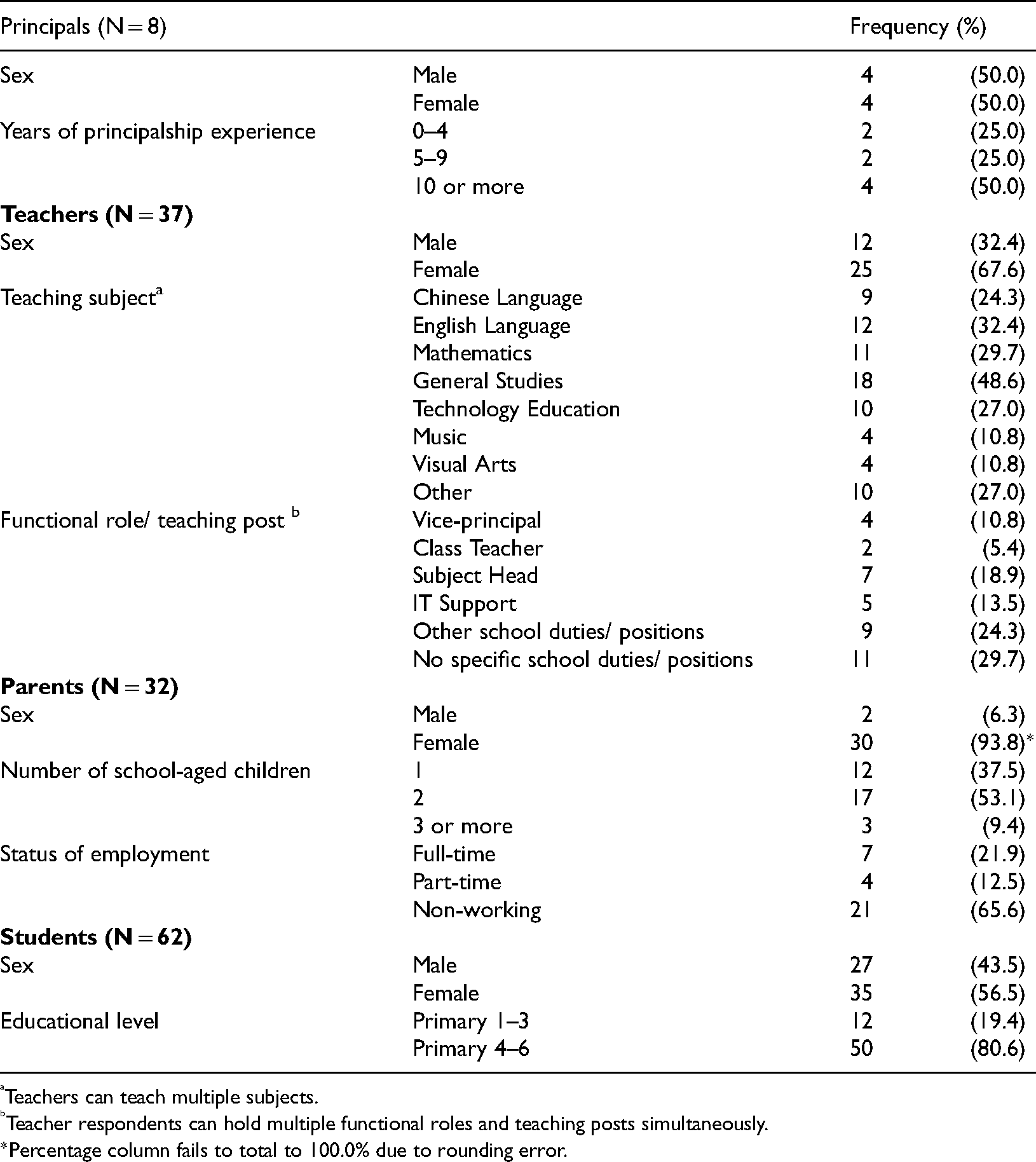
In the eight selected schools, a series of questionnaires were completed by principals (n = 8), teachers (n = 150), parents (n = 775), lower primary students (n = 855), and upper primary students (n = 850). The questionnaires were administered in each participating school primarily using theoretical sampling (e.g., teachers with different teaching experiences and subjects; students with varying grade levels; and parents with children at varying grade levels) to ensure diversity of the sample. Most questionnaires were distributed and collected via a web-based programme but paper questionnaires were provided for participants whose access to computers in schools or at home was not practical. In addition to covering contextual characteristics of schools and families, the questionnaire data were mainly used to examine school policies and practices, and the views and experiences of school leaders, teachers, parents/ guardians, and students regarding online learning before and during COVID-19. To obtain an in-depth understanding of the perspectives of various stakeholders about online learning experiences amid the class suspensions, semi-structured interviews were also conducted with principals (n = 8), teachers (n = 37), parents (n = 32) and students (n = 62). Each interview lasted one to two hours and was held at a location convenient for participants. All interviews were conducted in Cantonese, audio-recorded and transcribed verbatim. The socio-demographic characteristics of the participants are summarised in the Appendices.
Quantitative measures
As part of the mixed-methods study, the surveys included several quantitative measures among other socio-demographic information.
Socioeconomic-status grouping: To identify economically disadvantaged students, a measure of whether students received subsidies under the School Textbook Assistance Scheme (STAS) was used to indicate their families’ income levels. STAS is one of the government's financial assistance schemes offering subsidies to students from low-income families (Ma, 2015). Among the 775 parent questionnaires, 38.9% of the families were STAS recipients (considered ‘low-income families’; LIFs in short), and 61.1% were not (‘non-low-income families’; NLIFs in short). Further, to assess how each school's support of online learning varied as a function of the eight schools’ SES, the proportion of students receiving STAS subsidies in each school was measured as a proxy indicator of school-level SES 1 . Schools with a high proportion of students receiving STAS subsidies were considered low-level SES and vice versa. Accordingly, Table 1 shows a wide range of the SES compositions among the eight schools, with School 1 at one end leaning towards higher school SES and School 8 at the lower end. To delineate the SES divide, the school SES compositions were categorized into either low or high SES groups (see Table 1). The STAS binary marker was set at 50% (i.e., every other student receiving STAS in a given school).
The socioeconomic-status (SES) characteristics and samples of eight school cases.
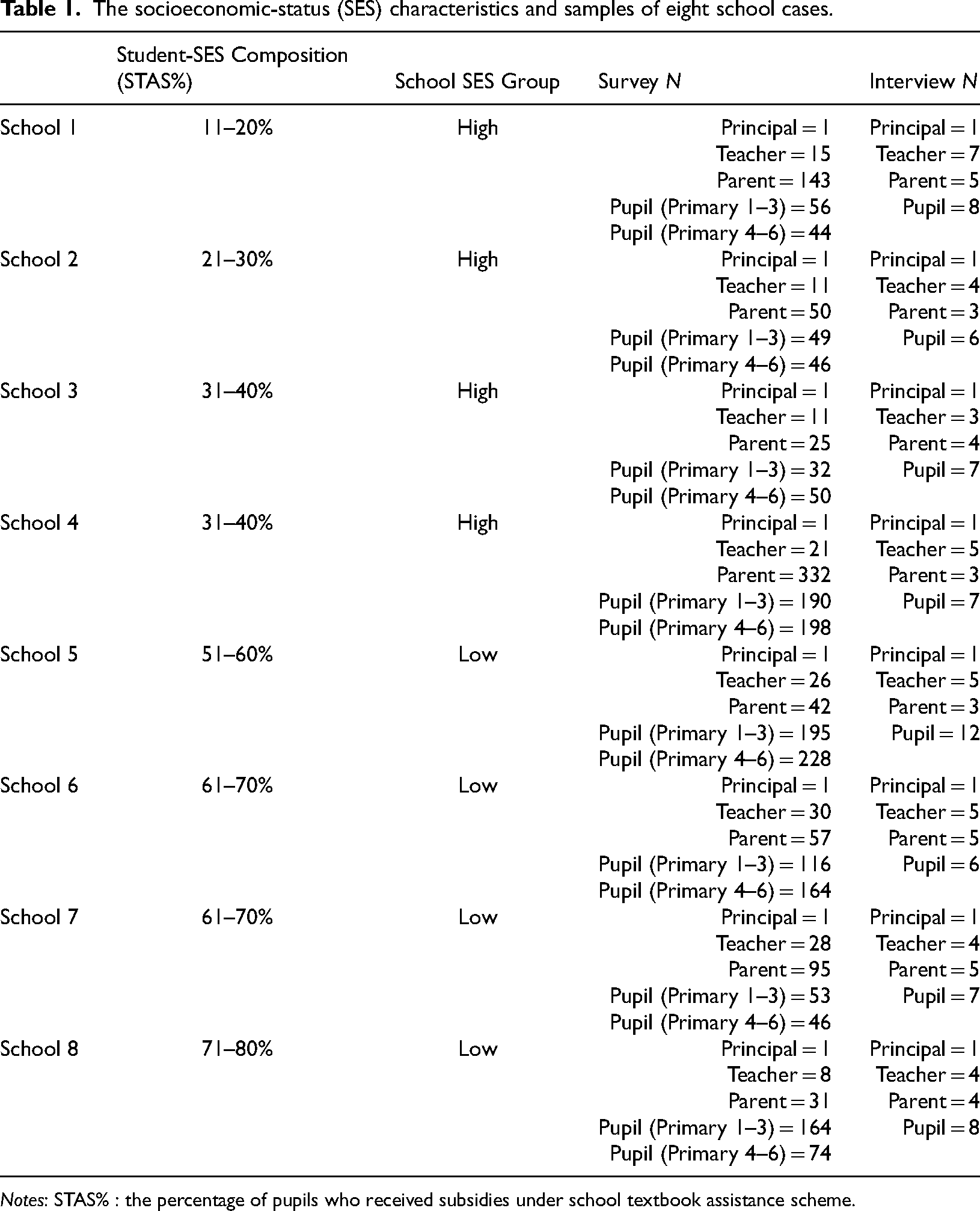
Notes: STAS% : the percentage of pupils who received subsidies under school textbook assistance scheme.
Digital resources and home environment: A series of yes-or-no items were used to measure the availability of digital resources and certain home environment facilities to students (e.g., whether they had a quiet space for learning at home).
Types of parental engagement: Adapted from the adolescent community of engagement (ACE) framework (Borup et al., 2014) as discussed in the previous section, an 18-item, five-point Likert scale (1 = Strongly disagree and 5 = Strongly Agree) was developed to measure five types of parental engagement in online learning: (1) Nurturing relationship and interactions; (2) Advising and mentoring; (3) Organizing; (4) Monitoring and motivating; and (5) Instructing (Cronbach's Alpha coefficients were 0.780, 0.576, 0.671, 0.802, and 0.820, respectively).
Parental stress: Five individual items on a five-point Likert scale (1 = No Stress and 5 = Very Much Stress) were employed to measure parental stress in five aspects: (1) Class timetable management; (2) Discipline and monitoring; (3) Technical problem solving; (4) Emotional behaviour handling; and (5) Expenditure on online learning
Mixed-methods analytic strategies
A systematic triangulation of quantitative and qualitative data was undertaken to generate a more holistic analysis of leadership practices in both school and family contexts for students’ online learning during the class suspension. The quantitative analysis was primarily based on responses to the parent questionnaire supplemented by other questionnaire data collected in the eight schools focusing on the differences between LIFs and NLIFs as well as between high and low SES schools.
The interview data was analysed to capture the in-depth experiences, challenges, and coping strategies of school leaders, teachers, students, and their parents during COVID-19. The author began by reading and coding the interview transcripts into four categories (i.e., principals, teachers, parents, and students) guided by four themes (school policy and principals’ crisis management; teachers’ pedagogical and assessment challenges; challenges confronting parents in supporting their children's learning; and adaptability to online learning). Relevant sections of each transcript were highlighted based on the coded themes. Next, the author sorted the coded items into ‘challenges’ and ‘coping strategies’ in terms of whether they involved digital resources and family conditions. The author then reread the coded items and wrote analytic memos identifying the patterns (e.g., common concerns and issues) emerging across the four categories illustrating the patterns with examples and excerpts. Excerpts from the transcribed interviews were translated into English by the author, in a way that preserved the literal meanings of the respondents.
Results
The findings draw attention to the broader context of school-family-community relationships within which principals and teacher teams provided strategic support to economically disadvantaged students and their families. Specifically, four main themes were identified in the eight schools, namely, (a) capitalizing on community resources for digital hardware essentials; (b) increasing flexibility to support students’ poor learning environment at home; (c) empowering parents as partners; and (d) understanding the stress of online learning for parents.
Capitalizing on community resources for digital hardware essentials
Principals and teacher teams were found to support online learning by using existing and accessible resources across sectors in the wider community to convert them into resources that more effectively helped students with insufficient digital access at home. For example, schools loaned laptops or tablets to LIF students or helped them apply for public financial aid. A teacher from School 7 explains: Initially, some NGOs had plans for economically disadvantaged families to apply for a SIM card… Each family can apply for two SIM cards for each student, which can be used for around half a year with unlimited data and full speed. In addition, the government also has an app for pocket WiFis. With the SIM cards and pocket WiFi, the students from these families can also connect to the internet with good speed for online learning, even though they didn't have broadband at home. (Teacher from School 7)
Many schools had a good understanding of their students’ backgrounds so they immediately acknowledged the deficiency of digital resources in many students’ homes once in-person classes were suspended at the outset of the pandemic. Table 2 shows that LIF students were less likely to have adequate digital devices, such as personal computers (χ2 = 11.248, p < 0.001), office software (χ2 = 42.925, p < 0.000), webcams (χ2 = 19.138, p < 0.000), microphones (χ2 = 22.227, p < 0.000), printers (χ2 = 5.138, p < 0.023), and a stable internet connection (χ2 = 19.010, p < 0.000) to meet the needs of their online learning at home. In interviews, for example, the principal from School 5 stated that LIF students ‘might not have enough digital devices and don't have a printer to print out their homework’. In addition to the lack of digital devices at home, the principal from School 7 also revealed that ‘some economically disadvantaged students might have only a mobile phone with a small screen for online lessons’.
Comparison of digital devices at home between low- and non-low-income families.
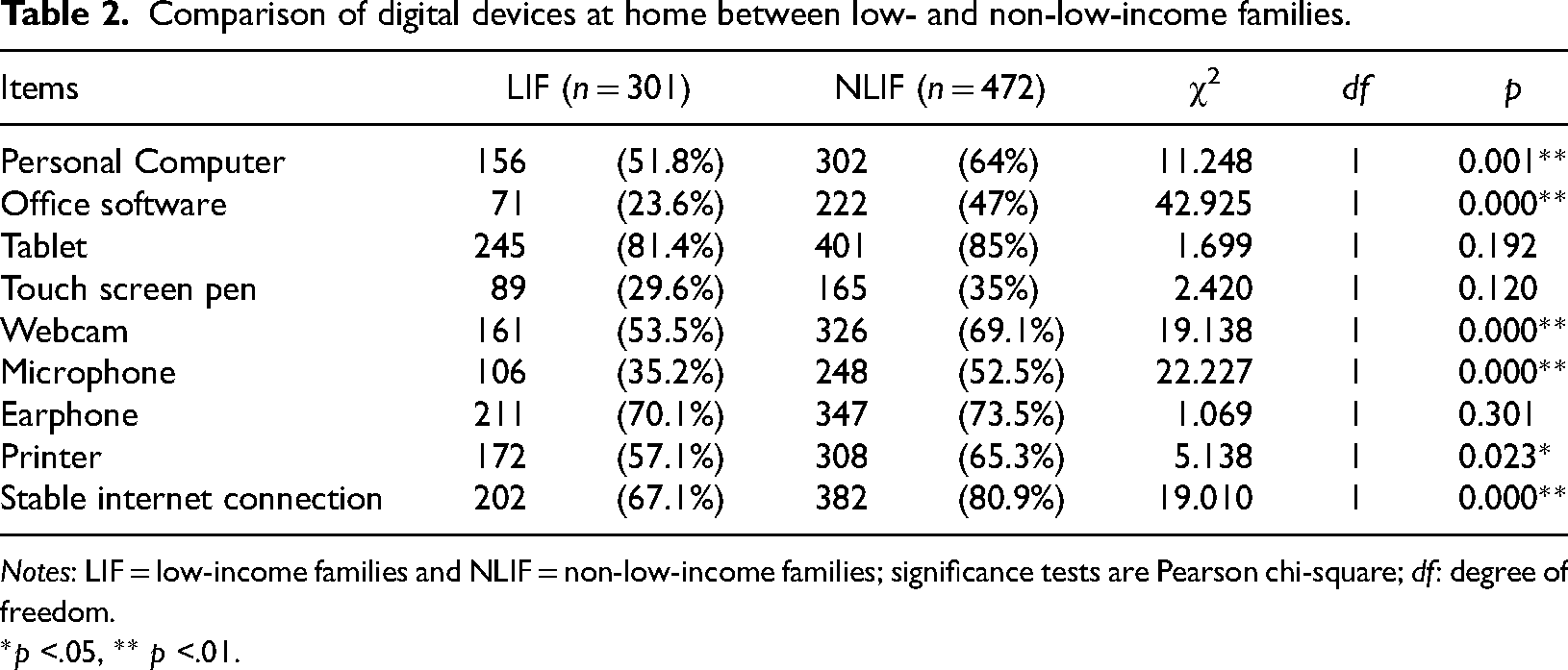
Notes: LIF = low-income families and NLIF = non-low-income families; significance tests are Pearson chi-square; df: degree of freedom.
*p <.05, ** p <.01.
Several interviewed principals explained that they tapped into various additional sources of financing provided by the government and other charitable organisations, such as Internet-access subsidies and subsidies under the Community Care Fund, a charitable trust fund in Hong Kong, for LIF students to purchase digital devices. As the interviewed teachers observed, many LIF students were able to get online at home with the support of their schools, NGOs, and the government.
Increasing flexibility to support students in poor home learning environments
Unfavourable home learning environments in Hong Kong can prevent students from participating in online learning during in-person class suspensions. As a viable workaround, interviewed principals decided to open their school doors to teach a limited number of disadvantaged students. One principal explains: Since the class suspension, we still have some students coming to school because of the poor home environment for online learning or else no one would take care of them. We have arranged some manpower to take care of these students and provided them with lessons in the classroom. (Principal from School 5)
LIFs living in cramped spaces of less than 20 square metres, such as so-called nano-flats or sub-divided flats, are common in Hong Kong, which has long been the city's major housing problem. Notably, the survey data of the present study showed that many LIF students had very limited space at home to learn online, i.e., no private room (χ2 = 11.383, p < 0.001) or quiet space (χ2 = 17.361, p < 0.000) (see Table 3). For example, a LIF parent from School 2 stated, ‘because of limited space at home, it was noisy when two children had online lessons at the same time, and that negatively influenced their learning’. A Primary 5 student from School 6 also shared his difficulty with learning online in a noisy home: Sometimes when I turned on the microphone to answer the question, there were some sounds from the kitchen. Therefore, the teacher couldn't hear what I was saying even though I spoke loudly. So, I had to go to the kitchen and ask my parents to keep quiet. At that moment, my teacher had no idea what I was doing.
Comparison of home environment between low- and non-low-income families.
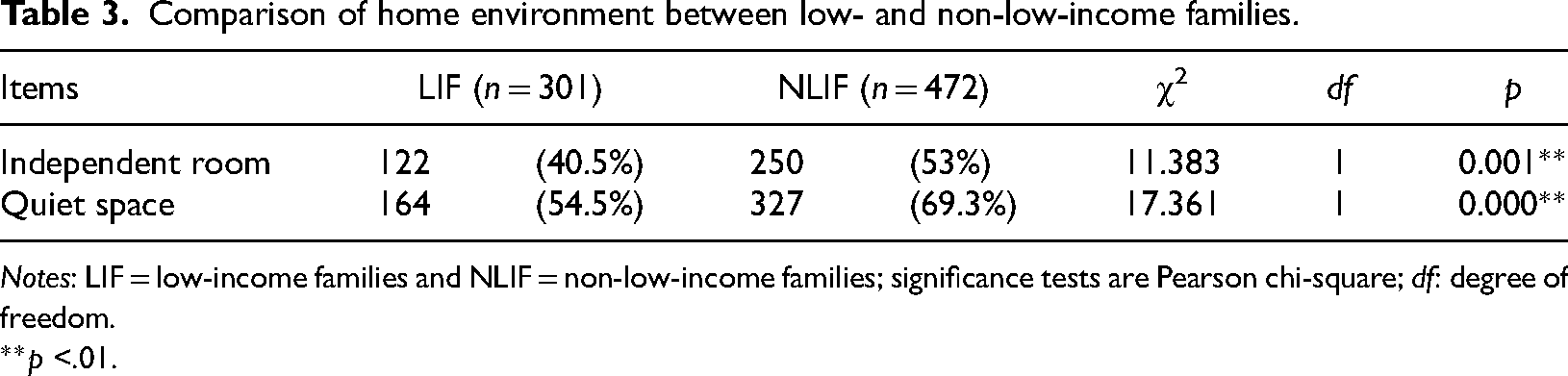
Notes: LIF = low-income families and NLIF = non-low-income families; significance tests are Pearson chi-square; df: degree of freedom.
**p <.01.
Similarly, students were often asked to keep their webcams on during online lessons, but this practice was difficult for LIF students. A teacher from the low SES School 5 explained, ‘some students, who live in a subdivided flat, were not willing to turn on their webcams since they didn't want other people to know their poor living situations’. LIF students were also often easily distracted in their tiny homes. For example, a teacher from School 2 expressed her frustration about some students’ home environment: ‘That is their home; they can sit on their bed or sofa, or have food during the lesson…but to be frank, is it an ideal environment for learning?’ Further, as a teacher from School 5 revealed, some LIF students attended online lessons in the street, the shopping mall, or even the bus, which could significantly impact their ability to focus. Because of these impediments, most of the principals and teachers tended to adopt a flexible approach to managing online classes. For example, the principal in School 6 and teachers in School 5 revealed that students living in a subdivided flat were allowed to turn off their webcams during online lessons to reduce their stress about their home condition and maintain the lessons’ smooth progression.
Empowering parents as partners
Principals in many schools worked with teachers on organizing parent workshops to support LIF students and their parents. The following are examples of the extra support for parents provided by School 6: Actually, the parents didn't need to teach their children on their own. They only needed to make sure they would come to class, and our teachers would provide additional learning activities for them. We had online lessons in the morning session, and we gave time to do homework and hold supplementary classes in the afternoon that we used to focus on their learning difficulties. (Principal from School 6)
We have launched a workshop to teach parents how to use the software. We have videos and guidelines so parents can teach their children how to use it. If some parents didn't know how to open the videos or set up the school apps, they could come to school, and we have colleagues to support them. We have tried many ways to help them solve technical problems. (Teacher from School 6)
A lack of parental engagement often created difficulties for students when learning online. Specifically, LIF parents were less likely to engage in the following: nurturing collaborative relationships (t = 0.220, p < 0.027); organising physical learning space and scheduling (t = 2.892, p < 0.005); monitoring and motivating their children's learning engagement (t = 2.400, p < 0.017); and instructing children on learning skills (t = 4.088, p < 0.000) (see Table 4). Likewise, responses to the student survey showed that when encountering problems in online learning at home, fewer students from low SES schools (50.1%) tended to ask their parents for help as compared with their counterparts from high SES schools (64.6%) (χ2 = 33.308, p < 0.000); in contrast, more students from low SES schools tended to ask their teachers for help (12.7%) than those from high SES schools (7.1%) (χ2 = 13.167, p < 0.000).
Mean differences between low- and non-low-income families on five parental roles in children's online learning.
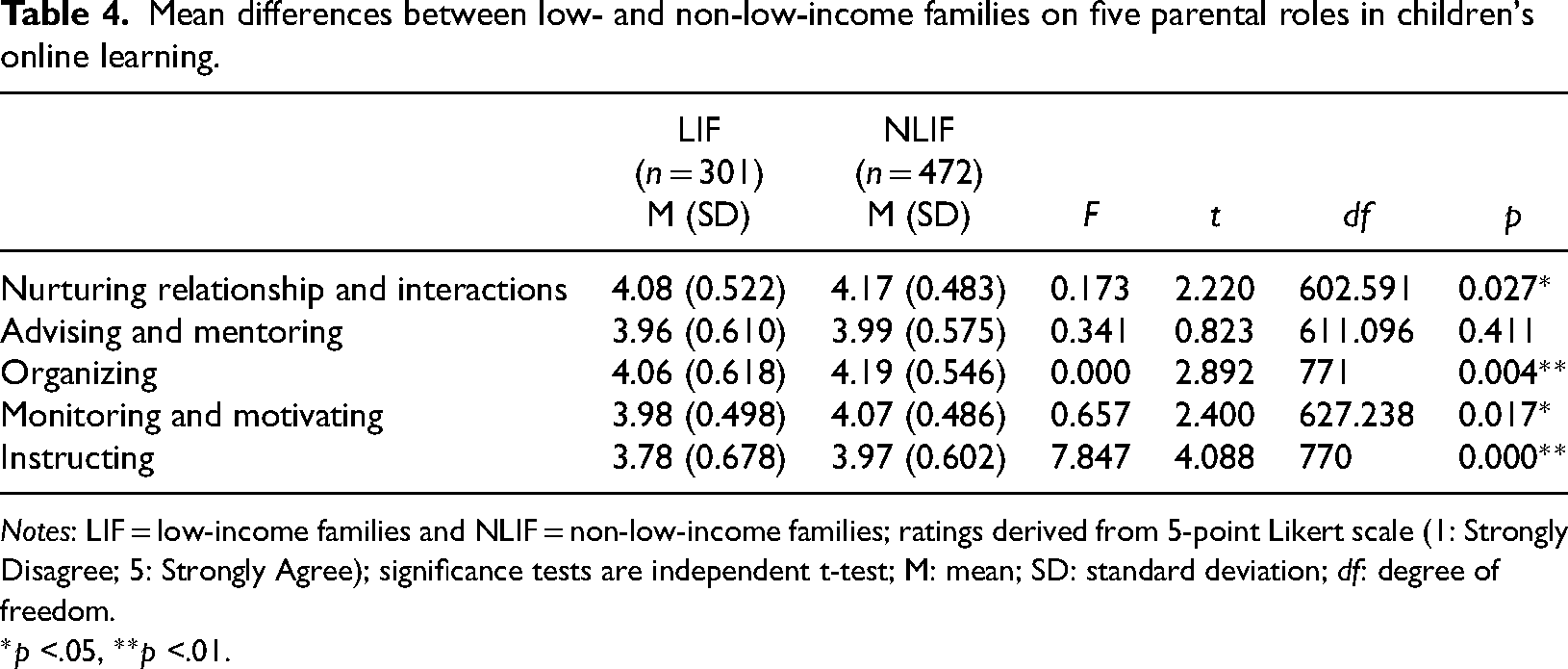
Notes: LIF = low-income families and NLIF = non-low-income families; ratings derived from 5-point Likert scale (1: Strongly Disagree; 5: Strongly Agree); significance tests are independent t-test; M: mean; SD: standard deviation; df: degree of freedom.
*p <.05, **p <.01.
Parents’ low self-efficacy in using digital technologies impeded their inclination to engage in their children's online learning. One LIF mother explains: It was difficult for me to support my child's online learning. I am not good at technology and don't know how to log in. Meanwhile, teachers were not around, and I could not ask for help. I was feeling grumpy, anxious and at a loss. I was worrying that my child would be late for lessons. (A LIF mother from School 5)
Many teachers from low SES schools also expressed their concerns about the issue of parental engagement, as in the following examples: Some working-class parents cannot speak English and therefore cannot help their children in some subjects, unlike the Chinese subject where parents can force them to study Chinese vocabulary. Some parents told me that they really didn't know what to do. Sometimes we also need to think about what to do to help them. (Teacher from School 6)
In our school, students and parents are mainly from grassroot backgrounds. The parental education level might not be able to handle their children's learning. Therefore, even if some parents were willing to assist their children, they might not have the ability. (Teacher from School 5)
Understanding the stress of online learning for parents
Engaging parents during the pandemic required the schools to establish emotional and empathetic relationships with parents. The principals revealed that they were clearly aware of the need to emotionally support families. Examples of emotional support efforts were parent helplines and ‘active listening’ support, as indicated in the following excerpts: We have an hour of ‘active listening time’ every day. If the students had some emotional problems, we could talk with them. At the same time, we also offered an hour for parents to release their pressure. Currently, we attempt to combine an ‘active listening time’ for students and parents, and turn it into ‘parent-child time’ to improve their relationship. (Principal from School 2)
During the online learning period, we make helpline calls every two to three weeks. Class teachers call the parents directly to show care about students’ and parents’ situation in terms of their child's learning, family needs and parent-child relationships. Some parents told me that they felt warm and happy to receive such a call. (Principal from School 7)
We understand the situation of low SES families. Many of them are living paycheck to paycheck and have no room to give support to their children. Therefore, we build relationships with students and hold interactive teaching and learning to enhance their involvement in online learning by having more interaction. Although it is a matter of parenting, we still hope that students can be motivated to attend class. (Teacher from School 2)
Overall, most of the teachers (66.7%) reported in the questionnaire that they had more communication with parents during the class suspension period compared with before the pandemic (t = 10.103, p < 0.000); more than half (53.3%) interacted with parents four times or more a month within the period by means of, phone calls, face-to-face meetings, and video conferences. With better communication between parents and students via the helplines, active listening support, and other support services, many teachers revealed that they had an elevated understanding of the diverse needs of parents and students regarding online learning.
Economic pressure on LIFs likely exacerbated the stress of online learning. The findings revealed LIF parents had more stress in supporting their children regarding class timetable management (t = −2.863, p < 0.004), discipline and monitoring (t = −2.565, p < 0.011), solving technical problems (t = −2.737, p < 0.006), handling emotional behavior (t = −5.500, p < 0.000), and expenditures for online learning (t = −6.369, p < 0.000) than NLIF families (see Table 5). Parental stress may have negatively affected parents’ attitudes and behaviour towards their children. For example, a LIF mother from School 6 explains: I cannot bear it. When my children had online lessons. I sat next to them and wholeheartedly assisted them, but they were still playing during the class. That really gave me a mental breakdown. They were not listening to me, and nothing changed even when I lost my temper and yelled at them. (A LIF mother from School 6)
Mean differences between low- and non-low-income families on parental stress in supporting children in online learning.
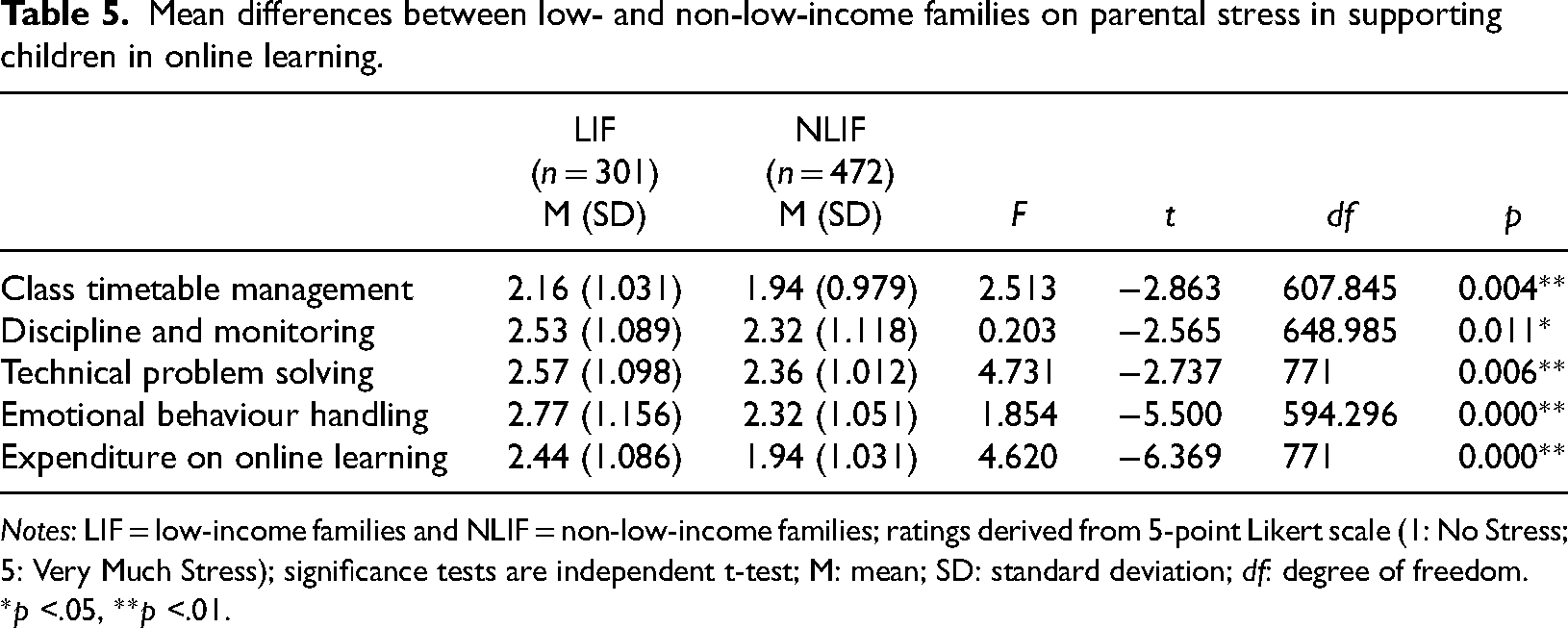
Notes: LIF = low-income families and NLIF = non-low-income families; ratings derived from 5-point Likert scale (1: No Stress; 5: Very Much Stress); significance tests are independent t-test; M: mean; SD: standard deviation; df: degree of freedom.
*p <.05, **p <.01.
Another mother from School 8 raised her concern about the debilitating effects of stress on children: My child felt anxious and impatient during the period because he had some bad experiences after he submitted his homework; the teachers told him that they didn't receive it and asked him to submit it again. (A LIF mother from School 8)
Principals and teachers in low SES schools acknowledged the stressful feelings of students and parents and tended to be considerate and supportive of those students who could not cope due to a lack of parental support at home. For example, the principal from School 7 described their contingency approach to school discipline during the class suspensions: I asked teachers to give more tolerance to the students if they could not submit their homework or participate in the live streaming lesson. Since parents and students might have encountered some difficulties that we cannot imagine, we would try to help them with different arrangements, such as uploading related videos for self-study and being tolerant of late homework submissions. We didn't mark any attendance or late homework submissions during this period. Thus, parents didn't need to be under pressure regarding the demerit record. (Principal from School 7)
Similarly, a teacher from School 5 said that the school had a tolerant attitude towards the disciplinary policy; for example, they did not apply demerit points for those who failed to hand in homework.
Discussion
Studies on educational leadership during COVID-19 have paid little attention to the interrelationship among various stakeholders. Accordingly, drawing on multiple sources of data from multiple stakeholders in eight school cases, the present study explores the intersectional nexus among principals, teachers, students, and their parents during COVID-19, with a particular emphasis on school leadership practices to support economically disadvantaged students. The findings of this study provide useful insights into areas for policymakers, practitioners, and researchers to be developed in Hong Kong and beyond.
First, the findings reveal that school-family-community collaborations provide an enabling environment for supporting the learning of primary school students regardless of their backgrounds, pointing to the need for a more integrated framework of school-family-community collaborations in school leadership development strategies and programmes. In Hong Kong, the principals’ continuing professional development framework is structured in six core areas of school leadership (Walker et al., 2013): (i) strategic direction and policy environment; (ii) learning, teaching and curriculum; (iii) teacher professional growth and development; (iv) staff and resources management; (v) quality assurance and accountability; and (vi) external communication and connection to the outside world. The last area is particularly relevant here because it alludes to how school leaders can better communicate and connect with the outside world. As the findings show, effective school leadership during the pandemic may not necessarily involve any advanced technologies, but rather, a deep knowledge and understanding of students, families, and the wider community, which constitute the necessary elements for establishing collaborative relationships. In this light, the present study recommends Hong Kong's existing leadership programmes to embed participants’ self-analysis of their students’ and community needs into a broader context of school-family-community relationships.
Second, the findings reveal the need to promote inclusive education and equity in school leadership, echoing recent studies on leadership for inclusion in the time of COVID-19 (Szeto, 2021; Vassallo, 2021). As the findings suggest, principals cannot cope with barriers to inclusive online learning alone. For example, to reframe the commonly held deficit conception of economically disadvantaged students and their families (e.g., Hunt and Seiver, 2018; Lee, 2022), principals and teachers should work together to consider both transformative and affirmative approaches in developing a school-wide understanding of the knowledge, needs, barriers, and experiences of those who are often marginalised in schools (Fenech and Skattebol, 2021). Such a school-wide culture may be more effectively cultivated and reflected in school leadership (senior leaders, middle leaders, or teachers as leaders) through professional learning communities, as suggested by previous studies in Hong Kong (e.g., Bryant and Walker, 2022; Tam et al., 2018). It is hoped that leadership development programmes, with an added emphasis on inclusive education, can help local schools develop a shared understanding and language of inclusive leadership in supporting both school-based and home-based learning of all students, as a long-term effort, regardless of pandemics or crises.
Third, consistent with the results of previous research (e.g., Razer et al., 2015), the present study found that principals and teacher teams in low SES schools tended to be responsive to economically disadvantaged students and sensitive to their needs in the design and delivery of school policies and teaching. Future research should continue to investigate the possible differential motivations, attitudes, and practices, as well as their determinants among teachers across schools serving different concentrations of economically disadvantaged students.
Fourth, generally guided by a relationalist approach, this study expands the scope of examining leadership in context through the lens of intersecting social circles among schools, families, and the wider community. As discussed earlier, methodological relationism offers a legitimate alternative to methodological individualism or collectivism, as an analytical approach to educational leadership practices (Crossley, 2022). The findings demonstrate how the experiences and perspectives of principals, teachers, students, and their families regarding online learning during the pandemic overlapped and intersected with one another, shaping the ways school leaders assessed, framed, and responded to the challenges. While a strand of research concerns social networks and school leadership centres around network structures and properties using statistical models and techniques (e.g., Díaz-Gibson et al., 2017), the conceptions generated in the present study can help advance a research agenda on school leadership towards an interpretative, qualitative paradigm that focuses on interdependency, intersubjectivity and reciprocity of social networks in experience and meaning (Crossley, 2022; Mützel and Kressin, 2021).
Conclusion
Via the analysis of eight primary school cases in Hong Kong, this study furthers our understanding of effective leadership practices for supporting the online learning of vulnerable students during COVID-19. This study extends Epstein's model of school-family-community collaboration (Epstein et al., 2011) in school-based learning to the realm of home-based online learning, and also contributes to an existing research-based knowledge grounded in Hong Kong concerning the role of school-family-community collaborations during online learning (e.g., Kong and Li, 2009; Tam et al., 2018). The pandemic has brought to light inequities in school learning as students around the globe have been forced to learn remotely (Bates et al., 2021). Policies should be enacted quickly to address the struggles of the disadvantaged so that they do not fall further behind. Arguably, the prolonged class suspensions and significant disruptions caused by the spread of COVID-19 have exposed weaknesses and limitations of existing school policies and practices. With an increasingly positive outlook toward post-pandemic digital resettlement of education in countries such as Singapore (Watermeyer et al., 2021), education policymakers and school leaders have the opportunity and responsibility to rethink learning models and develop policies and practices that will improve the quality of students’ learning, both in schools and at home. In the process of formulating school policy initiatives, the perspectives of families, which are just as important as those of educational authorities, school leaders, teachers, and other formal policy agents in mediating education policy, should not be overlooked (Chiong and Lim, 2022). Thus, one important direction for developing a long-term policy framework is to include parents, i.e., to sustain parents’ engagement so they can better support their children's education. Interim strategies such as monitoring parental engagement and communication mechanisms adopted during class suspensions should be formalised within long-term school policies. In addition, relying on only the leadership of individual schools, as an isolated effort in response to COVID-19, may limit what families in need can benefit from. Innovation in policy and practice is clearly required, for example, helping school leaders build a stronger inter-school network in neighbourhoods to share information and resources; assisting parents to form peer support groups; and helping parents tap into school and local community resources for sustained technology-, emotional-, and social-related support (Spear et al., 2021).
There are several limitations to this study. First, this study is not based on territory-wide and representative samples in Hong Kong primary schools (at least not in a statistical sense). That said, case studies based on eight schools with diverse socio-demographic characteristics provide a rich, detailed account of the experiences and perspectives of various stakeholders concerning online learning during COVID-19. Second, the results based on the cross-sectional data may have only captured the immediate responses of schools and families in crisis and, therefore, should be interpreted with caution. Third, a binary classification of low and high SES schools using the percentage of STAS student recipients may not accurately measure the diversity of school-level SES compositions. Researchers in the area may consider conducting future studies in other locales using finer-grained measures to explore whether the findings in the present study can be applied elsewhere.
Footnotes
Acknowledgements
Th author likes to thank Mr. Luke Chan, his senior research assistant, for his valuable help in collecting massive troves of data for this research project. He would also like to express his appreciation to all the research participants for giving their time.
Declaration of conflicting interests
The author(s) declared no potential conflicts of interest with respect to the research, authorship, and/or publication of this article.
Funding
The author(s) disclosed receipt of the following financial support for the research, authorship, and/or publication of this article: This work was supported by the Policy Innovation and Co-ordination Office, (grant number 2020.A5.076.20C)

Notes
Author biography
Appendix A Demographic Description of Survey Samples
| Teachers (N = 150) | Frequency (%) | ||
|---|---|---|---|
| Sex (n = 150) | Male | 29 | (19.3) |
| Female | 121 | (80.7) | |
| Age (n = 145) | 24 or below | 3 | (2.1) |
| 25–34 | 59 | (40.7) | |
| 35–44 | 50 | (34.5) | |
| 45 or above | 33 | (22.8)* | |
| Teaching subjecta (n = 150) | Chinese Language | 51 | (34.0) |
| English Language | 46 | (30.7) | |
| Mathematics | 49 | (32.7) | |
| General Studies | 48 | (32.0) | |
| Putonghua | 24 | (16.0) | |
| Music | 22 | (14.7) | |
| Visual Arts | 31 | (20.7) | |
| Other | 18 | (12.0) | |
| Years of teaching experience (n = 150) | 0–4 | 30 | (20.0) |
| 5–9 | 32 | (21.3) | |
| 10 or more | 88 | (58.7) | |
|
|
|||
| Sex (n = 774) | Male | 167 | (21.6) |
| Female | 607 | (78.4) | |
| Age (n = 716) | 21–30 | 17 | (2.4) |
| 31–40 | 352 | (49.2) | |
| 41–50 | 295 | (41.2) | |
| 51 or above | 52 | (7.3)* | |
| Family structureb (n = 775) | Two-parent | 716 | (92.4) |
| One-parent | 59 | (7.6) | |
| Education attainment (n = 775) | Primary education or below | 12 | (1.5) |
| Secondary education | 365 | (47.1) | |
| Tertiary (non-degree) | 154 | (19.9) | |
| University degree or above | 244 | (31.5) | |
| Number of school-aged children (n = 767) | 1 | 449 | (58.5) |
| 2 | 273 | (35.6) | |
| 3 or more | 45 | (5.9) | |
| School Text Assistance Scheme (STAS) (n = 773) | Not received STAS subsidies | 472 | (61.1) |
| Received STAS subsidies | 301 | (38.9) | |
|
|
|
||
| Sex (n = 848) | Male | 431 | (50.8) |
| Female | 417 | (49.2) | |
| Age (n = 853) | 6 or below | 174 | (20.4) |
| 7 | 198 | (23.2) | |
| 8 | 261 | (30.6) | |
| 9 | 184 | (21.6) | |
| 10 or above | 36 | (4.2) | |
| Education level (n = 850) | Primary 1 | 244 | (28.7) |
| Primary 2 | 253 | (29.8) | |
| Primary 3 | 353 | (41.5) | |
|
|
|||
| Sex (n = 846) | Male | 417 | (49.3) |
| Female | 429 | (50.7) | |
| Age (n = 850) | 9 or below | 87 | (10.2) |
| 10 | 214 | (25.2) | |
| 11 | 305 | (35.9) | |
| 12 | 202 | (23.8) | |
| 13 or above | 42 | (4.9) | |
| Education level (n = 845) | Primary 4 | 225 | (26.6) |
| Primary 5 | 290 | (34.3) | |
| Primary 6 | 330 | (39.1) | |
Percentages do not add up to 100% as teacher-respondents could select more than one teaching subject.
Two-parent families comprise two married or cohabitating adults with a common child or children residing in the same household; one-parent families are those with a dependent child or dependent children headed by a divorced, widowed, or unmarried parent.
*Percentage column fails to total to 100.0% due to rounding error.
Appendix B Demographic Description of In-depth Interview Respondents
| Principals (N = 8) | Frequency (%) | ||
|---|---|---|---|
| Sex | Male | 4 | (50.0) |
| Female | 4 | (50.0) | |
| Years of principalship experience | 0–4 | 2 | (25.0) |
| 5–9 | 2 | (25.0) | |
| 10 or more | 4 | (50.0) | |
|
|
|||
| Sex | Male | 12 | (32.4) |
| Female | 25 | (67.6) | |
| Teaching subjecta | Chinese Language | 9 | (24.3) |
| English Language | 12 | (32.4) | |
| Mathematics | 11 | (29.7) | |
| General Studies | 18 | (48.6) | |
| Technology Education | 10 | (27.0) | |
| Music | 4 | (10.8) | |
| Visual Arts | 4 | (10.8) | |
| Other | 10 | (27.0) | |
| Functional role/ teaching post b | Vice-principal | 4 | (10.8) |
| Class Teacher | 2 | (5.4) | |
| Subject Head | 7 | (18.9) | |
| IT Support | 5 | (13.5) | |
| Other school duties/ positions | 9 | (24.3) | |
| No specific school duties/ positions | 11 | (29.7) | |
|
|
|||
| Sex | Male | 2 | (6.3) |
| Female | 30 | (93.8)* | |
| Number of school-aged children | 1 | 12 | (37.5) |
| 2 | 17 | (53.1) | |
| 3 or more | 3 | (9.4) | |
| Status of employment | Full-time | 7 | (21.9) |
| Part-time | 4 | (12.5) | |
| Non-working | 21 | (65.6) | |
|
|
|||
| Sex | Male | 27 | (43.5) |
| Female | 35 | (56.5) | |
| Educational level | Primary 1–3 | 12 | (19.4) |
| Primary 4–6 | 50 | (80.6) | |
Teachers can teach multiple subjects.
Teacher respondents can hold multiple functional roles and teaching posts simultaneously.
*Percentage column fails to total to 100.0% due to rounding error.