




Abstract
This paper systematically reviews literature on meetings of the principal or principal meetings from 1970 to 2021. Even though meetings comprise the largest percentage of principal time, they have been overlooked as a topic of research. The purpose of this review is to study notations of meetings in academic literature and develop analytical insights on school leadership practice. The systematic literature search used keyword search, snowballing, and personal network references to yield 62 academic publications. The results of the review indicate that educational literature provides limited and often summative notations of principal meetings. Importantly, the limited notations are still able to illuminate and nuance three dimensions of school principalship – bridging, bending, and balancing. Further, three possible conceptualizations of principal meetings as waste of time, familiar events, and intervention tools provide analytical insights into meetings as a microcosm of school principal practice. Implications for theory, practice, and further research are provided.
School leadership writ small: meetings and school principal practice
All the principals attended the meeting. Siv came first, but announced that she had to leave early to make it to another meeting. Two of the other principals, Ulf and Joachim, were late so we could not start on time. When they arrived, they also announced that they would have to leave for a while for a staff meeting. (Nehez and Blossing, 2020: 20)
The excerpt above is an illustration signifying how the principal’s workdays are laden with multiple meetings. Principal meetings or the various meetings that principals attend or lead comprise the highest proportion of principals’ workday (Crisp, 2017; Pollock and Hauseman, 2019; Sebastian et al., 2018) and are noted in diverse educational literature topics such as school improvement (Chrispeels and Martin, 2002; Duke and Landahl, 2011; Meyers and Hitt, 2016; Schildkamp and Poortman, 2015), policy implementation (Coburn, 2005; Datnow et al., 2019; Newmann et al., 2000; Spillane et al., 2011), principal time-use (Grissom et al., 2015; Sebastian et al., 2018), and professional learning (DuFour, 2002; Garmston, 1987; Honig, 2014; Scribner et al., 1999). Principal meetings, however, are rarely conceptualized as a research lens to elucidate and nuance school leadership practice despite appeals by scholars like Riehl (1998) for educational administration scholars to move beyond prescriptive accounts of how school meetings must be conducted. 1 That principal meetings are overlooked is not surprising because of the taken-for-granted nature of workplace meetings (Schwartzman, 1989) and a “personal aversion to anticipated tedium, the dread, and loathing of meetings that so many academics experience” (Sandler and Thedvall, 2017: 1). To examine the familiar yet overlooked principal meeting and its connection with school leadership, this article describes a systematic literature review of notations of principal meetings in educational scholarship from 1970 to 2021.
A review of principal meetings to educational leadership literature is also conceptually significant because principal meetings may not only reflect, but also constitute organizational phenomena like school leadership, sensemaking, and organizational learning (Riehl, 1998; Schwartzman, 1989; Scott et al., 2015; Weick, 1995). To illustrate, principal meetings have been noted by educational scholars to study and theorize about the connection between school leadership and professional learning (Coburn, 2005; Schildkamp and Poortman, 2015; Scribner et al., 1999). In such literature, the principal meeting is relegated to the background as a generalized organizational form or a container of school leadership action intended to shape professional learning. This relegation of meeting to a simple tool or container is a problematic oversight according to meeting science scholars or those who theorize what happens before, during, and after a meeting (Allen et al., 2015). Instead, the meeting is a complex episode that reflects and constitutes a phenomenon (Allen et al., 2015; Giddens, 1984; Schwartzman, 1989; Scott et al., 2015; Weick, 1995) such as school leadership or professional learning. In other words, principal meetings are complex occurrences that embody both the medium and the outcomes of educational leadership (Kohler et al., 2012; Riehl, 1998). Put succinctly, principal meetings are school leadership writ small.
A review of principal meetings, therefore, becomes a critical step in understanding daily educational leadership practice which “is fundamentally about interactions” (Sherer and Spillane, 2011: 616). A review on the social practice of the principal meeting focuses on “activities and what drives them” (Thomson and Hall, 2011: 387) and a shift away from what the authors denounce as “thingifying” school leadership or treating school leadership as a homogeneous material entity ignoring the nuances of actions, context, and agency. A review of principal meetings in literature has a high potential to elucidate the various dimensions of school leadership by explicating the interplay between the contextual elements of the meeting and the actions of the school principal. Besides, as makers, meetings make certain outcomes possible and close others, enabling people to “impose projects of collective reason and interaction upon others” (Sandler and Thedvall, 2017: 16) – a key goal of school leadership (Coburn, 2005; Nehez and Blossing, 2020). Hence, a review of principal meetings can also highlight the habits of behavior and mind that animate school leadership.
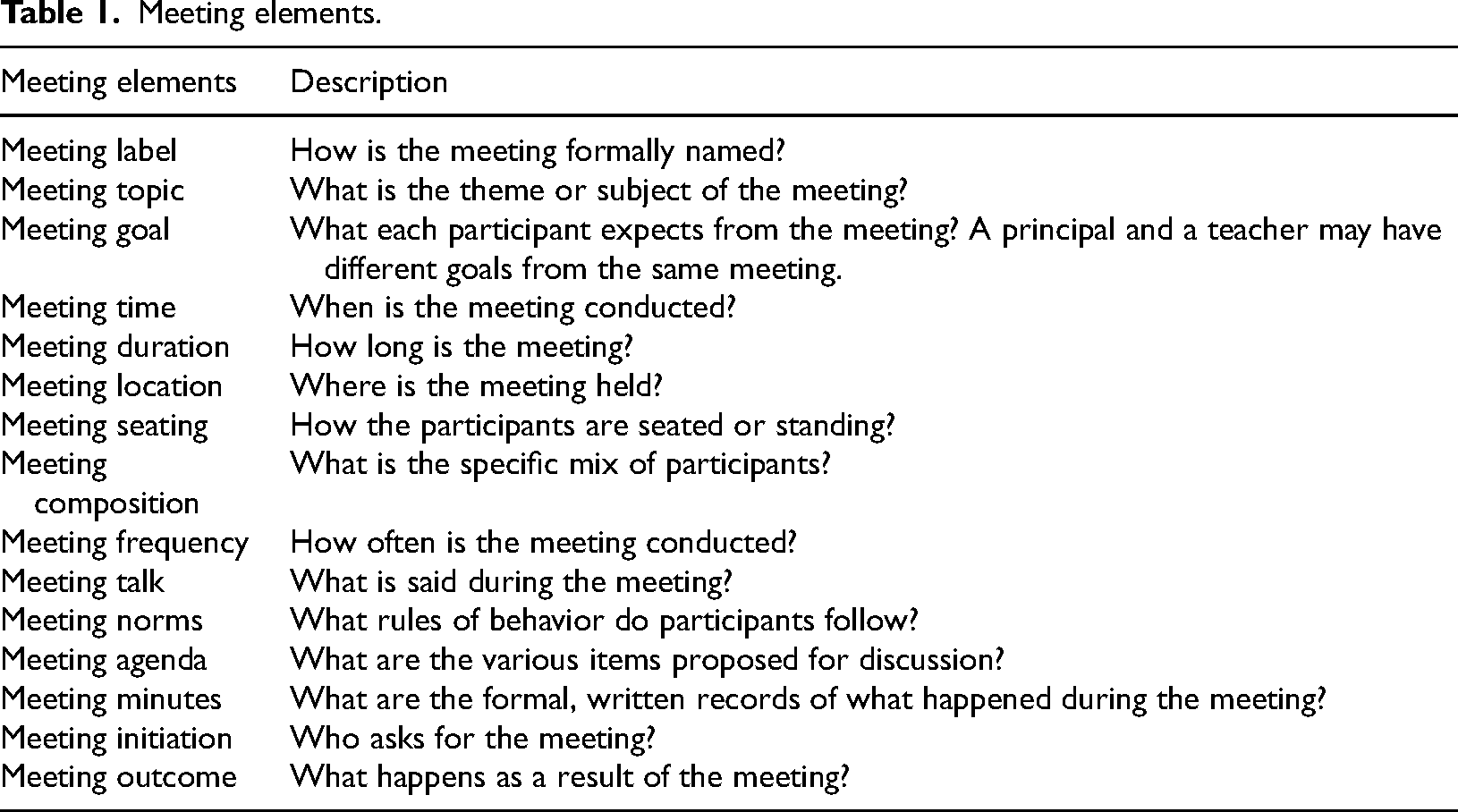
Building on the discussion so far, the review addresses the questions below by drawing upon educational leadership and meeting science literature. The meeting science literature supports the review by providing a vocabulary denoting meeting elements for a more comprehensive understanding of the meeting phenomenon (Table 1). The questions guiding this literature review are:
What elements of principal meetings are frequently noted in educational literature? What are the conceptualizations underlying principal meetings as inferred from literature? What can we infer about school leadership based on how principal meetings are noted?
Meeting elements.
This review contributes to educational management and leadership literature in five ways. First, analytical generalizations (Becker, 2013; Flyvbjerg, 2006) drawn from principal meetings provide a vocabulary to nuance three school leadership dimensions. Second, the conceptualizations of principal meetings indicate how educational leadership scholars and practitioners view and expect from meetings. Third, the review highlights aspects of meetings, paying attention to which, may improve understanding and practice of conducting successful principal meetings, thereby reducing principal stress, saving principal time, and making school leadership more effective. Fourth, the definition and methodological framework used in this systematic review may prove useful to conduct future reviews of school meetings. Finally, the review identifies significant principal meeting elements that may be included in future scholarship.
To summarize, this introduction builds a rationale for a review of principal meetings which are often overlooked in educational literature because of their familiarity and perceived boredom. Significantly, principal meetings comprise the highest proportion of a principal’s workday and both reflect and constitute school leadership practice. Hence, this review aims to answer how principal meetings are noted in academic literature and what inferences can be drawn from such notations. A key contribution of this review is the development of analytical generalizations about dimensions of school leadership practice.
Methodology
Greenhalgh and Peacock’s (2005) strategy on the review of complex evidence guided the search for literature on principal meetings. Gathering literature that mentions principal meetings is challenging and unlikely to be comprehensive because academic research is rarely indexed with principal meetings as a keyword and because the word “meeting” also means fulfillment, such as in “meeting a promise.” A web search using keywords like “principal meetings” or “administration meetings” in Google Scholar and databases EBSCOhost, ScienceDirect, and ERIC returns fewer than five research articles on principal meetings as a possible topic of research. Textbooks on the principalship rarely list meetings as part of their indexes (Drake and Roe, 2002; Sergiovanni, 1995; Wolcott, 1973). These challenges meant that a review of principal meetings in educational literature required searching through multiple and disparate sources to maximize the possibility of discovering rich notations of principal meetings. Hence, this review was undertaken similar to systematic reviews of complex evidence suggested by Greenhalgh and Peacock (2005) comprising: (a) protocol-driven search, (b) snowballing, and (c) personal knowledge as described in the next paragraph. The search was limited to peer-reviewed journal articles and book chapters written by scholars. Practitioner-oriented literature on principal meetings was excluded because they note difficult to verify accounts of principal meetings. Given Wolcott’s 1973 classic which had two chapters devoted to meetings of the principal, the year 1970 was taken as the starting point for this review. Finally, to include more impactful publications, those with fewer than five citations except if they were published in 2021 were excluded from the review.
A protocol-driven search or a search strategy defined at the outset of the review by perusing index terms and free text in select databases (Greenhalgh and Peacock, 2005) was first conducted. The databases of Google Scholar, EBSCOhost, and ERIC were searched for the keyword “meeting” in combination with the terms “principal,” “administration,” “leadership,” and “faculty.” The protocol-driven search yielded an initial set of 11 publications. The low number was not surprising since the use of the term “meeting” in titles and keywords of scholarship predominantly refers to fulfillment and also confirms the taken-for-granted status of meetings.
The initial collection of 11 publications noting principal meetings was complemented through the process of snowballing described as scanning through the reference list of all full text papers and using judgment to decide whether to pursue these further (Greenhalgh and Peacock, 2005). This process identified another 32 publications. This step yielded more publications also because of citation tracking wherein the initial 11 publications were forward tracked to find other papers in mainstream journals that had subsequently cited those publications.
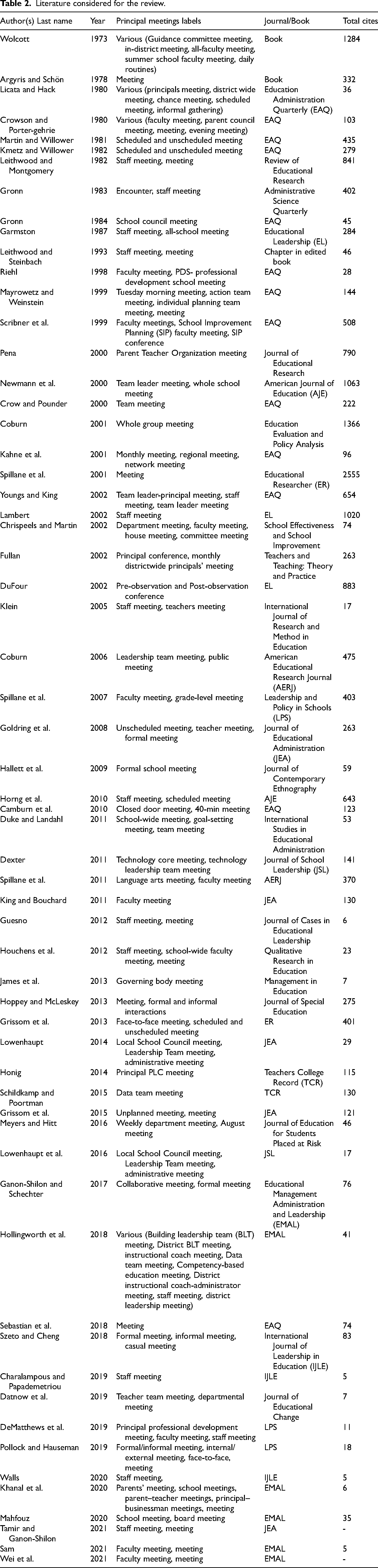
Finally, the collection of 43 publications was complemented through personal knowledge or what Greenhalgh and Peacock (2005) refer to as a combination of (a) suggestions from the author’s professional network and (b) serendipitous discovery (i.e. finding a relevant paper when looking for something else). Concurrent research projects and papers on school improvement and professional learning led to serendipitous discovery of 10 publications. Overall, this step added 19 more publications leading to a total of 62 publications (Table 2). More than 70% of the publications reviewed were published after the year 2000.
Literature considered for the review.
Four key limitations underpin this review. First, since principal meetings are rarely noted as journal keywords or within book indexes, therefore it is likely that other relevant scholarly publications were not discovered. Second, the elements of judgment and serendipitous discovery are inherently subjective; another reviewer may collect a different set of publications. Third, the three conceptualizations of principal meetings are based on inferences from the limited details of meeting elements. Fourth, the review draws upon meeting science which is a relatively new and still growing field (Allen et al., 2015) and as the field matures, the results discussed here are likely to get refined.
Results
This review answers three questions:
What elements of principal meetings are frequently noted in educational literature? What are the conceptualizations underlying principal meetings as inferred from literature? What can we infer about school leadership based on how principal meetings are noted?
In response to the first question, results indicate that principal meetings are largely considered as talk events with a variety of labels. Elements such as the agenda, minutes, meeting norms, location, or time are rarely noted. In response to the second question, principal meetings have been conceptualized as a waste of time, as familiar events, and as intervention tools. As an answer to the third question, the conceptualizations and notations highlight and nuance the bridging, bending, and balancing dimensions of principal practice with practices used to legitimize decisions and actions. Since principal meetings, to the best of the author’s knowledge, have not been defined, this section first provides a definition to guide the review.
Defining principal meetings
Defining what constitutes principal meetings is crucial to investigate and make unfamiliar the taken-for-granted nature of meetings and to identify and draw inferences from those principal talk events that are not labeled as a meeting (Gronn, 1983; Hoppey and McLeskey, 2013; McAdamis, 2010; Wei et al., 2021; Wolcott, 1973). However, defining meetings is challenging even for meeting scholars because most definitions capture the technical aspects of meetings such as more than two people, focused interaction, and pre-arrangement but not its underlying essence (Allen et al., 2015). To complicate matters, scholars may not label an instance of principal talk or conversation as a meeting even though it might be one. For instance, what would one label a brief interaction held in the corridor between the principal and a teacher to discuss staffing issues and planning for a staff meeting (Gronn, 1983)? Scholars might label this interaction as an unscheduled or informal meeting (Hoppey and McLeskey, 2013; Szeto and Cheng, 2018) but this might be challenged by Gronn himself who labels this interaction as “administrative talk.” In sum, defining principal meetings is necessary for a review, but challenging.
To meet the necessary challenge of defining principal meetings, this review first combines meeting definitions from eminent meeting scholars to capture the essential elements of a principal meeting. Subsequently, an analytic strategy from Wolcott’s (1973) study of principal practice is borrowed to identify principal meetings especially when the episode is not labeled as a meeting. In The Meeting: Gatherings in Organizations and Communities, regarded as a milestone book on the study of workplace meetings (Allen et al., 2015; Weick, 1995), Schwartzman (1989) defines a meeting as a “communicative event [characterized by focused interaction] involving three or more people who agree to assemble for a purpose ostensibly related to the functioning of an organization or group” (p. 7). Allen et al. (2015), in their introduction to the Cambridge Handbook of Meeting Science, a volume uniting the current thinking and empirical cases from the scholarship of meetings, define meetings as “purposeful work-related interactions occurring between at least two individuals that have more structure than a simple chat, but less than a lecture” (p. 4). Drawing upon the aforementioned definitions, principal meetings may be defined as “focused, work-related interactions of the school principal and at least one more person who have assembled for a purpose linked to the functioning of the school and that has more structure than a chat, but less than a lecture.”
To further clarify and illustrate the application of the definition above, an analytical strategy is borrowed from Wolcott’s (1973) ethnography which is rooted in school leadership and devotes over two chapters to formal and informal interactions of a principal. Principal meetings, for this review, comprise preplanned and deliberate (though not preplanned) meetings and exclude casual or chance encounters. Preplanned meetings refer to the formally announced meetings of the principal and those encounters which are less formal, but prearranged such as “seeing a group of pupils immediately after lunch” (p.89). Deliberate meetings are not planned in advance but at which intended issues were discussed such as “a walk down the hall for the express purpose of speaking with the particular teacher or pupil” or “parent coming to school and requesting ‘a moment’ of Ed’s [principal’s] time” (p. 89). Casual or chance encounters refers to all the other interactions such as the principal telling a student roaming in the hallway to return to class. So defined, principal meetings happen within or outside school walls, include formal and informal interactions, and can be initiated either by the principal or by others.
Using the definition above, the review discovered multiple notations of principal meetings which were analyzed to search for other meeting elements besides talk and label (Table 1). Key results of the review are described below.
Meetings are predominantly noted with limited details
Educational literature has largely limited itself to noting labels, topics, and brief talk segments of principal meetings (Coburn, 2005; Datnow et al., 2019; DeMatthews et al., 2019; Ganon-Shilon and Schechter, 2017; Leithwood and Steinbach, 1993; Martin and Willower, 1981; Pena, 2000; Sam, 2021). Detailed talk segments from principal meetings were rare and found usually in older literature (Gronn, 1984, 1983; Riehl, 1998; Wolcott, 1973). The principal meeting is considered by scholars as an episode wherein only the discursive practices are important since meeting elements such as meeting agenda, minutes, meeting time, duration, initiation, norms of interaction, pre-meeting talk, exact member composition, meeting goals, and meeting location are rarely noted or analyzed. This is not a critique of the substantive and meaningful topics that scholars have focused upon when noting principal meetings, rather the aim here is to underscore the contextual elements of meetings are significant.
The overlooked meeting elements, such as meeting location and meeting minutes, are significant in shaping meaning-making and professional knowledge (Evans, 2017; Lamp, 2017; Yarrow, 2017). Yarrow’s case study, for instance, powerfully illustrates how the location of a meeting shapes what type of professional knowledge is developed and shared. In her study, architectural site meetings, during which heritage experts walk and talk to sensorially experience a historical building, evoke grounded professional readings of the building’s character and aesthetics. In contrast, listing meetings held in sanitized office environments reconstruct the same heritage site differently as an imaginative architectural object. Therefore, a faculty meeting held in the math lab may construct a different plan for improving math instruction as compared to the same meeting held in the principal office or the “laughter arena” of the staff room (Gronn, 1983). 2 Alternatively, consider meeting minutes as an overlooked element in literature. In the analysis of meeting minutes of a land allotment society, Evans (2017) demonstrates that minutes reveal insights about organizational memory and participant action even though the minutes are sanitized to exclude the “subjective vagaries of interpersonal dynamics” (p. 126). In the same vein, minutes of a faculty meeting, when noted, may offer rich insights on how meeting records influence school memory of performance measures and maneuver the way forward.
Table 2 reveals that principal meetings have diverse labels that inform us about meeting participants (staff, school council, whole-school, board), meeting purpose (goal-setting, professional development, evaluation), the deliberateness (scheduled, unscheduled, formal, or chance) and occasionally time (Tuesday, breakfast 40-min). Ostensibly, meetings cover all dimensions of principal practice (Camburn et al., 2010) addressing widely varying topics such as instructional progress, student retention, special education, staff allocation, district updates, budgeting, educational planning, student data analysis, and professional development. If there is a stakeholder or a school topic that principals engage with, one is likely to discover that meetings, in some way, constitute that engagement – providing empirical evidence to the claim that principal meetings are school leadership writ small.
As a microcosm of school leadership, principal meetings suggest school leaders’ goals such as reinforcing accountability (Datnow et al., 2019; Duke and Landahl, 2011; Lowenhaupt et al., 2016; Schildkamp and Poortman, 2015; Spillane et al., 2011), orchestrating collaboration and shared vision (Hoppey and McLeskey, 2013; Khanal et al., 2020; Tamir and Ganon-Shilon, 2021; Wolcott, 1973), fostering reflective thinking (Argyris and Schön, 1978; Houchens et al., 2012; Scribner et al., 1999), smoothening administrative performance (Grissom et al., 2015; Gronn, 1983; Martin and Willower, 1981; Wolcott, 1973), and exhibiting authority and power (Friedman and Berkovich, 2020; Gronn, 1984; Sam, 2021).
A principal’s goals, however, often conflict with the goals of other meeting participants, which may thwart meeting outcomes (Argyris and Schön, 1978; Pena, 2000; Schildkamp and Poortman, 2015; Wolcott, 1973), arouse anger, and lead to burnout (DeMatthews et al., 2019; Mahfouz, 2020). During meetings, the principal and the teacher seek to control the interaction through deflection (Argyris and Schön, 1978) or reframing agenda items (Datnow et al., 2019). The conflict occasionally evokes strong emotions (Schwartzman, 1989) such as anger, “I almost lost it, like really…I wanted to just reach out and grab this teacher and say what the hell are you doing here?” (DeMatthews et al., 2019: 15)
Conceptualizations of principal meetings
A meta-analysis of principal meeting notations in the literature suggests three key conceptualizations of these meetings: a waste of time, familiar events, and intervention tools. Each conceptualization describes a particular, but partial view of the principal meeting, highlighting specific aspects and minimizing others. Further, these conceptualizations are mutually inexhaustive and interpretative (intervention tools) than technical (communicative events). The interpretive conceptualizations provide insight into subjective expectations from principal meetings which determine how principals perceive, plan, conduct, and judge their meetings.
The first conceptualization of principal meetings as a “waste of time” considers principal meetings as tedious and inefficient. The second conceptualization of principal meetings as “familiar events” considers these meetings as a phenomenon relegated to the background. The third conceptualization of principal meetings as “intervention tools” considers principal meetings as landmark and tactical tools of initiating and sustaining school reform.
Principal meetings as a waste of time
Ed felt that most meetings with the superintendent were a waste of time—the superintendent did all the talking and yet was very roundabout if one tried to put him on the spot for an answer. Ed had a similar reputation among many teachers, parents, and even pupils. (Wolcott, 1973: 313)
The quote above from Wolcott’s two-year ethnography pronounces the principal meeting as a waste of time both when the principal is conducting the meeting and when he has to endure being a participant. Principal meetings as a waste of time is a popular conceptualization across the literature (Argyris and Schön, 1978; Datnow et al., 2019; Honig, 2014; Mahfouz, 2020; Pena, 2000; Pollock and Hauseman, 2019; Riehl, 1998), conjuring up images of long, aimless, and tedious interactions, invoking frustration, indifference, and even sleep (Wolcott, 1973).
Principal meetings as wasteful can be inferred from principal’s own thwarted expectations from their meetings as described above (DeMatthews et al., 2019; Mahfouz, 2020; Wolcott, 1973), comments from teachers and parents (Hoppey and McLeskey, 2013; Pena, 2000; Schildkamp and Poortman, 2015), and scholarly interpretations (Argyris and Schön, 1978; Datnow et al., 2019; Riehl, 1998). Parent-Teacher Organization meetings, for instance, could draw criticism from non-English speaking parents, “Well, I do not understand anything, so what does it serve for people to come?” (Pena, 2000: 47). Faculty meetings may indicate passive engagement as Riehl (1998) notes with only about 20% of meeting time on constructive discussions and a perfunctory attitude to “simply getting it [tasks] done” (p. 108).
Principal meetings as familiar events
This conceptualization draws largely from the literature on educational management, administration, and time-use (Camburn et al., 2010; Grissom et al., 2015, 2013; James et al., 2013; Lambert, 2002; Spillane et al., 2001; Wei et al., 2021; Wolcott, 1973). Principal meetings are considered universally well-known and uncomplicated episodes in the background of principal practice.
Paradoxically, although principal-time use literature often indicates that meetings comprise a large percentage of principal time, the majority of this literature provides minimal detail denoting meetings with a brief label such as scheduled/unscheduled or foregoing even a label to use the generic term “meeting” (Camburn et al., 2010; Grissom et al., 2013; Horng et al., 2010; Sebastian et al., 2018). Principal meetings are relegated to the “general context” (Horng, 2010: 496). Scholars tend to note the meeting briefly and shift focus to making substantive claims about the multiple, competing demands on principal attention (DeMatthews et al., 2019; Goldring et al., 2008; Grissom et al., 2013; Kmetz and Willower, 1982; Sebastian et al., 2018). In contrast, Wolcott (1973) is a rare exception who draws upon the regularity of the principal meeting to make predictive claims – “Given the information that Ed [the principal] was on his way to a meeting and knowing the hour and day one could almost predict who would be at the meeting and perhaps even make a reasonable guess about the general tenor of business” (p. 93).
Principal meetings as intervention tools
Principal meetings as intervention tools (Schwartzman, 1989; Scott et al., 2015) are landmark and tactical measures to signal change and sustain school reform. As landmark measures, principal meetings are monumental events (Schwartzman, 1989), often noted by their large participation, transforming how whole school staff and parents perceive school reform (Duke and Landahl, 2011; Honig, 2014; Houchens et al., 2012; Kahne et al., 2001; Khanal et al., 2020; King and Bouchard, 2011; Mayrowetz and Weinstein, 1999; Wolcott, 1973; Youngs and King, 2002). School-wide meetings can be newly initiated events by principals to showcase accountability, inviting external members such as central office staff to observe teachers present student progress using data (Duke and Landahl, 2011). Principals often take the risk of confronting their teachers in school-wide meetings and share evidence about “low expectations for student learning” (Houchens et al., 2012: 158) to stimulate the teachers. The provocative meetings, however, often leave some teachers “visibly piqued,” leaving permanent marks on organizational memory as the principal “could not ‘unsay’ what he had shared” (King and Bouchard, 2011: 661).
Principal meetings, especially the prearranged and regular interactions, are tactical interventions where change initiatives receive “regular reiteration and potentially become institutionalized” (Scott et al., 2015: 37). The meetings become intervention routines to keep school change efforts on track (Chrispeels and Martin, 2002; Crow and Pounder, 2000; Sherer and Spillane, 2011; Spillane et al., 2011) and strengthen knowledge about school improvement methods amongst teachers and principals (Garmston, 1987; Hollingworth et al., 2018; Honig, 2014; Newmann et al., 2000; Schildkamp and Poortman, 2015; Scribner et al., 1999). As tactical measures, principal meetings also release emotional angst towards challenging tasks (Guesno, 2012; King and Bouchard, 2011; Mayrowetz and Weinstein, 1999) or act as informal pre-intervention tools to test or “trial balloon” (Licata and Hack, 1980: 95) ideas with the teachers (Gronn, 1983; Hoppey and McLeskey, 2013).
School leadership practice: bridging, bending, balancing
As school leadership writ small, principal meetings, even with limited noted details, highlight and nuance three dimensions of principal practice: bridging, bending, and balancing.
Notations of principal meetings indicate that principals act as dynamic knowledge disseminating bridges connecting a diversity of meeting participants outside and within the school boundary. To borrow a term from meeting science, principals are a trans-participant (Duffy and O'Rourke, 2015) attending a rich diversity of meetings with different participants (Hollingworth et al., 2018; Lowenhaupt, 2014; Wolcott, 1973). The familiarity of meetings makes them a convenient, yet flexible interactional practice to not only bridge the school to external communities (Goldring, 1990), but also to continually cross-pollinate ideas across internal audiences (Fullan, 2002; Hollingworth et al., 2018; Honig, 2014; Szeto and Cheng, 2018; Wolcott, 1973). This cross-pollination may be anchored by immutable artefacts or objects that retain meaning across meetings (Duffy and O'Rourke, 2015). For instance, educational books read and discussed during district leadership meetings become immutable artefacts for subsequent book studies in the staff meeting (Hollingworth et al., 2018). Importantly, the bridging role of the principal is not sit-and-tell work, but an emergent series of geographically and temporally distributed social interactions with principals “moving in and out of different location and areas and in and out of relationships” (Gronn, 1983: 19) as seen in the multiple unplanned but deliberate meetings in the hallways, corridors, and informal gatherings (Hoppey and McLeskey, 2013; Houchens et al., 2012; Szeto and Cheng, 2018).
Being a bridge is more complex than a simple conduit for the transmission of information as principals adopt and adapt ideas, test reactions to the proposed change, and build trust. Principalship involves (re)framing and adapting reform ideas to shape meaning-making across a diverse and wide sphere of meeting participants (Ganon-Shilon and Schechter, 2017; Gronn, 1983; Lowenhaupt, 2014; Lowenhaupt et al., 2016; Spillane et al., 2011). Principals meetings support testing or “trial ballooning” (Licata and Hack: 95) change plans with the teacher and parent subcultures before implementing the ideas (Guesno, 2012; Newmann et al., 2000). Importantly, the bridging role is enabled through transparent face-to-face interactions that both principals and teachers consider crucial to establish trust (Houchens et al., 2012; Szeto and Cheng, 2018; Tamir and Ganon-Shilon, 2021).
Principal meetings also demonstrate principalship as an act that bends or persuades others toward a preferred vision. A powerful strategy, made visible through meeting talk excerpts, is how principals discursively create absent participants (Duffy and O; ourke, 2015) to invoke the views, opinions, or assertions of others who are not physically present at the meeting (Coburn, 2001; Datnow et al., 2019; Gronn, 1984, 1983; Licata and Hack, 1980; Lowenhaupt, 2014; Lowenhaupt et al., 2016; Wolcott, 1973). Meetings become spaces of ventriloquism (Cooren, 2012) and principals use the voices of district leaders, parents, and even children to legitimize their knowledge, actions, and decisions (Coburn, 2001, 2006; Lowenhaupt, 2014, 2016; Datnow et al., 2019; Midha, 2020). “They [the district] want to know how you’re covering it and how you’re measuring the progress of your students. I will send you 3-4 questions to think about” (Datnow et al., 2019).
Besides ventriloquism, meetings show that principals strategically bend others by modifying the emotional, logical, and moral focus of their arguments or altering meeting agenda items (Datnow et al., 2019; Lowenhaupt, 2014; Lowenhaupt et al., 2016). Lowenhaupt’s (2016) analysis of 650 talk excerpts from 14 administrative meetings demonstrates that principals advance their own agenda by varying their rhetoric depending on whether they were interacting with the school council or the school’s leadership team. Moreover, this bending develops into a forward loop when teachers, in their own meetings, discursively create the principal as an absent participant and borrow the principal’s pronouncements to frame issues and “argue with their colleagues” (Coburn, 2006: 360). Another bending tactic to reinforce accountability is to press agenda items that “prompt teachers to discuss how they graded students” (Datnow et al., 2019). Unfortunately, bending is not always benign; literature also suggests the darker side of authority when principals use meetings to “shove their power in your [teacher’s] face”(Sam, 2021) and threaten adverse action for non-compliance. The lack of details such as who initiates such meetings, whether the meeting is held in the territorial domain of the principal’s office or the neutral site of the school corridor (Gronn, 1983), however limit refining these bending practices.
Finally, meeting notations point to principalship as a balancing act. Scholar-suggested remedies to improve meetings expect this complex balancing by asking the principal to actively build upon teachers’ knowledge, use praise, and exercise lesser authority “over the resources of time, information, and participation” (Riehl, 1998, p. 136) while challenging teachers to highlight the constraining assumptions of their instructional theory-in-use (Argyris and Schön, 1978; Houchens et al., 2012; Scribner et al., 1999). The frustration with meetings lies partly in this balancing making a principal from Wood’s 1976 study say, “managing a staff meeting called for more tact and skill than any church meetings over which I have presided” (Gronn, 1983: 11).
The principal’s balancing role is also evident in the choice of strategic and tactical meetings they initiate as reform mechanisms. The strategic whole-school meetings where everyone is physically present create powerful shared indexicality (Agar, 1996) creating an experience for all school staff to anchor their sensemaking of school reform. Symbolically, these meetings embody an “interruption” to amplify the shift in instructional efforts and reinforcing accountability (Coburn, 2006; Duke and Landahl, 2011). The weekly or monthly data-team meetings, in contrast, are initiated to become familiar school routines during which the school principals monitor and model data use nudging school teachers into ownership of reform (Hoppey and McLeskey, 2013; Schildkamp and Poortman, 2015).
To summarize, principal meetings are noted often in literature but with limited details. The details suggest that meetings can be inferred in multiple ways such as waste of time, familiar events, and intervention tools. The conceptualizations and the scant meeting details noted, nonetheless, indicate the rich diversity of meetings that principals engage in and describe the goal-conflicts they experience suggesting reasons underlying their frustration. Three dimensions of principal practice – bridging, bending, and balancing – are further refined drawing upon the empirical notations of principal meetings and analytical tools from meeting science.
Implications and future research
The results of the review suggest two research and practitioner implications: (a) paying closer attention to principal meeting elements (b) challenging the summative and prescriptive judgments to further nuance the bridging, bending, and balancing dimensions of principalship.
Principal meetings are significant to principal practice and analyzing elements such as meeting location, minutes, duration, norms of interaction, and meeting initiation is likely to refine our understanding of how meetings shape collaboration, decision-making, and knowledge transfer in schools. Since meetings are a microcosm of principal practice, meeting details such as who initiates the meeting, who is (not) invited to meetings, and which voices are (not) heard both influence and reflect issues such as power and equity in leadership. Importantly, the review captures the anger and frustrations evoked by and expressed during principal meetings, thereby highlighting a gap in elucidating the emotional and messy dimensions of school leadership. Hence, future research on capturing prolonged silences or heated arguments in meetings and the frustration that principals are likely to experience when their goals conflict with those of others in a high stakes meeting would further our understanding the emotional dimensions of leadership and how accountability is enacted in the daily practice of interactional negotiations. Even if scholars do not analyze meeting elements, they can support future reviews and meta-analyses by noting meeting locations, duration, and times or by providing appendices comprising longer talk segments, meeting minutes, and agenda.
The three conceptualizations of principal meetings challenge simplistic suggestions to improve meetings such as schedule time, circulate agenda, use right phrases, and assign roles noted in academic and practitioner-oriented literature (Boudett and City, 2014; Bowman, 2015; Hagan, 2016; Honig, 2014; Robb, 2020). Meeting scholars challenge simplistic suggestions to tame meetings because meetings “push back in ways that are often difficult to understand” (Schwartzman, 2015: 737). For instance, describing one of his meetings, the principal in Wolcott’s study leans over and whispers to Wolcott, “It always seems to take us an hour for the first item on the agenda, no matter what it is” (Wolcott, 1973: 95). Scholarly attention to principal meeting elements may shape practitioner-oriented literature by nudging such publications to move beyond a tinkering approach to make principal meetings more effective. Future research may use other conceptualizations to frame principal meetings as contexts for group task-performance (Hackman and Morris, 1975), communicative events (Schwartzman, 1989), cultural rituals (Scott et al., 2015), discursive episodes (Riehl, 1998), organizational routines (Feldman and Pentland, 2003), garbage cans for organizational decision making (Cohen et al., 1972), or sensemaking episodes (Weick, 1995).
Principal preparation and support programs could address how new and experienced school leaders strive toward their goals in their meetings or gather practical wisdom on how other elements, besides talk, shape school reform. Professional development programs could help principals notice, for example, the use of trial ballooning in their deliberate, but not prearranged meetings; emotional release during meetings; leveraging their trans-participant role; and creating absent participants to legitimize decisions and actions.
To conclude, principal meetings are not tedious episodes or a distraction from work but rather a microcosm of principal practice evident in their rich diversity, significant composition of principal’s workday, strategic and tactical power, and the potential to highlight different dimensions of principalship. As a leadership activity, they deserve more scholarly attention and future accounts of principal practice, in relation to time-use, school improvement, and professional learning literature, may gain significantly by analyzing a taken-for-granted episode of everyday principal life: the principal meeting.
Footnotes
Author note
Portions of these findings were part of an oral presentation at the 2019 Annual Convention of the University Council of Educational Administration, New Orleans, LO, United States. I have no conflicts of interest to disclose.
Declaration of Conflicting Interests
The author(s) declared no potential conflicts of interest with respect to the research, authorship, and/or publication of this article.
Funding
The author(s) received no financial support for the research, authorship and/or publication of this article.

Supplemental material
Supplemental material for this article is available online.