




Abstract
Changes to the structure of English education because of decentralisation policy, particularly since 2010, have resulted in the creation of large groupings of schools – multi-academy trusts, organisations with multi-level governance structures, set out in schemes of delegation. Although the government has demanded absolute clarity on the role and remit of each part of the structure and the relationship and reporting between them, recent research suggests that there is little clarity or consistency in the role and function of board structures, with members often confused about their roles. This study draws on data from a funded project to examine: What level of consistency there is in multi-academy trust schemes of delegation, and what evidence is there that schemes of delegation align with sensemaking models of board members? The article concludes with a discussion on what the findings imply for use of schemes of delegation as useful tools for board member sensemaking in multi-academy trusts; revealing that although they can be useful tools for sensemaking, their usage varies a great deal between boards and board members.
Introduction and background
Over the last three decades and to resolve complex and intractable societal problems, there has been a rise of marketisation, decentralization, and disintermediation within public education globally. These factors (among others) have led to sweeping changes within education systems, not least the English system of education. School governing boards, in existence since 1870, have evolved in response to these changes. The most recent of which, centralisation and decentralization, has had significant consequences for traditional middle-tier structures, such as school districts and local education authorities (Greany, 2018). This is described as ‘a process of reshaping, as decentralisation combines with centralisation and marketisation to reduce, but not completely remove the need for local oversight and coordination’. Lubienski terms this, ‘disintermediation’ (2014: 45): ‘the withdrawal of power and influence from intermediate or meso level educational authorities that operates between local schools and national entities.’ (2014: 424). However, much research tends to suggest that far from being a decentralised system in which schools have greater control, there has been a greater degree of centralisation over the past 20 years (see, e.g. Greany and McGinity, 2021).
National education policies have also emerged as part of a rise in the influence of transnational policies disseminated via influential players such as the Organization for Economic Cooperation and Development (OECD), who employ ‘soft governance mechanisms’ such as cross-country comparisons, in order to influence national policy climates (Baxter and Floyd, 2019).
As part of a move towards delegated governance and in an effort to raise standards in education, academy schools were introduced by the Labour Government of 1997–2005 and were established in England, to improve the standards in poorly performing inner London schools (Woods and Brighouse, 2014). The policy, borrowed from the long-established American Charter Schools Project (Ford and Ihrke, 2016a), aimed at resolving similar issues: to narrow the gap between socio-economically deprived learners and their peers; and to provide a robust education for all. This, together with a general policy shift in education at that time, encouraged the marketisation of education, and government aim to implement new public management techniques from the world of business and commerce (Glatter, 2003). In May 2000, the government decided a substantial change was needed within the structures of education in England (education is devolved within the UK), and funding was directed to the establishment of city academies (Heath et al., 2013). The Learning and Skills Act of 2002 created City Academies to be sponsored by business partners. City Technology Colleges (CTCs), set up by the previous conservative government, provided the template for academies, with CTCs encouraged to convert. The Education Act (later in) 2002 also allowed ‘City’ to be removed from the title so that schools in non-city areas could join the programme, and by 2006, there were 46 new academies, including some previous CTCs which had converted (Male, 2017: 5).
The academies project was premised on the belief that these schools were capable of providing a better education than traditional schools maintained by increasingly ‘inept’ Local Authorities (LAs), while also aligning with new public management goals, increasing parental choice, and reducing the size of the public sector (removed for blind review).
The move from single academy trusts to multi-academy trusts (MATs) began with an approach to system leadership, promoted by the then National College for School Leadership. School leaders were encouraged to work with others to improve the system overall (Male, 2017: 7). As Male reports (2017), in some instances, this was achieved through federations of schools, with soft federations retaining their governing bodies, while hard federations adopted for a single model of governance (removed for blind review). Executive heads, who typically led more than one school and MATS or groups of schools, began to emerge in early 2000. Since then, and particularly since legislation in 2010, MATs have grown; both in size and number. By June 2020, there were around 1200 MATs operating around 7600 academies, representing around a third of all schools (Greany and McGinity, 2021). Most recently, Education Secretary Gavin Williamson has announced that it is ‘the government's vision for every school to be part of a family of schools in a strong multi-academy trust’ (Williamson, 2021).
In effect, MATs can be classed as strategic alliances that set out to raise standards, pool resources, and achieve levels of academic success that may have been hitherto unattainable as a single entity (Kale et al., 2001). An academy trust is a charitable company limited by guarantee. It is an independent legal entity with whom the Secretary of State has decided to enter into a funding agreement on the basis of agreeing to their articles of association with the department (DfE, 2019a). However, it should be noted that although some schools elect to join MATs, others are mandated to do so by the Department for Education (DfE), because they are seen to be failing (according to their latest Ofsted report – Office for Standards in Education, Children's Services and Skills). This gives rise to the question of whether they can be described as collaborations, or whether it is preferable to term these MATs, acquisitions: this is discussed next in this article. This is further problematised by evidence that some schools join MATs believing that they were joining a collaborative organisation, when in fact, the power within resides almost solely with the trust board (Constantinides, 2021; Simon et al., 2019).
Collaborations, mergers, or acquisitions?
Defining whether an organisation is a collaboration, acquisition, or merger, is not straightforward, particularly in the public sector, where hybrid organisations, sub-contracting arrangements, and public/private partnerships, abound (Kale and Deshmukh, 2014; Kale et al., 2001). This is also the case in the third sector, where the picture is also mixed. This article refers to MATs as ‘collaborations or alliances’; however, as collaborations or alliances usually come about through the wish of the individual organisations, there are tensions in describing all MATs in this way: as mentioned earlier, sponsored MATs often have little say in whether they join the organisation, and as such, they may not fit within common understandings of this definition. However, sponsored academies, who enter a collaboration unwillingly, will still effectively, formally sign up to the commitment and a common vision and mission statement, which to all intensive purposes, makes them appear as a collaboration or alliance.
Writing on the third sector, Hoskins and Angelica (2005), define an alliance as, ‘a relationship between partners that is strategically formed to accomplish goals that benefit the community while strengthening the partners’. The authors depict a continuum of alliances that ranges from a very loose relationship to a complete merger. But, as Huxham and Vangen (2013: 164) point out, there are many different types of collaboration and the aims of a member organisation may be strongly influenced by the aims of organisations or individuals external to the collaboration. Mentioning that, ‘government is perhaps the most common stakeholder, exerting pressure on organisations, in forming and shaping them.’ (Huxham and Vangen, 2013: 164). They emphasise that although it is argued that members ‘know and agree what and who is involved,’ in reality, there is a great deal of ambiguity when organisations come together, no matter what the circumstances are that bring this about (Huxham and Vangen, 2013: 127). Likewise, the aims of the members of the collaboration are often divergent.
As this study sets out to examine schemes of delegation (SDs) as sensemaking formalisation documents, it uses the term collaboration to describe both sponsored and converter MATs, bearing in mind that the catalyst for joining the MAT may differ between schools. However, the discussion as to how we understand these organisations is an interesting and important one, and will be discussed in a follow-on article.
Research from the USA – in which similar school structures operate and from collaborations (of all natures) in the third sector – indicates that the role of local boards and the ways they interact with central ones is not straightforward and that weak powers of local boards undermine democratic governance of education (Ford and Ihrke, 2016b). In addition, poor or malfunctioning local boards; misunderstanding over roles and decision-making powers; and existing board member schemata that constrain or prevent new understandings of collaborative arrangements, can undermine organisational effectiveness and accountability. Research into the management of interorganisational relationships has focused primarily on the problems of coordination, control, and legitimacy, but as Vlaar et al. (2006: 1618) point out, issues of understanding and sensemaking are equally problematic: ‘such problems arise from differences between partners in terms of culture, experience, structures, and from the uncertainty and ambiguity that these partners experience in early stages of collaboration. To function effectively, SDs are used to outline the powers of different levels of governance within a MAT, and as such, function as a formalising tool, as described by Vlaar et al. (2006) and Weber and Glynn (2006): “Formalization enables, or even forces collaborating parties to engage in sensemaking, helping them to create common ground and achieve mutual understanding” (Vlaar et al., 2006: 1622)
The study of Vlaar et al. (2006) and Weber and Glynn (2006) is particularly helpful in understanding how formalisation tools, such as SDs or other documents, are used in collaborative organisations to create structures that provide cross organsational understandings and cooperation. Their study has been employed in numerous follow-on studies (see, e.g. Brown et al., 2015; Cunliffe and Coupland, 2012; Hahn et al., 2014), that focus on how and if, these tools can create cohesion and shared understandings in these circumstances. Their frameworks and how they are employed are described later in the article.
The full description of what an SD should include is located in Appendix 1.
Terminology – a note
Members sit at the top of the governance hierarchy; they do not have any specific duties imposed on them by the Companies Act 2006, but they are asked to provide a ‘guarantee’ such that if the Academy Trust were to be wound up and the assets did not meet all of its liabilities, they would be asked to contribute £10 each. They have the power to remove a trustee. Trustee–board members (TBMs) are top of the hierarchy of operational governance in MATs and academy, or local board members (LBMs) are those who are on boards at the academy level. They are both governing bodies with different levels of responsibility and delegated powers, but are termed TBM and LBM to differentiate between them.
MAT boards are multilevel and hierarchical in nature: members at the top level of the organisation ensure that the purpose/charitable object of the trust is being met, and that the trustees are discharging their duties effectively. Powers are set out in SDs and the Governance Handbook (DfE, 2019) states that MATs have flexibility in how to design them.
As Figure 1 illustrates, members sit at the top of the hierarchy, with trustees featuring next; at the lowest level are individual school boards. The individual school boards are referred to in several ways, either as: boards, committees, advisory bodies, or parent representatives. This often depends on powers delegated by trustees. For this article, we shall refer to them as local boards. If the MAT is large and geographically dispersed over a wide area, trustees may decide to include another layer of governance, in the shape of Cluster Committees. These boards sit between the trustees and local boards, and have oversight of schools within a certain geographical area. It should be noted here that the DfE states that SDs in MATs are advisory, rather than obligatory, and that unlike the case of individual stand-alone academies, it is not obligatory for such SDs to include parents. The paper discusses this in more detail in the Context section and also in relation to standardisation between MATs within the Findings and Discussion section.
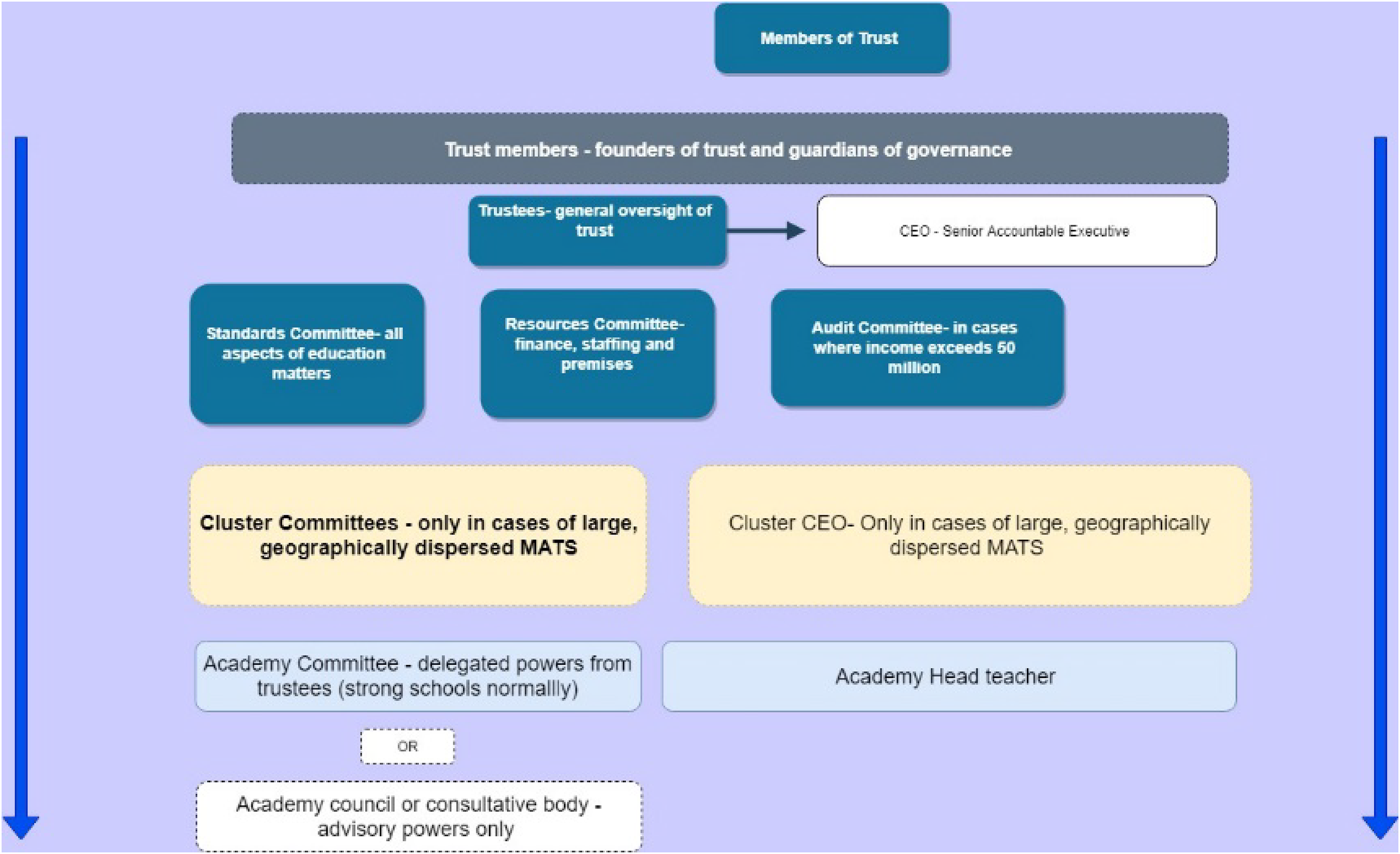
Structure of multi-academy trust governance adapted from Baxter and Cornforth (2021).
According to the DfE, one of the key features of such a scheme of delegation is that ‘it should be drafted clearly so that everyone in the organisation can understand it, in order to be clear about their role and that of others [..], explain the circumstances in which the arrangements set out may vary, and [describe] any triggers that may lead the board to review or change the levels of delegation.’ (DfE, 2019). The Department also describes the SD as a sensemaking tool; a tool for leaders to counter the high levels of ambiguity and uncertainty that emerge when organisations join forces to collaborate (DfE, 2019; Vaara, 2003). Research illustrates that the use of formalisation documents such as the SD are key elements in the micro and macro organising tools of sensemaking, yet it is an under-researched area, particularly in relation to power issues that arise while individuals make sense of their organisations (Brown et al., 2015). Vlaar et al. (2006: 1620) argue that such documents trigger four key mechanisms in relation to sensemaking:
The focus of attention directing sensemaking focus. As stimulus for articulation, deliberation, and reflection. As documents over which actors may interact in the process of sensemaking. As a place in which biases, judgement, errors, completeness and consistency in sensemaking can be articulated and contribute to sensemaking processes.
Their model is important in linking these mechanisms to the sensemaking processes within collaborations, in several ways: the partners within the collaboration; interorganisational relationships and the contexts in which these relationships are embedded. They also argue that formalisation documents are used by organisational leaders to overcome or minimise differences in culture, size, background, and to overcome discontinuity and uncertainty in the early stages of collaboration.
Weber and Glynn (2006: 1640), drawing on Hedstrom and Swedberg’s study (1998), argue that as sensemaking both constitutes and is constituted by organisations, investigating the macro (organisational level) activities along with the micro sensemaking activities of actors is key to understanding how one influences the other. Their model rests on the institutional capacity to prime, edit, and trigger sensemaking activities, in which, priming acts as a cognitive constraint on sensemaking; editing is the act of internalisation of particular understandings; and triggering is the act of embodying particular institutional ways of seeing the organisation (and, to a certain extent, the world as embodied by that organisation or in this case, MAT).
Key debates in sensemaking, emphasise not only ‘cognitive dimensions of sensemaking’, but also the linguistic, narrative discourse with its capacity to ‘simultaneously make and unravel sense in organisational settings,’ (Brown et al., 2015: 268) provide powerful insights into sensemaking processes. This is echoed in education research, which uses a narrative to create a ‘landscape of consciousness’, beyond the ‘landscape of action,’ (Bruner, 1996: 231), bringing certain elements into focus, while obscuring or negating others. Sensemaking using Vlaar et al. (2006) and Weber and Glynn’s (2006) study has been used to understand how collaborations use documents and artefacts to create order across these organisations; bringing strands of both elements of study together in this article, offers a useful way to understand whether and to what extent SDs may be used to fulfil this function.
This article uses a narrative approach to sensemaking to test how SDs are being used by boards to make sense of school collaborations and to clarify roles within them, and whether, as such, they are a useful tool to effectively promote sensemaking and understandings in interorganisational relationships in MATs. Combining two key models of formalisation in sensemaking, described earlier (Vlaar et al., 2006; Weber et al., 2006), it investigates; what level of consistency there is between MAT SDs? what evidence there is that SDs align with the model proposed by Vlaar et al. (2006) and promote priming, editing, and triggering processes, outlined by Weber and Glynn (2006); and, what do the findings imply for the use of SDs as sensemaking tools in MATs? In doing so, it furthers the understanding of these complex and multi-faceted organisations.
Context
Boards in English schools
In England (education is devolved in the rest of the UK), the trend to link education strongly with economic competitiveness has exponentially increased since The Black Papers of the late 1960s. They placed increasing pressures on the education sector not only to perform but also to demonstrate performance through league tables, inspection criteria, and a raft of other measures designed to monitor performance, ensure value for money, and convince the parent – as a consumer of education – that in the market place of education, their school was performing (Ozga and Segerholm, 2015). The trend to marketise and use statistics to measure educational quality has been illustrated to be highly problematic internationally, for example, reducing democratic local control of education (Greany, 2018), placing power in the hands of a small number of trustees and executives (Baxer and Floyd, 2019), and failing to bridge the performance gap between different socio-economic groups of learners (Francis et al., 2020).
Powers delegated to the academy school level vary greatly between MATs, presenting two challenges: the first, effectively integrating individual schools into the organisation; the second, ensuring that governing boards at all levels understand their role and powers. Successful integration of a new school into a MAT often depends upon why the school joined the trust in the first place. As discussed earlier, failing schools may be mandated to join a trust by the DfE, or they may have elected to join a trust, either to gain support and back-office services – that because of cuts are often no longer provided by LAs – or to avoid takeover by predatory trusts that may impose their own model on schools, regardless of local school context and climate (Greany and Higham, 2018). One hundred and fifty English LAs currently act as strategic lead for the education of children and young people, but because of the number of academies and MATs in some areas, school improvement departments attached to the LA have closed down (LGA, 2019). Some schools join trusts because of opportunities offered by the organisation: an ethos that matches their own or the opportunity to gain expertise in areas they lack (Baxer and Floyd, 2019). Whatever their reasons, their roles and responsibilities and boards change considerably on joining, as we explain in the next section.
Duties of a school board
In England, school boards have been in existence since the early 19th century; their duties revolving around the fiduciary oversight and monitoring of schools. The 1970s heralded a more democratic approach to governance, with representatives from the community, local government, and for the first time, the parent body (Baxter, 2016). The 1988 Education Reform Act allowed schools, for the first time, to break away from LA control, and from the mid-1990s, lacking LA support, those schools began to adopt a skills-based approach to governance. This more closely resembled corporate models – recruiting people for business skills, such as finance, HR, and marketing (Thody and Punter, 2000). With these changes, the powers and responsibilities of governing boards increased exponentially as boards were interpellated as agents of government oversight (Baxter, 2016): their responsibilities were set out in various editions of the Governors’ Handbook (DfE, 2019a). This important shift reflected a changing accountability regime in which boards would become instrumental in holding schools to account, while the ‘middle tier’ of educational accountability – the Local Education Authority – would see a steady diminution in the scale and shape of their powers within the system (Bagarette, 2011; Wilkins et al., 2021).
Uncertainty and ambiguity in collaborative organisations
As Mandell and Keast (2007) report, the ways in which collaborations tackle collaboration issues are key to their success; but as Agranoff argues, ‘collaborative decisions or agreements are the products of a very particular type of mutual learning and adjustment’ (2006: 59). Research into such organisations indicates that overcoming initial assumptions and organisational hegemonies, based on understandings of the organisation before the collaboration, is one of the greatest challenges for them (Huxham and Vangen, 2013). In MATs, misunderstandings and the lack of understanding of how schools fit into the overall organisational picture are well documented (Greany and Higham, 2018). Communication between levels within the organisation is also key to overcoming risk, assisting parties in defining and redefining ‘the terms of their independence’ (Vlaar et al., 2006: 66). According to the Governance Handbook (DfE, 2019), effective governance should provide confident and strong strategic leadership, which leads to robust accountability, oversight, and assurance for educational and financial performance. All governing boards, no matter what type of school or how many schools they govern, have three core functions:
Ensuring clarity of vision, ethos, and strategic direction. Holding executive leaders to account for the educational performance of the organisation and its pupils, and the effective and efficient performance management of staff; and Overseeing the financial performance of the organisation and ensuring its money is well spent (DfE, 2019, 1.1.2).
Elements for effective governance according to DfE guidelines are outlined in Figure 2.
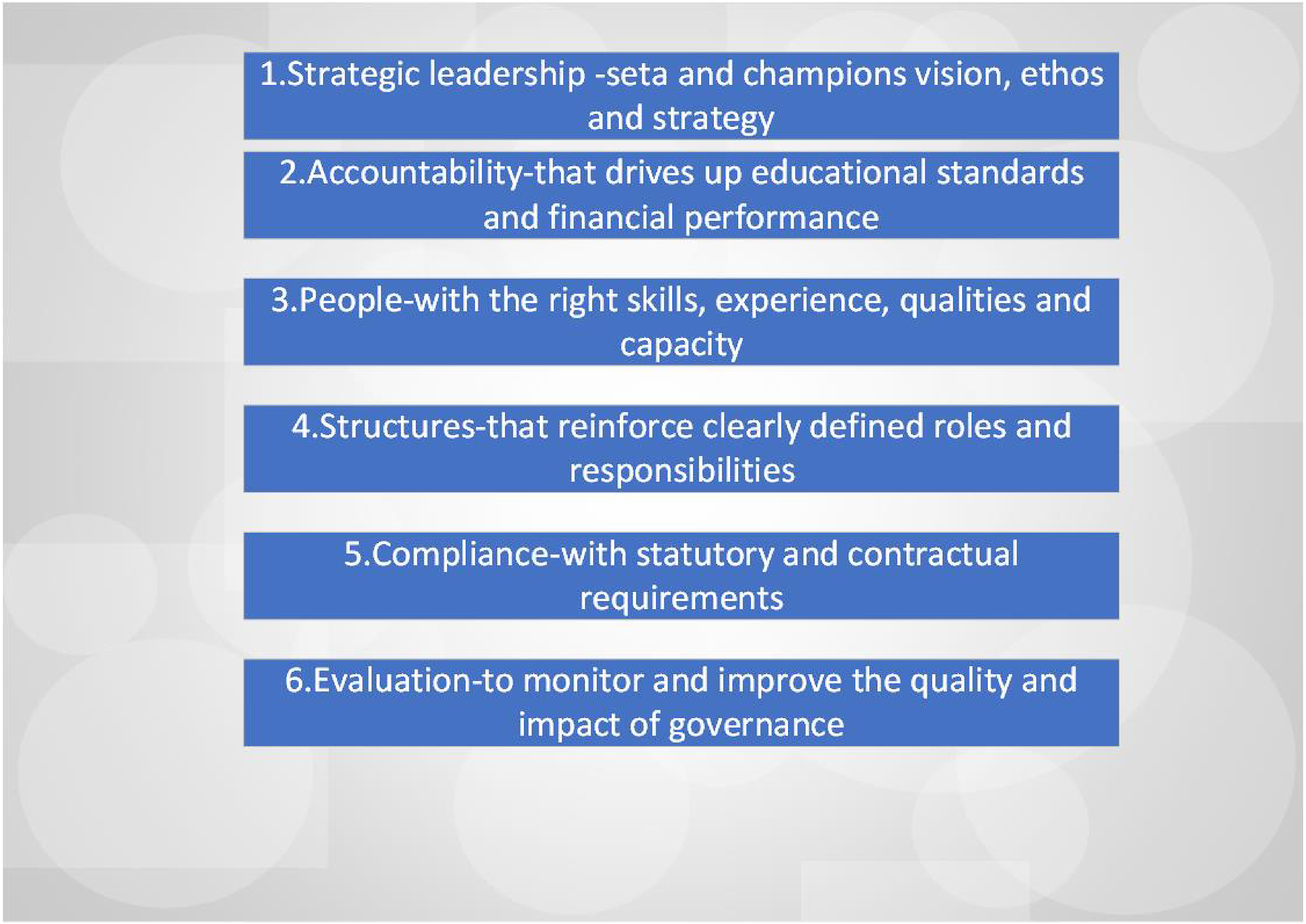
Effective governance of governing bodies.
The challenge for MATs is how, given the multilevel nature of the organisations, they will achieve the six elements for effective governance outlined in Figure 2, as well as ensuring the three core functions above.
SDs as formalisation tools in sensemaking
As our introduction outlined, there are a number of reasons why schools may join a MAT. Research into MATs indicates that many boards are not fully aware of the implications of collaborating in this way, even if they join an organisation voluntarily. For example, they may not realise the degree of curricular standardisation they will need to abide by, or that some/all of their decision-making powers may be removed (Baxer and Floyd, 2019). During this sensemaking process, ‘individuals exchange gossips, stories, rumours, and accounts of past experiences, and take note of symbolic behaviours.’ (Balogun and Johnson, 2004: 524). Gaining an understanding of the organisation and its place within it is even more demanding for governing boards than it may be for staff – as governing boards essentially sit on the periphery of the organisation. Our previous research indicates that communication between levels of the board is not always particularly effective and that trustees often feel ‘cut off’ from the schools within the trust, as well as being unclear about their particular roles (Baxer and Floyd, 2019).
The DfE advocates the use of SDs to ‘generate a professional ethos across the entire governance structure and a culture of one organization and away from any sense of “my school/your school”.’ (DfE, 2019a). It also indicates that SDs are flexible and may change as the MAT grows.
As a result of the discussion above, we argue that in the case of MATs, SDs can be considered to be formalisation tools: as to whether they engage the type of sensemaking activities that build bridges between levels of governance in the organisation, are a key research question for this study. To further elaborate our theoretical framework, we next turn to an explanation of the mechanisms of formalisation tools in sensemaking.
Mechanisms for sensemaking
Vlaar et al. (2006: 1623) describe the first mechanism through which a particular document enables sensemaking, as focusing attention in which, ‘participants in interorganisational relationships display a joint focus…on formal documents and processes, which renders formalization a focusing device’. This is then followed by articulation, deliberation, and reflection, whereby parties are forced to articulate their individual and mutual goals, during the [document forming] process (1624). They also argue that this helps participants to, ‘lift equivocal knowledge out of the tacit, private, complex, random past, and to make it explicit, simpler, ordered, and more relevant.’ This, in relation to schools that have been long established as independent entities, would be crucial if this were indeed the case. The third mechanism is instigating and maintaining interaction. This stage is particularly evident in study on strategic change or reorganisation, such as that of Balogun and Johnson (2004), who looked at sensemaking during an imposed shift from hierarchical to decentralised organisation, found that instigating and maintaining interaction was vital in order for the change to take place successfully. The fourth mechanism, reducing biases, judgement errors, incompleteness, and inconsistency, denotes the extent to which formalisation reduces individual biases by confronting assumptions and revising them in light of new information and interests. According to a number of reports, it also allows the opportunity for relevant information to be considered in decision-making circumstances: this arose during our previous study on communication in MATs, when boards suddenly become aware of new information emanating from particular schools, which subsequently altered their expansion ambitions (see Baxer and Floyd, 2019).
Discourse and sensemaking
In this study, we refer to discourse as both mirroring and creating social reality as well as both creating and reproducing norms: What Bourdieu (1991) calls habitus-socialised norms or tendencies that guide behaviour and thinking. In discursive fields – in this case MATs – different forms of knowledge may compete with one another in a space of practice; helping to define and give meaning to its practices, relationships, and claim the authoritative status of truth, becoming accepted and authoritative in relation to institutional knowledge.
To fully explore the use of SDs as formalisation tools, we also incorporate Weber and Glynn’s (2006) priming, editing and triggering, into our conceptual model (Figure 3), in which, priming acts as a cognitive constraint on sensemaking; editing is the act of internalisation of particular understandings, and triggering is the act of embodying particular institutional ways of seeing the organisation(and, to a certain extent, the world as embodied by that organisation).
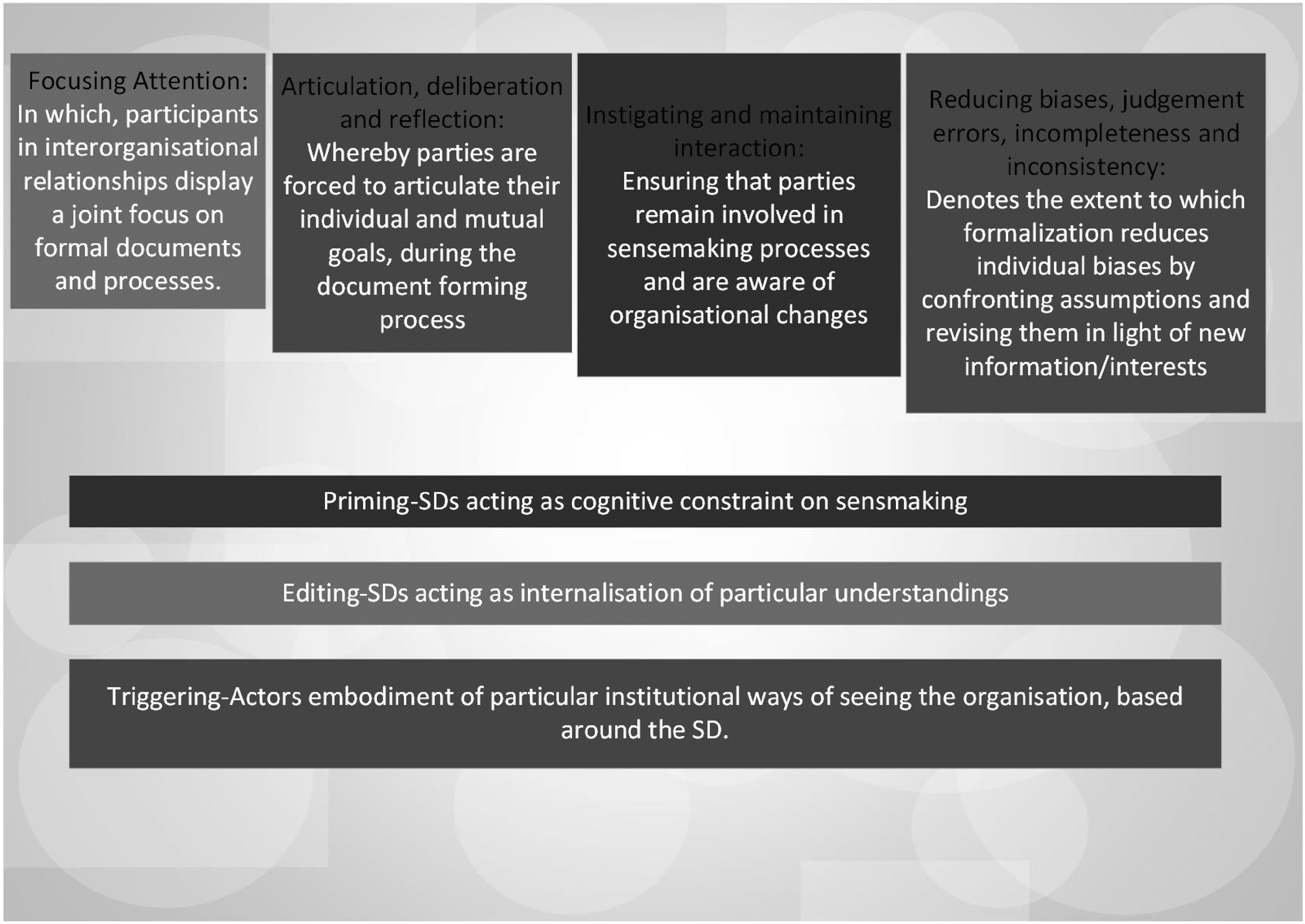
Theoretical framework.
We then test this adapted model using the method that follows.
Method
To first build up a picture of the degree to which SDs are homogenous in relation to the powers of both trustee boards and local school boards, we analysed 20 SDs. This provided us with a background to evaluate the degree to which sensemaking would be necessary when schools join a trust, and to offer a context for the research (Figure 4).
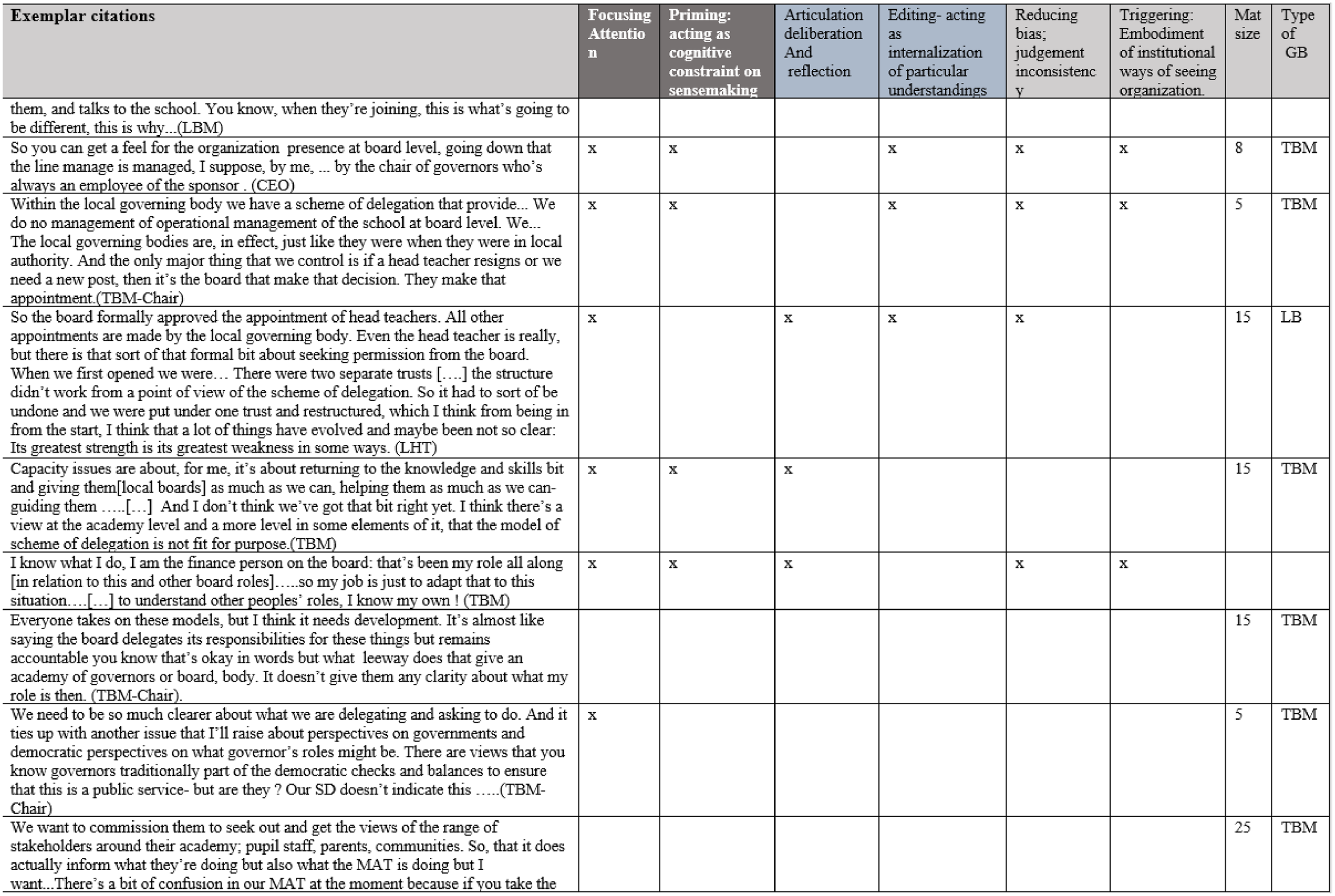
Exemplar sense making quotes.
To gain access from MATs, permission was sought from gatekeepers (normally chair of the trust or CEO) to take part. As the study focuses on SDs as formalisation tools, it does not differentiate responses according to geographical location or size of MAT. However, in order to provide a balanced overview of MATs in England, six MATs were based in the North of the country and six in the South. (Whatshalfway.com borders between North and South).
Interviews were drawn from an opportunity sample of 12 MATs which were selected using existing contacts (see, e.g. Appendix 2). The sample contains both sponsored and converter academies, but this article does not distinguish between responses from each; as our primary goal was to evaluate whether and to what extent SDs are used as formalisation tools in MATs, regardless of whether they are converter or sponsored.
Data were gathered from 50 1-hour semi-structured qualitative interviews with board members over the period 2018–2020.
Participants included (a) TBMs at the apex of the organisation with overall responsibility for the governance of the MAT and (b) Academy Board Members (ABM), located in individual schools and who possess delegated powers from the trustee board, and which, vary in scope and range according to the MAT's scheme of delegation. Participants were self-selecting and invited to participate via the CEO or Chair of Trustees.
Narrative
We employed a narrative methodology to investigate the qualitative data. We chose this method as narrative analysis has the capacity ‘to see what is agreed upon by all organisational members, that which is shared only within certain groups, and that which is fragmented and ambiguous’ (Elliot, 2005: 1149). For this reason, it has been employed successfully in sensemaking studies (Abolafia, 2010). We acknowledge that the narratives are both productive and tension-filled, as individuals and groups work through processes and power struggles to create strategic narratives that create organisational discourses; and are either rejected or become accepted into organisational cultures. Narratives can also convey information that would not be understood or accepted if conveyed directly in literal and explicit terms (Polkinghorne, 1988). In their capacity to link both events and understandings, they provide an effective tool for the analysis of sensemaking activities (Brown et al., 2015), and we have used this method effectively in previous studies of governing boards (Baxer and Floyd, 2019). As this study is investigating particular types of sensemaking, we are interested in how individuals use SDs as sensemaking tools and are looking for evidence of the four key areas outlined by Vlaar et al. (2006), while also exploring the narratives for the evidence of priming, editing, and triggering, as they appear in our theoretical framework (Figure 5).
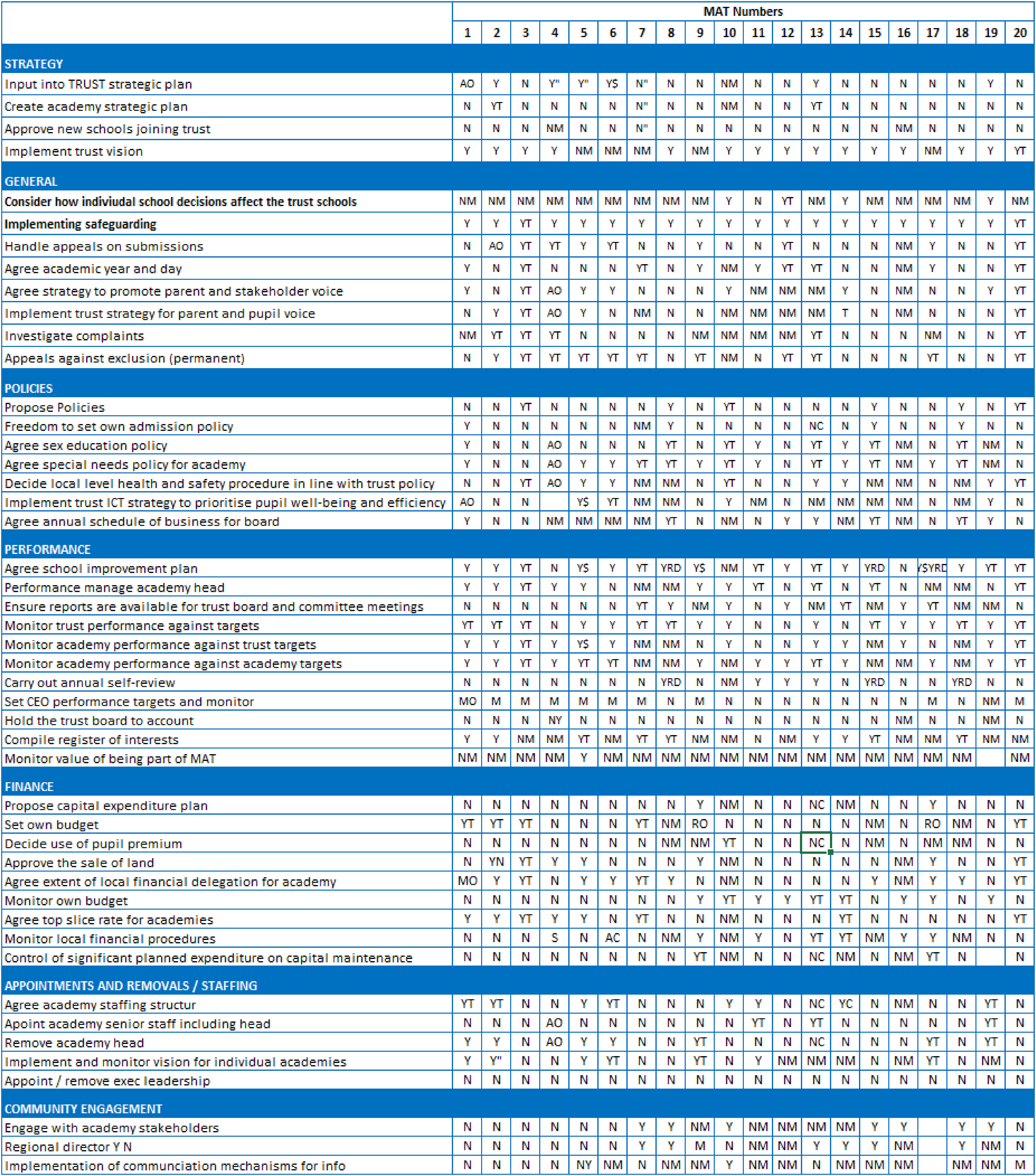
Analysis of schemes of delegation (SDs).
Findings and discussion
This section follows the conventions found in much narrative research, in that it combines the findings with a discussion to respond to the research questions (Barnett-Page and Thomas, 2009).
Is there any level of standardisation in relation to SDs?
The SDs from 20 MATs were first analysed to evaluate to what degree they are homogenous. This is key to indicating how much trustees and LBMs may assume about their responsibilities and duties on joining a MAT, for example, if we found that SDs were largely homogenous, then we may be able to assume that board members at both trustee and school level may already know what their responsibilities were. Although this is not a given, as past research indicates, school governors frequently underestimate the scale and nature of their responsibilities (James et al., 2014).
The evaluation of 20 SDs, illustrated in Figure 4, revealed several factors that may impact on sensemaking activities:
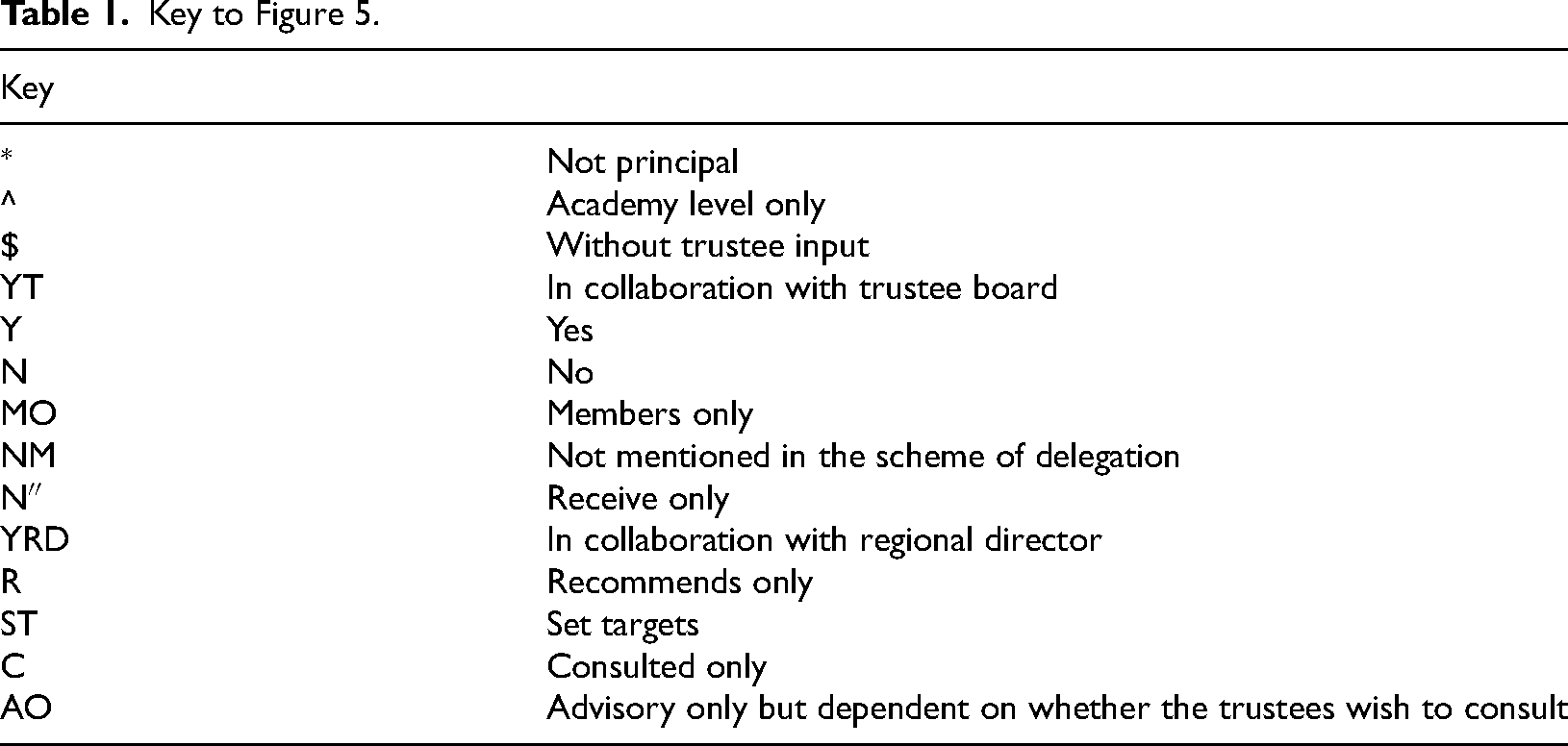
As the key indicates, different levels of discretion are awarded to local boards, for example, in relation to agreeing on a school improvement plan, the key indicates that in MATs 1 and 2, the response is a ‘yes’, but in MAT 3, this is only in collaboration with trustees; in MAT 8, responses indicate that this should only take place in collaboration with a Regional Director, while in MAT 10, there was no mention at all of this duty. Added to this complexity, is the fact that many boards, as mentioned in point 2, change their SDs as new schools come into the trust, and in response to performance issues. Many elements mentioned by some MATs are not mentioned by others, for example, several SDs make no mention of the performance management of the academy head; several SDs make no mention of holding the trust board to account.
Our findings from this research indicate that there is a great deal of ambiguity within the governance of MATs, both for trustees, in relation to which powers are delegated to local boards. Some SDs award so few powers /duties to local boards, that their work could hardly be called governance at all. Across the board, nearly all SDs allocate substantially less power and autonomy to local boards, than those boards would have had as single stand-alone schools. Although some are recreated from scratch when schools join a MAT, the boards in this sample all contained some members from the original school-level boards in place, prior to joining the MAT.
This effectively means that within our sample, local boards coming into a MAT need to make sense of their new context and powers, while comparing these to their duties and powers in the past. In this case, powerful norms compete with new understandings to create ambiguity, and in some cases, resistance to the new context. Our sample contains a mixture of BMs who came from previous school boards (more broadly), have been recruited as new to the organisation or those who were on boards of schools that have joined the MAT. The sample is too small to discriminate between categories, and a comparison is out of scope for this article. However, this would be an interesting line of inquiry for future research.
From this and in relation to the need and background for sensemaking:
Norms around powers allocated to governing bodies may still be dominant in standalone academies that join a MAT. This will, in terms of sensemaking, create a situation in which old norms compete with new understandings, creating ambiguity, and in some cases, resistance. Differences in duties of local boards and trustees are difficult to convey to volunteers on recruitment, because of complexity and changes as new schools join the trust. It is, therefore, imperative to have some mechanism by which boards (local and trustee boards) remain able to make sense of their changing roles. Schools may be struggling to retain their autonomy within the wider organisation.
How does the model help to illuminate the complexities of the relationships between trust boards and local governing bodies (LGBs)?
Table 1 The narratives were analysed for themes relating to the six areas outlined in Figure 5 and repeated below. Exemplar citations for each are shown in Figure 6 and the remainder in Appendix 3. These are each discussed in the section which follows. A critical analysis of the model is discussed later in the article.
Key to Figure 5.
Focusing attention and priming
Sixty percent of respondents indicated that boards focused on their SD as a way to understand the organisation and its dependencies. This supports Vlaar et al.'s assertion that they use the SD to clarify, ‘whether decisions need to be made and what that decision might consist of’ (Weick, 2001 in Vlaar et al., 2006: 1623). A considerable number of respondents at the trustee level referred to the SDs as a means of clarifying the future strategy of the organisation as well as controlling standards. Interestingly, a number of participants used the SDs as a metonym for the organisation, for example, ‘at the moment, the provision of anything… [is done by] clusters, they call them improvement clusters. That's okay, providing you have the skills and the abilities within that cluster. (TBM-Chair)’. In this case, the Chair of Trustees is referring to cluster boards, which often sit between trustee boards and local boards in MATs, which are geographically widely dispersed (Figure 1). There were considerably more TBMs that referred to the ability to revise SDs than did LBMs: this is perhaps unsurprising, as many LBMs felt that they were not able to engage in such discussions, as this power was wholly left to trustees (this is discussed in more detail in the section on Editing and Triggering). Trustees used the SD to reduce the apparent complexity of the organisation. This supports Putnam and Cooren (2004), in creating a discourse of coherence around the organisation, what Putnam and Cooren (2004: 324) term, ‘the recursive property of texts,’ to constitute an organisation. In this way, the texts represent not only the ‘here and now’, but also the ‘there and then’. The SDs is used by trustees to indicate the present state of the organisation as well as looking at the ways that the SD – a metonym for the organization – may change in the future. In doing so, there is evidence that they also act as a cognitive constraint on sensemaking. This is discussed in relation to priming in the section which follows.
Priming
As Weick (2001) argues, schema or perceptual filters lead actors to extract cues that activate identities and role expectations for particular organisations. In relation to boards, this means that SDs would have the power to, ‘set in motion, sensemaking processes that cumulate in overall situational framing and identity, which in turn, carry implications for action and further attention.’ (Weber and Glynn, 2006: 1648). They would need to offer cues as to the particular behaviour required of occupational groups within the organisation. As Weber et al. (2006) point out, the link between noticing cues and the action or internalised behaviours is not easy to analyse, because of the complex relationship between them and the identity of the actor. This is exemplified in this quote as one LBM points out: ‘We don't sit down and say, let's look at the scheme of delegation and sort out what we do, it kind of gets passed on (LBM).’ This statement is a good example of the ways in which roles indicated by the SD become internalised by individuals and part of the culture, as this TBM Chair points out: ‘The SD gives freedom, but not in terms of culture and ethos. The first two schools that joined were x and y. They were independent trusts, so standalone academies. So, there was very little connection between them. The only thing that they were driven by was a sense that we need to get the standards up and we need to sort of try and embed some of our cultures around the place and the SD was key to this (TBM Chair).’ Weber et al. (2006: 1468) argue that ‘priming differs from internalised cognitive constraint because the situational context that supplies the cues plays a greater role in action formation’. But as Weick (2001) points out, the cues ‘build the language,’ within which, actors make sense of their roles (or the converse). Some participants indicated that the SD constrained their agency in not permitting them to be part of or make certain decisions as this LBM points out: ‘and I think as a board, I think to a degree we’re excluded from it, primarily because that conversation seems to go on with executive… Well, it goes on at the operational between executive heads and CEOs. You know, they know what to do now, you know? They will say that they’ve had an approach, and the decision is then always made by the board. It's the board's decision’(LBM). Certainly, the SDs primed a particular power relationship between TBMs and LBMs, with the locus of power firmly in the hands of the trustees, as this TBM reports: ‘I think there is work to do around making sure that local governing boards are working to the same strategic priorities and reporting all their local priorities, you know, the context of their work locally to the trust board. Because I’m not sure that happens in a huge number of cases, but the scheme of delegation should make that clear, if they (local boards) ever read it’ (TBM). The priming actions of the SDs that appeared in the narratives of TBMs contained a number of references to the subordinate role of LBMs, to carry out the work set by TBMs. There was no evidence within the data, of any feeling that LBMs should be holding TBMs to account for the performance of the trust, even though LBMs are viewed predominantly through the narratives, as parent advisory bodies. This is interesting in terms of the ways in which the SDs prime actors change their cognitive schema from a traditional understanding of the role of local boards (or individual school boards as they once were, to that of an LBM within a MAT. For five of the actors at LBM level, this change was not welcome, for example, this individual states, ‘we don't have any of those responsibilities, so we just discuss what's going on in the school – we don't really communicate with parents much – the trust do that I think’ (LBM). Although, where this was the case, there was little evidence of resistance among participants, but rather a disappointed acceptance of the status quo. This is discussed further in the section in which we deal with triggering or embodiment of institutional ways of seeing the organisation. There were also only two incidences of the SD acting as a catalyst for articulation, deliberation, and reflection, as we discuss in the following section.
Articulation, deliberation, and reflection
Weick (2001) argues that bringing together ideas and organisational goals on paper prompts actors to think more deeply and deliberate beyond what he terms to be ‘general understandings’. Goffman (1974: 345), argues that such documents have the capacity to ‘break an actor's frame of understanding, ‘ but that this can only be achieved under certain circumstances, depending on how involved the individual feels, with the particular focus of the document. SDs would seem to be an ideal site for the deliberation and reflection on organisational structures, strategy, and decision-making. But previous research on strategy making in organisational collaborations, indicates that organisations that collaborate often become bound up in their own issues, with little concern for the whole (Huxham and Vangen, 2013). There is evidence that TBMs use the schemes to articulate how they want the MAT to function, but little clarity is provided in relation to actual roles, as this TBM Chair points out: ‘everyone takes on these models, but I think theyneeds development. It's almost like saying the board delegates its responsibilities, but it doesn't give them any clarity about what my role is then (TBM Chair). This study echoes our previous findings, that SDs are linked to deliberation about the future of the trust and its strategy; however, this is purely confined to TBM; being all, but absent at LBM level (Baxter and Floyd, 2019).
In summary, only 35% of respondents indicated that SDs were used in formalisation in relation to deliberation or reflection, and of those, all were members of trustee boards, rather than LBMs. Furthermore, a number of TBMs indicated that the hierarchy outlined and reinforced by the documents, actively discourages LBMs from involvement in such discussions.
Editing: Internalisation of particular understandings, and triggering embodiment of institutional ways of seeing the organisation
In many ways, internalisation of particular understandings and triggering or embodiment of institutional ways of seeing the organisation, have in their roots, similar gestation, both intrinsically linked to power (Baxter, 2016). As the previous sections in this article point out, it is not necessary to read and discuss the SD to be influenced by it and its common language of understandings, assuming symbolic power and creating discourses that align with this symbolism (Bourdieu, 1991). It was not clear from this investigation, how many local boards read their SDs, but what emerged is that a number of respondents at the local and trustee levels have internalised particular understandings, as a result of discourses emerging from narratives around delegated powers. For example, one LBM states: ‘I saw a document, I think it more or less sets out trustee work, I know my role is similar to the last one [as BM in a single school]’ (LBM).
Several respondents at the local level implied that although they were aware of the organisation as a whole, they still primarily saw their function in terms of their particular school, resisting other interpretations; this was particularly true when discussing values and ethos statement: ‘They [the SDs] tell us to promote the values of the trust, but we have those values, I mean, we have them already we’ve always had them’. (LBM)
This article does not compare the responses of schools that were mandated to enter a MAT by the DfE and those that willingly converted. While this would be an interesting line for further inquiry, it is out of scope for this study. However, there is some evidence that some participants entered a trust with very little knowledge of the powers that their school board would have; for example, this individual reports: ‘I don't think we are governors any more, we are advisers… we spread the trust ethos to our school’ (LBM). This LBM board member continued by stating that they thought at first, they would have more powers, but on reflection, was content to leave the trustees to make decisions.
Those who had become trustees, having formerly served on single school boards, did report a sense of loss of contact with school communities; this has been explored in more depth in an earlier study (Baxer and Floyd, 2019).
The narratives reflect that these elements of sensemaking are linked strongly to identity formation in relation to governance roles: participants frequently referred to their duties in relation to SDs, and their perceived amount of power or lack of it; as this respondent illustrates: ‘We aren't governors anymore, we are advisers, we also help to spread the trust ethos to the school (LBM).’ They also display what Abolafia (2010: 349) terms ‘selective retention’ – collective negotiation of policy choice which fits the emerging organisational narrative. This is particularly evident in relation to TBMs who draw from central policy documents produced by the government to justify their own roles in relation to SDs. In some cases, this results in a quasi-paternalistic view of LBMs, as this statement illustrates: ‘Capacity issues are about, for me, it's about returning to the knowledge and skills bit and giving them[local boards] as much as we can, helping them as much as we can- guiding them’ (TBM).
On the whole, examples of instances of editing and triggering appeared in 72% of participant narratives. This would appear to support the SD as a tool for both. However, as the discussion above has revealed, a more nuanced understanding of this, based on schema and also incorporating an identity perspective, may offer a more insightful view of these elements.
Reducing bias, judgement, and inconsistencies
The final category in this study relates to the capacity of SDs to reduce individual biases by confronting assumptions and revising them in light of new information. Although we treat this as a separate category, it is evident from the discussions above that this element permeates all other categories. It is also useful to examine it separately: as already mentioned, existing schema may be very powerful for those who have been working in single school contexts, and the need to be able to adapt and craft understandings for the new context is vital to achieve organisational coherence (Vaara, 2003). In relation to the participants in this study, 82% of the narratives reflected that they do use SDs to resolve inconsistencies, and by offering a visual pictorial image of the MAT and actors’ roles within it, SDs to some extent prompt revisions to some existing schema. In relation to TBMs, they create the ‘logics of appropriateness’ that Ostrom et al. (1991) refer to in their book on organisational politics: that is, they act to create organisational narratives that enhance legitimacy and storify, and thereby, enhance organisational legitimacy. However, as mentioned earlier, SDs are adaptive and change according to the circumstances of the MAT. This means that actors at all levels must adapt and change their understandings as the SDs evolve. This may well account for the considerable amount of ambiguity and uncertainty within the narratives, particularly at the LBM level.
SDs as formalisation tools in collaborative organisations: Practical contributions
The article provides two contributions. First, it elucidates that inter MAT relationships not only entail issues of coordination, control, and legitimacy, but also problems of understanding, originating from the differences between cooperating parties, and from the ambiguity and uncertainty that tend to prevail in the early stages of interorganisational cooperation. This description of cooperative endeavours conforms to Weick’s (2001) accounts of complex, ambiguous events, and it complements more conventional perspectives on interorganisational governance prevailing in the literature by challenging the assumption that participants in these relationships have clear images of their partners, the relationships in which they are engaged and the contexts in which these are embedded. Second, it capitalises on Weick’s (2001) contributions in this area to develop a richer and more comprehensive notion of the relationship between formalisation, sensemaking, and problems of understanding than has hitherto been available in the literature on MATs. In particular, the article argues that whilst SDs are used in various ways in the sensemaking process, the ways in which they are used differ according to who in the organisation is employing their use. This research has shown that while they are valuable in reducing bias and resolving inconsistency and editing previous understandings, this sample reflects that this is very often a top-down activity. In terms of their power to aid organisational sensemaking, we conclude that again, although they go some way to resolving inconsistencies within organisational understandings, they are more useful as tools for central teams who wish to impose particular understandings and power hierarchies on organisations within the collaboration. This finding implies that while formalisation documents are very useful, collaborations need to be aware that they close down as well as open up discussion and may cause resentment and concomitant, lack of trust among partners within the MAT, contributing negatively to their long-term sustainability.
Supplemental Material
sj-docx-1-ema-10.1177_17411432211051907 - Supplemental material for The scheme of delegation as a sensemaking framework in multi-academy trusts in England: Useful tool or constraint?
Supplemental material, sj-docx-1-ema-10.1177_17411432211051907 for The scheme of delegation as a sensemaking framework in multi-academy trusts in England: Useful tool or constraint? by Jacqueline Baxter and Katharine Jewitt in Educational Management Administration & Leadership
Footnotes
Declaration of conflicting interests
The author(s) declared no potential conflicts of interest with respect to the research, authorship, and/or publication of this article.
Funding
The author(s) disclosed receipt of the following financial support for the research, authorship, and/or publication of this article: This study was supported by the Leverhulme Trust (grant number SG161312).
Supplemental material
Supplemental material for this article is available online.
Author biographies
 . Her latest book is Trust, Accountability, and Capacity in Education System Reform (Routledge, 2020).
References
Supplementary Material
Please find the following supplemental material available below.
For Open Access articles published under a Creative Commons License, all supplemental material carries the same license as the article it is associated with.
For non-Open Access articles published, all supplemental material carries a non-exclusive license, and permission requests for re-use of supplemental material or any part of supplemental material shall be sent directly to the copyright owner as specified in the copyright notice associated with the article.
