



Abstract
The present study aimed to investigate elementary school principals’ self-reported causes of work-related stress, their coping strategies to deal with stress and the support they need for their leadership. Seventy-six principals filled in the questionnaire, which included open-ended questions. Qualitative content analysis was used to analyse the data. The results showed that the main sources of stress were workload, interpersonal conflicts, a lack of resources and internal pressures. Moreover, principals used emotion-focused, problem-focused and social coping to deal with stress. Additionally, principals reported a need for problem-focused support and social support for their leadership. The results revealed the importance of social support and coping for principals’ occupational wellbeing. A more intimate approach to principals’ perceptions about the causes of occupational stress, their coping strategies and the support they need provides opportunities to consider diverse personal requirements, which may be fundamental in promoting principals’ occupational wellbeing.
Introduction
Principals play a key role in ensuring the quality of school functioning and teachers’ and students’ wellbeing at school (Darmody and Smyth, 2016; Radinger, 2014). However, over the last two decades, the role of the school principal has evolved, becoming exceedingly more complex and demanding with a range of new responsibilities in addition to the existing ones (Beausaert et al., 2016; Chaplain, 2001; Engels et al., 2008). They must carry out a great number of administrative, instructional, managerial and pedagogical tasks while handling daily issues that arise in schools (Beausaert et al., 2016; Darmody and Smyth, 2016). Additionally, as society has become more complex, schools now play a more prominent role in the community in response to the diverse needs of students and their parents, which might increase the pressures on principals as well (Darmody and Smyth, 2016). Furthermore, a decrease in central regulation and an increase in school autonomy have extended principals’ responsibilities and, at the same time, increased the number of management domains they must account for (Engels et al., 2008). Therefore, it is not surprising that an international survey of principals’ health and wellbeing conducted in four countries – Australia, New Zealand, Ireland and Finland – found that school leaders experience significantly higher stress than the general population, mainly due to the sheer quantity of work and limited time to focus on teaching and learning (Riley, 2015, 2017, 2020; Trade Union of Education in Finland, 2020). Researchers have recognised the importance of gaining a deeper understanding of the causes of principals’ occupational stress and aspects they deem beneficial for their wellbeing at work (e.g. Beausaert et al., 2016; Darmody and Smyth, 2016). For example, according to Engels et al. (2008), many principals may feel that they lack the competencies to cope with the established performance standards, have too many different tasks to complete at work, and the available support from the working environment is insufficient. However, research on principals’ wellbeing is still limited, and most extant studies have used surveys and established scales to assess principals’ stress and wellbeing (e.g. Beausaert et al., 2016; Darmody and Smyth, 2016; Riley, 2015, 2017, 2020). Moreover, considering the rapid changes in principals’ work, it is important to investigate principals’ own perceptions about their occupational wellbeing.
In the current study, elementary school principals refer to principals who lead schools that provide compulsory basic education for Grades 1–9. Depending on the educational context, the position of elementary school principal may be described as, for example, head teacher or school administrator, all of whom fill the same kind of leadership role in their schools. In the Finnish context, elementary school principals lead effective organisations that offer basic education and prepare students for entry into secondary level education. Nowadays, comprehensive schools (Grades 1–9 and including pre-primary education) are on the increase, which can be large inclusive school units that have very diverse groups of students with individual needs (Official Statistics of Finland (OSF), 2019). However, elementary school principals’ workloads and stress levels are growing steadily (Kumpulainen, 2017; Leppäaho and Aatsinki-Hämäläinen, 2020). Therefore, the risk of principal burnout is high (Leppäaho and Aatsinki-Hämäläinen, 2020). Despite the growing awareness of increasing pressures on school leaders, less is known about what school leaders themselves consider the most pressing challenges, or, importantly, how they experience these challenges internally (Drago-Severson et al., 2018). Therefore, the aim of the current study is to investigate elementary school principals’ self-reported causes of work-related stress, their coping strategies to deal with the stress, and the support they feel they need for their leadership at school.
Principals’ coping with stress and needed support
Occupational stress and coping strategies
Work-related stress is when an individual feels that he/she does not have enough resources to respond to the pressures, challenges and requirements of work (Curbow et al., 2000). According to Lazarus and Folkman’s (1984) transactional theory, psychological stress is a particular relationship between the person and the environment that is appraised by the person as taxing or exceeding his/her resources and endangering his/her wellbeing. Lazarus and Folkman (1984) proposed that psychological stress is best regarded as a subset of emotions. A stressful situation can be described as one in which a person feels excited, nervous or has difficulties sleeping when something is bothering him/her (Elo et al., 2003).
Previous research has shown that principals experience more stress than the general population (Leventis et al., 2017; Mahfouz, 2020; Riley, 2015, 2017, 2020). Regardless of the educational context, the main causes of principals’ occupational stress seem to be the complexity of their work, the quantitative workload, insufficient time to concentrate on relevant tasks, interactions with different stakeholders, and the lack of social support and recognition. The challenges concerning the complexity of principals’ work are caused by, for example, managing constant change (e.g., Drago-Severson, 2018; Mahfouz, 2020), bureaucracy and a lack of assistive staff (Leventis et al., 2017; Mahfouz, 2020), high work demands with unreasonable expectations (De Jong et al., 2017) and simultaneous teaching and administrative duties (Leventis et al., 2017). The quantitative workload and insufficient time to concentrate on relevant tasks are also noted by researchers (e.g. De Jong et al., 2017; Leventis et al., 2017; Mahfouz, 2020). Tintore et al. (2020) found that interactions with different stakeholders – that is, problems with educational authorities and educational policy, staff, students, families and the school community, and society – are a great cause of stress for principals (see also De Jong et al., 2017; Leventis et al., 2017; Mahfouz, 2020; Pollock et al., 2015). Additionally, Drago-Severson et al. (2018) found that although principals are surrounded by people, and, in some cases, strong support systems, they had feelings of solitary responsibility and weight bearing. Their work-related stress might be caused by feelings of loneliness and a lack of appreciation and/or recognition (Leventis et al., 2017; Mahfouz, 2020). According to Darmody and Smyth (2016), principals’ occupational stress is related to a complex set of personal characteristics, working conditions, the school context and the teachers’ working climate. However, since earlier research on principals’ stress was mostly done via surveys (Darmody and Smyth, 2016; De Jong et al., 2017; Drago-Severson et al., 2018; Leventis et al., 2017; Riley, 2015, 2017, 2020) with ready-made measurement scales, it is important to obtain the principals’ viewpoints in an open-ended style to gain a deeper understanding of the phenomenon.
Coping, in turn, is seen as a complex, multidimensional process that is sensitive to both the environment and its demands and resources, and to personality dispositions that influence the appraisal of stress and resources for coping (Folkman and Moskowitz, 2004). The current research draws on Lazarus and Folkman’s (1984) cognitive appraisal theory of stress and coping (see also Folkman and Moskowitz, 2004; Park and Folkman, 1997). The cognitive appraisal theory posits that the way an individual interprets stressors determines how he/she responds to it in terms of emotional reactions, behavioural responses and coping efforts. Concurrently, individual interpretations are influenced by factors such as personal and social resources as well as characteristics of the stressful experience. Folkman and Lazarus (1980) make a distinction between emotion- and problem-focused coping. They define coping as the cognitive and behavioural efforts made to master, tolerate or reduce external and internal demands and the conflicts among those demands. Cognitive and behavioural efforts serve two main functions: to manage or alter the person–environment relationship that is the source of stress (problem-focused coping) and to regulate stressful emotions (emotion-focused coping; Folkman and Lazarus, 1980). Later, researchers (e.g. Gottlieb and Gignac, 1996; Park and Folkman, 1997) supplemented Lazarus and Folkman’s (1984) theory by identifying meaning-focused coping, a different type of coping whereby cognitive strategies are used to manage the meaning of a situation. Meaning-focused coping was seen as a suitable way for a person to talk about coping efforts by drawing on values, beliefs and goals to modify the meaning of a stressful transaction (Park and Folkman, 1997). Furthermore, social coping was added to the theory later (Folkman and Moskowitz, 2004; Gottlieb and Bergen, 2010), referring to coping responses that are influenced by and in reaction to the social context. It has been suggested that the effectiveness of certain coping strategies is dependent on the specific context, personal characteristics and the situation (Dijkstra and Homan, 2016; Reed, 2016). In addition, Folkman and Moskowitz (2004) found that positive outcomes of coping actions are highly dependent on the characteristics of the appraised stressful encounter (see also Lazarus and Folkman, 1984). In an attempt to address this, Reed (2016) proposed that one important aspect of coping is flexibility, such as using different coping strategies, depending on the stressful situation. Additionally, increasing each individual’s awareness of the effectiveness of coping strategies has the potential to decrease stress and increase occupational wellbeing. However, several researchers (Dijkstra and Homan, 2016; Folkman and Moskowitz, 2004; Lazarus and Folkman, 1984; Reed, 2016) found that the benefits and effectiveness of different coping strategies to reduce stress should be further investigated.
Earlier research on principals coping with work-related stress recognised the importance of social interaction. This could include spending time with family and friends (Mahfouz, 2020) or having good relations and interactions with staff, students and parents (Denecker, 2019). Drago-Severson et al. (2018) described the fuelling power of familial relationships within school as a recharging strategy unique to educators. However, it seems that a balance should be established between work and personal time (Denecker, 2019; Hancock et al., 2019). In the work context, for example, organising one’s work (Boyland, 2011) and setting realistic goals (Denecker, 2019) are described as effective coping strategies. Furthermore, it has been noticed that time management skills are associated with lower principal job stress (Denecker, 2019; Grissom et al., 2015). Another effective coping strategy for principals is having outlets outside work (Mahfouz, 2020). This can be implemented through regular physical exercise (Boyland, 2011), engaging in less active non-work or play activities (Denecker, 2019) and taking care of oneself mentally and physically (Drago-Severson et al., 2018; Hancock et al., 2019). However, a limited amount of research on principals’ perceptions has investigated both occupational stress and coping in the same study (for exceptions, see Boyland, 2011; Hancock et al., 2019; Mahfouz, 2020). Furthermore, as noted above, most previous studies have used surveys offering ready-made measurement scales. Thus, it is important to obtain the principals’ viewpoints in an open-ended style to explain the causes of occupational stress and to describe effective coping strategies in more detail.
Support at work
A number of researchers have highlighted the significance of social support in fostering occupational wellbeing (e.g. Aizzat Mohd et al., 2018; Gottlieb and Bergen, 2010; Ju et al., 2015; Morelli et al., 2015). For example, social support has been found to predict decreased stress among school principals (Darmody and Smyth, 2016). Additionally, the importance of identifying different types and sources of social support and their impact on job-related stress has been investigated (Fenlason and Beehr, 1994; Van der Doef and Maes, 1999). Beausaert et al. (2016) presented three different sources of support for principals: (a) colleagues inside and outside school; (b) supervisor(s) and the broader school community, including parents, alumni and community leaders; and (c) school board members. First, colleagues are an important source of social support, and the quality of relationships underpins all management and plays a key role in school leaders’ stress levels (Chaplain, 2001). Furthermore, cooperation with different partners inside and outside school could be considered an important issue to support school principals by taking responsibility for employment matters, finance and school maintenance and to provide schools with a range of support services (Darmody and Smyth, 2016). Second, relationships with supervisors and clients were found to be one of the major stressors for school principals (Friedman, 2002). In addition, Mahfouz (2020) found that the most challenging relationships in principals’ work were those with upper administrative levels, parents and teachers’ unions. Third, researchers (e.g. Chaplain, 2001; Darmody and Smyth, 2016) have recognised the role of the school board as an effective source of support for principals. Principals’ workloads could be reduced by giving more responsibility and decision-making power to school boards (Chaplain, 2001); however, currently, school boards often rely heavily on principals’ advice and work (Darmody and Smyth, 2016).
In the current study, analysis of the support needed draws on the cognitive appraisal theory of stress and coping (Lazarus and Folkman, 1984), describing emotion- and problem-focused coping, with supplementations from Folkman and Moskowitz (2004), who added social coping to the theory. The model gives us an opportunity to divide support into emotion-focused, problem-focused and social support. Emotion-focused support aims at ameliorating the negative emotions associated with the problem; for example, by engaging in distracting activities or using alcohol and drugs. Problem-focused support comprises addressing the problem causing distress by making a plan of action or concentrating on the next step (Lazarus and Folkman, 1984). Social support draws on seeking or receiving social support from colleagues, supervisors or family and friends, and interactions occurring in social relationships that are subjectively appraised as supportive (Folkman and Moskowitz, 2004; Gottlieb and Bergen, 2010). However, to our knowledge, no research exists on principals’ perceptions of the support they need for their leadership.
The aim of the current study
In the current study, we investigate elementary school principals’ self-reported causes of work-related stress, their coping strategies and the support they need for their leadership. By doing so, the study qualitatively contributes to the existing literature by deepening our understanding of the different factors influencing principal’s occupational wellbeing. Because elementary school principals’ stress levels and workloads are growing steadily (Kumpulainen, 2017; Leppäaho and Aatsinki-Hämäläinen, 2020), the focus of this study is on them. First, we studied self-reported causes of stress in an open-ended style to gain a deeper understanding of the phenomenon most often researched using surveys (e.g. Darmody and Smyth, 2016; De Jong et al., 2017; Drago-Severson et al., 2018; Riley, 2015, 2017, 2020). Second, Lazarus and Folkman’s (1984) theory of stress and coping (see also Folkman and Moskowitz, 2004; Park and Folkman, 1997) was used to describe principals’ coping strategies. As the same theory evidently fitted the data, it was also used to interpret the support principals need for their leadership. This also gave us an opportunity to spot similar factors influencing how principals cope with stress and the support they need for their leadership. The current study provides important insights into elementary school principals’ occupational wellbeing, as to the best of our knowledge this is the first one to investigate these issues together using qualitative methods. The more specific research questions are: What are the work-related stressors that principals experience? How do principals cope with work-related stress? What supportive elements do principals need for their leadership?
The present study was conducted in Finland where each elementary school should have a principal in charge (Basic Education Act, 1998/628; 37§). However, a principal may also be in charge of more than one school. Principals’ work descriptions can vary due to the wide variety of school units, the level of education provided and the organising body. Principals’ workloads involve general administration and pedagogical leadership. Elementary school principals always have a teaching obligation that varies in amount, depending on the size of the school’s student population. The number of assisting staff also depends on the aforementioned, and an assistant principal and school secretary are usually a principal’s closest associates (Kumpulainen, 2017). Principals are required to have a master’s degree and the pedagogical qualification, appropriate work experience, and a certificate in educational administration or the equivalent (Paronen and Lappi, 2018).
Methodology
Participants and procedures
The current study is part of a larger project investigating teacher and student stress and interactions in the classroom (Lerkkanen and Pakarinen, 2016). Principals from 12 Finnish municipalities involved in the larger project participated in this sub-study. The principals were working in elementary schools, delivering compulsory basic education to children in Grades 1–9. Questionnaires were mailed to principals in two cohorts in spring 2018 (78 questionnaires of which 37 were returned) and spring 2019 (137 questionnaires of which 67 were returned). The same principal was included in the study only once; that is, if they answered the questionnaire in both 2018 and 2019, their second response was excluded. This resulted in a total of 76 participants (38 male, 34 female and 4 gender not reported). All participating principals filled in a signed consent form. The participants’ ages ranged from 30 to 65 years (M = 51 years, SD = 7.5). Their teaching experience ranged from 1 to 35 years (M = 17.5 years, SD = 8.9) and experience as principals from 1 to 29 years (M = 11 years, SD = 7.6). From all 76 participants, 69 had a teaching obligation, and the number of teaching hours ranged from 1 to 28 hours per week (M = 12.6 hours, SD = 9.1). School size ranged from 18 to 1030 students (M = 372 students, SD = 290) and the number of staff in each school from 2 to 130 people (M = 38 people, SD = 31). One participant reported leading 5 different schools, 5 reported leading 3, 10 reported leading 2, and 46 participants reported leading only 1 school unit. Fourteen participants did not provide any information about the number of units led.
Measures
Principals were asked to fill in questionnaires, which included open-ended questions concerning stress, coping strategies and the support they need for their leadership. The more precise questions were: What causes you the most stress at work? What ways do you use to cope with work-related stress? What kind of support do you feel you need for your leadership?
Analysis
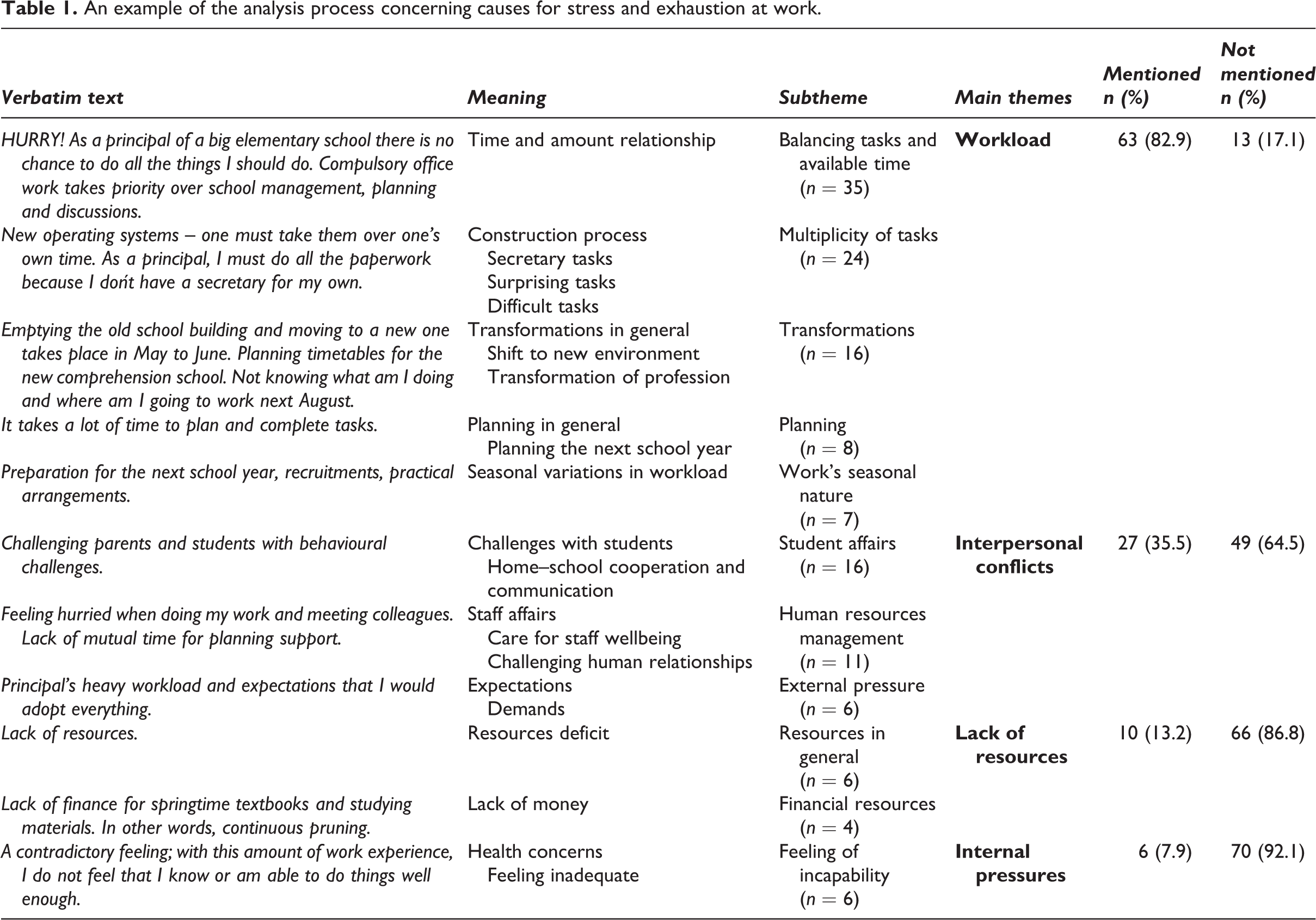
The present study was conducted by using inductive reasoning with content analysis (Krippendorff, 2013; Patton, 2015). Open coding was used to remain open to the data, label concepts, and define and develop themes (Patton, 2015). First, verbatim text units with relevant content answering the research questions were identified from self-reports. Second, existing literature was examined to determine the extent to which the current study’s data supports existing conceptualisations, results and/or theories (Patton, 2015). Consequently, analyses of principals’ causes of stress remained inductive throughout the analysis process (see Tables 1, 2 and 3 for examples of the analysis process, emerged themes and subthemes).
An example of the analysis process concerning causes for stress and exhaustion at work.
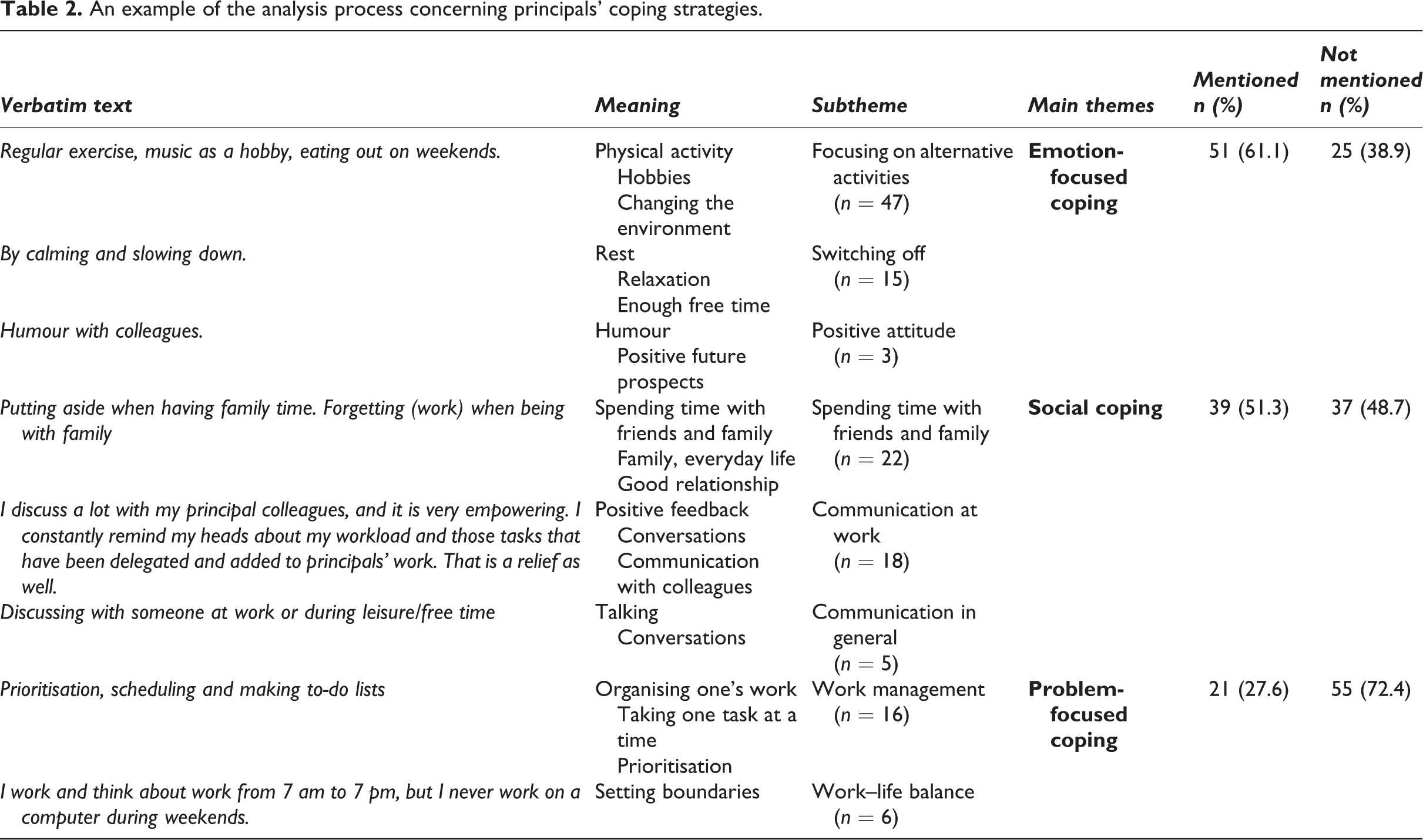
An example of the analysis process concerning principals’ coping strategies.
An example of the analysis process concerning the support principals need for their leadership.
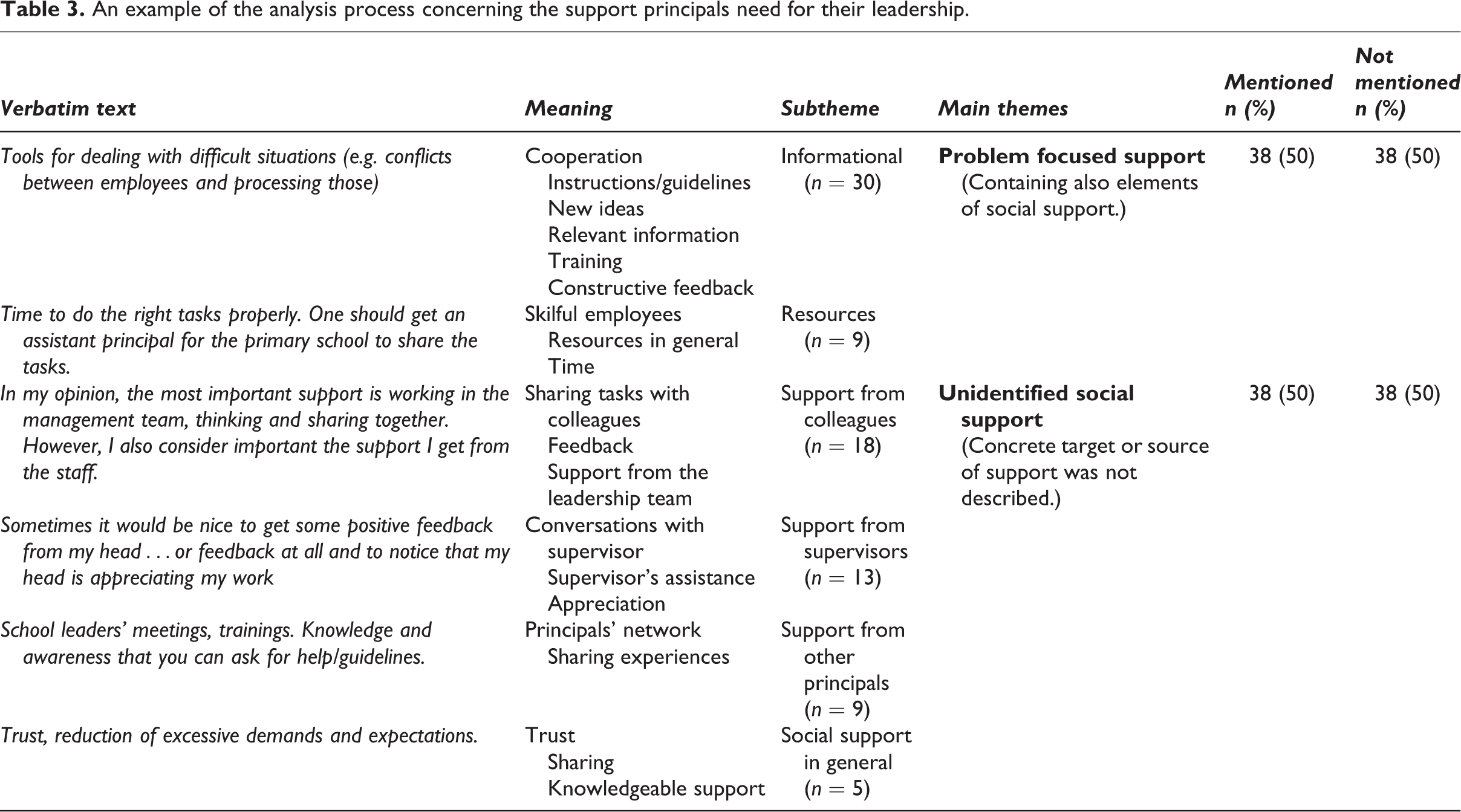
Analyses concerning how principals cope with stress was based on Lazarus and Folkman’s (1984) cognitive appraisal theory of stress and coping on distinguishing emotion- and problem-focused coping and seeing social support as an important coping resource. In addition, based on later supplementations to the theory by Folkman and Moskowitz’s (2004), ‘social factors’ was added as a third category of coping (see Table 2 for examples of the analysis process, emerged themes and subthemes). After the first familiarisation with the data, the analysis on support principals need for their leadership was (similarly to analysis on coping strategies) guided by cognitive appraisal theory (Folkman and Moskowitz, 2004; Lazarus and Folkman, 1984) as it fitted well to our data. As a result of theory guided content analysis, principals’ support needs were divided into problem-focused support, addressing the cause of distress, but also including aspects of social support, and into unidentified social support where the social feature of support was strongly present but the concrete target or source of support was not described (see Table 3 for examples of the analysis process, emerged themes and subthemes). Using the cognitive appraisal theory gave us an opportunity to see whether similar factors influence principals’ coping with stress and the support they need for their leadership. As an example, from an answer about the causes of stress: In addition to my main work, there are a lot of small extra tasks. I don’t really have enough time to concentrate on my main work as much as I would like to. I have a countless number of different roles here, and at the same time, one is responsible for a lot of things. (P32)
In the third phase, intercoder reliability was counted. The first author performed the initial categorisation of verbatim texts; then, the second coder was given the data and the created themes. The second coder read through the data and did the coding based on the themes independently to ensure good reliability of the qualitative analysis. Intercoder reliability between the categorisations was 93%. Finally, the remaining 7% of the data extracts were discussed and categorised by the two coders in cooperation, and the coders agreed upon the most suitable category for these extracts. During the whole analysis, we paid particular attention to not over-interpret the principals’ very brief self-reports. The participants were assigned random ID numbers from 1 to 76 to ensure confidentiality.
Results
Work-related stressors
The first aim was to find out what work-related stressors principals experience. As a result, principals’ self-reported descriptions were divided into four main themes. The main themes were divided into smaller subthemes based on the patterns emerging from the data (Patton, 2015): (a) workload – balancing tasks and available time, multiplicity of tasks, transformations, planning and work’s seasonal nature; (b) interpersonal conflicts – student affairs, human resources management and external pressures; (c) lack of resources – resources in general and financial resources; and (d) internal pressures –health concerns and feelings of incompetence (see Table 1 for examples of developed themes, subthemes and the analysis process).
Workload
More than 80% of principals reported their workload as a cause of stress (Table 1). It seems that most of the participants perceived that the number of tasks exceeded the time available to execute them. For example, P56 described having trouble getting all the paperwork done while simultaneously doing all the planning and administrative work: ‘HURRY! As a principal of a big elementary school, there is no chance to do all the things I should do. Compulsory office work takes priority over school management, planning and discussions.’ Additionally, under the same theme, another principal explained how there is not enough time to concentrate on what was described as the ‘main tasks’ alongside a large number of extra tasks: In addition to my main duties as principal, there are a lot of small extra tasks coming from somewhere. I don’t really have enough time to concentrate on my main tasks as much as I would like to. One must be here and there with a countless number of different roles and responsibilities. (P32) Emptying the old school building and moving to a new one, which takes place in May to June, cause stress. Planning timetables for the new comprehension school. Not knowing what I am doing and where I am going to work next August. (P71)
The final subtheme emerging under workload was related to ‘work’s seasonal nature’. Seven principals described seasonal variations in workloads as causing them stress. For example, P59 reported: ‘Cumulative issues. Sometimes there are no things to handle and sometimes they pile up, for example, during spring and autumn, and planning school events; it is always challenging.’ In addition, ‘accumulation of work between March and May’ was described by P10 as a cause of stress, and P30 added: ‘Spring – it burdens – schedules are too tight, reports after reports.’ It seems that when considering the workload, the end of the spring semester is the most stressful time of the school year for principals.
Interpersonal conflicts
More than 35% of the principals mentioned ‘interpersonal conflicts’ as increasing their work-related stress. This main theme consists of student affairs, human resources management and external pressures. Sixteen participants mentioned student affairs as causing them stress. This subtheme consists of challenges with students and with home–school cooperation and communication. For example, P16 described ‘challenging parents and students with behavioural challenges’, and P32 added: ‘Meeting challenging clients (parents) causes stress. Fortunately, there are only a few of them.’ In addition, principals reported human resources management as a source of stress, or, more precisely, staff affairs, care for staff’s wellbeing and challenging human relationships, as P47 described: ‘Feelings of hurrying my work and meeting my colleagues. Lack of mutual time for planning support.’ Six participants also mentioned external pressures, consisting of external expectations and demands. For instance, P7 described ‘requests to perform tasks for which it has not been possible to prepare in advance nor ask someone to handle those…in this case, you handle these tasks yourself without compensation when budget planning is already done during autumn’ as causes of stress. Similarly, P34 reported ‘principals’ heavy workload and expectations that I would adapt to everything’.
Lack of resources
Approximately 13% of principals mentioned a lack of resources. This theme consists of a lack of financial resources and resources in general; that is, participants did not clarify the type of resource. For example, P64 reported a ‘shortage of resources’ as a stressor. Concerning the lack of financial resources, P5 reported ‘scarce resources for springtime textbook and material orders’, and P14 added ‘the lack of money for study materials’. Furthermore, P30 described ‘children with special support needs’ as ‘demanding’ because of a lack of money to hire assistants.
Internal pressures
Six principals reported experiencing ‘internal pressures’, or, more precisely, feelings and emotions or because of personal health concerns. For example, P39 reported having ‘a contradictory feeling because with this amount of working experience, I do not feel that I know or am able to do things well enough’. In addition, P33 and P49 reported ‘feelings of inadequacy’, without specifying the reason. Furthermore, one participant described ‘certain health concerns’ as a reason for increased work-related stress levels.
Principals’ coping strategies
To answer the second research question, on how principals cope with work-related stress, the data was divided into three theory-based main themes, which were divided into smaller subthemes: (a) emotion-focused coping: focusing on alternative activities, switching off and keeping a positive attitude; (b) social coping: spending time with friends and family, communication at work, and communication in general; and (c) problem-focused coping: work management and keeping work and free time in balance (see Table 2 for examples of developed themes, subthemes and the analysis process).
Emotion-focused coping
More than 60% of the principals reported using ‘emotion-focused’ strategies to cope with work-related stress. In other words, the principals in the current study were attempting to manage emotional reactions to stressors. Concerning emotion-focused coping, 47 participants out of 76 mentioned the ‘focusing on alternative activities’ subtheme. Under this subtheme, participants mentioned being physically active, having a hobby and changing the environment as coping strategies. For example, P40 described regular physical activity as the best way to cope with work-related stress: ‘Physical exercise. The best and working coping strategy, regularly three times per week is enough for handling stress’. P65 added: ‘Leisure time: family, physical exercise, music and “compulsory” tasks of taking care of my own house and forest’ as coping strategies. In addition to being physically active through sports or other physical activities, being in nature and having different non-physical hobbies, such as listening to or making music, doing handicrafts or reading, were also mentioned under emotion-focused coping strategies.
Fifteen participants reported ‘switching off’ after a workday as an effective strategy to cope with work-related stress, as P52 described, ‘calming down and slowing down’ after a workday. Principals also mentioned maintaining ‘a positive attitude’, thinking that ‘tomorrow is a new day, and often it has been’, and having ‘humour with co-workers’. It seems that physical activity and rest often go hand in hand. For example, P16 reported ‘exercise, relaxation, picking up berries and mushrooms in the forest, reading’, and P13 added ‘conversations, exercise and rest’ as coping strategies.
Social coping
More than half of the participants mentioned social coping under coping strategies. This theme consists of spending time with family and friends, communication at work and communication in general; that is, participants mentioned talking to or having a conversation with someone without specifying whom. Support from family and friends was mentioned by 22 participants. For example, P52 described how ‘family and especially my children take my mind off work-related worries’, and P54 added getting support from a ‘well working relationship’. In addition, 18 participants mentioned the ‘communication at work’ subtheme. For example, P75 explained what helps him/her to cope with work-related stress: ‘Conversations with colleagues, making use of the management team’s support and opportunities to share, leisure time with friends and family’. In addition, P2 shared similar coping strategies: ‘Spending leisure time with family. Discussing work stuff with colleagues, sharing tasks’. Furthermore, P9 described a supportive work community with whom you can talk openly about your situation and they will understand: ‘I’d say that when I haven’t been able to take care of things because of some unexpected important tasks, being open about that situation, colleagues do understand.’ Five participants mentioned ‘communication in general’. As an example of this, P16 and P31 mentioned talking as a coping strategy and P13 mentioned conversations.
Problem-focused coping
Problem-focused coping was mentioned by more than 27% of principals, consisting of the subthemes ‘work management’ and ‘work–life balance’. ‘Work management’ was mentioned by 16 participants reporting managing one’s work, taking one task at a time and prioritising as coping strategies for handling work-related stress. For example, P22 said: ‘Prioritisation, fragmenting and working systematically’ are ways to keep the stress level low and under control. In addition, P26 explained: ‘I try to compartmentalise different things and only handle one section at a time.’ Furthermore, P5 mentioned ‘[c]oncentrating on one task at a time’. Six principals saw setting boundaries on working hours as a way to cope with work-related stress. For example, P9 said: ‘I work and think work from 7 am to 7 pm, but I never sit at a computer during weekends’, and P16 explained: ‘I try to finish working by 4 pm and not to work during the weekends’; he/she further revealed delving into his/her ‘own business’ during free time. Three other participants also highlighted the importance of counterbalancing leisure time with work.
Support needed for leadership
Our third aim was to find out what supportive elements principals need for their leadership. Principals’ self-reported descriptions were divided into two theory-driven main themes: problem-focused support: informational support and resources; and unidentified social support: support from colleagues at school, support from supervisors, support from other principals and social support in general (see Table 3 for developed themes, subthemes and the analysis process).
Problem-focused support
Half of the principals mentioned problem-focused support. Under this theme, 30 principals mentioned a need for ‘informational support’ for their leadership, involving cooperation, instructions/guidelines, new ideas, relevant information, training and constructive feedback. For example, P4 mentioned: Discussions and peer support. On the other hand, supervisors’ support when there are no clear directions or guidelines. New administrative programmes should be used without induction. I would like to study leadership, but I can’t handle it in addition to work.
Nine principals reported needing more resources, or, more precisely, skilful employees, as well as time and resources in general; that is, participants mentioned only ‘resources’ without further clarification. Four principals mentioned time as a needed resource; for example, P52 reported needing ‘time to do work properly’, and P56 mentioned ‘time to do the right tasks properly’. He/she also reported needing ‘a deputy principal for sharing tasks in elementary school’. Five other principals also mentioned a need for extra human resources.
Unidentified social support
Half of the participants mentioned unidentified social support where the social feature of support was strongly present but the concrete target or source of support was not described. This main theme was divided into three subthemes: support from colleagues, support from supervisor and support from other principals in the field. In addition, five principals mentioned social support in general; that is, the source of support was not possible to identify. Eighteen principals reported needing support from colleagues at school. As P75 described: ‘In my opinion, the most important support is working with the management team, thinking and sharing together. However, I also consider important the support I get from the staff.’ In addition, P40 mentioned similar feelings: ‘The management team at school is important – finding the solutions and drawing the lines together.’ On the side of support from the management team, six participants mentioned needing support from subordinates, and three principals reported wanting the possibility to share leadership tasks with their colleagues. Thirteen principals considered support from their supervisor important. Some participants described needing feedback without clarifying the concrete purpose of it, as P28 said: ‘Sometimes it would be nice to get some positive feedback from my head…or feedback at all.’ Three principals needed guidelines and operating models for complicated situations that they face. Seven participants mentioned ‘support from supervisors’ without any further comments. Sharing and cooperating with other school principals were also seen as great support for everyday work. For example, P9 wished for a ‘principals’ network where we can talk and train together’; P39 added a need for ‘conversations (with other principals) about everyday matters’; and P72 added needing ‘school leaders’ meetings, trainings. Knowledge and awareness that you can ask for help/guidelines’. Comments about needing trust, sharing and knowledgeable support, without clarifying from whom, were placed under the ‘social support in general’ subtheme.
Discussion
The present study contributed to filling the research gap on principals’ perceptions about their occupational wellbeing, or, more precisely, the causes of their stress, their coping strategies and the support they need for their leadership. First, the results indicated that principals’ occupational stress is mainly caused by high workloads and interpersonal relationships. Second, emotion-focused coping and social coping appear to be the two main strategies used by principals to handle work-related stress. Third, principals highly value problem-focused support and social support for their leadership. Finally, the results showed the importance of social support and coping for principals’ occupational wellbeing.
The first aim was to identify principals’ perceptions of the work-related stressors they experience. Similar to earlier research (e.g. De Jong et al., 2017; Leventis et al., 2017; Mahfouz, 2020), the results of the current study indicated that principals struggle with their high workloads and the lack of time to concentrate fully on the tasks they find essential in their work. This might refer to a problem of imbalance between the work setting and principals’ personal perceptions about their work (see also Engels et al., 2008). The results of the current study are in line with the principals’ health and wellbeing surveys conducted in Australia, New Zealand, Ireland and Finland (Riley, 2015, 2017, 2020; Trade Union of Education in Finland, 2020), which showed that regardless of the cultural differences and diversity in the school systems, the size of the principals’ workloads and the lack of time to focus on teaching and learning were two main causes of their stress in all four countries. This suggests that principals’ occupational stress is, to some extent, a universal phenomenon (see also Tintore et al., 2020). In addition to high workloads, principals are struggling with interpersonal conflicts. Considering the social nature of principals’ work (Darmody and Smyth, 2016), it is not surprising that causes of stress are related to student affairs, managing human resources and/or external demands and expectations. The relevance of social and interpersonal challenges that principals face in their work was also pointed out by Tintore et al. (2020). They found that principals struggled with problems associated with educational authorities, the staff and the teaching process, the students, the families and the school community, and society. Furthermore, insufficient human and financial resources cause principals stress, both of which have been recognised in earlier literature; for example, Curbow et al. (2000). Furthermore, in some cases, principals’ work-related stress is caused by internal pressures, such as health concerns and feelings of inadequacy (see also Drago-Severson et al., 2018; Engels et al., 2008), which can result from the stressors mentioned earlier; that is, high workloads, lack of time and resources, and interpersonal conflicts (e.g. Mahfouz, 2020).
The second aim was to uncover how principals cope with work-related stress. The findings of the present study indicate that principals are aware of their work-related stressors and are coping with those in line with the theoretical underpinning we applied (Folkman and Moskowitz, 2004; Lazarus and Folkman, 1984). Emotion- and problem-focused coping were used by principals to manage the person–environment relationship and to regulate stressful emotions. In addition, they actively seek and receive social support, which is in line with Folkman and Moskowitz (2004), who described social coping as coping responses that are influenced by and in reaction to the social context. Emotion-focused coping strategies seem to be more widely used and are utilised mostly after the workday during principals’ free time by focusing on alternative activities and switching off (see also Kaufman, 2019; Mahfouz, 2020). Principals seem to be aware that it is their own responsibility to take care of their mental and physical wellbeing and to act on its behalf. The findings of the present study indicate that social coping mostly takes place while spending time with friends and family and communicating with colleagues at work. Similarly, Mahfouz (2020) found that principals’ coping strategies comprised spending time with loved ones and having outlets outside work. Furthermore, in accordance with Riley (2015, 2017, 2020), the results of the current study suggest that employers and policymakers could support principals. Reducing the job requirements and/or increasing the resources to help principals cope with their numerous demands might also help them to take responsibility for their own physical and emotional wellbeing (Riley, 2015, 2017, 2020). To successfully support principals in their work, it is essential to take into account their perceptions of the work and their diverse occupational needs. It seems that the majority of the principals’ coping actions take place after the workday during their free time, mainly by focusing on alternative activities, switching off and spending time with friends and family (see also Boyland, 2011; Denecker, 2019; Mahfouz, 2020). Nonetheless, the principals themselves cannot deal with all the stressors. It is important to receive informational and social support from colleagues, supervisors and other principals in the field (Beausaert et al., 2016; Chaplain, 2001; Darmody and Smyth, 2016). Unbundling or repackaging the job responsibilities with an administrative team that shares the leadership of the school could also alleviate principals’ stress (Beausaert et al., 2016). In addition, Riley (2020) suggested that increasing professional support to improve principals’ wellbeing should be promoted.
The third aim was to investigate the supportive elements that principals need for their leadership. We found that principals highly value problem-focused support and social support for their leadership, which is in line with the cognitive appraisal theory (Folkman and Moskowitz, 2004; Lazarus and Folkman, 1984), distinguishing problem-focused, emotion-focused and social support. However, it seems that the principals need support to handle very concrete work-related issues to make plans of action or concentrate on the next step. That might also be the reason why principals did not mention emotion-focused support.
The results of the current study indicate that principals also highly value promoting cooperation at different levels. Similarly, researchers have found that colleagues inside and outside school, supervisors and the broader school community and school board members are useful sources of support for principals (Beausaert et al., 2016; Chaplain, 2001; Darmody and Smyth, 2016; Dempster, 2008). Collaboration might be advocated to receive informational support, constructive feedback, relevant information and instructions, and appropriate in-service training. However, it seems that despite the desire to participate in and the availability of relevant training, principals’ high workloads and the lack of time to execute tasks create barriers, which results in their reluctance to be physically absent from their work (see also Hancock et al., 2019). There is an evident need for extra time and human resources to enable principals’ professional self-development, which will result in reduced stress levels due to more efficient task solving.
Leadership involves working with teachers, students, parents and the wider community in order to improve schools (Townsend and Bogotch, 2008). It seems that despite the extent of social interactions, being a principal can be a lonely vocation for many in that position because of their decision-making obligations and confidentiality issues. Also, they might not receive enough social support from teachers or other colleagues. The results of the current study emphasise the role of social support and coping in principals’ work. It can be seen under causes of work-related stress as interpersonal conflicts concerning student affairs, human resources management and external pressures. In addition, the importance of friends and family, communication at work and communication in general emerged as principals’ coping strategies. Furthermore, regarding the support principals need for their leadership, they highly value social support from colleagues, supervisors and other principals in the field through principal networks and by sharing experiences. Similarly, Dempster (2008) described three support mechanisms to sustain principals emotionally and professionally throughout their careers: a mentor for conversations and consultations, well-developed avenues for immediate support when urgent issues arise, and opportunities for reflection in the company of others who face similar circumstances. When these support mechanisms are made available, experiences can be shared, insights gained and future practices enhanced (Dempster, 2008).
To offer practical propositions for global educational policy and practice, we need more high-quality longitudinal evidence of the diverse impact of different variables associated with the challenges that principals face in their work (Darmody and Smyth, 2016; Riley, 2020). The current research offers important knowledge about principals’ own perceptions of their occupational wellbeing. Drawing from the results of the current research, it can be suggested that changes should be made in respect of the balance between the quantitative workload and the relevance of tasks to ensure that principals can concentrate on what is relevant in their work. As noticed by the Organisation for Economic Co-operation and Development (OECD, 2016), sharing leadership tasks and responsibilities might ease principals’ workloads. Moreover, by engaging not only staff, but also students and their parents or guardians in school decisions, principals can stimulate a shared sense of purpose among all stakeholders (OECD, 2016). Pre-service training should offer principals more practical tools for dealing with their work and the challenges they are going to face. Furthermore, additional pre- and in-service training on social interactions, stress management skills and mentorship programmes could be beneficial in preventing stress and burnout. The role of principals’ leadership as a possible buffer for teachers’ burnout, which is increasing as well, should not be forgotten (Salmela-Aro et al., 2019). Ensuring principals’ wellbeing will enable a positive environment for teaching and learning, and, by supporting teachers, impact positively on students’ wellbeing and learning outcomes (Liebowitz and Porter, 2019). This study is among the few to focus on all causes of stress, coping strategies and the support needed. Taking into account that earlier research on principals’ occupational wellbeing was mostly done using surveys, we attempted to fill a research gap by using qualitative methods to gain a deeper understanding about the phenomenon. The study has some limitations that need to be taken into account. First, the principals’ answers were relatively short, which provided limited space for interpretation. Further research is needed; for example, combining interviews with questionnaire data or using a mixed method approach with a larger participant cohort to gain an even deeper understanding of the factors behind principals’ occupational wellbeing. Second, the data was collected at the end of the school year when principals’ stress levels might have accumulated. Third, despite the variety of results, there is the possibility of self-selection bias, meaning that because participation in the study was voluntary, it is possible that principals who were more interested or who were involved in work-related stress participated in the study. Fourth, in further research, the benefits of different coping strategies on principals’ occupational wellbeing should be investigated.
Conclusions
The results of the present study provide important insights into elementary school principals’ occupational stress, their coping strategies and the support they need, as it is among the few studies to focus on these issues from the principals’ own perspectives. More attention should be paid to the social aspects of principals’ occupational wellbeing. It is evident that principals’ work descriptions should be reviewed and revised in respect of the balance between the quantitative workload, relevance of the duties and the time to execute tasks. In addition, extra time and human resources could enable principals’ professional self-development and favour them in taking responsibility for their own physical and emotional wellbeing, which will result in reduced stress levels. However more high-quality longitudinal research, especially using qualitative methods, is needed to gain a deeper understanding of the different factors influencing principals’ occupational wellbeing. This might be fundamental to successfully promote principals’ occupational wellbeing, which will consequently improve teachers’ and students’ wellbeing and the overall functioning of the school.
Footnotes
Declaration of conflicting interests
The author(s) declared no potential conflicts of interest with respect to the research, authorship and/or publication of this article.
Funding
The author(s) disclosed receipt of the following financial support for the research, authorship and/or publication of this article: This study was supported by the Academy of Finland (No. 317610 for 2018-2022) and by the Finnish Work Environment Fund (No. 117142 for 2017-2020).
