




Abstract
In this paper, we present research that focuses on pedagogical leadership that is evaluated by the staff in the early education unit. The evaluations relate to the observed indicators of the well-being of children and leadership evaluations conducted by the early education centre directors. The methods include systematic observation of children, educators’ evaluation of leadership and directors’ evaluation of their leadership. The measurements are independent of each other. The data were collected between 2017 and 2019 in Finnish early education units. The results indicate the connection between the pedagogical leadership of director and observed activities of children, including involved learning, positive emotion, physical activity and participation. The connection between pedagogical leadership evaluated by the staff was also connected with leadership evaluated by the director, highlighting the need for the director to focus on pedagogical leadership and staff involvement. The results provide a perspective to help the director to focus on the main task of early education, the well-being of the children.
Introduction
The quality of Finnish early childhood education (ECE) is relatively high, but there are variations in quality between the centres (Repo et al., 2019; Heikka, Fonsén, Mäntyjärvi, et al., forthcoming). For this reason, continuous evaluation is necessary to guarantee the quality of ECE. The idea of quality is not permanent, and it changes according to the time and place. Therefore, quality-management work is a continuous development target itself (Vlasov et al., 2019).
In this article, we present the results of the research conducted between 2017 and 2019, in which we used three independent measures to evaluate the quality of pedagogical leadership. Firstly, we observed children’s well-being by focusing on learning, emotions, physical activity and social relations in a range of activities. Secondly, the staff evaluated the quality of the learning environment and the pedagogical leadership in the unit. At the same time, the directors themselves evaluated their leadership, management and the unit. The large-scale data with random observation provides a unique perspective to study the connections between children’s everyday well-being and pedagogical leadership.
Pedagogical leadership
Pedagogical leadership is the key to high-quality pedagogy in ECE (Fonsén and Vlasov, 2017; Soukainen, 2019). Recent research has shown that pedagogical leadership in ECE indicates the quality of the teachers’ high-quality pedagogy and promotes the children’s well-being and learning (Cheung et al., 2019; Soukainen, 2019). Still, the concept of pedagogical leadership is ambiguous, and the definitions vary (e.g. Male and Palaiologou, 2017). In this study, we use Fonsén’s (2013, 2014) ideas of pedagogical leadership as the theoretical background for the study. According to Fonsén (2013), pedagogical leadership is constituted by several dimensions, which are context, organisational culture, the professionalism of directors and management of substance (i.e. the pedagogical knowledge of ECE). The values pass through these four dimensions (Fonsén, 2014). Pedagogical leadership itself is a value choice. A centre director may put a lot of effort into administrative or management tasks or choose to emphasise pedagogical values in every daily decision as well as in future planning. It means that the director can look through ‘pedagogical glasses’ at the management and administrative work. Lahtero and Kuusilehto-Awale (2015) stressed that at a higher level in the broad-based pedagogical leadership is the symbolic and cultural task of leadership. This task includes representing the values of ECE pedagogy in all actions and speech of the director.
The contextuality of pedagogical leadership as one of the dimensions means that the structure of the organisations needs to be considered carefully to support good pedagogy (Fonsén, 2014; Bøe and Hognestad, 2018; Soukainen and Fonsén, 2018). Furthermore, it seems, that leadership needs to be shared (Heikka, 2014), and shared understanding about the purpose of the work and pedagogy of ECE can be built by having a shared view of the pedagogical leadership practices (Fonsén and Soukainen, 2019). In the Finnish context, the directors’ expanded areas of responsibility mean that ECE teachers also need to have responsibility for pedagogical leadership (Fonsén and Ukkonen-Mikkola, 2019). Therefore, distributed leadership practices have a crucial role in leading the implementation of the ECE curriculum (Cheung et al., 2019; Heikka, 2014; Kivunja, 2015).
The dimension of organisational culture is connected with the structures of pedagogical discussion and shared leadership practices as well as the atmosphere of the centre (Fonsén, 2013, 2014). In addition, Cheung et al. (2019) stress that building a collaborative and reflective culture is connected with the children’s learning in various domains. For this reason, the reflection of the organisational culture and habits as well as the teacher’s sensitive interaction with children is necessary. The National Core Curriculum for ECE in Finland stresses the evaluation and development of the operational culture. Furthermore, the emphasis is on children’s participation (FNAE, 2018).
Directors’ professionalism is an important aspect and one of Fonsén’s (2013, 2014) dimensions of pedagogical leadership. Centre directors need to manage many daily management and administrative tasks, but the ability to support the teachers’ pedagogical work and learning in the work community is crucial. According to Keung et al. (2019) leadership practices seem to be positively and directly related to teachers’ perceptions of whole-child development. They emphasise the impact of directors on the professional learning of teachers. In their research, they found an indirect connection between leadership and professional learning. A sense of purpose, collaborative activities and a collective focus on children’s learning were the components shared by the indirect professional learning communities.
The management of substance as the dimension of pedagogical leadership is the basis of the pedagogical leadership (Fonsén, 2013, 2014). Directors interpret the curriculum through their educational and pedagogical knowledge. The teachers’ expectation is that the director will show the direction of the vision of pedagogy, even if they also expect that the vision will be shared and built together. (Sergiovanni, 1998).
The new Finnish National core curriculum for ECE (FNAE, 2018) emphasises the pivotal role of the teachers in pedagogical leadership at the child group level as a team leader. However, it is not easy to take this role without the support of the centre director (Fonsén, Varpanen, Kupila, et al., forthcoming).
The pedagogy of Finnish ECE
The basis of the ECE pedagogy is laid out in the Act on Early Childhood Education and Care (540/2018) and the National core curriculum for ECE in Finland (FNAE, 2018). The core curriculum includes references to the legislation governing ECE as well as instructions for preparing and developing local curricula. The service providers prepare and adopt a local curriculum that is compliant with the core curriculum.
The Finnish Education Evaluation Centre (FINEEC) has provided the guidelines and recommendations for assurance of the quality of ECE and care. In these guidelines, quality is seen as being composed of structural and process-related factors which should be realised in order to deliver ECE and care with impact. Process-related factors refer to the core functions of early childhood pedagogy and operational culture, which are directly linked to the child’s experiences. Describing the quality factors, FINEEC also presented quality indicators that create a framework of aspects on which evaluation should be focused consistently at the national and local levels (Vlasov et al., 2019).
The Finnish quality indicators are derived from national and international research reviews on the key factors of ECE quality and from national policy documents. The indicators were based on the European quality framework for ECE and the indicators of quality and well-being prepared in the European Care project (Vlasov et al., 2019). As a foundation for the European indicators Moser, et al. (2017) used Bronfenbrenner’s (1979, 1989) ecological model to provide indicators on all the levels of ECE. The first level of the model comprises the ECE system design, policy, funding and legislation, while the second level covers the ECE centre or service delivery, its leadership, organisational structure and culture. The third level focuses on educators and the practices they create in interaction with children, and the fourth on the individual child. Moser et al. emphasised the high-quality practice and policy at all ECE levels as a requirement for high quality and well-being at the level of an individual child (Moser et al., 2017). Therefore, evaluation and development should happen nationally and locally at all levels of ECE to ensure high pedagogical quality and well-being of individual children.
In this study, the quality of ECE has been evaluated from several perspectives. In the observation, the focus of the quality is on the observed learning, physical activity, emotions and social relations. In the learning environment, evaluation conducted by the teams, the quality of the pedagogical work, work community activities and leadership were evaluated. In the leadership evaluations, the directors evaluate their own work, their work community and the pedagogical work.
Children’s well-being and learning
For this article, children’s well-being has been measured with the observed quality of learning, physical activity, emotions and social participation. According to Reunamo et al. (2014), children’s culturally mediated motor skills are combined in many ways in children’s personal, emotional, social and learning skills. A child’s physical orientation is based on interactions with one or more peers, especially in their choices of friends away from the teachers. In the shared creation of physical activity, children create their own physical environment with their peers in material play, role-play and hanging about with others. Withdrawn and uncertain children can easily be left out of shared activities. During intense physical exertion children become mentally involved in their activities. It is also possible that higher mental involvement evokes physical activity. (Reunamo et al., 2014; Sandseter and Seland, 2016.)
Owing to a child’s agency being important to their well-being, ECE must involve the fostering of communicative, collaborative and creative abilities, which are significant for children’s development and participation (Cheng Pui-Wah et al., 2015; Kangas, 2016). Such skills are also vital in the construction of meaning and effective engagement with the challenges presented by the ever-changing world. Children’s participation is reflected in their play and play-based interventions and shared cultural creation are essential for children’s well-being and inclusion (Arvola et al., 2020).
Furthermore, Sillman’s (2019) research indicates that children’s emotions are mostly positive in ECE, but they are closely connected with children’s self-regulation and learning skills. Happiness, joy and contentment were more common for children with better learning skills.
Methods
The focus of this research is the connection between children’s well-being and the need for pedagogical leadership in ECE. The research questions are as follows: How is the evaluated pedagogical leadership connected with the observed indicators of children’s learning, emotions, physical activity and participation? How is the evaluated pedagogical leadership connected with the directors’ evaluations of their leadership?
Participants
The population was 14 municipalities participating in our research, including the largest cities in Finland, which included more than one-third of Finnish early education, concentrating on southern Finland. A random sample of early education units within the population was conducted and a total of 573 teams of educators evaluated their learning environment and leadership. In each unit, the observers used random sampling to pick one group for observation. In the group, the observers used random sampling to choose five children from those children with their parents’/guardians’ consent for the research, resulting in 2402 observed children. In the observation, systematic sampling was used.
The class sizes varied from eight to 40 children (M = 17.1, SD = 5.4). The number of children in the early education units varied from between eight and 300 children (M = 72, SD = 17.3). The number of teachers in the class varied from zero to four (M = 1.27, SD = 0.52), the number of nurses varied from zero to four (M = 1.67, SD = 0.69), the number of special teachers ranged from zero to two (M = 0.07, SD = 0.26), the number of assistants from zero to two (M = 0.27 SD = 0.48) and the number of other people from zero to three (M = 0.56, SD = 0.56).
The children’s ages were from 11 to 90 months (M = 56.1 months, SD = 18.8 months). Of the children, 46.9% were girls and 53.1% were boys. The children had been attending the observed early education unit from between one and 75 months (M = 21.0 months, SD = 18.5 months). Of the children, 6.0% had special needs and 16.0% had an immigrant background.
The centre directors had from one to 14 kindergartens to run (M = 2.2, SD = 1.61) and in 6.8% of the cases, they were also open on weekends, at least on Saturdays. The age of the directors varied between 27 and 66 years (M = 52.2 years, SD = 8.0 years). Of the directors, 94.8% were female, 4.8% were male and 0.4% other. Most of the directors had completed early educator teacher education (the exact number is not known). The directors’ own teaching experience varied from 0 to 40 years (M = 14.49 years, SD = 8.01) and they had worked as a kindergarten director for 0–40 years (M = 15.24 years, SD = 10.17 years). In the current early education unit, they had been working for between 0 and 35 years (M = 7.93 years, SD = 7.36 years). Of the directors, 83.6% had management training.
Child observation
All the observers (n ≈ 180) were volunteer teachers recruited by the municipalities. The observers were trained for the observation by undertaking a two-day training session and practice in their own class. However, the actual observation was carried out in other day care centres, where the observers did not know the staff or the children. The dates of the observation were random, and the educators of the observed groups did not know the observation days beforehand. The observation started in September 2017 and ended in May 2019. There were no observations in June, July and August 2018. Using systematic sampling, the observers picked each child for observation at four-minute intervals following a list that was repeated every 16 minutes. The four-minute observation cycle consisted of two minutes of preliminary observation to understand the context of the child, one minute of actual observation and one minute for coding. The observers used tablets for coding, and they uploaded the data to the online server as the observation progressed. If a child was missing, the next child on the list was chosen for observation. One observation session lasted four hours, either from 8:00–12:00 or from 12:00–16:00, including all activities from breakfast, teaching, play, care and outdoors. Rest and sleep sessions were omitted from the analysis. The observed children were not aware that they were being observed. The observer did not seek contact with children but answered their questions if necessary. Avoiding communicative eye-contact was important and the observer could move around as needed. The observer did not interfere with the normal activities in any way. The staff were not informed of the exact days for observation to avoid unconscious observer impact on the everyday activities. Table 1 summarises the sampling procedure.
The sampling procedure.
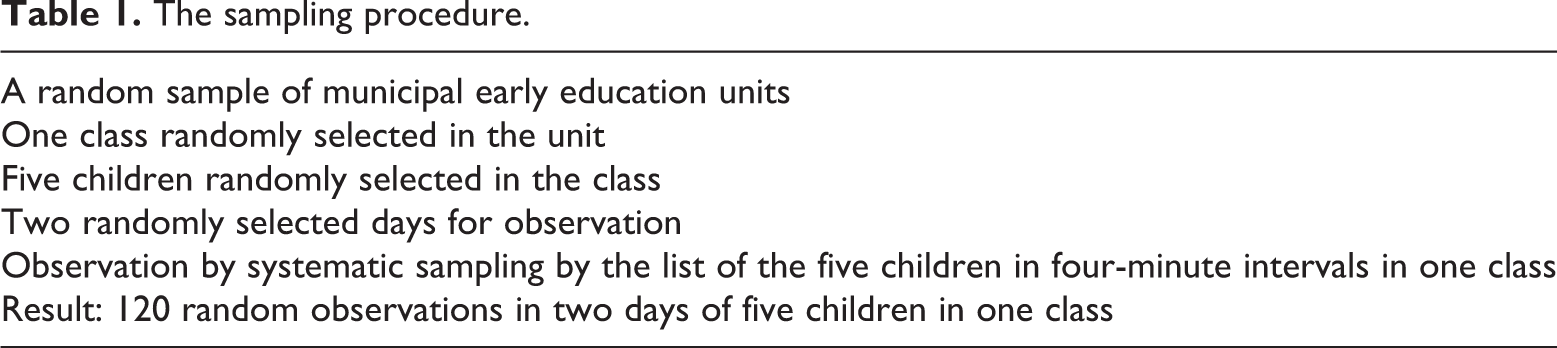
The observed items included ECE activities, children’s activities, children’s object of attention, peer contact, physical activity, involvement, emotions and social orientations and teachers’ orientations (Reunamo, 2007). In this article, we concentrate on children’s involvement, emotions, physical activity and social orientations. The reliability of the observation was checked throughout the observation with paired comparison. Nineteen pairs of observers were randomly chosen to do the same (random) observations without knowing each other’s classifications, totalling 736 observations.
The categories of involvement were based on the Leuven Involvement scale (Laevers, 1994), in which the degree of children’s sustaining, creative and energetic processing of their activity was measured on a Likert scale. High involvement is an indicator of deep processing of the activity and the zone of proximal development. The reliability of the paired observation (intraclass correlation coefficient, one-way random) for involvement was .756 (confidence intervals (CI) 719, 789, p < 0.0005).
The emotion categories were originally based on Ekman’s (1994) categories of observable emotions but adapted later based on the 2015 round of research (e.g. Veijalainen et al., 2019). The reliability of the paired observation (kappa) for emotions was 44.1% (CI 39.1%, 39.1%, p < 0.0005). The Ekman categories of emotions were used because of their relatively reliability in observation.
Social orientation observation categories were based on Reunamo’s (2007) categories, classified into accommodative, participative, dominant, non-social and not defined social role. The Kappa for the social orientation was 40.5% (CI 38.1%, 45.3%, p < 0.0005). Social orientation is based on the relative openness and personal input in the context. The categories make it possible to evaluate children’s connection to others and their social impact. A thorough explanation of the social orientation categories has been presented by Reunamo (2007).
Physical activity categories were based on OSRAC-P (The Observational System for Recording Physical Activity in Children-Preschool Version, Brown et al., 2006). The reliability of the paired observation (intraclass correlation coefficient, one-way random) for physical activity was 0.868 (CI 847, 885, p < 0.0005).
The observations were used in the analysis to see the relationship between the observed level of involvement, positive emotions, physical activity, participative relationships and the evaluated need for pedagogical leadership. The observation instrument was independent of other measures, the observers had no access to the evaluations and did not discuss them with the class educators.
There were 84,428 observations that could be connected with the learning environment evaluation, and 56,926 observations connected with the director’s evaluation.
Learning environment evaluations
The evaluation form is based on the Finnish National guidelines on early childhood education and care in Finland (2005). According to Sillman (2019) the evaluation form covers about two-thirds of the process-related quality indicators of the Finnish Education Evaluation Centre (FINEEC) (see Vlasov et al., 2019). The educator team of the class evaluated their learning environment by completing a survey with 76 items (Likert scale 1–5). The pedagogical leadership was evaluated with the item ‘Pedagogical leadership should be strengthened in our unit’. The educators evaluated the statement from one to five. For simplicity, the scale was reduced to two classes, strong enough leadership (1 = does not describe, 2 = describes poorly) and not strong enough pedagogical leadership (3 = describes somewhat, 4 = describes fairly well, 5 = describes very well). There were teams in 480 classes. The reliability of the statement was evaluated by 21 paired teachers evaluating the same statement (intraclass correlation coefficient, one-way random) for the two classes was 0.632 (CI 0.57, 0.739, p = 0.001). The need for pedagogical leadership was used as the connection for both the leadership evaluations and observations. Because the learning environment evaluations were independent of the other measures, the statistically significant connections should have real life connections between measures.
Leadership evaluation
The directors evaluated their unit with a leadership evaluation survey comprising 86 items. There were 513 evaluations. Because there was only one director in most of the units, it was not possible to check the reliability of the leadership evaluation. The directors’ evaluations were used to describe the items in connection with the evaluated need for pedagogical leadership in order to give tangible content for pedagogical leadership. Approximately 67% of the directors evaluated their leadership.
Analysis
In the analysis, we used cross-tabulations to check the connections between the observed qualities of children’s well-being (learning, positive emotions and participation, physical activity) and the staff evaluated need for pedagogical leadership. The statistical significances were tested with the chi-square test and the column proportions tested using the z test (adjusted p-values Bonferroni method). The correlations are Spearman correlations. The results were checked with partial correlations controlling children’s age and gender.
Ethics
The Ethical Review Board in the Humanities and Social and Behavioural Sciences at the University of Helsinki evaluated the research instruments and procedures. The participating municipalities agreed to allow the data to be collected for the research. The educators and directors did their evaluation as part of the municipal early education evaluation. The names, groups and units were not collected, securing full anonymity of the evaluators.
Because most of the children were less than four-years old and none of the children was older than seven years, it was considered necessary to get parents’ consent for the research. Very young children may not be able to understand the complicated procedures and consequences of the research. All the children participating in the research had a signed consent from their parents/guardians to allow their participation in the research. The children were not exposed to strong stimuli and no register of the children was collected. The research procedures did not affect the children’s everyday activities in any way. The children’s names, birthdays, social security numbers, or other data that could enable identification of a child were not collected. Personal information of the parents/guardians and teachers was also not collected. Instead, each child and child group received a number that was used in the analyses. The data collection was conducted as part of the everyday activities. The children’s physical integrity was not violated in any way while the observations were being carried out. The observers’ training emphasised respecting the children’s own feelings and rights. The results were distributed to the municipalities participating in the research.
Results
First, we studied the connections between the evaluation of pedagogical leadership and the observed items of children’s well-being: involvement (learning), emotions, participation and physical activity, to study how the need for leadership is reflected in the children’s everyday ECE. Then we studied the connections between the evaluated need for pedagogical leadership and directors’ evaluations to study the content of the positive and negative aspects of leadership.
The need for pedagogical leadership and children’s observed well-being
The differences in the Table 2 percentages are statistically significant (Χ2= 71.713, df = 4, p < 0.0005, n = 64,022). In the groups needing pedagogical leadership, there were more simple-and-frequently-interrupted activities than in classes with enough pedagogical leadership, and the difference was statistically significant. In the groups with enough pedagogical leadership, there was more continuous activity, and this was statistically significant. Involvement is a measure of the depth of the learning process. The results describe a shallower learning process in classes in which the need for pedagogical leadership was greater.
The cross-tabulation of the evaluated need for pedagogical leadership and observed involvement (learning).
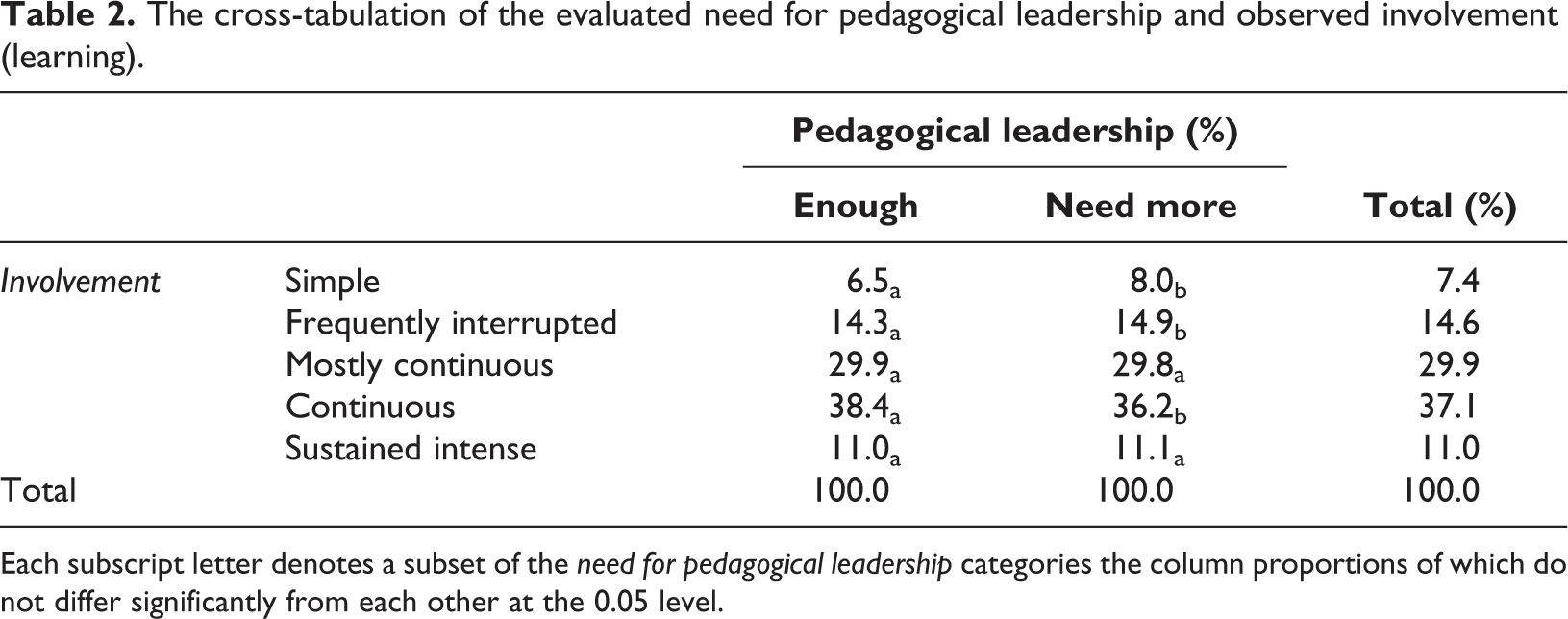
Each subscript letter denotes a subset of the need for pedagogical leadership categories the column proportions of which do not differ significantly from each other at the 0.05 level.
The differences in the Table 3 percentages are statistically significant (Χ2= 152.860, df = 8, p < 0.0005, n = 64,022). Between the groups, the largest difference was in neutral emotion, which the classes with need of pedagogical leadership had statistically significantly more in comparison to groups with enough pedagogical leadership. In classes with an additional need for pedagogical leadership, there was also statistically significantly more sadness and depression and other emotions (not able to define during the observation, confusion, changes, etc.).
The cross-tabulation of the evaluated need for pedagogical leadership and observed emotions.
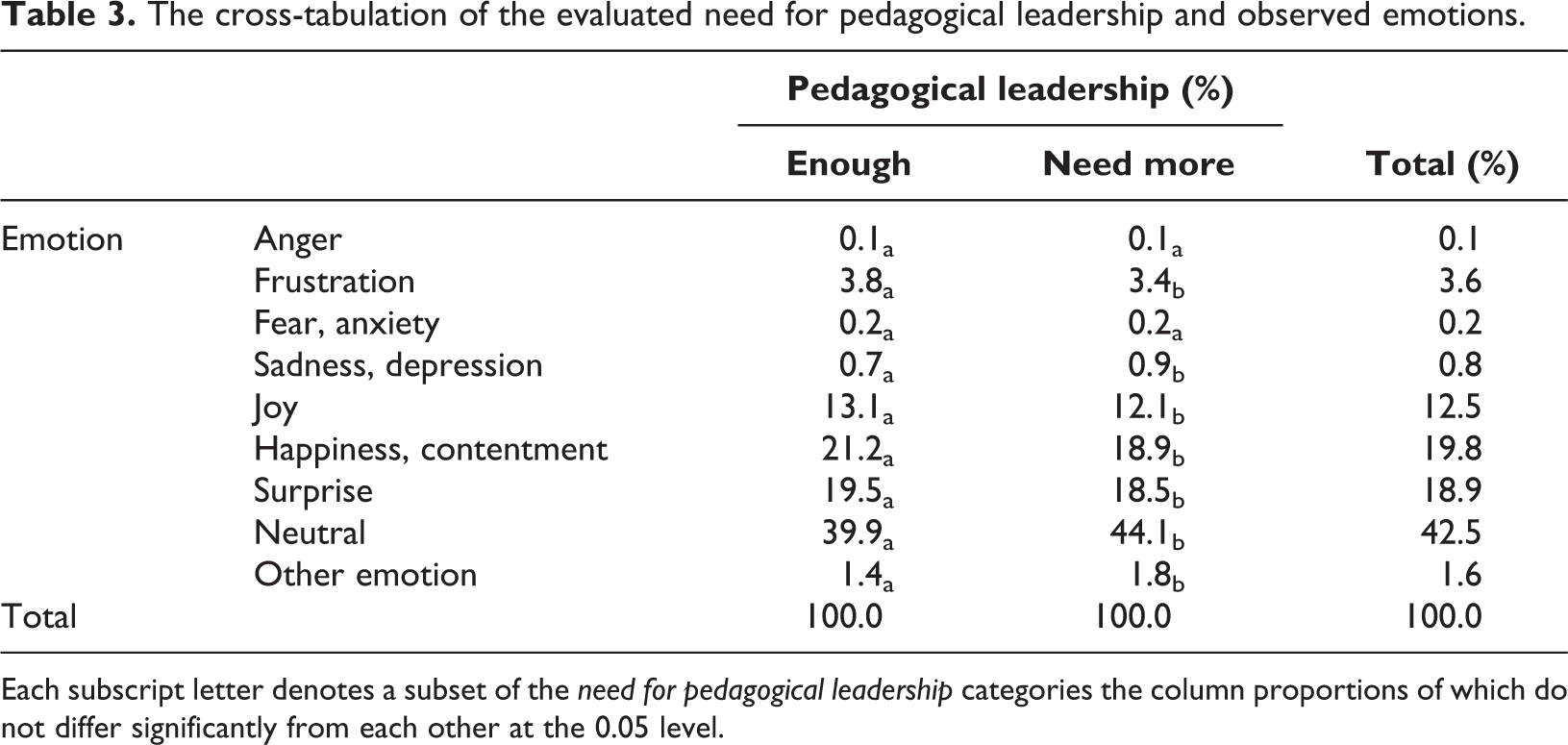
Each subscript letter denotes a subset of the need for pedagogical leadership categories the column proportions of which do not differ significantly from each other at the 0.05 level.
In the classes with enough pedagogical leadership, there was statistically significantly more happiness and contentment, joy and surprise. However, there was also statistically significantly more frustration. In a closer examination concerning frustration, the classes with enough pedagogical leadership had statistically significantly more frustration during basic care situations, such as dressing up.
The differences between the two categories shown in Table 4 are statistically significant (X2= 125.765, df = 4, p < 0.0005, n = 64,023). In the groups with more need for pedagogical leadership, there was statistically significantly more non-social behaviour, in which the child withdraws from others or there was no social contact to observe.
The cross-tabulation of the evaluated need for pedagogical leadership and observed social participation.
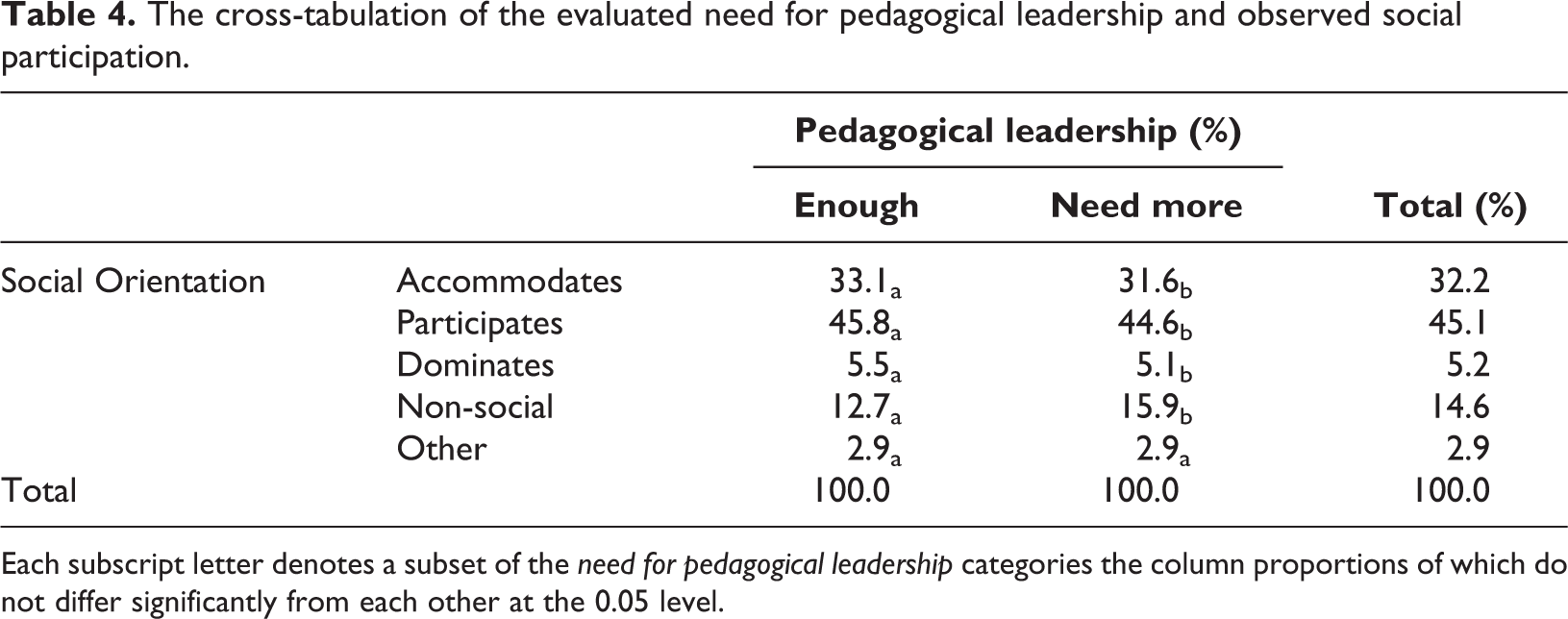
Each subscript letter denotes a subset of the need for pedagogical leadership categories the column proportions of which do not differ significantly from each other at the 0.05 level.
In the groups with enough pedagogical leadership, there were statistically significantly more participative relations with openness and shared creation between children. There were also statistically significantly more accommodative activities with more openness, and adaptation and dominating activities between children. With more social contacts in the classes with enough pedagogical leadership there were more different social roles in the children’s interactions.
The proportions between percentages shown in Table 5 are statistically significant (Χ2= 65.748, df = 4, p < 0.0005, n = 64,015). In the groups with a need for more pedagogical leadership, there were statistically significantly more activities with no movement at all. On the other hand, in the groups with enough pedagogical leadership, there was statistically significantly more light, intermediate movement. The results indicate that there was more physical variety in the activities in the classes with enough pedagogical leadership.
The cross-tabulation of the evaluated need for pedagogical leadership and observed physical activity.
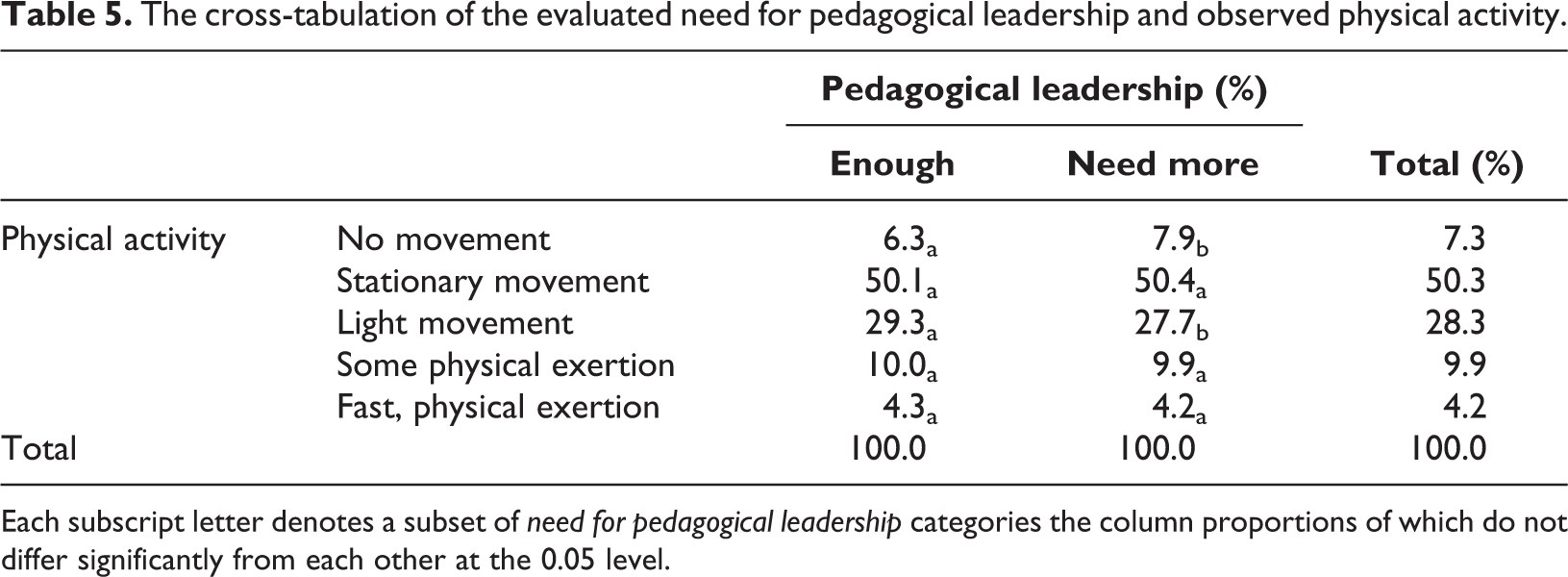
Each subscript letter denotes a subset of need for pedagogical leadership categories the column proportions of which do not differ significantly from each other at the 0.05 level.
The need for pedagogical leadership and leadership evaluations
In the previous section, the results described how the need for pedagogical leadership was related to children’s everyday learning, experiences, social relations and physical activity. But what does having appropriate or inadequate pedagogical leadership mean in practice? For that we need to compare the class team evaluations for adequate and inadequate pedagogical leadership with the independent measure of leadership evaluation conducted by the directors. The directors filled in a survey with 86 items on a Likert scale from 1–5. The largest differences between directors are shown in In Table 6.
The largest positive differences in director evaluation means between classes with enough and need for more pedagogical leadership.
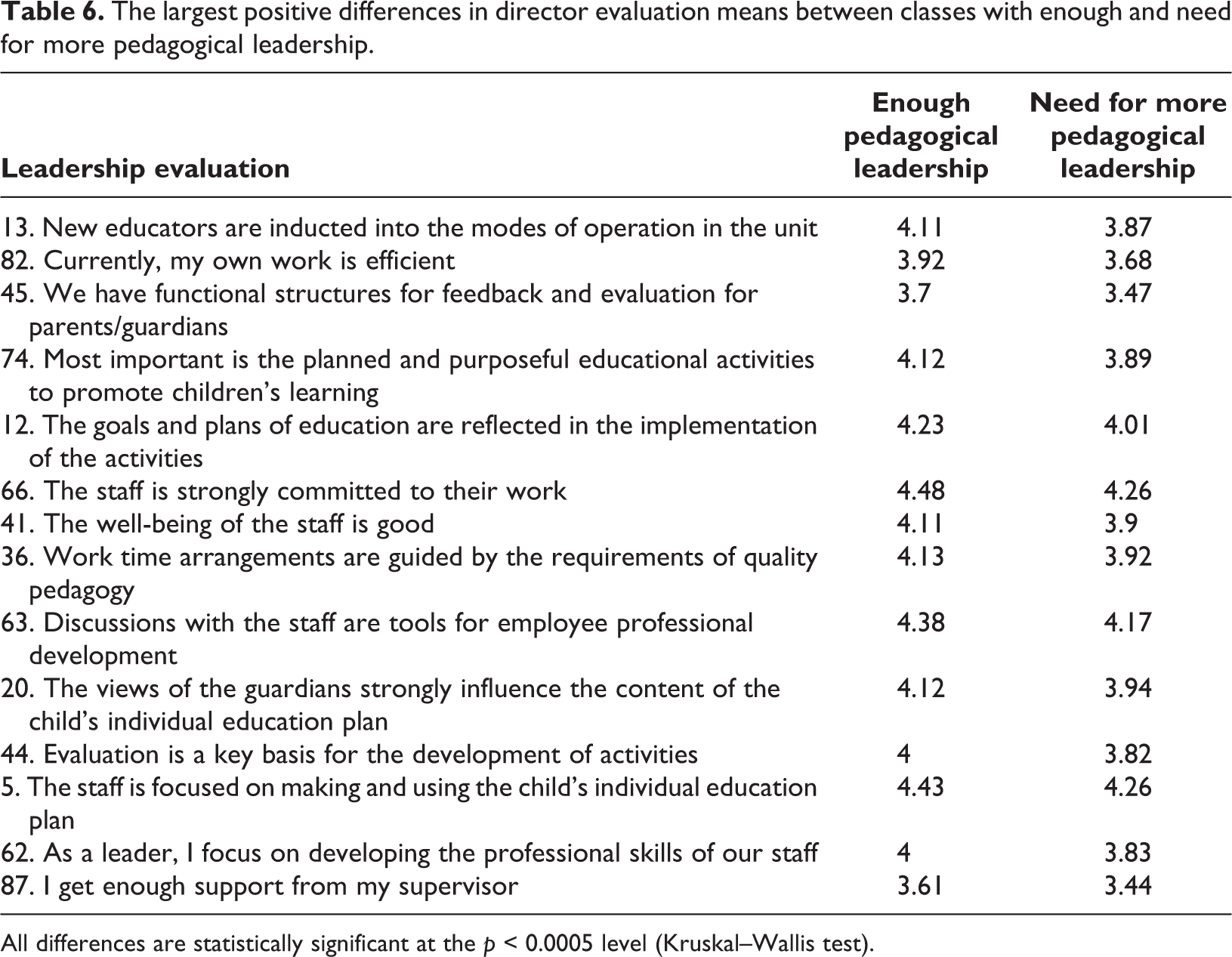
All differences are statistically significant at the p < 0.0005 level (Kruskal–Wallis test).
The largest difference between units with no increased need and increased need for pedagogical leadership was in the induction to the modes of operation in the unit. This indicates two things: there is induction and there are modes of operation in the unit, which means that the unit has a pedagogical culture. Most of the statements in Table 6 describe the unit culture. The educational activities are planned and purposeful and the plans are reflected in the activities. Evaluation is important. The level of staff well-being is good, and the members of staff are strongly committed to their work. In the units with less need for pedagogical leadership, the work is well organised. There are functional structures for feedback and evaluation for parents/guardians and they can influence the child’s education plan. Work time arrangements relate to pedagogical needs.
Personally, the directors of the units tended to describe their work as efficient. The directors used discussions with the staff actively as a tool for pedagogical development, which is also reflected in the active development of the professional skills of the staff. The differences seem to relate to the meaningfulness of the work.
The main finding in Table 7 in comparison to Table 6 is the lack of pedagogical content in the descriptions. There just is no place and time for pedagogical leadership. Conflicts between staff take up a lot of time and resources. Uncertainty, frustration and chaos are linked with the need for more pedagogical leadership. The fact that the division of labour between teachers and nurses is based on their shifts and personal skills (not qualifications) describes the lack of organisation and structures in the unit. Increased flexibility in work–time arrangements seemed not to help.
The largest negative differences in directors’ evaluation means between classes with enough and need for more pedagogical leadership.
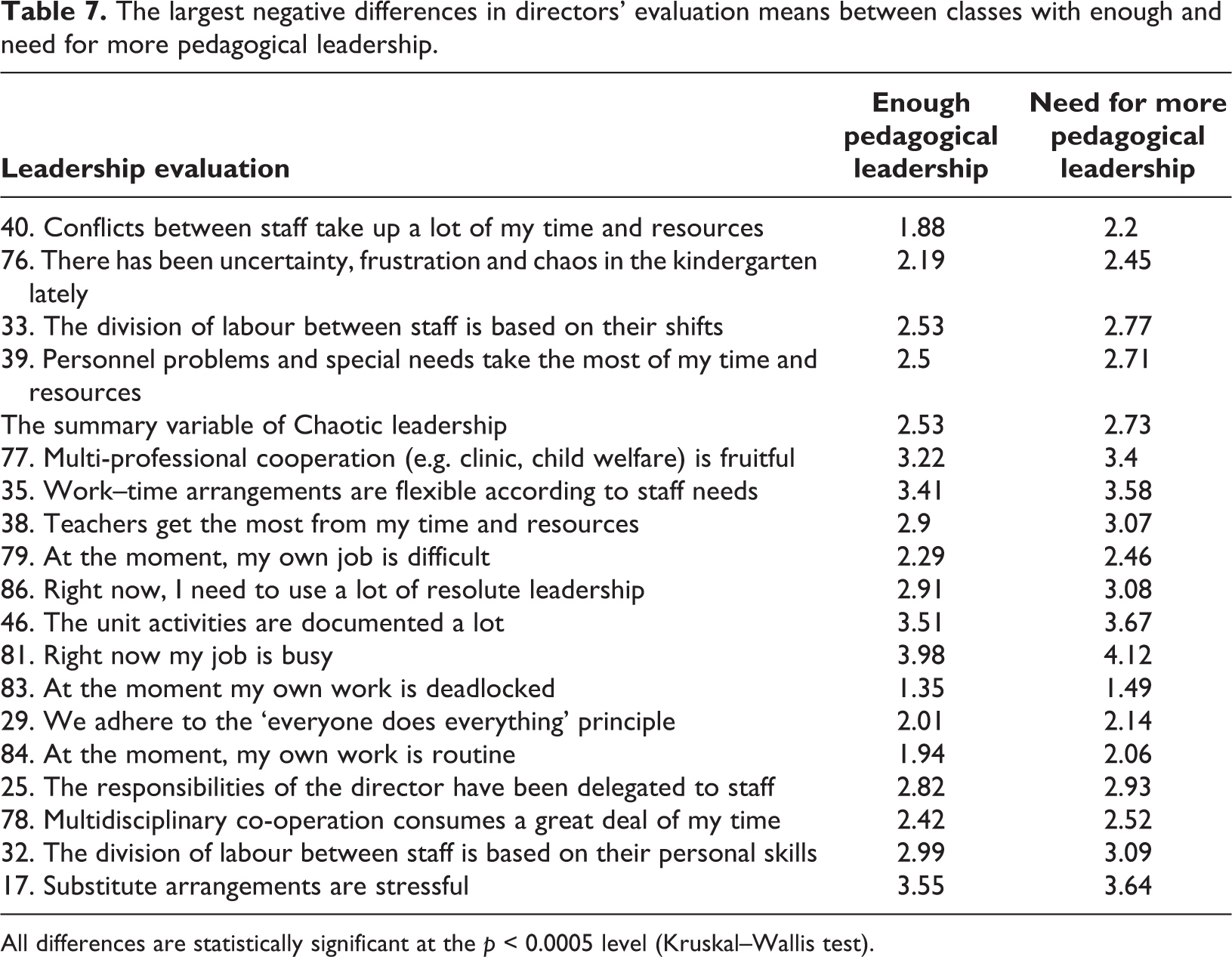
All differences are statistically significant at the p < 0.0005 level (Kruskal–Wallis test).
When there is more need for pedagogical leadership, the director just does not seem to have time for that. Personnel problems make the work difficult. However, descriptions like the work being routine or the responsibilities delegated to the staff may indicate a tendency to avoid active pedagogical development. In Table 7, the directors’ work goes to anything but pedagogical leadership.
Discussion
As the results of this study show, pedagogical leadership is crucial for the quality of pedagogy. Similar findings of the high-quality leadership practices and the teachers’ quality pedagogical practices have been made by Keung et al. (2019) in their research. They found that leadership practices are directly and positively related to teachers’ perceptions of whole-child development. At the centre of high-quality pedagogy are the sense of purpose, collaborative activities and a collective focus on children’s learning.
Much evidence was found about high-quality pedagogy in the centres in which the pedagogical leadership was evaluated as being good. The results of our study indicate that there is a connection between pedagogical leadership and children’s involvement in the learning process (continuous activities, less interrupted activities). In addition, there was the connection between pedagogical leadership and children’s emotions: more positive children’s emotions (happiness and contentment, joy and surprises) were found with enough pedagogical leadership in the centre. More negative children’s emotions (sadness and depression) were found when pedagogical leadership was missing. Furthermore, more social contacts, more different social roles in children’s interactions and more physical variety in the activities in the classes were found when there was enough pedagogical leadership.
One of the more critical leadership tasks is leading the implementation of the ECE curriculum (Cheung et al., 2019). Through to implementing the curriculum, it is possible to develop the management of quality (Fonsén, 2014). The vision of the pedagogy is shared and built together, but nevertheless, the director is expected to be the leader and show leadership initiative (Sergiovanni, 1998). Therefore, the director needs to manage the substance and, at the same time, have enough professional ability and skill for leadership (Fonsén, 2013, 2014). Due to many changes in the field of ECE in Finland, quality-management work also needs to be developed to meet current requirements (Vlasov et al., 2019).
The results of this study indicate the same phenomena as highlighted in previous research: the structure of the organisations needs to be considered carefully to support good pedagogy (Fonsén, 2014; Soukainen and Fonsén, 2018). Furthermore, the study showed that pedagogical leadership needs a place and a time in the director’s work and in the organisation’s culture, something Keski-Rauska et al. (2016) have also shown in their research.
Conclusions
Pedagogical leadership is a specific skill that needs qualified directors in ECE. The directors need to have the skills to lead their own work, and to lead the curriculum and evaluation work (Fonsén, 2014). They need knowledge about pedagogy and knowledge about leadership and management. The main question may still be how to implement the distributed leadership, because the director needs to share the pedagogical leadership with teachers to show trust in their professionalism. However, the results of this study showed the paradox of distributed leadership: the responsibilities delegated to the staff may indicate a tendency to avoid active pedagogical development. This may be a critical issue to take into account in ECE teachers’ education, as teachers also seem to need skills for pedagogical leadership.
The directors need resources for pedagogical leadership. There is a need for administrative changes and support from the directors’ own supervisor. When the director needs to concentrate on the management, uncertainty, frustration and chaos, there is no time for pedagogical leadership. Because children’s well-being is the focus of good quality ECE, the directors need the resources for sustainable pedagogical leadership.
Limitations and reliability of the study
The study is related to the Finnish ECE context. Other countries have different practices and ECE organisations and, consequently, the results may not reflect other cultures. In addition, the sample did not include the north of Finland or small rural municipalities, which could have affected the results. For example, in small municipalities the support from other directors or administration may be different. The reliability of the observation and learning environment evaluation instruments were good. However, it has not been possible to check the reliability of the leadership evaluation with paired evaluations, because usually there is only one director in charge of each ECE unit. The research instruments have been independent of each other. In the end, the levels of statistical significance describe relationships, not clear causes or effects. Therefore, we cannot say that good pedagogical leadership is the cause of good quality ECE but we can conclude that good pedagogical leadership is connected with good quality ECE.
Footnotes
Declaration of conflicting interests
The author(s) declared no potential conflicts of interest with respect to the research, authorship, and/or publication of this article.
Funding
The author(s) received no financial support for the research, authorship, and/or publication of this article.
