



Abstract
The professionalisation of the workforce in early childhood education (ECE) is aligned with policy aspirations in England and internationally to raise the quality of provision, reduce inequalities in children's outomes, and improve standards. This article aims to consider how policy discourses of leadership are interpreted by Graduate Leaders, and the discursive conceptualisation and enactment of their roles in practice. The analysis adopts a reflexive re-viewing of interviews with Graduate Leaders in a range of ECE settings in the context of continued crises in the workforce in England. The interviews were conducted in phase 1 of the Australia-England project (Australian Research Council Discovery Grant DP180100281). The analysis identified four main roles: team player, pedagogical leader, responsible agent, and change agent. Evidence of the impact of policy took the form of attributes related to accountability and compliance, whereas constructions related to learning and quality were characterised by attributes linked to established discourses of work in ECE. The conclusion highlights the tension between policy discourses of leadership, and the discursive resources that informed how leaders were constructing their roles.
Introduction
Early childhood education (ECE) in the United Kingdom has been the focus of policy reform and government investment for over 25 years. Each of the four nations (England, Scotland, Wales and Northern Ireland) has discrete ECE policies but share common discourses and aspirations for raising quality and standards, and all foreground workforce reform as essential for achieving policy goals. Strategies for workforce reform include raising the status and qualifications of all employees, and charging leaders with overall responsibility for achieving educational goals. Taking into account the range of settings in the private, independent, and voluntary (PVI) sectors, and the maintained sector, it is not a requirement that those designated as leaders (and/or managers) have graduate-level qualifications. In England, government policy states that ‘A level 3 Early Years Educator may be expected to supervise staff or lead a setting’ (Department for Education, 2024: 44). However, based on an analysis of longitudinal data from the National Pupil Database, Bonetti and Blanden (2020) identified a small but positive and sustained association between the presence of degree-qualified early years staff and children's learning outcomes. Furthermore, high-quality ECE is known to impact positively on children's achievements, which draws attention to the association between Graduate Leaders/teachers, improving quality in all aspects of provision, and ensuring positive outcomes for children on transition to compulsory education. Informed by this association, this project provides new insights into how Graduate Leaders discursively construct their roles, including the attributes (understood as qualities and characteristics) they consider to be inherent to their roles, and how policy discourses are taken up and interpreted in the contexts of practice.
The first section reviews the international literature to identify the distinctive ways in which leadership in ECE is conceived. The second section describes the statutory policy and regulatory framework in England, showing how leaders are discursively positioned and responsibilised for ensuring that policy goals are achieved. The third section describes the research design and analytical strategies for the phase 1 data, and justifies the reflective thematic analysis to address the aim of this article. Drawing on the perspectives of Graduate Leaders, the thematic analysis identified four categories that portray how the participants constructed discourses of leadership in relation to their roles, to policy and to practice. The discussion considers these findings in light of persistent structural problems and current crises in the ECE workforce, and the role of Graduate Leaders in the achievement of policy goals.
Leadership in early childhood education: International perspectives
Research on ECE leadership reflects the influence of international and national policy drivers towards quality improvement via professionalisation of the workforce and, specifically to this article, effective leadership (Dyer, 2018; Douglass, 2019). Although notions of quality and quality improvement are contested (Elwick et al., 2018; Hunkin, 2019; Hunkin et al., 2022), policy and regulatory discourses have become increasingly powerful as governments buy into the logos of a virtuous cycle of investing in ECE, raising children's outcomes and improving their life chances. Improving both structural and process quality has associated the qualifications of the workforce, and specifically graduate-level teachers with raising overall quality (Manning et al., 2019). As a result, governments have become regulators of provision, with recruitment, qualifications and standards for initial and continuing professional development as recommended policy drivers for effecting and sustaining change (European Commission, 2021).
Graduate-level ECE leaders in England occupy a strategic position within policy discourses, because they are responsibilised for ensuring quality improvement in line with maintaining standards, managing change, and being accountable to families and to regulatory and inspection bodies. The responsibilisation of their roles is also evident in related expectations that ECE will contribute to achieving health, welfare and social policy goals, and ameliorating the effects of poverty and disadvantage on children and families (Douglass, 2019; Archer and Oppenheim, 2021; Sutton Trust, 2024). Therefore, how leaders discursively construct their roles in the contexts of policy and practice is critical to understanding their strategic position.
Research evidence indicates the range of discourses that inform how leaders take up and interpret their roles, with a focus on individual dispositions, skills and identities. Themes include relational practice, an ethic of care and emotions, including the emotional labour that leaders perform towards staff, children and families (Bøe and Hognestad, 2017; Heikka et al., 2019), all of which indicate the breadth and complexity of the role. These dispositions, skills and identities are mobilised in the socio-cultural-historical contexts of ECE, including the impact of national policy frameworks. Based on a small-scale study of 26 teachers and leaders in an early childhood centre in Aotearoa New Zealand, Cooper (2023) acknowledges the complexity of constructing multiple roles and identities as teachers and teacher-leaders with a designated leadership position. Cooper also identifies the tensions reported by the participants between taking up positional/individual power in contrast with typical ECE practices of working within collective, team-based approaches where roles, tasks and responsibilities may be distributed (such as room leaders, curriculum leaders).
Building on existing research, we argue that in policy-intensive systems, the cultural, historical and structural conditions of leaders’ work are significant, including the power relations that inhere in workplace systems. This is because leaders must be able to influence systemic change with teams via the components that have been identified in policy frameworks as necessary for achieving quality, such as curriculum planning, pedagogy, assessment, professional development, shared understanding of visions and strategies, evidence-based reflection, as well as professional and ethical commitments to children and families (Heikka et al., 2019; OECD, 2022). However, there are limitations on what aspects of their roles can be shared across team members because leaders bear ultimate responsibility for demonstrating the relevant quality standards. In policy-intensive systems, certain attributes may be valued and desired, for example where ‘strong’ and ‘effective leadership’ are critical for achieving policy goals.
Based on this brief review, we argue that leadership is informed by available models based on established beliefs, knowledge, values and practices in the field, and newer models based on policy goals. To contextualise phase 1 of the project, the following section presents a brief policy genealogy of the Graduate Leader within the policy assemblage for ECE in England.
The Graduate Leader in England – policy genealogy
In 2012, the Conservative-Liberal Coalition Government commissioned a review of Early Years qualifications. The report, Foundations for Quality (DfE, 2012) (also known as the Nutbrown Review), identified inconsistencies in the standards, rigour, and depth of some qualifications. The recommendation to create a new early years specialist route to Qualified Teacher Status (QTS) would replace the graduate level Early Years Professional Status (EYPS) with teachers who would be able to lead settings, with parity of pay and conditions with the existing QTS for teachers in maintained nursery and reception classes (age 3–4 years) and compulsory (age 5–16 years) education. In the context of economic austerity following the 2008 financial crisis, the government response to the Nutbrown Review, More Great Childcare (DfE, 2013) failed to recommend the full suite of recommendations. The Early Years Workforce Strategy for England (DfE, 2017) subsequently set out the government's aspirations for raising the qualifications and status of the workforce, and creating progression routes through different levels in order to improve the quality of provision across the sector. The new Early Years Teacher Status (EYTS) replaced the EYPS qualification, and created the new designation of Graduate Leaders who would lead education and care in settings for children age birth-five. The Strategy made the optimistic claims that Achieving EYTS can give a real feeling of professionalism to nursery staff, increasing their confidence, giving them the ability to promote excellent practice and the authority to share knowledge and good practice with colleagues. Early years teachers inspire and encourage learning and provide children with the best possible educational start, ensuring they are prepared for the transition to school. (DfE, 2017: 14)
Within the wider policy assemblage, the professional standards sit alongside the Statutory Framework for the Early Years Foundation Stage (EYFS) (DfE, 2021a). The EYFS is the curriculum framework for children from birth to 5 years which all providers in receipt of the Early Years funding in England are required to follow. The framework defines the desired outcomes for children across seven areas of learning on transition to compulsory education (Reception into year 1). At the end of the Reception year, children (aged 4–5 years old) are assessed using the summative EYFS Profile (STA, 2017) to establish whether they have met the required learning outcomes, the results of which are reported to the government. In addition to these curricular and assessment performativity constructs, the Office for Standards in Education, Children's Services and Skills (Ofsted) inspects all training providers, and all education settings in order to judge the standards and quality of provision. Ofsted thus exerts considerable power as the ‘sole arbiter of quality’ through inspection, practice guidance and research reports, which are direct interventions into practice (Kay, 2022, 2024; Wood, 2019).
This brief summary indicates how the workforce strategy created leaders with different types of qualifications, but with similar responsibilities within a complex and changing policy assemblage. Graduate Leaders are responsibilised for all aspects of provision: curriculum, pedagogical practice, quality and accountability, and continuous improvement of practice. These are significant requirements in light of the range of workforce qualifications, and the roles leaders are expected to deploy alongside their own pedagogical work. Dyer (2018) questions whether graduate-level qualifications have empowered practitioners to claim a professional status arising from specialised knowledge, or produced compliance with externally regulated, policy-led conceptions of what is needed to improve practice and raise quality. We propose that this is not an either/or question, rather the focus needs to be on the discursive resources leaders draw on as they work with historically evolving discourses within complex work environments. The following section sets out the phase 1 research design and methods used to elicit how leaders discursively construct their roles, how they mobilise their professional knowledge in the contexts of practice, and how they orient towards policy compliance.
Research design and methods
The project, including the parallel analysis of the phase 1 data for the participants in Australia, is reported in Nuttall et al. and Martin et al. (2020). The empirical research in England was conducted with 20 teachers. All were Graduate Leaders with at least level 6 qualifications in Early Childhood Education, working in a range of Early Years Foundation Stage settings (i.e. with children from birth to 5 years old) across the private, voluntary, independent (PVI) sector and maintained (government funded) sector, including nursery and Reception classes in Primary schools (Appendix 2). Around 40% of the participants in the semi-structured interviews held both qualifications (EYTS/EYPS and QTS) which enabled them to work across the sectors.
Ethical review was undertaken at the University of Sheffield, Australian Catholic University and Monash University prior to the commencement of the project. Consistent with institutional standards, protocols were followed regarding de-identification of the participants and their workplaces following data gathering, with due regard for principles of research ethics at each stage of the research. Informed consent to participate was given in written form, including the use of individual data for publication purposes. The phase 1 sampling strategy in England was opportunistic, using social media to recruit participants, with the assurance of de-identification of the data in subsequent publications and dissemination. Interviews took place according to participants’ availability and choice of location, and were conducted either face-to-face or online, lasting typically up to 90 minutes.
As a way of identifying the concepts and practices Graduate Leaders were using to discursively construct the role of leader in a practice context, the data from the phase 1 semi-structured interviews were analysed combining a Membership Categorisation Analysis (MCA) and thematic analysis approach. MCA is an approach to discourse analysis that enabled us to focus on the types of people Graduate Leaders constructed during the interviews (categories) and how they assign attributes concerning how people act in a particular membership category (King, 2009; Nuttall et al., 2024). The data sets for England and Australia were analysed deductively using sensitising concepts that informed the project. A further inductive analysis aimed to identify any new concepts arising on completion of the project (Nuttall et al., 2024). This stage of the analysis enabled us to extract four specific aspects of leadership from the data with a focus on:
Participant identity (How do participants describe who they are?) Roles (What roles (categories of leaders) do people adopt?) Activity (What activities are linked to the adopted roles?) Ethos (What values, beliefs, knowledge and motivation do participants have?)
A table was created with the headings Identity, Roles, Activity and Ethos (Appendix 3) and data from each participant transcript was entered into the table along with specific quotes that substantiated these aspects of leadership. The data in the tables were then thematically analysed as a whole corpus to identify recurring themes and the associated attributes.
Based on this analysis, four categories of leaders were constructed: team player/builder, pedagogical leader, responsible agent and change agent (towards practice and towards staff). Participant identity was gathered from the interview questions (e.g. nursery owner, manager and early years consultant). The data in the tables were then analysed to highlight the activities that the leaders carried out and the values and beliefs that they held to identify the emerging themes. Each of the interview questions was followed by an invitation to provide examples of practice, which enabled us to link attributes with policy and practice (Appendix 4). For example, in the theme of ‘Responsible agent’, an attribute is ‘Knowing when to assert authority’. This is exemplified in practice as ‘when you’re accountable for Ofsted … at some point you have to stand up and be an autocrat’. Inevitably there were areas of overlap in their responses because teachers tend not separate out their roles and practices, for example, managing policy changes but ‘keeping children at the heart of everything we do’. Our analysis thus generates knowledge about how policy discourses of leadership in ECE are taken up and interpreted, and how leaders conceptualise and enact their roles in practice. The participants’ own words illustrate their understanding of their roles, and the knowledge that informs their actions and decisions in the contexts of practice. When the participants use the term ‘practitioner’ they are referring to colleagues with different levels of qualifications, including Level 3 Early Years Educators, teaching assistants for children with additional needs, other EYTs and EYPs.
We then reflectively reviewed the phase 1 data to explore how Graduate Leaders in England discursively construct their leadership roles considering the continuing crises in the workforce. In early childhood settings, how leaders describe themselves and their work is a salient concern because of the absence of traditional hierarchical structures. For example, some leaders typically undertake parallel pedagogical work with children and team members. Leaders in PVI settings may also hold managerial roles, with responsibility for budgets, staff recruitment and other operational matters. Whilst the breadth of these roles was evident in the data, our focus in the project has been specifically on educational leadership in their work with children and team members (Figure 1).
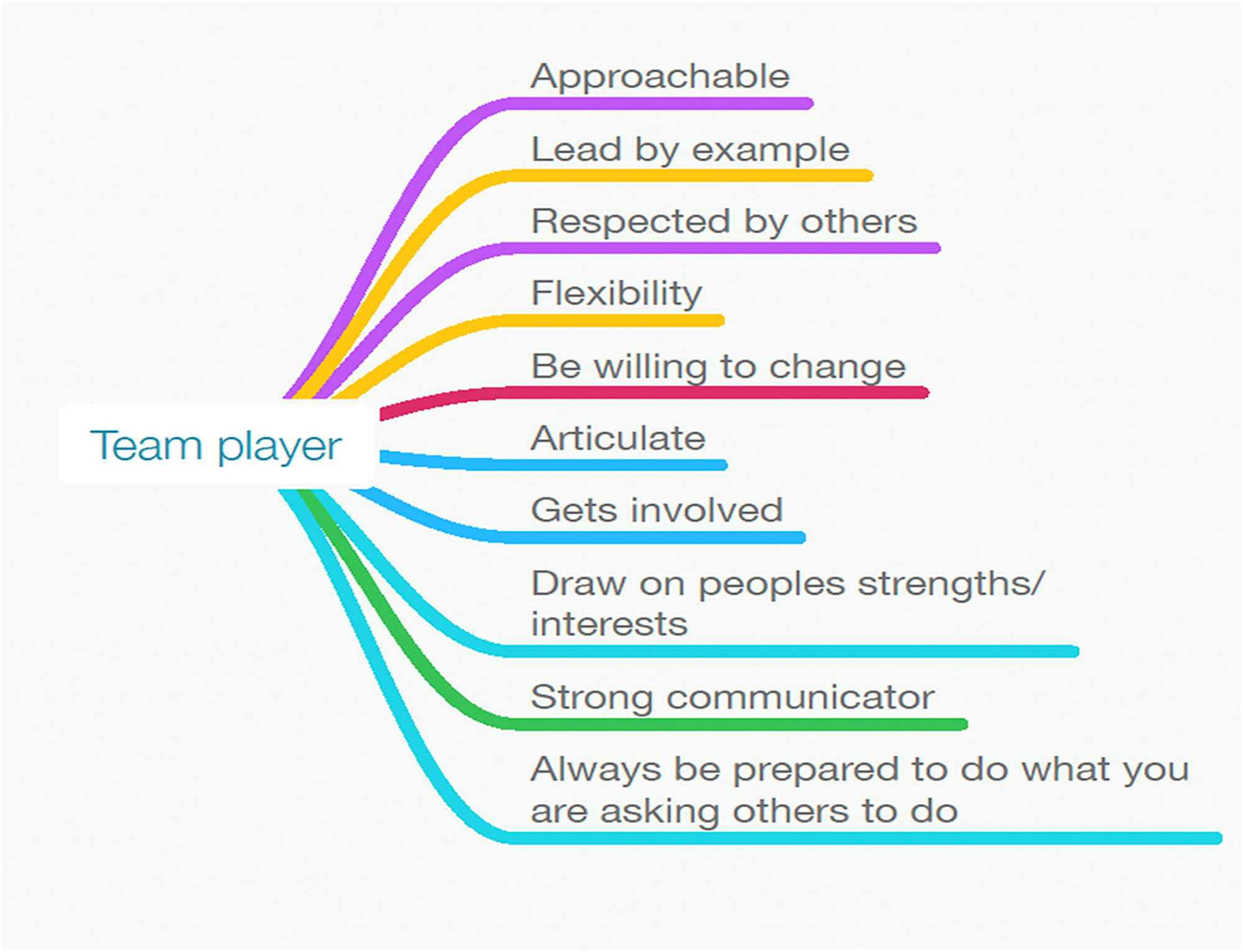
Team player themes/sub-themes.
Team player/builder
The theme of team player/builder was constructed through enabling staff to support children's learning in effective ways. This included drawing on strengths, skills and interests of the team members, leading by example, and modelling good practice:
I make sure I draw upon their strengths so then we are using their skills, their interests which in turn is fed into the children, so the children are able to get different perspectives and views.
So it's very very collaborative. You’ve really got to be a good listener and then dovetail it all together and work out “Well okay, so this practitioner wants to do this but this one wants to do something completely different. How are we going to make that work? How are we going to incorporate that into our week or the next couple of weeks?”
I think really strong communication is the absolute key so that everyone knows what's going on, what's happening, and just to be able to ask if they don’t understand something, or if they don’t like it, you can help them develop with that and have an understanding so they can all work effectively as a team.
There's no them and us. I’m one of them.
I don’t over delegate and I accept that at the end of the day it is my head on the chopping block and although I want them to have their own control over what they do and their own satisfaction, I wouldn’t ask them to do anything that I wouldn’t do and I like seeing them see me do the same job.
It's a physically and emotionally draining job. Sometimes at the end of the day it's reading signs of whether we’re sitting down to have an evaluation meeting or … make a cup of tea and have a group hug.
We’ve got some lovely people in our team, and they’re willing to go the extra mile, but equally we’re willing to support them and be flexible in the way that we recognise their needs, both professionally and personally. We’re dealing with human beings here who have lives and have crises that need taking care of.
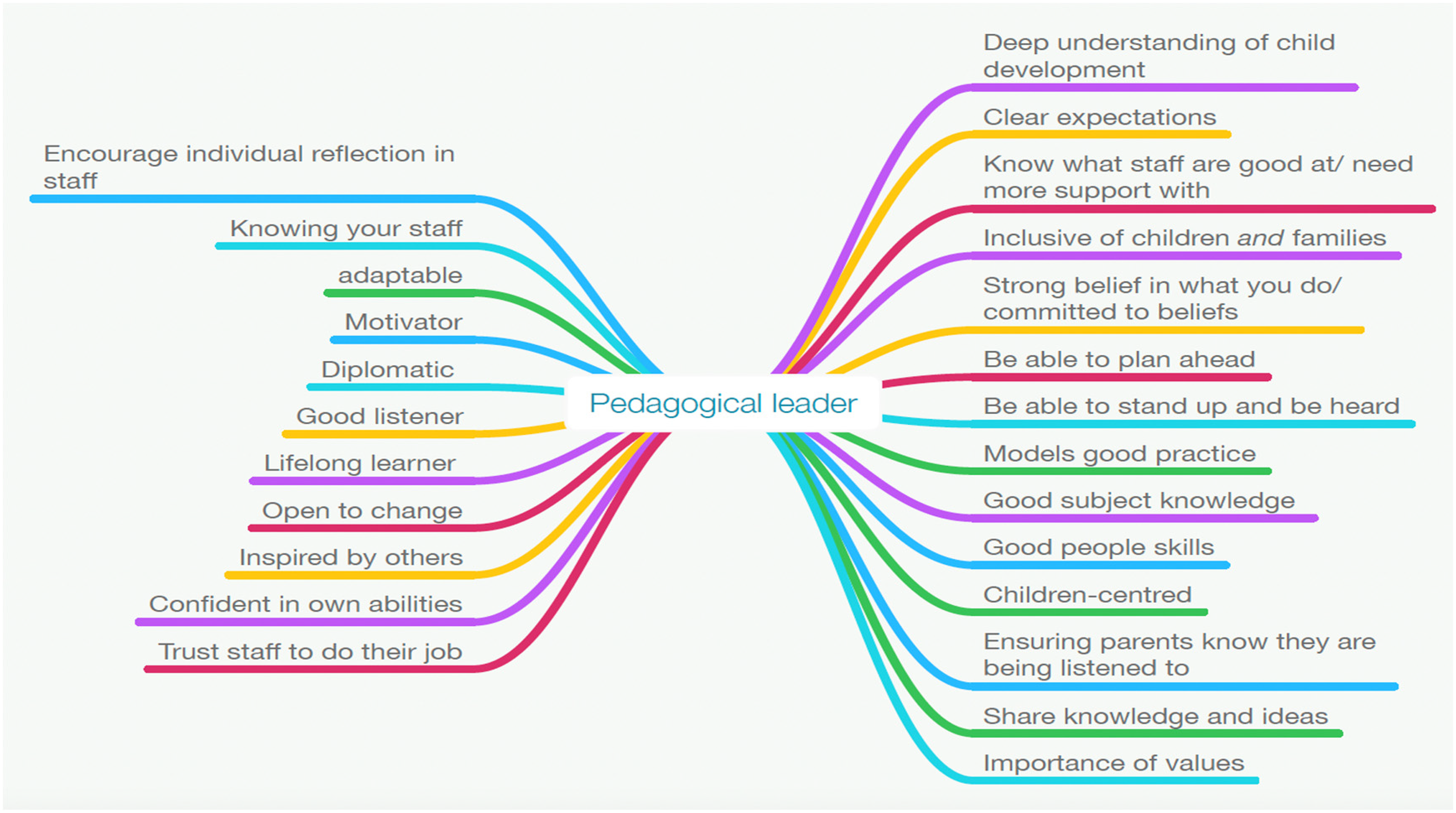
Pedagogical leader themes/sub-themes.
Pedagogical leader
This theme included overlapping attributes with the other themes, and was constructed through the leaders’ confidence in their roles and responsibilities, their specialist knowledge and understanding, as well as being a good motivator, being adaptable and open to change, and trusting staff to do their jobs. In the context of specialist knowledge for ECE, having a graduate-level qualification was a positive asset in several areas of their work:
I definitely think having done my EYT, having that pedagogy and having that understanding of how children learn at this key point in their development really helps me to feel confident to lead the practice … it has helped me become more reflective and I am always thinking about and assessing what went well, what hasn’t worked well, talking it over with my TA as well, making sure she is always involved in the decision making. We are making joint decisions together about how we take our practice forward and I don’t think you can ever stop learning…I am always thinking, always questioning why whenever I am asked to do something with Reception children. Why and how? How is this going to benefit the children? Is this something that you would want everybody to do because its consistent across the school but will it actually benefit my children in Reception?
It's quite hard to put into words because it's a fluid responsive system.
The staff are really good at saying I really don’t like what's happening here, let's talk about it now … they don’t wait … they come to it straight away … so we’re very responsive in that way … Let's see what's happening and what we can do.
I think being trained to that higher level … it does make you more of a reflective practitioner … It's built into the training that you need to be reflecting on everything that you do and understanding how you are doing things and why you are doing those things.
I’m a teacher… I work in Early Years … but there's a little bit of hesitation over whether that's what I’m doing …of course we are teaching but I don’t value that …I think I’m caring as well, and I’m guiding and facilitating and doing all those things. But I’m an Early Years teacher and I need to be saying that and being confident when I’m saying it.
Leaders expressed that being clear in their expectations is a way of ‘making it work’ and supporting staff to learn and understand change. On the one hand leaders are enabling staff to bring ‘new vision and new energy’ but at the same time pedagogical leadership might also be about doing things in a specific way, and articulating the warrant for their actions.
So I think you’ve got to be quite diplomatic, quite skilful in how you deal with people because you don’t want to squash people's ideas and thoughts and passion for their job. But at the same time, it's got to function. There's 30 children in there every day, it's got to work. So I think you’ve got to have very, very good people skills and always be planning ahead, knowing that it takes time to change.
So I do try a lot with the planning, if I want them to do something specific I make sure it's quite detailed so they know what they’re doing. And though it might take me another half an hour to do that planning, but I know then that they’ll feel more comfortable with it.
And you think, how am I going to learn if I don’t listen and respect others’ views?
Being “firm but fair” and understanding practitioners need support.
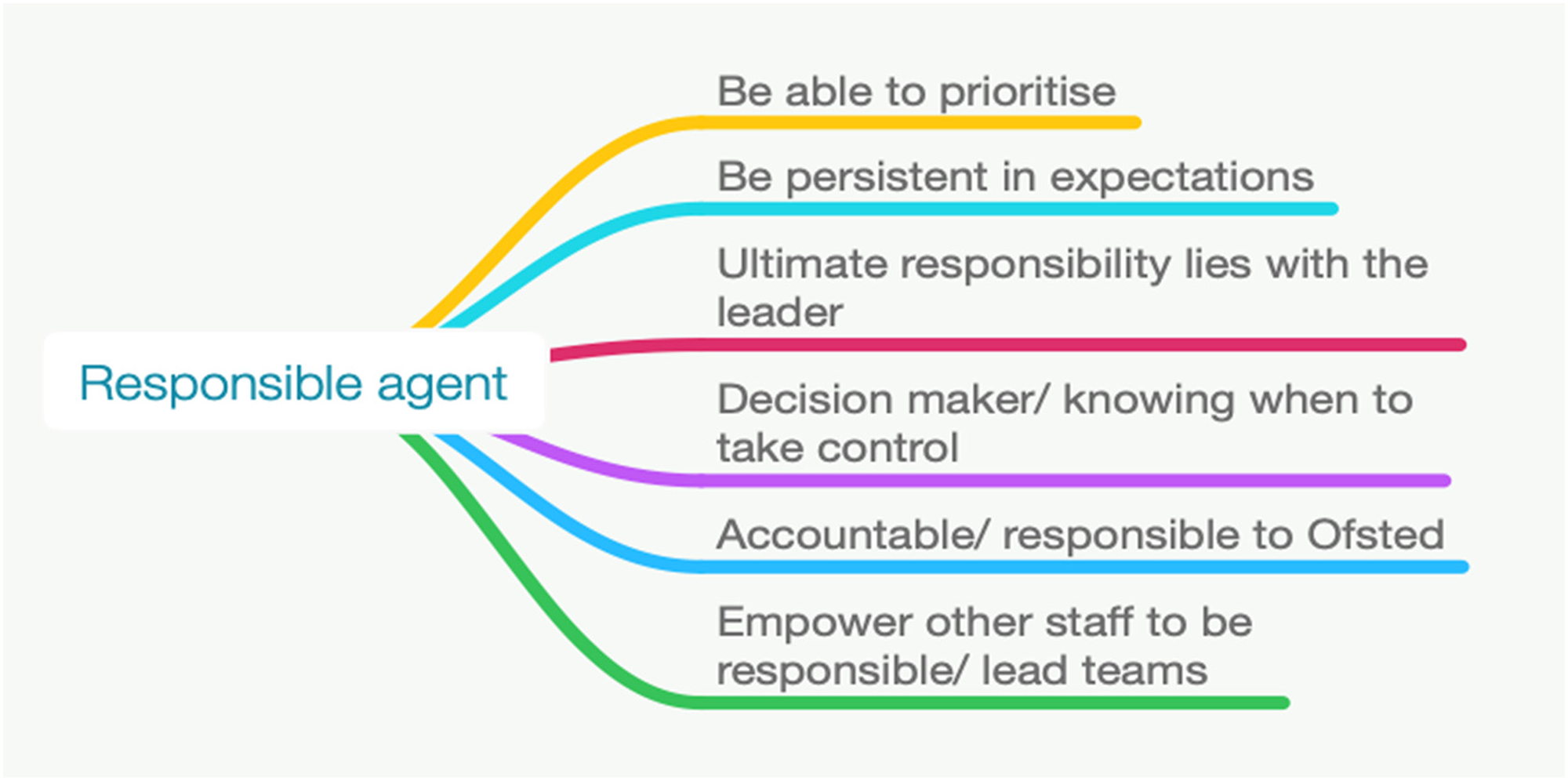
Responsible agent themes/sub-themes.
Responsible agent
The category of responsible agent was constructed through leaders expressing how they take ‘ultimate responsibility’ for all aspects of practice. They identified multi-dimensional approaches to dealing with different challenges, contextual factors, policy changes, and responsibilities of leading and managing the setting (including business skills in the PVI sector). Being a responsible agent means being organised and confident in one's own leadership, with professional knowledge supporting those attributes:
I’m very organised and I have to be. I think knowing who's where, who's meant to be doing what, who's out on apprenticeship training. Who's covering lunch that day. It's being organised and kind of playing to people's strength … I deal with whatever's thrown at me.
I do actually know what I’m talking about. I’ve done it for a long time.
If you want to deliver a difficult message and drive improvement within a team of people who have been doing things a certain way for a long time…that's challenging…you have to be confident and stick to your guns.
Standing up for things that you really, really don’t agree with … but then again sometimes you need people to stand up … children don’t have a voice that's going to be heard very loudly … I think in all my careers I’ve never been afraid to stand up and say when I think something is wrong.
It was a lot of hard work to get it and keep it…it almost became a bit all-consuming.
… when you’re accountable and responsible for Ofsted … at some point you have to stand up and be an autocrat and so what I try and do now is empower people to do as much as is humanly possible…and if it goes wrong it doesn’t matter, we can sort it. But when it's a big issue … I have to say, I know you don’t want to, but . you’re doing this and this is why you’re doing it. And I’ve given you a reason. If you don’t like it and you don’t understand it, I’m sorry but you’re doing it because you have to have some accountability.
The responsibilisation of the individual leader relates to systemic responsibilisation: everybody in the team has a role in implementing change and maintaining quality. Leaders accept the accountability agenda, but not uncritically; for example, they recognise the pressures that are placed on staff, the pressures they place on themselves, and the importance of learning from mistakes. However, as the following category indicates, they are not passive recipients of change, because they engage in interpretive work with policies and with colleagues (Figure 4).
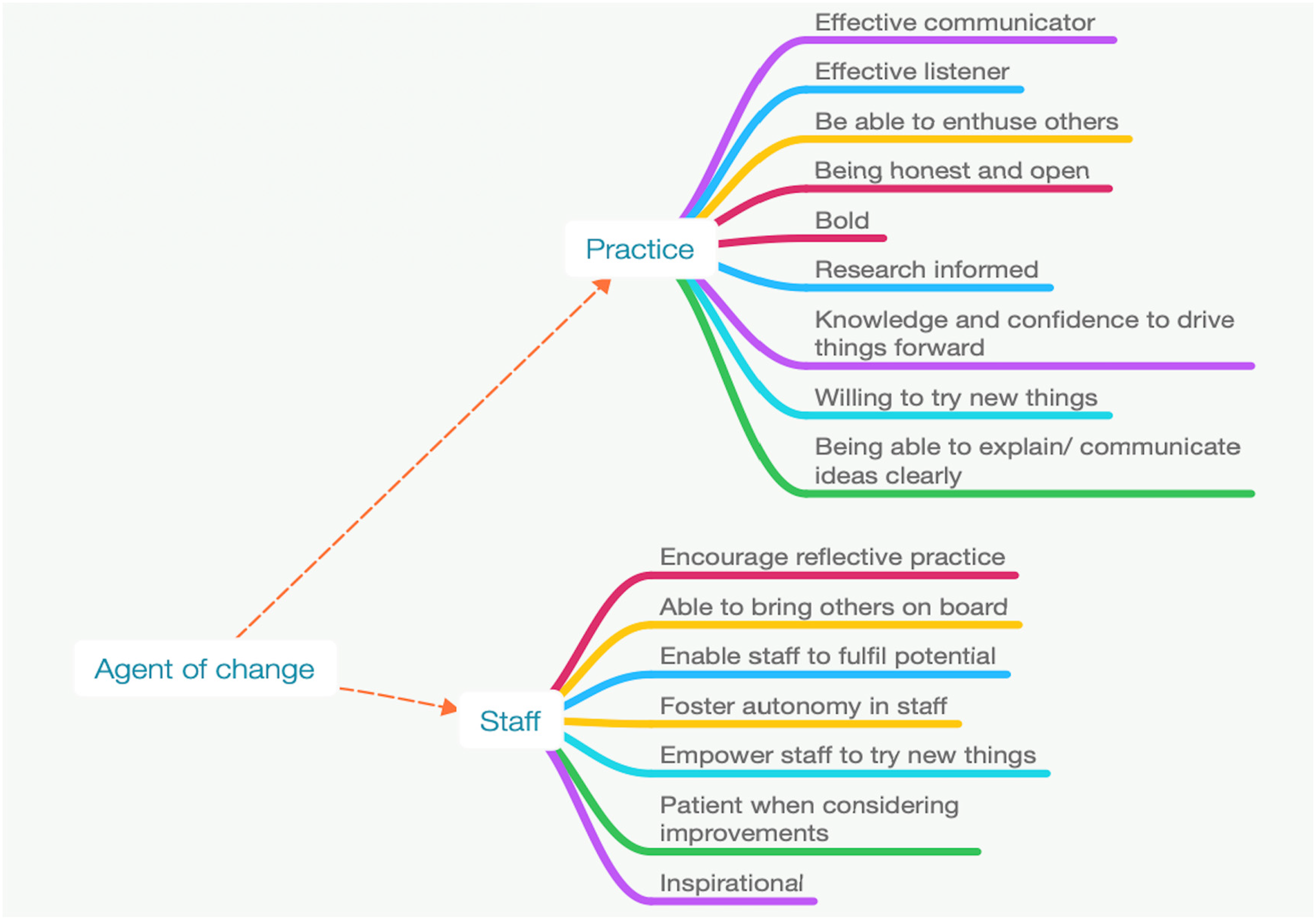
Agent of change themes/sub-themes.
Agent of change
The category ‘agent of change’ involves leaders developing their own and others’ knowledge, which includes contextualising policy requirements alongside the practice changes they want to implement in their own settings. In light of the policy context outlined above, it is not surprising that the theme of change recurs, because they were preparing to implement another revision of the EYFS (DfE, 2021a) and EYFS Profile (STA, 2017).
Policy changes often have to be implemented in a short time frame, whereas leaders understand that change and improvement evolve gradually:
You need to be patient, I think, because sometimes things need to be drawn out over a period of weeks and months to see change and improvement, particularly in staff members, rather than instantaneous.
So I’ve been doing a lot of room observations and working out not just resources and environment but how people need to perhaps change their practice to be able to respond to the children's individual needs rather than imposing what they think on the child, very different sort of waiting and listening and getting alongside children and allowing the children's ideas to develop.
… I think you do have to be open to change as well. Early Years at the moment is changing and there's lots of things happening across the board… You have got to be aware of what's going on, not just within your school in terms of these pressures, but the top down pressures that are happening nationally…I think you do have to have an opinion on it. I do think you have to thrash out whether you think these changes are good or not and maybe that you have to go with them if they do come into being, but how you might make those changes work best for your children.
Being persuasive about the benefits of a particular course of action again draws attention to the relational/positional dimensions of leaders’ work, and how they have to work on and with their staff to design and implement practice change:
I find change really hard and any changes that we put in place, they may have real intrinsic benefits for the children but, if the staff aren’t on board with it, then it just isn't going to work.
But you need to get people on board to explain why and how and why it's good for the children but why it's good for them [staff].
I think being reflective is a really strong thing to have because if you’re afraid to say let's stop this wasn’t right then you are going to keep going down a path that isn’t appropriate for the children and that's what's keeping children at the heart of everything that you do.
Summary
The findings from this analysis indicate that these Graduate Leaders claim a professional status arising from their qualifications and experiences, and the discourses drawn from specialised, field-specific knowledge and values. Their professional status underpinned their practice across all four themes, as leaders and as agents of change. Referring back to the questions posed by Dyer (2018) the practitioners in this study articulated a professional status arising from specialised knowledge, whilst at the same time enacting compliance with policy. Evidence of the impact of policy mainly took the form of attributes related to accountability and compliance, whereas constructions related to learning and quality were more strongly characterised by attributes found in available models based on established ECE discourses, particularly those that focus on the best interests of children.
Both discourses are salient for the following reasons. In order to lead practice and manage change, they needed to access the epistemic resources available within the setting, and engage team members in professional learning. Mobilising those resources through shared meanings also oriented leaders towards collective appproaches to support team members and sustain the relational qualities of their work. However, as designated leaders they also worked towards policy compliance because they held responsibility for standards and accountability. In their approaches to leadership, the breadth and scope of their roles demand that they simultaneously work on different workplace goals, including statutory policy requirements and ‘top-down’ pressures from the next phase of education. Some tensions were evident for leaders as they managed the collective/relational and individual/positional discourses in their orientations towards practice and policy. Thus their interpretive work encompassed espoused or desired ways of leading in collective and relational ways, and taking individual responsibility for accountability. These tensions are understandable in light of the systemic impact of policy reforms and, in the context of ECE in England, the frequency of changes to the EYFS and EYFS Profile.
The collective/relational and individual/positional attributes of their roles draw attention to the multiple discourses they draw on to inform their leadership practice, and how this is enacted in the structural and cultural conditions of their work. Accordingly we are not arguing that leaders engaged in the kind of policy compliance that is expected in the policy assemblage in England. Whilst the policy assemblage conveys technical (and arguably limited) understanding of ‘what works’, leaders’ decisions and actions were framed by their moral agency and ‘what works for us’.
Conclusion
We now return to the implications of the reflective re-viewing of these data in the context of subsequent policy changes in ECEC. Because the sample in this study was limited to 20 Graduate Leaders in England, with a focus on educational leadership, no generalisations can be made from the findings. However, the findings remain relevant to current policy aspirations in England and internationally to raise quality. In the contexts of post-COVID changes and economic austerity, the policy focus on ameliorating the effects on children of living in poverty and disadvantage creates additional demands on leaders’ work with staff, families and communities, as well as raising quality and improving children's outcomes (Montacute, 2020; Social Mobility Commission, 2020; Sutton Trust, 2024). Our research shows how Graduate Leaders managed the complexity and demands of their roles, the knowledge they mobilised to interpret and contextualise ECE policies, and the moral agency that permeated their decisions and actions. The findings thus contribute to wider debates about the association between Graduate Leaders/teachers and raising quality as complex and multifaceted. Specifically, there is an implicit understanding that a compliance-oriented approach is limited when applied to improving quality.
The Teacher Standards, and the designation of Graduate Leader were necessary policy interventions into building the capacity of the early childhood workforce. However, although ‘strong’ and ‘effective’ leadership continue to be recognised as critical to policy aspirations in ECEC (DfE, 2021b), the work of Graduate Leaders may be constrained considering the persistent structural problems identified by Kay et al. (2021), and the absence of sustainable solutions. There is a crisis of capacity and capability within the workforce to meet increased expectations (Nutbrown, 2021), which calls into question the sustainability of the role of Graduate Leaders/teachers in improving quality and raising children's outcomes. In an analysis of the impact of previous workforce reforms in England, Bonetti (2018, 2020) has shown how contradictions emanate from the continuing disparities in pay, status, and career progression between those with EYTS, and those with QTS, and pay disparities between the PVI and maintained sectors. As Bonetti argued, the lack of a coherent government strategy for workforce development, ‘turned into a missed opportunity for real impact’ (Bonetti, 2020: 7).
It remains to be seen whether recent attention to these problems will lead to the sustainable solutions and transformative change needed across the sector, or increase expectations of leaders’ roles and responsibilities. A policy response to enhancing leadership capacity is the National Professional Qualification: Early Years Leadership Framework (DfE, 2021b), which can be undertaken by leaders who are qualified to at least level 3 and will enable them to work across the maintained and PVI sectors. As the following extract indicates, individualistic discourses of leadership pre-dominate, within hierarchical structures: This framework is a codification of essential knowledge, skills and concepts that underpin successful leadership of a high-quality nursery. It sets out what those leading a nursery should know and be able to do within the areas related to their role and in relation to approaches that enable their nursery to keep improving. (DfE, 2021b: 12)
This reflexive reviewing of the phase 1 data has highlighted the ongoing process of policy reform, its effects on leaders, and their perspectives on the sustainability of their roles. We have also highlighted the complexity of leaders’ roles, including how they mobilise different discursive resources in ways that work for their setting, children and families. In light of the phase 1 findings, and the research project (Nuttall et al., 2024) we argue that leaders need to sustain the collective/relational and individual/positional attributes of their roles. However, the complexity of their work needs to be recognised and supported through urgent attention to the current crises in the ECE workforce, and sustainable solutions to persistent structural problems.
Footnotes
Declaration of conflicting interests
The authors declared no potential conflicts of interest with respect to the research, authorship, and/or publication of this article.
Funding
The authors disclosed receipt of the following financial support for the research, authorship, and/or publication of this article: This work was supported by the Learning-rich leadership for quality improvement in Early Childhood Education, 2018–2020 (Australian Research Council Discovery Grant DP180100281).
Ethical statement
This study was approved by the Australian Catholic University Research Ethics Committee (2018-128E) on 1 June 2018.
