




Abstract
In vocational education and training (VET) colleges worldwide, teacher teams work on innovations to improve their educational quality. To foster this process, teams benefit from team-oriented human resource management (HRM) aimed at stimulating teachers’ team learning. This qualitative study explores in-depth how team leaders enact team-oriented human resource practices and how this affects teachers’ perceptions of these practices and their engagement in team learning. Interviews with four team leaders and group interviews with 11 teachers from these four teams were conducted in one VET college in the Netherlands. The results showed that team leaders were both controlling and stimulating in their enactment. To foster team learning, it appears not just necessary that team leaders’ enactment and teachers’ perceptions of this enactment should be aligned, but that team leaders’ enactment also should be geared towards the team’s needs. This study therefore shows team leaders’ crucial role in the effective implementation of team-oriented HRM in VET colleges.
Keywords
Introduction
As vocational education and training (VET) colleges are one of the main suppliers of graduates for the labour market, it is crucial that VET colleges offer educational programmes in which students acquire professional competencies that are demanded by the labour market. To do this, VET colleges have implemented competence-based education (CBE), in which these competencies and authentic vocational problems are at the core of courses and curricula (Wesselink and Biemans, 2010; Mulder and Winterton, 2017). Implementing CBE as such is a major innovation, and relevant professional competencies change due to changing society and innovations. VET colleges are therefore urged to continuously redesign and develop courses and curricula.
The success of developing educational innovations such as CBE depends to a large extent on teachers’ willingness to put extra effort into their work (Somech and Ron, 2007). As the development of CBE is a complex task, it requires that teachers combine their expertise and collaborate with each other to be able to deal with this complexity. This implies that teachers need to go beyond their primary and largely individualistic task of teaching, and collaborate in teams to learn from and with each other and help each other improve their practice (Barber and Mourshed, 2007). More specifically, engagement in team learning, which refers to teachers sharing information and constructing shared interpretations of this information, is considered to be necessary during complex educational innovations (Dochy et al., 2014). Previous research acknowledges this crucial role of team learning in VET colleges by showing that it contributes to the establishment of a shared understanding of the principles of CBE in teacher teams (Runhaar et al., 2014), to innovative team behaviour (Bouwmans et al., 2017a), and to the successful implementation of CBE (Wijnia et al., 2016).
However, teachers’ engagement in team learning is for several reasons not always a matter of course. First, although collaboration and team learning are regarded as key components of a teacher’s competence profile, it remains a challenge for educational organizations to find a balance between investment in individual teachers’ teaching competencies, related to the role of teachers in the classroom, and investment in collaboration and teamwork among teachers (European Commission, 2013). In many cases individual teaching competencies get more attention than collaboration and teamwork. Second, not all formally established teacher teams can be characterized as real teams that consist of interdependent individuals who share responsibilities and see themselves and are seen by others as an intact social entity (Vangrieken et al., 2015). This is because teachers tend to retain their privacy and autonomy, are not used to frequent collaboration, and find it difficult to make time for collaboration with colleagues (Oude Groote Beverborg et al., 2015; Vangrieken et al., 2015).
Therefore, to foster teachers’ engagement in team learning, VET managers have invested in the development and implementation of human resource management (HRM) with the aim to support teams and teamwork (Runhaar and Sander, 2013). Team-oriented HRM covers all human resource (HR) practices such as recruitment, team development, team evaluation and teamwork facilitation, specifically geared at enhancing teams’ abilities, motivation and opportunities to collaborate, learn and perform. Team-oriented HRM has recently gained attention in the HRM literature in both the public and private sector context (e.g. Bouwmans et al., 2017a; Chuang et al., 2013). Although these studies show the potential of team-oriented HRM in stimulating team learning, they measure team-oriented HRM through employee perceptions and in merely abstract and quantitative terms. Furthermore, these studies largely neglect the role of line managers (i.e. team leaders in VET colleges), who are important executors of HRM and thus play an important role in the relationship between HRM and performance outcomes (e.g. Knies and Leisink, 2013; Purcell and Hutchinson, 2007). A focus on line managers, or team leaders in this study, is relevant for the VET sector, where our study took place. These team leaders, for instance, do not always have the knowledge and skills to perform their HR role (Runhaar and Sander, 2013), or perform their role in a way that does not meet teachers’ needs (Runhaar and Runhaar, 2012).
In this study, therefore, a qualitative approach is taken to explore in-depth how VET team leaders’ enactment of team-oriented HRM affects teachers’ perceptions of these HR practices, and their responses in terms of team learning.
Hence, this study aims to answer the following research question: How does team leaders’ enactment of team-oriented HRM affect teachers’ perceptions of team-oriented HRM and their responses in terms of team learning?
In answering this research question, this study aims to provide insights into the relationship between HRM and team behaviour in VET colleges. This insight is needed because very few studies on HRM inside or outside the educational context include teams in their research (Jiang et al., 2013). First, by focusing on team learning as a specific team behaviour, new insights can be provided into how team learning processes can be stimulated, which is a topic that remains largely unexplored (Chuang et al., 2013). Second, by specifically focusing on the role of team leaders’ enactment of team-oriented HRM, this study aims to provide insights into the process by which HRM in VET colleges can be effective in stimulating team learning.
Theoretical framework
Team-oriented HRM
To understand the relationship between team-oriented HRM and team learning, it is first explained which practices are regarded as team-oriented HR practices (the content), before it is explained how these HR practices may affect team learning (the process).
The content of team-oriented HR practices is described based on the ability–motivation–opportunity (AMO) model. The AMO model argues that an organization’s performance is best served by an HRM system that contributes to employees’ performance by increasing their abilities (A), creating motivational incentives (M) and providing opportunities to perform (O) (Boselie et al., 2005). As far as the content of team-oriented HRM is concerned, this implies that HR practices should be aimed at developing team performance by investing in the teams’ abilities, motivation and opportunities. In a previous study on team-oriented HRM in VET, four HR practices were distinguished that were positively associated with teachers’ team learning and/or team performance, namely the practices of recruitment, team development, team evaluation, and teamwork facilitation (Bouwmans et al., 2017a). These HR practices are summarized in Table 1 and are the starting point for this study.
The content of team-orientated human resource management.
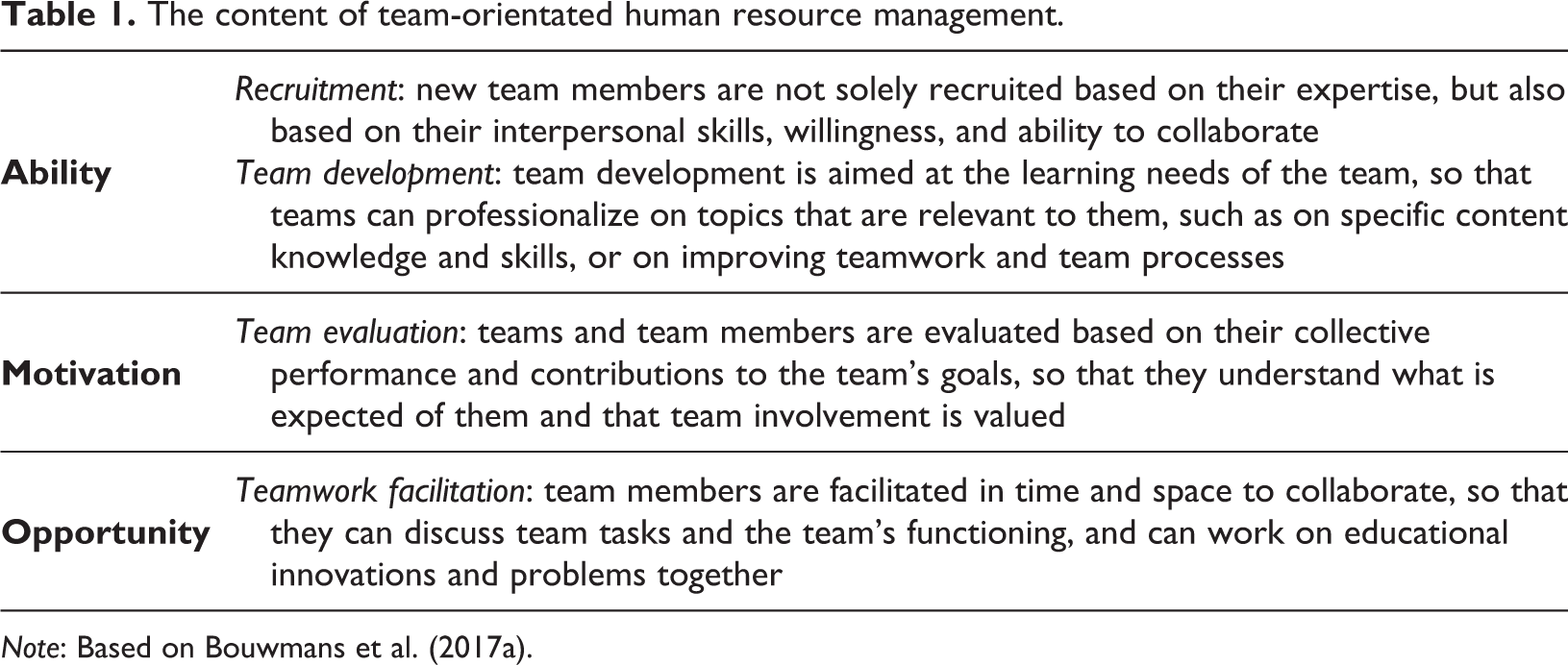
Note: Based on Bouwmans et al. (2017a).
If a VET college values team performance, it is likely that a team-oriented HRM strategy will be developed that aims to stimulate team processes, such as collaboration and team learning, which increase performance. Whether this intended strategy actually leads to team learning depends on: (a) how these practices are enacted; and (b) how teachers perceive these practices and respond based on their perceptions (Wright and Nishii, 2013).
Team leaders’ enactment of team-oriented HRM
In practice, not all intended HR practices that are described in an HRM strategy are enacted, or they are enacted in ways other than intended (Wright and Nishii, 2013). This is because the enactment of HR practices is often devolved to line managers (Hailey et al., 2005), or team leaders in the case of VET. These team leaders are the linking pin between the higher management’s strategy and teacher behaviour, which makes their role in realizing educational innovations crucial yet complex. Their complex role is reflected in the symbiotic relationship that exists between HR practices and team leaders’ behaviour (Purcell and Hutchinson, 2007). On the one hand, team leaders need well-designed team-oriented HR practices to have the opportunity to stimulate and reward teachers’ engagement in collaboration and team learning. On the other hand, the effectiveness of these team-oriented HR practices depends on how team leaders implement these HR practices.
In the HRM literature, different reasons are distinguished that may influence the effectiveness of team leaders’ implementation and deviation from HRM strategy (Hailey et al., 2005; McGovern et al., 1997; Nehles, van Riemsdijk et al., 2006), varying from a lack of motivation or necessary knowledge and skills to a lack of time because HRM tasks are often devolved without reducing other tasks. In our specific VET context, we can imagine that the difficulty of team leaders to find a balance between control and commitment in their HRM enactment may influence their HRM enactment. This difficulty is due to Western governments’ decentralization of power, responsibilities and funding in an effort to enable educational organizations to pursue the highest possible quality of education. On the one hand, decentralization offers educational organizations the opportunity to develop a commitment-oriented HRM strategy aimed at committing teachers to team goals through empowerment and stimulation of team involvement, but on the other hand, the pursuit of the highest possible quality of education has led to an international trend in education of paying much attention to the control element, such as the monitoring of teacher performance. Because performance monitoring is often accompanied by sets of rules, regulations, and procedures, less time is left to stimulate teamwork and create an inspiring workplace as a means to enhance performance (Mossholder et al., 2011). We therefore use the control–commitment distinction as a theoretical lens to examine whether and how team leaders differ in their enactment of team-oriented HRM, and what the effect is on teachers’ engagement in team learning.
Teachers’ perceptions of team-oriented HRM
Following the line of reasoning of Purcell and Hutchinson (2007), it is argued that teachers’ behaviour is influenced by how they experience both team-oriented HR practices and their team leaders’ behaviour. Teachers form an understanding of appropriate behaviour by interpreting HR practices and by interpreting the signals that team leaders send out through their enactment (Bowen and Ostroff, 2004; Purcell and Hutchinson, 2007; Wright and Nishii, 2013). The social exchange theory has proven its value in explaining how individuals’ perceptions lead to certain behavioural responses (e.g. Alfes et al., 2013; Runhaar, 2016). It explains the reciprocity within social relationships (Blau, 1964): if teachers perceive the presence of team-oriented HR practices and their team leader’s support for collaboration and team learning through his/her enactment of these practices, teachers feel obliged to reciprocate with positive team behaviour, such as engagement in team learning.
Teachers’ team learning
Team learning is regarded as positive team behaviour and is central to this study because team learning is shown to be positively related to team performance and CBE implementation (Bouwmans et al., 2017a; Van Woerkom and Croon, 2009; Wijnia et al., 2016). Team learning refers to interactions between team members that contribute to achieving mutual understanding and shared cognition in teams (Van den Bossche et al., 2006). To achieve this, teams need to engage in different team learning processes. The following three processes form the core of team learning, team members: (a) share previously unshared information with each other; (b) co-construct this information into shared interpretations by questioning, concretizing, and refining this information; and (c) engage in constructive conflict to openly discuss and negotiate about different opinions so that they can reach consensus (Decuyper et al., 2010). When mutual understanding and shared cognition are achieved through engagement in these processes, teams perform more effectively (Van den Bossche et al., 2006; Vangrieken et al., 2016).
In Figure 1, the process through which intended team-oriented HRM may lead to increased engagement in team learning, which is described above, is visualized.
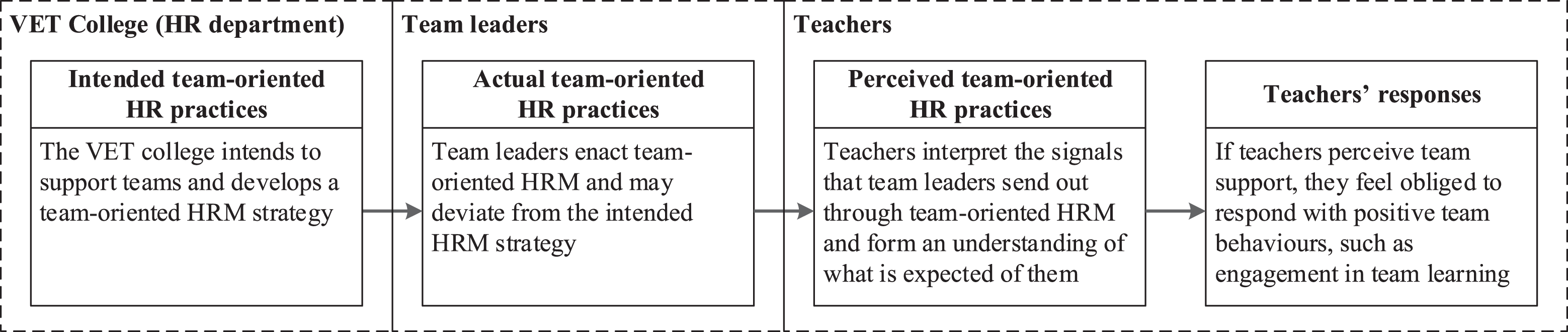
Conceptual model.
Methods
A small-scale qualitative study was executed to make in-depth comparisons between how team leaders enacted team-oriented HRM, and how their enactment affected teachers’ perceptions of appropriate behaviour and their engagement in team learning.
Sample and research context
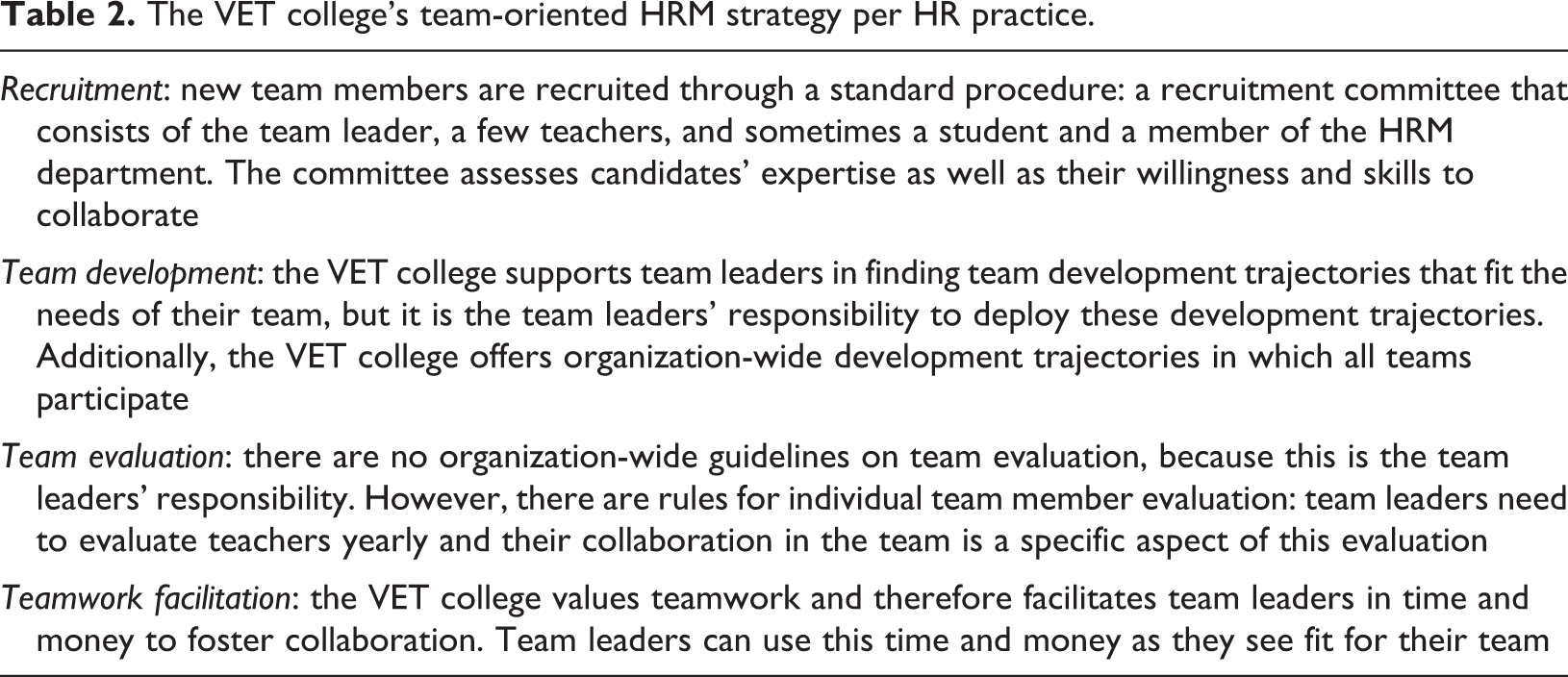
Purposive sampling with two steps was used to select one Dutch VET college with a team-oriented HRM strategy in which the responsibility for enacting team-oriented HRM was devolved to team leaders. First, based on a large-scale quantitative analysis of team-oriented HRM and team learning (Bouwmans et al., 2017a), one VET college was selected in which teachers recognized the presence of team-oriented HR practices and team leaders were responsible for enacting these HR practices. Second, a group interview was conducted with the HRM and educational development department heads to determine the content of the team-oriented HRM strategy. The results are described in Table 2.
The VET college’s team-oriented HRM strategy per HR practice.
The selected VET college focused on teams in their HRM strategy because these were held responsible for implementing a renewed vision on CBE in their educational programmes. The main goal of the teams was to increase linkages between the courses in their curricula. Project groups were established within each team to increase these linkages, and worked for instance on standardizing grading methods for all courses or developing project-based education.
Participants and study design
Team leaders from all seven teams in the VET college were requested to participate and to let their teachers participate in interviews. Three team leaders declined because of practical reasons (e.g. time constraints). The remaining four team leaders participated with a total of eleven teachers: three teachers from teams 1 to 3; and two teachers from team 4. These teachers were the driving forces behind the educational projects in their teams and had a good overview of team processes. During the interviews, a topic list was used that addressed engagement in team learning, team-oriented HR practices, and team leaders’ behaviour. The team leaders participated in face-to-face interviews of about one hour each and teachers from each team participated in group interviews of about one to one and a half hours each. Group interviews were conducted because of the expected snowball effect: by discussing their perceptions on the interview topics, teachers could reconstruct their team reality together (Barbour, 2007). To individually prepare these group interviews, teachers filled in a short questionnaire about team learning and perceived team support before the interview. Their answers were discussed during the group interviews.
Analysis
The interviews were transcribed and coded in Atlas.ti version 7.5, using thematic analysis as the coding process (Braun and Clarke, 2006). First, initial ideas were noted during the transcribing process, followed by an initial round of coding relevant fragments. This initial round was both deductive and inductive: some codes were based on theory on team-oriented HRM and team learning, while other codes were created without a predetermined theory, such as the codes that described team leaders’ behaviour. Next, codes were sorted into themes related to the different team-oriented HR practices and team learning, and both codes and themes were refined. Reliability was taken into account by calculating interrater reliabilities for two transcripts that were coded by the first and second author. The first and second author discussed codes on which they had an agreement of 0.60 or lower (moderate agreement or less). Codes were changed based on their consensus, resulting in an average Cohen’s kappa of 0.92 with a range of [0.65;1], which indicated a high agreement (Viera and Garrett, 2005). The first author re-examined the remaining transcripts based on this consensus and consulted the second author in case of doubt. The final codes and themes were used for the results section.
Validity of the analysis was taken into account using data triangulation, which implied comparing team leaders’ and teachers’ responses per team, testing the consistency and accuracy of codes by comparing the content of codes within and between transcriptions, and providing evidence for the analysis through examples and quotes. Ethics were taken into account by obtaining verbal informal consent from all participants and by ensuring anonymity (Barbour, 2007; Gibbs, 2007).
Results
First team leaders’ differences in their HRM enactment, teachers’ perceptions of team-oriented HRM, and the alignment between team leaders’ enactment and teachers’ perceptions are discussed. Second, teachers’ engagement in team learning is discussed.
Team-oriented HRM
Team leaders’ enactment and teachers’ perceptions are described per team-oriented HR practice. It is notable that some differences between team leaders’ enactments were found (see Table 3). Regarding recruitment, no differences were found, while small differences were found for team development and team evaluation. The differences were most prominent in team leaders’ enactment of teamwork facilitation, which is therefore discussed in more detail below.
Differences in team leaders’ enactments of team-oriented human resource (HR) practices.
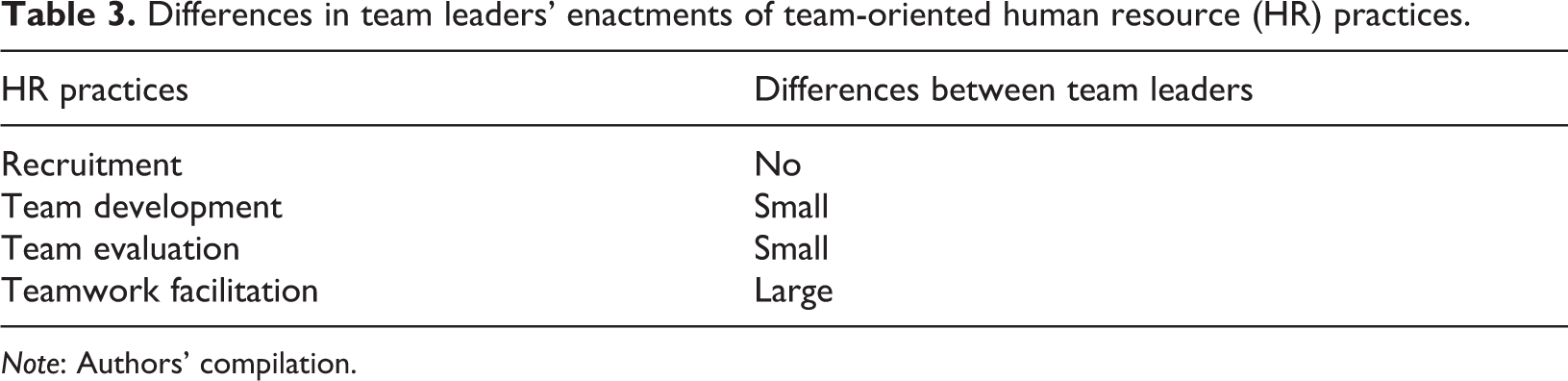
Note: Authors’ compilation.
Recruitment
Team leaders followed the VET college’s standard procedure and collaborated with teachers and sometimes students or HR specialists in recruitment committees. A consequence of the standard procedures was that team leaders had little discretionary room to differ in their enactment of recruitment. The standard procedures for recruitment were also known to teachers and their perceptions of recruitment were therefore aligned with how team leaders described them.
Team development
Based on the descriptions of the team leaders and teachers of teams 2, 3, and 4, it was determined that these team leaders took their teams’ needs and team involvement as a starting point for team development. For instance, these team leaders regularly organized education development days in which the newly-established project groups were encouraged to collaborate and engage in team learning. Moreover, team leaders 2 and 3 also organized training sessions on topics that their teams wanted to develop on, such as student coaching (team 2) and project-based education (team 3). Through team development, all team leaders wanted to increase teachers’ content knowledge and abilities and their collaboration and engagement in team learning. They believed that increased collaboration and team learning were achieved through team development, as explained by team leader 3: “That is the nice thing about team development…Teachers find each other. Afterwards, they work better as a team. That is a positive result” (team leader 3). Teacher 1: It [team development] is often pragmatic…Such as training on a particular software program. Teacher 2: Everything to make the organization manageable. Control by means of tools. Teacher 1: Yes, while we would rather have training on specific topics, such as giving feedback (teachers, team 1).
Team evaluation
All team leaders described that they evaluated a broad array of topics with their teams, such as team performance and teacher collaboration. However, the main purpose of team evaluation was to exercise control on team performance by evaluating student results and employee satisfaction surveys. In addition, formal, individual teacher evaluations primarily focused on teacher performance during lessons, based on students’ satisfaction with the lessons. During these formal teacher evaluations, all team leaders only discussed teachers’ team involvement when problems had occurred. Only team leaders 3 and 4 evaluated teachers’ team involvement informally during daily practice and before problems had occurred as well. The perceptions of teachers from all teams were aligned with team leaders’ descriptions of team evaluation: all teachers perceived that team involvement was not an integral part of team evaluations and individual teacher evaluations.
In addition to team evaluations and teacher evaluations, only team leader 3 organized peer coaching meetings on new projects in which the evaluation of collaboration and engagement in team learning was an integral part: “I evaluate new projects. For instance, we developed a new intake procedure. We reviewed it and focused, among others things, on collaboration” (team leader 3).
Teamwork facilitation
All team leaders had in common that they facilitated collaboration in the newly-established project groups during time that was originally reserved for regular team meetings. For instance, instead of organizing regular team meetings every week, team leader 4 switched to organizing regular meetings biweekly and using the other weeks for collaboration in project groups. Team leader 3 reserved time during regular team meetings for collaboration in project groups. Teachers of all teams also perceived that team leaders made time available during regular team meetings for project groups to collaborate.
Despite these similarities, team leaders clearly differed in their approach to teamwork facilitation and in their reasons for this. Team leaders 1 and 2 described that they empowered teachers by granting autonomy, because they believed in the teachers’ professional attitude and abilities to engage in collaboration and only intervened when they perceived that collaboration was not going well. The perceptions of the teachers of teams 1 and 2 on their team leaders’ approach were aligned with how the team leaders described their role: teachers perceived that their team leaders relied on their initiative to engage in teamwork. However, the teachers of both teams preferred a different approach of their team leader. For instance, in team 2, teachers desired more steering and guidance from their team leader: Sometimes you miss targets. I have the feeling that targets are set at a higher level, but that these targets are not communicated to us [by the team leader]. Then I think: “Just tell us what you want. Then we can take that into consideration and maybe change our plans” (teacher, team 2). Teacher 1: Some of us take initiatives but do not make progress. We think about solutions…but need support. Teacher 2: Sometimes we are also inhibited… Teacher 1: Everybody sits on their own ‘island’ and creates all kinds of things…But we remain on our ‘islands’… Teacher 1: We have the desire, motivation and inspiration [to seek collaboration]…But we miss a step. Teacher 2: It is often said [by the team leader]: “you are going too fast, take it slowly” (teachers, team 1). “If I had to wait for teachers to take the initiative to meet, it wouldn’t happen. That is why I say, childish as it may sound: ‘Your project group will meet at 9 a.m. and our regular meeting will start at 9.30’” (team leader 3). Teacher 1: I have the feeling that we [the project group] can no longer say that we never discuss our project during the school year. That possibility does not exist. Teacher 2: You are given a task, and it is expected of you that you deliver results. Teacher 1: Yes…if you want engagement in team learning in a team, you should point that out by saying: “Because we are here together, we are going to do things together” (teachers, team 4). When the team leader heard too much description of the process [of a group’s project], she asked how the project could be concretized…She steered on making things specific…By discussing this with everybody, we looked at how we could integrate assessments. Some teachers provided input and then it was done (teacher, team 4). Teacher 1: She believes it is important that we collaborate on projects and consider these projects from different perspectives. She really stimulates that. Teacher 2: Yes, she also stimulates new initiatives…by saying “examine the possibilities” (teachers, team 3).
Teachers’ engagement in team learning
In this section, the teams’ engagement in team learning is described and related to team leaders’ enactment of team-oriented HRM. Based on the descriptions of the teachers, it was determined that teams 1 and 2 were characterized by limited engagement in team learning, while the teachers of teams 3 and 4 engaged much in team learning. These differences between team 1 and 2 on the one hand and team 3 and 4 on the other hand seem to be related to the team leaders’ approach in their enactment of teamwork facilitation, as is clarified below.
Although some teachers of team 1 initiated collaboration and tried to stimulate other teachers’ engagement in team learning, most teachers were hesitant to engage in team learning and therefore did not take the initiative. These hesitant teachers argued that they did not have enough time for collaboration and blamed the team leader’s lack of support for their limited engagement in team learning: Teacher 1: Many teachers are very hesitant [to engage in the team] and search for support. They say: “we cannot meet because of different schedules”. Teacher 2: They do not search for solutions themselves (teachers, team 1).
Similarly, in team 2, the team leader trusted in teachers’ professional attitude and abilities to engage in team learning at their own initiative. However, also in this team, the team leader’s approach did not result in more engagement in team learning. The absence of a directive team leader resulted in that teachers felt no urgency to prepare team meetings and that the few teachers who had prepared meetings did not call on other teachers to prepare as well: Teacher 1: Team meetings are often poorly prepared by everybody. This slows down our progress…Nobody has very strong opinions. Teacher 2: Yes, we just sit and wait for what comes…Nobody is entirely prepared [and says to others]: “Come on, you should prepare as well!” (teachers, team 2). “Teachers in our team have different perspectives on grading…We have not succeeded in reaching agreement on that…Everybody continues to use their own grading method” (teacher, team 2). “It goes like this: ‘What should we do? What do you do, and what do I do? How are we going to do this?’…We try to connect aspects [of our courses] as much as possible” (teacher, team 3). This week we had a meeting with teachers who were not involved in our project on the following questions: “How can we design these projects for years 1 and 2 of our educational program? What kind of projects can we work on? What are the implications? How can we collaborate in these projects?” It is not always easy…but I do believe that this team really tries to collaborate (teacher, team 3). We have seven projects on which teachers collaborate and develop things together. Effort is put into that…For instance, we designed a new grading method in a smaller meeting, and discussed this in the regular team meeting. Together we reach agreement, and then we bring it into practice (teacher, team 4).
Conclusion and discussion
Conclusion
The goal of this study was to explore how team leaders’ different enactments of team-oriented HRM affected teachers’ perceptions of team-oriented HRM and their response in terms of team learning. The small-scale qualitative approach allowed for in-depth comparisons between team leaders and their teams, and led to insightful findings.
Results showed that: (a) team leaders largely determined the enactment of team-oriented HR practices in their teacher teams; and (b) their enactment seemed to affect teachers’ engagement in team learning. Hence, this study confirms that team leaders seem to play a crucial role in stimulating teachers’ team learning through team-oriented HRM.
This conclusion is based on several important findings that highlight the central role of team leaders. First, it was found that team leaders differed at least to some extent in their enactment of the HR practices of team development, team evaluation, and teamwork facilitation. These differences can be attributed to the absence of procedures for these HR practices, which led to much discretionary room for team leaders to differ in their approaches. Because of procedures for recruitment, team leaders did not differ in their enactment of this HR practice. The differences in team development, team evaluation, and teamwork facilitation seemed to be a result of the extent to which team leaders wanted to control team performance, and of the extent to which they empowered teachers. The latter was most clearly demonstrated in their facilitation of teamwork. Team leaders 1 and 2 believed that teachers will take their own responsibility in engaging in their team and therefore granted them autonomy. On the contrary, team leaders 3 and 4 believed that teachers needed to be actively stimulated to engage in their team and therefore had a directive role in team meetings.
Second, differences were found in the degree of alignment between team leaders’ enactment and teachers’ perceptions of team-oriented HRM. More specifically, teachers in teams 2, 3 and 4 experienced the team leaders’ approach as it was intended by the team leader, whereas in team 1 there was misalignment because teachers perceived their team leaders’ enactment as controlling, while the team leader wanted to stimulate collaboration and team learning.
Third, this alignment, combined with a fit between the team leaders’ enactment and teams’ needs, seemed to result in a high level of engagement in team learning. That is, in teams 3 and 4, team leaders knew that their active involvement was needed to ensure engagement in team learning. This is because teachers then knew why and how they needed to work on improving their CBE programmes, and understood that they had no other option than to engage in team learning. Where the alignment was not accompanied by a fit between team leaders’ enactment and the teams’ needs, this resulted in limited engagement in team learning. More specifically, the team leader of team 2 granted autonomy, while teachers desired a more directive team leader so that they knew what was expected of them. The absence of direction led to teachers not taking their responsibility in engaging in team learning. In team 1, the misalignment was accompanied by a misfit between the team leaders’ enactment and the team’s needs; teachers felt inhibited by their team leader to engage in team learning, with limited engagement in team learning as a consequence.
These findings provide important insights in HRM in educational organizations. The main findings of this study are discussed in more detail below, and suggestions for future research are given.
Discussion of findings
Team leaders’ enactment of team-oriented HRM
As mentioned in the theory section, team leaders may use HRM as a tool to exercise control over team performance or as a tool to commit teachers to team goals through empowerment and stimulation of team involvement. During their enactment of team-oriented HRM, the team leaders in this study showed a combination of exercising control over team performance and committing teachers to team goals by granting autonomy and stimulating collaboration and team learning. For future research it would be interesting to examine more in-depth to what extent and why team leaders use this combination of approaches. We suggest that future in-depth research on team leaders’ use of control and commitment includes leadership theory that is closely related to the balance between control and commitment. This can be done by including transactional leadership styles and transformational leadership styles in future research, because the former is control-oriented and the latter commitment-oriented. That is, a transactional leadership style implies a focus on performance and preventing work avoidance by exercising control and being directive, and a transformational leadership style implies a focus on committing teachers to team goals by empowering them and stimulating out-of-the-box thinking (Judge and Piccolo, 2004).
Reflecting on the findings of this study, one could say that the team leaders’ behaviour showed characteristics of both transactional and transformational leadership styles. This combination of leadership styles is common, because transformational leadership is regarded as an extension of transactional leadership (Bass, 1999). Which leadership style is most visible in a manager’s behaviour depends on his/her perception of which style is most suitable in a certain situation (Bucic et al., 2010). Rosing et al. (2011) refer to this capacity of managers to flexibly switch between leadership styles as ambidextrous leadership. Depending on the situation their team is in, ambidextrous leaders show opening or closing behaviours. Opening behaviours are similar to a transformational leadership style and involve leaders’ stimulation of followers’ exploration through experimentation and risk taking, while closing behaviours are similar to a transactional leadership style and involve followers’ exploitation by stimulating their adherence to rules and risk avoidance. Consequently, team leaders’ enactment of team-oriented HRM seemed to be ambidextrous. They exercised control in situations in which they thought control was needed, such as during team evaluations because of accountability demands. They also granted autonomy and stimulated out-of-the-box thinking in situations that they thought were suitable for this, such as during teamwork facilitation.
Given the similarities between team leaders’ behaviour during their enactment of team-oriented HRM and transactional and transformational leadership styles, it is notable that these leadership styles have been largely overlooked so far in studies on effective HRM implementation inside and outside the educational context. Only Vermeeren et al. (2014) and Zhu et al. (2005) have related these leadership styles to HRM implementation in their studies outside the educational context. In the educational context these leadership styles are only included in studies that neglect HRM. Studies in universities for instance show that a combination of both leadership styles contributes to teachers’ team learning (Bucic et al., 2010; Koeslag-Kreunen et al., 2017), while specifically in the VET context, transformational leadership seems to be positively related to team learning and individual teachers’ informal learning (Runhaar et al., 2010; Bouwmans et al., 2017b; Oude Groote Beverborg et al., 2015). Given that both leadership styles are generic and applicable to different educational contexts, we believe that the inclusion of both leadership styles in future research on HRM in VET colleges could increase our understanding of the effectiveness of team leaders’ enactment of team-oriented HRM.
Teachers’ perceptions and team learning
As mentioned above, in teams 2, 3 and 4 there was, to a large extent, alignment between how team leaders enacted HR practices and how teachers perceived these practices in their teams. According to Bowen and Ostroff (2004), this alignment increases the chance of achieving desired employee behaviour through HRM. This indeed seemed to be the case in the teams where there was much engagement in team learning (teams 3 and 4). However, based on the findings, it seems insufficient for team leaders to communicate their enactment in a consistent and unambiguous way, so that teachers know what is expected of them and alignment arises. To make HR practices effective, team leaders also need to adjust their enactment to their team’s needs, as team leaders 3 and 4 seemed to have done but team leader 2 did not.
Based on these findings, it is suggested that ambidextrous leadership is needed to stimulate teachers’ team learning, which is confirmed by previous research (Bucic et al., 2010; Koeslag-Kreunen et al., 2017). This implies that, in certain situations, teacher teams benefit from control and direction instead of autonomy, while in other situations they benefit more from autonomy. There seems to be no blueprint for stimulating team learning by enacting team-oriented HRM. Instead, the team’s needs should be the starting point for enacting HR practices and exercising leadership. As such, this study underlines the conclusion of Szczesiul and Huizenga (2014), who argued that not all educational organizations or teacher teams may be ready to rely on a teacher team’s responsibility to work on educational improvements autonomously, and that teachers need direction and support from a manager during their work so that it is clear to them why and how they should work on these improvements. Teams that are ready to take their responsibility are likely to benefit from empowerment, while teams that are not ready are more likely to benefit from a directive and stimulating team leader. For future research, it would therefore be interesting to focus more on this fit between the enactment of HRM and teacher teams’ needs: to what extent do team leaders take the teams’ needs into consideration and adapt their leadership style to these needs, and does a fit lead to desired team behaviour, such as team learning and better team performance?
Limitations and future research
Although we proposed that CBE implementation requires team learning, we did not examine how the participating teams operationalized CBE. It may well be that teams differed in their CBE operationalization: some teams may have used standardized competency frameworks that focus on routine tasks and lead to conservative training, while other teams may have adopted a more holistic view on competencies, meaning that students must acquire a combination of skills and attitudes required for performing in actual practice (Biemans et al., 2009). Hence, although we assumed that the teams adopted a holistic view, which requires team learning to implement, we did not examine this. We therefore recommend that future research includes the operationalization of CBE, and examines the influence of support through team-oriented HRM and teachers’ engagement in team learning on this operationalization.
Another limitation of this study is that it is based on retrospective self-report data, which could lead to subjective and biased reports. This issue was partly addressed by collecting data from different perspectives and by comparing these perspectives. Nevertheless, all respondents may have been unaware of specific team processes or unfamiliar with specific team-oriented HR practices. We therefore suggest that future research combines in-depth self-report data with more objective data, such as HRM documents, team plans, and team observations.
Another limitation is the generalizability of the findings of this study, because it was conducted within one small Dutch VET college. As team leaders of larger colleges in other educational contexts and in colleges with different experiences in developing an HRM strategy may also have discretionary room to enact HR practices, we suggest that future research includes a broader array of colleges and schools.
Practical implications
Vocational education and training colleges that try to implement effective team-oriented HRM systems should be aware of the crucial role that line managers, or team leaders, play in this process. It is often the line managers who enact HR practices in teams, and how they do this affects teachers’ perceptions of these practices and their responses. When leaders give clear directions to teachers by pointing out the goal of teacher collaboration and stimulate teachers’ collaboration during educational innovations, they seem to realize higher engagement in team learning.
Footnotes
Declaration of conflicting interests
The authors declared no potential conflicts of interest with respect to the research, authorship, and/or publication of this article.
Funding
The author disclosed receipt of the following financial support for the research, authorship and/or publication of this article: This work was supported by the Netherlands Organization for Scientific Research (NWO) under Grant411-12-070.