




Abstract
This article mainly considers the problem of trajectory tracking control problem of quad-rotor system with velocity constrain under the consideration of safety. A model-based nonlinear controller is proposed which can guarantee not only the asymptotical stability for control system but also the velocity under a safe range. Firstly, based on backstepping design, a position tracking controller with velocity constraint is proposed to ensure that the desired position can be tracked with velocity constrains. At the second step, considering attitude subsystem, an attitude controller is proposed to improve the attitude dynamic response performance. Finally, the validity and superiority of the design has been verified in simulation results.
Introduction
With the continuous development of industrial society, the research on robot control is becoming increasingly intense. 1 –5 Unmanned aerial vehicle (UAV) system, as a hotspot of robotic technology, is widely employed in different kinds of fields. As one of the main types of UAV, unmanned multi-rotor aircraft has many advantages such as high mobility, great reliability, and good adaptability, which is extensively applied in military and civilian industry, such as aerial photography, freight transportation, rescue, and mapping. 6 –8 In particular, the quad-rotor system is a 6-degree-of-freedom (DOF), nonlinear, under-actuated, and coupled system; the model is not only complex but also prone to be disturbed. 9
In the previous work, various nonlinear control strategies were employed to improve the system response performance for attitude and position control in UAV system. In the literature, 10 a robust backstepping-based approach combined with sliding mode control is proposed for trajectory tracking of a quadrotor UAV subject to external disturbances and parameter uncertainties associated with the presence of aerodynamic forces and possible wind force. An adaptive model-based predictive controller for attitude and trajectory tracking of a vertical take-off and landing (VTOL) aircraft in the simultaneous presence of model uncertainties and external disturbances is introduced in the work by Emami and Rezaeizadeh. 11
The system state of quad-rotor, especially the velocity, can be hardly constrained with hardware means. Generally, by changing the control parameters, the dynamic response can be slowed down to reduce the velocity of the flight. This kind of method has poor adaptability for different constraints, and some tracking performance is sacrificed. In recent years, some high-performance control strategies have been proposed for dynamic and steady-state performance of several kinds of state constrained systems 12 –19 and for spacecraft systems. 20 –27
This article focuses on designing a method of constraint control to solve the position tracking control problem for quad-rotor system with velocity constrains. Firstly, considering the position subsystem, a position tracking controller with velocity constraints is proposed to ensure that the desired position can be tracked with velocity constrains. A remarkable feature is that the nonlinear term is added into the differential feedback to adjust the control gain actively to achieve velocity constrains. Secondly, an attitude controller is proposed to improve the tracking performance of the attitude subsystem. The main contribution of this article lies in two aspects: (i) The proposed controller is simple to implement and has low complexity which reduces the processing requirement. (ii) Without cost function or other auxiliary tools, the velocity constraint is satisfied which is proved strictly in theory.
Mathematical model and problem statement
Mathematical description of quad-rotor aircraft
Figure 1 gives a model of a quad-rotor aircraft with “+” shaped rigid structure. Each propeller at the end of each arm has one motor. The lifts

where


Model illustration of quad-rotor aircraft.
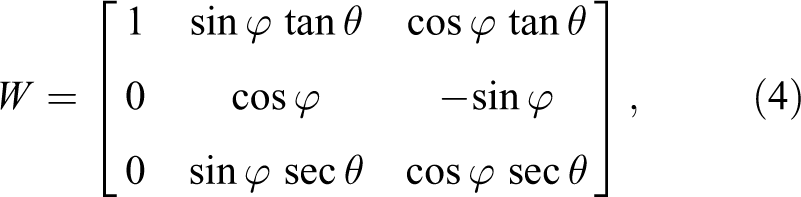
It follows from Zuo 29 that the attitude dynamic equation of a quad-rotor is given by

Note that W is the orthogonal rotation matrix by the Euler angles and explained as
and

Remark 2.1
It should be pointed out that in practice the actual control input for the quad-rotor aircraft is the four motors rather than the control forces

For the sake of statement, we only consider the design of the control inputs with
Control goals
This article focuses on designing a finite-time position control algorithm for a quad-rotor spacecraft such that the desired position trajectory of quad-rotor
where
To achieve the control objective, the following assumptions are imposed.
Assumption 3.1
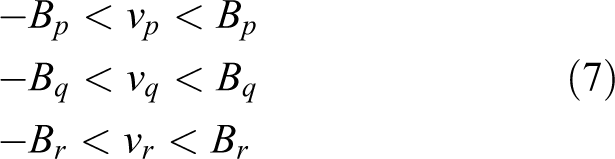
In common sense, for the sake of guaranteeing the stable and reliable flight of the quad-rotor aircraft, the desired velocity is restricted to the velocity constraint. Hence, the following inequality will be held as the following:

Controller design for quad-rotor aircraft
In this section, the backstepping approach is used in the controller design for quad-rotor aircraft. To be specific, the control design method is developed in two steps.
Design of a position controller with velocity constraints
For convenience of PD controller design, a virtual control

Substituting (9) into (1), the position subsystem of quad-rotor becomes a second-order system in vector form, that is

The key to serve the needs of the velocity constraints is to construct a self-regulation mechanism for velocity in the control behavior. An active nonlinear adjustment term is designed for differential gain in the controller directly. At this point, the virtual control outputs are constructed as:

where
Theorem 4.1
If the nonlinear controller is constructed as (11), then the position
Proof
There is no loss of generality where only the proof about p, the position of p-axis, is presented. For the sake of statement, the process is finished into two parts, that is, global asymptotic stability and velocity constraints. Part one: Global asymptotic stability
In this part, the error dynamics equation of position subsystem (10) is provided first, and then the analysis method of Lyapunov function is used.
The position tracking error is defined as

According to the position subsystem (10), the dynamic equations of (12) can be acquired, that is

Obviously, the following relation holds

For simplicity’s sake, denote

where
Moreover, the active nonlinear adjustment term for differential gain can be reformed with

Substituting the proposed PD position controller (11) with (16) into (13) results in a closed-loop error system:

Choose the Lyapunov function

whose derivative along system (17) is
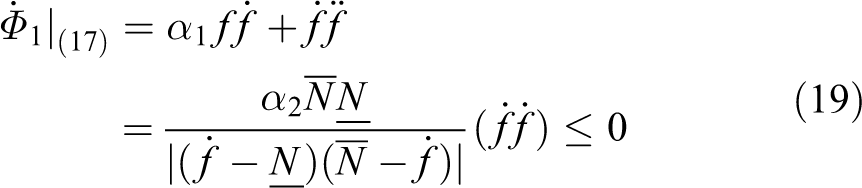
According to LaSalle’s invariant principle, it is easy to conclude that Part two: Velocity constrains
In this part, two Propositions are used to prove that
Proposition 1
Proof of Proposition 1
According to Assumption 3.1,

The proof of Proposition 1 is completed.
Proposition 2
There exist
Proof of Proposition 2
Based on Proposition 1,
Case 1
If

It indicates that

Case 2
If

It indicates that

The proof of Proposition 2 is completed.
According to these two propositions, the velocity constrains can be guaranteed. The proof is completed.
Remark 4.1
It should be pointed out that the essence reason in the proposed nonlinear position controller (11) is to employ the active nonlinear adjustment term
Design of an attitude controller
For attitude subsystem, a PD control method will be designed to make sure the desired attitude can be asymptotically stable tracked in this section. In the above section, the attitude of quad-rotor
The desired attitude, which is denoted by

Considering
Define the attitude tracking error as

where
Theorem 4.2
Considering the system (26), and τ is designed as

where
Proof
For sake of convenience, the proof about roll angle ϕ has been provided. On the basis of the attitude controller (27), Rewrite the system (26) in the following form

Similar to Theorem (4.1), two parts are employed here to proof the global asymptotic stability. Part one: Global asymptotic stability
Choose the Lyapunov function

whose derivative along system (28) is

Define set
Simulation results
To verify the utility of the proposed control method, this section has provided the simulation results. The main parameters for the quad-rotor are as follows:
As for the quad-rotor in simulation part, the initial state is set to

The desired position trajectory is given by

For the sake of illustration, three kinds of control strategies are applied to have a comparison, that is, low gains PD control without velocity constrains, PD control without velocity constrains (PDVC), and the proposed PD control without velocity constrains. The control gains of finite-time control with velocity constrains are as follows:
From the view of practice point, indoor conditions should be considered in this simulation environment. For security protection, the velocity constrains are designed by

For comparison, the position tracking error curves of the four control methods are given in Figure 2. The results show that the proposed PD controller with speed limit has better convergence performance when the system reaches the equilibrium point.

The position tracking error curves.
Moreover, a quantitative comparative analysis was made. Table 1 describes the comparisons with the convergence time after when the position tracking error is smaller than 0.003.
The convergence time of position tracking under employed controllers.

For illustrate the characteristic of velocity constrained, Figure 3 shows the velocity response curves in this simulation. It can be found that the velocity responses of the controllers which have characteristics of velocity constrained, that is, PDVC, can be restricted in velocity constrains while have been exceeded in the PD controller. Besides, the velocity constrains also can be achieved in LPD, which has unsatisfied performance due to lower control gains.

The velocity curves.
Conclusions
In this article, a nonlinear position control method with velocity constrains is proposed to solve position tracking problem for quad-rotor system with velocity constrains. Firstly, a PD position tracking controller with velocity constraints is proposed to ensure that the desired position can be asymptotically stable tracked with velocity constrains. Secondly, considering attitude subsystem, a PD attitude controller is proposed to improve the attitude dynamic response performance. Finally, simulation results proved the validity and superiority of proposed position controller with velocity constrains.
Footnotes
Declaration of conflicting interests
The author(s) declared no potential conflicts of interest with respect to the research, authorship, and/or publication of this article.
Funding
The author(s) received no financial support for the research, authorship, and/or publication of this article.
