



Abstract
Sandwich structures are important innovative multifunctional structures with the advantages of low density and high performance. Creative design for sandwich structures is a design process based on sandwich core structure evolution mechanisms, material design method, and panel (including core structure and facing sheets) performance prediction model. The review outlines recent research efforts on creative design for sandwich structures with different core constructions such as corrugated core, honeycomb core, foam core, truss core, and folded cores. The topics discussed in this review article include aspects of sandwich core structure design, material design, and mechanical properties, and panel performance and damage. In addition, examples of engineering applications of sandwich structures are discussed. Further research directions and potential applications are summarized.
Keywords
Introduction
Sandwich structures are light multifunctional composite structures, constructed by embedding a low-density core between two thin stiff facings. Figure 1 shows one typical sandwich structure with foam core configuration. Numerous alternative cores designs have been employed, including typical cores like truss core, honeycomb core, corrugated core, and various novel cores such as bioinspired core, hybrid core, and folded core. The facings of sandwich structures are relatively thinner than core and seldom exceed several millimeters, while the thickness of the core may be over 50 mm. In order to obtain good mechanical performance, sandwich structure typically has stiff facings (such as aluminum alloys, 1 fiber-reinforced polymer (FRP), 2 and carbon/epoxy prepreg 3 ) and lightweight core (such as processed woods, 4,5 metals, 6 –10 and polymers 11 –17 ). The facing–core interface is the weakest part of the sandwich structure. Adhesives are usually used in this interface to bond up and bottom facings with inner core.

Sandwich structure.
The multifunctional performance of sandwich structure greatly depends on the structure configuration and the choice of sandwich materials. The advantages of sandwich structures include enhanced energy absorption properties, great stiffness to weight ratios, excellent ballistic resistance performance, and good thermal and acoustic isolation properties. These benefits of sandwich structures lead to wide range of engineering applications including integrated thermal protection systems, 18 –20 marine manufacturing, 21,22 and aeronautical and aerospace industries. 23,24
Creative design 25 procedure for sandwich structure is described in Figure 2. First of all, investigating the formation and evolution mechanism of sandwich core structures by analyzing the geometric features. Based on the evolution mechanism, optimized sandwich structure is accomplished by executing topological design. Thirdly, selecting suitable structure material including facing material and core material. Finally, predicting the structure response for certain load condition by proposed performance prediction model.
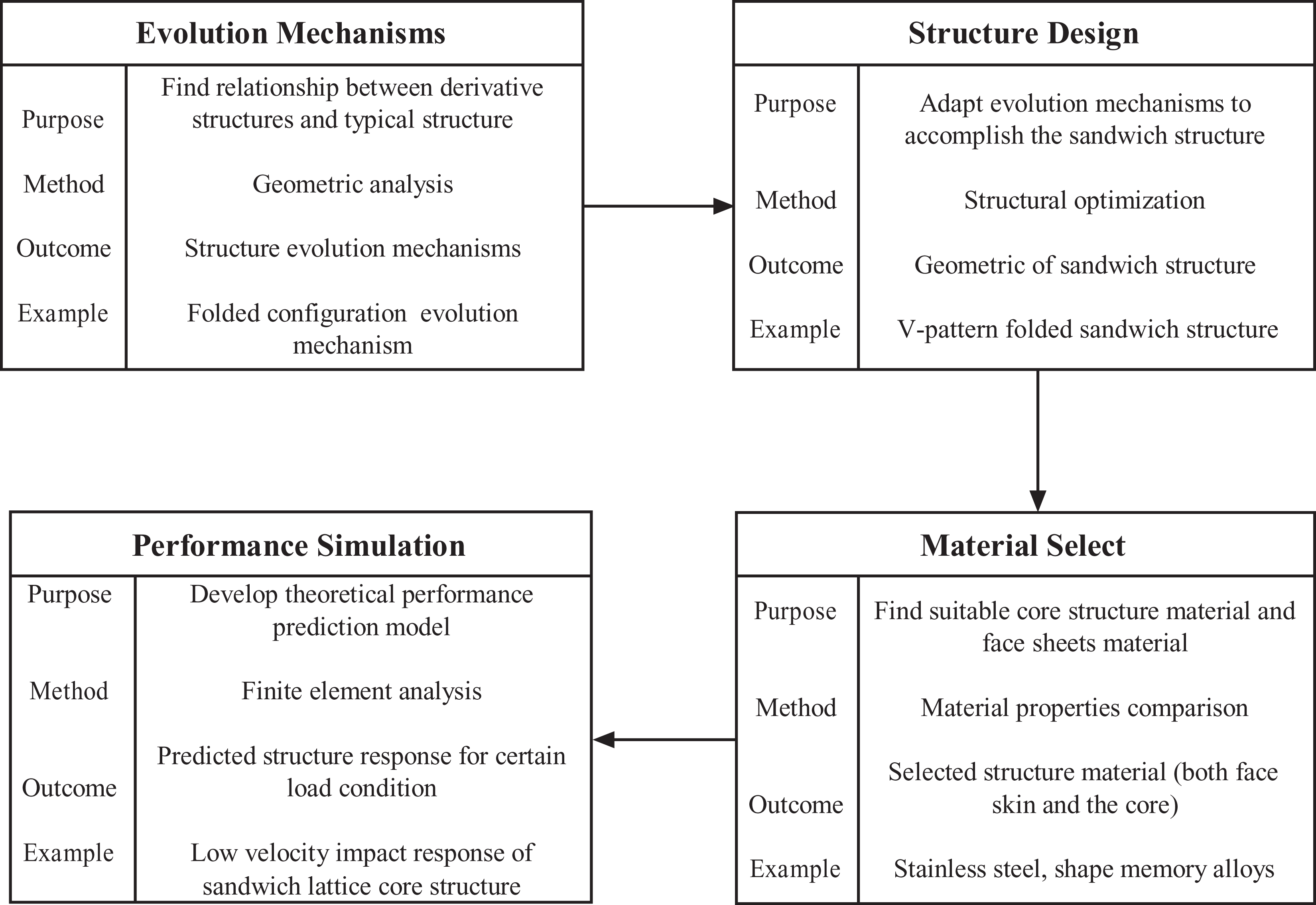
Creative design process for sandwich structure as it relates to the organization of this work.
Extensive research studies have been conducted to present a comprehensive picture for sandwich structure design. Birman and Kardomateas 26 reviewed modern trends in theoretical developments, novel designs, and modern applications of sandwich structures. Ramakrishnan et al. 27 reviewed tested properties, mechanical behavior, and major applications of sandwich structures with natural fiber composites. Abrate and Di 28 reviewed one type of plate theories called equivalent single layer theories, including polynomial theories and no-polynomial displacement fields. Caliri et al. 29 reviewed theories and solution methods for laminated and sandwich structures. A comprehensive review of recent research efforts on the development and characterization of sandwich structures with corrugated, honeycomb, and foam cores was published by Xiong et al. 30 Ahn 6 reviewed research on metallic sandwich plates with periodically repeated metallic inner structures in terms of design, manufacturing, and formability. Nikbakt et al. 31 presented a review of optimization studies on composite structures by representing a classification based on the type of structures. Jusoh et al. 32 summarized the characterization and researches of natural fibers-reinforced composites to create corrugated core for sandwich structures. Zaid et al. 33 proposed a review of sandwich structure based on corrugated core. Betts 7 reviewed the benefits and current modeling tools for metal foams. Grünewald et al. 34 presented an overview of research that has been done in the area of manufacturing thermoplastic composite sandwich structures. Ning et al. 35 reviewed some of the most important developments in functional materials and their practical applications. Eshaghi et al. 36 reviewed the applications of magnetorheological and electrorheological fluids in adaptive sandwich structures for vibration control. D’Alessandro et al. 37 focused on the acoustic behavior of sandwich panels and presented an exhaustive list of dedicated and validated models. Sun et al. 38 presented a brief review on the current progress in stimuli-responsive shape memory materials (SMMs), including traditional shape memory alloys (SMAs), shape memory polymers (SMPs), and newly emerged shape memory hybrids (SMHs). Chai and Zhu 39 reviewed low-velocity impact response studies of composites sandwich structures subjected to large, small, and medium mass impacts. Sayyad and Ghugal 40 reviewed the recent research done on the free vibration analysis of multilayered laminated composite and sandwich plates. Nondestructive evaluation techniques and instruments for sandwich structures and thick-section composites were summarized by Hsu 41 and Ibrahim 42 Thomas and Tiwari 43 reviewed quasi-static and dynamic crushing behavior of honeycomb structure. Manalo et al. 44 presented an overview of state-of-the-art research on FRP sandwich systems for lightweight civil infrastructure. A comprehensive review of the literature on corrugated structures, with applications ranging from traditional engineering structures through to morphing aircraft wing structures, was presented by Dayyani et al. 23
This review concentrates on the latest work on creative design for sandwich structure. In this review, a general guideline for the reader is provided by deconstructing the sandwich structure creative design process into four main sections. These sections include core structure design, material selecting, structure performance and damage, and applications.
Core structure design
Structure design is the first step of sandwich structure creative design. Sandwich structure can be typically classified as honeycomb, foam, corrugated, and truss core sandwich structures according to different core structures. The categorization of sandwich structure is summarized in Figure 3 and is discussed in detail below.
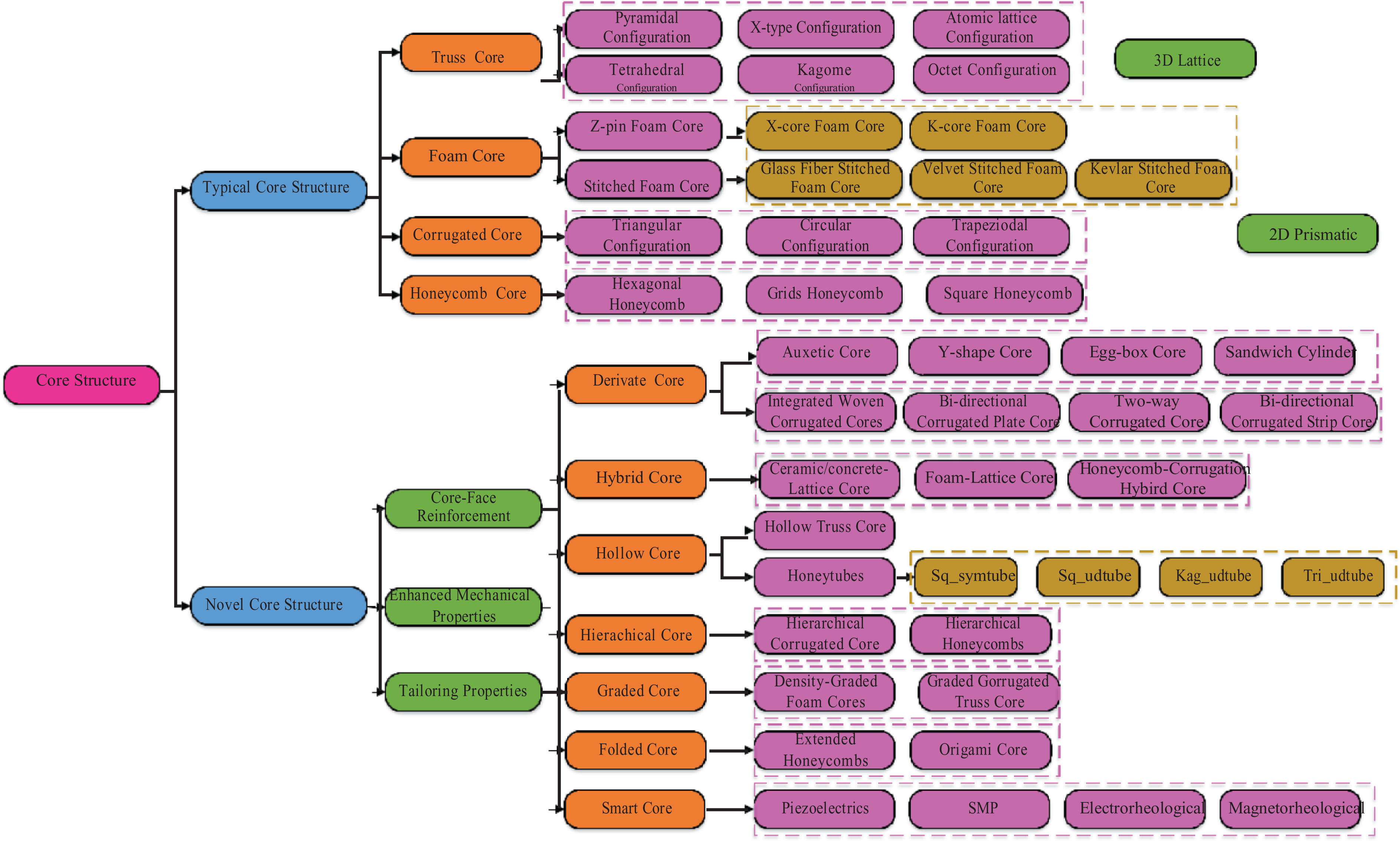
Categorization of sandwich structures.
Typical core structures
Truss cores, foam cores, corrugated cores, and honeycomb cores are typical core structures. Figure 4 shows some typical sandwich structures. Among them, honeycomb cores, corrugated cores, and truss core are periodically repeated inner structures. Compared with foam, more empty volume is formed in the core region with periodically repeated inner structures. As shown in Figure 4(d), corrugated cores typically have open channels in one direction. Opposed to corrugated cores, honeycomb cores are usually closed-cell structure, such as hexagonal honeycomb cores, square honeycomb cores, and square honeycomb cores.

Typical sandwich structures: (a) pyramidal truss, (b) square honeycomb, (c) foam core, and (d) triangular corrugated sheet.
In recent few years, extensive research studies have been conducted on derive pattern design of typical core structures. Examples of derive pattern design and latest development in typical sandwich structures are discussed below as the order of truss core, foam core, corrugated core, and honeycomb core.
Truss core
Truss core sandwich structures are one of the oldest and most used sandwich structures. The traditional geometries for truss cores include pyramidal, tetrahedral, Kagome, and X-type configurations. However, several derivative patterns have been developed in the last few years. 45 –53
Li et al. 45 proposed a novel design of composite pyramidal truss core sandwich panels with reinforced joints. Based on the typical pyramidal truss core, a new type enhanced lattice structure called “Hourglass” truss sandwich structure was designed by a transition process. 25 –27 As shown in Figure 5, the Hourglass truss core is similar to the two-layer pyramidal truss core and has the same inter-node spacing. However, Hourglass truss cores are arranged more sparsely and have smaller slenderness ratio which lead to superior resistance to buckling.
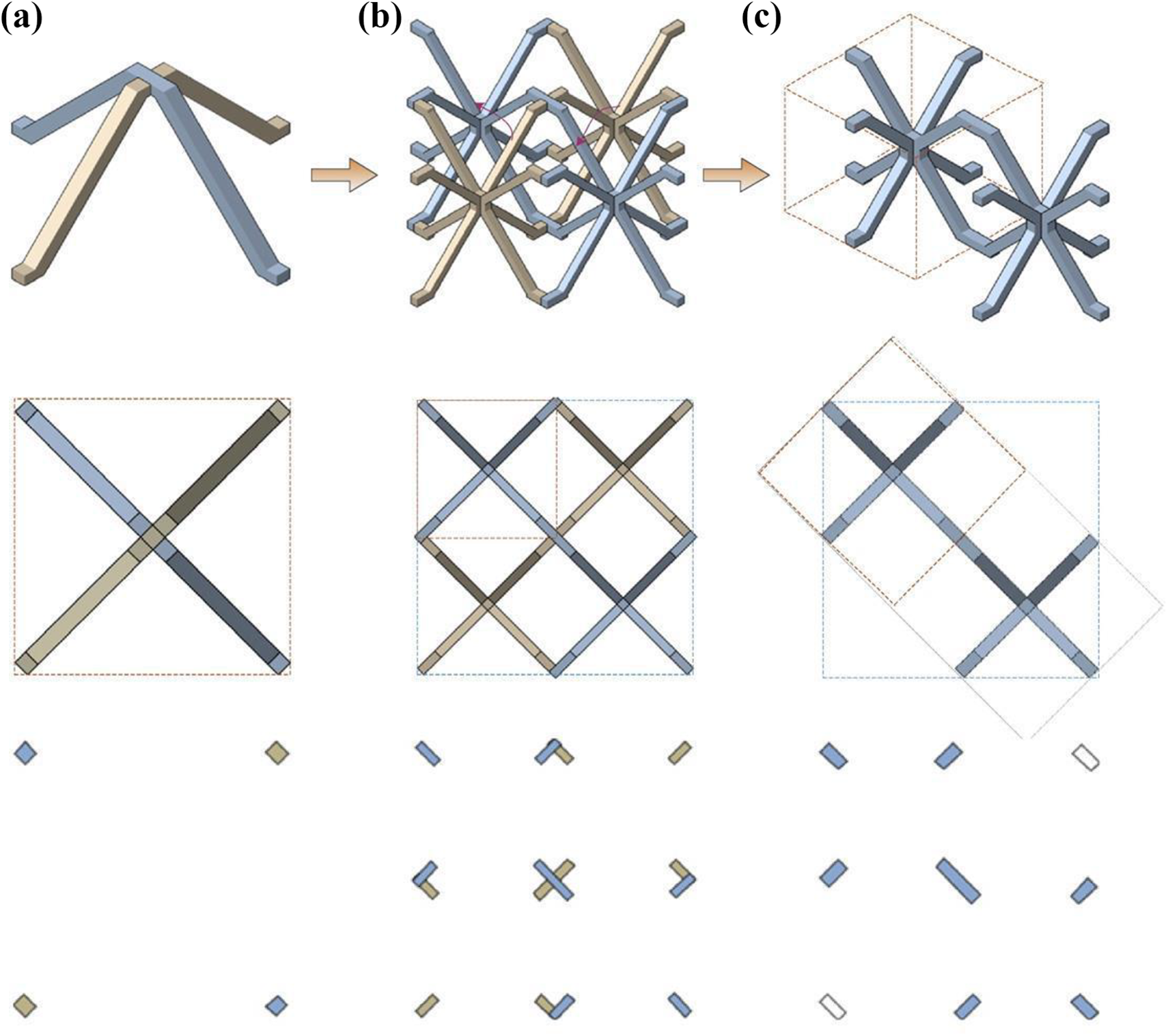
The process of transformation from a single-layer pyramidal truss lattice to an Hourglass truss lattice: (a) single-layer pyramid, (b) two-layer pyramid, and (c) Hourglass truss.
Parameters and configuration of advanced three-dimensional (3D) truss core structures called lattice truss core structures are shown in Figure 6. Inspired by atomic structure, stretch atomic lattice structures with lightweight and high strength were designed, such as body-centered cubic (bcc), ace-centered cubic (f2cc), and f2bcc (combination of bcc and f2bcc). Ullah et al. 48 researched on energy absorption capacity and failure characteristics of Ti-based Kagome and atomic lattice truss structures. It is found that Kagome structures perform best and have superior strength compared to atomic lattice structures shown in Figure 6. Yin et al. 24 proposed a lightweight double-curvature composite sandwich hood with a pyramidal lattice core and achieved minimum head injury by selecting carbon fiber-reinforced composite (CFRC) panels and a flax fiber-reinforced composite lattice core. Octet-truss lattice core is an ultralight 3D spacing filling structure which can be fabricated by using a mechanical snap fitting and adhesive bonding technique. 49,31 Dong et al. researched on mechanical response of Ti-6Al-4V octet-truss lattice structures 49 and carbon fiber-reinforced polymer (CFRP) octet-truss lattice structures. 31 The feasibility of employing Ti-6Al-4V octet-truss materials in high-temperature applications is demonstrated in the work of Dong et al. 49 It is found that snap-fit CFRP octet-truss lattice structures have superior mechanical properties than Ti-6Al-4V octet-truss materials when densities are 24–230 kgm−3. Gautam et al. 51 studied the compressive performance of the Kagome truss unit cell to help understand the macroscopic behavior of Kagome truss sandwich plates. Jishi et al. 52 proposed a novel composite lattice structure by weaving carbon fiber tows in the through-thickness direction. Two wearing patterns were adopted as shown in Figure 7. Gao and Sun 53 presented a thermal control study of a composite sandwich structure with lattice truss cores based on the thermal resistance network model and fin theory. Core geometry parameters were considered as one of the main factors which effect the maximum temperature of the heat source. Wang and Hu 4 investigated the bending properties of lattice sandwich structure with wooden truss by three-point bending method. The study found that lattice sandwich structure with poplar veneer truss has superior bending performance to oriented strand board truss.

Parameters and configuration for (a) Kagome structures and atomic lattice structures for (b) bcc, (c) f2cc, and (d) f2bcc (combination of bcc and f2bcc). 48 bcc: body-centered cubic; f2cc: face-centered cubic.

Schematic drawings of the two procedures used to thread the samples. (a) The fibers extend through the holes and then between the wax core and the skins. (b) The fibers extend through the holes and the skins and then back.
Foam core
Foam core sandwich structures are a major class of lightweight structure materials and widely used in engineering filed including aerospace, automotive, and marine structures. 54 –59 Min et al. 9 designed a stainless steel fan bland with metal foam core to process a high stiffness with lighter weight. Bai and Davidson 54 presented the theoretical development of composite foam core sandwich panels and provided a rigorous analysis methodology for foam insulated concrete sandwich structures. Inspired by stitching of monolithic composites materials, the core-face reinforcement of foam core sandwich structures called stitched foam core structures were designed (as shown in Figure 8). Although the stitching of sandwich structure limited the applications, the bonding of face-core interface has been improved. Therefore, good mechanical properties of stitched foam core sandwich structure are guaranteed. Xiong et al. 30 summarized the schematic of stitched foam sandwich structure as shown in Figure 9. There are various types of stitched foam cores such as X-core foam core, K-core foam core, vertical stitched foam core, and oblique stitched foam core. Xia and Wu 55 studied the impact properties of through-thickness stitched foam sandwich composites. Moreover, z-pin foam core structures are reinforced foam core structures which apply truss elements in foam core sandwich structures. The “pin” reinforcement technique offers better mechanical performance such as multifunctional loading bearing, energy dissipation, sound absorption, and enhanced thermal properties. 30 Grigoriou et al. 56 demonstrated that multifunctional z-pinned sandwich composites can increase electrical and mechanical properties concurrently and also provide the functionality for in situ real-time damage detection. Nanayakkara et al. 57 investigated the flatwise compression properties, strengthening mechanisms, and failure modes of sandwich composite materials reinforced with orthogonal z-pins. It is found that the total absorbed compressive strain energy of sandwich composites is improved greatly by z-pinning (more than 600%) due to the z-pins resisting core crushing. 57 Li and Crocker 58 reviewed theoretical models for passive damping in composite sandwich structures and analyzed the effect of the thickness and delamination of composite honeycomb-foam sandwich beam on damping. Banhart and Seeliger 10 presented an optimized design for dense foam core sandwich structures and assessed its current and potential applications. John et al. 42 applied CFRP/polymethacrylimide (PMI) foam core sandwich structure as a primary structure in commercial aviation with its specific environmental requirements.

Picture of through-thickness stitched foam sandwich structure. 55

Schematic of stitched foam sandwich panels: (a) stitched foam core with oblique direction, (b) stitched foam core with vertical direction, (c) X-core foam core, and (d) K-core foam core. 49
Corrugated core
Corrugated sandwich structures are widely used in aeronautics, aerospace, naval, civil engineering, and automobile industries for their outstanding load-bearing and energy-absorbing capacities. 60 –70 The corrugated core between the face sheets has various geometrics such as rectangular cores, triangular cores, trapezoidal cores, arc-tangent cores, and sinusoidal cores as shown in Figure 10. Extensive research has been conducted on corrugated sandwich structures design in recent years. Zaid et al. 33 proposed a review of sandwich structures with trapezoidal, triangle, and sinusoidal corrugated core and concluded that corrugated sandwich structures offer higher shear strengths in the longitudinal direction when compared with square honeycombs and foam cores. Eshaghi et al. 36 summarized several natural fiber-reinforced composites corrugated core including straight cores, curvilinear cores, hat type cores, triangular cores, and reference stiffened panels. Dayyani et al. 23 reviewed the development of composite corrugated core sandwich structure, and concluded in Figure 11. He et al. 61 focused on low-velocity impact behavior of trapezoidal corrugated core sandwich structure with CFRP faces sheet and aluminum alloy cores. Li et al. 18 conducted a combined theoretical, numerical, and experimental investigation of the integrated thermal-protection system based on C/SiC composite corrugated core sandwich plane structure. Xu et al. 62 designed a novel 3D corrugated core sandwich structure and fabricated it by the auto-cutting process. Inspired by Odontodactylus scyllarus, Yang et al. 63 designed a bidirectionally corrugated core sandwich panel called double-sine corrugated panel (as shown in Figure 12). Dayyani et al. 65 performed an optimal design of composite corrugated core by using high-fidelity models for better nonlinear static and dynamic behavior. Norman et al. 66,67 investigated the properties of multi-stable corrugated shell structures by using a simplified analytical elastic model and morphing of curved corrugated shells. Previtali et al. 68 utilized the anisotropic properties of corrugated panels to design morphing skin. Seong et al. 70 designed bidirectionally corrugated cores optimally to reduce the anisotropic behaviors of sandwich structures.

Unit cells of various corrugated sandwich cores: (a) rectangular, (b) triangular, (c) trapezoidal, (d) arc-tangent, and (e) sinusoidal. 60
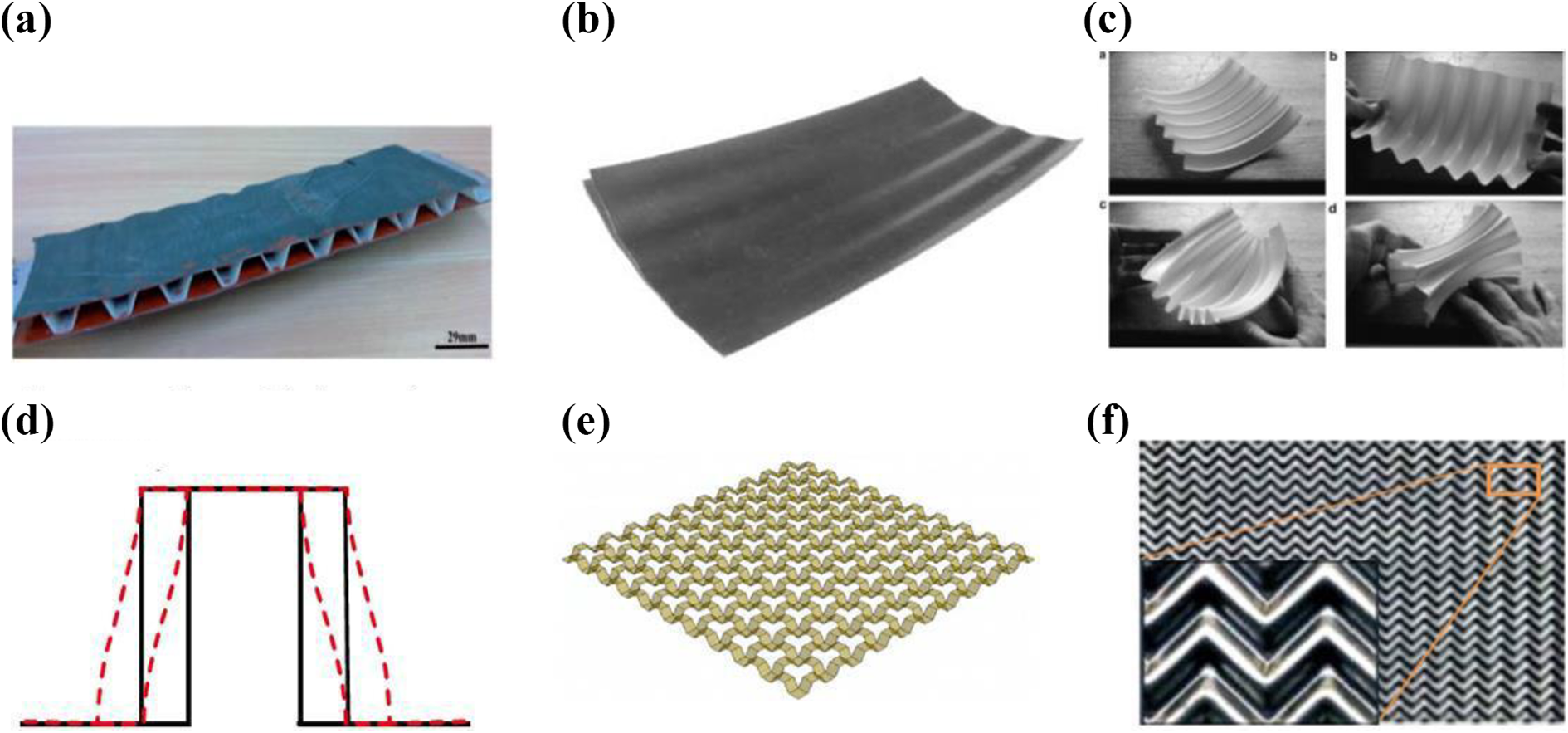
Corrugated structures developments and concepts. 23 (a) Corrugated core with elastomeric coating, 50 (b) twisted bi-stable corrugated core, 51 (c) curved corrugated sheet and some of its global deformations, 52 (d) double wall corrugated concept, 53 (e) schematic of bidirectional corrugated core, 54 and (f) schematic of corrugated bidirectional core. 55

Bioinspired design of DSC panel: (a) representative appearance of Odontodactylus scyllarus with two integrated dactyls, (b) individual drawing of the dactyl club, 49 CT scanning of a dactyl club section, 49 (d) bioinspired bidirectionally sinusoidal corrugated panel, and (e) bioinspired bidirectionally sinusoidal corrugated sandwich structure. DSC: double-sine corrugated.
Honeycomb core
Honeycomb core structures are most common closed-cell prismatic lattice structures. The typical geometries for honeycomb cores include square, triangle, chiral, circular, hexagonal, and auxetic honeycombs. 71 –78 Several novel honeycomb core designs have been developed in the past few years. Wang et al. 71 designed square honeycomb sandwich plates with asymmetric face sheets and investigated the influence of core structure topology to dynamic mechanical response. Auxetic cores have the negative Poisson’s ratio (NPR) effect which offer higher fracture toughness, indentation resistance, shear modulus, and vibration absorption, as well as lower fatigue crack propagation. Lira et al. 73 designed a center symmetric auxetic multi reentrant honeycomb structure. Inspired by cubic crystals, Hughes et al. 74 designed three types of auxetic framework whose stiffness can be altered by changing the Young’s modulus. Pikhitsa et al. 75 designed a regular auxetic lattice of individual multi-pods properly assembled in three dimensions. The lattice structure has NPR and expanding or contracts uniformly in three directions. Bückmann et al. 76 designed and fabricated a complex 3D mechanical metamaterial with NPRs by using dip-in direct-laser-writing optical lithography. Imbalzano et al. 21 investigated the relationship between design parameters and blast resistance performances of auxetic composite panels. And compared the parametric designs and blast resistance with honeycomb sandwich structure panels. 22 As shown in Figure 13, Ingrole et al. 77 designed two types of auxetic-honeycomb structures by combining regular honeycomb and auxetic structure. The designed auxetic-honeycomb structures have higher compressive strength and can absorb more energy compared with other structures. Strek et al. 78 conducted research on dynamic response of sandwich panels with auxetic cores and designed a cellular auxetic structure immersed in a filler material of a given Poisson’s ratio and compared with reentrant honeycomb or rotating square.

Examples of honeycomb core structures: (a) honeycomb, (b) reentrant auxetic, (c) auxetic-strut, (d) auxetic-honeycomb1 (AH-V1), and (e) auxetic-honeycomb2 (AH-V2). 77
Novel core structure
Derivative core
Typical Y-shape unit core and sandwich structure are shown in Figure 14. Folded regions are created in the vicinity of edges of the Y-shape core which improved the joining characteristics between face sheets and the Y-shape core. 26 The geometric parameters and relative density were crucial to understand the mechanical properties of Y-shaped cores. 79 As shown in Figure 14, the geometry of the Y-shaped core is characterized by the thickness t of the constituent members, the height h of the leg of the Y-shaped cores, the inclined angle a of the Y-flanges, the web size e, and the overall height H. Thus, the relative density of the unit cell is given by

where
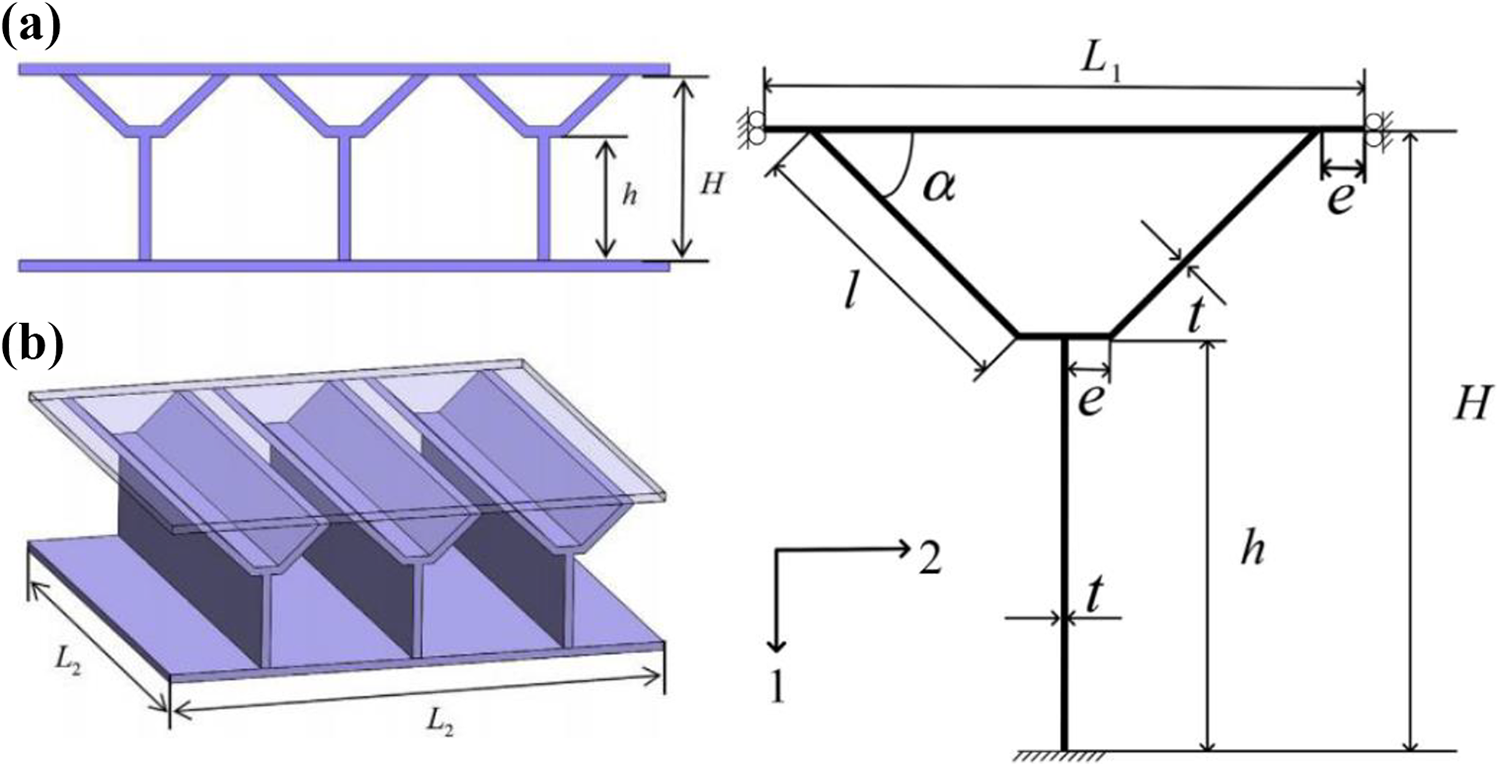
Schematic of Y-shaped core sandwich structure: (a) cross-section, (b) 3D geometric model, and (c) unit cell. 79 3D: three-dimensional.
The relative performance of Y-shape cores has been explored recently for a range of loadings in a laboratory setting. Liu et al. 79 designed a novel all-composite sandwich structure with Y-shaped core and fabricated it by hot-press molding method. Pierre et al. 80,81 studied the low-velocity impact response 80 and dynamic indentation response 81 of sandwich panels with Y-frame core compared with corrugated core. The study found that the corrugated core and Y-frame core had similar performance. Rubino et al. 82 focused on quasi-static three-point bending response of simply supported and clamped Y-frame core sandwich structures. Liu et al. 83 fabricated the novel composite Y-frame core sandwich panel by hot-press molding method and tested the shear mechanical response of Y-frame core sandwich panels with different relative densities. Pierre et al. 84 also investigated the bending response of stainless steel Y-frame core sandwich beams by three-point bending experiment.
Sandwich cylinders (as shown in Figure 15) are a kind of derivation pattern of sandwich panels. There are several studies conducted on sandwich cylinder design and performance investigation in recent years. Jiang et al. 86 designed a carbon fiber-reinforced orthogrid sandwich cylinder and performed uniaxial compression test to reveal strength and failure mode. Xiong et al. 85 designed sandwich cylindrical shells with corrugated cores and investigated the failure behavior of these structures with different geometrics. Zhou et al. 87 focused on geometric design and mechanical properties of cylindrical folded core sandwich structures. And demonstrated the folded core structures have better axial compression performance than honeycomb cores. Yang et al. 88 investigated the manufacturing defect sensitivity of modal vibration responses of composite pyramidal truss-like core sandwich cylindrical panels.

Geometric parameters of the unit cell of sandwich cylinder with longitudinal corrugated cores. 85
Sandwich structure with truncated dome core is composed of repeated alternately arranged truncated domes, as shown in Figure 16. The radius of contact area between face sheets and the core is R 0. The radius of upper and lower domes is denoted as R 1 and R 2, respectively. Zhang and Yanagimoto 89 designed a formable carbon fiber-reinforced thermoplastic sandwich sheet with truncated dome core. Seong et al. 90 proposed bendable sandwich sheets with a sheared dimple core that can be bent without failure. The smaller gap between the attachment points, the higher core shear strength obtained. This characteristic produces benefits, such as preventing face buckling and core shear failure (CSF). 90 Besse and Mohr 91 performed an optimal design of bidirectional dome core for effective shear properties.

Sandwich sheet with truncated dome core. 89 (a) Top and front views, (b) core shear fracture shape, (c) different bending directions, and (d) different radius ratios.
Hybrid core
Ultralight sandwich structures with either 2D prismatic or 3D lattice truss cores, such as honeycombs, corrugations, and pyramidal trusses, are known to possess attractive mechanical stiffness/strength and impact resistance. 92 –103 These properties can be significantly improved further by inserting different materials into the interstices of the lattices to construct hybrid lattice-cored sandwiches. 92 Yungwirth et al. 92 reviewed three different types of hybrid lattice core for sandwich constructions, including ceramic- or concrete-filled lattice cores for superior penetration resistance, metallic or polymeric foam-filled lattice cores for simultaneous enhancement in load-bearing and energy absorption, and metallic honeycomb-corrugation cores for simultaneous load-bearing, energy absorption, and broadband low-frequency sound absorption. Unlike honeycombs, the energy absorption capacity of corrugated cores is typically low. 93 In order to increase the crushing strength and energy absorption capability, various hybrid cores are designed. Han et al. 93 reviewed recent advances in hybrid lattice-cored sandwiches for enhanced multifunctional performance. Han et al. 94,95 designed a novel sandwich structure with honeycomb-corrugation hybrid core by filling the interstices of aluminum corrugations with trapezoidal aluminum honeycomb blocks. It is found that the interaction effect between honeycomb intersections and corrugation sheet leading to significantly enhanced compressive performance. Yan et al. 96,97 designed sandwich panels with aluminum foam-filled corrugated core and tested the bending performance, compressive strength, and energy absorption ability. Li and Yang 98 designed sandwich panels with hybrid cellular cores of hexagonal, reentrant hexagonal, and rectangular configurations along the panel surface and predicted the dynamic performance by using spectral element method. Li and Crocker 58 reviewed theoretical models for passive damping and analyzed the effects of the thickness of honeycomb-foam hybrid core and face sheets and delamination on damping. Ni et al. 100 explored concepts to enhance the ballistic resistance without changing the volumetric efficiency of the panels by filling the spaces within the core with combinations of polyurethane, alumina prisms, and aramid fiber textiles. Hu et al. 101 designed a novel CFRC corrugated truss sandwich panel to obtain optimal compression strength and shear strength. Yang et al. 102 designed hybrid lightweight composite pyramidal truss sandwich panels with high damping and stiffness efficiency. Inspired by biological tissues, Sun et al. 103 designed porous core sandwich structures and conducted topological optimization on the micro structures of core to achieve exceptional mechanical properties.
Hollow core
Lattice truss reinforced honeycombs, termed honey tubes, a novel type of honeycomb formed by reinforcement with lattice trusses, were reported to exhibit enhanced buckling resistance. 104 –109 Xu et al. 104 designed four types of honey tubes based on different topologies, geometries, and tube patterns as shown in Figure 17. And proposed hollow lattice materials 105 which can be fabricated by a newly developed bottom-up assembly technique and the previously developed thermal expansion molding technique. Hwang et al. 106,107 developed a bendable pyramidal Kagome structure strengthened by semicircular cross-section, flat rectangular cross-section, and tubular cross-section. The semicircular cross-section pyramidal Kagome structure showed improved bending stiffness and maximum bending load. Yin et al. 108 demonstrated that hybrid designs that capitalize on micro-topologies can populate vacant regions in mechanical property charts and provide increased energy absorption as crushing protection structures. Clough et al. 109 designed hollow tetrahedral truss cores and conducted mechanical testing to demonstrate their super shear and compression strengths.
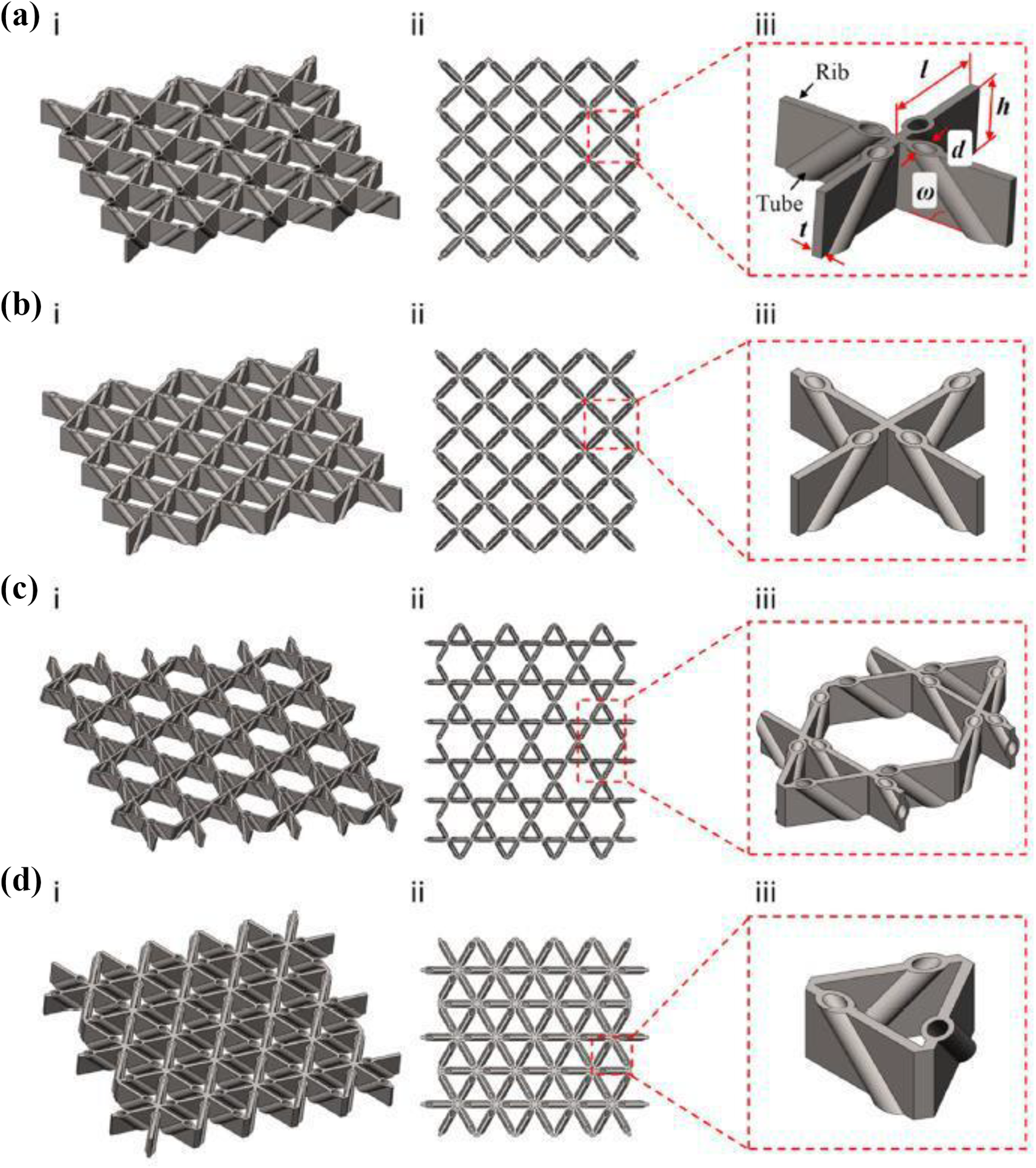
Illustrations for four types of honey tubes: (a) Sq_symtube, (b) Sq_udtube, (c) Kag_udtube, and (d) Tri_udtube, with (i) 3D view, (ii) top view, and (iii) representative unit cell of these honey tubes structures. 104 3D: three-dimensional.
Hierarchical cores
Hierarchical design offers a solution to enhance the buckling strength of the corrugated cores and in-plane elastic properties of honeycombs. 110 –118 One typical way to obtain excellent anti-buckling ability and energy absorption capability within structural applications is to use sandwich structures containing lightweight cellular cores. Velea et al. 110 designed a second-order hierarchical sandwich structure made of self-reinforced polymers by means of a continuous folding process. Ajdari et al. 111 proposed 2D hierarchical honeycomb structures and investigated the mechanical behavior by using analytical, numerical, and experimental methods. Sun and Pugno 112 design two types of hierarchical honeycombs with NPR substructures: (a) hierarchical honeycomb with reentrant honeycomb substructures and (b) chiral honeycomb substructures hierarchical honeycomb. Zhao et al. 113 designed Kagome hierarchical composite honeycombs with integrated woven textile sandwich composites ribs. Liu et al. 114 proposed a honeycomb core filled with circular metallic tubes (HFCT) and tested the blast resistance performances of sandwich plate filled with HFCT. Fan et al. 115,116 designed a new hierarchical lattice truss material reinforced by woven textile sandwich composite by adopting interlocking method and investigated the compression behaviors. Wu et al. 117 investigated the mechanical properties and failure mechanisms of sandwich panels with “corrugated-pyramidal” hierarchical lattice cores through analytical modeling and detailed numerical simulations. Sun et al. 118 designed hierarchical triangular lattice structures with lattice-core sandwich walls and revealed the energy-absorbing mechanism.
Graded sandwich structure
Grated cores present improvements to mechanical properties such as energy absorption and impact resistance compared with homogenous cores. 60,119 –127 A variety of design methods have been developed for sandwich structures with graded cores. Loja et al. 119 studied the static and free vibration behavior of functionally graded sandwich plate type structures, using B-spline finite strip element models based on different shear deformation theories. Sun et al. 120 developed a design method for three types of composite sandwich structures with grated corrugate truss core based on bending strength and continuum damage evaluation. The width of the grated corrugate truss core and inclination angle were described by linear and exponential functions. Xu et al. 121,122 presented new methods based on an auto-cutting and mold-press process for forming the sandwich structures with graded corrugated truss core and graded lattice core and investigated the bending behavior to probe different failure modes. Beharic et al. 123 designed three types of cellular cores (reentrant auxetic, octet-truss, and bcc lattice) and investigated the geometrical effect of the cellular core design for low energy impact performance. Ajdari et al. 124 investigated the dynamic crushing and energy absorption of regular, irregular, and functionally graded cellular structures using detailed finite element (FE) models. Zhou et al. 125 investigated the impact response of sandwich structures with graded foam core by combining FE model and the experimental data. Li et al. 126,127 proposed a generative design and optimization method for functional graded cellular structures based on triply periodic level surface. Zhang et al. 60 developed a series of modified sinusoidal corrugated (MSC) sandwich panels, with multiple layers and gradient design and illustrated the out-of-plane compression performance and energy absorption.
Folded core
As the development of origami engineering, a novel low-density multifunctional structure called folded core was proposed. Rich designs in origami offer great freedom to design the performance of such folded core sandwich structures. 128 –147 Typical origami patterns including Miura pattern, 19,20,128 –131 Resch’s pattern, 132 –134 Waterbomb pattern 135 and Yoshimura pattern. Inspired by Miura-folded origami pattern, Zhou et al. 19,20,128 designed sandwich panel with V-pattern folded core and M-pattern folded core to perform as an integrated thermal protection system. The influences of various factors on the V-pattern folded core radar cross section (RCS) are investigated. 129 It is found that the folded core height has significant effects on the radar absorbing performance. Schenk and Guest 130 introduced two folded metamaterials based on Miura-ori fold pattern including a folded shell structure with NPR for in-plane deformations, and a cellular metamaterial with varying fold pattern within each layers. Gattas and You 131 studied the rigid-foldable morphing sandwich mechanisms based on the Miura rigid origami pattern. Different from the regular folded configuration, six-ray folded configuration of folded cores formed by a periodically repetitive combination of unit facet was designed by Wang et al.. 132 Tachi 133 produced a family of origami tessellation by generalizing Resch’s patterns. Kshad et al. 134 investigated the compression and impact load damping on Ron-Resch-like origami cores fabricated by 3D printing. Fang et al. 135 investigated the deformation mechanisms of a generic degree-four vertex origami cell and demonstrated it’s a combination of contracting, shearing, bending, and facet binding. Different design strategies for constructing the architected sandwich structures with folded core were carried out by Overvelde et al. 136 and Bassik et al. 137 Yang and Silverberg 138 introduced a design strategy for constructing 1D, 2D, and 3D mechanical metamaterials inspired by modular origami and kirigami. Based on octet-truss core structures, Saito et al. 140 –143 developed a lightweight rigid core panels called truss core panels with dia-core corresponding to space filling model. The relationship between geometrical patterns and mechanical properties in designed truss core panels was investigated by Saito 140 and Saito and Nojima. 142 Scarpa et al. 144 analyzed the mechanical properties and wave propagation characteristics of folded auxetic pyramidal cores. Saito et al. 145 –147 designed a foldable aluminum honeycomb structures based on origami technology.
Smart (stimulus responsive) core
The development of smart core sandwich structure is pursued in parallel with the development of smart materials. 11 –17,36,148 –160 Currently, piezoelectrics, SMAs, electrorheological, and magnetorheological fluids are widely used smart materials. Figure 18 shows some typical smart core structures. Tolley et al. 11 designed a self-folding sandwich structure with shape memory composite core based on origami. Deng and Chen 12 and Deng et al. 13 designed a foldable hinge by constraining the shrinkage of mild prestrained polystyrene film. Cui et al. 14 designed 3D checkerboard pattern by heating tessellation origami/kirigami core sandwich structures. Wang et al. 15 designed freestanding 3D mesostructures, functional devices, and shape-programmable systems based on mechanically induced assembly with SMPs. An et al. 16 designed origami-inspired self-folding structures by hydrogel trilayers. Na et al. 17 fabricated microscale self-folding origami trilayers with crosslinkable temperature-sensitive hydrogel as the middle layer. Khalili et al. 148 investigated dynamic analysis of multilayer composite plate embedded with SMA wires. Zhang et al. 149 reviewed modeling techniques of piezoelectric integrated plates and shells. The geometrically nonlinear dynamic performance of functionally graded sandwich plates using one to three piezoelectric composites was investigated by Kumar 150 and Ray and Ghosh. 151 Nath and Kapuria 152 developed an improved zigzag theory for mart, piezoelectric, and laminated cylindrical shells. Beheshti-Aval and Lezgy-Nazargah 153 developed a coupled refined high-order global-local theory for predicting fully coupled behavior of smart multilayered/sandwich beams under electromechanical conditions. Mechanical properties of composite sandwich structures with piezoelectric were studied by Loja et al., 119 Hasheminejad and Gudarzi, 155 and Konka et al. 156 Free vibration and buckling analyses of cylindrical sandwich panel with magnetorheological fluid layer were performed by Malekzadeh et al. 157 Damping optimization of hybrid active–passive sandwich composite structures were presented by Araújo et al. 158,159 Eshaghi et al. 36 reviewed dynamic characteristics and control of magnetorheological/electrorheological sandwich structures.

Material selecting
Face sheet
Aluminum alloys, graphite-epoxy, carbon-epoxy, glass-epoxy, and glass-vinyl ester are widely used as face sheet materials. Aluminum alloys 1 are most common facings material in sandwich structures. The energy absorption characteristics of metal sheets sandwich structure and aluminum sheets sandwich structure were contrasted with glass fiber-reinforced plastic sheets sandwich structure in the study of Liu et al. 161 High strength carbon fiber/epoxy composite prepreg (USN150) with the stacking sequence of [0/90]Ns are used as face sheets of composite sandwich panels in the study of Kong et al. 162 FRP 2 including CFRP 50,61,103 and glass fiber-reinforced polymer (GFRP) 163 –165 are used to improve the bending characteristics. Kong et al. 3 tested the strength of composite sandwich panels with face sheets made of carbon/epoxy fabric and carbon/epoxy unidirectional prepreg. Table 1 lists mechanical properties of some typical facing materials.
Mechanical properties of some typical facing materials.

FRP: fiber-reinforced polymer.
Core material
Stimulus-responsive materials 38 are smart materials which can response to particular stimulus, such as, heat, chemical, and light. Stimulus-responsive SMMs (as shown in Figure 19) including SMAs, SMPs, and newly emerged SMHs are alternative core material for smart sandwich structures. SMAs can be activated by heating (thermos-response) and a static or alternating magnetic field (magneto-response). There are three major types of SMAs, namely Cu-based, Ni-based, and Fe-based. Cu-based SMAs are more suitable for engineering application. Ni-based SMAs have high actuation stress (up to 500 MPa), large recoverable strain (about 7%), and high biocompatibility. Fe-based SMAs are newly developed and seldom used.

Stimulus-responsive materials. 38
Aluminum alloys, stainless steel, Nomex, paper, carbon fiber, and natural fiber are alternative materials for honeycomb cores. 95,146,164,165,167 –172 As seen in Figure 20, it was found that composite honeycomb performs much better than metallic honeycombs under both quasi-static and dynamic conditions, however, cost of composite honeycomb was higher than metallic honeycombs. Aluminum honeycombs are widely used for their high mechanical performance as well as relatively low cost. Noel hybrid composite structures are designed by Prabhu et al. 164 by using GFRP, aluminum (Al-5052) and paper-resin based honeycomb cores (Nomex).

Cost of fabrication versus performance curve for different honeycomb materials. 42
Material property charts as shown in Figure 21 compare the mechanical properties of low-density materials including foam core materials and truss core materials. Polymer foams, metal foams, 167 and alumina foams are typical low-density core materials for foam sandwich structures. Properties of several polymer foam core materials are listed in Table 2. It is found that phenolic foam has relative higher shear modulus and higher density, while polyurethane (PU) foam has relative lower compressive strength. Stainless steel, mild steel, aluminum alloy, copper/beryllium, and titanium alloy are the most used core materials for truss core sandwich structures. Dong et al. 49 developed Ti-6Al-4V octet-truss lattice structures and tested their mechanical response.
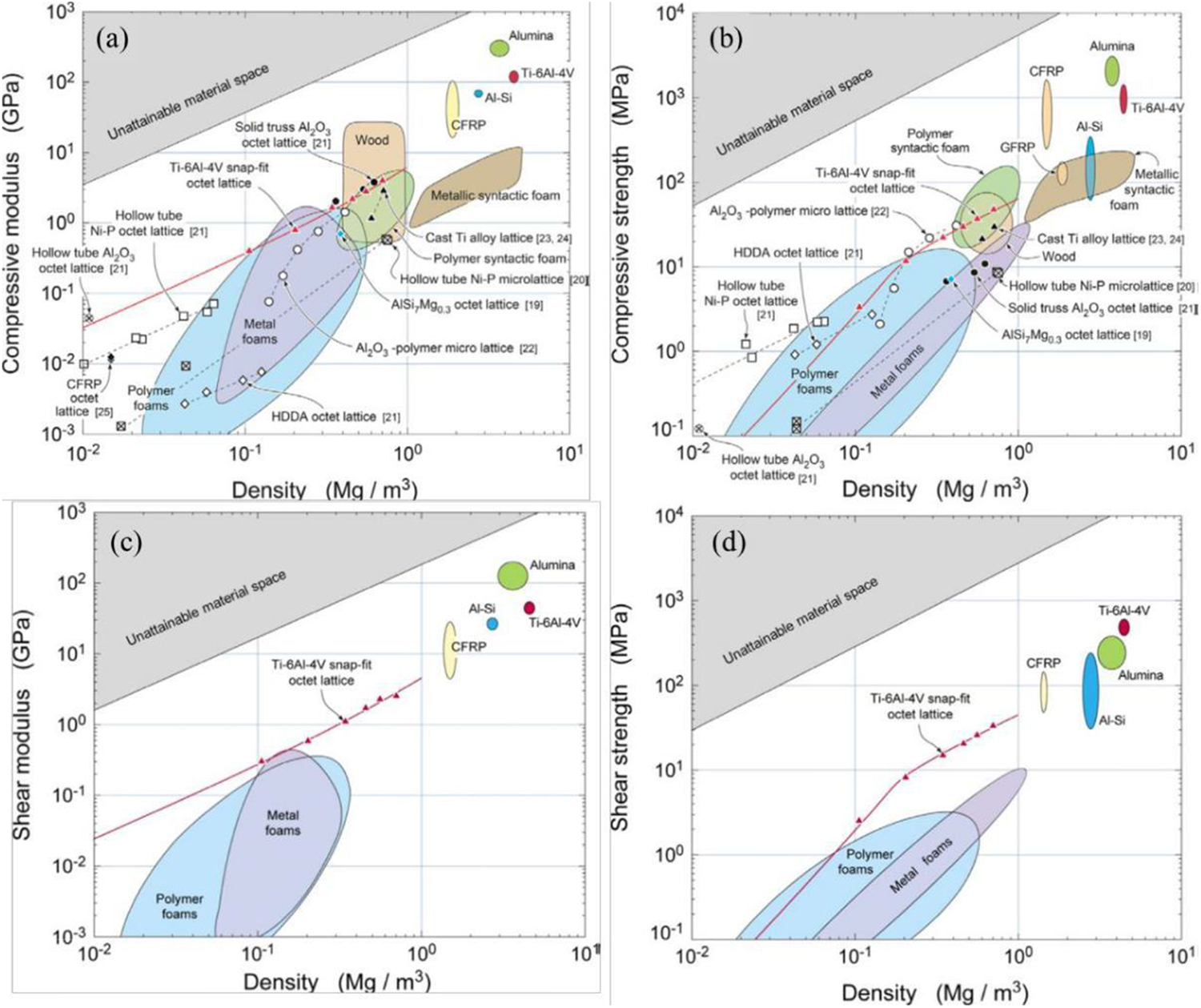
Material property charts comparing material stiffness: (a) compressive modulus, (b) compression strength, (c) the shear modulus, and (d) the shear strength. 49
Properties of foam core materials.

PVC: polyvinyl; PUR: polyurethane; PET: polyethylene terephthalate.
Performance and damage
Performance
Multifunctional characteristics and excellent mechanical properties can be obtained due to low-density core structure and two high-performance thin facing sheets. The performance of sandwich panels strongly depends on geometric configuration of the core and the mechanical properties of face and core materials. In the past few years, extensive research studies have been carried out to study the energy absorption, ballistic resistance, heat dissipation, and acoustic absorption capabilities of sandwich panels.
Energy absorption
Energy absorption is one of the most common characteristics of sandwich structures. 166,173 –179 Zhang et al. 60 proposed a MSC by incorporating the advantages of different corrugated cells. It is found that graded sinusoidal corrugated configuration has excellent energy absorption capacity. Ajdari et al. 111 studied the dynamic crushing and energy absorption behavior of 2D honeycombs with regular, irregular, and functionally graded arrangements. At early stages of crushing, decreasing the relative density in the direction of crushing was shown to enhance the energy absorption of honeycombs. 111 Aluminum honeycomb cores in various geometries are suitable core structures for energy absorption when susceptible to low speed impacts. 48 Increased shear strength of titanium honeycomb cores has been demonstrated when compared to equivalent density aluminum honeycomb materials. Basis function network with response surface method was applied to optimize the shape of truss core panel for superior energy absorption ability. 132 Yan et al. 96 investigated the compressive strength and energy absorption of sandwich panels with aluminum foam-filled corrugated cores. The foam-filled corrugated panels were found to have better energy absorption ability than empty corrugate panels and the foam alone. 132 Kagome structures are similar to rod-like internal structures of cancellous bone and have been identified as a near-ideal lattice configuration for exceptional strength properties. Composite materials are widely used in sandwich structures due to lightweight and good mechanical performance. Biological materials such as bio coconut are chosen as core material in the study of Kong et al. 162 and shown excellent crashworthiness performance.
Ballistic resistance
Moreover, the ballistic resistance performance of sandwich structures has been studied for a wide range of applications. 180,181 Ni et al. 100 investigated the ballistic resistance of three different types of hybrid-cored sandwich structure. Sandwich panels having metallic pyramidal lattice trusses with ceramic prism insertions and void-filling epoxy resin were demonstrated better ballistic resistance performance than the other two types. It is found that the back-sheet is more important than the front face-sheet in resistance ballistic impacts. Imbalzano et al. 22 compared the ballistic resistance performance of equivalent sandwich panels composed of auxetic and conventional honeycomb cores and metal facets. Auxetic panels demonstrated enhanced ballistic resistance by progressively drawing material into the locally loaded zone which lead to better crushing behavior.
Heat dissipation
Sandwich structures can be used as thermal protection system structures due to their heat dissipation characteristic and load-bearing ability. Ceramic matrix composites such as C/C composite, C/SiC composite, and C/C-SiC composite have outstanding combined properties of high temperature resistance, oxidation resistance, corrosion resistance and low density, and low thermal conductivity. Li et al. 18 developed the equivalent thermal conductivity prediction method for the C/SiC composite corrugated core sandwich plane. Zhou et al. 20 conducted thermal-mechanical optimization of V-pattern folded core sandwich panels for thermal protection systems. Zhou et al. 19 developed an improved analytical rule of mixtures approach for calculating thermal conductivity considering shape of M-pattern folded core with Inconel 718 top-face sheet, Ti-6Al-4V titanium alloy folded core, and aluminum 2024 alloy are bottom-face sheet.
Acoustic absorption
In addition to the mentioned multifunctional abilities, the acoustic absorption performance of sandwich structures has also been investigated in recent years. Li and Yang 98 presented shape optimization designs for maximum sound transmission loss (STL) of the sandwich panels with cellular core. The STL of presented sandwich panels can be changed by adjusting their hybrid cellular core configurations. Wang and Ma 154 investigated the STL through sandwich structure with pyramidal truss cores immersed in the surrounding acoustic fluids. Generally, the sound insulation property of sandwich structures turns better with the increase of compactness of the structure.
Damage
Sandwich structures can damage in several ways, such as tension or compression failure of facings, 18,90,122,182 –184 shear failure of the core, 90 wrinkling failure of the compression facing, 75 de-bonding of the core-facing interface, 18,88 local indentation, 109 and global bucking. 183 Load type, structure material properties, and geometrical construction can influence the failure modes in the aspect of initiation, propagation, and interaction. Xu et al. 109 summarized four possible failure modes in three-point bending of the graded lattice core sandwich structure, including face crushing, face wrinkling, CSF, and indentation failure. The collapse load can be calculated according to different failure mode. Wang et al. 183 found two main kinds of compressive failure of X-type lattice core sandwich structure including structure fracture (large relative density) and structure bucking (small relative density) which are caused by axial force. There are one more modes corresponding to shear failure namely face-core de-bonding. Yang et al. 88 introduced four structure defects including face-truss de-bonding, truss missing, face sheet wrinkling, and gap reinforcing to study the dynamic behavior of pyramidal truss-like core sandwich cylinder panels. Hu et al. 101 observed a coupled compression-shear mode in the compression of corrugated lattice truss composite sandwich panels. Failure maps 183 were conducted for different sandwich structures by deriving analytical closed-form expressions for strength for all possible failure modes under each loading.
Applications
Sandwich structures have been widely used in almost every branch of industry including aeronautical and aerospace industries, marine applications, civil engineering, and biomedical applications (as shown in Figure 22). Graphite-epoxy and carbon-epoxy multilayered facings and aluminum or Nomex honeycomb core are typical in aerospace applications. John et al. 42 analyzed the dimensional changes in sandwich structures with carbon fiber-reinforced plastic face sheets and a polymethacrylimid foam core for primary structure in commercial aviation. The effect of geometrical parameters and elastic foundation on the panel flutter and thermal bucking of sandwich panels with pyramidal lattice core are considered by Chai et al. 99 Folded core sandwich structures were adopted as fuselage for reduced RCS as well as excellent aerodynamic performance. 119 Composite lattice core sandwich structures were introduced as an alternative proposal for engine hood in the work of Caliri et al. 29 Besides, composite corrugate sandwich structures have been innovative developed by the interest in morphing aircraft. 23 Sandwich structures with glass-epoxy or glass-vinyl ester facings and auxetic core are commonly used as marine structures. The blast resistance of auxetic and honeycomb sandwich panels were analyzed for armored vehicles application in the study of Imbalzano et al. 22 Parametric analyses were performed to evaluate the blast resistance performance of different designs of auxetic composite panels. 21 In civil engineering, the sandwich structures usually have a closed-cell or open-cell foam core and two glass-epoxy or glass-vinyl ester facings. The development of FRP sandwich panels with enhanced core structure provided an opportunity to expand the application in lightweight civil infrastructure. 44 Smart materials used in smart sandwich structure provide a potential application in biomedical area. The hybrid composite sandwich structure with glass/epoxy facings and flax/epoxy core have been demonstrated as ideal candidate for bone fracture fixation with close mechanical properties to human cortical bone.

Application of sandwich structures.
Conclusions
The present review summarized the recent development of creative design for sandwich structures including sandwich structure design, material selecting, and performance optimization. Based on a comprehensive state-of-art review, major conclusions are drawn as follows: The flexibility in sandwich structure design allows innovation core structures development from typical core structures to enhance mechanical properties. New types of sandwich structures with a low relative density and multifunctionality should be designed to meet industry requirements. Sandwich structures typically have stiff outer facing sheets and lightweight core. New materials are introduced to sandwich structure for new sandwich design, such as SMAs, SMPs, piezoelectrics, and magnetorheological fluids. New mechanical theory and structure design method have been developed. The structure behavior is largely depending on geometrics parameters of sandwich structure and the row material properties. Multifunctionality of sandwich structure is the design objective. Such performance including energy absorption, ballistic resistance, heat transmission, and acoustic absorption are considered in practical applications. Multifunctional sandwich structures have been widely used in almost every branch of industry including aeronautical and aerospace industries, marine applications, and civil engineering. The potential applications are focused on biomedical area and active structures.
Through this review of recent research on the creative design for sandwich structures, several future research directions were identified from the viewpoint of the structure design, the material selecting method, the performance prediction technology, and the application of sandwich structures with different core configuration, as listed below: Deformable inner core structure design with a low relative density to improve jointing characteristic. Research on the evolution mechanisms between typical core structures and derivative core structures for reliable structure optimization design. Investigate the influence of process parameters and environment factors on the mechanical properties of the structure materials. New materials (such as smart materials) and hybrid materials need to be considered as core materials or even facing sheets materials. Enhance the load-bearing capacities as well as the structure flexibility of sandwich structures with folded core. Research on core-face reinforcement and failure mechanisms. More potential applications should be extended and developed including micro robotics, vascular stent, and active origamis.
Footnotes
Declaration of conflicting interests
The author(s) declared no potential conflicts of interest with respect to the research, authorship, and/or publication of this article.
Funding
The author(s) disclosed receipt of the following financial support for the research, authorship, and/or publication of this article: This work was supported by the National Natural Science Foundation of China (nos 51775489 and 51675477) and Zhejiang Provincial Natural Science Foundation of China (no. LZ18E050001).
