




Abstract
The article describes a method to stimulate users’ creativity within constraint-based scenarios and OTSM-TRIZ, which allows to define the problems and partial solutions to be solved during the design process in an appropriate manner. The proposed method aims to overcome constraints and problems defined within product development and related organization resources. Indeed, if these constraints are not properly taken into account, the risk of generating unsuccessful and even ineffective solutions can be high. In this work, a method has been defined, based on the OTSM-TRIZ theory: it guides the users toward the problem solution through a mapping of both the problem to solve and the relationships existing among the problems and constraints. A step-by-step approach is used to describe and propose a systematic structure, allowing to link the conceptual solution with specific solution criteria in the automation field. The validation of the proposed method corresponds to a real case study, that is, the necessity of increasing the productivity of an operational plant for the palletizing process has been selected to discuss the method implementation. Finally, the results of the case study were considered successful, because it was not necessary to introduce high investments for solution development and implementation.
Introduction
The manufacturing industry in the next decade will be prone to address new challenges and constraints due to the dynamics characterizing today’s global market. 1 The main drivers and motivation to change derive, on one hand, from internal company reasons, motivated by the need for product and process improvements. 2 On the other hand, they are caused by external “events” (e.g. changes in environmental or social policies), which directly affect the growth and the internal processes of organizations. 3 In this dynamic context, creation of solutions reducing time-consumption for product development plays an important role in different types of companies. In this scenario, particular attention will be given to constraints (e.g. technical, economical, or organizational) due to their potential role as triggers to generate creative solutions.
Several classifications of constraints exist in the literature; among those analyzed at company level, Kornai 4 proposes three main clusters: resource constraints, demand constraints, and budget constraints. The first class refers to the volume of available resources (e.g. the quantity of materials or the capacity of machines and equipment). The second cluster takes into account the limits given by the buyer’s demand at a given price, which determine the product sales, as well as the manufacturing capacity to be satisfied. The third one considers the financial expenses that should not exceed the amount of money stock available. These three clusters help defining company requirements, as well as understanding whether a solution is suitable to achieve the expected goal. Overall, thousands of constraints can be mapped for any firm. 4
However, it is not only a matter of the number of constraints to deal with (i.e. the quantity) but also a matter of the way these constraints are considered and managed, since, in some cases, they are not only numerous but also complex and even contradictory. 5 However, these constraints are usually analyzed separately (in relation to the various company departments) and the effects of their interactions are not immediately perceived and taken into account. In fact, this happens later in companies’ processes, when decisional meetings discover project bottlenecks, leading to wasteful iteration cycles and project overrun. 6 These dynamics are represented by Ford and Sterman 6 through a model suitable to simulate how project constraints interact with the managerial decision-making process, in order to capture these interrelationships. However, a method or technique that allows companies to better guarantee the satisfaction of these constraints is still missing.
Despite the difficulties in dealing with company constraints (i.e. in terms of quantity and the way they are managed), it is also worth mentioning that they also play a positive role for companies. They indirectly determine the performance of any system, since their existence represents an opportunity for improvement, 7 especially for innovative companies that make use of creativity techniques to continuously fit new requirements. In this scenario, Gu et al. 8 highlighted the relevance of requirements for an adaptable design process by managing product adaptability in order to satisfy markets’ demand. However, during creative sessions, both resource-related constraints and process-related constraints (e.g. relationships among the activities) are usually overlooked. Consequently, it happens quite often that the proposed ideas suffer of poor effectiveness and inconsistency with organization restrictions, thus resulting in delays and iterations within and among project phases.
The opposite situation occurs when constraints imply the emergence of technical problems. These are usually satisfied through already implemented and well-known solutions because of their reliability; besides, these solutions are intrinsically not creative and even not effective, if all the constraints are not correctly managed and taken into account, as previously discussed. In this scenario, the anticipation of requirements and problems during the product development process can help companies to increase their efficiency when need to create a new product. 9 Indeed, traditional design methods such as those presented in Paul et al. 10 and Eppinger et al. 11 allow the development of products by following a systematic approach, but the solution process continues to be an essential analysts’ skill rather than a structured approach to follow when problems need to be solved. Automation industries are not far from these type of issues. Indeed, automation solutions are mostly constrained by different types of requirements coming from different company levels (social, economic, technology, environmental, etc.). 12 With these premises, the authors propose a method for improving the development of automation solutions using TRIZ logic, more specifically the design and development of a specialized robot gripper. The proposed method will be used in the collection and analysis of different requirements by integrating OTSM-TRIZ (general theory on powerful thinking—theory of inventive problem solving) during the project development process, which allows the analysts to generate ideas and solve problems.
In this work, the theory of inventive problem solving, 13 better known as TRIZ, and particularly, its recent evolution OTSM-TRIZ, has been applied to deal with non-typical and complex interdisciplinary problems, within scenarios of designing under constraints. Indeed, TRIZ has demonstrated its usefulness in technological process and product innovation, by allowing the increase in the efficiency of problem-solving processes. 14 Exploring the integration as a continuing project development process is part of this research.
Additionally, the main purpose of the work is to propose a structured and repeatable approach to be used in the creative process of generating solution concepts that are able to first make explicit the relationship existing among requirements and/or constraints and to guide the user toward an understanding of the consequences resulting from each solution.
Problem-solving approaches and OTSM-TRIZ logic
A complete review of problem-solving methodologies dealing with constraints goes beyond the scope of this article. Nevertheless, the authors present the general features of constraint satisfaction problem (CSP) and TRIZ considering them as two relevant approaches dealing with requirements and constraints with different perspectives, so as to show how constraining conditions can better trigger creative behavior and foster innovation.
CSPs are a class of problems that can be addressed with optimization methods for the definition of a proper set of values for constrained variables. 15 In detail, a CSP model consists of three sets of data:
A set of design variables;
A set of possible values for each variable;
A set of constraints the variables must satisfy (i.e. a specific range restricting the domain of values).
In case the optimization process does not bring to the satisfaction of all the constraints at the same time, it means that the problem is over-constrained. Such over-constrained problems require a non-routine design approach, since their solution cannot be achieved by means of the simple adjustment of variable values. Constraint hierarchies, partial CSP, and extending CSP (probabilistic CSP, fuzzy CSP, and weighted CSP) are methods for coping with over-constrained problems. They follow two main approaches:
To rank constraints or define preferences about constraints, as for extending CSP and constraint hierarchies.16,17 This approach overrides some constraints whenever the routine CSP algorithm does not come up with the solution. The search for the solution, then, is carried out through the satisfaction of the highest number of constraints, fulfilling the strictly required or “hard” ones, thus overlooking those that at the beginning have been classified among the preferential or “soft” ones.
To relax (extend) the range of values that the variables may assume and the related constraints, whenever a routine solution is not viable, as for Partial CSP. 16
Nevertheless, these methods do not allow the introduction of new variables in the problem model, reducing the space of potential solutions.
As any problem concerning design optimization (e.g. topology optimization), the constraining conditions affect just the design variables; the aim becomes finding the best achievable compromise, even turning requirements into wishes for over-constrained problems. This approach, indeed, cannot be deemed as really creative as for the various optimization algorithms.
On the contrary, TRIZ refuses the trade-off logic of optimization approaches and stresses the problematic situation toward the exaggeration of design conflicts (contradictions) that make problems over-constrained as a mean to stimulate individual creativity.13,18 Contradictions, represented in Figure 3(d) through the OTSM-TRIZ model, 19 go beyond the conflicts appearing at the level of design variables (namely, control parameters (CPs)) and consider non-mutually compatible conditions also at the requirements level (namely, evaluation parameters (EPs)). Moreover, according to the TRIZ logic, it does not matter if the couple of EPs consists of requirements, objectives, drivers, or barriers. Since they should be fully met avoiding any compromise, the EPs are to be considered as constraints determining the approval or the rejection of a solution concept. In other words, the contradiction links design variables directly with the constraints according to the following logic:
If a design variable (CP) assumes a certain value V, then the constraint EP(1) is satisfied, but the constraint EP(2) is not;
If the design variable (CP) assumes an opposite value anti-V, then the constraint EP(2) is satisfied, but the constraint EP(1) is not.
For this reason, in the following, the concepts of requirement, constraint, and EP will be considered as synonyms, consistently with the TRIZ perspective.
OTSM-TRIZ is an evolution of classical TRIZ aiming at managing complex and interdisciplinary problems. 15 It introduces a new problem-solving process supported by several tools for describing problematic situations in the form of networks,20,21 so as to clarify the mutual relationships between objectives and solving directions at different detail levels. The OTSM-TRIZ network of problems (NoPs), Figure 1(b), approaches a problematic situation with a dialectical logic. The initial problematic situation gets decomposed in more elementary problems (Pb) so that the analysts can more easily define solution concepts (partial solutions (PSs)) suitable to address those issues. However, the implementation of PSs is not always free of consequences. In reference to Figure 1(a), an analyst can solve the first problem with a known strategy, but this PS triggers the emergence of a new problem that acts as an obstacle against its implementation. The two problems characterizing this triad “Pb-PS-Pb” can appear at substantially different company levels. For instance, a PS solving a technical problem may have consequences at the organizational level or vice versa. The combination of these connections in a more complex and complete network represents the overall description of the problematic situation that an analyst has to take into account for defining a suitable solution concept (Figure 1(b)). A critical review of these networks is available by Baldussu et al. 22 and Becattini and Cascini. 23 In more details, the logic of this translation is shown in Figure 1(c) and (d): a PS can be described by means of a change of value of one or more CPs; in turn, an EP is a measurable criterion to evaluate the capability of a solution to satisfy a problem. The organization of elementary cause-and-effect relationships between CPs and EPs in a NoP is shown in Figure 1(e). Considering that the NoP, by its own nature, collects problems occurring in different company sectors (e.g. business, organization, and product manufacturing), the identification of contradictions with the network of contradiction (NoC) allows overcoming the current limitations of creative methodologies addressing problems occurring at an homogeneous level of representation.

Relation between problems and parameters according to the OTSM-TRIZ formalism: (a) and (c) problem-solution structure, (b) problem flow network, (d) contradiction for single problem solution relation, and (e) multiple contradiction relations.
As described above, in order to reduce the risk of business failure, the company management often rejects new and already partially developed technical solutions, because they do not meet company constraints. To address this issue, in the next section, the authors propose an approach for easing the evaluation of the impact and the constraint satisfaction of innovative solution concepts, at the diverse levels of company organization, combined using OTSM-TRIZ logic.
Methodological approach for development of automation solutions
A gripper is a tool used in robotic arms that allows to grasp, hold, lift, move, and control materials as long as they are not being processed. 24 The grippers are kinetic tools at the end of an articulated system of an industrial robot that facilitates interaction within the working environment. 25 As Seegräber 26 states: “The gripper plays an important role within automation systems. They are the interface between the object and the entire production process.” That is why a gripper has a high economic impact when used in an automated system. However, the availability of flexible and adaptive grippers are rare and expensive. 27 Thus, it becomes important to develop a flexible gripper that can handle different package boxes used in the company. The needed gripper can be controlled in a computerized way, so that it is not necessary to change the gripper in order to be able of lifting different types of boxes.
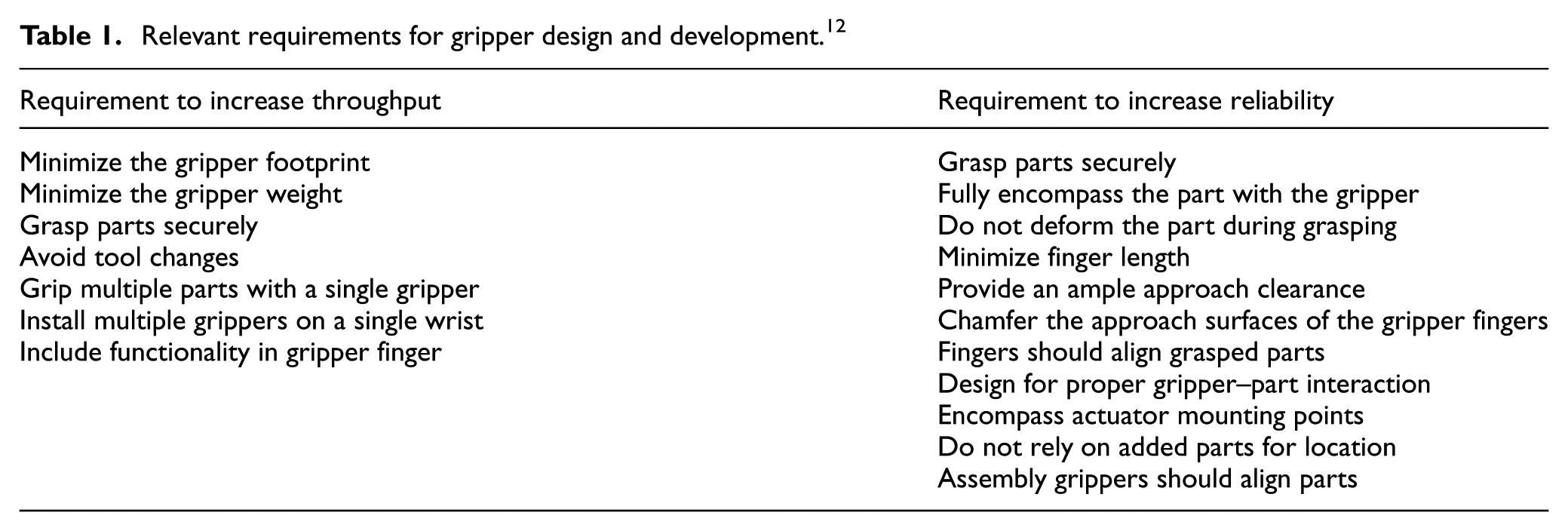
Causey and Quinn 12 highlighted a detailed list of requirements to consider in gripper design, but without considering its context of application or problems that can emerge according to a specific context application. Nevertheless, this list of requirements can be considered as an initial process for a model of idea generation in conceptual design, which is considered as the most creative stage in the product design process. 28 Table 1 shows the list of requirements.
Relevant requirements for gripper design and development. 12
The approach proposed in this article aims to provide a step-by-step structured analysis to deal with the complexity during the design process of industrial grippers. It allows engineers and designers to analyze the initial context, as well as the resources and conflicts associated with the execution phase, based on the combination of requirements through OTSM-TRIZ. As a consequence of this integration by stages, the design process will contemplate less unexpected obstacles during the manufacturing, as well as the fulfillment of the requirements associated with the design and specifications of the company. Indeed, the proposed model is based on the method of problem-solving OTSM-TRIZ, during the formal process of product development. Next, the method is presented, which consists of five structured steps (see Figure 2).
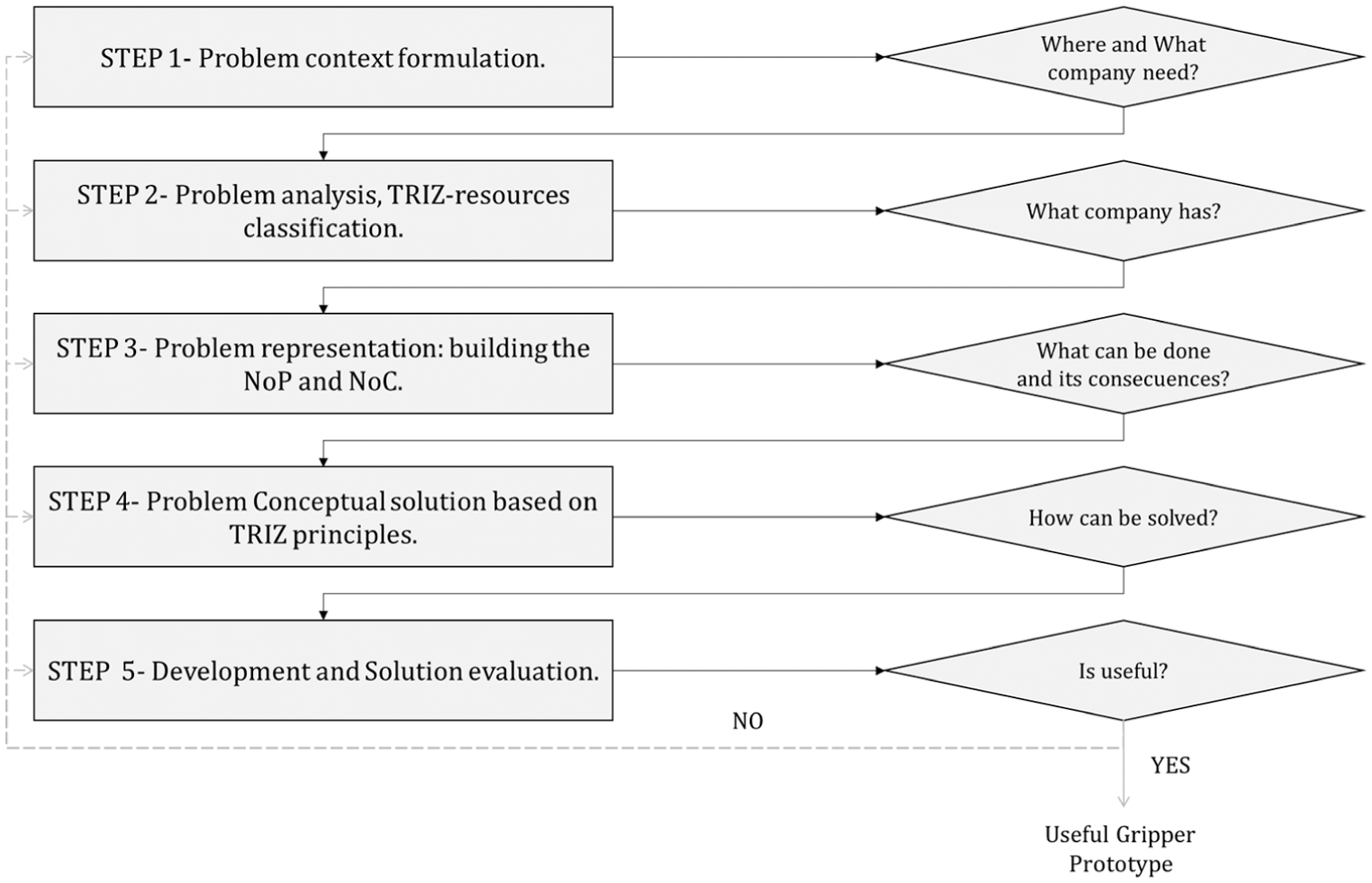
Stages for the application of the proposed approach for the design of solutions.
Step 1: problem context formulation. This step aims at defining the boundaries of the analysis. It consists in the description of the problem context considering company’s current processes or activities. Since, in this step, the analyst must describe the current situation, the choice of a modeling technique that can be used to understand different process stages (e.g. IDEF0 29 and BMPN 2.0 30 ) depends on the familiarity of the analysts with their characterizing constructs and on the available information to be represented. Regardless of the modeling choice, the overall process under investigation should be split into elementary phases. This step aims at the analyst to understand the current company process and potential stages where the solution will be implemented. On one hand, an analyst without experience in the field of application can obtain knowledge about the company process. On the other hand, the analyst can identify initial requirements where the solution will be embedded. These new requirements should be complementary to the technical requirements proposed in Causey and Quinn. 12
At the end of this step, the analysts need to have a clear vision about where the solutions should be implemented and which are the real company needs. This approach is useful to define general boundaries for the solution to be created.
Step 2: problem analysis, TRIZ-resources classification. Considering the current scenario characterized by scarcity of resources, this step aims at helping analysts to identify resource-related constraints and opportunities for further development of solutions in the context of the process under examination. In this perspective, resources in design can characterize both drivers and barriers. In the first case, they characterize the objectives to be achieved (e.g. modular gripper). In the second case, they can be considered as the required entities (tangible or not) for turning an idea into a viable solution. However, not all the resources needed for the implementation of a solution concept are barriers. Their current level of exploitation distinguishes between the opportunities for further development of solutions (i.e. not yet exploited, but available resources within the system under investigation) and the constraints limiting their implementation (i.e. fully exploited resources also characterized by a limited availability. Therefore, they cannot be further exploited and thus represent barriers for the solution of a problem).
For supporting this stage, analysts can rely on already existing classification as TRIZ classification resources.31–33 In relation to the definition of constraints for the acceptability of a solution concept, the authors suggest the identification of company barriers (as above) and resources consumption already determined by external factors. On the contrary, in relation to opportunities for further development of solution concepts, the focus should be on the already existing resources that still allow a residual amount of exploitation.
TRIZ provides a set of heuristics to overcome contradictions by leveraging available resources classified into five categories: time, space, energy, information, and materials; some authors have proposed more structured resource classifications as in Becattini et al., 31 also considering managerial-based resources. 32 The TRIZ-based classification of resources represents the basis for resolving the contradictions that will appear in the next stages:
Material: what composes a system and its surroundings. Readily available resources include raw materials or semi-finished products, as well as waste or absence of a substance; material manufacturing, it is a mix of general and specific elements of the company production plant equipment (i.e. cutting/press machines), as well as the manufactured by-products.
Energy: any kind of energy inside or around a system (i.e. gravitation, light, or electromagnetic radiation); energy human resource, when humans are just contributing with their force and motion.
Information: any perceptible information about the system (i.e. properties of the system and their changes, temporary information, and information flow); informatics human resource, when humans contribute with their know-how and creativity.
Time: any kind of time including intervals (i.e. preliminary work, scheduled workflow, parallel processes, pauses, and temporary actions).
Space: any free/unused space in a system or in its environment (i.e. the spare wheel space in a car). Step 3: problem representation: building the NoP and NoC. The third stage of the approach is focused on the analysis of the problematic situation according to the OTSM-TRIZ approaches to obtain main parameters for designing the gripper solution. First, it is necessary to model the problematic situation as a NoP. Several sub-steps characterize this task: Analysis stage. Decompose the problematic situation, considering all the different process phases (from Step 1), into more elementary problems and iteratively repeat the decomposition until no more problems appear; Synthesis stage. Where it is possible, by intuition and according to the team’s experience, generate PSs for the elementary problems that currently populate the network; Evaluation stage. For each of the generated PSs, identify new problems that might appear as a consequence of their implementation.
These three design stages can be iteratively repeated so as to get a more complete picture of the problematic situation. Afterward, consistently with the OTSM-TRIZ logic, the structure of the NoP is to be transformed into a NoC by assigning problems and solutions.
For the nodes in the NoP:
Identify at least one CP for each PS;
Identify at least one EP for each problem;
Define contradictions by connecting parameters deriving from a problem-partial solution-problem (Pb-PS-Pb) sequence in the NoP;
Identify more contradictions by considering the cause-and-effect relationship between each CP and the EPs that are not yet connected to it.
At the end of such step, a clear vision of the complex NoC characterizing the problematic situation appears, with both the constraints concerning the satisfaction of requirements (EPs) and the limitations on design variables (CPs). These EPs will serve as a reference to measure the effectiveness of both partial and final solutions in terms of constraint satisfaction during Step 6.
Step 4: problem conceptual solution based on TRIZ principles. It is important to mention in this step that TRIZ approach offers generic solutions linked to the context of the problem, the creativity can be take up the work of interpret these beginnings of ideas by transposing them to a specific problem.
34
With this in mind, the purpose of the fourth step is to address and resolve the contradictions emerging from the NoP and NoC. The generation of solutions is further guided by “inventive principles” and generalized “standard solutions.” Among others, it is useful to mention the four separation principles, which help addressing physical contradictions: Separation in space. The contradictory requirements or functions of a system can be separated into different spatial regions, for example, according to the sub-systems distribution, so that these sub-systems can perform their own functions without negatively affecting the others (e.g. hospitals are often separated into different departments and into different space zones (ophthalmologists, pediatrics, etc.) or supermarkets create different places for food and chemical products). Separation in time. The contradictory requirements of a system can be separated in different time intervals, so that these requirements or functions can be met or operate at different time schedules without negatively affecting the others (e.g. in case of variable manufacturing cycles, a company can temporarily hire more people; cinemas offer discounts in different periods to balance customer demands). Separation between the whole and its parts. The contradictory requirements can be overcome by distinguishing the property of the whole system with respect to its sub-systems (e.g. a company with a large and diversified network of very specialized suppliers is flexible as a general-purpose manufacturer, but professional as an expert in the field). Separation upon conditions. The contradictory requirements can be separated changing the condition settings (e.g. a Mexican restaurant cooking the same dish with different levels of “hotness” upon condition of customer taste).
The implementation of the four separation principles does not represent the only available strategy, within TRIZ, to support the solution generation phase; the fact is that in developing the case study, these principles have been found to have high potentialities for solving automation problems characterized by a strong managerial focus.
Figure 3 shows the reasoning workflow that decision-makers should follow to correctly solve the occurred contradictions. 34,35 That workflow has been designed to help non-TRIZ experts to correctly perform such a fundamental step.

The decision-makers’ reasoning workflow: an example of how to correctly address problem contradictions.
Step 5: development and solution evaluation. This step focuses on the assessment of constraint satisfaction, so as to determine the expected acceptability of the developed solution concepts. In other words, it aims at effectively measuring the impact of the solutions according to the EPs described in the previous steps 1 and 3. In detail, EPs evaluate the impact of solutions on the process under examination (as defined in Step 1) and the suitability of the solution according to the specific requirements, mostly concerning the technical domain (as emerged after the definitions of NoC in Step 3). Hereinafter, the authors show a real industrial application of this method, so as to expose how the constraints can be managed with the support of TRIZ and OTSM-TRIZ logics, within a problem-solving process in design.
Case study
In this section, the authors will demonstrate the effectiveness of the proposed approach by discussing its application within the decisional process of a Chilean multinational company, RUCARAY S.A., renowned worldwide as one of the leaders in the exportation of fruit (e.g. cherries, apricots, plums, peaches, grapes, pears, apples, kiwis, and nuts). RUCARAY is now focusing its attention not only on satisfying its customers but also on efficiently balancing the company’s needs with those of its employees and the productivity requirements as well. This is the starting point that has stimulated the company to introduce in the last years new productive strategies, like the introduction of a robotic palletizing process in its plants. The case study discussed in this section is part of a research project, between Federico Santa Maria Technical University and RUCARAY S.A., aiming at the improvement of the evaluation process of technical solutions:
Step 1: problem context formulation. The palletizing process for RUCARAY starts from the arrival of different types of boxes to palletize. A number of workers identify the type of box visually and create pallets associated with a specific box type. The regular company batch uses three different types of stock-keeping unit (SKU) at a time, so the batch number is related to the specific SKU-type to export. Table 2 presents different SKUs according to the different types of boxes used in the packaging line for palletizing.
Example of different types of boxes and related SKUs.
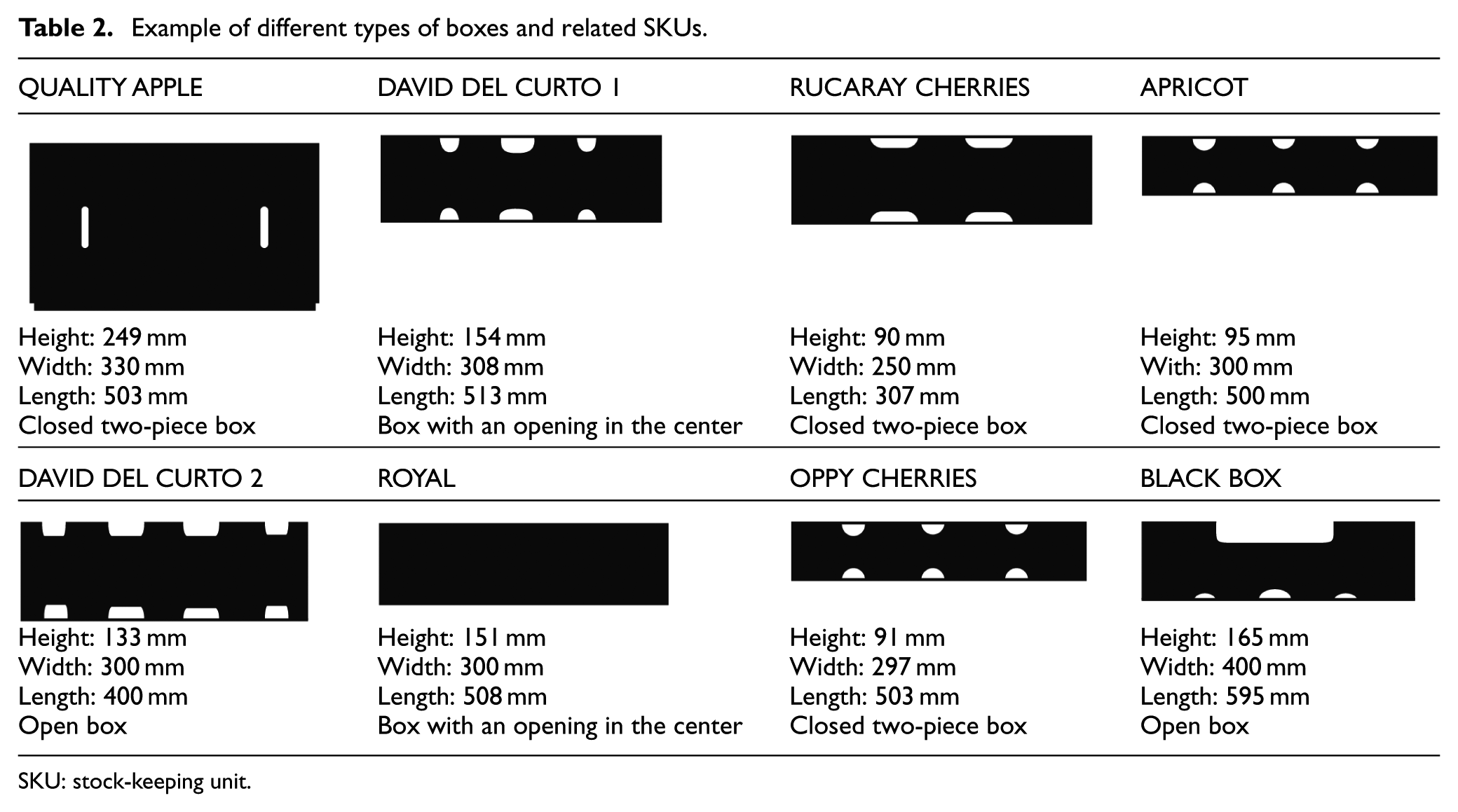
SKU: stock-keeping unit.
One of the main challenges for building an automation solution based on robots is related to the different types of SKU, so specific design requirements are related to “the capability to adapt to different types of SKU-boxes.” As a result of this step, a definition of the specific need of the company that has to be solved in order to improve company’s production was elicited. In addition, a set of company requirements (dimensional boxes) was defined as well. This is particularly useful in the identification of boundaries for the expected solution. It is important to mention that this information has to be integrated with the requirements proposed for gripper development as proposed in Altshuller et al. 33
Step 2: problem analysis, resources classification. The resources analysis of this step is carried out consistently with what has been explained in previous sections. The specific problem under examination has one resource that constrains the implementation of the solution: the time for palletizing. In relation to the analysis of the availability of resources for the implementation of new solutions, the company decided to focus its attention mainly on those it can control. Indeed, the only regulation they have to comply with concerns to the safety of workers. Table 3 distinguishes the resources the company can control into two categories: those representing barriers not to be overcome in terms of exploitation (e.g. because of unbearable increment of costs) and those not fully exploited within the process, or whose further exploitation is acceptable. Moreover, the rows of Table 3 show the classification according to energy, material, information, space, and time since the company was driven in the identification of these resources by means of these concepts.
Simple resources classification based on TRIZ and relevant parameters as opportunity for solution development.

SKU: stock-keeping unit.
In this step, a clear scenario was conceived allowing to define available resources that can be used in order to develop a plausible solution for the company. At the same time, this information should stimulate creativity thinking about more desirable results 9 in relation to company requirements.
Step 3: problem abstraction: building the NoP and NoC. The company approached this step by recollecting all the problems they had experienced in the past, considering both the ones emerged during operation and those evaluated whenever the research and development department proposed solution concepts for them. Such solution concepts have been enriched by others intuitively generated by the group of designers involved in this activity. Figure 4 presents a manageable set of these concepts, organized according to the logic of the NoP, after several rounds of iterations.

Extract of network of problems for gripper solution development.
Consistently, the NoP has been translated into a NoC, so as to clearly highlight the cause-and-effect relationships between design variables and requirements. Figure 5 presents an excerpt of the complete NoC, so as to better clarify its structure with reference to what has been discussed. Moreover, it collects the relevant parameters characterizing the problem for which the company can disclose the solution concept. It is worth noticing that with this representation, the analyst gains an overall perspective of the impact of design choices on the satisfaction of constraining conditions.

Part of the network of contradiction with the discussed problem.
As a result of this step, the analyst obtained a clear scenario of problems and a PS using OTSM-TRIZ logic. Additionally, in this step, the relevant parameters were collected, characterizing the problem for which the company can develop the solution concept. In other words, analysts obtain a clear vision of the boundaries of a potential solution and their related consequences in the framework in which they are working, which is very useful in reducing as much as possible trial-and-errors iterations.
Step 4: problem conceptual solution based on TRIZ principles. Generally, the prioritization of design problems in a NoC should be most conveniently done with appropriate algorithms. This aspect goes beyond the purpose of this article and further information about the hierarchization of problems represented with NoC can be found in Baldussu et al. 22 and Nikulin et al. 36 Nevertheless, in this step, an example of application of the TRIZ principles will be presented for one of the contradictions (Figure 5). This choice is driven by the possibility to present the details of the solution concept; other and more creative solution concepts developed within the project are considered as strategic assets by the developers and, therefore, are not disclosable.
Consistently with the TRIZ theory, before the application of the separation principles, the separation on time and separation on condition has been defined (time in box identification and adaptability according to box condition). The combination of separation on time and separation under condition suggests that there is a good opportunity to address the problem by designing a gripper capable of adapting according to the conditions and time, so as to satisfy the constraining conditions of the system requirements. Table 4 shows how the “separation under condition” principle supports overcoming the apparently non compatible constraints.
General design concept for gripper development which should adapt according the condition of SKU boxes.


SKU: stock-keeping unit.
A virtual prototyping model has been created attempting to address the different EPs emerged from NoC and resource classification, which are relevant for satisfying company’s requirements (Table 5).
Virtual prototyping and real prototype solution.


The TRIZ-based problem-solving approach allowed the definition of solutions, that satisfy conflicting constraints, thus overcoming the not completely effective logic of the search for the best compromise found typically in optimization methods. At the end of this process, the expected solution was developed.
Step 5: development and solution evaluation. The EP coming from previous steps allow to assess the effectiveness of the proposed solution. Table 6 includes a general overview of the impacts generated by the solution according to such constraining conditions that determines its viability.
Evaluation of the requirements of the network of problems.

SKU: stock-keeping unit.
From another point of view, the requirements proposed by Causey and Quinn 12 have been assessed from a more holistic perspective rather than as each requirement specifically. This decision is based on that Causey and Quinn’s 12 requirements that largely depend on company’s resources in each specific case. Nevertheless, these requirements have been useful to define the direction for solution development, in order to avoid a trial and error approach. A more detailed list about how Causey and Quinn’s 12 was used is presented in Table 7.
Description of requirements assessment for developed gripper.

Discussion and conclusion
This article presents a method to identify and solve complex problems enabling the representation of company constraints through OTSM-TRIZ concepts. As a result, it is expected to achieve a significant reduction of human and intellectual resources waste, due to the rejection of good technical solutions, once evaluated as inadequate within the perspective of the company business. The method is articulated around five steps aiming at analyzing the process stages and defining the related parameters for the evaluation of constraint satisfaction. Moreover, its application provides a complete overview of the relationships between elementary problems and the consequences of the implementation of trivial or intuitive solutions for tackling them. The analysis of company resources can help to define what supports or limits the engineers and designers in the generation of solution concepts.
In this work, the authors addressed a real industrial problem in the field of gripper design and development for the agronomic industry. It focuses on searching for new solutions suitable for improving the productivity of a robotic palletizing process. The discussion of this case study is driven by the intent of focusing the readers’ attention on two main strengths of the method: (1) making easier the understanding of the challenges the engineers have to address, fostering problem decomposition and resources identification, in terms of usefulness. The proposed approach allowed to anticipate design problems at initial stages of the project, and at the same time, the combination of requirements proposed in Altshuller et al. 33 within company’s requirements, and fostered problems emerged by overall perspective that has been used to better assess the design concept of initial gripper; (2) guiding the engineers, first on identifying and then on correlating constraints and requirements has been useful to reduce trial and errors, which sometimes are produced by the lack of knowledge in a specific field to develop a design project.
More specifically, for the case study, OTSM-TRIZ provides a big picture of the problematic situation, decomposing this situation in sub-problems (together with their related PSs) that emerge not only at a technical level, but can be integrated at different organizational levels as well. 29 This problem decomposition and the initial problem context formulation not only foster a clear contextualization of the problem within a specific scenario but also support the identification of the constraints and requirements to satisfy (i.e. EPs). The identification of sub-problems highlights also the possible consequences of the PSs, so as to boost engineers’ consciousness about the importance of avoiding trivial or non-effective solutions.
The definition of resource-related constraints, as for Step 2, represents another key feature of the method. It drives the engineers to evaluate and distinguish the available resources for solving the problem, and the ones that cannot be used or are scarce. Pushing the user to think about the available resources for the specific problem to be addressed is fundamental to better contextualize the problem from the technical perspective (within the design variables of a specific design space). Moreover, it also allows the clarification of the constraints from the perspective of the company business, so as to take also into account the organizational-related ones; these resources are, on one hand, affected by their highly variable availability and, on the other hand, usually overlooked during the development of technical solutions.
The cause-and-effect relationships between CPs and EPs are identified through the NoC (Step 3). In other words, this network makes more explicit the main constraints to be satisfied for solving the problem and how they are linked with each other: this is a fundamental aspect to make evident the relationships existing among all the measurable indicators that describe the initial problem. Assigning priorities is, then, fundamental in order to let the creative process follow a structured reasoning path. To this aim, TRIZ problem-solving principles (applied at Step 4 of the method) represent a valid help on guiding the creative process in dealing with constraints and developing highly creative solutions that go beyond the results commonly achievable through optimization-based activities.
Further strengths have emerged in the company as a consequence of the identification of barriers related to the availability of human resources and means for the concrete development of the solution concepts (Step 4), as well as for the direct evaluation of the impact of the solution concept in the context of the company business (Step 5).
The authors, therefore, define a more efficient approach where constraints are both a set of criteria to drive design decisions and a metric to evaluate the goodness of solution concepts, also considering organizational criteria. The TRIZ-based problem-solving approach allows the definition of solutions, that satisfy conflicting constraints, thus overcoming the not completely effective logic of the search for the best compromise that is typical of optimization methods.
In other words, the different constraints can be organized with a step-by-step procedure that allows analysts to better understand where to focus their efforts and how to evaluate the outcomes of their design process with an unbiased metric. This metric has to be defined before the synthesis of the technical solutions start in order to overcome problems due to conflicting constraints.
The application in the field of agronomic industry was introduced to show the applicability and usability of the proposed approach. The results of the case study were considered successful, because it was not necessary to introduce high investments for the gripper development and implementation of the proposed robotic solution. The case study discussed in this article presents a practical example of the above evidences. The activity presented through the case study required three persons/month during which different steps have been carried out and integrated together, starting from the detection of constraints, until the ideation and development of the solution concepts. Moreover, during this period, the employees have been trained on this method and the TRIZ concepts required to generate solutions from constraints.
The limits of the method are mostly related to the limited support to the identification of root causes and critical problems. As an expected evolution of this work, the integration with complementary techniques as fault tree analysis, Pareto analysis, and PROACT can help to improve these weaknesses.37,38
Footnotes
Handling Editor: Yong Chen
Declaration of conflicting interests
The author(s) declared no potential conflicts of interest with respect to the research, authorship, and/or publication of this article.
Funding
The author(s) disclosed receipt of the following financial support for the research, authorship, and/or publication of this article: This work was supported by the CONICYT through the project FONDECYT-Iniciación (ID 11170227) and the Technological Center of Valparaiso—CCTVAL, Basal Project (FB-0821).
