




Abstract
Tai Chi is an excellent traditional culture of the Chinese nation and a treasure of traditional national sports. It has been developing since thousands of years and is increasingly loved by more and more people at home and abroad. Because of the development of the times and the influence of the change of value orientation of Tai Chi and other factors, people’s understanding of many problems of Tai Chi such as theory and method has been biased, which makes the idea of action and skill weakening and action not uniform in the process of inheritance and development of Tai Chi routines. Even the prescribed routines may be practiced and understood differently. To inherit, develop, and disseminate Tai Chi better, these traditional valuable experiences should be made scientific and standardized. With the help of the research method of sports human mechanics and advanced experimental instruments (Xsens MVN system), this article studies and analyzes the human mechanics of the main movements of traditional Yang and Wu Tai Chi, which are the most popular. This provides a scientific experimental basis for the technical research of Tai Chi. The results show that there is no significant difference between Wu-style Tai Chi and Yang-style Tai Chi practitioners in the percentage of body weight in front leg, knee joint, and sole pressure, but there is significant difference in the percentage of body weight in back leg. As a result, the foot pressure gap between Yang-style Tai Chi and Wu-style Tai Chi is smaller, while the foot pressure gap between Wu-style Tai Chi and Wu-style Tai Chi is larger. There were no significant differences in trunk force, front hip force, back hip force, front knee force, and back knee force (p > 0.05).
Introduction
Tai Chi Wushu is the excellent traditional culture of the Chinese nation, 1 –3 the treasure of traditional national sports, the crystallization of the wisdom of the working people, and the most precious traditional sports of the Chinese nation. It has been handed down continuously in China for thousands of years. Through digging and sorting out 131 kinds of boxing determined by the state, each type of boxing has its own unique routine movement system and style characteristics. 4 In the course of the development of Tai Chi, a variety of schools have been formed, and Yang’s Tai Chi is a kind of national traditional sports with distinct reality, internal and external training, the combination of upper and lower, dynamic and static, rich in philosophical connotation and Chinese traditional cultural connotation, with oriental charm. 5 The characteristics of traditional Yang’s Tai Chi, such as generous stretching, correct body style, round and lively coherence, light and spiritual calmness, distinct emptiness and reality, vigorous and solemn charm and concise action, soft and rigid exterior, calm manner and beautiful nature, are deeply loved by the majority of Tai Chi fans at home and abroad. Because of the development of the times and the influence of the change of the value of Wushu and other factors, people’s understanding of many problems such as the theory of Tai Chi Wushu and the method of boxing has been biased, which makes the idea of Wushu routine’s action and skill weaken and the action is not uniform in the process of inheritance and development. Even the prescribed routine may be practiced and understood differently by everyone. 6,7 This is not conducive to the healthy development of Tai Chi Wushu, nor to the practice of Tai Chi Wushu practitioners: it is not conducive to the development of competitive value of Tai Chi Wushu but also to the wide spread of Tai Chi Wushu. 8 In this situation, the Sixth National Wushu Work Conference and the Chinese Wushu Association will “promote the scientific, standardized, standardized and international development of Wushu, create a new situation of Wushu work, and make positive contributions to the construction of a strong sports country” as the theme of the conference.
Nowadays, when many people are doing Tai Chi or pushing their hands, they are either soft, loose, and powerless 9 or they are stiff, rigid, a little move, leaning forward and backward, and unable to stand on their feet. 10 What is more worth mentioning is that when practicing Tai Chi or pushing hands in Tai Chi, we do not know how to control our own center of gravity, so that we can really make “virtual and real” clear. 11 In addition to inheriting and developing the essence of Tai Chi, Yang’s 85-style stereotyped boxing, which is popularized nowadays, is characterized by vivid, slow, and coherent movements; clear-cut virtual and solid, generous stretching; natural relaxation; combination of rigidity and softness; and involves all major muscle groups and joints in the whole body. Meanwhile, it requires the integration of consciousness, breathing, and movement as well as “Qi-training, brain-training and body-training.” There are three main effects, so they have many effects on the human body. 12 –15 The transformation of “virtual reality” of human body is centered on the change of gravity and gravity of human body, which is closely related to the joint parts of human body and echoes back and forth. A series of combined movements such as flexion, extension, contraction in Tai Chi are just the “virtual and real” transformation of the relevant parts of the human body, so as to achieve the favorable situation of the relative balance of the human body. In the process of practicing Tai Chi, the change of virtual and real gait runs through the whole routine of Tai Chi from beginning to end. According to the Tai Chi thought of “first in mind, then in body, as a commander, as a driver,” the evolution process of virtual and real gait is the control and guidance of its own gait movements. 16 For hundreds of years, the inheritance of Tai Chi is mostly based on the theory of Tai Chi and taught by oral teaching and personal teaching. At the same time, the theory of Tai Chi is also a theory of interpreting the movements of Tai Chi using traditional Chinese language. In the process of teaching Tai Chi, there may be a lack of scientific method guidance, and some errors that violate the theory of Tai Chi appear in teaching, coupled with Tai Chi. Blind application of Western teaching methods in the process of teaching, such as the unscientific decomposition of Tai Chi teaching, will make Tai Chi fitness gymnastics, away from the essence of Tai Chi, so it has a negative impact on the inheritance and development of Tai Chi. Therefore, the scientificity, standardization, and internationality of the development of Tai Chi make it necessary to use scientific methods to conduct qualitative and quantitative research and analysis on the movement of Tai Chi, organically combine the valuable experience of Tai Chi with scientific methods, and use modern scientific instruments and means to analyze the transformation of virtual and real Tai Chi, so as to form a quantitative and standardized action system index. To further construct the theoretical system of Tai Chi. 17,18
Many studies have proved that Tai Chi exercise has a good effect on improving body balance, muscle strength, and flexibility. 19,20 This is closely related to the kinematic characteristics of Tai Chi. For the kinematic characteristics of Tai Chi, some scholars have focused on the proportion of different support modes of lower limbs in Tai Chi, and the duration of support. 21 Generally speaking, Tai Chi can be divided into two kinds of postures: bipedal support and single foot support. This further requires the rotation of the head and upper and lower limbs and torsion of the trunk to coordinate the two postures. 22 Mao Dewei and his colleagues 23 recruited 16 subjects with Tai Chi exercise experience and used video analysis to compare the kinematic characteristics of their 42-style Tai Chi exercise and normal walking feet. The results show that in Tai Chi movement, the transition from the previous movement to the next movement is slow, while the duration of each step direction is shorter and the direction changes more frequently than that of normal walking. In daily life, we often face the challenge of maintaining balance, which requires us to improve our ability to maintain balance and stability. Successful recovery of balance requires precise adjustment of the foot movement to control the position of the center of gravity, so that a new support state can be established. Feet can be compensated in all directions, which is an important strategy to maintain stability. They believe that Tai Chi can better simulate the falls that may occur in daily life. In Tai Chi, the constant change of the body’s center of gravity may provide a special exercise effect for the improvement of lower limb muscle strength, thus improving people’s ability to control body balance. Huang and Liu studied nine elderly people who had a history of Tai Chi exercise 24 and found the potential value of Tai Chi in promoting posture control. They describe Tai Chi as a series of individual movements, which are connected continuously, gently, smoothly, and orderly through special movements. Through exercise, the slow rhythm of the whole set of movements promotes the sensory awareness of speed, strength, and trajectory. Ballard et al. studied the changes of body function after 2 years of Tai Chi exercise. 22 Forty-five subjects were assigned to the Tai Chi group, and 39 subjects were assigned to the control group. They believe that during Tai Chi practice, the maintenance of the semi-squat posture requires different amounts of lower limb muscles to participate in centripetal and centrifugal contractions. The movement characteristics of Tai Chi have certain particularities. People need to control their body to maintain a balance state when they are doing Tai Chi. These muscles, especially the muscles of lower limbs, which are involved in maintaining postural stability, also get better exercise.
To better distinguish the style characteristics of Wu-style Tai Chi from Yang-style Tai Chi, so that practitioners can achieve better practice effect in the course of practice, to promote the promotion of Wu-style Tai Chi and Yang-style Tai Chi. In this article, 12 Wu-style Tai Chi and Yang-style Tai Chi practitioners are analyzed and studied using the advanced feature; advantage; benefit (FAB) ontology sense test system, and the specific analysis of individual athletes’ movements is carried out to explore the similarities and differences between Wu-style Tai Chi and Yang-style Tai Chi. Through the comparative analysis of the human mechanics of Wu-style Tai Chi and Yang-style Tai Chi, it can help practitioners grasp the style and characteristics of Wu-style Tai Chi and Yang-style Tai Chi more accurately. Correct distinction between Wu-style Tai Chi and Yang-style Tai Chi is conducive to the promotion and dissemination of Tai Chi, public fitness, and even the internationalization of Tai Chi.
Proposed method
Characteristics of Tai Chi movement
Motion characteristics of each joint
Kinematic characteristics of knee joint: The knee joint consists of an elliptical trochlear joint consisting of the medial and lateral femoral condyle, the medial and lateral tibial condyle, the patellar surface, and the patella. The articular surface of the femoral condyle is trochlear joint head. The articular surface of the tibial condyle is flat and slightly depressed. It does not conform to the shape and size of the articular surface of the femoral condyle. Because of the inconsistency of the two articular surfaces, there are medial and lateral meniscus on the femoral condyle to deepen the articular fossa and increase the flexibility and stability of the joint. A patella is attached to the femur and trochlear joints, and the front and side of the patella are surrounded by tendons of quadriceps femoris. Tendons are very important in joints. They can not only prevent the dislocation between the femur and the tibia when the knee joint is in the extension or flexion position but also prevent the overextension or overflexion of the knee joint. The posterior cruciate ligament restricts the posterior displacement of the tibia. The synovium plays the role of lubricating the joint and filling the joint gap. The fibular collateral ligament and the tibial collateral ligament are located on both sides of the joint, respectively, and play a role in fixing the knee joint and preventing excessive extension of the knee joint from both sides. The knee joint has the function of flexion, extension, and slight internal and external rotation. It has two motion axes and can move around the coronal axis and the vertical axis, which is determined by the shape of the joint. First of all, flexion and extension can be done on the coronal axis. When the leg extends until it is in line with the thigh, it cannot be extended any more due to the limitation of the collateral ligament and is firmly fixed in the extension, making the thigh and the leg a stable support. Second, it can be done on the vertical axis, either in-rotation or out-rotation, but only in flexion. At this time, the articular surface of the femur changed from trochlear to spherical shape, and the collateral ligament relaxed. However, due to the limitation of cruciate ligament, the magnitude of intra-rotation or extra-rotation will not be very large.
Kinematic characteristics of hip joint: The hip joint consists of the femur and pelvis. The femoral head is located in the acetabulum. The femur connects the knee joint and the tibia and fibula to the foot forming our lower limbs. Because the structure of hip joint requires us to use the body shape of back opening and front closing, crotch pan buttock when practicing boxing. That is, femoral head rotation, increase the range of motion of the hip joint, because the femoral head connects the knee joint and both feet, so the knee joint cannot be supported, both feet cannot be outside the eight words, require the tips of the feet to be slightly closed, require the right, parallel. But do not clip the crotch and form the “human” crotch. For example, when we observe cats, dogs, tigers, and other animals, they are running and moving in front of the body, buttocks, and rear legs force. For example, when we humans usually run fast, when carrying heavy things, and so on, it is the same form. Because, this is the most comfortable, so that we can use force, so that it is the most natural. If we do not do this, when practicing boxing, we should put our feet outward, because the feet connect the knees, causing knee braces, knees affect femoral valgus, and make femoral head braces, then the hip joint movement is inconvenient. When doing rotation, only the knee joint can rely on the knee joint, but the knee joint cannot rotate, often causing knee joint pain. Therefore, when practicing boxing in peacetime, human anatomy must be studied. We can only avoid injuries by training according to the structure of the human body.
Characteristic of wrist movement: Wrist joint is the most flexible joint in the whole body, and it also plays the most important role in technology. The movement of other joints can only be completed under the guidance of wrist joint, so the degree of flexibility directly affects the level of our fighting skills. So how to train it? Chen’s Tai Chi only has the word “opening and closing.” It also says that “there is opening and closing in one place, and there are opening and closing in each place.” Therefore, there is also opening and closing in wrist joint. What is the opening and closing of the wrist joint? That’s the ups and downs. Opening and closing are formed through the upside and downside entanglement. At the same time, the function of five fingers can be distinguished in the winding process. It starts with the little finger leading power and gradually goes over to the big finger. Reverse entanglement begins with the leading force of the big finger and gradually transits to the small finger. This is why we have to distinguish the movement on the wrist from the reverse in our boxing practice. We must distinguish the relationship between the five fingers and draw out one or two styles from the boxing style, such as lazy dressing, to specialize in the training of the forward and backward winding. Only in this way, we can really reflect the pulling, stabbing, squeezing, pressing, picking, ranking, elbow, and relying on eight different forces in pushing hands.
Kinematic characteristics of hip joint: In Tai Chi, there are double illnesses that are not realized, and they must be sought from the waist and legs. The waist and leg refer to the crotch. Chen-style Tai Chi terminology says that “The term for Chen-style Taijiquan is: "It must be folded when going back and forth, and it must be converted and retreated in advance: it still refers to the hand, that is, when one enters and retreats, one looks left and right. In this way, you can freely advance and Step back and win an amazing victory in the actual combat of Sanda.” The deficiency and excess of lower limbs are transformed by crotch, and the weight of upper limbs is also transformed by crotch. The crotch is also the center of upper and lower limbs. It can be seen that crotch is also the general hub of upper and lower movements of human body. “Transforming virtual and real needs attention,” fully demonstrating the pivotal position of crotch in the whole spiral movement. Chen-style Tai Chi for hip joint training. In practice, the crotch joints are required to walk down the arc, through the crotch down the arc, gradually open the crotch joints, and at the same time, in every kick, every stop, every foot to achieve knee loosening, and body sinking, without leading to body floating. Chen’s Tai Chi said that “the opening and closing of the virtual and the real, the rising and falling rotation” can include the whole Tai Chi, and the essence of which is really a crotch.
Motion characteristics of vertebral joints: Vertebral joints are the most important joints in the whole human body. At the same time, the degree of motion of the vertebral joints is directly related to the level of Tai Chi art. In Chen-style Tai Chi terminology, “air sticking to the back, force from the spine” is said to show the importance of the vertebral joints. The vertebral joint is one of the five arches we call the body arch, and it is also the most important arch. Its arch tip is based on the first segment of cervical vertebra, the last segment of the caudate, and the middle is based on the arch handle of the life gate corresponding to Dantian. The whole vertebral movement is in oblique circular arc. So how to master the motion of the vertebral joint? This requires us to practice boxing with a hundred perceptions of strength, empty lead, under the tail, and forming a sense of pulling up and down, so as to lengthen the spine. But stretching alone is not enough, because there is no thoracolumbar opening and closing dominated by vertebral joints, it will lose the requirement of “moving is divided, static is conformed,” Therefore, in the practice of boxing, besides pulling up and down, the thoracolumbar needs to be as meticulous as nine beads. Strengthen the opening and closing movement of the chest and waist, so that over time, it can be airtight to the back and force from the back.
Human mechanics
Human mechanics is a science that studies how to maintain and master the balance of the body and how to coordinate the body effectively when the body changes from one posture to another posture using the principles of mechanics. 25 Based on the knowledge of human physiological anatomy and theoretical physics, it studies the structure, function, and movement law of human motion organs, so as to guide human protection and health care. It is widely used in sports, dance, handling and weight-bearing, medical, aerospace, and other fields.
Physiological basis of human mechanics
Leverage of musculoskeletal system: The first kind of lever (fulcrum between action point and resistance point) is used to maintain balance. Small force can be used to overcome large resistance, and its mechanical efficiency can be greater than or less than 1. Occipital ring joint, pelvic thigh joint, and knee-foot joint belong to this category. If the pulling force of the posterior cervical muscle is the action force, the head weight is the resistance, and the occipital ring joint is the fulcrum, the action force and resistance are on both sides of the fulcrum and opposite to the direction of the support force of the fulcrum, this lever can be used to adjust the posture of the human body to maintain the balance of the head posture. The second kind of lever (the resistance point lies between the action point and the fulcrum) is a labor-saving lever with mechanical efficiency greater than 1. A person’s toes constitute such levers when standing. Achilles tendon of ankle joint acts as force, its gravity (resistance) falls on the ankle joint, and the sole of thumb is used as fulcrum to adjust and maintain the balance of walking, running, and jumping. The third is the laborious lever (the power point is between the resistance point and the fulcrum), and the power arm is shorter than the resistance arm. Knee joint, shoulder joint, and elbow joint belong to this category. For example, when holding a heavy object, the elbow joint bends, the biceps brachii muscle acts as a force, the hand as a force, and the articular pulley as a fulcrum. When the biceps brachii muscles contract, bend the elbow joints to maintain the stable posture of the upper limbs.
Direction and angle of joint activity: The direction and angle of the human body’s active parts (mainly the joints as the core) depend on the surface morphology of the joints. It can determine the degree of freedom of joint displacement. Since the skeleton is in a fixed state, the degree of freedom of the joint is not more than three (less than that of the robot). 26 Different joints have different degrees of freedom. With more than one degree of freedom, the joint can complete its maximum possible direction of motion. If there are three degrees of freedom of pelvic and mandibular joints, then the upper and lower, left and right, and forward and backward direction of movement can be completed. The shoulder joint can perform three directional movements in the human coordinate system: bending and stretching on the sagittal plane; adduction and extension on the frontal plane; and rotation along the vertical axis. Each active part of the human body has its own direction and range of activity.
Muscle strength and energy: Muscle activity (contraction, relaxation and tension, which robots do not have) consumes energy. 27 The greater the amount of activity (intensity), the more muscles involved in the activity and the more energy consumed. For example, compared with quiet, the human body participates in more muscle groups in maintaining standing posture, and the energy metabolism rate is sometimes higher than 22% in quiet state. The increase of energy metabolic rate is accompanied by an increase in a series of physiological functions (respiratory circulation and heat production, etc.). When overload or human activities are severely blocked (e.g. pressure suits are in a pressurized state), muscle strength and energy consumption increase excessively, and material metabolic disorders will also occur, which will lead to fatigue (robots do not have it). Therefore, energy saving is an important preventive measure of human mechanics.
Contribution of this paper
This article uses an advanced FAB proprioceptive test system to analyze the upper movements of Yang-style Taijiquan practitioners. Each athlete's movements are analyzed and studied in detail to explore the similarities and differences between Wu style and Taijiquan. Through the comparative analysis of the human body mechanics of Wu-style Tai Chi and Yang-style Tai Chi, it can help the practitioner to grasp the style characteristics of Wu-style Tai Chi and Yang-style Tai Chi more accurately. The correct distinction between Wu-style Tai Chi and Yang-style Tai Chi is conducive to the promotion and spread of Tai Chi and is conducive to the popularization of mass fitness and even Tai Chi.
Experiments
Research subjects
Twelve Tai Chi and athletes were selected as the study subjects. Inclusion criteria for admission were they should have more than 10 years of Tai Chi exercise experience (average 13.4 ± 8.6 years), aged between 27 years and 35 years (31 ± 4 years), weight should be 65 ± 8.3 kg) and height should be 170.7 ± 7.4 cm: (1) To ensure the accuracy of the test results and reduce errors, the gender of the subjects should be female. (2) Subjects must know both Wu-style Tai Chi and Yang-style Tai Chi, and both kinds of Tai Chi have high technical level. With one or two kinds of Tai Chi in the national or Beijing large-scale Tai Chi competitions has achieved excellent results. (3) Wu-style Tai Chi and Yang-style Tai Chi have been practiced for at least 15 years. (4) Exercisers with knee pain or other physical lesions that may affect the test were excluded.
Experimental equipment
Xsens MVN system inertial motion capture system: Xsens MVN is a portable inertial motion capture system, equipped with inertial sensors, which can be installed on the Lycra capturing suit or on the capturing belt. Xsens MVN is a portable motion capture system with great flexibility, because it does not use camera to capture, so it does not impose any restrictions on the movement of subjects. It is also suitable for indoor and outdoor working environments. This product avoids the problem of signal blocking or label confusion, and saves the time spent in data capture and cleaning. MVN is easy to use and quick to calibrate. It can be installed in 15 min and put into use immediately.
F-Scan plantar pressure analysis system: The system was developed by TecScan Company in the United States. The F-Scan measurement system placed light, reusable insole sensors in the subjects’ shoes and recorded the foot pressure completely. Real-time identification, display, and recording of plantar pressure and strength. Its flexibility allows users to move without any hindrance, and maintain a natural gait and activity, so that they can get the most real pressure data without interfering with human movement. This research adopts this system to carry out plantar pressure test, which is used to obtain plantar pressure data in the process of Tai Chi exercise.
Discussion
Plantar pressure as a percentage of body weight
From Table 1 and Figure 1, it can be seen that when practitioners do Wu-style Tai Chi step and Yang-style Tai Chi step, the percentage of plantar pressure of forelegs in body weight is not much different. However, there was a significant difference in the percentage of plantar pressure in body weight (p < 0.05). The plantar pressure of forelegs accounted for a larger percentage of body weight, while the plantar pressure of hind legs accounted for a smaller percentage of body weight.
The percentage of plantar pressure of forelegs and hind legs in body weight (n = 12).


Proportion of plantar pressure to body weight.
Bending angle of knee joint and hip joint
From Table 2 and Figure 2, it can be seen that there is no significant difference in the bending angle of the knee joint of the fore leg and the knee joint of the hind leg between Wu-style Tai Chi and Yang-style Tai Chi (p > 0.05). The bending angle of the knee joint of the foreleg is larger than that of the knee joint of the eastern recession.
The bending angles of the knee joints of the forelegs and hind legs (n = 12).


Bending angle of knee joint.
From Table 3 and Figure 3, it can be seen that there are significant differences in the angle of hip joint bending of foreleg and hind leg between Wu-style Tai Chi and Yang-style Tai Chi (p < 0.05). The bending angle of anterior hip is larger than that of posterior hip.
Hip joint bending angles of forelegs and hind legs (n = 12).


Hip bending angle.
Stress on knee joint, hip joint, and trunk
From Table 4 and Figure 4, it can be seen that there is no significant difference in trunk force, front hip force, back hip force, front knee force, and back knee force between Wu-style Tai Chi and Yang-style Tai Chi (p > 0.05). In the process of Wu-style Tai Chi and Yang-style Tai Chi, the force on the hip and knee joints varies greatly, which indicates that the lower limbs of the practitioners are more effective and the intensity of stimulation varies greatly. The force difference between the front leg and the back leg of the bow step in Yang-style Tai Chi upper step is smaller, and the force difference between the knee joint is smaller. This shows that the front and back legs bear relatively uniform force during the upper step, which is conducive to the balance and stability of the movement. In Wu-style Tai Chi, the force difference between the front leg and the back leg, hip joint and knee joint is large. The body center of gravity is mainly on the front leg, which is conducive to the development of the leg strength of the front leg. Secondly, the trunk force of the practitioners is almost the same when they do Wu-style Tai Chi and Yang-style Tai Chi, which proves that the center of gravity of the practitioners in Wu-style Tai Chi and Yang-style Tai Chi is stable and fluctuates slightly.
Trunk force, hip force and knee force (n = 12).


Trunk force, hip force, and knee force.
Torsional force of knee joint, hip joint and trunk
From Table 5 and Figure 5, it can be seen that there is a significant difference in torsional force between Wu-style Tai Chi and Yang-style Tai Chi (p < 0.01). There is no significant difference in torsional force of front hip, back hip, front knee, and back knee (p > 0.05). Anterior hip torsion exerts the greatest force, while other joints and trunk exert little force. The torsional force of the knee joint of the front leg and the knee joint of the back leg of the bow step in Wu and Yang Tai Chi upper steps is very small, which can be almost neglected. Previous studies have found that the bending moment of the knee joint of the foreleg of bow step is too large, which leads to the lateral displacement of the knee patella, resulting in knee pain in some Tai Chi practitioners. This study again found that the torsion force of knee joint is very small, and the torsion force of front leg and hip joint of bow step is very large. This shows that Tai Chi mainly relies on the hip joint twist to step up in the process of step-up, and the knee joint almost has no twist.
Trunk torsion force, hip torsion force and knee torsion force (n = 12).

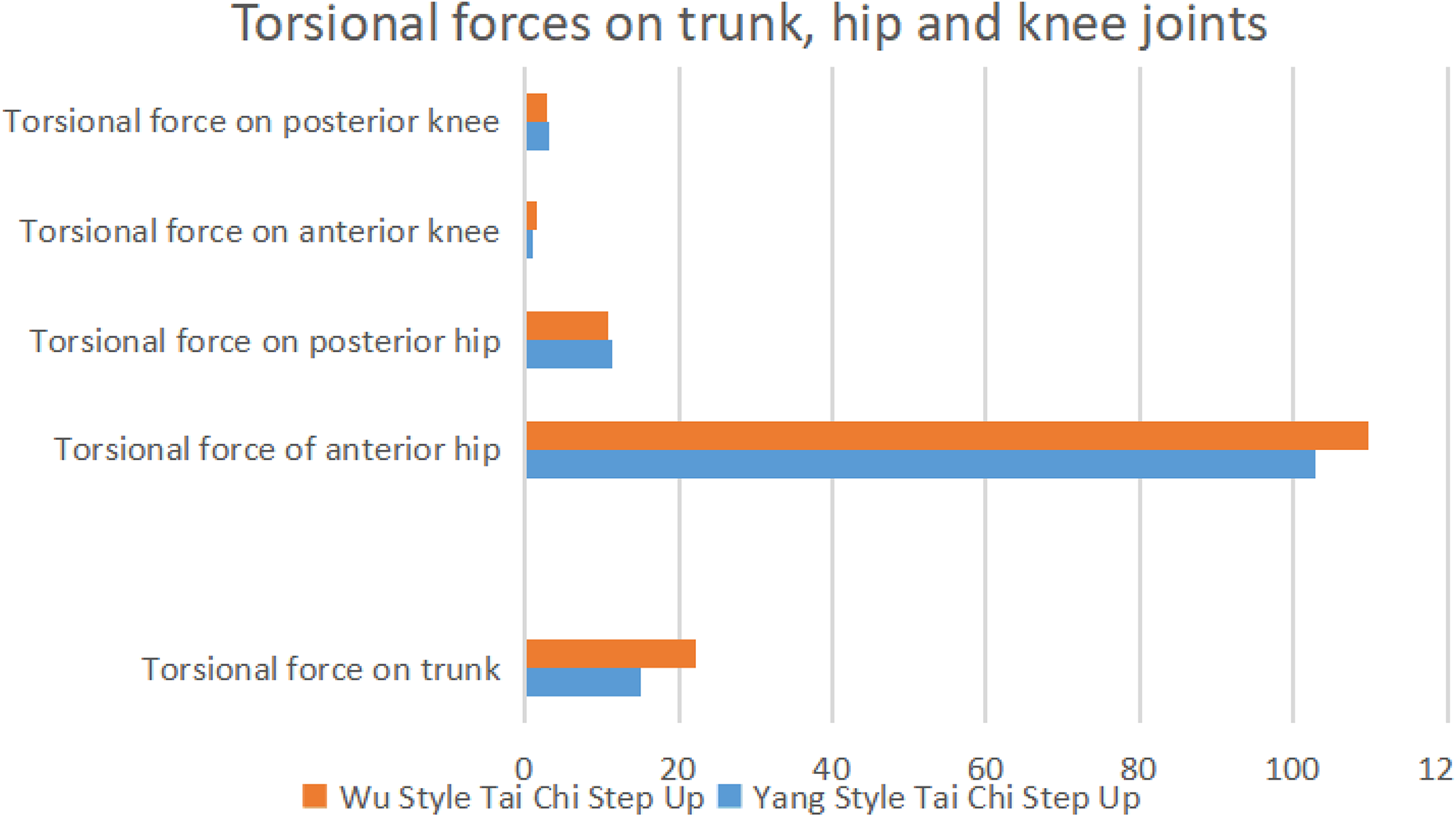
Trunk torsion force, hip torsion force, and knee torsion force.
Conclusions
In this article, the advanced FAB ontology sense test system is used to analyze and study the step-up movements of 12 Wu-style and Yang-style Tai Chi practitioners, and the specific analysis of individual athletes’ movements is carried out to explore the similarities and differences between Wu-style and Yang-style Tai Chi. Through the comparative analysis of the human mechanics of Wu-style and Yang-style Tai Chi, it can help practitioners grasp the style and characteristics of Wu-style Tai Chi and Yang-style Tai Chi more accurately. Correct distinction between Wu-style and Yang-style Tai Chi is conducive to the promotion and dissemination of Tai Chi, public fitness, and even the internationalization of Tai Chi.
The results of this study show that Wu-style and Yang-style Tai Chi are conducive to increase leg strength and balance stability, Wu-style Tai Chi upgrade is more conducive to increase leg strength, and Yang-style Tai Chi upgrade is more conducive to the stability of footwork. Wu-style and Yang-style Tai Chi have little change in the trunk force during the upper step, which ensures the stability of the center of gravity. The greater changes in the force on the hip and knee joints indicate that the upper step has a greater effect on lower limb exercise.
The results show that there is no significant difference between Wu-style and Yang-style Tai Chi practitioners in the percentage of body weight in front leg, knee joint, and sole pressure, but there is a significant difference in the percentage of body weight in back leg. As a result, the foot pressure gap between Yang-style Tai Chi and Wu-style Tai Chi is smaller, while the foot pressure gap between Wu-style Tai Chi and Wu-style Tai Chi is larger. There were no significant differences in trunk force, front hip force, back hip force, front knee force, and back knee force (p > 0.05).
Footnotes
Declaration of conflicting interests
The author(s) declared no potential conflicts of interest with respect to the research, authorship, and/or publication of this article.
Funding
The author(s) disclosed receipt of the following financial support for the research, authorship, and/or publication of this article: This work was supported by Stage results of 2018 Wuhan Business University Teaching research topics, 2018Y015.
