




Abstract
With the arrival of the big data era, a lot of valuable data have been generated in the entire product life cycle. The gathered product data contain a lot of design knowledge, which brings new opportunities to enhance the production efficiency and product competitiveness. Data-driven product design is an effective and popular design method, which can provide sufficient support for designers to make smart decisions. This article focuses on a comprehensive review of the existing research in data-driven product design. Based on the product design process, this article summarizes the data-driven design methods into the following aspects: customer requirement analysis, conceptual design, detailed design, and design knowledge support tools. In the customer requirement analysis stage, through data mining and transformation methods, customer requirements are predicted and then mapped to obtain accurate requirement expressions for aiding designers to explore the design space. In the conceptual design stage, the intelligent algorithms and data warehouse technologies are discussed in detail for function reasoning and scheme decision-making to achieve the iterative mapping from customer space to solution space. In the detailed design stage, data modeling languages and methods are introduced to support the simulation verification of the design process. For the design knowledge support tools, the methods of extracting knowledge from product data are discussed in detail, and the realization of computer-aided conceptual design is assisted through the development of knowledge-oriented design tools. Finally, this article summarizes the key points of data-driven product design research and provides an outlook for future research directions.
Keywords
Introduction
With the development of artificial intelligence technology, intelligent manufacturing integrates computer and information science technology into manufacturing industry to achieve flexible and smart manufacturing process in respond to dynamic market demands. 1 Information technology is deeply integrated into advanced manufacturing technology under the background of intelligent manufacturing. 2 With the application of advanced information technologies such as the Internet of Things and edge computing in manufacturing industry, a large amount of valuable data have been accumulated. 3 How to apply the resource data of the intelligent manufacturing system to manage product life-cycle process is of great significance to enhance the value chain of the manufacturing industry.
During the interaction between the product and the outside world (such as users and environment), a large amount of data can be produced, which represent the characteristics of the product’s connection with the outside world. 4 Data-driven product design mainly refers to the process of mining the relevance and hidden pattern of things through modeling and analysis of these data to assist product design. The logical starting point of data-driven product design is to connect the virtual digital world and the real physical world. 5 Decision makers can discover the hidden patterns by analyzing and mining the product data. 6 The content of data-driven product design includes the improvement of product and system scheme according to the data of product and system operation. Data-driven design serves the whole product life cycle and improves the product quality according to the data of the system operation.
Product life-cycle management (PLM) is an important information strategy for companies to manage knowledge-intensive processes. 7 The product life cycle covers the entire process including product requirement analysis, design, manufacturing, sales, after-sales service, and recycle. 8 As a key component of industrial activities, product design process has a significant impact on the product life cycle. A set of knowledge and several of data are used in each stage of the product design including product planning, conceptual design, embodiment design, and detailed design. 9 During the design process, engineers usually take more than half of the time to organize the design knowledge and data. Therefore, effectively managing design knowledge and data is one of the enabled technologies for enterprises to remain competitive and reduce the product development time. 10 Therefore, how to effectively use these massive data and promote the methods of data-driven design for products has become a research hotspot. 11
Data-driven design can realize the digitalization of production process 12 while linking users, products, and production processes to improve design efficiency. 13 Product design data can improve the ability and quality of management, adjust the method in time according to the demand of the market, and increase the attractiveness of the product. 14 In terms of user experience, information can also be feedback in time to meet requirements. 15 Analysis of collected data during product usage process can also enhance the understanding of consumers. 16
Many researchers have carried out numerous studies on data-driven design, such as data-driven design methods, applications, and case studies. 17 As a research basis, data-driven design method has an important impact on product creativity and design efficiency. The research content of data-driven design focuses on knowledge and data mining technology, 18 product usage data analysis approach, 19 and customer preference prediction. 20 The relationship between data-driven design and PLM is complex, and key scientific issues such as design methodology and knowledge classification system still need to be studied intensively.
In this article, we review the product design process from a data-driven perspective. This article helps designers deepen their understanding of data-driven methods and improve the efficiency of product design. Based on the data generated in the product life cycle, it helps designers to perceive customer preferences, make scheme decisions, and perform data modeling. The purpose of this article is to contribute to the development of data-driven method in the field of product design.
As shown in Figure 1, the data-driven product design in intelligent manufacturing research framework consists of basic process of product design, classification of data-driven design methods, data modeling, and design knowledge base. Data-driven design method provides an important theoretical tool for product design, and a series of hot issues have been studied in this field. This article aims at the research of data-driven design method applied in customer requirement analysis, product conceptual design phase, data modeling in detailed design phase, and design knowledge support tools. Finally, in view of the latest research trend of data-driven product design, this article provides an outlook for future research directions.

Data-driven product design research framework.
Data-driven analysis of product design process
Concepts and characteristics of product data
With the development of society, data resources are continuously accumulated and have played an irreplaceable role in all walks of life. Product data are generated along with the product’s entire life cycle and are produced by the interaction of products, people, and the environment. 21 Nowadays, there are three main sources of product data: Internet digital resources, cyber-physical systems, and scientific experiments.
In the era of intelligent design, through the matching function of customer requirements, terminal memory and simulation learning are formed to predict customer preferences, and the human brain-like thinking function is realized. As an important factor in product design and development, data are already in an irreplaceable position during the entire life cycle of the product.
Data-driven product design process
The product design process can be described as a process in which a designer makes design decisions with the help of various product data and converts a set of functional requirements into a specific implementation structure. Product design is a complex iterative process, from the product’s principle scheme design, overall design to detailed scheme design. Each design task has a clear division of labor, and each task is often broken down into subprocesses composed of many subtasks. Design tasks need to be iteratively repeated, and there is a large demand for data support during this period. There are four main phases in the product design process: planning and task clarification, conceptual design, embodiment design, and detailed design. 22 Each stage of the product design process has its specific activities, involving relevant staff and departments, and generating large amounts of data. This section focuses on product data related to requirement analysis, conceptual design, and detailed design.
Requirement analysis: According to the requirements of customers and market data, this stage analyzes the key customer preference and correctly translates them into appropriate product attributes and characteristics. 23 Effectively capturing and screening customer preference data are the focus of requirement analysis. The data involved in requirement analysis include customer comments, satisfaction, videos on the Internet, and so on.
Conceptual design: At this stage, a data-based product conceptual design model is constructed, and the relevant knowledge is acquired from the data in combination with the conceptual design process to assist the product conceptual design. After establishing the functional structure and searching for the appropriate working principle, the solution is combined into a working structure. 24 The data involved in conceptual design include product function data, product structure data, and design alternative data, and so on.
Detailed design: Based on the product data information, this stage models the product development process. Data in product modeling describe the process of creating product solutions based on requirements, and it can support the simulation verification of the design process. 25 The data involved in detailed design include the product appearance data, product configuration data, design parameter data, and so on.
Data-driven requirement analysis for preference perception
Requirement analysis is a process of obtaining customer requirement information through certain methods and then screening them according to the importance of customer requirements data and its impact on product design. 26 The initial motivation for manufacturing a product is to meet the requirement of the customers, and customer requirement is the direct power of data-driven product design. With the development of big data, Internet of Things, and other technologies, the data-driven customer preference perception has become a hot research direction. Customer requirement analysis methods tend to use some intelligent analysis and data processing methods for customer requirement processing. The market facing enterprises today has changed from a single, stable market to a market segment that requires product differentiation and diversification. If enterprises want to survive for a long time, they must accurately grasp the voice of customers (VOC) and produce products that meet customer requirements. Therefore, in face with the huge data generation environment and competitive market situation, design engineers must consider a variety of customer preferences and requirements.
Lots of customer preference data can be obtained from various data sources such as customer feedback, network crawling, and company databases. Understanding and assumptions about customer requirements during the inspiration and analysis of requirement data have a significant impact on product design and manufacturing in terms of quality, delivery cycle, and cost. 27 Therefore, effectively capturing the key customer preferences and requirements, systematically analyzing, and properly transforming them into appropriate product attributes and features are the focus of requirement analysis. 28 The framework of data-driven design method in customer requirement analysis phase is shown in Figure 2.

The framework of data-driven design method in customer requirement analysis phase.
Requirement perception and forecasting
Properly identifying and forecasting product features is the basis for requirement analysis. The framework of data-driven requirement perception and forecasting is shown in Figure 3. The premise of requirement forecasting is to obtain customer requirement data through certain methods, which is also a time-consuming part of data-driven product design. Traditional customer requirement acquisition is mainly carried out in the form of questionnaire. With the application of Internet and big data technology, the acquisition of demand is becoming more intelligent, convenient, and fast. After obtaining the customer requirement data, the requirements of the customer are analyzed and supplemented in combination with data from each stage of the product life cycle. Bae et al. 29 proposed a Web-based customer data analysis and mining technology to capture customer requirement. Analysis of VOC allows companies to identify customer needs in advance and actively respond to upcoming opportunities. The proposed system for analyzing VOC can improve its processing and utilization. The integration of conventional statistical techniques and data mining techniques increases the confidence of VOC analysis. In addition, the proposed system can provide early warning and solutions by integrating product or service databases, customer databases, and knowledge bases. Chong and Chen 30 adopted an artificial immune and neural system approach to analyze and manage the dynamic customer requirement data. The proposed approach proactively manages and predicts dynamic customer requirements to reduce the inherent risks of developing products for rapidly changing markets. In this work, the customer needs analysis and prediction system were defined to support product development capabilities through quantitative and qualitative customer demand information to produce products for future markets. Jin et al. 31 identified product features and emotional polarity from big consumer opinion data and then use a Kalman filter method to predict the trends of customer requirements. The proposed method aims to facilitate designers by making market-driven product designs using valuable information from large consumer data. In this work, a framework was created to handle consumer big data, such as characteristics, quantity, kind, speed, and value. Burnap et al. 32 proposed a feature learning method to improve preference prediction accuracy without collecting more customer requirement data. The proposed method uses the feature as an intermediary between the design variables of the original customer link and the preference model, converting the original variables into feature representations to more effectively capture the underlying design preference tasks. In this work, three feature learning methods (low rank and sparse matrix decomposition, principal component analysis, and exponential sparse restricted Boltzmann machine) were used to help enhance data-driven design decisions.

The framework of data-driven requirement perception and forecasting.
To meet and understand the diverse heterogeneous requirements of customers better, it is necessary to classify the requirement data. With the explosive growth of customer requirement data, requirement classification methods are not limited to traditional categories. At present, fuzzy clustering and data mining methods are mostly used for requirement classification processing. Ji et al. 33 defined a new approach on how to classify customer requirement data by quantitatively integrating Kano’s model into quality function deployment (QFD) to optimize product design to maximize customer satisfaction (CS) under cost and technology constraints. In this work, Kano’s model is quantified by determining the relationship between customer demand and CS. Then, the qualitative and quantitative results of the Carnot model are integrated into the QFD. Finally, a hybrid nonlinear integer programming model was developed to maximize CS under cost and technical constraints. Zhai et at. 34 proposed a novel rough set-based QFD approach to manage the uncertain customer requirement data in product development. To evaluate the fuzzy requirement data in customers’ perceptual preferences, Chan et al. 35 proposed a novel fuzzy modeling method named fuzzy stepwise regression which is composed of an appropriate polynomial that only includes significant regressors. Based on the understanding and management of the complex relationship between customer requirements and technical requirements, the proposed method is used to manage inaccurate design information in product development. To reduce the adverse effect of small sample customer requirement data, Liu and Cheng 36 developed an improved gray QFD method based on interval gray numbers, TRIZ techniques, and QFD, which can assist product developers in identifying important engineering characteristics. The proposed method can help product developers determine the strengths, weaknesses, expected market position, and point of sale of new products and provide useful information to product developers (e.g. importance ranking, competitive analysis of new products, product improvement recommendations). To solve the importance analysis of the customer requirement data in innovative product design, Su et al. 37 proposed a customer knowledge management model to accurately describe the management process of customer data in the product development process, which can extract customer knowledge from different market segments. Bae and Kim 38 used the Apriori and C5.0 algorithms to mine the design process, so as to extract the design knowledge and requirement data contained in the design process. Ur-Rahman and Harding 39 proposed a hybrid textual data mining method using clustering technology and Apriori algorithm. The textual data were divided into two categories, and the classifier was improved using support vector machines and naive Bayes to improve the accuracy of the classifier. Song et al. 40 proposed a textual data mining method based on F-Term algorithm, which classifies invention patents from different perspectives by identifying the target technical characteristics and technical attributes.
Requirement transformation and mapping
The collected customer requirement data include not only the customers’ requirements for product functions but also the customers’ requirements for product performance. When conducting customer requirement transformation and mapping, it mainly includes the determination of the customer requirement importance and the mapping of customer requirement functional characteristics.
Forecasting the future importance weights of product features has a significant impact on the data-driven product design, as it significantly affects the target value setting of engineering requirements. 41 The determination of the importance of customer requirements is a key part in the process of customer requirement forecasting and comprehensive analysis. At present, there are many methods to determine the importance of customer requirements, mainly including expert evaluation method, analytic hierarchy process (AHP), fuzzy analysis method, characteristic analysis method, and QFD. In general, multiple methods are used in combination. Chan et al. 42 adopted the fuzzy-AHP to deal with the fuzziness of the data involved in analyzing the importance of customer requirements and calculate overall CS based on membership. The proposed method solves the ambiguity of the data involved in determining the preferences of the different decision variables involved in the supplier selection process. Clegg et al. 43 developed a novel approach to quantify Kano’s model and measure the relationships between CS and the customer requirement data. In this work, the relationship functions between the fulfillment of customer requirements and CS help understand customer requirements better and provided a way for model or tool integration to optimize customer-centric product design. Because the priority of customer requirements may be different among different customer groups, Prasad and Subbaiah 44 adopted conjoint analysis to obtain the priority structure of customer requirement data. The priority level of customer demand may vary for different customer segments. In this work, the k-means clustering method was used to cluster the customers according to their main interests. Factor analysis was used to reduce the size of the customer demand portion of the house of quality (HOQ) prior to the joint analysis.
The data-driven correlation analysis of customer requirements and product design parameters can help predict and perceive customer requirement preferences, which has become a hot research direction. To solve the difficulties and challenges of customer preference data-driven product design, Ma and Kim 45 proposed a predictive data-driven product design method and determined the best product design direction through k-means cluster analysis. This work utilized extended market value prediction method to capture the trend of customer preferences in the prediction model. To enhance the connection between user experience and product design, Lin et al. 46 proposed a UNISON framework for data-driven product innovation design to capture design factors, user needs, and user preferences, so as to provide useful design rules to guide product design. Based on the relationship between visual esthetic product characteristics and user experience, Chien et al. 47 proposed a data-driven product design framework for capturing the visual esthetic user experience of the product, so as to effectively identify the user preferences and reflect them into product conceptual design. To confirm the important interaction between the customer review function and other factors, Li et al. 48 proposed a method for mining and analyzing product review data and realized the analysis and prediction of product sales and development trends.
The mapping of customer requirements to product features is a key aspect of product design. Customer requirement mapping is applied to convert customer requirement data into product engineering features that can be easily understood. McAdams et al. 49 introduced a new matrix approach to identify the relationship between product characteristics and customer requirement data. Yu and Wang 50 proposed a Pareto-based GA which can mine the association rules that reflect the mapping relationship between customer needs and product specifications. In this work, four targets (support, confidence, fun, and comprehensibility) were extracted for evaluating the rules of extraction. To solve this multi-objective problem, based on the product documentation in the transaction database and design database, a Pareto-based genetic algorithm is used to perform rule extraction. The proposed method of extracting rules can help engineers better understand the tacit knowledge of the design database. Zeng and Gu 51 proposed a customer requirement data description method for product structure and performance and adopted set theory to describe the design objects in the dynamic design process. McKay et al. 52 built the data model of the requirements using the specification format of the Express-G diagram and implemented the requirement management based on the product data model simulation system. Wang and Ma 53 proposed a systematic approach to mapping customer requirement data into product quality characteristics. The proposed method covers three processes, namely qualification and classification of customer requirements, generation and conversion of product quality characteristics, and optimization of product quality characteristics. In this work, the analytic network process (ANP) approach was adopted to determine the weight of different customer needs and product quality characteristics. Based on the establishment of customer requirement data index, Cariaga et al. 54 transformed the technical characteristics of the product through data envelopment analysis technology. The proposed hybrid framework integrated the value analysis and decision-making capabilities to evaluate design options.
In addition to the requirement transformation methods mentioned above, the QFD is a more useful tool for designers. 55 QFD is an integrated decision-making approach that ensures and improves the consistency of design process elements with customer requirements. The key to QFD in requirement transformation is to use HOQ to establish a relationship matrix between customer requirement data and technical characteristics and to transform customer requirement data into product technical characteristics through matrix transformation. The QFD expansion model is shown in Figure 4. Karsak et al. 56 proposed a method based on the ANP to achieve the transformation of customer requirement data into product technical requirements in product planning QFD. Fung et al. 57 used the fuzzy linear programming method to improve the QFD and enhance its application effect in the presence of fuzzy and uncertain requirement data. Yang et al. 58 developed a system that provides a viable decision-making method for quantitative buildability assessments at the early design phase. It aims to adjust HOQ to meet the needs of industry design and develop fuzzy QFD systems for decision evaluation. In order to solve the problem that team members’ preferences in QFD usually conflict with various goals, Ho et al. 59 proposed an integrated group decision system to minimize the inconsistency of group and individual preferences. Due to the uncertain nature of QFD, it is more difficult to evaluate the performance of the design process through accurate quantitative assessment. Therefore, Büyüközkan et al. 60 proposed a new fuzzy group decision-making method to integrate multiple preference styles and respond to customer requirements and QFD in product development in a better way. Karsak 61 proposed a fuzzy multi-objective decision-making method, which combines the inherent inaccuracy and subjective information in the QFD planning process to determine the degree of satisfaction of the design requirements.

QFD expansion model. QFD: quality function deployment.
Data-driven conceptual design
Product conceptual design is a series of iterative and complex engineering processes oriented to design requirements. It proceeds through the establishment of functional behavior correlation to seek the correct combination mechanism, determine the basic solution path, and generate the design scheme. 62 The success of new product development depends on the design concept generation during the conceptual design phase. 63 Companies need to quickly produce new products that meet the diverse and individualized requirements of consumers, without increasing production costs and product development cycles. Product conceptual design is one of the key steps to solve these problems, and the efficiency of product data usage is the main factor affecting the efficiency of product conceptual design. 64
Under the background of big data era, data can play a positive role in product conceptual design. The requirements of most consumer groups can be determined from a large number of product data, thus reducing the ambiguity of conceptual design. Product data contain rich design knowledge that can improve the efficiency of conceptual design and the innovation of design solutions. Other aspects of the data include a lot of methodological experience that can assist the design process.
In product conceptual design, designers often need to rely on their own design experience and find relevant design knowledge to solve design problems. Sometimes, when encountering a new problem, it is difficult to solve the problem only by relying on the designer’s own knowledge and experience, which will lead to low design efficiency. Data-driven product conceptual design can not only reduce the workload of designers but also improve the quality of product design. The process of data-driven product conceptual design is shown in Figure 5.

Process of data-driven product conceptual design.
Function reasoning
In the product conceptual design phase, high-level abstract expressions such as design concepts and functional requirements need to be addressed to effectively capture the evolution of thinking. It is necessary to generate the basic physical structure that implements the design function, so as to express the design intent explicitly. 65 The process of generating a product conceptual design scheme is a mapping process from fuzzy requirements to specific structures. The functional reasoning approach in product conceptual design focuses on the functional level to generate and evaluate solutions for specific design problems. 66 A large amount of actual data are involved and executed in the reasoning process. Many scholars have introduced data processing technology into conceptual design and formed a series of data-driven functional reasoning approaches.
The need to reuse design knowledge and data has promoted the development and application of case-based reasoning (CBR) in the field of product design. CBR technology is applied to solve new problems by associating solutions to similar problems in the past and modifying them appropriately, which is similar to human decision-making process. By effectively organizing and utilizing the original design knowledge and data, CBR technology has overcome the bottleneck of knowledge acquisition in general intelligent systems. 67 Chiu 68 described CBR as a five-step reasoning process: presentation, retrieval, adaptation, validation, and update. Han and Lee 69 proposed the notion of virtual function generators to identify and conceptualize the basic design concepts of existing mechanisms and generate feasible design alternatives by combining some adaptive rules with virtual function generators. Hicks and Culley 70 used a computer-based system modeling tool to integrate conceptual design and structural design through CBR technology. Lee and Lee 71 developed an intelligent system based on knowledge engineering that supports the conceptual design phase and adopted a learning algorithm to extract a suitable design case for the new product design from the case library.
Intelligent algorithms can deal with specific product data, so they are introduced to perform the reasoning process better. Neural network has the ability of self-organization and self-learning, which can solve the classification task and the recapture of associative memory. In functional reasoning, neural network can handle insufficient and easily changing data, which is used to extract and express knowledge. Huang et al. 72 proposed an integrated computational intelligence approach for dealing with product conceptual generation and evaluation. A set of satisfactory concepts can be generated by using genetic algorithms in conjunction with information from the knowledge data. The fuzzy neural network was then used to implement concept evaluation and decision-making to obtain the optimal concept. Srinivas and Ramanjaneyulu 73 combined artificial neural networks with genetic algorithms for cost optimization of bridge deck configurations. Artificial neural networks were used to predict structural design responses which were used further to assess fitness and constraint violations in the genetic algorithms process. The time of the optimization scheme is greatly reduced through integrated reasoning. Parmee and Bonham 74 proposed the interactive evolutionary computational methods to achieve innovation in the conceptual design phase of the product. The method was based on information gathered from the initial search using evolutionary techniques to quickly identify high-performance regions of complex design spaces. Jin et al. 75 proposed a layered co-evolution method that supports conceptual design. In conceptual design generation, a higher level function is decomposed based on a group of grammar rules, and a mapping between functions and their solutions or devices is achieved through a collaborative evolutionary computational process. Kondoh et al. 76 proposed a model of the cell manufacturing system and a self-organizing algorithm through software simulation. Through self-organizing algorithms, the product configuration can be determined under the conditions that meet the manufacturing requirements.
Hybrid reasoning is a combination of two or more kinds of reasoning techniques. Through certain information exchange and mutual cooperation, the conceptual design optimization scheme is generated, which effectively solves the shortcomings of single reasoning method. The development of conceptual design methodology, information modeling and artificial intelligence technology provides a good platform for the implementation of hybrid reasoning technology. Ociepka and Świder 77 proposed a functional structure framework for conceptual design of complex products, using expert systems and CBR techniques for reasoning and retrieval. Tung et al. 78 developed a hybrid reasoning using rule-based reasoning and CBR to transform knowledge of experts into the knowledge base of the solution retrieval system, which improved the accuracy of search cases and significantly reduced search time.
Multi-attribute decision-making for design alternatives
After product functional design, principle solution and original understanding combination, multiple product principle solutions were obtained. The goal of conceptual design is to choose a satisfactory design scheme and further develop it in the subsequent detailed design phase. The decision of the conceptual design scheme is to evaluate and compare several generated candidate schemes during the scheme generation phase and to select the best conceptual design scheme. At this stage, the optimal principle scheme is optimized by setting reasonable evaluation goals and selecting appropriate evaluation and decision-making methods. The factors that need to be considered in scheme decision-making include functional factors, manufacturing, reliability, safety, and other economic and social requirements. Because the decision-making process is affected by many factors such as the diversity, ambiguity, and uncertainty of the evaluation data, the reasonable evaluation index and weight data are the key to the decision-making of the conceptual scheme.
Data-driven scheme decision-making provides decision support information by selecting and analyzing selected data objects. Product type and product element are used as data-driven influencing factors and threshold weight to realize product design scheme decision. Product type is value innovation based on data, which originates from the mining of user data. The acquisition of product elements is based on data clustering, which is a process of integration, analysis, and induction, and is the relevant characteristics of a class of users. These features are related, which are the ties of mutual understanding and communication between users. The classical methods of decision-making commonly used include linear weighting method, technique for order preference by similarity to ideal solution (TOPSIS), AHP, and so on. With the deepening of the research, scholars introduced other mathematical analysis programs, such as gray theory and rough set theory. This improves the classical multi-attribute decision-making methods and broadens the idea of multi-attribute decision-making. The multi-attribute decision-making methods such as grey relation evaluation method and fuzzy comprehensive decision method are generated. Geng et al. 79 proposed a combination decision-making method based on vague set and TOPSIS method. The vague set was used to deal with the uncertain decision-making opinions of decision makers, and the TOPSIS method was used to evaluate and make decisions on the scheme. To deal with uncertain data and improve the efficiency of evaluation process, Zhai et al. 80 combined rough set and grey relational analysis, and proposed an integrated evaluation method of product conceptual design scheme based on their respective advantages of data processing. Based on the generalized model of product conceptual design and some decision-making methods commonly used in uncertain data processing and decision-making, Yeo et al. 81 proposed a fuzzy AHP method which integrates AHP and self-expatiation method. The proposed method is applied to the conceptual design of precision fixture, which proves the feasibility and effectiveness of the method. Feng et al. 82 proposed an improved multi-objective ant colony algorithm to help decision makers choose the best plan and sequence when performing a product disassembly process. To reduce the negative impact of the ambiguity of uncertain evaluation data on the decision of product design schemes, Song et al. 83 proposed a product design scheme evaluation model based on a combination of rough numbers, AHP, and TOPSIS. The novel method combines the advantages of rough number in dealing with vagueness, of AHP in hierarchical evaluation, and of TOPSIS in modelling multi-criteria decision-making. To qualitatively select the best green decoration materials, Tian et al. 84 proposed a hybrid multi-criteria decision-making approach which combined AHP and grey correlation technique, which provided an effective and reasonable decision support tool for the performance evaluation of green decoration materials. By integrating evaluation laboratory-based analytical network process and a decision-making trial, Feng et al. 85 proposed an environmentally friendly multicriteria decision-making model for reliability-based product optimization.
With the application of data analysis and data-driven methods in product design, methods such as machine learning and neural networks are gradually being used in the evaluation and decision-making of product design solutions. Hsiao and Tsai 86 proposed a method which enables an automatic product form search or product image evaluation by means of fuzzy neural network and genetic algorithm. The proposed method automatically outputs the optimal appearance image by constructing the fuzzy neural network model of product appearance parameters and product images, so that the designer can obtain the product form quickly. Golmohammadi 87 proposed a fuzzy multi-criteria decision model based on a feedforward artificial neural network. This model was used to capture and represent the preferences of decision makers. The proposed model can use historical data and update database information over time for future decision-making. To compare and select one best scheme from the new scheme according to historical or current ones, Kong and Liu 88 proposed an radial basis function neural network method. This method not only has the advantages of the ordinary neural network method but also requires much less samples and is simple and clear. The model can automatically determine attribute weights, making the weight assignment more objective and accurate. To optimize the disassembly sequence in remanufacturing and recycling used or discarded products, Tian et al. 89 developed an improved artificial bee colony algorithm that can efficiently generate a set of Pareto solutions for this dual-objective disassembly optimization problem. Feng et al. 90 proposed a flexible product recycling process planning and end-of-life decision-making method, aiming to model and optimize the mixed disassembly and end-of-life operation of product disassembly, so as to maximize the recovery profit and minimize the environmental impact.
Data modeling in detailed design
Since the earlier part of the 20th century, the use of models has been widely spread in engineering design, and mathematical models cover almost all aspects of engineering products. Start with physical representations and iconic models of a design, followed by analog models, or use one thing to represent another. 91 Design problems can be modeled and represented in different ways to help designers in their work. The symbolic model of product data information is composed of a group of symbols under the constraints of symbolic association. The design process model is an abstract expression of the design process, which can clearly represent design data and knowledge and describe the design variables and their transformation relationship. 92 Feldkamp et al. 93 integrated structural modeling, taxonomies, and constraints to model design problems based on solution libraries and propagation techniques. Devanathan and Ramani 94 modeled the design of the implementation as a product configuration issue and quickly complete important aspects of the detailed design of the predefined product concept to provide designers with performance and design information.
With the development of sensors and data storage technologies, large volumes, various types, and multiple sample rates are new features of product data, making modeling and application difficult. Data mining and database technology provide powerful technical support for the development and application of data-driven modeling methods in product design. Data in product modeling describe the rationale for the reasons and ways in which product solutions (such as design candidates and manufacturing processes) are created based on requirements. When changing requirements or identifying new requirements, designer can use product data to modify existing solutions or create new ones. In all aspects of product data, product design data play a key role in product modeling in the development of computer-based product development system. In recent years, data modeling has become the focus of research in academia and industry and has made important progress in modeling languages and modeling methods.
Modeling languages
According to the highly distributed and reconfigurable characteristics of products, data-driven modeling languages can be divided into two categories: ontological modeling languages and object-oriented modeling languages.
The ontology modeling languages are used to construct semantically rich product models. The most widely used ontology language is the Ontology Web Language (OWL), which promotes machine interpretability of Web content by providing additional vocabulary and formal semantics. OWL is intended to be used when the information contained in the document needs to be processed by the application, and can be used to clearly indicate the meaning of the terms in the vocabulary and the relationship between these terms. 95 Bock et al. 96 developed an ontological and model-based technology in languages and proposed the ontological product modeling language to facilitate collaborative design exploration. They applied model-based techniques to develop more powerful, engineering-friendly languages to use ontology. The product model was seen as an ontology classification of the entire system in a model-based architecture. Barbau et al. 97 proposed a way to convert the STEP pattern and its instances to OWL. This work developed an OntoSTEP model, first converting the STEP data schema to the OWL scheme, then converting the data instances in STEP to OWL individuals, and finally integrating the scenarios and examples into the plug-in Protégé to automate the translation process. Panetto et al. 98 proposed a method to promote system interoperability in a manufacturing environment called product-driven ONTOlogy for product data management. In this work, they first conceptualized existing standards to provide product-centered information model and then formalized product-centered information model into product ontology. This approach formalized all the technical data and concepts that help define the product ontology. These technical data and concepts were embedded in the product itself and interoperable with the applications, thus minimizing the semantic loss.
Object-oriented modeling languages apply object-oriented programming concepts, which include instantiation, inheritance, encapsulation, and polymorphism, to model product data. They include many popular modeling languages, such as unified modeling language which is often applied in object-oriented design and analysis, EXPRESS which is used to represent product data in STEP and its graphical representation format called EXPRESS-G. Szykman et al. 99 introduced a language that has been developed for engineering design workpiece modeling. In this work, a data language with four basic entity types (relationships, objects, relationship classes, and object classes) was developed. They applied the design representation language to model a variety of product data information, such as the classification of semantic and class hierarchy artifacts, and the classification of functions and processes. Xue et al. 100 improved the feature-based product modeling language to derive a distributed feature-based product modeling language for modeling distributed mechanical design systems. Johnson et al. 101 proposed a formal method to model the dynamic system behavior in System Modeling Language (SysML) through a language mapping between Modelica and SysML. Based on the existing SysML functions, they explored how to extend the functionality of SysML to model continuous systems. To support the simulation, they also proposed a graph-based two-way mapping mechanism to perform bidirectional conversion between the SysML model and Modelica.
Data modeling method
Ontology-based product modeling is a very popular modeling method. Kim et al. 102 proposed a new paradigm-based assembly design as a formal and clear specification for data and knowledge in the field of assembly modeling. Witherell et al. 103 proposed an optimization ontology and its implementation in a computational knowledge-based prototyping tool called ONTOP. Notable features of ONTOP include a knowledge database that combines standardized optimization terminology, formal method definitions, and optimization details that are typically undocumented. As the industry continues to redesign and optimize products and processes, optimizing knowledge data are becoming more and more valuable. ONTOP’s representation of abstract engineering design optimization modeling knowledge data will greatly facilitate the development of robust design optimization models for modified and similar products. Borsato 104 proposed an ontology that associates sustainability terminology with product and process data entities through semantic linkages, which supports interoperability between engineering and business tools, and promotes the use of sustainability data through the product life cycle. Compared to standards-based data exchange methods, ontology-based methods have the necessary semantics to allow for explicit information sharing. Using formal ontology as an interlanguage language provides a possible strategy for passing relevant information between heterogeneous environments. Štorga et al. 105 introduced the nature, construction, and practical role of design ontology, which is a more effective framework for product development data, information and knowledge description, interpretation, understanding, and reuse. In this study, they gave a description of the design ontology research project and proposed an easy-to-understand and unified product/design description language to achieve a formal description of the genetic design model system structure. To effectively and efficiently develop a product configuration system by reusing configuration knowledge, Yang et al. 106 adopted an expressive OWL ontology language and an SWRL rule language to model product configuration knowledge data. The advantage of OWL-based configuration model is that OWL, as an ontology language, supports the reuse and sharing of knowledge data, so it can ensure the reuse of configuration model. Structural knowledge data are represented in OWL and constrained knowledge data are described in SWRL. Moon et al. 107 proposed a method of developing service ontology by integrating object-oriented concepts and ontologies to capture and reuse design knowledge data in service families. By sharing and reusing knowledge and data across a range of products and services, a differentiated set of economic products can be effectively developed by increasing the flexibility and responsiveness of product and service development. Moon et al. 108 proposed a product series design knowledge discovery method that integrates ontology modeling method and data mining technology. In the proposed method, the ontology represented the attributes of the product components in the functional hierarchy, and the fuzzy clustering was used for data mining. Bellatreche et al. 109 proposed an ontology-based integration approach for handling large, autonomous, and heterogeneous data sources. Each data source participating in the integration process contains an ontology which defines the meaning of its own data. This approach ensures automation of the integration process when all resources reference the shared ontology, and may extend the integration ontology by adding its own conceptual expertise. Based on an in-depth analysis of the prior art, El Kadiri and Kiritsis 110 defined seven key roles of the ontology: trusted source of knowledge, database, knowledge base, bridge for multiple domains, mediator for interoperability, contextual search enabler, and Linked Data enabler.
Through the modeling method based on product function, the appropriate product can be determined when the design function is provided. Functional modeling provides an abstract but straightforward way to understand and represent the overall product functionality. Functional modeling can also strategically guide design activities such as problem decomposition, physical modeling, product architecture, concept generation, and team organization. Hirtz et al. 111 developed a general taxonomy of product features and related process data for these functions for product modeling. Kurtoglu et al. 112 developed a new classification of electromechanical components to assist design engineers in mapping from functional requirements to component solutions. Bohm et al. 113 developed a design repository that can transform existing heterogeneous product knowledge data. The repository supports product design knowledge data archiving and Web-based search, display and design models, and tool generation.
Through the modeling method based on production rules, appropriate products can be identified for design as new requirements arises. Based on the distributed product life-cycle modeling method, Zhang and Xue 114 introduced a distributed optimal parallel design model. In this work, all possible product implementation process alternatives are integrated into the same environment by modeling the relationships between different product development life-cycle databases and knowledge bases at different locations. Zhang and Xue 115 proposed a feature-based approach to product data modeling and rules related to product data description.
Design knowledge support tools
Knowledge is the whole of information and data collection, and the data related to the product design process contain a lot of knowledge. Product design is a process of continuously expanding and optimizing design knowledge. Knowledge can be structured and stored in a knowledge base to facilitate the organization and management of design knowledge. The knowledge base system is used to the storage, management, and reuse of knowledge and data. The product data-driven design knowledge base and instance library serve as the information support foundation, including design principles and specifications, design standards and methods, and expert experience. The effective construction can help designers manage product design example information and improve the efficiency of product design. As the design process continues, data are continuously produced and transformed into design knowledge. Through structured processing and storage of data, the accumulation of knowledge and the improvement of product design are promoted. The framework of data-driven design knowledge base is shown in Figure 6.

The framework of data-driven design knowledge base.
To overcome the shortcomings of the database model in terms of knowledge expression ability, it is necessary to strengthen the semantic components of the database. Szykman et al. 116 proposed a next-generation product development model for knowledge-based product development. Barnard and Rothe 117 built a Web-based computer-supported collaborative engineering knowledge management platform that supports the evolution of design knowledge. Nacsa et al. 118 studied the knowledge management support of machine tool design and proposed a rule-based knowledge to capture engineering method and a set of KBE application software, including product data management, design process management, design document management, and dynamic rule-based graphics generator. In terms of knowledge acquisition, Khalifa and Liu 119 studied and compared the role of semantic network in knowledge acquisition and proposed a new method of knowledge acquisition: computer-mediated semantic network knowledge acquisition method, which has certain advantages in more complex knowledge acquisition and better integration of knowledge structure. Chen and Rao 120 proposed a matrix representation and mapping method to promote the utility of knowledge acquisition in building a knowledge base system.
In the early stage, domain knowledge is transformed into knowledge base by means of transformation. It became unrealistic and impossible to collect all the knowledge of domain experts and transform it into knowledge in knowledge base, so the idea of knowledge development changed from transformation to modeling. In the modeling framework of knowledge base system, the CommonKADS method is a collection of structured methods for building knowledge-based systems. One of its key components is the general inference model library, which can be applied to tasks of a given type. 121 The model-based and incremental knowledge engineering approach is used to develop knowledge-based systems that integrate semi-normative and formal specification techniques with prototyping into a coherent framework. 122 Protégé system is a persistent and extensible platform for knowledge-based system development and research. It can run on various platforms and support customized user interface expansion, including the open knowledge base connection knowledge model. 123
The product data-driven design knowledge base effectively supports knowledge reuse in design process modeling and design object modeling. The management and reuse of design knowledge can improve the efficiency and quality of product design. In the era of knowledge economy, the effective use of the accumulated knowledge of enterprises has a vital role in maintaining competitiveness, especially for knowledge-intensive enterprises like product design companies. 124 Iyer et al. 125 developed a new method for accurately retrieving the required design knowledge through keywords. Baxter et al. 126 proposed a process-based knowledge reuse model, which provides an integrated design knowledge reuse framework. The framework reuses best practices and designs basic captured elements and knowledge-based support in a consistent framework. Using the design process as the basis for knowledge structure and retrieval, it facilitates the dual purpose of design process capture and knowledge reuse: capturing and formalizing the underlying principles that support the design process and providing a framework for storing design knowledge, retrieval, and application. Bryson et al. 127 proposed a product development solution based on ontology-based knowledge reuse model, which embodies the concept of ontological knowledge structure and provides a mechanism for capturing product and process knowledge during the execution of development programs. The solution can be implemented in actual product development practices to capture and reuse product and process knowledge. Kim and Kim 128 conducted a mathematical comparison of causal knowledge and procedural knowledge and discussed the potential role and feasibility of causal knowledge in product development knowledge management. According to knowledge expression, decision substitution representation, reasoning ability, and knowledge cultivation perspective, causal knowledge representation is superior to procedural knowledge representation. Baxter et al. 129 proposed a framework for integrating requirement management and reuse of design knowledge and pointed out that the specific needs of knowledge users and knowledge producers need to be further studied to reuse design knowledge more effectively.
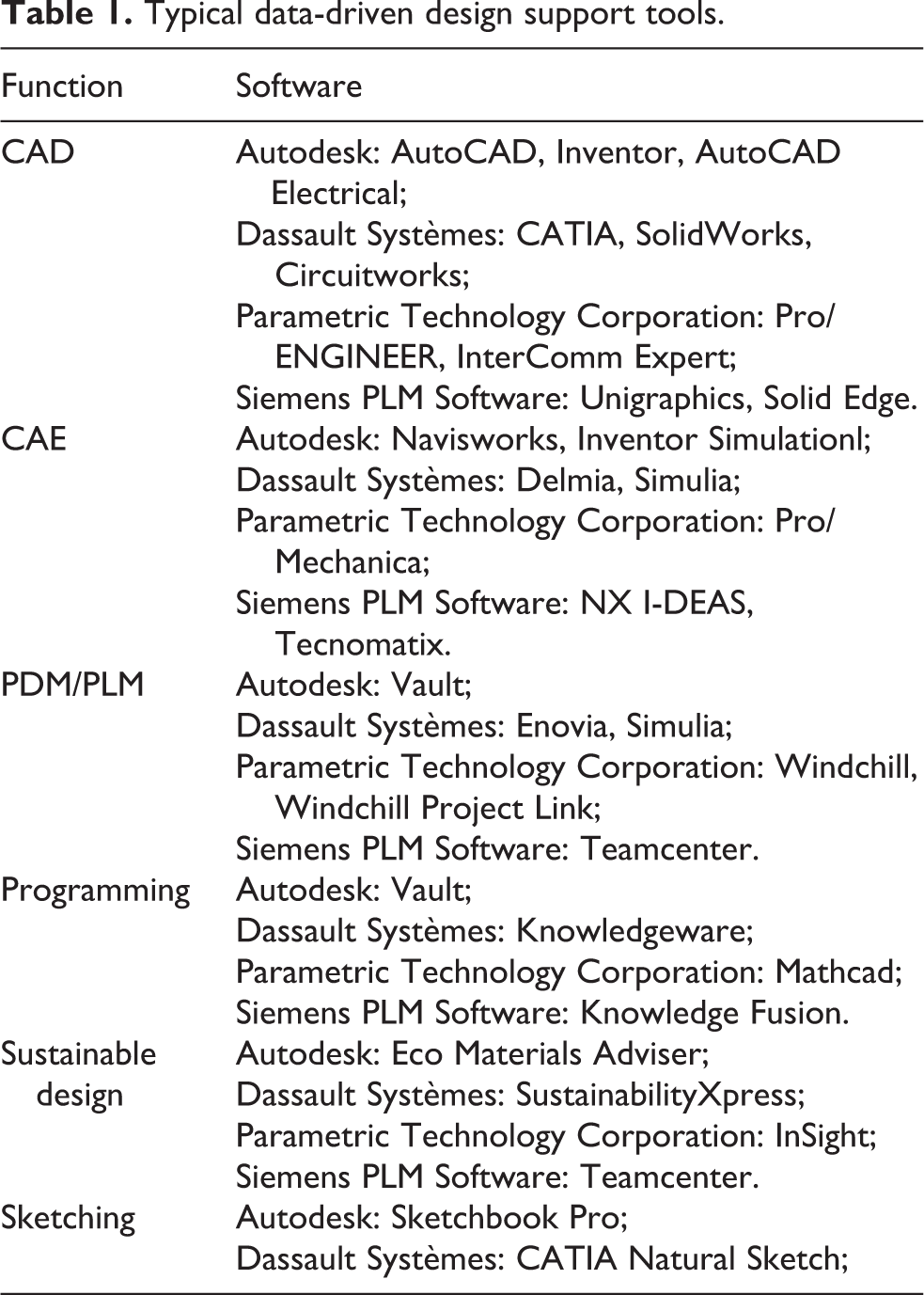
As an extension of application, data-driven design support tool integrates design knowledge base, case base, database, and product model, which helps designers to optimize product structure and parameters under the condition of incomplete information in the initial stage of design. With the assistance of computer-aided technology and product data management in product development process, the recent data-driven design tools focus on the environmental integration and interface association which greatly facilitates the product development process. Table 1 lists several typical data-driven design support tools and their main function.
Typical data-driven design support tools.
Conclusion
This article systematically reviews the data-driven product design in intelligent manufacturing, where the hot issues of the data-driven design method are regarded as its focuses which are applied in customer requirement analysis, product conceptual design phases, data modeling, and design knowledge support tool. It covers multidisciplinary fields such as product design, text mining, natural language, machine learning, and statistics and studies the acquisition, processing, mining, and product concept design based on relevant knowledge.
It can be seen that the product data-driven design has formed a relatively complete theoretical framework after decades of development. Even so, there are still a number of key issues in this area that need to be addressed or further studied. This article provides an outlook for the following main research areas.
Product design based on mining of implicit customer requirement data: At present, there are few studies on the in-depth mining of implicit requirements that customers do not directly express. With the development of text mining technology and natural language processing technology, the mining of hidden requirement data will become an important direction of customer requirement analysis. Therefore, using data mining and affective computing to mine implicit customer requirements will be able to design products that meet customer preferences better.
Product design historical data mining: Product design history is an important storage form for designers’ knowledge and data such as design intent, design experience, and design standards. Product design history contains a lot of design information, so it is difficult and inefficient to mine it. In the future, text mining technology and product reverse solution technology can be combined to improve the accurate and efficient mining and reverse reconstruction of historical product design data. Thus, when encountering similar design problems, the product can be designed quickly.
Collaborative product conceptual design: Conceptual design can be done through collaboration between team members. Collaborative conceptual design includes not only the collaborative design of experts in different fields but also the different links, such as collaboration between customers, designers, and manufacturers. Collaborative conceptual design integrates the knowledge required for design, especially for complex product conceptual designs involving multiple disciplines. The core issue is how to manage various product data and knowledge, and solve the conflict in collaborative conceptual design.
Data-driven optimization design: Most of the traditional engineering optimization methods are based on subjective experience to deal with the uncertainty in design. How to integrate the uncertainty parameters described by the model into the data-driven uncertainty optimization model is one of the important directions for the next research. Existing research studies have certain restrictions on data in terms of modeling and solving optimization models. How to extend the research conclusions to more general situations is also one of the key issues that should be explored in the next research.
Footnotes
Declaration of conflicting interests
The author(s) declared no potential conflicts of interest with respect to the research, authorship, and/or publication of this article.
Funding
The author(s) disclosed receipt of the following financial support for the research, authorship, and/or publication of this article: This work is supported by the National Natural Science Foundation of China [nos 51675477, 51805472, 51775489], the Zhejiang Provincial Natural Science Foundation of China [no LZ18E050001], and the Innovation Foundation of the State Key Laboratory of Fluid Power and Mechatronic Systems.
