



Abstract
Aiming at the problems of modeling error and uncertain external disturbance in the multi-joint robot control model, an adaptive block compensation trajectory tracking controller based on LuGre friction model is proposed. Firstly, the algorithm divides the interference term of LuGre friction model into three parts with different physical quantities. Secondly, an adaptive neural network compensator is designed to assess the three parts of the LuGre friction model. Thirdly, a robust sliding mode controller is developed to reduce the influence of these estimation errors of neural network compensator and other uncertain disturbances and ensure that the system converges in a finite time at the same time. Finally, numerical simulations under different input and disturbance signals for the planar multi-joint robot and the inverted pendulum are conducted to validate the effectiveness of the proposed controller, and the performance of the proposed controller is compared with conventional sliding mode controller to illustrate the usefulness and efficiency of the proposed controller.
Keywords
Introduction
The uncertainty of parameters and complex friction types of multi-joint robot are the main factors that make it difficult to establish the complete and accurate dynamic model of multi-joint robot. Some scholars have studied the sliding mode control method based on neural network. 1 –15 For example, Vikas 1 studied wavelet neural networks controller based on fast terminal sliding mode control, where the wavelet neural network is used to compensate the unknown robot dynamics. Wai and Muthusamy 2 proposed a sliding mode controller based on fuzzy neural network genetic algorithm, where a projection algorithm is used to derive the adaptive adjustment algorithm of network parameters. Pham and Yaonan 3 proposed a robust compensator based on radial basis function neural networks (RBFNNs), which implemented high-precision position tracking control and ensured the stability and robustness of the controller. Van and Wang 4 proposed a robust adaptive control method based on RBFNNs for the joint position control and predefined trajectory tracking control of two link cleaning and detecting robot manipulators, where a three-layer RBFNN is used to approximate nonlinear robot dynamics. Considering the trajectory tracking of robotic manipulators with structured and unstructured uncertainties, Liu and Zhang 5 proposed a neural network-based robust finite-time control strategy, which possesses finite-time convergence and strong robustness. Boudjedir et al. 6 proposed an adaptive neural network control with neural state’s observer for quadrotor, where a new neural observer based on the structure of sliding mode observer is used to estimate the states. Chiang et al. 7 proposed a sliding mode angle controller with neural network estimator for a fan-plate system, where the neural network estimator is used to estimate the unknown lumped bounded uncertainty of parameter variations and external disturbances. Tuan et al. 8 proposed a robust adaptive system for a ship-mounted container crane using second-order sliding mode control and designed a modeling estimator on the basis of RBF network, which approximates almost all the structure of a crane model. Rahmani et al. 9 proposed an adaptive neural network integral sliding mode controller to control a biped robot, where the adaptive neural network is applied to estimate the unknown disturbances. Vijay and Jena 10 developed an adaptive observer backstepping terminal sliding mode control for three degrees of freedom overhead transmission line deicing robot manipulator, where the neural network observer is used to estimate tracking position and velocity vectors of the controller. Jung 11 presented a neural network control technique to improve the tracking performance of a three-link rotary robot manipulator, where a neural network compensator is used to deal with the stability and performance more intelligently. Toshani and Farrokhi 12 developed an optimal sliding mode control method based on the projection recurrent neural networks for a class of linear systems. Nguyen et al. 13 proposed a neural network-based adaptive sliding mode control method for tracking of a nonholonomic wheeled mobile robot subject to unknown wheel slips, model uncertainties, and unknown bounded disturbances, where self-recurrent wavelet neural networks are employed to approximate unknown nonlinear functions. Mien 14 proposed an adaptive neural integrated sliding mode control method, which integrates the advantages of neural network approximation ability and the robustness of integral sliding mode control. Pavol and Yuri 15 established the multi-fingered manipulator model and conducted target recognition, check and attitude tracking based on the deep learning model of convolutional neural network. However, these aforementioned neural network sliding mode controllers have just provided an overall compensation control for structured and unstructured uncertainties. Most of them have paid no attention to the separate compensation control for these uncertainties. As a matter of fact, there are great differences between structured and unstructured uncertainties in many ways, for example, structured uncertainties are characterized by the existence of an upper bound, but unstructured uncertainties may be unbounded. These characteristics should be taken into account in the exploration of the control scheme for a robot manipulator with uncertain dynamics. Therefore, this article proposes an adaptive block compensation trajectory tracking controller.
There are diverse frictional disturbances in the multi-joint robot control model. To reduce the negative effect of friction interference on robot’s control performance, some scholars have proposed compensation methods for friction interference. 16 –18 For example, Luo et al. 16 designed a disturbance observer based on RBFNN to compensate for friction interference; however, the linear disturbance observer is only effective for a certain bandwidth signal but not enough for the friction signal acting on the whole bandwidth region. Ufnalski and Grzesiak 17 designed a feed forward compensation method for friction interference based on neural network, but the speed tracking signal brought compensation error. Wang et al. 18 designed two neural networks identifier based on different velocity directions to compensate for friction interference; however, the two neural networks identifier has the disadvantages of related nonlinearity and measurement limitations. In view of the abovementioned problems, this article proposes an adaptive block compensation trajectory tracking controller based on RBFNN, where the local approximation characteristics of the neural network are used to compensate for the three friction subfunctions with different physical quantities. A robust term is designed to eliminate the estimation errors and external disturbance of neural network.
This article is organized as follows. In the “Problem formulation and preliminaries” section, the robot control problem is formulated, and a brief description of the LuGre friction model is presented. In the “Design of controller” section, an adaptive block compensation trajectory tracking controller is developed. In the “Proof of convergence” section, the convergence of the proposed controller is analyzed. In the “Simulation results and discussion” section, the simulation results are presented and discussed. Conclusion is given in the last section.
Problem formulation and preliminaries
Control problem of multi-joint robot manipulator
According to the Lagrange–Euler approach, the dynamic model of the multi-joint robot manipulator with n serial links is expressed as follows

where
For the dynamic model of the multi-joint robot manipulator described in equation (1), it is generally of the following properties.
Property 1
Property 2
Property 3
There is a parameter vector that depends on the robot parameters, so that

where
LuGre friction model
In equation (1), the term
The average deformation of the bristles is represented by a state variable zi (joint i = 1, 2,…, n). 19

where
The LuGre friction model can be described as the function of the flexibility of the bristles, thus

where σ0i represents the stiffness of the bristles, σ1i denotes the microscopic damping coefficient, and σ2i indicates the viscous friction coefficient.
The following function

where Fci and Fsi represent the joint Coulomb friction and joint viscous friction, respectively;
To facilitate the implementation and programing of the model, it is necessary to discretize the continuous time-domain model of equations (3) to (5). Let


Substituting equation (6) into equation (7) yields the following discretized LuGre friction model

where
According to equation (9), we take
Design of controller
This article designs the controller block diagram as shown in Figure 1. The four RBFNNs in Figure 1 are used to estimate and compensate for the unknown model and friction model, of which three of them are used for the three subfunctions

Block diagram of the proposed controller.
Design of sliding mode robust controller
The following sliding surface is designed to track the ideal position

where
The position tracking errors, speed tracking errors, and acceleration tracking errors are, respectively, expressed as follows

Differentiating r in equation (10) results in

According to equations (10) to (12), the closed-loop error dynamic equation is expressed as follows
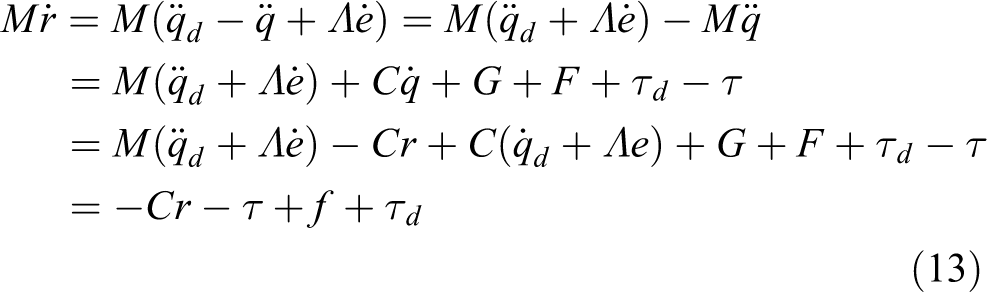
where the uncertain nonlinear function f can be expressed as follows

The control inputs of the sliding mode controller are defined as follows

where
Design of RBFNN controller
RBFNN has good properties of approaching arbitrary nonlinear functions and expressing the inherent law of the system. 21 Therefore, RBFNN is appropriate to compensate for the modeling errors of the LuGre friction model. The function of RBFNN chooses Gauss function as the basis function, thus the ideal algorithm of RBFNN can be expressed as follows 22

The output function of the neural network is described as follows

where ci is the center of the Gaussian function, σi is the width of the Gaussian function,
Assuming that there is a constant weight value W, the uncertain nonlinear function f in equation (14) can be estimated using the following output function of the neural network

where h denotes a suitable basis function,
The estimated value of neural network in equation (18) is defined as follows

where
The RBFNN can be used not only to compensate for the uncertain nonlinear function but also to evaluate the three parts of the LuGre friction model. Thus, the RBFNNs are designed to evaluate the three components of friction F0, F3, and F4 and the sum of four matrices Ff

According to equation (15), the control law of the neural network is designed as follows

where
Substituting equation (21) into equation (13) yields the following closed-loop error dynamic equation

where
The adaptive laws of the four adaptive neural network controllers are designed as follows

Proof of convergence
Theorem 1
If the ideal trajectory q,

where
Proof
Lyapunov function is defined as

where F represents a positive definite matrix.
Differentiating L of equation (25) results in

Substituting equation (22) into equation (26), one can get

Then, by considering property 2 and the fact that

where
Let
Therefore, we can draw a conclusion that the tracking error r and the tuning weight error
Theorem 2
The control input is designed as follows

Then, the sliding mode controller in equation (15) and the adaptive laws in equation (23) can guarantee a consistent final boundedness of the control system.
Proof
Lyapunov function is defined as follows
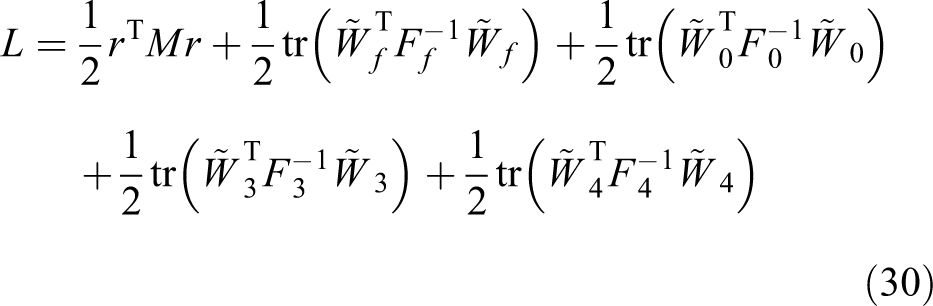
Differentiating L along the tracking error equation (13), the following equation can be obtained as follows

Substituting equation (13) into equation (31) yields

Substituting the adaptive laws (23) into equation (32) can obtain the following equation

Then, by considering the fact that
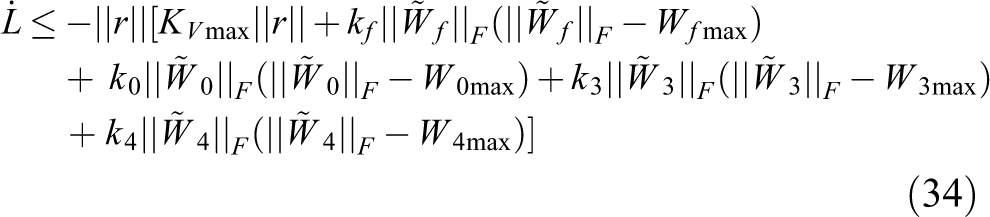
We can also observe that
Using Theorem 2, it can be seen that the tracking error converges, and all the solutions are also bounded.
Simulation results and discussion
A two-link planar robot manipulator and a two-stage inverted pendulum are applied to validate the effectiveness of the adaptive block compensation trajectory tracking controller.
Control of two-link planar robot manipulator
The dynamic equation of the two-link planar robot manipulator is given as follows



Numerical simulations are performed to evaluate the trajectory tracking control performance of the proposed controller. The idea behind these simulations is to force the proposed controller to track a desired trajectory sin(t) and t2. The parameters in the dynamic model are picked as
Case 1
The traditional proportional derivative (PD) controller is used to control the two-link planar robot manipulator. The tracking positions illustrated in Figures 2 and 3 show that large errors exist between the desired trajectory and the actual datum. The actual position has noticeable ups and downs that are mainly caused by model errors and friction terms. The total simulation time is designed as 10 s. The position tracking errors displayed the first 2 s and the total 10 s to effectively show the transient and steady-state responses. Figures 2 and 3 show that the tracking position errors of the traditional PD controller have a tendency to deteriorate. Thus, the traditional PD controller is not suitable for the robot manipulator with uncertain dynamics.

Position tracking control for two-link robot manipulator when input function is sin(t): (a) first joint and (b) second joint.

Position tracking control for two-link manipulator when input function is t2: (a) first joint and (b) second joint.
Case 2
Adaptive block compensation trajectory tracking control with model error compensation is applied to the two-link planar robot manipulator. The model errors and friction terms are the same as in case 1. The green curves in Figures 2 and 3 illustrate the tracking position of the proposed controller including the model error compensation. Compared with the traditional PD controller in case 1, the tracking position errors in transient and steady state in case 2 are remarkably reduced. The reason is that the model errors are reduced by the model error compensator. However, it is noteworthy that unavoidable large error between the actual and desired trajectories in case 2 still exists. Thus, many additional compensators should be appropriately designed and embedded into the proposed controller to eliminate these unknown uncertainties.
Case 3
Adaptive block compensation trajectory tracking control with model error and friction compensation is applied to the two-link planar robot manipulator. As can be calculated from the data shown in Figure 2, the position errors of the two joints in case 2 are 0.0013 mm and 0.0042 mm, whereas their corresponding values in case 1 are 0.045 mm and 0.057 mm. The comparison results demonstrate that the position errors in case 2 are sharply smaller than those in case 1. The results confirm that the adaptive block compensation trajectory tracking controller with model error and friction compensation eliminates uncertainties.
To verify the adaptive ability of the algorithm, this article performs simulations about the approximation effect of the uncertainty term f under the action of RBFNN. As can be seen from Figure 4, the simulation data of the proposed controller with model error and friction compensation of fn can quickly estimate the desired term f.

Approximation results of neural network when input function is (a) sin(t) and (b) t2.
Control of a two-stage inverted pendulum
In the case of the small swing angle (<5°), the linearization model of the two-stage inverted pendulum can be described as follows 23 –27
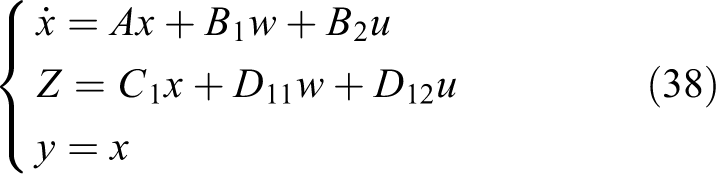
where
The initial state of the two-link planar robot manipulator is selected as x(0) = [0, 0, 0, 0, 0, 0]T. Numerical simulations are performed to evaluate the trajectory tracking control performance of the proposed controller and the traditional PD controller. The idea behind these simulations is to force the proposed controller to track a desired trajectory sin(t).
Case 1
The traditional PD controller is applied to the two-stage inverted pendulum. Numerical simulation results of the tracking position under the actions of the traditional PD controller are illustrated in Figure 5. It can be seen that the tracking position errors tend to deteriorate, and especially the positions of the y4, y5, and y6 are off the track. Hence, some compensators should be appropriately designed and embodied into the traditional PD controllers to reduce the effects of uncertainties.

Tracking position of traditional PD controller when the input signal is sin(t). PD: proportional derivative.
Case 2
The proposed controller with model error and friction compensation is applied to the two-stage inverted pendulum. Figure 6 illustrates the tracking position of the proposed controller with model error and friction compensation. The simulation results demonstrate that the proposed controller tracks the desired trajectory extremely well and also reaches convergence rapidly. Furthermore, the position tracking ability shown in Figure 6 clearly demonstrates the advantage of the proposed controller over the traditional PD controller. Therefore, a conclusion can be drawn that the proposed controller provides the best control efficiency and compensation ability compared with the traditional PD controller.

Tracking position of the proposed controller when the input signal is sin(t).
Conclusion
An adaptive block compensation trajectory tracking controller based on LuGre friction model is proposed. An adaptive neural network compensator is designed to assess the three parts of the LuGre friction model. A robust sliding mode controller is developed to reduce the influence of these estimation errors of neural network compensator and other uncertain disturbances and ensure that the system converges in a finite time at the same time.
The proposed controller guarantees that all the involved control signals in the control system are bounded and the trajectory tracking errors converge asymptotically to zero. Finally, simulation studies are conducted to verify the effectiveness of the proposed controller. Simulation results confirm the superiority of the proposed adaptive block compensation trajectory tracking controller with model error and friction compensation. In the future, a two-link robot manipulator will be applied to verify the effectiveness of the proposed control algorithm.
Footnotes
Declaration of conflicting interests
The author(s) declared no potential conflicts of interest with respect to the research, authorship, and/or publication of this article.
Funding
The author(s) disclosed receipt of the following financial support for the research, authorship, and/or publication of this article: This work was supported by Science and Technology Program of Shenzhen, China [grant no. JCYJ20170818114408837].