



Abstract
Different biometric methods are available for identification purpose of a person. The most commonly used are fingerprints, but there are also other biometric methods such as voice, morphology of ears, structure of iris and so on. In some cases, it is required to identify a person according to his/her biomechanical parameters or even his/her gait pattern. Gait is an outstanding biometric behavioural characteristic that is not widely used yet for identification purposes because efficient and proven automated processes are not yet available. Several systems and gait pattern databases have been developed for rapid evaluation and processing of gait. This article describes an original automated evaluation procedure of gait pattern and identification of unique gait parameters for automatic identification purposes.
Introduction
Currently, the preferred biometric techniques are fingerprints, iris scans, voice imprint, analysis of ears and face morphology, and motion analysis, which are some of the newest methods. 1 Biometrics can be used as a method for authentication, which is based on the measurement of physiological data or properties in relation to the behaviour of a person. 2 Behavioural characteristics are the characteristics that are very stable, and it is very difficult to change them intentionally because they are produced as a result of multiple inputs of conscious and subconscious activities such as voice colour, style of speech, body and movement of its parts during walking, writing style and signature. 3,4 The advantages of those characteristics are universality, existence in all humans and uniqueness, allowing for differentiation between individuals, which securely distinguish one person from all others, and the overstability of the characteristics is maintained during the aging process.
There are several approaches to the identification of persons based on their gait. Two main approaches are (a) identification based on the examination of the body silhouettes 5,6 while walking and (b) recognition of walk based on automatic analysis of the video frames. 7 The second method analyses trajectories of joints and angles over time from video recording of a subject’s walk. Accordingly, the mathematical model of movement is created and then compared with other samples in order to determine their identity.
The determination of movement patterns that can reliably connect records of closed-circuit television cameras installed in interior or exterior environments with records stored in the database is still a major challenge. 8
The aim of this article is to create the movement pattern through which we would be able to identify an unknown subject using mathematical and statistical analysis of gait parameters and assign the uniqueness of a person’s gait to the existing entity. The proposed method assesses kinematic parameters of gait (angles and trajectories of individual body segments) in terms of the possibility to obtain appropriate information for identification of the person. The result should be a ‘gait formula’ suitable for identification purposes.
Experiments and methods
The laboratory-based measurements were done with 10 people, 5 males and 5 females, labelled persons F1–F5 and persons M1–M5, respectively. The individuals simulated regular walking conditions, and we recorded gait parameters for 10 gait cycles of each individual. Gait cycle is an event from the heel strike of one foot till the heel strike of the same foot on the mat. We captured trajectory and angle changes using a 6-camera optoelectronic system for gait analysis(SMART; BTS Bioengineering, Italy). The method uses passive reflective markers that enable to record just a set of significant points distributed on the human body without recording the full body details.
Reflective markers have been placed on the human body at 25 selected points that are moving when walking. The placement of markers is shown in Figure 1.

Model of markers placement on the human body in SMART software.
For detection of the correlation of gait parameters of two individuals, it is necessary to compare multiple parameters. The task was to select the combination of parameters that show the slightest difference in the intra-individual comparison and the greatest difference when comparing inter-individual variability. The aim was to select the most relevant parameters for the identification of the individual and to reduce the number of evaluated parameters. Based on this consideration and the results described in the study by Dolná, 9 we chose the following 10 trajectories from the 25 measured: the right elbow, right and left wrists, right thigh, left and right knees, right and left elbows and right and left ankles. These 10 selected trajectories were statistically evaluated to obtain the mean value from 10 repeated measurements of each angle trajectory for every selected marker for every subject. The multicriteria analysis was used for the synthesis and transformation of values.
Selection of parameters
To evaluate the differences, we searched the maximum and minimum values during the gait cycle in the plotted waveforms and calculated their differences and distances (Figure 2). We then compared those differences with the average trajectory of the gait cycle.

Maximum and minimum values with calculation of distances for left ankle, one gait cycle.
From the determined maximum and minimum values as well as from their differences, we obtained the following information: Length of the vectors that are time and spatial dependent; Slope of the trajectory and step changes in the implementation of targeted movement; and Movement speed in the restricted area.
Some parameters have specific curves where the graph contains two maximum values and one minimum, one maximum and two minima or when the angular characteristics have a trajectory course with two maxima and two minima. In these cases, we created the so-called embedded database with value differences.
Multicriteria evaluation
The aim of all multicriteria evaluation methods is to synthesize and transform different values of variables into one integral indicator that comprehensively indicates the adherence of individual objects into the examined group. 10
For multicriteria evaluation, we first defined weights for all variables by comparing changes in the coefficient of variation. The weight is the result of dividing the sum of all the coefficients of variation by the particular coefficient of variation of the analysed parameter. These values are sorted from the largest to the smallest, from the most important parameter to the least important one.
We rescaled the differences between variables of the evaluated subject (one gait cycle) and the averaged gait cycle as

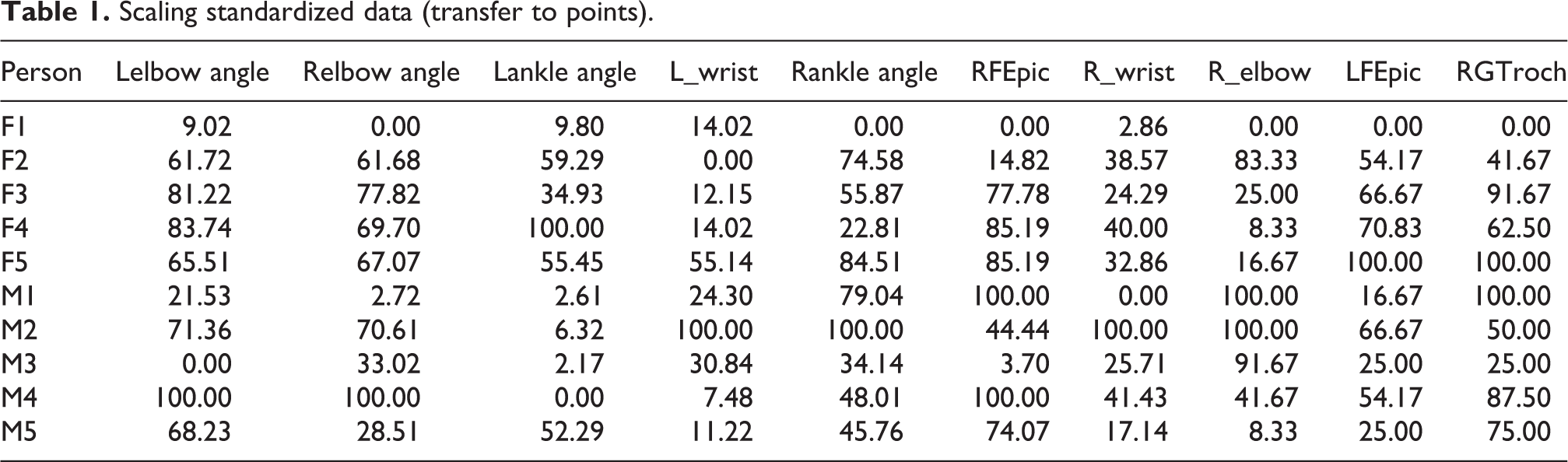
To biometric data, converting to zero (with a downward trend), is assigned the lowest score, while to the largest data (with upward trends) is assigned to the rating approaching the upper limit of 100. For zero value, the examined parameter does not differ when we compare it with representative database in which biometric data of all subjects are stored. Based on the data in Table 1, we can determine the weighted rank arising from the variability of the variables (features) and determine the degree of compliance that is critical for assigning the identity of an unknown entity.
Scaling standardized data (transfer to points).
Motion formula for identification
As part of this work, we created two representative databases. Table 2 represents one of the databases consisting of parameters that had the highest compliance with intra-individual comparing for one person. RFEpic2 are parameters whose trajectory showed a second maximum or minimum, and for these parameters, we used the embedded database with value differences.
Database of the selected parameters for 10 subjects.

Using the multicriteria analysis described in the previous chapter, we obtained and verified results for the identification of a specific person from the database of all 10 people. The following tables show results for the identification of person F1 (Table 3) and person M2 (Table 4). The yellow cells represent 100% compliance parameters (joint motion feature) between the examined subject and identified existing entity. Red cells contain critical values (high variability) to assign identity of the object in the given parameter. Every critical value of individual motion parameters of multicriteria analysis increases the result value for assigning person’s identity, and thus unwanted distortion of the identification results for intra-individual comparison is achieved.
Results of identifying the person F1.
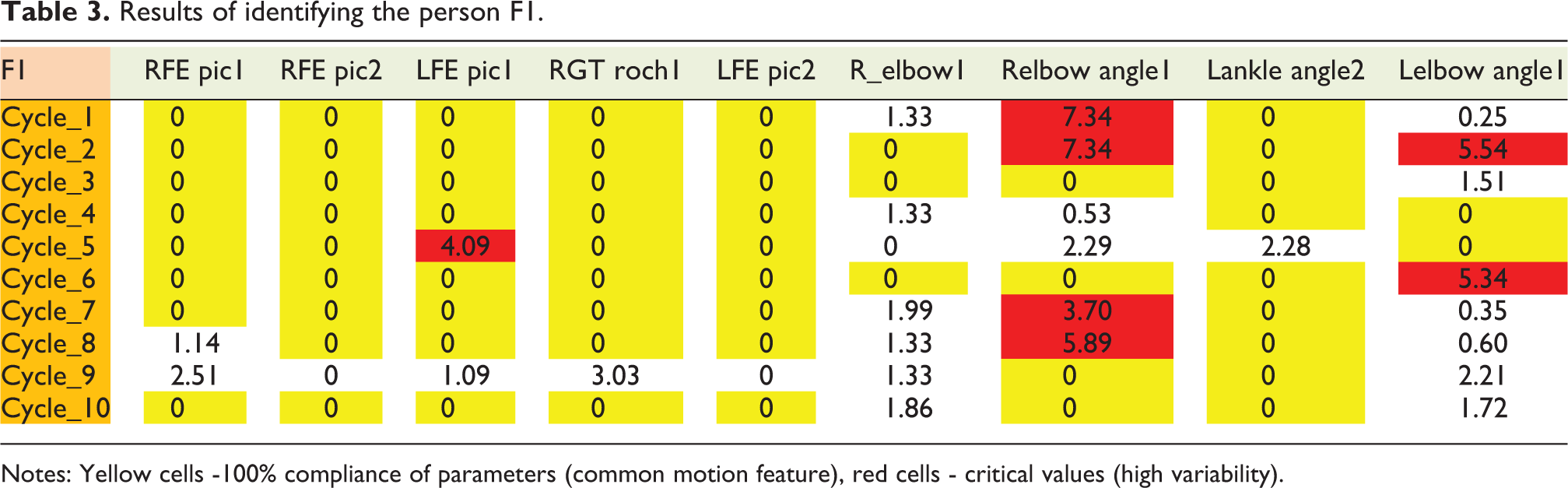
Notes: Yellow cells -100% compliance of parameters (common motion feature), red cells - critical values (high variability).
Results of identifying the person M2.

Notes: Yellow cells -100% compliance of parameters (common motion feature), red cells - critical values (high variability).
Both tables contain parameters for unknown subjects that were used to correctly identify them within the group of 10 individuals. Comparing the tables, however, we can see the diversity of the significance of individual parameters for the identification of individuals. While a RelbowAngle1 parameter (angle right elbow) is the least suitable for F1 subject for the assignment of identity, this parameter appears to be the most significant for subject M2 for the identification purposes. This confirms that the movement features most accurately reflecting the identity of the subject differs from person to person.
Conclusion
Walking has many specifications that are on one side useful for the identification of an individual but on the other side it is difficult to automate the processing of identification or verification. The proposed statistical method was effective. We were able to identify a subject within the database of 10 individuals with 95.92% success rate. Therefore, we can conclude that the chosen method is suitable to distinguish people on the basis of selected walking parameters and assign a particular individual identity. However, it is important to note that this methodology does not identify the significance of one or a group of parameters for the surveyed subjects, which would be relevant for the identification process. The research results point to the fact that each subject is identifiable by a different number and/or combination of parameters from the 10 parameters stored in the database.
Our continued research will concentrate on the expansion of the gait patterns database aiming to identify the best group of parameters allowing the creation of a robust and reliable model of the movement patterns for the identification process.
Footnotes
Declaration of conflicting interests
The author(s) declared no potential conflicts of interest with respect to the research, authorship, and/or publication of this article.
Funding
The author(s) disclosed receipt of the following financial support for the research, authorship, and/or publication of this article: This work has been supported by the Slovak Grant Agency VEGA Contract Nb. 1/0911/14 “Implementation of wireless technologies into the design of new products and services to protect human health”.