




Abstract
This article introduces the successful methodology adopted for the realization of the Brazilian Robotics Olympiad. Organizational and scientific issues are presented and discussed as well as results of statistical surveys performed with participants that verify the benefits brought by this robotics Olympiad. The Brazilian Robotics Olympiad is a nine-year-old nation-wide initiative created with the mission of promoting robotics among Brazilian students with or without previous knowledge of robotics, fostering their interest to engage in science, technology and engineering studies and careers. The Olympiad is fully free for participants, being annually organized by hundreds of volunteers from several Brazilian universities. It is divided into practical and theoretical components with several levels, each one designed for a certain student age. More than 300,000 students have already participated in the Brazilian Robotics Olympiad and, according to 58% of these students, the Brazilian Robotics Olympiad helped them to decide which university course to pursue.
Introduction
The Brazilian Robotics Olympiad (OBR – http://www.obr.org.br/) is an initiative started in 2007, created by a team of several university professors with the main objective of promoting robotics and technology in the Brazilian (elementary and high) school system. The philosophy and the methodology of the OBR are designed to attract students with or without previous knowledge of robotics, intending to engage them in science, technology and engineering studies and careers. Participation in the Olympiad is free of any charges and registration fees, both for schools and students, being organized for the last nine years by volunteers from several top Brazilian universities together with representatives from the private and public schools that participate in the OBR. OBR activities are divided into two modalities, practical and theoretical, each one with levels that are designed according to student grades and/or knowledge. It is worth noting that the theoretical exams are designed to give knowledge and contextualization about robotics and related disciplines to the students, rather than merely being a tool for assessment of their own knowledge of robotics. Currently, OBR records show that more than 300,000 students have participated in the nine events. According to 58% of these students, the OBR has influenced them in the decision of which career to pursue at university. Besides this and other analyses of experience and results, this article describes how the OBR is organized, including its scientific and technological issues, and presents results of statistical surveys performed with past and present OBR participants, showing the benefits brought by the robotics Olympiad.
In complement or jointly with educational robotics, robotics competitions are known to be exciting and a motivational tool for helping students to learn how to solve problems in a more practical fashion. As said by Ayorkor Korsah and Ken Goldberg, founders of the African Robotics Network, “Robots excite people of all ages. Their physical behavior often inspires primary and secondary student interest in computers, science, math, and engineering more broadly.” In fact, several studies have proven the effectiveness of using robotics in education as a tool for more interesting and motivating classes, which offers a unique learning experience. 1 –8 Moreover, Alemany 9 argues that courses involving robotics significantly increase the number of enrolled students. Another advantage of using robotics in education is the improvement of students’ creativity and problem solving skills. In fact, Varnado 7 conducted a study with 9–14-year-old students enrolled in the FIRST LEGO League Robotics Competition and observed a significant increase in the confidence of such students and in their problem solving styles in eight weeks. Another positive aspect of robotics competitions is that it not only attracts students but also motivates teachers, parents and tutors. 10
In the specific case of the OBR, reports obtained from unstructured interviews with teachers and parents show that participation in the OBR makes students more persistent, creative, polite and helpful. Furthermore, year after year, parents and teachers enthusiastically watch the participation of their children and students, vibrating, cheering and even crying by seeing their pupils’ robots in the arenas. Also, as Brazilian scientific societies promote other knowledge Olympiads such as the Math Olympiad and the Biology Olympiad, among others, all typically dealing only with theoretical knowledge, teachers and parents argue that the OBR is the only Olympiad that allows them to interactively participate by watching and cheering for their teams.
Although the last OBR event had 100,000 participants, its organizing team is small thanks to a web-based automated system developed to manage all aspects of the Olympiad. This software is called the “Olimpo System” (http://www.sistemaolimpo.org/) and it allows teachers and students to register for the event, regional and local coordinators to control their activities, and certificates to be automatically assigned and sent to participants across Brazil. In this way, it should be noted that the OBR relies on only two paid employees (a manager and a secretary) and that all other organizers are volunteers. Strategic decisions are made by a superior council that is composed of OBR founders and former coordinators, which every two years appoints a general coordinator who can select auxiliary coordinators (general vice-coordinator, theoretical exam coordinator, practical exam coordinator and pedagogical coordinator).
Another important milestone that has enabled the growth of the Olympiad is the wide range of documents created during the 2012 event, which are continuously updated. These manuals are available at the OBR homepage 11 and allow participants, regional coordinators, state coordinators and teachers to easily learn organizational and functional aspects of the OBR, reducing email exchanging and subjective interpretations. Examples of current manuals or guidelines that are available are: a study-guide manual for the theoretical exam, question elaboration guidelines for the theoretical exam, rules and a manual for the practical component, a regional event preparation manual for coordinators, and a referees manual.
The OBR is promoted by the organization team each year by distributing banners and letters to around 20,000 Brazilian schools. The list of schools is provided by the Brazilian Ministry of Education. This informative material basically describes the OBR, the enrollment rules and the modalities. Moreover, on-line manuals and guides are provided to help the students to prepare themselves to participate either in the theoretical exam or in the practical component. Professors are responsible for registering students for the Olimpo system and for preparing them for the Olympiad. Each school is free to select the component that each student will participate in, and there are no limits in the number of students and participating teams from each school. Some schools even create extra classes for preparing students for the OBR and for studying robotics. The OBR organization also publishes a periodical magazine called “Robotics World” (Mundo Robótica – in Portuguese), 12 which contains testimonials, information, technical tips and lots of other robotics and OBR-related information.
The OBR theoretical component
The OBR theoretical exam consists of a series of written tests that are prepared by a commission of robotics professors and teachers all over the country. Six levels of written tests are prepared and distributed according to Brazilian school grades. Level 1 is for six-year-old children enrolled in the first grade of elementary school, while level 6 is for students in the last year of high school (generally 17 years old). Figure 1 shows the exponential growth of the number of participants of the OBR theoretical exam.
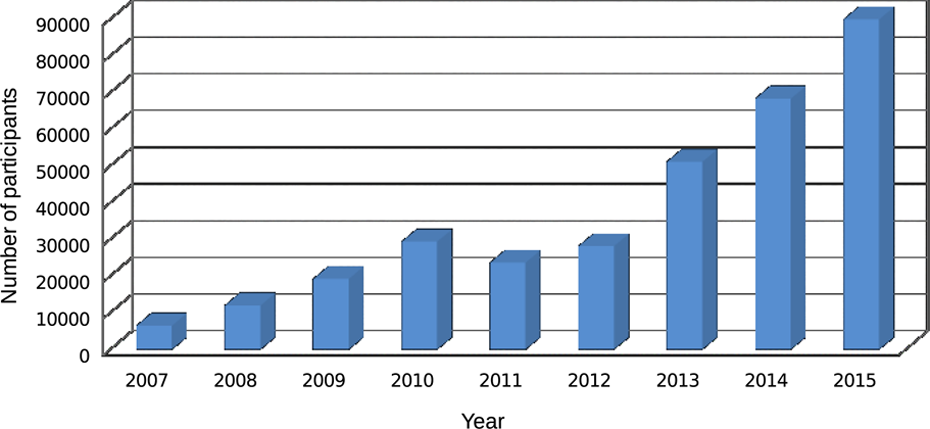
OBR theoretical exam participants since 2007.
The preparation of the exams is done with the support of the Olimpo System. Firstly, teachers and professors of more than 1500 Brazilian schools and universities are invited to propose questions through a module of the Olimpo System. 13 The OBR’s question elaboration manual, which is formulated based on the Brazilian “National Curriculum Parameters” (PCNs), provides pedagogical guidelines for this cooperation. The PCNs are the official guidelines from the Brazilian Ministry of Education defining the contents that should be taught at each school grade. The OBR organization team selects multidisciplinary contents every year from the PCNs in order to propose robotics questions that are related to or that apply the concepts taught in the classroom. This model allows students to realize that what they are learning at school (i.e. math, science and languages) can be applied to solve real world robotics problems. More than that, by using this model, novelties, concepts and contents that are intrinsic to Robotics can be passed to the students through the question rubrics, thus making the exam a way for students to learn robotics facts and concepts. Figure 2 illustrates a sample question of the 2014 OBR theoretical exam written for level 2 students (7–8-year-old children). Other examples of theoretical questions and further discussion of the theoretical tests can be found in the work of Colombini et al. 6

OBR Level 2 theoretical component exam: example of question applied in 2014. The correct answer is (b).
From the questions cooperatively provided by volunteers in the Olimpo System, selected questions are then revised by a pedagogical team, and the six different exams are prepared. Exams are mostly composed of multiple-choice questions and each test is designed to have 25% easy-difficulty questions, 25% complex-difficulty questions and 50% medium-difficulty questions. As said above, to avoid frustrating students, and with the intent of spreading the notion of robotics, several questions present a low level of difficulty, allowing students to obtain a minimal grade and to get some knowledge from them.
The operational model that has being successfully used in the last years is to send printable files of the exams to a pivot person in all registered schools. The schools, through their representatives, are responsible for administering and correcting the exams, occurring all over the country on the same day at the same time. On the following day, a correction template is sent to the registered teachers to correct the tests and to upload the results into the Olimpo system. Finally, the OBR coordination establishes the ranks of students and states. As the exams are administered and corrected at each school by their own staff, logistical costs for the OBR organization and for the schools are reduced.
All students and teachers automatically receive certificates of participation. Gold, silver and bronze medals are awarded to the best students of each school, to the best students of each state and to the nation-wide best students. Selected students with the best grades in the theoretical component that have never had contact with any robotics kits are awarded with a free-of-charge hands-on robotics course that is annually offered during the OBR national finals of the practical component. Historically, students with the maximum grade range from 0.22% to 1.7% of the total number of participants. Since 2007, about 10% of registered students have been awarded medals annually, meaning a distribution of about 6000 medals (reference from 2014) for the theoretical exam. Figure 3 shows the students’ grade distribution for all OBR events.

OBR theoretical exam grade distribution including all OBR events up to 2014.
Although the growing number of participants evidences an increasing interest of both schools and students in the subject, the performance observed in the theoretical exams is still below the desired level. Since more than 70% of students are not able to exceed 50 points, some aspects on multidisciplinary and application development skills should be revised and worked out at schools. We remark that this in an important result that can only be observed through a multidisciplinary Olympiad such as OBR. Thus, it is important to emphasize that the exams only have questions based on the contents taught to each grade.
The OBR practical component – RoboCup junior – Rescue mission
The OBR practical test is based on the RoboCup (C) Junior rescue mission, 14 which consists of a simulated disaster environment where teams of up to four students must build fully autonomous robots to rescue victims. The task consists of building a rescue robot that must follow a safe path (black lines on a white surface), avoid debris (obstacles), overcome gaps in the black lines, pass through speed reducers, go over a mountain (climb a ramp), identify the victims (5 cm diameter balls) and rescue these victims, taking them to a safe place.
Due to the large interest and number of participating teams of Brazilian students, the OBR practical component is divided into: regional phase, state phase and a national finals phase. São Paulo state alone, for example, had more than 550 competing teams in this component (2200 students) for the year 2015. There are no restrictions to teams regarding their robots; any kind of materials, components, processors and solutions can be used. The only restriction is that all the design, assembly and programming has to be done only by the students. Teachers are allowed only to give directions and to help resolve doubts of the teams. Figure 4 shows an example of an OBR rescue arena and Figure 5 shows the competition environment (photos of a regional phase of 2014). The arenas’ lines configuration, obstacles and other aspects are not known by the teams before the competition starts.

Typical OBR arena used at a regional level in 2014.
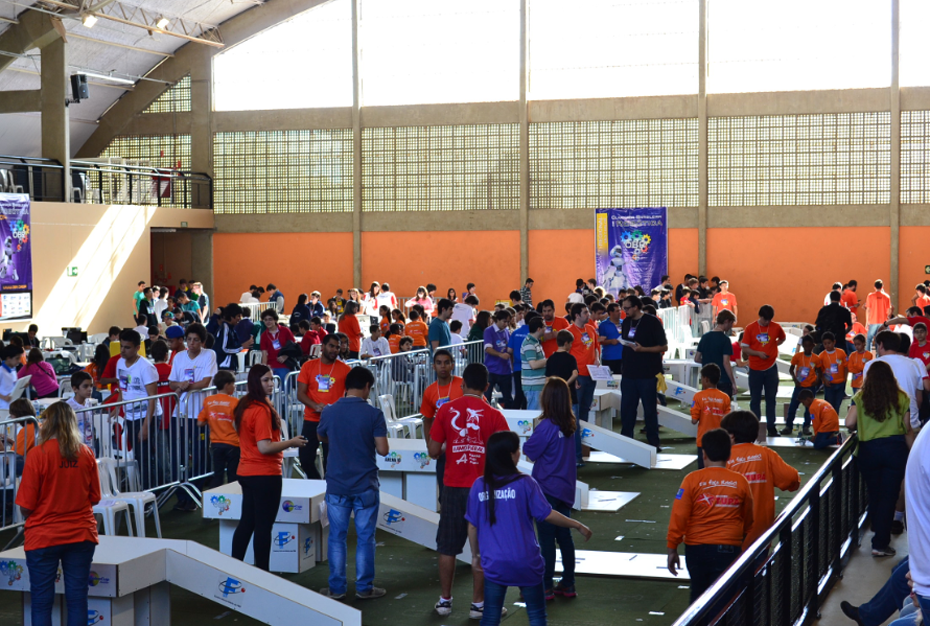
Typical OBR practical component event environment. Photo of the São Carlos-SP regional event in 2014, in which 89 teams participated.
In order to develop a rescue robot, students must work hard to learn several aspects of robotics, physics, and electronics, among other subjects. Several sensors are needed, and a good mechanical design is also required to avoid the robot’s wheels slipping or to becoming blocked in speed reducers. Sensors must be used, adapted or even invented to detect obstacles, the lines and the victim. In the 2015 rules, additional color sensors are also needed to detect the turn direction on crossings.
The robot programming gives the final aspect of the autonomous rescue robot. Students commonly start by using block based programming tools available on commercial robotics kits, and it is notable that, as students advance with their robot design skills, they adopt procedural programming languages such as C++ and rebuild the control systems using Arduino boards, smartphones or other embedded processors.
The practical component is divided into two levels: 1 and 2. Level 1 is for elementary school students and level 2 is suited for high school, with a restriction that students of up to 19 years can participate. The main difference is that, at level 1, the robot must only identify one victim, while for level 2, the robots must identify and rescue one or several victims. For level 1, color sensors to detect turn directions are also not needed.
In 2015, there were 2533 teams registered in the practical component. These teams were first divided into state regional phases and the best ones were selected for the state phase. As mentioned previously, São Paulo state had 550 enrolled teams, so seven regional phases were needed in this state to select the teams to represent the state in the national finals that occurred in October. Each regional event is organized by a volunteer regional coordinator, several referees and other volunteers for the event such as secretary, security, sound, first aid, and others. It has been noted over the years that undergraduate and graduate students really enjoy acting as referees, so finding volunteers is usually not a problem for the organization. One interesting observation is that, often, several teams do not show up in the practical component regional phases. This happens due to the free enrollment cost, and the absence varies from 12% to 30%, depending on the state. Well-organized regionals have lower absence rates. In addition, no punishments are imposed on teams that miss the competition. After the nationals, the best teams are selected by the Brazilian RoboCup Committee (trustees) to represent Brazil in the RoboCup Junior international competition.
A survey about the OBR
Over the years, it became clear that the educational and social benefits brought by the OBR are positive. The important aspects of the OBR are not the competitions themselves, but the development brought during the preparation tasks, the motivation, the confidence and other skills developed by the students. Although about half of the participants are from private schools with plenty of financial resources, several social initiatives around the OBR promote educational robotics courses and workshops with low-income schools and students in developing regions. These students are commonly enrolled in schools and environments with very limited and struggling resources and many of them have no future aspirations, and do not even aspire to technician undergraduate jobs or graduate level jobs. However, when these students have the opportunity of participating in the OBR and have robotics classes in their schools or communities, they realize that they could and that they are capable of pursuing and looking forward to better qualified jobs and careers. In unstructured interviews, students in such situations affirmed: “I never thought I could build a robot by myself” and “Building a robot is like a dream”. Moreover, it is known that several students in the mentioned situation are now enrolled on professional undergraduate technical courses, such as electronics, mechanics and computing, or even preparing for university admission tests. In its ninth year, the event has many former participants that are already pursuing graduate level studies or have even graduated from good universities.
Teachers also report that preparation for the OBR practical component notably drives an increase of responsibility in the students and in their problem solving skills. It also reduces students’ evasion, and many students became more helpful in daily school activities. Some teachers also state that they select students with bad grades, bad behavior and ones that frequently miss classes to prepare robots for the OBR. These teachers report that they have observed considerable improvement in the mentioned bad habits and behaviors from these students.
The notable positive results of using robotics in the classroom are also leading the Brazilian government to invest more and more in educational robotics for public schools. Many public schools have received dozens of robotics kits from the government or are receiving Arduino-based robotics kits. As a developing country, Brazil has huge social inequalities, including in education. Although digital and social inclusion are not the main goals of the OBR, these results have been noted over the years as indirect consequences of OBR activities. Furthermore, since 2015, the OBR has had an official extension program for such kinds of activities. These extension activities are currently focused on promoting robotics in states in which most students had never had contact with robotics, or with particularly low student performance in the overall country average.
In order to quantitatively assess OBR results for the students, an on-line survey was conducted by sending one email request to teachers and a different one to students asking them to answer some on-line questions. Although more than 300,000 distinct students participated in all OBR events, the request was sent only to randomly selected students with valid emails in the Olimpo system. In that way, the request was sent to 4628 teachers (389 teachers answered the questionnaire) and to 30,580 students (536 students answered the questionnaire). With an average age of 15.6 years, 92% of the students who answered the questions were between 12 and 18 years old and the remaining students were younger. About the schools, 48% of the participants of the survey studied in public schools while 52% studied in private schools and 47% of the students were already enrolled on some professional/technical training course.
The validation of the samples presented on this article is based on a confidence level of 95% both for teachers and for students and with a margin of error of ± 4.6% for teachers and ± 4.2% for students.
OBR participation by regions can be seen in Figure 6, which shows a map view of cities that have students participating in the OBR. Brazil has 5570 cities, from which 2350 have OBR participants. The southeast and northeast regions have states with most representative participation: 38% and 36% respectively. Specifically, São Paulo state accounts for 26% of all participants, followed by Ceará (9.59%), Pernambuco (7.33%), and Paraíba (5.25%). One clear difference in these states is the existence of active coordinators and volunteers continuously visiting schools to promote the OBR or the existence of government supported educational robotics activities. Nevertheless, every year, more than 20,000 printed posters are sent to the Brazilian schools to publicize the OBR.
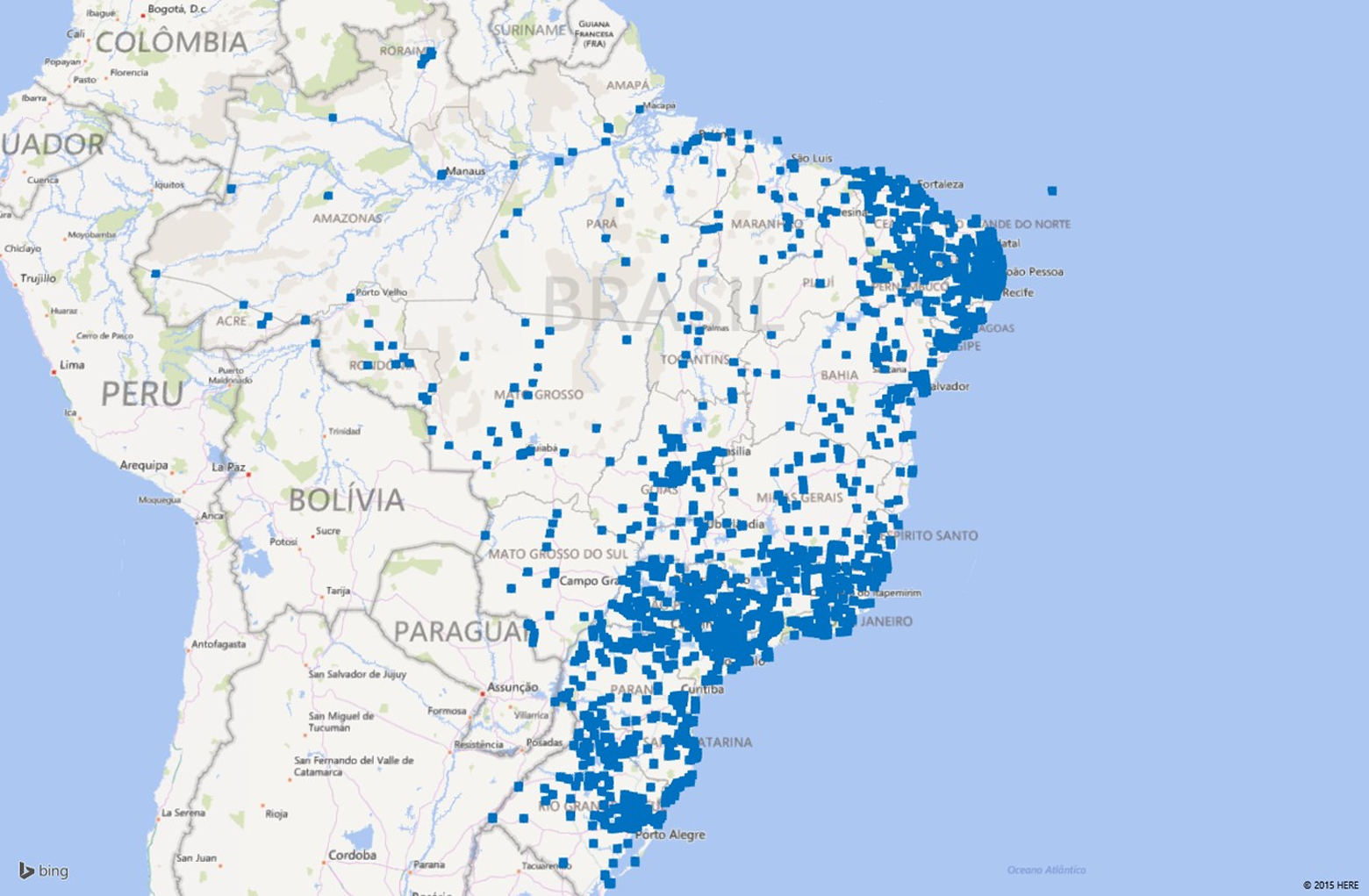
Map of Brazil with cities that have students that participated in past OBR events. Each dot represents a city with participants.
Figure 7 depicts the distribution of enrollments of girls and boys for each state. With the exception of Acre state, that has more girls than boys enrolled, all other states have more boys than girls. For the theoretical component test, grades are well distributed over the country, with average grades of 37.00 (standard deviation of 3.33) for girls and 37.08 (standard deviation of 2.74) for boys, including grades in the range of 0 to 100. However, within each state there are notable variations in grades; the smaller standard deviation of all states is 21.97 and the largest standard deviation is 27.06. It is interesting to note that both the participation and the grade distribution between girls and boys reflects gender equality in interest and performance, despite what is usually expected for technological areas.

Girls’ (red) and boys’ (blue) participation over Brazilian states. On average overall, boy’s enrollment rates are only 17% higher than girls.
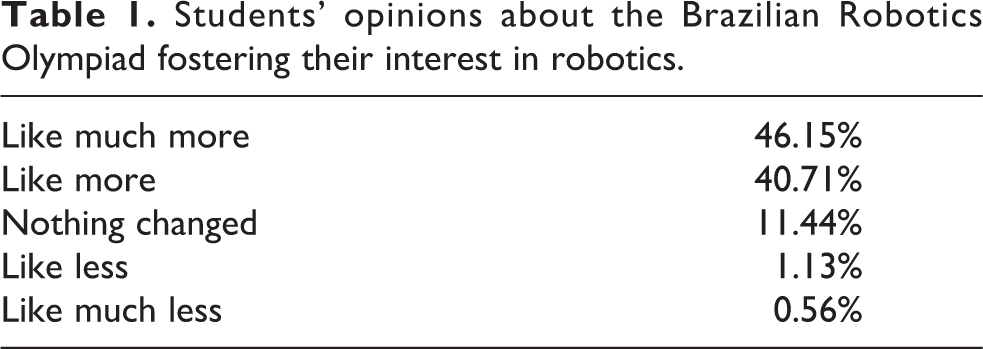
As previously mentioned, the OBR aims to motivate students to follow Science, Technology, Engineering and Mathematics (STEM) courses and careers. To verify possible results of such goals, students were asked whether the OBR helped them to decide which career to follow. Of the students that answered the survey, 58% stated that the OBR helped them to choose their graduate course, and 99% of the students that are already enrolled in a university course affirmed that they are doing STEM courses. Students were also asked whether the OBR made them like robotics and technology more or less. Tables 1 and 2 depict students’ opinions for such questions. Similar questions were asked of teachers, and their answers are shown in Table 3. For the teachers, these questions had multiple-choice answers, and participants could select none, some or all options, hence the sum of answers can be greater than 100%.
Students’ opinions about the Brazilian Robotics Olympiad fostering their interest in robotics.
Students’ opinions about the Brazilian Robotics Olympiad fostering their interest in technology.

Teachers’ opinions about the Brazilian Robotics Olympiad results for their students.

Another question of the survey asked students what they liked most about the OBR. Students could select only one option out of the questionnaire, and results are shown in Table 4.
Students’ distribution of answers to question “What do you like more on OBR?”

Teachers were also asked to select none, some or all behavior aspects that they think improved in students due to participation in and preparation for the OBR. This question was asked for both the theoretical and practical components. Results are shown in Table 5. Once again, teachers could select none, some or all options.
Teachers’ opinions about the Brazilian Robotics Olympiad (OBR) students’ behavior improvements due to the OBR.
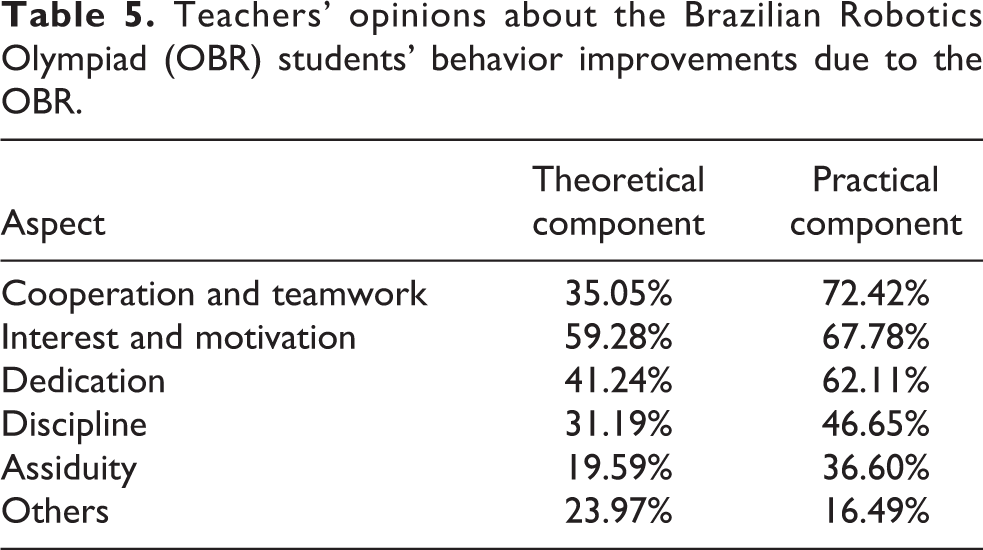
As shown in Tables 1–5, the OBR accomplishes its mission of awakening and stimulating interest in robotics and related fields and of promoting the dissemination of basic knowledge about robotics and technology through cooperative and interesting ways. According to the teachers that answered the survey, cooperation and teamwork are especially improved, as well as the motivation of students. Moreover, both students and teachers answers agree that participation in the OBR increases the interest of students in robotics and technology and makes them like these subjects “more” or “much more”. The participants profile also shows a similar amount of boys and girls participating in the OBR, which may point to a future with higher gender equality in science and technology careers.
Conclusion
The OBR has been created with the goal of promoting robotics among young Brazilian students, and year after year more students are involved all around the country. The theoretical component allows students to have their first contact with robotics using only the knowledge and skills they learn at school and without the need for any investment. It also helps students to perceive real applications of their studies. The practical component requires multidisciplinary skills and teamwork to build a fully autonomous rescue robot. Students enjoy each aspect of building their robots, and also teachers, parents and families commonly get involved following the developments, accompanying students during development, tests and the competition.
Surveys of students and teachers show considerable positive results in behavioral aspects of students who participate in the OBR, and as shown, the OBR helps students to decide more confidently which career to pursue. Gathered information also shows that the OBR helps students like robotics and technology more, while their teamwork skills are improved, especially by participating in the practical component.
Beyond social and digital inclusion as an indirect result, the OBR also created and continues creating market opportunities for companies and people. Basic robotic courses, robotics kits, high-school-level robotics materials, classes and other products are already available and are being more actively developed each time for students, teams and schools interested in the OBR.
The OBR is in its infancy and still has much to evolve, but future results are promising for fostering future engineers and scientists, and more importantly, more dedicated, interested, disciplined and collaborative people. While the robotics Olympiad grows up, even the poorest states have had exceptional participation of students with national highlights. We believe that the OBR and its main theme of robotics can change the country in upcoming years and make regions that today are technologically discredited into better developed places in the near future.
Footnotes
Acknowledgements
The authors would like to thank the Brazilian government and the societies that support the OBR. The OBR is an event organized by the Brazilian Computer Society (SBC), the Brazilian Automation Society (SBA) and the National Council for Scientific and Technological Development (CNPq). We also thank our administrative team, specially Luciana Piccinini and Susana P. Rocha. Finally, we acknowledge the help and enthusiasm of all OBR coordinators, volunteers, students, teachers, sponsoring companies and government agencies that makes the OBR a reality.
Declaration of conflicting interests
The author(s) declared no potential conflicts of interest with respect to the research, authorship, and/or publication of this article.
Funding
The author(s) received no financial support for the research, authorship, and/or publication of this article.