



Abstract
In the industrial and military sector, work activities are required transporting or supporting heavy loads manually, affecting this the human spinal column due to the weight of the loads or the repetition of this labor. In this regard, the use of force-enhancing exoskeletons is a potential solution to this issue. Therefore, this article summarizes the state of the art in relevant contributions to structural design, control systems, actuators, and performance metrics to evaluate the proper functioning of exoskeletons used for load support and transfer. This is essential to address current and new open problems in these applications, and this includes reducing the metabolic cost and enhancing the loading force in exoskeletons, in which challenges such as structural design and kinetic interactions between the human and the robot are presented. The systematic review of the strategies found in the literature helps addressing these challenges in an orderly way. The proposal of some alternative solutions could help to solving some of the challenges mentioned above, as well as further research to improve the design of these devices is necessary.
Keywords
Introduction
Automation and robotics have been continuously evolving in industry. Nevertheless, the human hand is still essential in certain manufacturing tasks. In some processes, workers must lift heavy loads, and this presents a risk factor. 1,2 The use of exoskeletons alleviates physical effort and offers an alternative to minimize risks to the spine. 3,4 Additionally, exoskeletons increase endurance and other capabilities when lifting loads and/or carrying objects or tools for prolonged periods over long distances. 5,6 Moreover, these devices can be used in aiding or assisting the elderly. 7
Recently, there has been an increasing interest in employing exoskeletons to reduce the physical effort on workers carrying out demanding activities in several occupational sectors as these devices may offer an efficient alternative to existing solutions. In this sense, these exoskeletons are referred to as occupational exoskeletons. 8
On the other hand, unlike a robot, an exoskeleton combines human intelligence and the strength of a machine. In the designing process of the control system, problems arise when combining the dynamics of the user with that of the robot since the user is part of the control loop of the device, and both must walk naturally; however, this represents a great challenge in engineering design. 9 –11
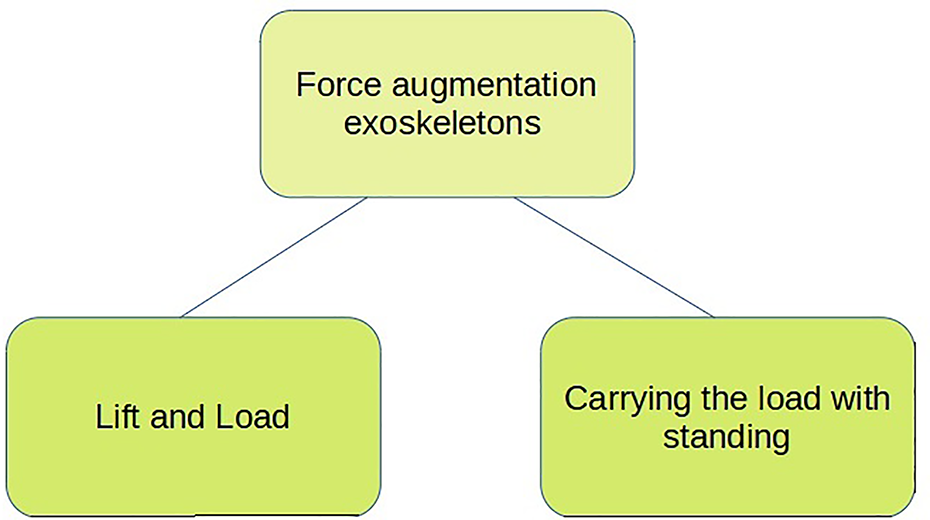
This article aims to provide an overview of the literature that contributions to force augmentation exoskeletons for extremity strengthening, and these contributions have been reported from 2005 to 2021. The review was conducted in journal publications, conferences, book chapters, and Internet sites. The keywords used in the search were as follows: “exoskeleton,” “load-carrying augmentation,” “payload capacity,” “wearable robot,” “augmentation exoskeleton,” “weight-bearing assistance,” “performance augmentation,” “occupational exoskeletons,” and “passive exoskeletons.” Studies of exoskeletons for medical applications were excluded, for example, those used for rehabilitation and assistance. 12 Only force augmentation exoskeletons such as those shown in Figure 1 were studied. That is, the exoskeletons under study are used for military applications and are employed by workers support and carry loads manually and perform repetitive tasks and those who maintain an awkward position while carrying a tool or holding a load for a long time. In this article, we refer to active, sub-active or quasi-passive, and passive exoskeletons. 5,13 –15 That is, we focus on the challenges related to hardware design and implementation of control strategies aiming to improve the kinematic interaction between the user and the robot. In the second section, we introduced the two types of exoskeletons to increase strength: exoskeletons that perform tasks such as rigid lifting and carrying objects and exoskeletons dedicated to carrying loads. Furthermore, some design aspects are addressed in the third section, and a classification of commonly employed control systems is presented in the fourth section. The fifth section demonstrates some ways to measure the performance of control systems, and the sixth section presents current challenges followed by the conclusions.
Exoskeletons for human force augmentation in support and heavy load transport activities or lifting objects from the ground.
Force augmentation exoskeletons
Lift and load
Soft exosuits are soft exoskeletons; in other words, they are exoskeletons that do not contain a kinematic structure and are wearable clothing-like devices that can generate moments around biological joints through cables acting in parallel to the action of muscles and tendons. These exoskeletons are generally passive, containing springs, shock absorbers, or spring-like elements to store and release energy in various phases of human movement during lifting loads. Some exoskeletons for lifting loads are mentioned below.
The Robo-Mate exoskeleton is light and portable, and it supports workers in the production industry in their manual tasks, mainly handling heavy loads. 16 Furthermore, the SPEXOR 17 project addresses the problem of low back pain and presents a passive exoskeleton (SPEXOR) that achieves a range of motion similar to that of a human lumbar spine of up to 60° in the sagittal plane. This exoskeleton consists of an elastic back support mechanism, a compensation module for hip misalignment, and a passive source of hip torque where each actuator can generate a supporting torque between 10 and 30 Nm, so the total maximum torque can reach 60 Nm (both sides). The authors conclude that to improve the design of exoskeletons, consideration should be given to disconnecting the device depending on the task performed; for instance, it should support the spine during loading tasks but allow full range of motion at the hip during unloading tasks. Furthermore, they conducted tests with male workers during which they had to raise and lower a 10 kg box from ankle height with and without the exoskeleton. The findings demonstrated that the metabolic cost was reduced by 18% while muscle activity decreased by up to 16% when using the exoskeleton. 18
Another passive exoskeleton to reduce low back pain was proposed by Wei et al. 19 : MeBot EXO. This exoskeleton aims to transfer forces from the lower back to the abdomen and leg pads to reduce the load on the back muscles when the users work. The authors performed tests to validate the effectiveness of the exoskeleton using experimental methods of sEMG and energy consumption, and they conclude that the workers exhibit lower muscle activity (35–61%) and lower energy metabolic cost (22%) when wearing the exoskeleton.
Furthermore, other similar passive exoskeletons that have been proposed and analyzed include the following: PLAD, 20 LAEVO, 21,22 and VT-Lowe’s exoskeleton. 23 LAEVO, Apex by Herowear, and the Auxivo LiftSuit exoskeletons are commercially available passive soft exoskeletons for frequent lifting and handling of objects below hip level or working in a forward-leaning position.
On the other hand, an active exoskeleton dedicated to reducing lower back pain is the one proposed by Wei et al. in 2020. 19 This device can help the muscles of the waist and the hip joint in reciprocating of semi-squat lifting movements, reducing lower back muscle activity while lifting, and reducing energy consumption in the reciprocating transport. The control system consists of a state machine, proportional-derivative torque feedback, a feed-forward action torque from inverse dynamics, and the power controller.
Additionally, another active exoskeleton was proposed by Koopman et al., 24 and it is a modified version (Mk2B) of the Robo-Mate project. This exoskeleton has a mass of 11 kg and uses two actuators aligned with the hip flexion and extension axis, both of which can generate a maximum torque of 20 Nm each. Moreover, it has three control modes: inclination (based on trunk inclination), electromyography (EMG) (based on forearm EMG), and hybrid (combining inclination and EMG). Other reported active exoskeletons are the following: iWear 25 and spine-inspired continuum soft exoskeleton. 26
Load transport with rigid exoskeletons
One of the first exoskeletons financed by the Defense Advanced Research Projects Agency (DARPA) for load transport in the military is the BLEEX, the first autonomously powered exoskeleton. The controller of this device is designed to minimize the interface between the human and the robot. However, a high computational cost and a large number of sensors are required because the control system is model-based and the parameters vary considerably. 27,28 On the other hand, Walsh presented a design that allows substantial energy savings because the torque of the knee joint is supplied by a low-power shock absorber; likewise, in the hip, he used a low-consumption actuator, called Series Elastic Actuator (EAS). Experimental tests demonstrated that the device directs 90% of the load to the ground through the structure. 29 In parallel, Low et al. presented an exoskeleton that can walk forward and backward. It places an additional degree of freedom between the waist and the trunk, and this allows the torque to be controlled through a linear electric actuator to keep the load in a vertical position and prevents it from falling on the user’s back. 30,31 Eventually, HULC emerged. HULC is an exoskeleton with amazing versatility for walking on uneven terrain and performing movements such as squatting and jogging 32 others. It is said to be an improvement of BLEEX. Unfortunately, its design has not been peer-reviewed and little information exists around its design. Table 1 describes other force augmentation exoskeletons with a rigid structure, which are analyzed in the following sections
Comparative of active, sub-actuated and quasi-passive force-enhancing rigid exoskeletons.

NA: not available; GRF: ground reactions force; hip (flexion/extension); knee (flexion/extension); ankle (plantar flexion/dorsiflexion, eversion/inversion, inter/extern rotation).
Use of passive elements
One of the main aspects to consider in the design of exoskeletons is energy saving, such is the case of NES-1 that—through the design of a mechanism and a gas spring placed below the knee—applies a certain torque to the hip joint for payload support during the stance phase and has an electric actuator in the knee. Likewise, Heng Cao et al. 36 implemented a mechanism with a passive support element in the hip joint and a hydraulic element in the knee.
On the other hand, Seungnam Yu et al. 42 developed an under-actuated exoskeleton that only contains an electrical actuator in the leg placed on the knee. Regarding the torque required at the hip, it uses a quasi-passive folding mechanism that provides load support during the support phase to transfer the weight to the ground when the foot hits the ground; additionally, it employs a quasi-passive mechanism at the ankle providing that provides the torque required to propel the leg during the swing phase.
Reduced inertia in the exoskeleton legs
While designing exoskeletons, the aim is to reduce the leg weight to reduce their inertia. An alternative was proposed in the NES-3 device (Zhang et. al) where the knee joint is activated remotely using cables and a pulley. Thus, the motor is placed the exoskeleton load carrier, and the weight of the leg decreases. 49 Another alternative was presented in the HUMA exoskeleton, where a four-bar mechanism was implemented to decentralize the action in the knee, achieving a decrease in the leg inertia. 45
Increased range of flexion at the knee joint
In certain operating conditions, greater knee flexion is required, where an electric actuator could present a condition that can decrease its load capacity, for example, when lifting objects from the ground. In this case, hydraulic actuators present a possible solution to this problem (Heng Cao et al.). In case a greater range of flexion is required, some contributions focus on increasing the range of flexion up to 140°. 46
On the other hand, Hyo-gon Kim et al. 41 implemented a mechanism with an additional elastic element that strategically compresses when the user squats, and the energy is released when moving to the upright position.
Aspects of the engineering design
Human-robot axial misalignments
Generally, the structure of exoskeletons is composed of a load carrier connected to a harness that is, in turn, connected to two legs. Finally, the robot’s feet have direct contact with the ground. The frame of the exoskeleton is responsible for transferring a percentage of the load’s weight to the ground and must be compatible with the anthropometric and kinematic characteristics of the human being. 37,50 The links connected to the thigh and leg are oriented parallel to those of the user. Generally, there are two active degrees of freedom at the hip and knee joints. On the other hand, the ankle joint is commonly found passive, and it is also suggested to place this joint as close as possible to the ground, to minimize the moment during stance phase. 42
An important aspect to consider is the misalignment between the human-robot joints, since its deficiency causes significant changes in the interaction forces of the exoskeleton during movements. Discomfort leads to subjective variables such as friction, reddening of the skin; and objective variables such as random reaction forces at the interfaces or unwanted inertial movements. 5 On the other hand, different kinematics between the user and the exoskeleton will cause muscle fatigue. In this regard, one way to improve comfort is to create kinematically similar links, thus avoiding resistance forces between the human and the robot. 34,44 Another design improvement is to align the movements of the human joints with those of the robot, and such is the case of Walsh who implemented a cam mechanism to adjust the leg length of the exoskeleton during abduction/adduction movements. 29 On the other hand, most designs consider a simple revolute joint to compensate for the complex motion of the knee, called the instantaneous center of rotation. Dong Jin Hyun et al. 45 implemented a four-bar polycentric mechanism that allows a uniform movement of the knee joint.
Interconnection points to the user
When interconnecting the structure with human beings, shear forces originate, causing discomfort. An alternative to reduce this discomfort is to place larger area fasteners to improve comfort 51 or soft items such as sponges.
In exoskeletons for workers, the location of the fastening points (straps) is an aspect that should be considered to minimize the magnitudes of the forces applied to the human body and reduce interference with natural movements. In most of the studies, the human-robot interconnection was made at the waist and foot; while, in some designs, in addition to those two segments, the connection of the straps was made at the thigh and shin, 38,42,52 while in other cases, it was made at the thigh 29,37,43,44,47,53,54 and the shin. 27 In some designs, 7,34,55 only the hip and foot were interconnected (Figure 2). Finally, given the complexity of the knee movement, some studies mentioned that it is inappropriate to connect the exoskeleton to the thigh or shin. Instead, they suggest connecting the clamps in such a way that one clamp is attached to the waist and the other to the foot to avoid interference in human-robot movements in the thigh or shin. 7

Human-robot interface points in lower extremity exoskeleton.
Actuators
According to the literature, brushless motors and harmonic drive (HD) reducers are the most commonly used due to their great precision and compact size. One disadvantage of HD is its high cost compared to other types of transmissions. On the other hand, in applications where high-power densities are required, it is common to use hydraulic actuators.
However, it requires additional equipment and its control implies a greater challenge. Series Elastic Actuators are rarely chosen due to their size. In some works, unconventional actuators, such as pneumatic muscles or shape memory, have been used; conversely, challenges arise concerning its control and its operation, all of which must be resolved for futures implementation. 56
Materials
Material selection should consider size and weight. In general, the structure is intended to be light but rigid enough to support the dynamic forces of the system. In rigid exoskeletons, materials such as carbon fiber, aluminum, or aluminum alloys are used. Titanium is lighter, but its high cost is a limitation. 57,58 Additionally, some devices use materials with more flexible structures, which reduces the weight of the device. 59 Generally, exoskeletons use a type of aluminum alloy for the links between the joints. 5 For soft exoskeletons, plastic backing, nylon straps, and aluminum bars are used, resulting in light exoskeletons ranging from 2.5 to 8 kg. 19,60
Control systems
Although there are several important aspects in the hardware design, a motion detection system and a control strategy are critical aspects for an efficient design. 5,34 Four important aspects to consider when implementing a control strategy for a force-augmenting exoskeleton: (a) intention of human movements, (b) estimation of the required joint torques, (c) control architectures, and (d) sensors.
Human intent detection
The system must have the ability to detect the intention of human movements such as walking. For example, a gait cycle begins with a heel strike of one foot and ends with consecutive heel strikes on the ground. It is subdivided into two phases: stance and swing. One way to detect the support of the leg on the ground is to measure each joint and ground reactions force (GRF). 2,43 On the other hand, the estimation of the swinging leg can be done using inertial sensors or angular measurements. 47 The signals are usually sent to the human interaction controller through force and inertial sensors in the leg, feet, or trunk.
Torque estimation
In the force augmentation exoskeletons, systems commonly have double or triple control loops to control the position, speed, and torque of the joints. The estimation of the torque provided by the user will allow obtaining the reference signal of the controller, and different methods to calculate it exist. One way is through the use of sensors. However, external force/torque sensors are generally expensive; thus an alternative is to estimate the torque instead. 2 Furthermore, one method is based on the disturbance observer, whose estimation depends on the plant model; however, a very accurate model is required. 2 Additionally, one method uses contact parameters or contact forces 61 while another involves myoelectric signals, 62 and one employs state observers, such as the optimal Kalman filter state estimator. 2
Control architectures
A fundamental aspect of the structure’s balance entails designing an efficient control system. In this context, this article describes some controls used in the literature, and they include the following: zero moment point, model-based control system, hierarchy-based control system, and physical parameter-based control system. 15,53
Model-based controllers can be classified depending on whether a dynamic model or a muscle model-based control is used. The dynamic model is obtained by modeling the human body as rigid links connected by joints, considering inertial, gravitational, Coriolis, and centrifugal effects, 63 and it can be obtained in three ways: mathematical model, identification systems, and artificial intelligence. The BLEEX exoskeleton employed the hybrid mathematical model method with a position (support phase) and force (oscillation phase) controller. In this sense, the control is based on the movements of the exoskeleton during the two gait phases. 64 In the stance phase, it obtained three dynamic models: single support, double support, and double support with redundancy, each sub-phase was distinguished by pressure sensors on the footbed. In the oscillation stage, BLEEX implemented a least-squares method to estimate the dynamic model parameters using the input and output data torques. The control functionality employed in BLEEX implies the need for a very accurate model, 65 –67 which is very complicated in practice.
To compensate for the exoskeleton model uncertainties, some works propose artificial intelligence using neural networks or fuzzy control as alternatives to reduce the problems of obtaining the parameters of the mathematical model. 68,69 This method is popular for solving problems with many nonlinearities. 70,71 It seeks to obtain the coordination between the mechanical leg and the user, while the interaction is minor.
On the other hand, the muscle model predicts the forces based on muscle activities and joint kinematics. The input is the EMG signal and the output is the force estimation. 63 For example, the exoskeleton called HAL used this technique to estimate human force. 72,73 Some studies developed a real-time myoprocessor based on the Hill-based model to predict joint torque as a function of joint kinematics and neural activation levels; moreover, the model parameters were obtained utilizing genetic algorithms. 74
On the other hand, the hierarchy-based control system of the exoskeleton consists of three levels: task-level, high-level, and low-level controllers. The task-level controller, which is the highest level, is performed based on the assigned task. The high-level controller is responsible for controlling the strength of the human-robot interaction based on the information from the task level controller. Finally, the low-level controller controls the position or force of the exoskeleton joints, and it has direct contact with the exoskeleton. 63
Control systems based on physical parameters can be classified as position, torque/force, and interaction force controllers. The position control scheme is commonly used to ensure that the exoskeleton joints rotate to the desired angle, and it is implemented as a low-level controller. 37,63 The torque/force control system has human-robot interaction. On the other hand, the interaction force can be controlled by the impedance or the admittance controller. In this regard, the impedance controller accepts the position and produces force while the admittance controller accepts the force and yields the position.
Furthermore, Zhang et al. 43 developed an exoskeleton with interaction forces between human and robot, and this allows the human to have a bipedal gait with payload. The control system was based on mathematical models that interact with the reaction forces originating from the feet and the back of the exoskeleton. When the foot is in the air, it employs pressure sensors and measures mechanism forces on cantilevered microbeams. It is proposed the control of four modalities that are foot support (right or left), two-foot support, and no support (both feet in the air). The system allows greater movements compared to other exoskeletons.
Finally, state machine control is a strategy that switches between different control strategies, depending on the gait or activity being performed. Additionally, the measurement of variables such as angular position, velocities, and reaction forces allows a greater robustness of the controller and enables the user a better flexibility by being able to make changes in speed or stride. 5
Sensors
In exoskeletons focused on lifting loads or reducing low back pain, instrumental measurement systems usually include wearable sensors such as inertial sensors (IMU) and wireless EMG sensors. 59 The most commonly used sensors in exoskeletons include the following: two-dimensional force sensors to detect the interactive forces between the exoskeleton and the user, encoders that are used to record the angle of the joints, and inertial sensors (IMU) to estimate joint angles and the inclination of the user’s back. 19,25,26,49 Additionally, unidirectional force sensors have been used to record the forces between the hands and the handles attached to the load. 49,60 Other sensors include strain gauges to measure human-robot interaction. 22
Performance evaluation
Performance of the controllers
Although there is no regulation for evaluating the performance of the controllers in the exoskeletons during gait, 5 the scientists conduct a series of tests to verify the performance of the controllers. These tests consist of making a quantitative comparison with and without the exoskeleton under various operating conditions such as walking on a treadmill and testing at various load values. The performance evaluation metrics found in the literature are as follows: (a) gait kinematics and kinetics, (b) amplitude of EMG signals, (c) transfer loads to ground (GRF), and (d) metabolic cost measurement.
Some studies consider gait kinematics to verify the alterations in the angular positions of the joints in the ranges of motion. For this test, cameras are used and the user walks on a fully instrumented treadmill. 75
Another commonly used technique is the measurement of EMG signals. This consists of evaluating the muscular activity of the main muscles that contribute to gait, since there is a correlation between EMG signals and metabolic cost. 2,42,75,76 In Yu et al., 42 the response of the quadriceps and gastrocnemius muscles was measured; then, the percentage of maximum voluntary isometric contraction (%MVIC) was evaluated in five healthy subjects. The findings demonstrated a 33.3% decrease in %MVIC when walking on flat ground and 40.8% when walking uphill. At the same time, 77 Yu et al. verified that the magnitude of the muscular signals of some rectus femoris and gastrocnemius muscles were reduced by 20% when using knee-acting assistance. 42
Another method of great importance is the measurement of reaction forces, which consists of measuring and analyzing the forces that are transferred to the human being due to the payload and the exoskeleton itself, seeking to ensure that these forces are null. 7,37,43
Furthermore, some devices measure the metabolic cost of the user when wearing the device. In Asbeck et al., 75 the metabolic cost was evaluated using a portable system called COSMED K4b2, in addition to combined methods of evaluating the controller.
Finally, some studies employ a combination of the above methods. In particular, muscle activity and reaction forces in the stance phase have been measured to analyze the effect of the exoskeleton on the user. 37,47
Experimental tests
The goal of evaluating exoskeletons in field studies is to determine their effects in the workplace on one or more of the following variables: (a) behavior, (b) use, usability, and acceptance, (c) performance, and (d) workload, ergonomics, and fatigue. 59 In the first place, the performance of the user with and without the use of the exoskeleton is analyzed to subsequently evaluate the impact of the exoskeleton on the activity carried out. 2,18,19,24,26
In back support exoskeletons, tasks performed include repetitive lifting, load carrying, static flexion (a simple manual task at knee height, trunk flexion 30–60°, max. 5 min), and three-point kneeling (a simple manual task with one hand on the ground, max. 5 min). 59 Unlike the exoskeletons mentioned in Table 1, soft exoskeletons consider loads from 4 to 15 kg. 2,19,24,26,60
Furthermore, composite tasks have also been performed on exoskeletons to evaluate their performance, and examples of these tasks are follows: sitting and standing, walking, lifting and lowering, walking backwards and sitting down. 78
Current challenges
The design of strength-enhancing exoskeletons remains a major challenge, unlike rehabilitative and assistive exoskeletons. In this case, the human being is part of the control algorithm, and since these exoskeletons are intended for healthy people, a great challenge face achieving the synchronization of random movements by the user.
After reviewing the state of the art of force augmentation exoskeletons, it is noteworthy that certain aspects that impact the operation of the device, and these aspects are discussed below:
Contact force between the user and the exoskeleton
The challenge is to reduce the contact forces between the exoskeleton and the user, which can be achieved through the use of force sensors and control strategies.
Energy consumption
The challenge of a portable exoskeleton is to have a power supply that gives it autonomy to carry out applications in everyday situations. Thus, exoskeletons depend on changes in battery technology. However, to improve its performance in terms of energy consumption, passive elements such as springs and clutches have been used to store and release energy during its operation. By doing so, the energy consumption of the batteries is reduced, and their usage time is extended.
User ergonomics
Most exoskeletons regard the knee as a revolute joint. However, it is important to review the biomechanics of the human knee to improve design and comfort for the user. 79
Conclusions
Force augmentation exoskeletons are an alternative solution mainly for people who required increased strength or workers who can move by themselves, but who require additional power input to perform repetitive work activities and avoid injury or reduce fatigue.
This article presents advances in force augmentation exoskeletons, both rigid and soft-structured. Exoskeletons have proven to be a technology with great impact in the industrial sector where load transport or repetitive activities of lifting and unloading loads are required. However, the reported literature shows that there are several challenges to be addressed so that these exoskeletons can be commercially available to users.
Accordingly, this work is important because it allows new designers to become aware of the progress in current contributions and provides helpful guidelines for developing new exoskeleton designs.
Footnotes
Declaration of conflicting interests
The author(s) declared no potential conflicts of interest with respect to the research, authorship, and/or publication of this article.
Funding
The author(s) received no financial support for the research, authorship, and/or publication of this article.
