



Abstract
Purpose:
The correlation between patatin-like phospholipase domain-containing protein 3 (PNPLA3) rs738409 polymorphism and hepatocellular carcinoma was investigated by several pilot studies, but the results of these studies were controversial. Therefore, we performed this study to better assess the relationship between PNPLA3 rs738409 polymorphism and the likelihood of hepatocellular carcinoma.
Methods:
Eligible studies were searched in PubMed, Medline, EMBASE, and Web of Science. Odds ratios (ORs) and 95% confidence intervals (CIs) were calculated to assess the relationship between PNPLA3 rs738409 polymorphism and hepatocellular carcinoma.
Results:
A total of 17 studies with 10,330 participants were analyzed. A significant association with the likelihood of hepatocellular carcinoma was detected for the PNPLA3 rs738409 polymorphism in dominant (P = 0.0001; OR 0.66; 95% CI 0.53, 0.82), recessive (P < 0.0001; OR 2.32; 95% CI 1.76, 3.06) and allele (P < 0.0001; OR 0.64; 95% CI 0.53, 0.77) comparisons. Further subgroup analyses revealed that the PNPLA3 rs738409 polymorphism was significantly associated with the likelihood of hepatocellular carcinoma in Caucasians (dominant model: P < 0.0001, OR 0.57, 95% CI 0.45, 0.71; recessive model: P < 0.0001, OR 2.74, 95% CI 2.02, 3.71; allele model: P < 0.0001, OR 0.56, 95% CI 0.46, 0.67). However, no positive results were detected in Asians.
Conclusions:
Our findings indicated that the PNPLA3 rs738409 polymorphism may serve as a potential biological marker of hepatocellular carcinoma in Caucasians.
Introduction
Hepatocellular carcinoma (HCC) refers to malignancy that originates from hepatocytes. It is the fifth most commonly seen cancer worldwide. 1 Moreover, despite rapid advances in early diagnosis and surgical treatment over the past few decades, HCC still accounts for approximately 9% of cancer-related deaths, making it the second most frequent cause of cancer-related mortality globally. 2 To date, the exact cause of HCC remains unclear. Although excessive alcohol intake and chronic viral infection have been identified as potential pathogenic factors of HCC,3-4 the fact that a great inter-individual variability in disease susceptibility existed in those exposed to the abovementioned carcinogenic factors suggests that genetic factors also a play crucial part in the pathogenesis of HCC.
Patatin-like phospholipase domain-containing protein 3 (PNPLA3) is a multi-functional enzyme encoded by the human PNPLA3 gene located on chromosome 22. 5 Previous experimental studies have shown that PNPLA3 could regulate metabolism of carbohydrates and lipids in the liver,6-7 and altered expression levels of PNPLA3 have also been proved to be correlated with multiple chronic liver diseases, such as alcoholic liver disease and nonalcoholic fatty liver disease.8-9 Consequently, functional PNPLA3 polymorphisms were thought to be implicated in the development of end-stage liver diseases like HCC.
The rs738409 polymorphism is located on exon 3 of PNPLA3 gene; the C to G substitution at this locus could lead to reduced enzymatic function, and this variant has been consistently shown to be associated with liver steatosis and fibrosis.10-11 So far, some pilot studies have been conducted to investigate the possible correlation between PNPLA3 rs738409 polymorphism and the likelihood of HCC. But the results of these studies were controversial and the sample size of individual studies was inadequate to draw a definite conclusion.12-14 Therefore, we conducted this meta-analysis to better analyze the role of PNPLA3 rs738409 polymorphism in HCC.
Materials and methods
Literature search and inclusion criteria
The current meta-analysis was performed according to the Preferred Reporting Items for Systematic Reviews and Meta-analyses (PRISMA) statement. 15 Potentially related articles were searched in PubMed, Medline, and EMBASE using the combination of following key words: “patatin-like phospholipase domain-containing 3,” “PNPLA3,” “adiponutrin,” “ADPN,” “polymorphism,” “variant,” “mutation,” “genotype,” “allele,” “hepatocellular carcinoma,” and “HCC.” The initial literature search was conducted in March 2018 and the latest update was performed in August 2018. The reference lists of all retrieved publications were also screened to identify other potentially relevant articles.
To test the research hypothesis of this meta-analysis, included studies should meet all the following criteria: (a) case-control study on the correlation between PNPLA3 rs738409 polymorphism and the likelihood of HCC; (b) provide adequate data to calculate odds ratios (ORs) and 95% confidence intervals (CIs); and (c) full text in English is available. Studies were excluded if one of the following criteria was fulfilled: (a) not relevant to PNPLA3 rs738409 polymorphism and HCC; (b) family-based association studies; (c) case reports or case series; and (d) abstracts, reviews, comments, letters, and conference presentations. For duplicate reports, only the study with the largest sample size was included.
Data extraction and quality assessment
The following data were extracted from all included studies: (a) name of first author; (b) year of publication; (c) country and ethnicity of participants; (d) the number of cases and controls; and (e) the genotypic distribution of PNPLA3 rs738409 polymorphism in cases and controls. Additionally, the probability value (P value) of Hardy–Weinberg equilibrium (HWE) was also calculated on the basis of genotypic frequency of PNPLA3 rs738409 polymorphism in the control group.
The Newcastle–Ottawa scale (NOS) was used to assess the quality of eligible studies. 16 The NOS has a score range of zero to nine, and studies with a score of more than seven were thought to be of high quality.
Two reviewers conducted data extraction and quality assessment independently. When necessary, the reviewers wrote to the corresponding authors for extra information or raw data. Any disagreement between two reviewers was solved by discussion until a consensus was reached.
Statistical analysis
All statistical analyses were conducted with Review Manager Version 5.3.3 (The Cochrane Collaboration, Software Update, Oxford, UK). ORs and 95% CIs were calculated to assess the potential association of PNPLA3 rs738409 polymorphism with the likelihood of HCC in the dominant (CC vs. CG + GG), recessive (GG vs. CC + CG), additive (CG vs. CC + GG), and allele (C vs. G) models, and a P value of 0.05 or less was considered to be statistically significant. Between-study heterogeneities were evaluated based on the Q test and the I2 statistic. If the P value of the Q test was less than 0.1, or if the I2 was greater than 50%, random-effect models (REMs) would be used for analyses on account of obvious between-study heterogeneities. Otherwise, fixed-effect models (FEMs) would be applied for analyses. Subgroup analyses by ethnicity of participants were subsequently conducted to obtain more specific results. Sensitivity analyses were carried out to test the stability of synthetic results. Funnel plots were applied to evaluate possible publication bias.
Results
Characteristics of included studies
The literature search generated 675 results. After exclusion of irrelevant and duplicate articles by reading titles and abstracts, 38 articles were retrieved for further evaluation. Another 21 articles were subsequently excluded after reading the full text. Finally, a total of 17 eligible studies containing 3154 cases and 7176 controls were included for analyses (see Figure 1). All eligible studies were published in English between 2011 and 2018. The NOS score of eligible articles ranged from 7 to 8, which suggested that all included studies were of relatively high quality. The characteristics of included studies are summarized in Table 1.
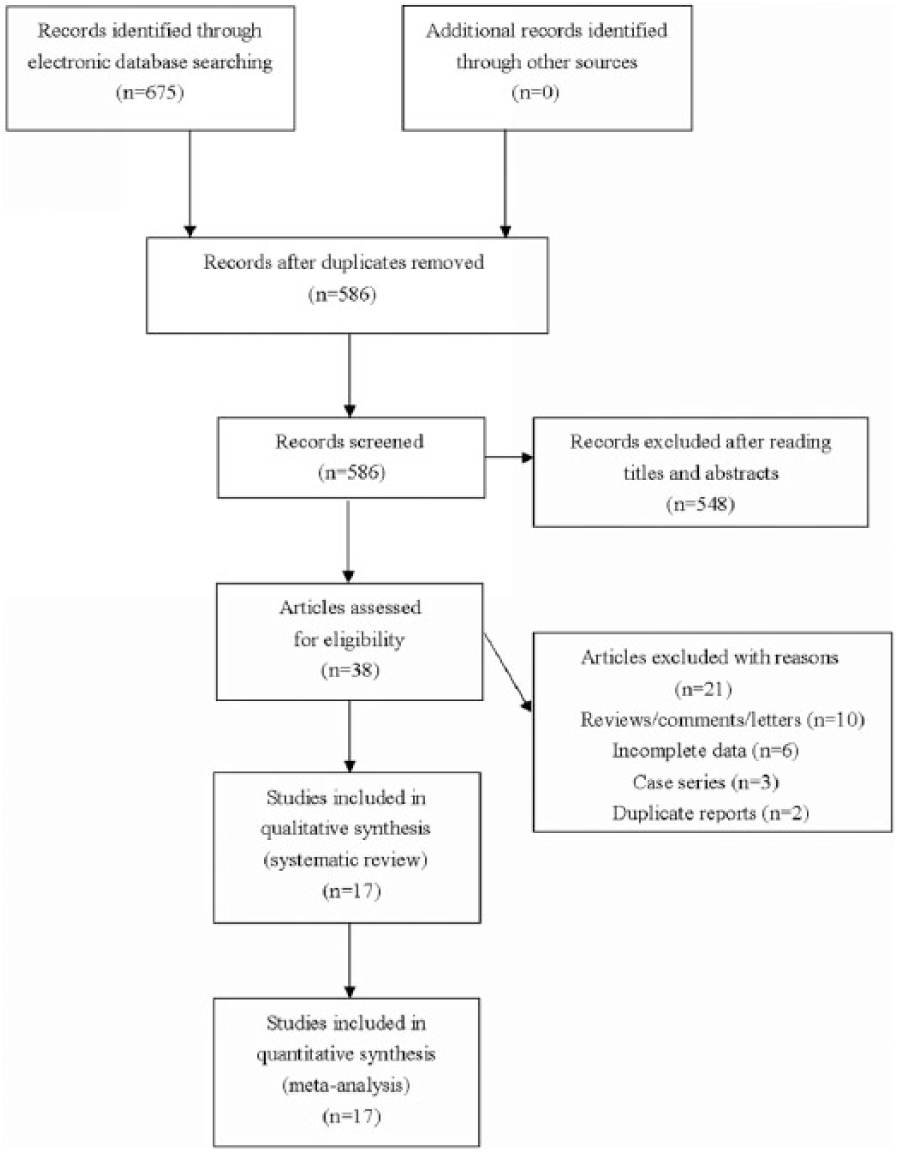
Flowchart of study selection for the present study.
The characteristics of included studies for PNPLA3 rs738409 polymorphism and HCC.
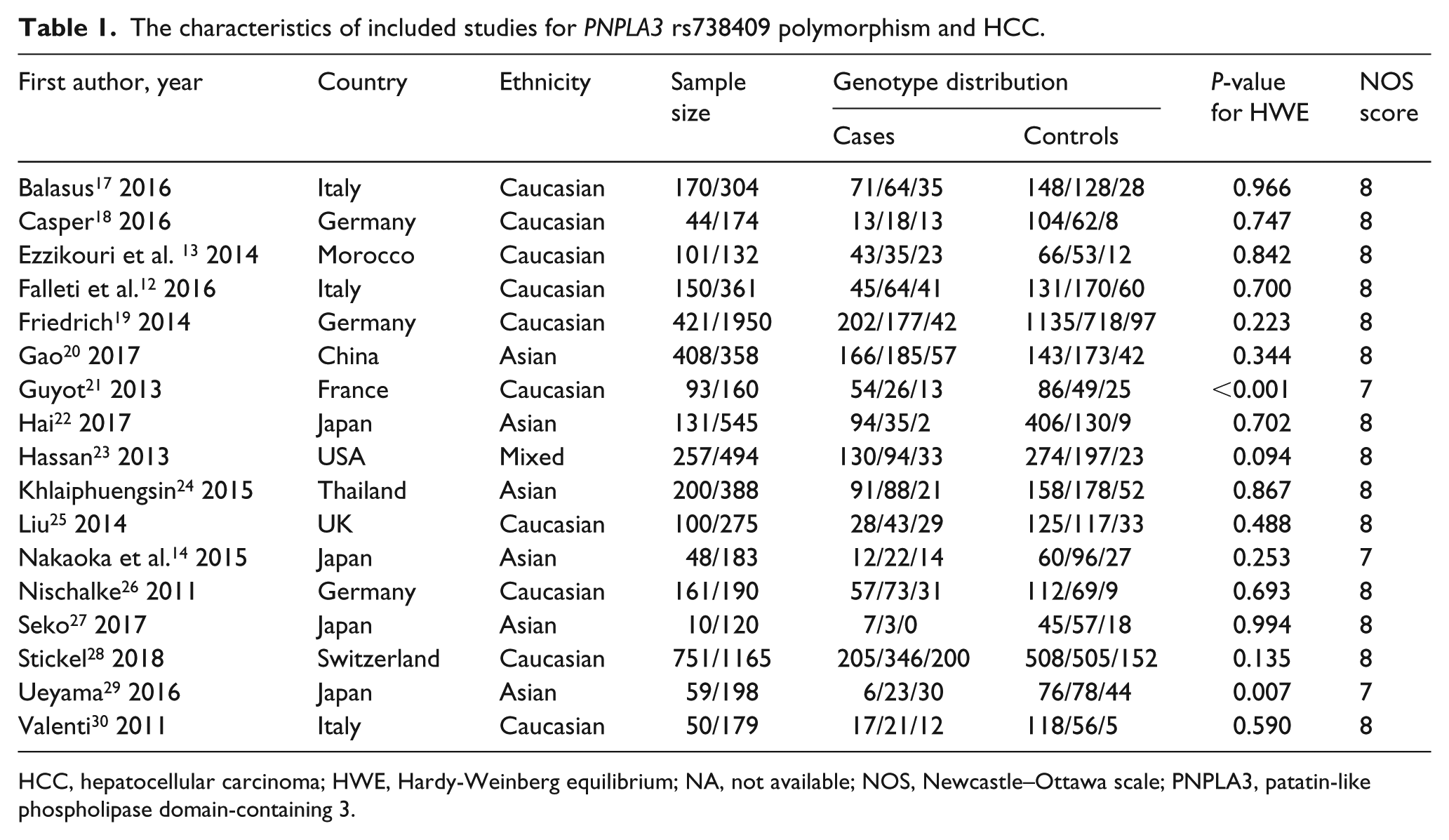
HCC, hepatocellular carcinoma; HWE, Hardy-Weinberg equilibrium; NA, not available; NOS, Newcastle–Ottawa scale; PNPLA3, patatin-like phospholipase domain-containing 3.
Overall and subgroup analysis
A total of 17 studies with 10,330 participants were analyzed. A significant association with the likelihood of HCC was detected for the PNPLA3 rs738409 polymorphism in dominant (P = 0.0001; OR = 0.66; 95% CI 0.53, 0.82), recessive (P < 0.0001; OR = 2.32; 95% CI 1.76, 3.06), and allele (P < 0.0001; OR = 0.64; 95% CI 0.53, 0.77) comparisons. Further subgroup analyses according to ethnicity of participants revealed that the PNPLA3 rs738409 polymorphism was significantly associated with the likelihood of HCC in Caucasians (dominant model: P < 0.0001, OR = 0.57, 95% CI 0.45, 0.71; recessive model: P < 0.0001, OR = 2.74, 95% CI 2.02, 3.71; allele model: P < 0.0001, OR = 0.56, 95% CI 0.46, 0.67). However, no positive results were detected in Asians (see Table 2 and Supplementary file 1).
Results of overall and subgroup analyses for PNPLA3 rs738409 polymorphism and HCC.
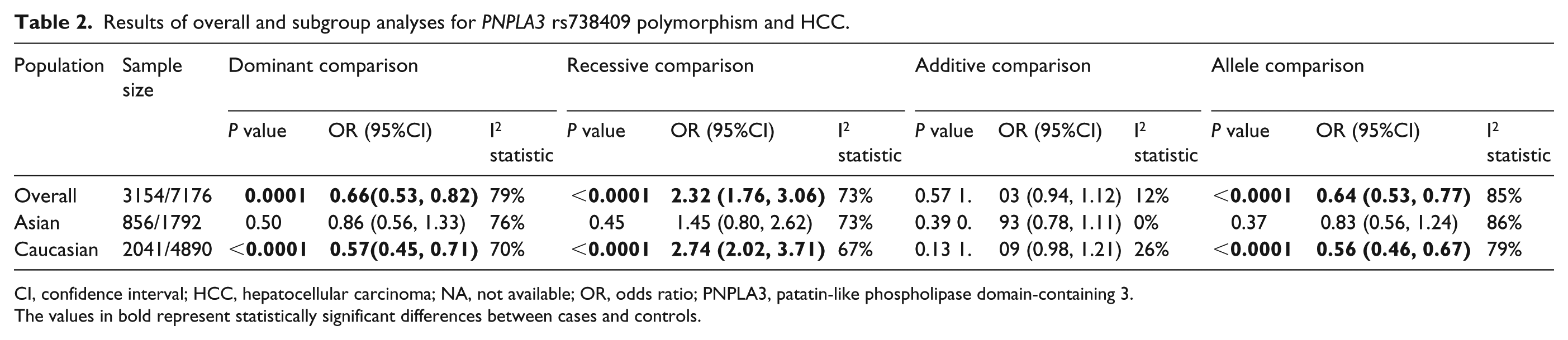
CI, confidence interval; HCC, hepatocellular carcinoma; NA, not available; OR, odds ratio; PNPLA3, patatin-like phospholipase domain-containing 3.
The values in bold represent statistically significant differences between cases and controls.
Sensitivity analysis
Sensitivity analyses were carried out to examine the stability of synthetic results by eliminating studies that deviated from HWE. No changes of results were observed in any comparisons, which indicated that our findings were statistically reliable.
Publication bias
Potential publication bias in the current study was evaluated with funnel plots. No obvious asymmetry of funnel plots was observed in any comparisons, which suggested that our findings were unlikely to be influenced by a severe publication bias.
Discussion
To the best of our knowledge, so far this is the largest meta-analysis on the correlation between the PNPLA3 rs738409 polymorphism and HCC. Our overall and subgroup analyses revealed that the PNPLA3 rs738409 polymorphism was significantly associated with the likelihood of HCC in Caucasians. The stability of synthetic results was subsequently evaluated in sensitivity analyses, and no changes of results were observed in any comparisons, which indicated that our findings were quite stable and reliable. As for evaluation of heterogeneities, obvious between-study heterogeneities were detected in dominant, recessive, and allele comparisons, and thus analyses were performed with REMs. In further stratified analyses, a reduction tendency of heterogeneity was found in the Caucasian subgroup, which suggested that differences in ethnic background could partially explain observed heterogeneities between studies.
There are several points that need to be addressed regarding this meta-analysis. First, previous experimental studies have shown that the mutant allele of rs738409 polymorphism was correlated with reduced enzymatic activity and hepatic steatosis, and this may partially explain positive findings in the current study.6-9 Second, the pathogenic mechanism of HCC is highly complex, and hence it is unlikely that a single gene polymorphism can significantly contribute to its development. Therefore, to better illustrate the potential correlations of certain gene polymorphisms with HCC, we strongly recommend further studies to perform haplotype analyses and to explore potential gene–gene interactions.
As with all meta-analyses, this study certainly has some limitations. First, our results were derived from unadjusted analyses due to lack of raw data, and failure to conduct further stratified analyses according to age, gender, and co-morbidity conditions may impact the reliability of our findings. 31 Second, obvious heterogeneities were detected in certain subgroup comparisons, which indicated that the inconsistent results of included studies could not be fully explained by the differences in ethnic background. Other unmeasured characteristics of participants may also contribute to between-study heterogeneities. 32 Third, the association between the PNPLA3 rs738409 polymorphism and HCC also may be influenced by gene–gene and gene–environmental interactions. However, the majority of studies did not consider these potential interactions, which accordingly hindered the performance of relevant analyses. 33 Considering these limitations, the results of the current study should be interpreted with caution.
Overall, our meta-analysis suggests that the PNPLA3 rs738409 polymorphism may serve as a potential biological marker of HCC in Caucasians. However, further well-designed studies are warranted to confirm our findings. Additionally, future investigations are needed to explore the potential roles of other PNPLA3 gene polymorphisms in the development of HCC.
Supplemental Material
Supplementary_file_1-Forest_plots_for_PNPLA3_rs738409_polymorphism – Supplemental material for Correlation between PNPLA3 rs738409 polymorphism and hepatocellular carcinoma: a meta-analysis of 10,330 subjects
Supplemental material, Supplementary_file_1-Forest_plots_for_PNPLA3_rs738409_polymorphism for Correlation between PNPLA3 rs738409 polymorphism and hepatocellular carcinoma: a meta-analysis of 10,330 subjects by Zongsheng Huang, Xianwen Guo, Guo Zhang, Liexin Liang and Bing Nong in The International Journal of Biological Markers
Footnotes
Authors’ contributions
Zongsheng Huang and Bing Nong conceived the study and participated in its design. Zongsheng Huang and Xianwen Guo conducted the systematic literature review. Guo Zhang and Liexin Liang performed the data analyses. Zongsheng Huang and Bing Nong drafted the manuscript. All authors have read and approved the final manuscript.
Declaration of conflicting interests
The author(s) declared no potential conflicts of interest with respect to the research, authorship, and/or publication of this article.
Ethical approval
This article does not contain any studies with human participants or animals performed by any of the authors.
Funding
This research received no specific grant from any funding agency in the public, commercial, or not-for-profit sectors.
Informed consent
For this type of study formal consent is not required.
Supplemental material
Supplemental material for this article is available online.
References
Supplementary Material
Please find the following supplemental material available below.
For Open Access articles published under a Creative Commons License, all supplemental material carries the same license as the article it is associated with.
For non-Open Access articles published, all supplemental material carries a non-exclusive license, and permission requests for re-use of supplemental material or any part of supplemental material shall be sent directly to the copyright owner as specified in the copyright notice associated with the article.
