




Abstract

Keywords
Correspondence
By using an ALK IHC four-tiered system based on the D5F3 clone (Cell Signaling Technology/Ventana) as a screening method, with all IHC-positive cases undergoing confirmatory FISH (Vysis ALK Break Apart Probe kit), 50 ALK IHC-/FISH-positive advanced adenocarcinomas were identified at our institution from June 2011 to May 2017. In addition to the ALK IHC score (1+, 2+, and 3+ with any percentage of cells stained considered as positive), the H-score, which translates into a score from 0 to 300 according to a specific formula as described elsewhere (Figure 1(a)), was also assessed. 3 Overall, 47/50 (94%) had any ALK positivity by IHC in ≥ 50% of cells, with the majority of patients having an ALK IHC score ≥ 2+ or an H-score ≥100 (Figure 1(b)). Of them, 31 patients were treated with crizotinib for advanced disease, whose main characteristics were as follows: median age 50 years (28–80 years), male/female (42%/58%), never/ever smokers (61%/39%), performance status 0/1 (74%/26%), and chemotherapy-pretreated (90%). The results showed no significant correlation between the intensity of ALK IHC score or H-score with regard to response to crizotinib. Similarly, no significant association was noted between the intensity of the ALK IHC score as well as the H-score and progression-free survival (Figure 1(c) and (d)).
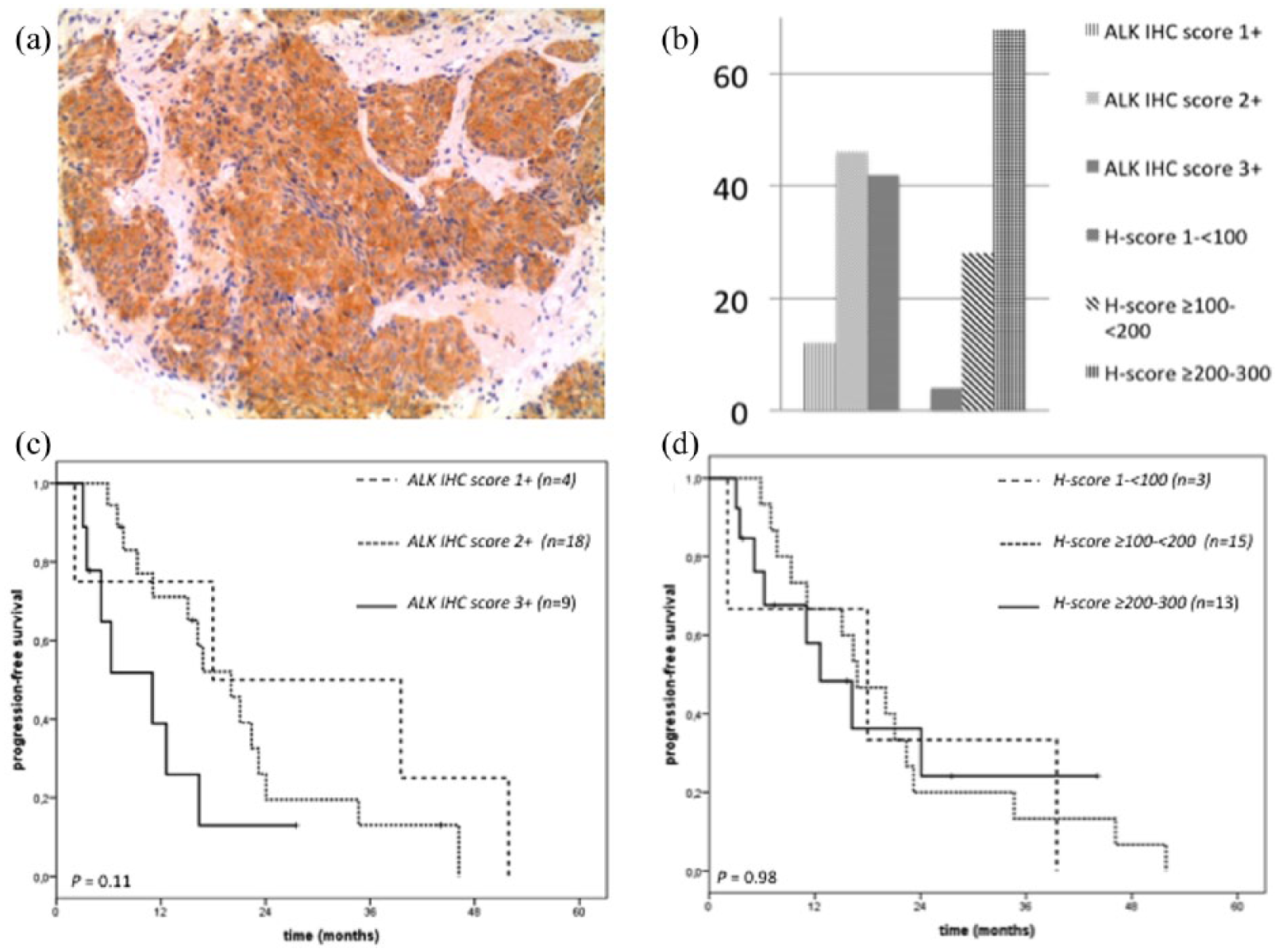
(a) ALK IHC analysis (200×) shows a diffuse cytoplasmic positivity in a predominantly moderate intensity, H-score = 200: [2 × (90% cell 2+) + 1 × (20% cells 1+)]. (b) Distribution of the ALK IHC score and the H-score in a population of 50 ALK IHC-/FISH-positive patients. (c) Kaplan–Meier estimates of progression-free survival according to the ALK IHC score. (d) Kaplan–Meier estimates of progression-free survival according to the ALK H-score.
To our knowledge, this is the first report evaluating an association between the ALK IHC scores with sensitivity to crizotinib. However, we could not demonstrate that the levels of the expression of the ALK protein were predictive of benefit from crizotinib. Although this analysis is flawed by the low number of patients that were taken into account, it is interesting to observe that the ALK protein was present with a mostly diffuse cytoplasmic staining, which is consistent with the ubiquitous presence of the protein in ALK-positive tumors. 4 Accordingly ALK IHC score and H-score were typically skewed towards high values (Figure 1(b)). This preferentially higher distribution of ALK IHC scores implies difficulty in setting a threshold of activity when it comes to sensitivity to crizotinib, thus suggesting poor discriminatory value for the ALK IHC scores. On this basis, we conclude that the ALK IHC score and the H-score have no role in predicting sensitivity to the ALK-TKI crizotinib, and other molecular determinants of sensitivity to treatment should be sought.
Footnotes
Declaration of conflicting interest
The author(s) declared no potential conflicts of interest with respect to the research, authorship, and/or publication of this article.
Funding
The author(s) received no financial support for the research, authorship, and/or publication of this article.