




Abstract
Introduction
According to World Health Organization (WHO) data in 2020, there are approximately 1.3 billion adult smokers worldwide. 1 Cigarettes cause more than 8 million mortality in the world and 7 million of them are active smokers. It is worth noting that over 80% cigarette smokers reside in low and middle-income countries. 2 The increasing number of smokers is due to nicotine that causes addiction and encourages smokers to stay smoking. 3 Cigarettes are circulated in various types of products such as kretek, pipe cigarettes, and hand-rolled cigarettes. 1
Cigarette smoke contains more than 7000 chemicals, hundreds of which are toxic, and 70 that can cause cancer. 4 The adverse effects caused by exposure to toxic substances in cigarette smoke are determined by the concentration and duration of exposure. 5 Repeated inhalation of cigarette smoke at different dose concentrations and durations can lead to short- and long-term adverse health effects affecting most organ systems, particularly the lungs. 5 Exposure to primary and second-hand smoke increases the risk for respiratory disease, cardiovascular disease, stroke, hormonal disorders, immune system disorders, cancer, reproductive system, and death.6–8
Infertility is a prevalent global issue affecting 8-12 of couples. A significant proportion of infertility cases, around 50%, are attributable to a male factor, either as the primary cause or as a contributing factor. In approximately 20%–30% of cases, the male partner is solely responsible, while in an additional 20%, a male factor contributes to the infertility. 9 Spermatogenesis is a vital process for male fertility, where male gametes develop from spermatogonia in the seminiferous epithelial tissue and are released as haploid germ cells into the seminiferous tubules. Even slight deviations from the natural course of spermatogenesis can result in male infertility. Semen analysis, which evaluates the quality and quantity of sperm, is the primary method of diagnosing male infertility. This evaluation assesses various parameters of spermatogenesis, such as the concentration or amount, motility, viability, and morphology of the sperm. 10 WHO has established normal reference values for these sperm parameters, and males with values below these norms are considered to have male factor infertility. The most significant parameters are low sperm concentration (oligospermia), poor sperm motility (asthenospermia), and abnormal sperm morphology (teratospermia). Other factors, such as semen volume and various seminal markers of epididymal, prostatic, and seminal vesicle function, have weaker associations with infertility. 11
Numerous investigations have been carried out on both animal and human subjects to investigate the potential correlation between cigarette smoking and male infertility, with a focus on various parameters of spermatogenesis.12,13 The findings from these studies have been somewhat inconsistent. While many studies reported negative impacts of smoking on spermatogenic parameters, others have found no such correlation, and in certain cases, have even noted favorable effects on said parameters.14–17 Previous study conducted by Lewin et al. have indicated that smokers tend to have a lower sperm concentration, but no significant difference was observed in sperm motility and progressive motility. Vogt et al reported similar results stating that smoking habits did not have any statistically significant effect on sperm density, motility, or morphological features in healthy adult males. Furthermore, Adelusi et al. found that smoking significantly improved sperm motility in infertile men.18–20 The objective of our study is to recapitulate the evidence from all available published data related to rats about spermatogenesis in a systematic literature review and meta-analysis, in order to provide a comprehensive overview of the effects of cigarette smoke exposure on the parameters of spermatogenesis.
Materials and methods
Eligibility criteria
The present systematic review and meta-analysis was developed and conducted in accordance with the Preferred Reporting Items for Systematic reviews and Meta-Analyses (PRISMA) guideline. Our study focused exclusively on experimental studies conducted on rat models, as these models are commonly used in experimental research on spermatogenesis.
The inclusion criteria were as followed: 1 experimental studies conducted on rat models; 2 utilized either conventional or electronic cigarettes as the experimental stimuli; 3 outcome measures were required to be one of the following parameters of spermatogenesis: sperm count, morphology, motility, and viability; 3 written in English and Bahasa; 4 full-text availability.
The exclusion criteria were as followed: 1 conference reports, case reports, reviews, commentary; 2 outcome of studies not relevant; 4 the quantitative data could not be obtained or calculated.
The review was not registered in the international register of Systematic Reviews and a protocol was not prepared.
Data sources and search strategy
A literature search was performed to identify all relevant information regarding the impact of cigarette exposure on spermatogenic parameters. To ensure an exhaustive search, we utilized various electronic databases including PubMed, EBSCO, ProQuest, Science Direct, Taylor & Francis, Springer Link, GARUDA, and Google Scholar, covering the period from inception until January 29th, 2021. The search strategy adopted was tailored to fit the requirements of each database, utilizing the search term “smok*”, “cigar*”, “tobacco”, “e cig*”, “electronic cigarette”, “vape”, or “vaping”, in any combination with “rats” and “sperm*” or “semen”. Additionally, we conducted a manual search of relevant papers’ references. Although we made efforts to include unpublished studies, we did not find any.
Study selection and data extraction
Initially, we manage the bibliography of the selected literatures and remove duplicate entries with the use of EndNote X9. The articles were screened for relevance by the four co-authors (AS, MS, MK, MK) by reviewing the titles and abstracts, then evaluating the remaining papers for eligibility. In the case of the meta-analyses, only those articles containing sufficient data to calculate the effect sizes were included. Concerns about eligibility were resolved through group discussion, with no unresolved disagreements. Subsequently, the relevant articles were independently reviewed and data were extracted accordingly. The following data were extracted from included studies: first author, year of publication, study design, study characteristics, rat species, the total number of sample groups and experimental groups, and the relevant effect size data. The following characteristics were assessed for each study: age, types of exposure, dose of exposure per day, and the period of exposure. The key statistical information that we extracted from each paper were tests of the primary effect of conventional cigarette smoke on dependent variables, relative to the control groups. Specifically, we sought the raw descriptive statistics, such as means and standard deviations.
Risk of bias and quality assessment
For quality assessment, two independent reviewers critically appraised the included studies using SYRCLE’s Risk of Bias tool for animal studies, 21 which is derived from the Cochrane Risk of Bias Tool. The tool addresses several domains, including selection bias, performance bias, detection bias, attrition bias, reporting bias, and other sources of bias. We evaluated each domain separately and critically, classifying them as low risk of bias, unclear risk, or high risk of bias according to the criteria provided by SYRCLE’s RoB tool. Any discrepancies in quality assessment were resolved through consensus or, if needed, by a third reviewer. This thorough evaluation is a crucial step in ensuring the integrity and reliability of the data used in our analysis.
Statistical analysis
The statistical analysis aimed to assess the correlation between cigarette smoke and rat spermatogenesis was conducted using JASP version 0.14.1. A 95% confidence interval was used to estimate the overall size effect of cigarette smoke exposure on the parameters of spermatogenesis. Prior to selecting the appropriate analysis model, a statistical I2 test was performed to evaluate the degree heterogeneity among the included studies. Statistical significance was established at p value <.05. In instances where heterogeneity was deemed high, as indicated by I2 > 50%, a random-effect model (REM) was employed to account for potential variations across studies.
Each parameter of spermatogenesis was assessed independently in this study. The analyses focused on the parameters of sperm count, morphology, motility, and viability, comparing exposed rats with control. To identify potential sources of heterogeneity, subgroup analyses were carried out based on the age of the rats, the number of cigarettes exposed per day and the period of exposure. The rats were categorized into prepubertal and adult based on their age, with the cut-off of 6 weeks. 22 Exposure was classified as light (1-20 cigarettes/day) or heavy (>20 cigarettes/day), and the period of exposure was categorized into two groups: under 50 days and more than 50 days, given that the period of complete spermatogenesis in rats is approximately 52 days. 13 Finally, the trim and fill effects were utilized to identify potential publication bias that may result in asymmetry in the funnel plot asymmetry.
Result
Characteristic of included studies
A comprehensive initial search of relevant databases yielded a total of 783 studies. Following screening and assessment for eligibility, 23 studies, providing data from 527 rats, were selected for inclusion in this systematic review. The schematic flow diagram describing the selection process is summarized in Figure 1. Of the 23 studies, 22 utilized conventional cigarettes, while only 2 reported the use of electronic cigarettes. The number of studies included in each meta-analysis varied according to the reported sperm parameters: with 9 studies providing data on sperm count, 4 studies providing data on morphology, 2 studies providing data on motility, and 3 studies providing data on viability. The main characteristics of included studies were summarized in Table 1. Selection process of PRISMA flow diagram. Main characteristics of the studies included in the systematic review. *Only these studies were included in the meta-analyses as they had mean and standard deviations needed to calculate the effect sizes.

A qualitative assessment was conducted by using the SYRCLE’s Risk of Bias tool for animal studies to assess various indicators for each study (Supplementary Table S1). Given the bias summary, selection bias and performance bias were not an issue.
Quantitative Analysis
There were 10 articles included in this meta-analysis study. These selected articles reported the mean and standard deviation of the effect of cigarette smoke exposure on the parameters of spermatogenesis. The data from these 10 studies were analyzed using JASP. The resulting combined correlation was 0.70 with CI (95%) = 0.61-0.79 (Figure 2). This meta-analysis revealed a statistically significant correlation between cigarette smoke exposure and the parameters of spermatogenesis in rats, with a p value of <0.001. Forrest plot: combined correlation of the effect of cigarette smoke exposure on the parameters of spermatogenesis.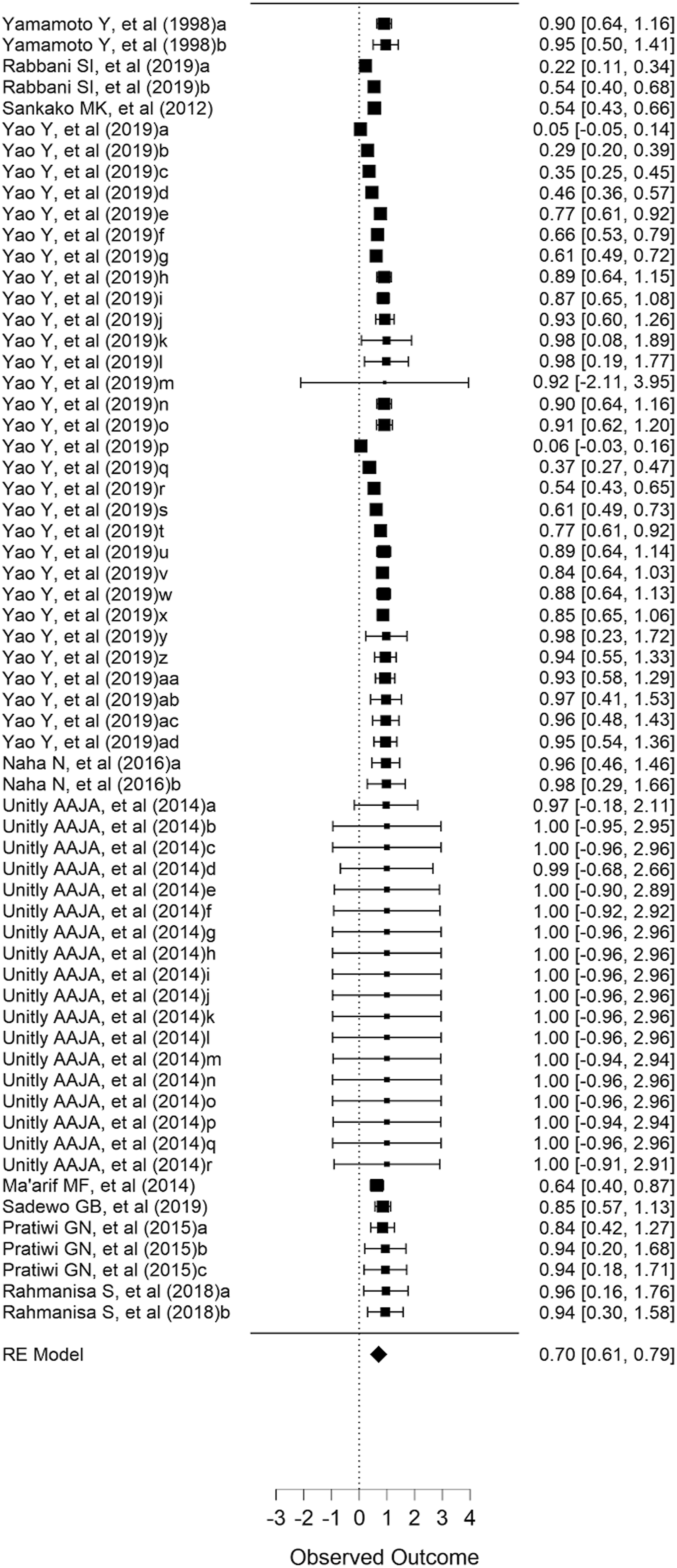
Sperm count
The mean sperm counts in rats exposed to cigarette smoke ranged from 6.6 to 171,11 x 10⁶/ml, while in control rats, the counts range from 18.4 to 246.29 x 10⁶/ml. The findings revealed that the count was lower in rats exposed to cigarette smoke as compared to control. By using a REM, the pooled mean difference (MD) was estimated to be 0.65 x 10⁶/ml (95%CI, 0.51 to 0.78; p < 0.01). Figure 3 depicts the effect sizes of cigarette exposure on sperm count in 26 coded groups from 9 studies. The meta-analysis demonstrated in a significant overall effect size of 0.65 (95% CI: 0.51 - 0.78, p < .001). Forrest plot: the effect of cigarette smoke exposure on sperm count.
Subgroup analyses of the sperm count parameter according to the amount of cigarettes smoke exposure.

Sperm morphology
Overall, smoking was found to be a risk factor for impaired morphology. Figure 4 displays the effect sizes of cigarette exposure on sperm morphology in 26 coded groups from 4 studies. The meta-analysis demonstrated a significant overall effect size of 0.74 (95% CI: 0.61 - 0.86, p < .001). Forrest plot: the effect of cigarette smoke exposure on sperm morphology.
Sperm viability
The effect sizes of cigarette exposure on sperm viability in 8 coded groups from 3 studies were presented in Figure 5. The meta-analysis resulted in a significant overall effect size of 0.96 (95% CI: 0.54 - 1.38, p < .001), and the data were found to be homogenous. Forrest plot: the effect of cigarette smoke exposure on sperm viability.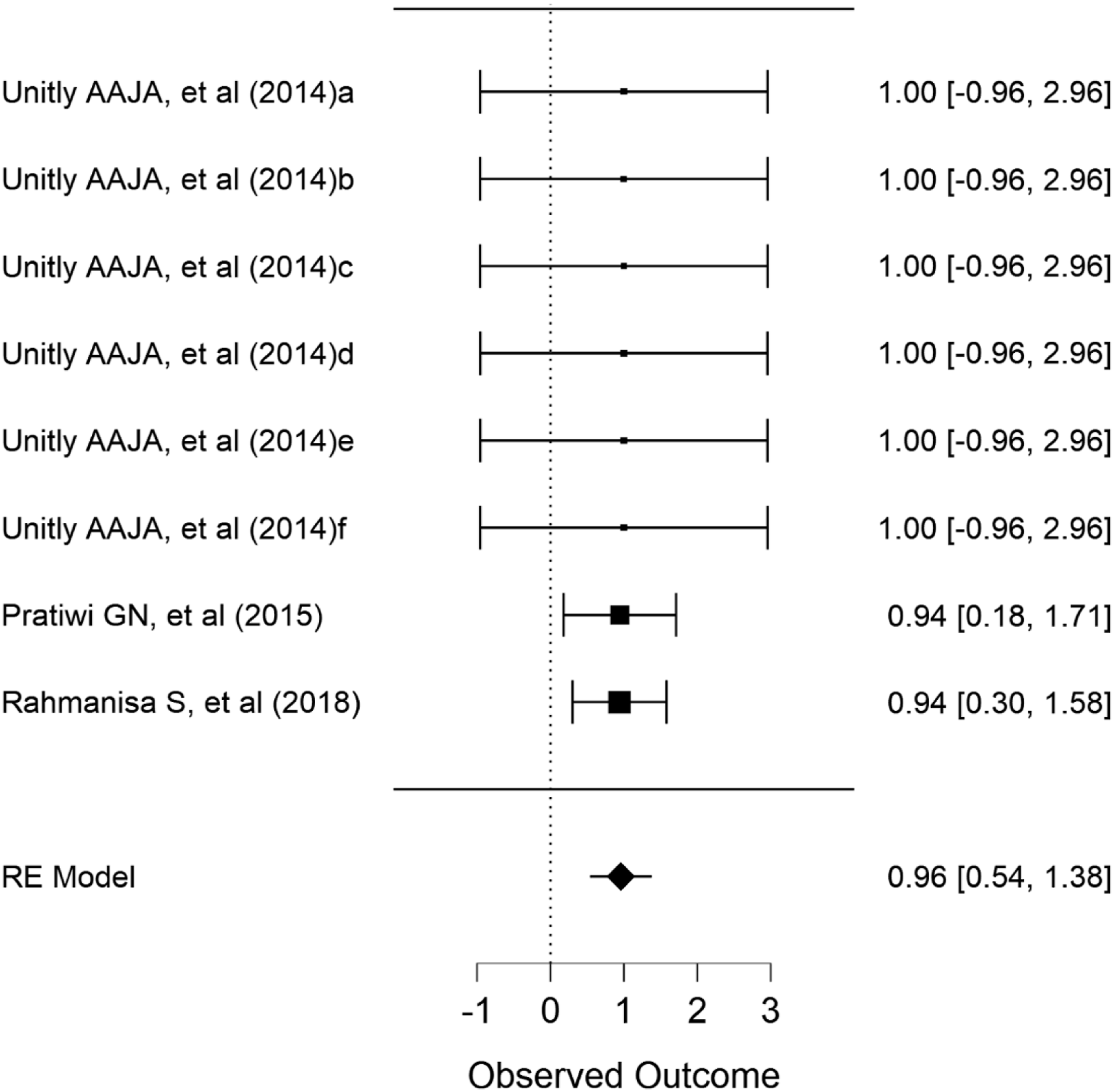
Risk of bias across studies
A funnel plot was generated to evaluate the potential for publication bias in these included studies; the plot shows its shape to be asymmetrical (Supplementary Figure S1). This finding suggests that publication bias may exist in this meta-analysis.
Discussion
In this study, we conducted a meta-analysis and systematic review to assess the correlation between cigarette smoke exposure and the parameters of spermatogenesis in rats. All studies demonstrate a consistent negative correlation between exposure to cigarette smoke and spermatogenesis, indicating that cigarette smoke has a detrimental effect on the process of sperm production. Our findings revealed that cigarette smoke exposure had a significant negative impact on sperm count, sperm normal morphology and sperm viability, with an overall size effect of 0,70 and a CI (95%) = 0.61-0.79
Limitations
The methodological aspects of this research warrant careful consideration. In particular, within the selected body of research, only two studies were identified that examined the use of electronic cigarettes. Furthermore, neither of these studies reported mean and standard deviation data. Additionally, due to the limited number of studies and data available, we were unable to perform an analysis on the motility parameter. As a result, we included them only in the systematic review.
Conclusions
In conclusion, the present study contributes to the existing body of literature indicating that exposure to conventional cigarette smoke has a significant negative effect on spermatogenic parameters in rats, particularly in terms of sperm count, morphology, and viability, which can lead to infertility. Electronic cigarettes are promoted as a healthier replacement for conventional cigarettes but in reality, there is a scarce body of evidence that compares their impact on the reproductive system, and specifically the spermatogenesis process. We believe that our results, taken together with previous reports, might help address the profound necessity for research in this field to further investigate and compare the effects of electronic cigarette vapor and conventional cigarette smoke on spermatogenesis. Future research should also aim to explore potential interventions that can mitigate the damage caused by cigarette smoke exposure on reproductive health.
Supplemental Material
Supplemental Material - The effect of cigarette smoke exposure on rat’s spermatogenesis: A systematic literature review and meta-analysis
Supplemental Material for The effect of cigarette smoke exposure on rat’s spermatogenesis: A systematic literature review and meta-analysis Tena Djuartina, Iskandar Rahardjo Budianto, Andreas Steven, Maria Stefani, Melani Kawilarang and Melisa Kawilarang in European Journal of Inflammation
Footnotes
Acknowledgments
We dedicate this paper to Dr Elisabeth Rukmini, S.Si., M.S. Ph.D, who provided invaluable support and guidance to co-authors and authors throughout the completion of this systematic review and meta-analysis.
Author contributions
TD - Study concept and design, critical revision of the manuscript, supervision. IR - Study concept and design, critical revision of the manuscript, supervision. AS - Acquisition of data, analysis and interpretation of data including critical appraisal of the studies, drafting of the manuscript, critical revision of the manuscript, statistical analysis. MS - Acquisition of data, analysis and interpretation of data including critical appraisal of the studies, drafting of the manuscript, critical revision of the manuscript, statistical analysis. MK - Acquisition of data, analysis and interpretation of data including critical appraisal of the studies, drafting of the manuscript, critical revision of the manuscript, statistical analysis.
Declaration of conflicting interest
The author(s) declared no potential conflicts of interest with respect to the research, authorship, and/or publication of this article.
Funding
The author(s) received no financial support for the research, authorship, and/or publication of this article.

Supplemental Material
Supplemental material for this article is available online.
References
Supplementary Material
Please find the following supplemental material available below.
For Open Access articles published under a Creative Commons License, all supplemental material carries the same license as the article it is associated with.
For non-Open Access articles published, all supplemental material carries a non-exclusive license, and permission requests for re-use of supplemental material or any part of supplemental material shall be sent directly to the copyright owner as specified in the copyright notice associated with the article.
