




Abstract
The present research work was aimed to study the mutual interaction of reactive oxygen species (ROS) and basal cells antioxidant capacity in the male reproductive system and to further establish the association between selected heavy metals and stress markers. Total oxidant status (TOS) and total antioxidant status (TAS) of serum and seminal plasma were determined by automated photometric methods. The concentrations of Selenium (Se), Lead (Pb), and Cadmium (Cd) were determined by using atomic absorption spectrophotometer. The TOS was increased significantly (P <0.05) in seminal plasma as well as in the serum of the infertile group when compared with the fertile group. On the other hand, the TAS of the infertile group was found to be noticeably decreased (P <0.05) when compared with the TAS of the fertile group. Among the heavy metals, a noticeably lower concentration of Se was detected in the infertile group whereas markedly elevated levels of Cd and Pb were observed in the infertile group compared with the fertile group. Among the infertile group a significant inverse correlation (r = −0.521, P <0.05) was observed between Se and TOS and between Cd and Pb (r = −0.407, P <0.05). Contrarily among the infertile group a considerable positive relationship was established between Se and TAS (r = 0.507, P <0.05). It was concluded that the oxidant stress reduces the antioxidant activity in infertile men by elevating the production of ROS. A lower concentration of Se and elevated levels of Pb and Cd explain the individual’s exposure to these heavy metals. The study also revealed that the heavy metal toxicity contributes significantly to male infertility.
Introduction
Reactive oxygen species (ROS) are thought to be linked with degradation of spermatozoa associated with reduced motility and morphology and de-creased capacity of sperm penetration in oocyte.1,2 ROS cause infertility either by damaging the sperm membrane or the sperm DNA directly. Membrane damaging activity reduces the sperm’s motility and their fusion with the oocyte. 3 A living body has enzymatic and non-enzymatic antioxidant defensive mechanisms against oxidative free radicals. The over-production of ROS leads to oxidative stress causing cellular damages.4,5 The human body has established built-in antioxidant mechanisms to cope from damaging effects of ROS. 6 Glutathione peroxidase is one of the key players among the antioxidant system of cells and protects the body from the deteriorating effects of noxious ROS by preventing membranes lipid peroxidation. Reduction in Selenium (Se) concentration renders the spermatozoa more susceptible to free radicals and is associated with defective sperm motility, modification in morphology of the mid-piece, and loss of flagellum of the spermatozoa. 7
Exposures of numerous environmental agents are linked with fertility disorders in human populations. 8 An elevated concentration of Cadmium (Cd) has a toxic effect on iron-dependent enzymes such as cytochrome P450. 9 Lead can cause metabolic, enzymatic, oxidative, and genetic damage by producing adverse effects on the body’s organs. 10 Conventional semen analysis is not confirmatory for diagnosis, so the basic and advanced technologies must be practiced to verify fertility status.
The present study was conducted to investigate: total oxidant status (TOS); total antioxidant status (TAS); Selinium (Se), Lead (Pb), and Cadmium (Cd) in seminal plasma and serum samples of the under trailed volunteers. The findings of the study provide important information relating to the potential causes of infertility in the existing knowledge so as to address the socio-ethical and clinico-medical issues of the Pakistani population in such a conservative scenario.
Materials and methods
Twenty infertile men (test group) attending various fertility centers in Faisalabad, Pakistan were recruited in the study and 20 fertile male volunteers (control group) were also recruited as procedural controls based on the biophysical analysis of semen. According to World Health Organization (WHO) protocol, normal human semen has a volume of 2 mL or greater, pH in the range of 7.2–8.0, sperm concentration of 20×106 spermatozoa/mL or more, sperm count of 40×106 spermatozoa per ejaculate or more, and motility of 50% or more with forward progression of 25% or more with rapid progression within 60 min of ejaculation. 11 Written consent has been taken from study subjects and the research plan was approved by the research scrutiny committee of the Department of Biochemistry, Faculty of Sciences, University of Agriculture Faisalabad, Pakistan.
Collection and biophysical analysis of semen samples
Semen samples were collected by masturbation after a sexual abstinence for 3–5 days according to WHO criteria.11,12 The liquefied semen sample was examined for its physical (color, appearance, and pH) and cytological parameters (motility percentage, sperm count per mL, live and dead sperm percentage). The remaining semen sample was centrifuged at 4000 g for 20 min and the seminal plasma was frozen at −40°C until further analysis.
Collection of blood samples
Blood samples were collected from all the study subjects and centrifuged at 4000 g for 15 min after coagulation and supernatant serum was stored at −40°C until further analysis.
Measurement of total oxidant and total antioxidant status
The TOS and TAS were measured by the calorimetric method using Microlab-300 semi-auto chemistry analyzer. 13 The assay for TOS was based on the principle of oxidation of ferrous ion into ferric ion making a colored complex with xylenol orange in acidic medium in the presence of a variety of oxidant species and the color intensity was measured at 560 nm. 14 In the TAS assay, most powerful hydroxyl radical is produced through Fenton’s reaction resulting in the production of colored dianisidin radical cations in the reaction medium at low pH and color intensity was measured at 660 nm.
Measurement of Cadmium, Lead, and Selenium
Seminal plasma and serum sample were subjected to wet digestion, a method described by Richards 15 to determine the levels of Pb, Cd, and Se. Pb (µg/L), Cd (µg/L), and Se (µg/L) were detected by atomic absorption spectrophotometer at Central Hitech Lab, University of Agriculture Faisalabad according to the protocols described by Xu et al. 16 The samples were aspirated to the instrument and reading was recorded at particular monochromatic wavelength for each element.
Statistical analysis
Statistical analysis was executed using Statistical Package for Social Sciences Software (SPSS for Windows, version 7.0). The results were expressed as means ± SD (95% confidence interval [CI]). Statistically significant differences between means of fertile and infertile groups were compared using Student’s t test. The Pearson’s correlation was applied to assess the relationship among studied parameters.
Results
The TOS, TAS, Se, Pb, and Cd in seminal plasma and serum were determined in the present study in order to evaluate the effect of ROS on the antioxidant defense mechanism of the male reproductive system. TOS, Pb, and Cd concentrations were high whereas TAS and Se concentrations were lower in the infertile group compared to the fertile group. The results were shown as mean ± SD (95% CI) in Table 1. Average values of the biochemical characteristics in serum and seminal plasma have been shown in Figures 1 and 2, respectively. On statistical analysis, a significant (P <0.05) increase in the level of TOS was observed in seminal plasma and serum of the infertile group compared to the fertile group whereas TAS was significantly (P <0.05) decreased in infertile group. Se concentration was significantly lower (P <0.05) whereas Pb and Cd concentrations were found to be significantly higher (P <0.05) in the infertile group. The result also showed that a significant inverse correlation exists between Se and TOS (r = −0.521, P <0.05) and between Cd and Pb (r = −0.407, P <0.05) in the serum of the infertile group. In contrast, a significant positive correlation was observed between Se and TAS (r = 0.507, P <0.05) in the serum of the infertile men. In seminal plasma a significant negative correlation was observed between Se and TOS (r = −0.48, P <0.05). The results are presented in Figure 3.
Mean variability of biochemical parameters.

CI, confidence interval; SD, standard deviation.
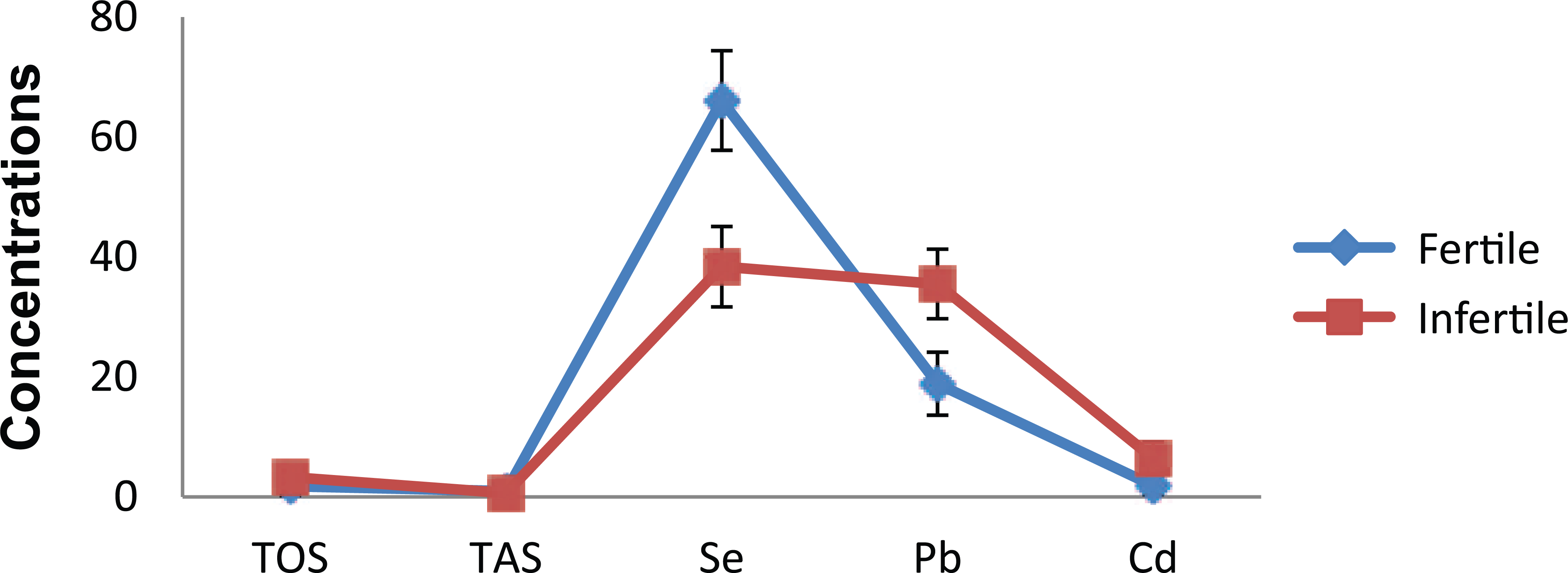
All average values of biochemical parameters in the serum of fertile and infertile volunteers. Among the fertile group, the Se level is significantly high compared to the infertile group while Pb and Cd levels are lower in the fertile group than the infertile group.

All average values of biochemical parameters in seminal plasma of fertile and infertile volunteers. In seminal plasma the level of oxidants like TOS, Pb, and Cd are higher in the infertile group than the fertile group.

Scatter diagram of biochemical parameters. (a) Result showing significant negative correlation between TOS and Se concentration in serum. (b) Significant negative correlation between Cd and Pb in serum. (c) Positive correlation between TAS and Se in serum. (d) Significant negative correlation between TOS and Se concentration in seminal plasma.
Discussion
The results of our study indicated an increased ROS and reduced TAS level in the infertile group as compared to the fertile group due to increased ROS production and lipid peroxidation by the abnormal spermatozoa. This increased level of ROS damages the blood–testis barrier, reaches the testes, and ultimately become the part of seminal plasma. Nutritional deficiency and lack of enzymes are reported to be involved in antioxidant metabolism and lower the level of TAS in infertile human men. So our results verify the findings of Lewis et al. 17 and Smith et al. 18 as they also described lower levels of TAS and increased ROS in sub-fertile men. Hammadeh et al. 19 also reported that male infertility is linked with high concentration of ROS production and reduced total antioxidant activity in infertile men. In our study we also documented significantly (P <0.05) reduced Se concentration in the infertile group due to elevated production of ROS when compared to the fertile group. Increased exposure to heavy metals also reduces Se concentration. Xu et al. 20 reported a lower concentration of Se in infertile men. So our results are in good agreement with the findings of Xu et al. 20 The findings of our research demonstrated a significant (P <0.05) negative correlation between Se and TOS while a considerable positive correlation was also observed between Se and TAS. Exposure to Pb and Cd has also been linked with the impairment in semen quality, reduction in fertility rates, and increased male infertility ratio. 19 Increased Cd concentration in seminal plasma causes disruption of spermatogenesis, hence infertility. Akinloye et al. 9 reported an increased Cd concentration in infertile men compared to fertile men. In the present study we found a significant (P <0.05) increase in concentration of Pb and Cd in infertile men. We also found a significant inverse correlation between Cd and Pb (P <0.05). Our results support the findings of Omu et al. 21 who detected a significantly increased concentration of Cd in infertile men. Pant et al. 22 also found increased Pb and Cd concentrations in the seminal plasma of infertile men.
We concluded that increased ROS production causes impairment in the functioning of antioxidant defense mechanism of the male reproductive system; hence reduction in TAS with increased TOS in infertile men. Findings of the present study also revealed a substantial association among studied characteristics in infertile individuals. To the best of our knowledge, this is the first time that the association between heavy metals and stress markers for the assessment of male factor infertility has been reported.
Footnotes
Acknowledgements
The authors express gratitude to the Staff of Biomedical Research Laboratory, Department of Biochemistry, University of Agriculture Faisalabad-Pakistan. Authors are also thankful to incharge infertility Centre of Faisalabad.
Declaration of conflicting interests
The author(s) declared no potential conflicts of interest with respect to the research, authorship, and/or publication of this article.
Funding
This research received no specific grant from any funding agency in the public, commercial, or not-for-profit sectors.