



Abstract
Objective:
Lung cancer is still one of the most frequently diagnosed cancers all over the world, especially in developing countries. The aim of this study was to investigate the relationship between two well-characterized non-synonymous polymorphisms (Arg194Trp and Arg399Gln) in X-ray repair cross-complementing group 1 (XRCC1) gene and the risk of lung carcinoma in the Han population.
Methods:
This study was hospital-based in design and included 159 participants (63 patients with lung carcinoma and 96 cancer-free controls) of Chinese Han descent. Genomic DNA from blood samples was extracted for PCR studies, followed by direct sequencing to determine the variants of the XRCC1 gene.
Results:
Carriers with Arg194–Arg399 haplotype of XRCC1 gene conferred a 189.3% increased risk compared to the non-carriers (95% confidence interval [CI], 1.195–2.998; P = 0.006). And single-locus analysis (both allele and genotype distributions of polymorphism Arg194Trp and Arg399Gln) identified neither association with cancer risk nor with clinico-pathological parameters of lung carcinoma in the Han population.
Conclusions:
Arg194–Arg399 haplotype of XRCC1 gene might increase lung cancer susceptibility and serve as a risk factor for lung cancer in the Han population.
Introduction
Lung cancer is still one of the most frequently diagnosed cancers all over the world, 1 especially in developing countries. It is estimated that the prevalence of lung cancer in China will be the highest around the world. The mortality rate of lung cancer will have been projected to exceed 1 million by 2025 if allowed to proceed uncurbed. 2 Previous studies show that genetic susceptibility and gene-environment interactions play an important role in lung carcinogenesis.3,4 Among the risk factors of lung cancer, the DNA damage repair system is one of the most important mechanisms underlying the lung carcinogenesis.3,4
X-ray repair cross-complementing group 1 (XRCC1), a major DNA repair gene in the base excision repair (BER) pathway, can stimulate the DNA kinase at damaged DNA termini, and thereby accelerate the overall repair process. 5 Therefore, the polymorphisms of XRCC1 gene, especially those polymorphisms that lead to amino acid changes, might alter the efficiency of DNA repair 6 and have functional significance. Among them, Arg194Trp (C > T, rs1799782) and Arg399Gln (G > A, rs25487) polymorphisms of XRCC1 gene were the most extensively studied 7 and were reported8,9 to be associated with DNA repair activity.
Studies have reported the association between Arg194Trp or Arg399Gln polymorphism and the risk of lung cancer. However, the results available remain conflicting. Some studies showed that 194Trp/Trp,10–12 399Gln/Gln,7,13,14 and 399Arg/Gln 14 variant genotypes could increase lung cancer risk. Other studies found that 194Arg/Trp,10,15,16 399Gln/Gln,16,17 and 399Arg/Gln11,15,18 genotypes might be protective factors in the development of lung cancer. However, other studies clarified that both Arg194Trp13,19,20 and Arg399Gln19,21 polymorphisms were not associated with the risk of lung cancer. Studies also found that effect on XRCC1 gene to lung cancer was distinct in different regions or ethnics. For example, Jiang et al. 10 revealed that 194Trp/Trp variant genotype increased lung cancer risk in Asians but not in Caucasians. They also found that both the heterozygote Arg/Trp and the combined of Trp/Trp and Arg/Trp variant genotypes could decrease the risk of lung cancer in Caucasians but not in Asians. Wang and Cai 7 also found that the 399Gln allele increased the risk of lung cancer in Asians and Caucasians but not in Africans. Thus, the association between the XRCC1 gene polymorphisms and lung cancer is still unclear. Moreover, most of the research only focused on the correlation of single gene locus with lung cancer susceptibility, and ignored that a haplotype had a higher level of heterozygosity than single gene locus. That is, haplotype-based analysis may have an increased power for detecting disease associations compared to single nucleotide polymorphism (SNP)-based analysis.
Hence, in order to provide a comprehensive assessment of the association between XRCC1 polymorphisms and lung cancer risk in the Chinese Han population, the two well-characterized non-synonymous polymorphisms (rs1799782:Arg194Trp and rs25487:Arg399Gln) were investigated.
Material and methods
Study participants
A total of 159 participants of Chinese Han descent (63 sporadic patients with lung cancer and 96 age- and gender-matched cancer-free controls) were recruited to verify the association between XRCC1 polymorphisms and lung cancer risk from Fujian Provincial Hospital. All participants underwent either computed tomography (CT) or enhanced CT or positron emission computed tomography (PET)-CT scan (standardized uptake value [SUV] >2.5), and were confirmed by radiologists. Those who were susceptible to lung cancer were further pathologically confirmed by biopsy through operation. Healthy people recruited from the community with no history of cancer and normal CT or enhanced CT or PET-CT results were treated as cancer-free controls in this study. Lung cancer was clinically classified into adenocarcinoma, squamous cell carcinoma, and other carcinomas (defined as lung cancers apart from adenocarcinoma and squamous cell carcinoma, such as small cell lung cancer). This study had protocols approved by the Ethics Committee of Fujian Medical University. All participants signed the informed written consent.
DNA extraction and genotyping
A total of 2 mL of peripheral blood was taken from each patient before chemotherapy and from the cancer-free controls. Genomic DNA was extracted from white blood cells using TIANamp Blood DNA Kit (Tiangen Biotect, PR China). XRCC1 genotypes were detected using PCR-direct sequencing.
Briefly, the upstream primer 5’-GCCCCGTCCCAGGTA-3’ and the downstream primer 5’-AGCCCCAAGACCCTTTCACT-3’ were used to generate a region of rs1799782. And the upstream primer 5’-TTGTGCTTTCTCTGTGTCCA-3’ and the downstream primer 5’-TCCTCCAGCCTTTTCTGATA-3’ were used to generate a fragment of rs25487. The experimental conditions were reported previously 22 and amplification parameters were 94°C for 5 min, 30 cycles of 94°C for 30 s, 61°C for 30 s, 72°C for 30 s, with a final extension step at 72°C for 10 min. The PCR products were purified for sequencing after electrophoresis on an agarose gel. For sequencing, a Perkin Elmer Big Dye Sequencing kit (Perkin-Elmer, Shelton, CT, USA) and an ABI PRISM7700 sequencer (Perkin-Elmer ABI, Foster City, CA, USA) were used.
Statistical analysis
All data were analyzed with SPSS version 18.0 (SPSS Inc., Chicago, IL, USA). Continuous variables are expressed as median (min-max). Comparisons were made using unpaired t-test for continuous variables and χ2 test for categorical variables between groups. Statistical significance was declared at P <0.05.
Results
Characteristics of the study population
The clinical characteristics of study population were summarized in Table 1. There were no significant deviations in the distribution of age, gender, and smoking status (P = 0.227, 0.156, and 0.083, respectively) between patients and controls.
Characteristics of selected variables in lung cancer patients and cancer-free controls.
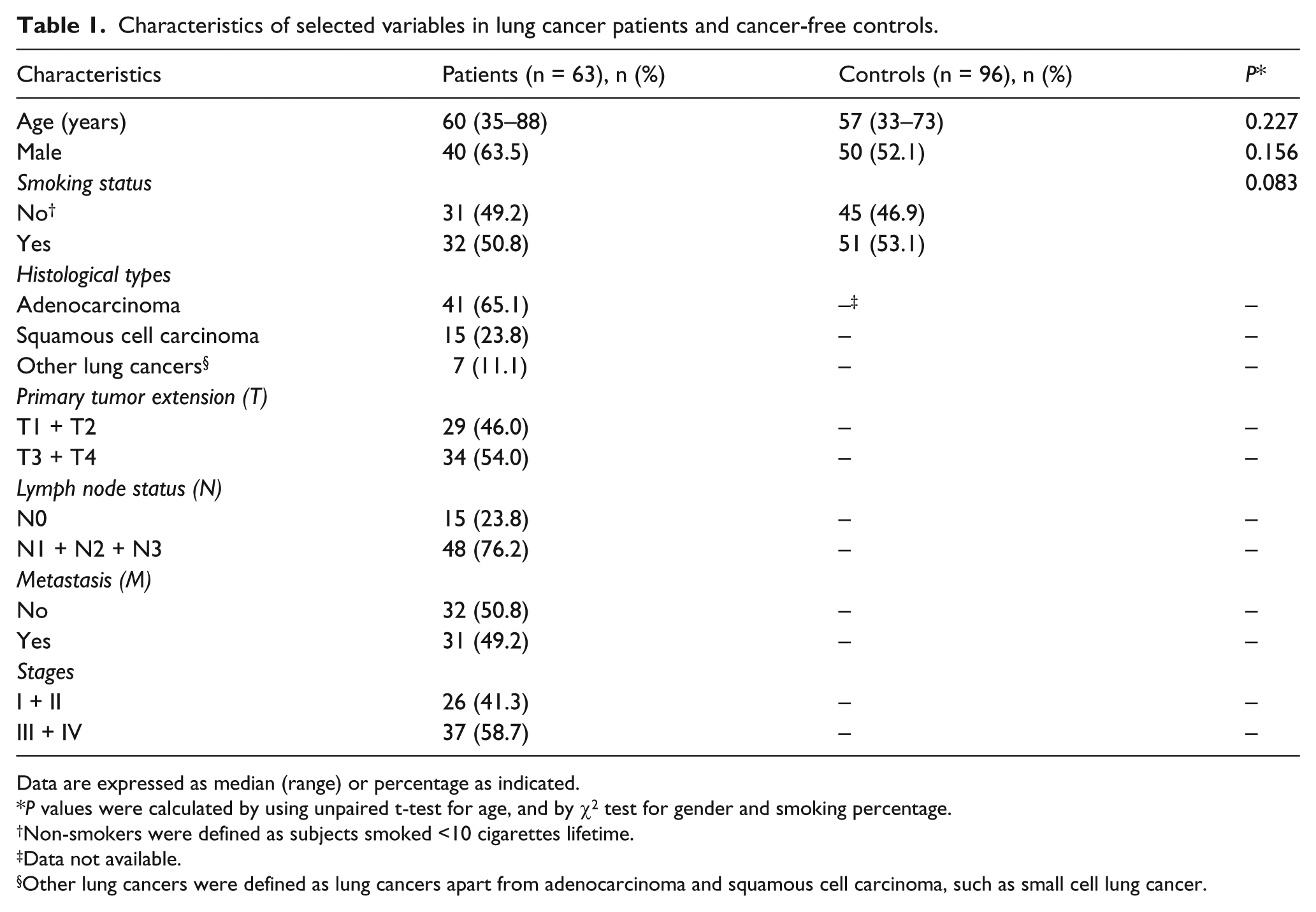
Data are expressed as median (range) or percentage as indicated.
P values were calculated by using unpaired t-test for age, and by χ2 test for gender and smoking percentage.
Non-smokers were defined as subjects smoked <10 cigarettes lifetime.
Data not available.
Other lung cancers were defined as lung cancers apart from adenocarcinoma and squamous cell carcinoma, such as small cell lung cancer.
The relationship between the XRCC1 genotype and lung cancer
The genotypes of XRCC1 gene were confirmed by direct sequencing (Figure 1). Arg194Trp (rs1799782) contains three genotypes: CC (Arg/Arg), CT (Arg/Trp) genotype, and TT (Trp/Trp) genotype. Arg399Gln (rs25487) also contains three genotypes: GG (Arg/Arg), GA (Arg/Gln), and AA (Gln/Gln) genotype. The genotype and allele distributions of XRCC1 gene in lung cancer patients and controls are described in Table 2. The genotype distributions of two examined polymorphisms complied with Hardy–Weinberg equilibrium in both patients and controls (P >0.05). There were no significant differences in the allele and genotype distributions of Arg194Trp and Arg399Gln (P >0.05). Excitingly, the frequency of Arg194–Arg399 haplotype of XRCC1 gene was significantly higher in patients (49.2%) than in controls (33.9%) (Table 3), that is, Arg194–Arg399 haplotype carriers had a 189.3% increased risk of lung cancer relative to controls(95% CI, 1.195–2.998; P = 0.006).

Representative DNA sequencing analysis for different genotypes of XRCC1 gene. Arg194Trp (rs1799782): A, CC (Arg/Arg) genotype; B, CT (Arg/Trp) genotype; C, TT (Trp/Trp) genotype. Arg399Gln (rs25487): A, GG (Arg/Arg) genotype; B, GA (Arg/Gln) genotype; C, AA (Gln/Gln) genotype.
Distribution of genotypes in XRCC1 gene and associations with risk of lung cancer.

OR, odds ratio; 95% CI, 95% confidence interval.
Distribution of haplotypes in XRCC1 gene and associations with risk of lung cancer.

OR, odds ratio; 95% CI, 95% confidence interval.
The relationship between genotype frequencies of Arg194Trp and Arg399Gln in XRCC1 gene and clinico-pathological characteristics of lung cancer
Tables 4 and 5 summarize the relationship between the Arg194Trp and Arg399Gln genotype and clinico-pathological characteristics of lung cancer, respectively. The genotype in the two SNPs in lung cancer patients showed no significant associations with the examined parameters, including age, gender, histological types, primary tumor extension, lymph node status, metastasis, and stages.
Association between the genotype frequencies of Arg194Trp and clinico-pathological characteristics of lung cancer.

Association between the genotype frequencies of Arg399Gln and clinico-pathological characteristics of lung cancer.

Discussion
In this study, we intended to investigate the association of two well-characterized non-synonymous polymorphisms in XRCC1 gene with lung cancer risk in the Chinese Han population. Our study first found that Arg194–Arg399 haplotype of XRCC1 gene was a significant contributor to lung cancer.
XRCC1 plays a major role in the multi-step base excision repair pathways in order to maintain genetic integrity. 5 It is becoming clear that defects in repair pathways are connected to many different types of diseases, especially in cancers. Various types of carcinoma were investigated for XRCCl gene Arg194Trp, Arg280His, and Arg399Gln polymorphism, such as esophageal cancer, prostate cancer, colorectal cancer, lung cancer, breast cancer, and hepatocellular carcinoma. Most of the studies showed the association between single-locus polymorphism of XRCC1 gene with cancer susceptibility. However, the relationship between polymorphism of XRCC1 gene and carcinogenesis risk differed in different Asian countries.14,18,19 Our study showed that there were no significant differences in the allele and genotype distributions of Arg194Trp or Arg399Gln single-locus polymorphism between lung cancer patients and controls. Previous studies15,16,20,21 also support our data that there is no association between XRCC1 gene polymorphism and the susceptibility to lung cancer. Research 19 in a Southern Italian population also showed that there is no evidence for the relationship between the XRCC1 Arg194Trp and Arg399Gln polymorphisms and the risk of lung cancer. However, there was a striking result that people who had carried Arg194–Arg399 haplotype in XRCC1 gene had a 1.893-fold increased risk of lung cancer relative to non-carriers in our study. And Matullo et al. 17 supported our study from the opposite aspect which revealed that XRCC1 399Gln allele might have a protective effect of lung cancer. Similar haplotype analysis of XRCC1 gene codons 194 and 399 based on large patient populations with cancer also supported our study, which showed that Arg194–Gln399 haplotype of XRCC1 gene might be a risk factor for breast cancer in Asian countries 23 and T194–G280–G399 haplotype pairs of XRCC1 gene would shorten the survive of lung cancer patients treated with radiotherapy. 24 Besides, from the experimental point of view, it is fully confirmed that Arg194–Arg399 haplotype had an increased power for detecting disease association compared with Arg194Trp or Arg399Gln SNP-based analysis. It also illustrates the Arg194–Arg399 haplotype may be a biomarker for lung cancer screening.
Our data suggested that there was no significant association between the two SNPs (Arg194Trp and Arg399Gln) and clinico-pathological parameters. The results are similar to a previous study 14 that showed lack of statistical significance between these polymorphisms and the clinico-pathological parameters included age at diagnosis and tumor stage.
Taken together, our study significantly demonstrated a contribution of XRCC1 gene haplotype Arg194–Arg399 to lung cancer susceptibility in the Han population. A larger group should be analyzed in further studies but that Arg194–Arg399 might possibly serve as an additive biomarker for the definition of a lung cancer risk population in the subgroup of the Chinese Han population.
Footnotes
Declaration of conflicting interests
The author(s) declared no potential conflicts of interest with respect to the research, authorship, and/or publication of this article.
Funding
This work was financially supported by the National Natural Science Foundation of China (nos. 81571613, 81572442, and 21275028), grants from Natural Science Foundation of Fujian Province (no. 2014J01337), Foundation of Fujian Education Department (no. JA12147), Foundation of National Innovative Entrepreneurial Training Program for College Students (no. 201310392025), and Foundation of Medical Technology and Engineering College in Fujian Medical University for Youth Teachers (no. 2011XY002).