Due to numerous applications, stretched flows got much attention now days. Current inspection discusses the involvement of thermal and mass transport in Williamson material past over a bi-directional surface. The surface in stretched along and axies and flow occupies the region Heat transport is modeled via modified heat flux model (MHFM), whereas, generalized mass flux has been used in transportation of mass. The theory of boundary layer (BL) has been utilized on modeling the conservation laws with certain important considerations. Afterwards, the obtained ODEs have been approximated after transformation via optimal homotopy analysis procedure (OHAP). The convergence of used scheme is shown through error analysis table. Efficiency and authenticity of the code is shown by comparative study. Applications of magnetic field (variable), Williamson number, and index number make reduction in flow. The maximum amount of production in thermal energy is obtained using large values of Brownian motion and thermophoresis. Such considered model is used in the applications like improvement in thermal energy, recovery in petroleum, adjusting cooling (devices), and energy devices.
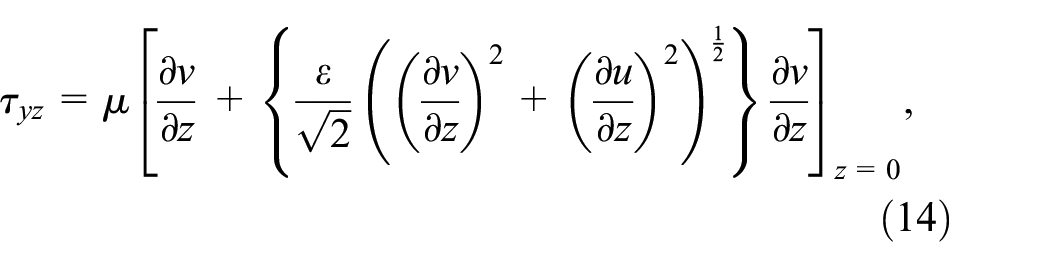
Non-Newtonian materials occur frequently in the universe and these does not obey the stress-strain relationship proposed by Newton. Several researchers proposed non-Newtonian models to study the characteristic of numerous materials in different processes. An important non-Newtonian model for pseduplastic material was proposed by Williamson, whose constitution relation is given by
Several researchers have worked on Williamson model. For instance, Tlili et al.1 discussed the mass and heat transport in Williamson model in Darcy-Forchheimer medium. An involvement of chemical reaction. Viscous dissipation, and magneto-hydrodynamic effects are analyzed. They studied the thermal transport with entropy analysis. They solved the equations numerically and impact of different influential parameters on solution profiles deliberated through graphs. They recorded the increase in entropy against diffusion parameter and concentration difference parameter. Salahuddin et al.2 worked on Williamson model with variable diffusivity, thermal conductivity, and viscosity. They recorded a decline in velocity field against viscosity parameter. Moreover, an enhancement in concentration field is observed against diffusion parameter. Hamid3 solved the unsteady problem for Williamson model with viscosity dissipation, variable thermal conductivity, and homogenous-heterogeneous reaction. They used shooting method for the transformed problem. They recorded the decline in velocity against material parameter and an increase in thermal profile. Dawar et al.4 used the concept of activation energy to study the Williamson model. They computed some important physical quantitation and presented the homotopic solution. They observed an enhancement in heat transfer rate against Prandtl number, whereas diffusivity parameter increases the mass transfer rate. Khan et al.5 studied the Williamson slip flow with double diffusion models over a porous stretching sheet. They recorded the depreciation in surface drag against fluid parameter. Contribution of inclined magnetic field on heat and mass transportation in Williamson model was studied by Srinivasulu and Goud.6 They recorded the enhancement in temperature and concentration fields against Biot number. Moreover, the velocity of code is studied by computing the wall dimensionless stress and heat transfer rate. They observed an excellent agreement with the published work.
Several researchers paid their attention on electrically conducting liquids due to their diverse applications and significance in nature for instance, Khan et al.7 studied the contribution of slip on micro-polar MHD viscous model comprising thermal transport under radiation. Numerical solution has been presented and they established the comparative study for dimensionless stress against slip factor and an excellent matching in results are recorded. They noticed the decline in velocity field against slip and magnetic parameters. Investigation for MHD Jeffery flow in a converged/divergent channel with heat transfer via spectral homotopic procedure was reported by Mahmood et al.8 Boundary driven MHD convective flow past over a permeable stretching surface was examined by Rashidi et al.9 They presented the HAM analysis for flow comparative study is presented for the justification of solution and bearing of Biot number on thermal and velocity fields. Nadeem et al.10 examined the MHD flow over a porous stretching surface by engaging numerical procedure. They noticed the increase in dimensionless stress against porosity parameter and magnetic number. Naz et al.11 modeled the MHD bio-convection flow phenomena of Carreau liquid in straight medium. They handled the transformed boundary layer equations analytically. They monitored the increase in velocity field for curvature parameter. Boundary driven MHD convective flow past over a permeable stretching surface was examined by Rashidi et al.9 They presented the HAM analysis for flow comparative study is presented for the justification of solution and bearing of Biot number on thermal and velocity fields. Arifuzzaman et al.12 investigated the natural convective MHD chemically reactive viscous fluid with heat transportation. They presented the convergence and stability analysis for utilized numerical procedure. Several important physical effects are taken while modeling the conservation laws. They observed the increase in velocity field got Darcy number and depreciation in thermal profile against Dufour parameter. Inc and Akgul13 studied the MHD axisymmetric flow model past over a stretching cylinder by using the concepts of functional analysis. Their investigation analyzing the operator theory and discusses the boundedness. Abel and Mahesha14 studied thermal transport in second grade fluid under several effects. They show the solution graphically and found the increase in temperature profile for radiation parameter, whereas decline for Prandtl number. Heat transport in MHD Maxwell nanofluid with radiation, and Joule heating was reported by Nadeem et al.15 Their modeling of flow situation contains several important parameters and they have made a computational analysis against these influential variables. Rashidi et al.16 studied the heat MHD viscoelastic model analytically. They presented the graphical analysis for the convergence region of the used scheme. Kim et al.17 investigated consequences of energy transfer including effects related to Dufour and Soret using convective boundary conditions. They added nanofluids into heat energy and observed absorption phenomena regarding heat energy. RamReddy et al.18 used mixed boundary conditions to derived heat transfer aspects considering Soret effect along with nanoparticles. Ho et al.19 numerical studied of flow related to buoyancy in heated cavity adding nanofluids via Ludwig–Soret impact. Iasiello et al.20 adopted curved artery to analyze influences hyperthermia and Hypo via experiment and numerically studied. Iasiello et al.21 performed model regarding transport of hyperthermia studied internal and external in arterial wall under action of a stenosis. Alam et al.22 discussed characteristics of energy transfer in heated triangular shape using micro-pin-fin. Ganesh Kumar et al.23 studied rheology of hyperbolic tangent martial in the presence of activation energy using zero mass condition. Saha et al.24 captured investigations aerosol particle in view of CT-scan considering mouth-throat approach. Bit et al.25 securitized 3D model based on hemodynamic of stenosed artery adopting outlet BCs (boundary conditions). Kumar et al.26 discussed a novel approach related hybrid nanofluid in ferromagnetic liquid under action solar radiation. Some additionally benchmarks covering several effects are covered in Ali et al.,27 Vaidya et al.,28 Sohail et al.,29,30 Hayat et al.,31 Sohail and Tariq.32
Current investigation covered the mass and heat transport in Williamson model under several effects. This report is organized as follows: section “Introduction” covers the literature survey, modeling is included in section “Mathematical formulation of transport problem,” section “Numerical method for solution” discusses the methodology, results analysis is drafted in section “Discussion and analysis on graphical and tabular results,” and important findings of current work are mentioned in section “Conclusion and key findings of performed investigation.”
Mathematical formulation of transport problem
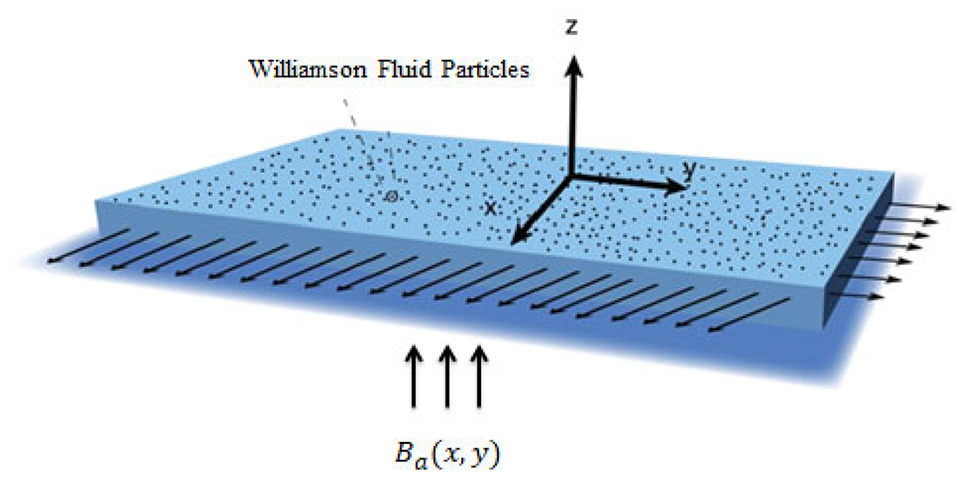
Flow of Williamson model over a nonlinear stretching surface as shown in Figure 1 is considered. Bi-directional stretched surface cause to maintain the flow situation having are the velocity at sheet, temperature is presented by and the concentration. Flow occupies the region Following important physical assumptions have been made.
Incompressible 3D nonlinear flow is considered;
Williamson fluid rheology is addressed;
Steady flow is assumed;
Heat and mass transport is analyzed;
Modified Fourier and Fick’s laws (Cattaneo-Christov theory) is considered;
Thermophoresis is captured;
Variable magnetic field is inserted;
Brownian motion is added;
Single phase nanofluid model is assumed;
Boundary layer approximation is taken out.
Sketched flow behavior of Williamson fluid.
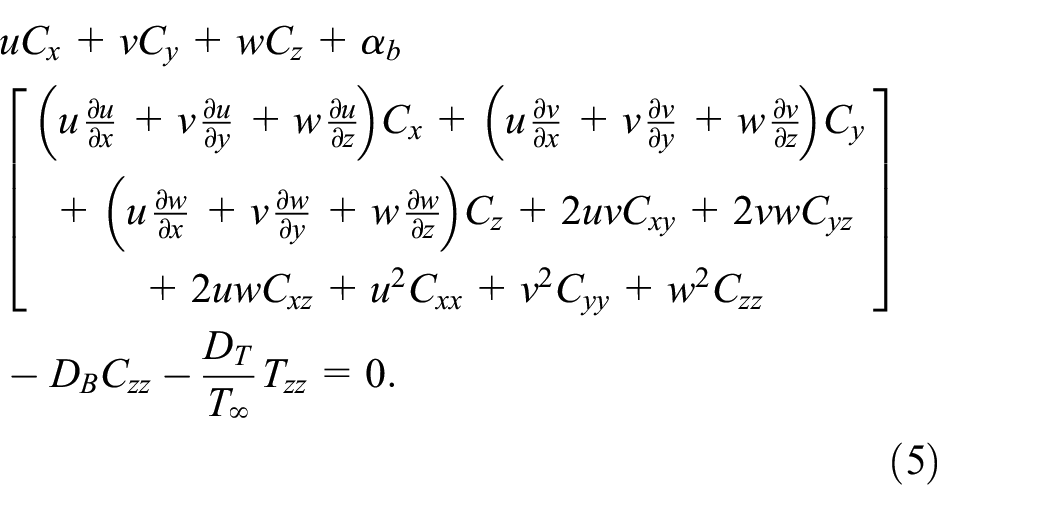
With above stated considerations, boundary layer equations are
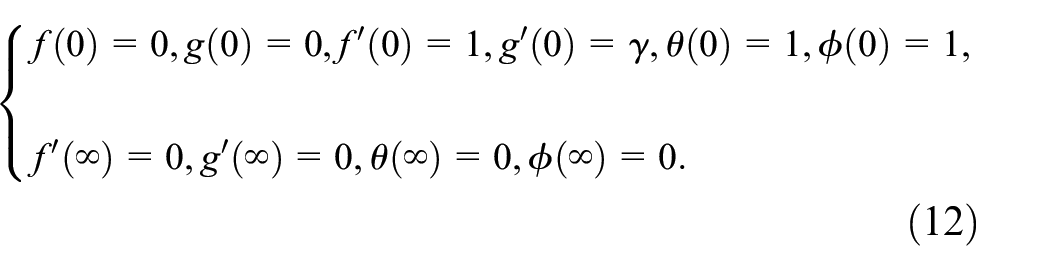
Boundary conditions for the dimensional problem are
With the use of following similarity variables governing laws reduces to
The velocity components in , , and axes are denoted by and respectively, fluid temperature by , fluid density by , electrical conductivity is represented by , magnetic field strength by , Kinematics viscosity , Williamson model parameter thermal relaxation time by , heat capacities ratio by , ambient temperature by , diffusion coefficient by , the thermophoresis coefficient, concentration field by , the concentration relaxation time, specific heat by , power index , dimensionless velocity by the dimensionless independent variable, dimensionless temperature, dimensionless concentration by dimensionless Williamson fluid parameter , magnetic parameter Prandtl number , thermophoresis parameter and Brownian motion parameter, ratio parameter , , thermal relaxation and concentration relaxation parameters, Schmidt number denoted by .
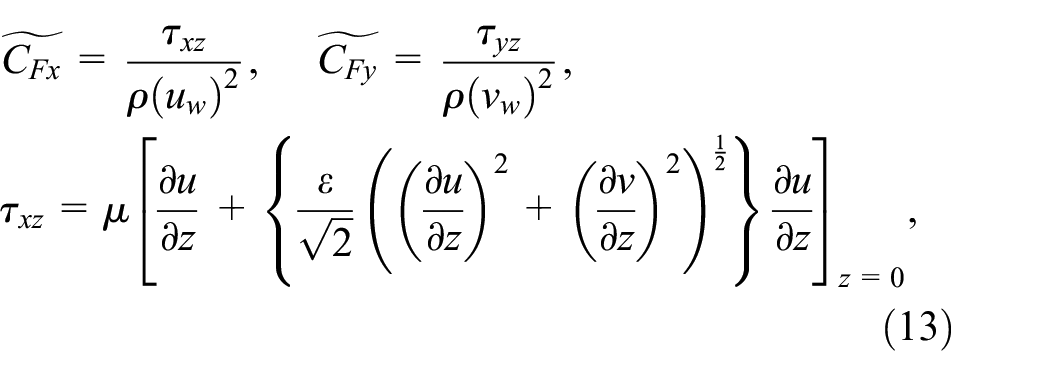
Physical quantities
Mathematical expression for the skin friction coefficients, heat and mass transportation rates are
The dimensionless forms after boundary layer theory is
Numerical method for solution
The solution of arising mathematical model is essential to understand the physics behind them. This section covers the necessary steps for adopted procedure. It has following steps
Linear operator selection;
Using the boundary data;
Determination of unknown constants;
Adopting of initial guesses;
This procedure requires the linear operators and initial guess for the start of algorithm. These are
Using the concepts of minimization of average squared residual error11,29,30,33
where
The minimum error at third order is and optimal values at third order are by fixing the involved parameters as as mentioned in Table 1.
Computation of averaged squared residuals errors of velocity, temperature, and concentration solution.
m
2
4
8
12
16
20
Discussion and analysis on graphical and tabular results
The assessments of developed flow model (3D) are fabricated in Williamson liquid under the action of Brownian motion and magnetic field (variable). The concept of Fourier’s theory is inserted in mass and energy equations in the presence of thermophoresis whereas assumptions are considered over a melting surface. The simulations in view of motion (fluid particles), thermal energy, and mass versus variation in various parameters are captured via numerical approach. The important discussion related to current flow model is discussed below:
Distribution of flow mechanism
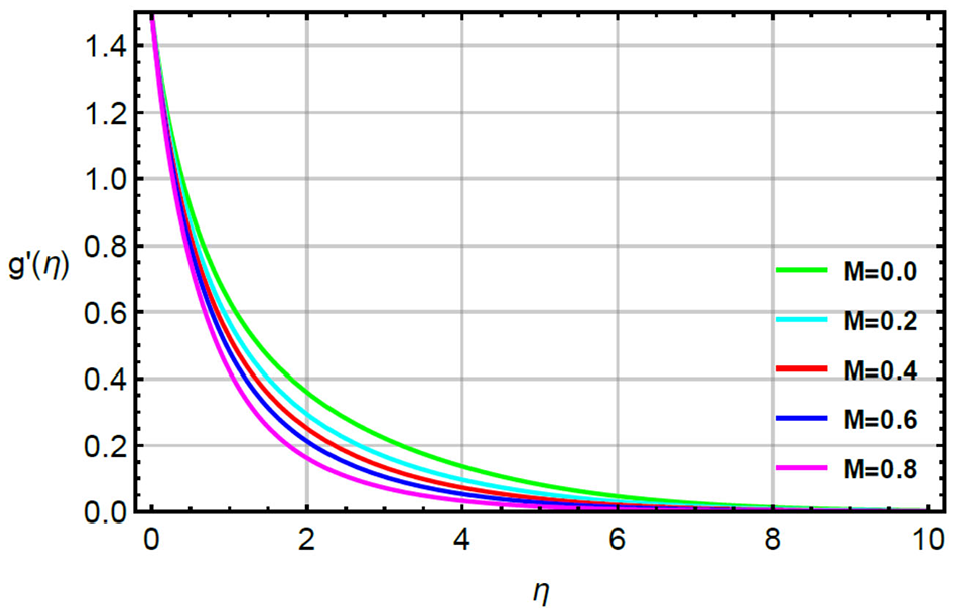
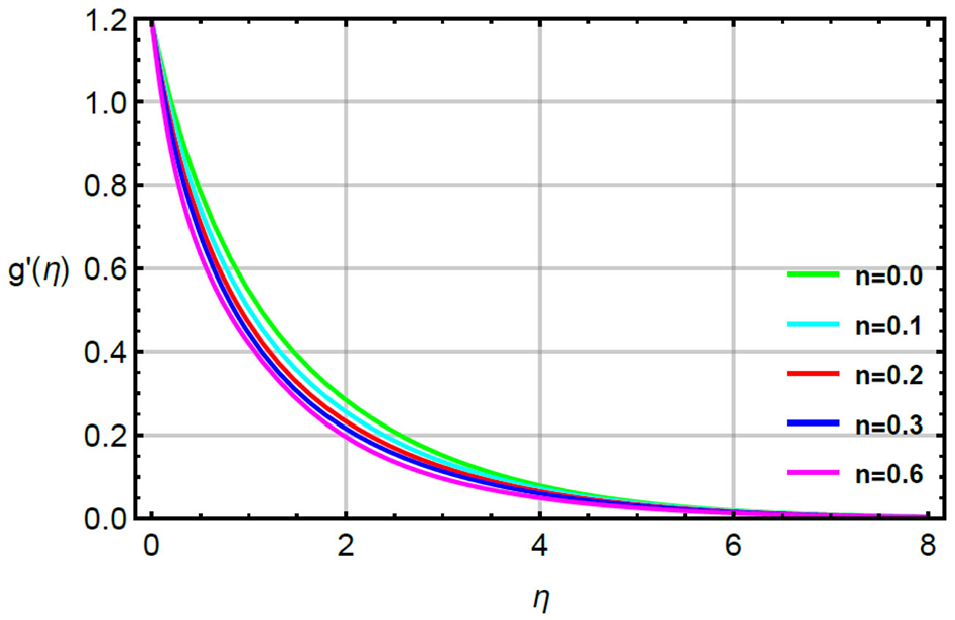
The variation in fluid particles versus (magnetic number) , (Williamson number) , (power index number) , and (ratio number) is captured by Figures 2 to 9 in the presence of variable magnetic number. The distribution in fluid particles is measured with respect to variable magnetic number via Figures 2 and 5. The frictional force is occurred in fluid particles under the action volitional impact in magnetic number whereas this frictional force called drag force (Lorentz force) creates frictional during the flow of fluid particles. Therefore, variable magnetic force is not suitable to attain the maximum flow of fluid particles due to Lorentz force (negative). Further, from these figures flow in view of secondary and primary directions is reduced due to appearance Lorentz force (negative) in momentum (dimensionless) equations. The flow in the absence of magnetic number (variable) is higher than that flow in the presence of magnetic number. Physically, applied magnetic field is inserted along perpendicular direction of heated surface. But flow of fluid is against direction of applied variable magnetic field. Therefore, frictional force is occurred among layers of fluid. Layers based on momentum boundary are decreased when applied variable magnetic field is inserted. Figures 3 and 6 appear the motion in fluid particles against large values of It is observed that appearance of in momentum (dimensionless) equations is due to transformations. The velocity curves in both directions (vertical and horizontal) are reduced using higher values of . The situation of flow (vertical and horizontal) in rheology of Williamson liquid becomes fast for as compared that flow (vertical and horizontal) for the case . The thickness in (MBL) is also reduced using higher values of The behavior of velocity curves (vertical and horizontal) is captured with respect to (see Figures 4 and 7). The Williamson number is occurred in momentum (dimensionless) equations due to appearance tensor of Williamson liquid. Further, it is noticed that fluid layers for momentum boundary are decreasing function versus an implementation of n. The character of in current flow model plays a vital role regarding simulations of velocities in y- and x-directions. From physical point of view, Williamson number is modeled due to division of relaxation and retardation times whereas retardation time is reduced due to higher values of Williamson number. This reduction in retardation time generates the resistance force in fluid particles. Hence, less acceleration in fluid particles is generated. In simple arguments, the flow in y- and x-directions becomes slow using higher values of Williamson number. An appearance of Williamson liquid generates more motion rather than disappearance of Williamson rheology in view of motion. Layers based on momentum are also decreased when Williamson number is increased. Figure 9 depicts the graphical simulations against The enlargement in flow situation (vertical and horizontal) is measured using various values of From mathematical point of view, the fraction between stretching rates (y- and x-directions) is called . The more stretching for surface is responsible for reduction in the resistance force regarding fluid particles. Consequently, flow situation (vertical and horizontal) becomes fast and increasing function versus Basically, motion into particles is generated using stretching of surface. Therefore, flow becomes fast due to higher stretching number whereas thickness based on momentum layers is increased when stretching number is increased.
Behavior of for .
Behavior of for .
Behavior of for .
Behavior of for .
Behavior of for .
Behavior of for .
Behavior of for .
Behavior of for .
Distribution of thermal mechanism
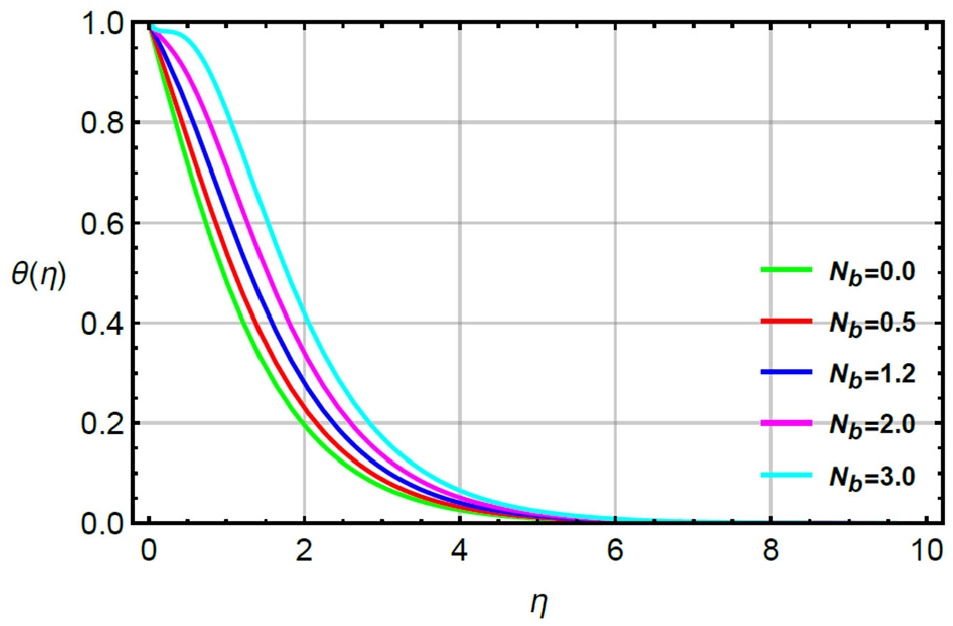
Thermal mechanism is verified using the impacts of , and . The outcomes regarding these influences are fabricated by Figures 9 to 11. The variation in thermal energy is captured versus enlargement in (see Figure 9). The reduction in TBL (thermal boundary layer) is simulated via . The decreasing role in TBL due to . It is also predicted that depresses the thermal conductivity. Therefore, large values of is suitable parameter to make the enhancement in thermal conductivity. Maximum amount of heat energy is produced against higher values of Physically, Prandtl number is used to measure layers based on thermal as well as momentum. Therefore, measurement of momentum as well as thermal layers is based on Prandtl number. Momentum and thermal layers can be controlled using numerical values of Prandtl number. Figure 10 reveals outcomes of The maximum enhancement in thermal performance is achieved considering higher values of Hence, is favorable for achieving the large amount in thermal performance. This maximum amount in thermal energy is obtained due to random motion in fluid particles while random motion in fluid particles make a reason for achieving maximum production of heat energy. Maximum random motion is produced into particles during flow over a surface which is based on . Due to random motion into particles generates maximum amount of heat energy into particles. TBL is also adjusted via enlargement in Figure 11 exhibits the role of on thermal energy. acts as a thermal migration of fluid particles and increases the thermal energy of fluid particles. Meanwhile, temperature curves are increased versus large Moreover, concept regarding thermophoresis is developed by suspension of fluid particles under the action of temperature gradient. Thermal gradient produces reduction in heat energy.
Behavior of for .
Behavior of for .
Diffusion of mass transport
The aspects of thermal energy is fabricated versus large values of , and whereas these aspects regarding diffusion of mass are captured by Figures 12 to 14. Figure 12 demonstrates the characterization of on diffusion of mass. The distribution in diffusion of fluid particles becomes slow by adding the appearance of It is indicated that is constructed using the concept of momentum (diffusivity) and mass (diffusivity) in concentration equation. From the mathematical of view, the fraction between momentum (diffusivity) and mass (diffusivity) is called . So, large makes the reduction in mass (diffusivity). Therefore, diffusion of mass particles is reduced. Further, CBLT (concentration boundary layer thickness) becomes thick versus large Basically, inverse relation is noticed versus an impact of Schmidt number. The procedure of concentration phenomena becomes slow down because of an enhancement of mass (diffusivity). Diffusion into particles is also slow down. The role of on the diffusion of mass particles is illustrated by Figure 13. This type of force (thermophoresis) is occurred due to temperature gradient due movement of particles toward the cold wall. Moreover, concept regarding thermophoresis is developed by suspension of fluid particles under the action of temperature gradient. Thermal gradient produces reduction in heat energy. Meanwhile, the diffusion in mass particles is increased considering large . Figure 14 captures the characterization of on mass transport. This motion (Brownian motion) generates random motion in fluid particles. So, random motion of fluid particles makes the low concentration into fluid particles. Consequently, diffusion of fluid (particles) becomes slow conceding large .
Behavior of for .
Behavior of for .
Behavior of for .
Distribution of temperature gradient, shear stresses, and concentration gradient
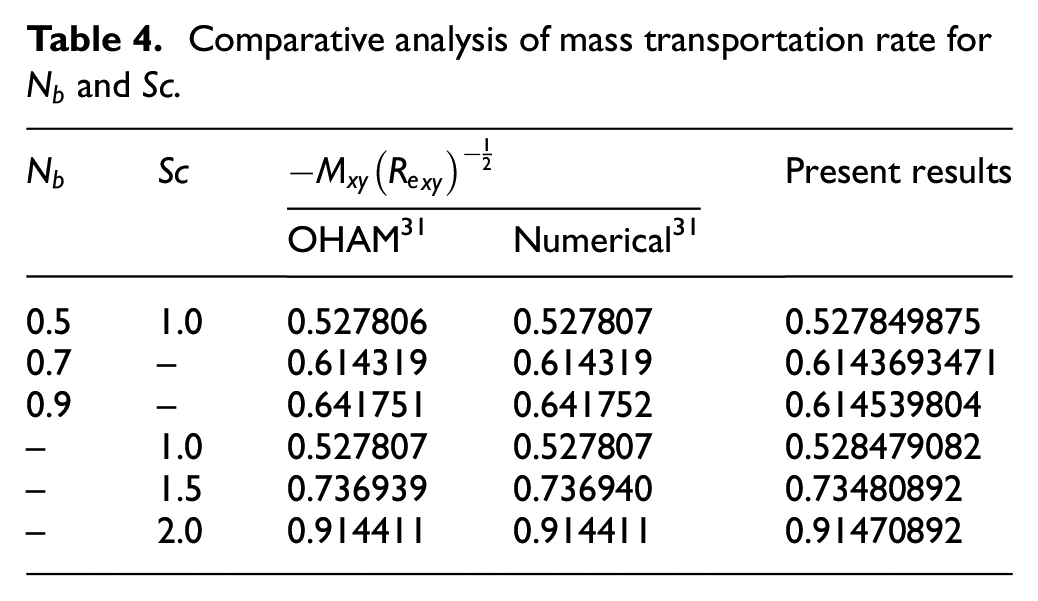
The distribution of temperature gradient, shears stresses and concentration gradient versus , , and is fabricated by Tables 2 to 4. The shear stresses in view of y- and x-directions is measured considering large values of and (see Table 2). In this table, flow situation for divergent velocities is enhanced versus large and . This validation in view of shear stresses is simulated with published work.31 The change in gradient thermal energy versus large values of and is fabricated in Table 3. The higher production is obtained considering the higher values of and The comparison of gradient temperature is also validated with published work.31 The outcomes of concentration gradient called Sherwood against the large values of and The rate of diffusion in fluid particles is increased when and are enlarged. The validation outcomes regarding concentration are obtained with published study31 (see Table 4).
Comparative analysis for dimensionless stress against and by fixing the other parameters.
Conclusion and key findings of performed investigation
The numerical assessment of mass and heat transfer in rheology of Williamson liquid influenced by Brownian motion and thermophoresis past a melting 3D surface is considered. The theory of Fourier’s law is added in mass and heat energy equations under magnetic field (variable). The numerical scheme is used to obtain numerical simulations of current 3D model. The consequences of developed flow model are captured below:
The applications of magnetic field (variable), Williamson number, and index number make reduction in flow;
The flow of fluid is significantly improved by increasing values of stretching ratio number;
The maximum production in thermal energy is obtained using large values of Brownian motion and thermophoresis;
TBL (thermal boundary layers) become shorter against variation in Prandtl number;
The opposite trend in view of concentration is estimated versus Brownian motion and thermophoresis;
These consequences are used in the applications like improvement in thermal energy, recovery in petroleum, adjusting cooling (devices), and energy devices;
Diffusion into concentration becomes slow down when Schmidt number is decreased;
Opposite trend is noticed into mass diffusion versus impacts of Brownian motion and thermophoresis;
Coefficients associated with drag forces in vertical and horizontal directions are declined versus large values of magnetic field while drag force coefficient is enhanced versus higher impact of Prandtl number.
Footnotes
Handling Editor: Chenhui Liang
Declaration of conflicting interests
The author(s) declared no potential conflicts of interest with respect to the research, authorship, and/or publication of this article.
Funding
The author(s) received no financial support for the research, authorship, and/or publication of this article.
ORCID iDs
Muhammad Sohail
Wasim Jamshed
Data availability
The data used to support this study are included in the manuscript.
References
1.
TliliIKhanMSalahuddinT, et al. Entropy generation minimization and chemical response for Williamson fluid flow with thermal diffusion. Appl Nanosci2020; 10: 3123–3131.
2.
SalahuddinTKhanMSaeedT, et al. Induced MHD impact on exponentially varying viscosity of Williamson fluid flow with variable conductivity and diffusivity. Case Stud Therm Eng2021; 25: 100895.
3.
HamidA. Numerical study of temperature dependent thermal conductivity and homogeneous-heterogeneous reactions on Williamson fluid flow. J Phys Commun2020; 4: 085009.
4.
DawarAShahZIslamS. Mathematical modeling and study of MHD flow of Williamson nanofluid over a nonlinear stretching plate with activation energy. Heat Transf2021; 50: 2558–2570.
5.
KhanMIAlzahraniFHobinyA, et al. Modeling of Cattaneo-Christov double diffusions (CCDD) in Williamson nanomaterial slip flow subject to porous medium. J Mater Res Technol2020; 9: 6172–6177.
6.
SrinivasuluTGoudBS. Effect of inclined magnetic field on flow, heat and mass transfer of Williamson nanofluid over a stretching sheet. Case Stud Therm Eng2021; 23: 100819.
7.
KhanRMAshrafWSohailM, et al. On behavioral response of microstructural slip on the development of Magnetohydrodynamic micropolar boundary layer flow. Complexity2020; 2020: 1–12.
8.
MahmoodAMdBasirMAliU, et al. Numerical solutions of heat transfer for magnetohydrodynamic Jeffery-Hamel flow using spectral homotopy analysis method. Processes2019; 7: 626.
9.
RashidiMMRostamiBFreidoonimehrN, et al. Free convective heat and mass transfer for MHD fluid flow over a permeable vertical stretching sheet in the presence of the radiation and buoyancy effects. Ain Shams Eng J2014; 5: 901–912.
10.
NadeemSHaqRUAkbarNS, et al. MHD three-dimensional Casson fluid flow past a porous linearly stretching sheet. Alex Eng J2013; 52: 577–582.
11.
NazRTariqSSohailM, et al. Investigation of entropy generation in stratified MHD Carreau nanofluid with gyrotactic microorganisms under Von Neumann similarity transformations. Eur Phys J Plus2020; 135: 178.
12.
ArifuzzamanSMKhanMSMehediMF, et al. Chemically reactive and naturally convective high speed MHD fluid flow through an oscillatory vertical porous plate with heat and radiation absorption effect. Eng Sci Technol Int J2018; 21: 215–228.
13.
IncMAkgülA. Approximate solutions for MHD squeezing fluid flow by a novel method. Boundary Value Probl2014; 2014: 1–17.
14.
AbelMSMaheshaN. Heat transfer in MHD viscoelastic fluid flow over a stretching sheet with variable thermal conductivity, non-uniform heat source and radiation. Appl Math Model2008; 32: 1965–1983.
15.
NadeemSAkhtarSAbbasN. Heat transfer of Maxwell base fluid flow of nanomaterial with MHD over a vertical moving surface. Alex Eng J2020; 59: 1847–1856.
16.
RashidiMMAliMFreidoonimehrN, et al. Mixed convective heat transfer for MHD viscoelastic fluid flow over a porous wedge with thermal radiation. Adv Mech Eng2014; 6: 735939.
17.
KimJKangYTChoiCK. Soret and Dufour effects on convective instabilities in binary nanofluids for absorption application. Int J Refrig2007; 30: 323–328.
18.
RamReddyCMurthyPVChamkhaAJ, et al. Soret effect on mixed convection flow in a nanofluid under convective boundary condition. Int J Heat Mass Transf2013; 64: 384–392.
19.
HoCJChenDSYanWM, et al. Buoyancy-driven flow of nanofluids in a cavity considering the Ludwig–Soret effect and sedimentation: numerical study and experimental validation. Int J Heat Mass Transf2014; 77: 684–694.
20.
IasielloMVafaiKAndreozziA, et al. Hypo-and hyperthermia effects on LDL deposition in a curved artery. Comput Therm Sci2019; 11: 95–103.
21.
IasielloMVafaiKAndreozziA, et al. Effects of external and internal hyperthermia on LDL transport and accumulation within an arterial wall in the presence of a stenosis. Ann Biomed Eng2015; 43: 1585–1599.
22.
AlamMWBhattacharyyaSSouayehB, et al. CPU heat sink cooling by triangular shape micro-pin-fin: numerical study. Int Commun Heat Mass Transf2020; 112: 104455.
23.
Ganesh KumarKBaslemAPrasannakumaraBC, et al. Significance of Arrhenius activation energy in flow and heat transfer of tangent hyperbolic fluid with zero mass flux condition. Microsyst Technol2020; 26: 2517–2526.
24.
SahaSCIslamMSRahimi-GorjiM, et al. 2019. Aerosol particle transport and deposition in a CT-scan based mouth-throat model. In: AIP conference proceedings, vol. 2121, no. 1, p.040011. Melville, NY: AIP Publishing LLC.
25.
BitAAlblawiAChattopadhyayH, et al. Three dimensional numerical analysis of hemodynamic of stenosed artery considering realistic outlet boundary conditions. Comput Methods Programs Biomed2020; 185: 105163.
26.
KumarKGHaniEHBAssadMEH, et al. A novel approach for investigation of heat transfer enhancement with ferromagnetic hybrid nanofluid by considering solar radiation. Microsyst Technol2021; 27: 97–104.
27.
AliBRasoolGHussainS, et al. Finite element study of magnetohydrodynamics (MHD) and activation energy in Darcy–Forchheimer rotating flow of Casson Carreau nanofluid. Processes2020; 8: 1185.
28.
VaidyaHRajashekharCPrasadKV, et al. MHD peristaltic flow of nanofluid in a vertical channel with multiple slip features: an application to chyme movement. Biomech Model Mechanobiol2021; 20: 1047–1067.
29.
SohailMAliUZohraFT, et al. Utilization of updated version of heat flux model for the radiative flow of a non-Newtonian material under joule heating: OHAM application. Open Phys2021; 19: 100–110.
30.
SohailMNazirUChuYM, et al. Bioconvection phenomenon for the boundary layer flow of magnetohydrodynamic Carreau liquid over a heated disk. Scientia Iranica2021; 28: 1896–1907.
31.
HayatTKiyaniMZAlsaediA, et al. Mixed convective three-dimensional flow of Williamson nanofluid subject to chemical reaction. Int J Heat Mass Transf2018; 127: 422–429.
32.
SohailMTariqS. Dynamical and optimal procedure to analyze the attributes of yield exhibiting material with double diffusion theories. Multidiscip Model Mater Struct2019; 16: 557–580.
33.
SohailMShahZTassaddiqA, et al. Entropy generation in MHD Casson fluid flow with variable heat conductance and thermal conductivity over non-linear bi-directional stretching surface. Sci Rep2020; 10: 12530.