Effects of chemical reaction,viscosity,thermal conductivity,heat source,radiation/absorption,on MHD mixed convection nano-fluids flow over an unsteady stretching sheet by HAM and numerical method
Open accessResearch articleFirst published online January, 2022
Effects of chemical reaction,viscosity,thermal conductivity,heat source,radiation/absorption,on MHD mixed convection nano-fluids flow over an unsteady stretching sheet by HAM and numerical method
Investigations are performed for further observations of heat and mass transfer in magneto-hydrodynamic mixed-convectional nano-fluid flow with the assumption of variable viscosity and thermal-conductivity over an unsteady stretching sheet. Base fluid is Carboxy-methyl cellulose (CMC) water as a carrier fluid with different nano-particles such as (Titanium), Ag (Silver), (Aluminum), and Cu (Copper). Flow contains different physical parameters, such as heat source, chemical reaction effect, Schmidt number, and radiation absorptions effects are observed to be significant in the presences of magnetic field. Obtained equations are solved by numerically BVP4C-package (shooting method) and analytically by BVPh2.0-package (Homotopy Analysis Method “HAM”). Interested physical quantities are, viscosity-parameter (A), Thermal-conductivity parameter (N),Thermocapillary-number (M), Hartmann-number (Ma), Prandtl-number (Pr), 4-nano-particles (), temperature Grashof number (), and mass Grashof number () are the focus to the velocity, temperature, and solute concentration profiles. It is concluded that, Solute concentration of ()-water has higher than the other 3-nano-fluids. Mass flux, heat flux, and Skin friction of fluids are direct functions of magnetic force, while inverse function of temperature. Magnetic force also decreased the speed of fluids and hence mass flux reduced which implies that, the temperature reduces. has also inverse relation with mass flux, heat flux, and skin friction, while direct relation with the speed of fluids. Similarly, has inverse relation with , , and , but direct relation with . Different results are shown in graphical and tabular form.
Non-Newtonian fluids are the important class of fluids, where the connection between shear stress and shear rate is non-linear therefore, they are much complicated and not possible to have a single constitutive relation. Large number of non-Newtonian fluids can be found in the literature, for example nano-fluid, Micro-polar fluid, Maxwell fluid, Jeffrey fluid, Casson fluid, second grade fluid, etc. The nano-fluid has been examined widely by the scientists and researchers due to its complicity. Nano-particles are the nano-sized powders consisting of heterogeneous mixture of metallic polymeric or nonmetallic polymeric containing in a base fluid to obtained the best heat transfer rate in many problem. A large number of application based on the nano-fluid due to the requirement of heat transfer to the problem, therefore researchers give full consideration and produce a large number of problems on nano-fluid. Similarly, on manufacturing side large number of applications such as, wire coating, daily life uses equipments, foodstuff processing, polymer extrusion, drawing of plastic sheets, metal extrusion, continuous casting, etc, the nano-fluids plays an important rule over an unsteady free surface flow. Wang1 took the unsteady flow by considering thin film with time dependent stretching surface. Another scientist, Jou and Tzeng2 took the concept of Khanafer to understand the effects of heat transfer under the enclosure nano-fluid for various parameters. Palm et al.,3 heat transfer phenomena is adjusted to the cooling system of flow with the introduce of nano-size particles to the laminar forced-convection flow, and solution of the nano-fluid is done with the help of numerical method. Circular tube considered by Zeinali Heris et al.4 and pass laminar flow of nano-fluid ( water) under forced convection and the temperature of the wall kept constant. Experimental results for suitable parameters of heat transfers are noted. Buoyancy forces are considered by Oztop and Abu-Nada5 for the analysis of heat transfer during nano-fluid flows under the condition that the vertical opposite side walls are flush heaters and solution is discussed by numerical method. Heterogeneous mixture (nano-particles) is considered by Wang and Mujumdar,6 in the base fluid flow under the force convection, this experimental observation is performed on the heat transfer. Meanwhile, Ho et al.7 assumed, that conductivity and viscosity are variables in the presence of free convection, and flow is observed in square area filled with aluminum (nano-fluid-water) while, numerical method is used for discussion. Bazhlekova et al.8 took second grade fluid Reyleigh-Stoks model. Chen et al.9 took second grade fluid and observed there five cases in the micro-tube volume inlet flow with the help of Laplace transform method (technique). Wang at al.10 discussed, second grade fluid with the help of fractional derivatives and solutions are presented with the of numerical and analytical methods. The experts, Dehghan and Abbaszadeh11 took Rayleigh-Stokes model for second grade liquids and numerical technique is used for solution by applying finite element method. Experimental work of Fotukian and Nasr Esfahany12 discussed turbulent flow of convective nano-fluid in a tube for heat transfer, and observed that dilute CuO/water become more dilute (less than 0.24/100) then pressure profile dropped, and when CuO particles increased in water then heat flux increased. Porous inclined plates are chosen by Goyal and Kumari13 for the observation of many physical properties to the MHD convected flow and results are made for different parameters by analytical method. Vertical heated plates are considered by Ghalambaz et al.14 for the nano-size fluid flow with the saturated Darcy porous medium and solved by Numerical method. Further, Haroun et al.15 added unsteady MHD stretching/shrinking sheet and Viscus dissipation term to the work of Ghalambaz et al.14 Some relevant and recent work (from literature) can be seen in Lin et al.16 and Bibi et al.,17 and the corresponding references are there. A special type of particles called GDN (Ginger-derived nano-particles) are discussed by Zhuang et al.19 in the mouse model and found that mice verses alcohol induced liver damages are protected. Some more physical based experts in the same area and their derivation can be seen in resent literature.20–22 Hayat et al.23 considered Copper nano-particles due to its importance in engineering and industry applications for both theoretical and experimental areas. Khan et al..24 presented copper nano-fluids study in the presence of MHD with base fluid is water in two parallel plates. Further, lecturer survey for copper nano-particles can be seen in Toghraie et al.,25 Arqub and Shawagfeh,26 Abu Arqub,27–29 and their references are cited in them.
In the above survey, it is noted that further meaningful models exists for investigation of nano-fluids with the possible physical properties. For this purpose, new nano-particles along with new physical properties are considered for the improvement of sufficient heat and mass transfer. Aluminum, Titanium, Silver, and copper are the considered particles with the most important physical properties, mixed convection, radiation and absorption, Schmidt number, chemical reaction, variables viscosity, thermal-conductivity, and MHD thin film flow. The surface tension is directly dependent on temperature. Different relations are derived between nano-particles with several important physical properties, for the system of partial differential equations describing MHD flow. Momentum profile along with heat and mass transfers of a thin fluid film on an unsteady stretching nonuniform-surface in the presence of external magnetic field are observed. A two dimensional model, nonlinear partial differential equations (PDEs) are found. Considered transformations enable reductions of the model to a coupled system of nonlinear ordinary-differential equations (ODEs). Analytic solution is presented by HAM by HAM package and numerical solution is presented by shooting package, are shown in figures and tables.
Governing equations
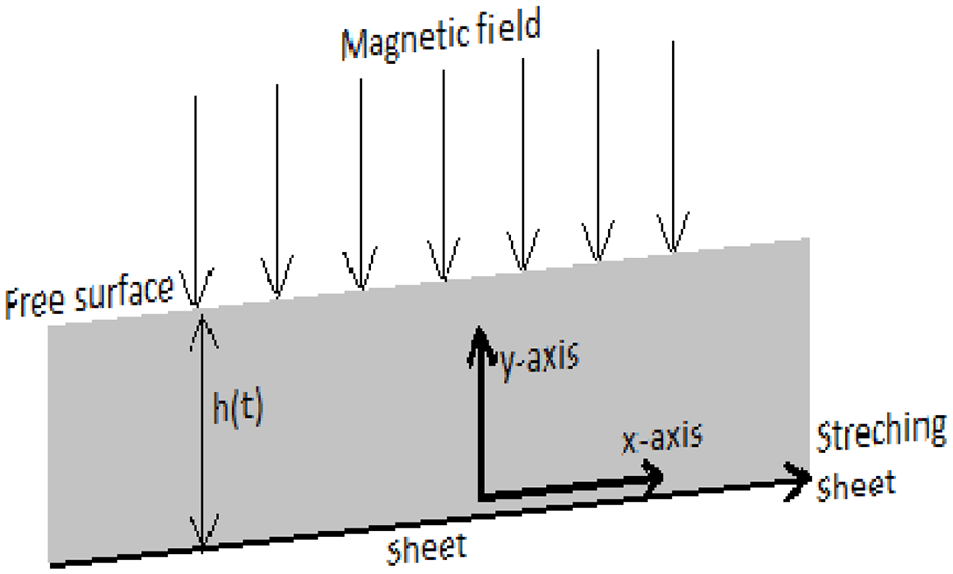
Unsteady flow emerges from a narrow-slit which lying on the origin of the non-rotating frame of reference under the influence of large number of physical properties. Here thickness of the slit is denoted by h(x, t) over a plane sheet with the effect of pressure profile(depend upon velocity). Mass transfer is also focus of this study which are inter related with heat transfer. Infinite stretching sheet is considered along in one direction (x-axis) while the magnetic force () is considered in normal direction (y-axis). Geometry of the two-dimensional nano-fluid flow is given in Figure 1. The very basic equation in fluid dynamics are:
Flow geomatry of the model.
When the fluid is independent of the density then the fluid flow will be incompressible and will be constant therefore the reduce equation will get the form as
The momentum equation is:
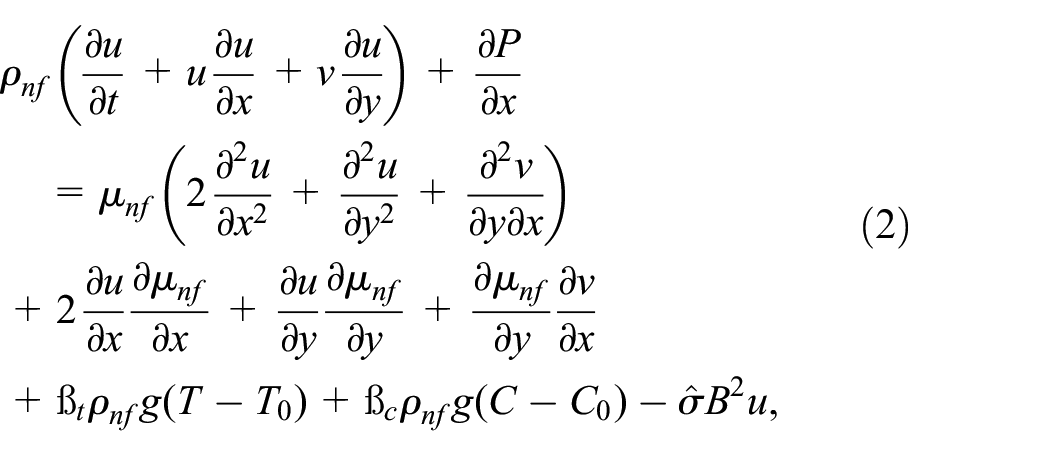
where the acceleration time’s derivative is on left hand side, that is actually the total rate of change of velocity vector with respect to time, while in the above equation the other side (right hand side) expresses the addition of body forces. Surface forces are , Cauchy tensor is denoted by and can be expressed as,
where denote normal stresses and are the shear stresses. Momentum equation in directions along and components are given by
as the gravitational force called body force therefore, the change of gravity will effect the principle of , respectively. Energy equation is:
where is the material derivative, the specific heat, is the constant density, the fluid temperature, the thermal conductivity, and is the dissipation function define as
here the tensor denotes shear stress and indicates velocity gradient. The diffusion equation in three-dimensional (in various forms of documentation) as
which is the very basic equation in fluid dynamics of a concentration equation. The following governing equations are:
The following scaling is used for the governing equations with boundary conditions to transform into their dimensionless form:
Vertical length is denoted by and horizontal is denoted by . The relation represents aspect ratio, sheet surface temperature is denoted by while, fluid surface temperature is . Using (6) (dimensionless scaling) to (1)–(5) and remove asterisk we get:
Here components and are along and axes respectively. represents temperature, electrical-conductivity is expressed by , time is denoted by , represents kinamatic viscosity, and is density, is viscosity, while is the thermal-conductivity, and the surface-tension is quadratically varied with temperature18:
the positive is liquid property. Lin et al.16 introduced thermophysical properties as:
the notion denote solid volume fraction of nano-size particles. Here, , , , and are different notations used for, viscosity, temperature diffusivity, temperature conductivity, and density of the effective nano-fluids. Similarly, , , , and are different notations used for, dynamic-viscosity, density, thermal conductivity, and heat-capacity of the base fluid. Further more, , , and are different notations used for, density, thermal conductivity, and heat-capacity of nano-particles. Dandapait et al.30 and Liue and Andersson31 introduced Surface scratching velocity as:
the notions and represents positive constants. is called initial stretching rate and called effective stretching rate.
denote surface (temperature) and denote sheet (temperature), where denote constant reference (temperatures) ∀. Converting PDEs to ODEs, below given transformations are to be used:
is the new similarity-variable and non-dimensional film-thickness.32,33 Variable-viscosity and thermal-conductivity are and . Similarly, base-fluid viscosity and base-fluid thermal-conductivity are and . Temperature difference with constants , are the viscosity parameter and thermal conductivity parameter respectively. The obtained transformed-equations from previous equations (7)–(12) are:
Subject to the attached boundary conditions:
here prime represents, derivatives of the functions with the new variable where, the non-dimensional represents film-thickness, , , , , are the time dependent parameter, magnetic number, thermal Grashof number, and mass Grashof number. Further, , , , , , and , are heat source, Schmidt number, chemical reaction parameter, Prandtl number, Thermocapillary number, and radiation absorption number, respectively.
HAM34 is used for the result of equations (18)–(20) and initial guesses are:
Auxiliary linear operators are , , and as:
are integral constants.
Nusselt number, Skin-friction coefficient, and Sherwood number
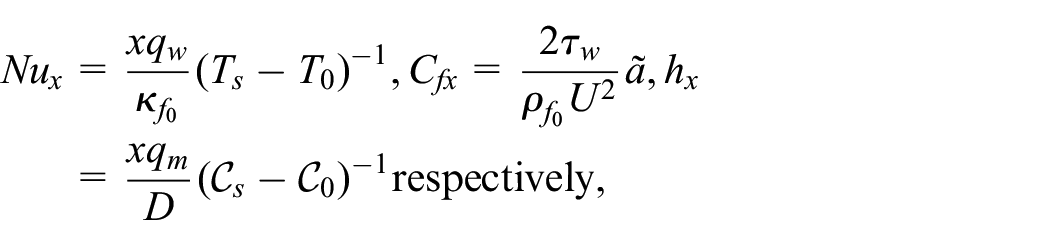
Some interesting, physical numbers are , , and are:
Where (heat transfer from sheet), (shearing-stress at surface of wall), and (mass-flux at surface of wall) respectively, as shown below:
Where, is viscosity and is thermal conductivity of the nano-fluid. With the use of mention transformation, we obtained as:
The expression is a local Reynolds number.
Optimal-convergence control parameters
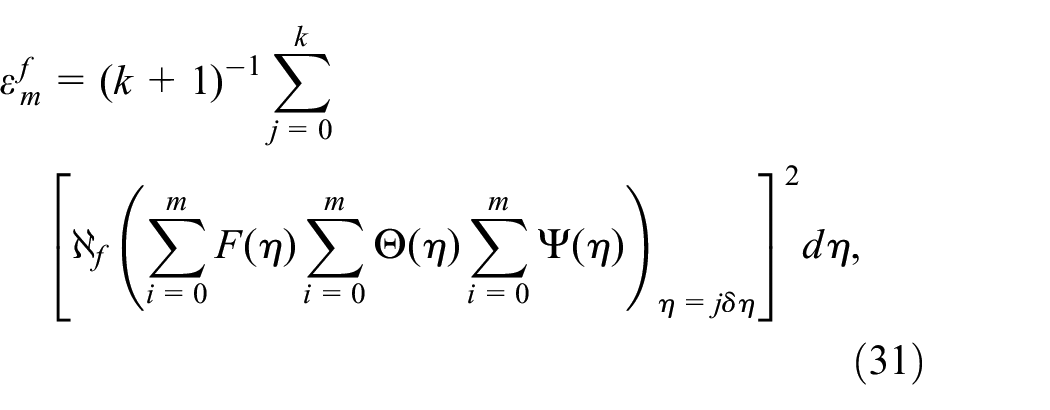
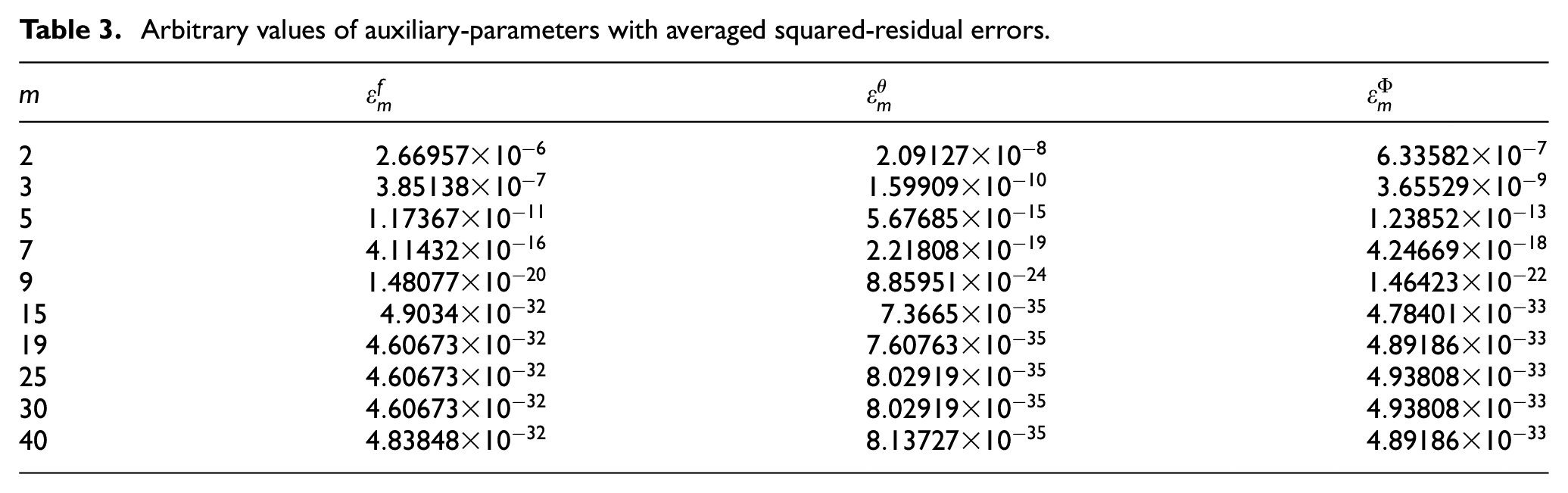
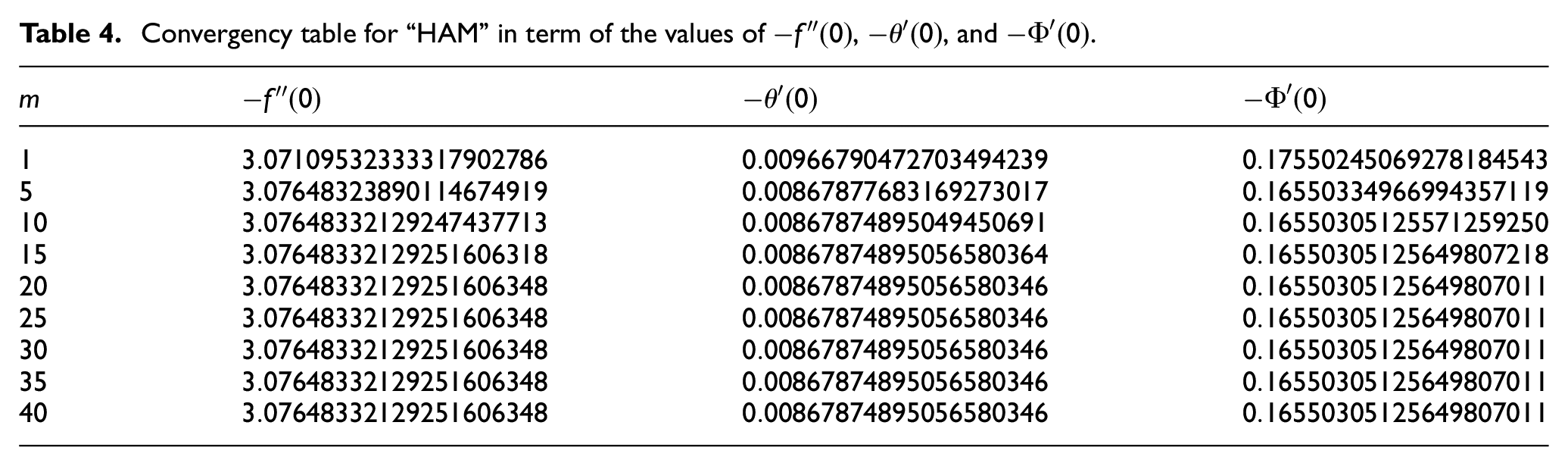
Before the discussion of the problem by HAM, here we check the validity of the method and therefore first present error analysis. For this purpose, we draw Figure 2 and constructed Tables 2 to 4. Minimum error is chosen for the HAM-package (BVPh2.0) during solution procedure. Plus point of the package is the auxiliary parameters, that is , , are available for the predication of the solution region, during solution algorithm. These auxiliary numbers are used for the average residual error to their optimal values introduced by Liao35 as:
Using HAM package where , , , , , , , , , , , , , , , , , , and for observing diferent errors.
The expression is used to represent, the summation of square residual error, for the fixed value of , and . A package ( package BVPh2.0) was introduced by Zhao36 to minimize the total average squared residual error. Different values of parameters are considered to observe errors for arbitrary order of approximation.
The value of (viscosity-parameter) is increased and the remaining all parameters are kept constants, as , , , , , , , , , , , , , , , , , , , and . Figure 2 shows that, maximum average squared residual-error decreased as the order of approximation increased for the corresponding value of . In Figure 2, , , and are also discussed for different values of .
Nano-fluid properties12,37 are listed in the Table 1, where water is base fluid and the other nano-fluid particles are , , , and . Convergence control-parameter with the minimum-values of total averaged squared residual error versus different orders of approximation where, , , , , , , , , , , , , , , , , , , , , and as shown in Table 2. Optimal values are the self selection of the package (BVPh2.0) therefore, different orders of approximation to the individual average-squared residual-errors shown in Table 3, for , , , , , , , , , , , , , , , , , , , , and . In Table 4, order of approximation gives decimal places accuracy of for , , , , , , , , , , , , , , , , , , , , and .
Convergence control-parameter with the total averaged squared residual error values, versus different orders of approximation.
2
−0.460411
−0.430624
−0.965284
3
−0.499334
−0.454133
−0.938005
4
−0.439808
−0.452610
−1.015860
5
−0.498697
−0.438797
−0.941023
6
−0.472116
−0.428209
−1.010350
Arbitrary values of auxiliary-parameters with averaged squared-residual errors.
2
3
5
7
9
15
19
25
30
40
Convergency table for “HAM” in term of the values of , , and .
1
5
10
15
20
25
30
35
40
Results and discussion
Investigation is made for the flow of nano-fluid over a stretching sheet, in which CMC-water has base-fluid with the involved nano-particles of Titanium, Aluminum, Silver, and Copper. Interesting results are obtained by BVP4C and HAM. Meaning full results of , and due to the variations of , and shown in Table 5. While, Tables 6 to 15 are made for the observations of , , , , , , , , and on , , , , and .
Variations of , , and on , ”, ”, , and by using order HAM ( package), where , , , , , , , , , , , , , , , , , , and .
−0.434883
−0.462200
−0.945527
0.098721
−3.07867
1.00479
−0.00627683
0.165503
−0.509409
−0.415644
−0.971426
0.088721
−3.07584
1.00436
−0.00573356
0.149368
−0.439945
−0.466722
−0.950890
0.078721
−3.07300
1.00392
−0.00517037
0.133097
−0.451238
−0.460377
−1.011950
0.068721
−3.07014
1.00347
−0.0045869
0.116688
−0.507471
−0.416417
−0.966934
0.098721
−3.07358
1.00271
−0.00355292
0.165505
−0.448828
−0.456536
−0.996059
0.088721
−3.07123
1.00247
−0.00324491
0.149369
−0.503311
−0.425872
−0.974448
0.078721
−3.06888
1.00222
−0.00292572
0.133098
−0.501097
−0.430809
−0.978096
0.068721
−3.06652
1.00196
−0.00259517
0.116688
For, , , , , , , , , , , , , , , , , , , and varying , the comparisons between analytical HAM, and numerical BVP4C package of , , , , and .
HAM
BVP4C
0.04
0.0987
−3.07774
1.00771
−0.0100
0.16550
−3.07774
1.007710
−0.0101
0.16550
0.08
0.0887
−3.07610
1.00623
−0.0080
0.14936
−3.07610
1.006231
−0.0081
0.14936
0.12
0.0787
−3.07370
1.00499
−0.0063
0.13309
−3.07370
1.004985
−0.0065
0.13309
0.16
0.0687
−3.07077
1.00393
−0.0049
0.11668
−3.07076
1.003931
−0.0051
0.11668
0.04
0.0987
−3.07855
1.00764
−0.0011
0.16550
−3.07855
1.007637
−0.0100
0.16550
0.08
0.0887
−3.07742
1.00611
−0.0008
0.14936
−3.07741
1.006113
−0.0080
0.14936
0.12
0.0787
−3.07527
1.00484
−0.0005
0.13309
−3.07526
1.004842
−0.0063
0.13309
0.16
0.0687
−3.07238
1.00378
−0.0003
0.11668
−3.07238
1.003779
−0.0049
0.11668
0.04
0.0987
−3.07491
1.00772
−0.0101
0.16550
−3.07490
1.007717
−0.0101
0.16550
0.08
0.0887
−3.07152
1.00624
−0.0082
0.14936
−3.07151
1.006240
−0.0082
0.14936
0.12
0.0787
−3.06823
1.00499
−0.0065
0.13309
−3.06823
1.004993
−0.0065
0.13309
0.16
0.0687
−3.06509
1.00394
−0.0052
0.11668
−3.06509
1.003938
−0.0052
0.11668
0.04
0.0987
−3.07520
1.00783
−0.0102
0.16550
−3.07519
1.007830
−0.0102
0.16550
0.08
0.0887
−3.07198
1.00642
−0.0084
0.14936
−3.07198
1.006419
−0.0084
0.14936
0.12
0.0787
−3.06878
1.00520
−0.0068
0.13309
−3.06878
1.005204
−0.0068
0.13309
0.16
0.0687
−3.06566
1.00416
−0.0054
0.11668
−3.06566
1.004157
−0.0054
0.11668
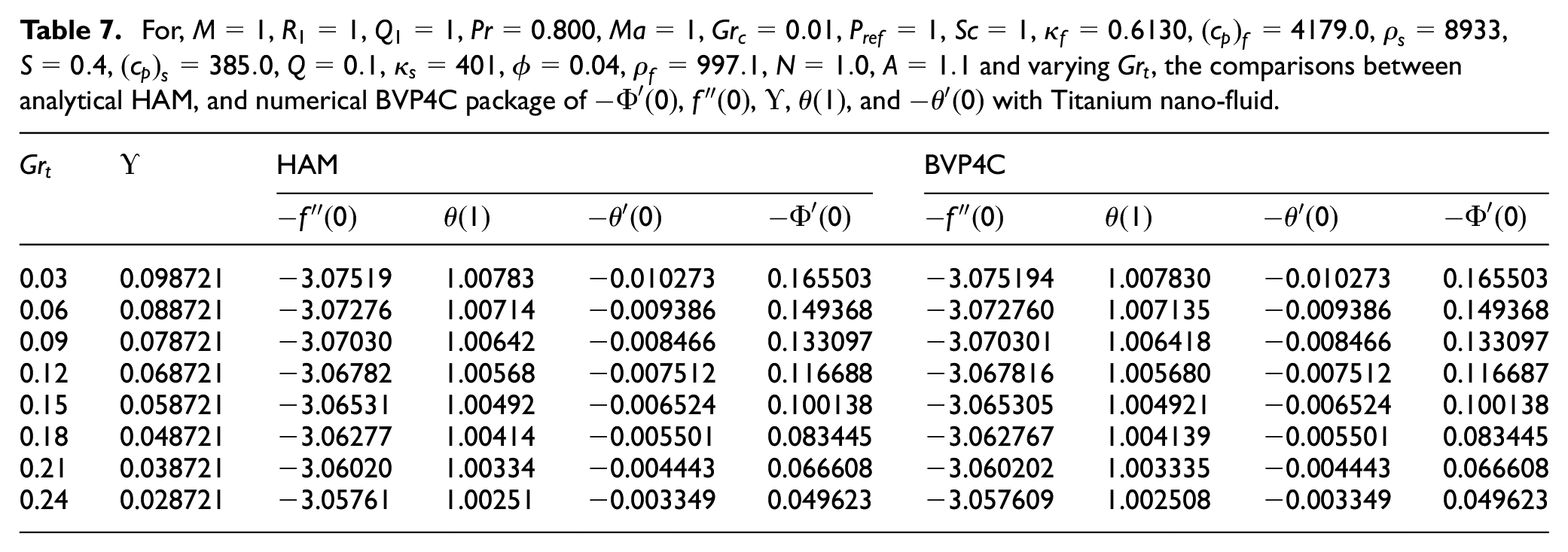
For, , , , , , , , , , , , , , , , , , , and varying , the comparisons between analytical HAM, and numerical BVP4C package of , , , , and with Titanium nano-fluid.
HAM
BVP4C
0.03
0.098721
−3.07519
1.00783
−0.010273
0.165503
−3.075194
1.007830
−0.010273
0.165503
0.06
0.088721
−3.07276
1.00714
−0.009386
0.149368
−3.072760
1.007135
−0.009386
0.149368
0.09
0.078721
−3.07030
1.00642
−0.008466
0.133097
−3.070301
1.006418
−0.008466
0.133097
0.12
0.068721
−3.06782
1.00568
−0.007512
0.116688
−3.067816
1.005680
−0.007512
0.116687
0.15
0.058721
−3.06531
1.00492
−0.006524
0.100138
−3.065305
1.004921
−0.006524
0.100138
0.18
0.048721
−3.06277
1.00414
−0.005501
0.083445
−3.062767
1.004139
−0.005501
0.083445
0.21
0.038721
−3.06020
1.00334
−0.004443
0.066608
−3.060202
1.003335
−0.004443
0.066608
0.24
0.028721
−3.05761
1.00251
−0.003349
0.049623
−3.057609
1.002508
−0.003349
0.049623
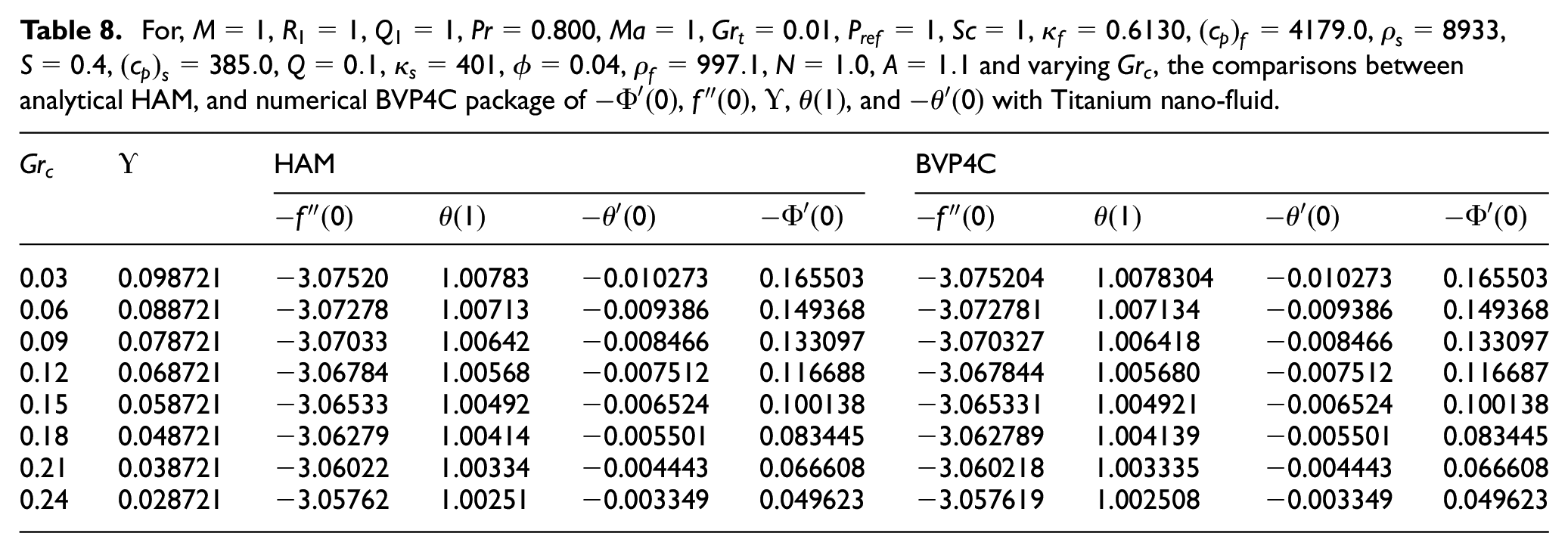
For, , , , , , , , , , , , , , , , , , , and varying , the comparisons between analytical HAM, and numerical BVP4C package of , , , , and with Titanium nano-fluid.
HAM
BVP4C
0.03
0.098721
−3.07520
1.00783
−0.010273
0.165503
−3.075204
1.0078304
−0.010273
0.165503
0.06
0.088721
−3.07278
1.00713
−0.009386
0.149368
−3.072781
1.007134
−0.009386
0.149368
0.09
0.078721
−3.07033
1.00642
−0.008466
0.133097
−3.070327
1.006418
−0.008466
0.133097
0.12
0.068721
−3.06784
1.00568
−0.007512
0.116688
−3.067844
1.005680
−0.007512
0.116687
0.15
0.058721
−3.06533
1.00492
−0.006524
0.100138
−3.065331
1.004921
−0.006524
0.100138
0.18
0.048721
−3.06279
1.00414
−0.005501
0.083445
−3.062789
1.004139
−0.005501
0.083445
0.21
0.038721
−3.06022
1.00334
−0.004443
0.066608
−3.060218
1.003335
−0.004443
0.066608
0.24
0.028721
−3.05762
1.00251
−0.003349
0.049623
−3.057619
1.002508
−0.003349
0.049623
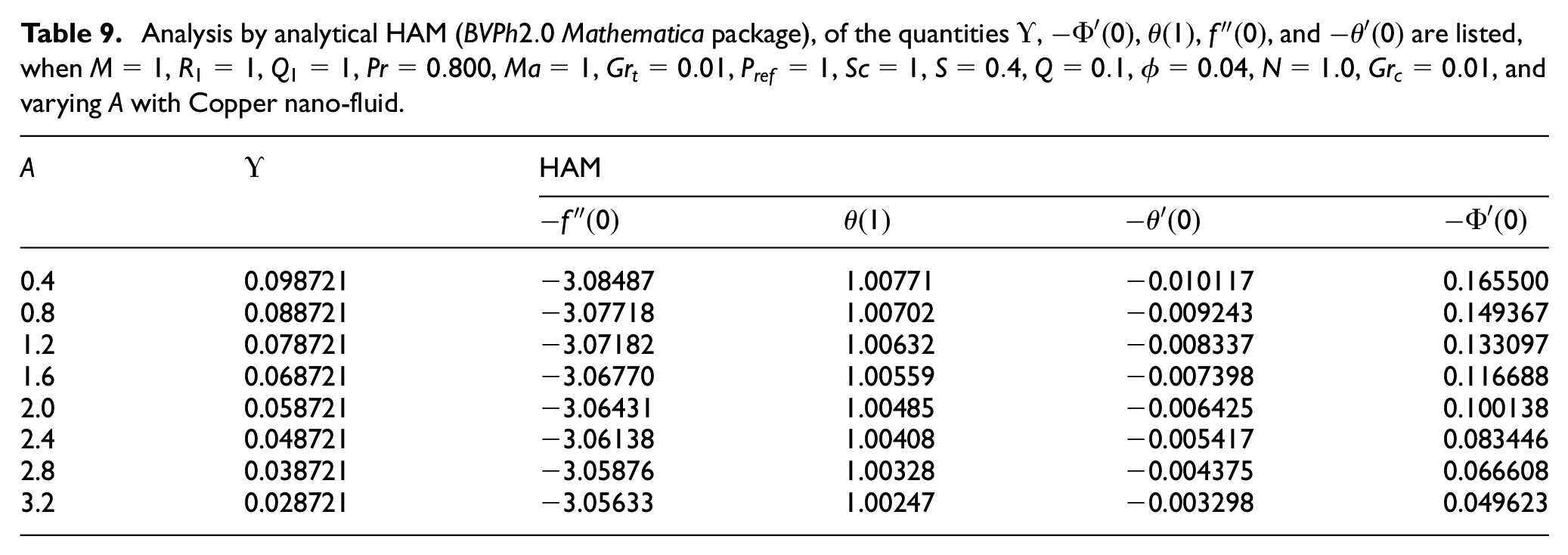
Analysis by analytical HAM ( package), of the quantities , , , , and are listed, when , , , , , , , , , , , , , and varying with Copper nano-fluid.
HAM
0.4
0.098721
−3.08487
1.00771
−0.010117
0.165500
0.8
0.088721
−3.07718
1.00702
−0.009243
0.149367
1.2
0.078721
−3.07182
1.00632
−0.008337
0.133097
1.6
0.068721
−3.06770
1.00559
−0.007398
0.116688
2.0
0.058721
−3.06431
1.00485
−0.006425
0.100138
2.4
0.048721
−3.06138
1.00408
−0.005417
0.083446
2.8
0.038721
−3.05876
1.00328
−0.004375
0.066608
3.2
0.028721
−3.05633
1.00247
−0.003298
0.049623
Analysis by analytical HAM ( package), of the quantities , , , , and are listed, when , , , , , , , , , , , , , and varying with Copper nano-fluid.
HAM
0.2
0.098721
−3.08213
1.01154
−0.015134
0.165500
0.5
0.088721
−3.07665
1.00842
−0.011081
0.149367
0.8
0.078721
−3.07233
1.00632
−0.008337
0.133097
1.1
0.068721
−3.06868
1.00480
−0.006344
0.116688
1.4
0.058721
−3.06543
1.00364
−0.004822
0.100138
1.7
0.048721
−3.06247
1.00272
−0.003615
0.083446
2.0
0.038721
−3.05969
1.00197
−0.002627
0.066608
2.3
0.028721
−3.05706
1.00135
−0.001800
0.049623
Analysis by analytical HAM ( package), of the quantities , , , , and are listed, when , , , , , , , , , , , , , and varying with Copper nano-fluid.
HAM
0.01
1.098721
−3.25008
0.997383
0.366996
1.33412
0.05
1.088721
−3.25685
1.004740
0.021483
1.32511
0.09
1.078721
−3.26356
1.012040
0.006386
1.31606
0.13
1.068721
−3.27022
1.019280
−0.008588
1.30699
0.17
1.058721
−3.27682
1.02644
−0.023432
1.29788
0.21
1.048721
−3.28335
1.03354
−0.038142
1.28873
0.25
1.038721
−3.28982
1.04056
−0.052710
1.27955
0.29
1.028721
−3.29622
1.04751
−0.067131
1.27034
Analysis by analytical HAM ( package), of the quantities , , , , and are listed, when , , , , , , , , , , , , , and varying with Copper nano-fluid.
HAM
0.01
1.098721
−3.15089
0.914014
0.233960
1.33632
0.05
1.088721
−3.15470
0.918850
0.222673
1.32736
0.09
1.078721
−3.15848
0.923641
0.211491
1.31836
0.13
1.068721
−3.16220
0.928387
0.200415
1.30932
0.17
1.058721
−3.16589
0.933086
0.189445
1.30025
0.21
1.048721
−3.16952
0.937739
0.178584
1.29114
0.25
1.038721
−3.17311
0.942346
0.167831
1.28200
0.29
1.028721
−3.17666
0.946905
0.157189
1.27282
Analysis by analytical HAM ( package), of the quantities , , , , and are listed, when , , , , , , , , , , , , , and varying with Copper nano-fluid.
HAM
0.5
1.098721
−3.26501
1.00956
0.002931
1.33379
1.0
1.088721
−3.27219
1.01875
0.005566
1.32473
1.5
1.078721
−3.27915
1.02760
0.007890
1.31565
2.0
1.068721
−3.28590
1.03615
0.009893
1.30653
2.5
1.058721
−3.29247
1.04443
0.011567
1.29739
3.0
1.048721
−3.29889
1.05247
0.012899
1.28822
3.5
1.038721
−3.30515
1.06028
0.013910
1.27902
4.0
1.028721
−3.31130
1.06789
0.014572
1.26979
Analysis by analytical HAM ( package), of the quantities , , , , and are listed, when , , , , , , , , , , , , , and varying with Copper nano-fluid.
HAM
0.3
1.098721
−3.29503
1.03672
−0.035139
0.936098
0.6
1.088721
−3.28071
1.02561
−0.016776
1.11284
0.9
1.078721
−3.26870
1.01654
−0.001812
1.26619
1.2
1.068721
−3.25844
1.00903
0.010563
1.40138
1.5
1.058721
−3.24955
1.00274
0.020922
1.52214
1.8
1.048721
−3.24176
0.99741
0.029665
1.63117
2.1
1.038721
−3.23482
0.99286
0.037136
1.73048
2.4
1.028721
−3.22864
0.98899
0.043489
1.82162
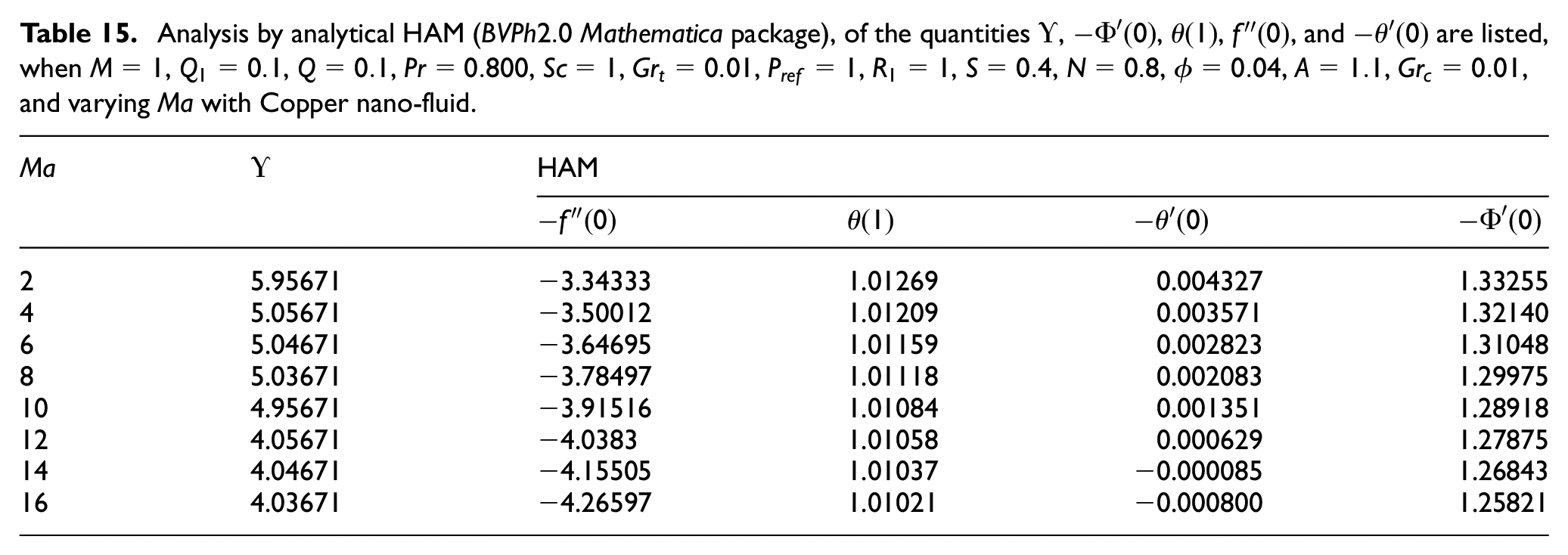
Analysis by analytical HAM ( package), of the quantities , , , , and are listed, when , , , , , , , , , , , , , and varying with Copper nano-fluid.
HAM
2
5.95671
−3.34333
1.01269
0.004327
1.33255
4
5.05671
−3.50012
1.01209
0.003571
1.32140
6
5.04671
−3.64695
1.01159
0.002823
1.31048
8
5.03671
−3.78497
1.01118
0.002083
1.29975
10
4.95671
−3.91516
1.01084
0.001351
1.28918
12
4.05671
−4.0383
1.01058
0.000629
1.27875
14
4.04671
−4.15505
1.01037
−0.000085
1.26843
16
4.03671
−4.26597
1.01021
−0.000800
1.25821
In Table 6, nano-particles are varying while, the remaining parameters are fixed and analysis is performed on free temperature (), skin friction (), temperature flux (), and mass flux (). Here when we increased nano-particles that is , , , and reducing the film thickness, and are increased, while and are decreased. This shows that, increased in the nano-particles, skin fraction, and heat flux are increased but, free temperature, and mass flux are decreased. Table 7 is about the effect of thermal-Grashof number, in which is increased the corresponding and are decreased while, and are increased. Concentration-Grashof number has direct relation with nano-fluids, because heat transfer provides dominant buoyancy-forces to the flows. Table 8, shows that as is increased and thickness of the sheet is reduced, and are decreased, meanwhile and are more quantities. Table 9 represents, the effect of , the more viscosity of the fluid are the increased of and , meanwhile the decreased of and . Increased of are the increased of and , but decreased of and as shown in Table 10. Further, Table 11 represents the effects of . Increased of and decreased of , implies that decreased are seen in , , and , but increased is seen in . Similarly, increased in is a reason for the decreased of , , and , while increased of as displayed in Table 12. As is increased the reciprocal effects are seen on and , while direct effects are seen on and as shown in Table 13. Addition of Table 14 is about . Increased of and decreased of , implies that increased are seen in , , and while decreased is seen in . Addition of the effect on , , , and are shown in Table 15, in which increased of is the decreased of , , , and . Excellent agreement are observed between two methods (HAM and BVP4C) for different physical number shown in Tables 6 to 8.
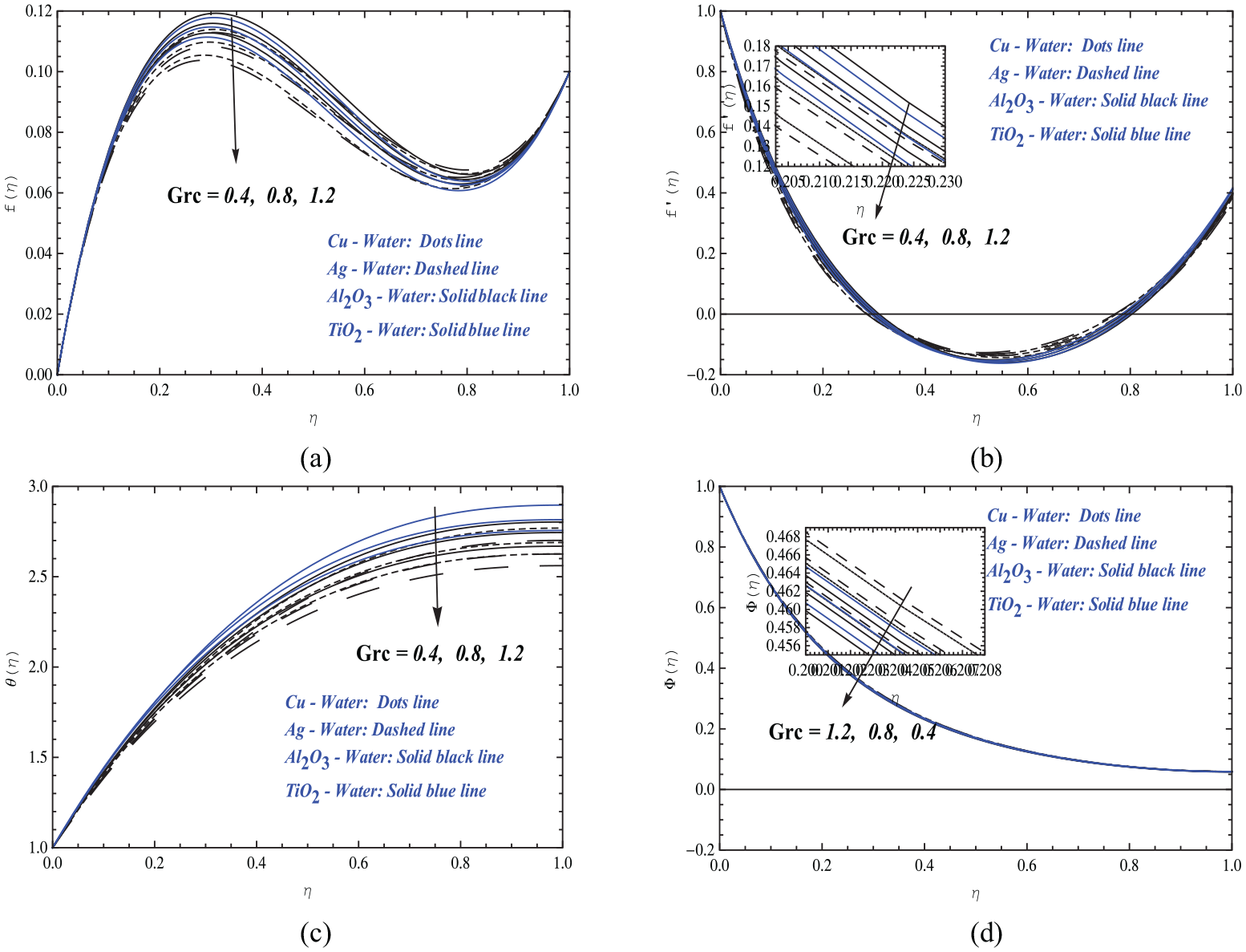
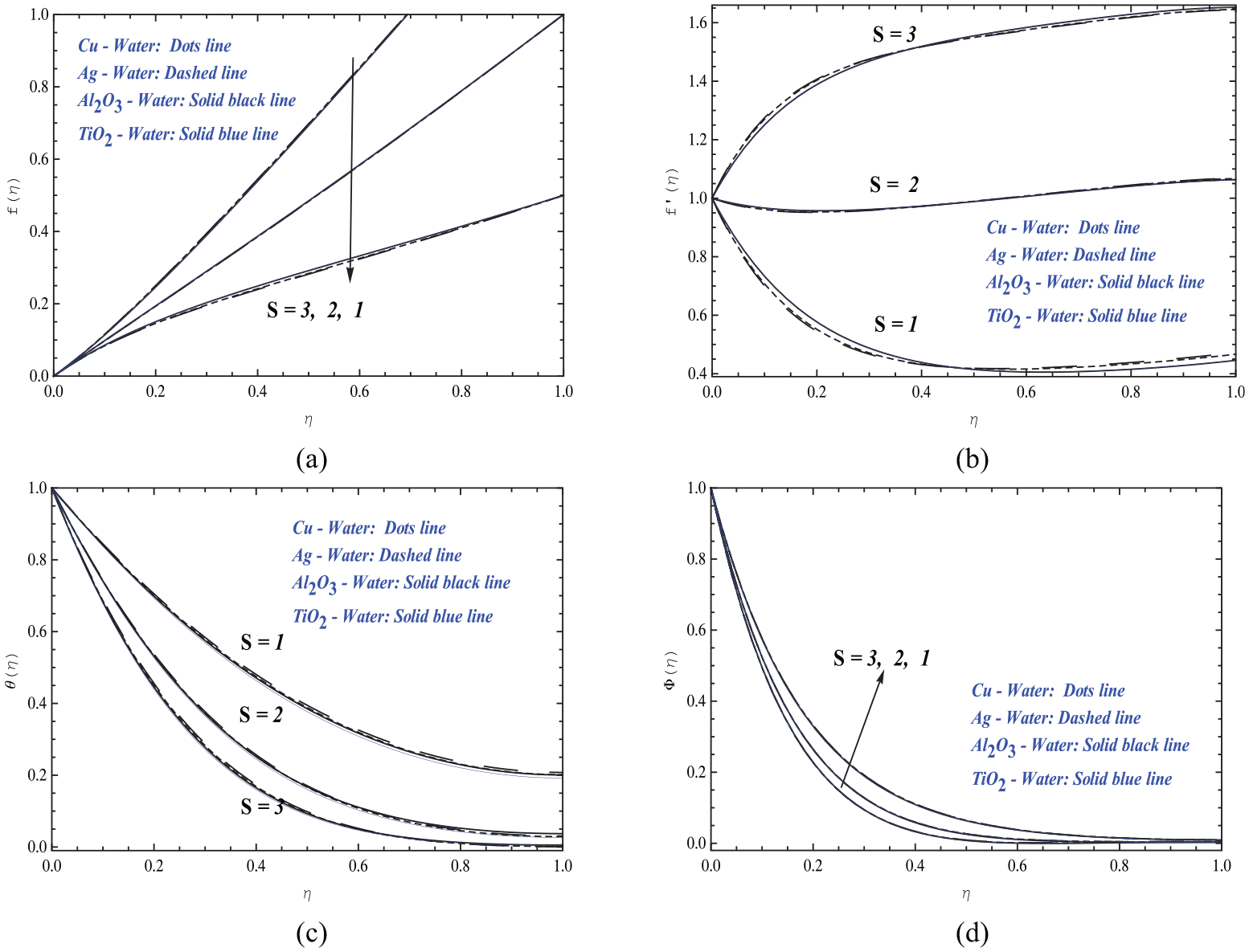
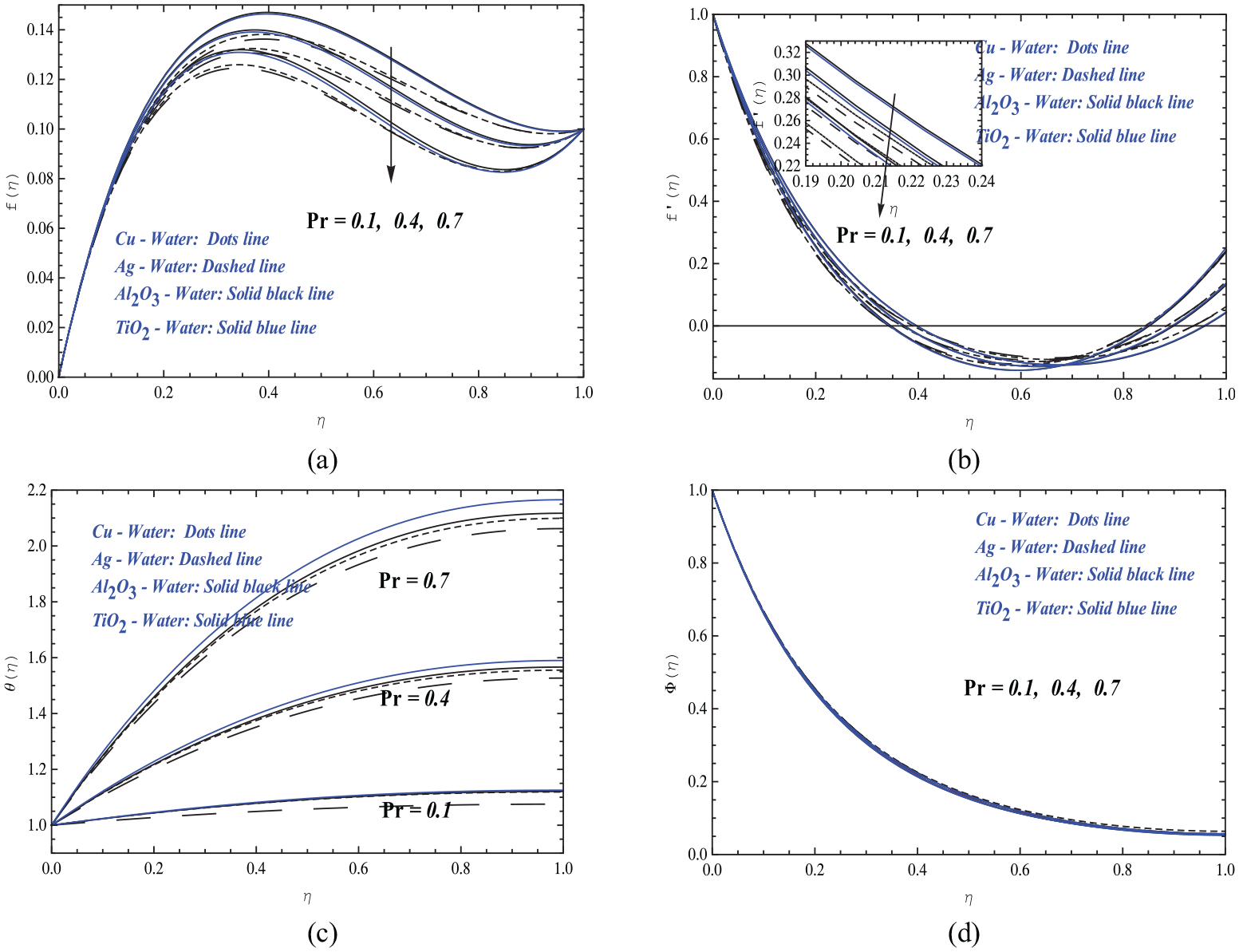
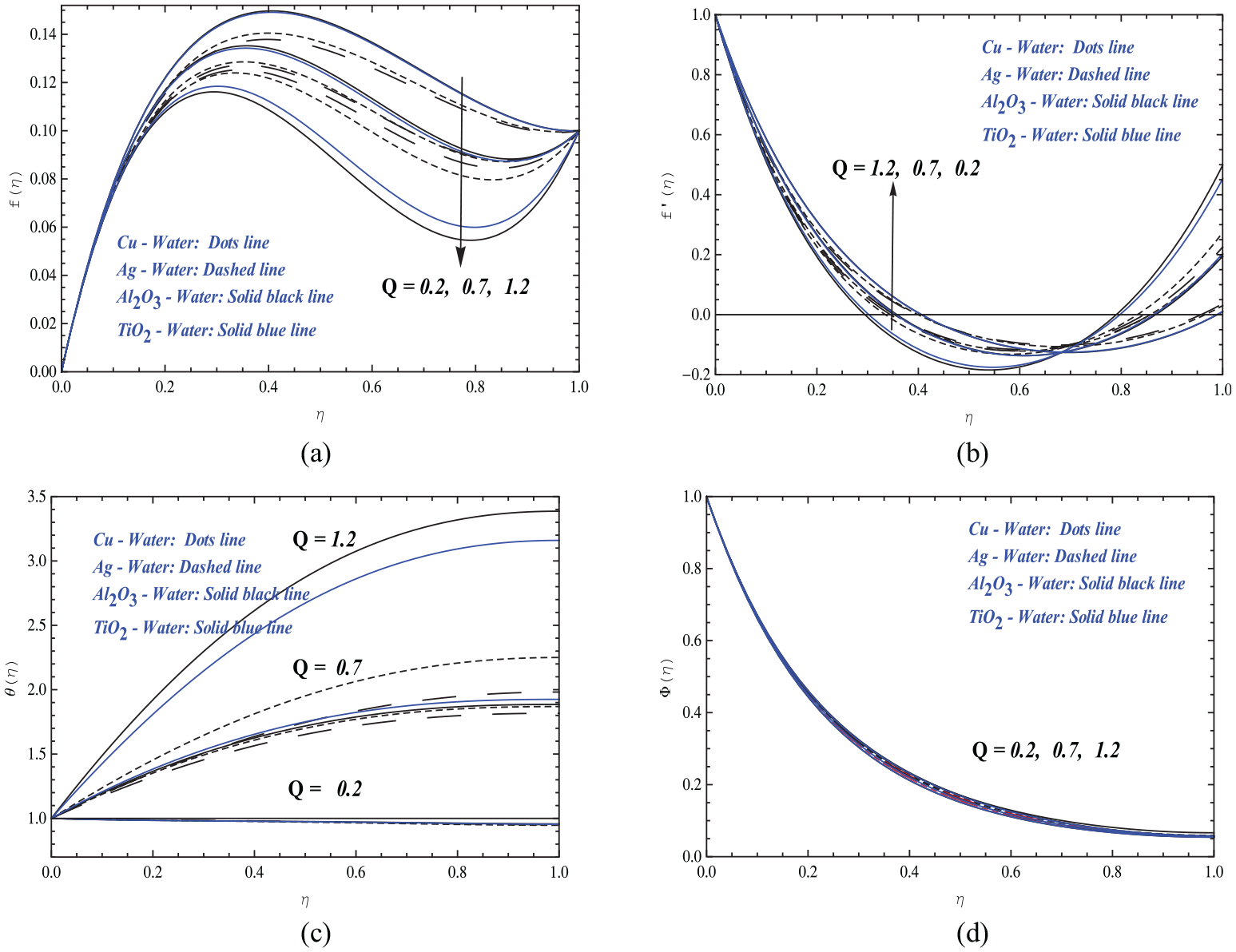
As this observation is also about mass transfer and the parameters involved in this model effected the concentration of nano-fluid. Heat, mass and momentum equations are discussed by HAM. Figures 3 to 10, are drawn for arbitrary parameters with nano-particles to observe the influence of azimuthal-velocity, velocity, solute-concentration, temperature, and their rate of changes. Increasing the quantity of (viscosity) for the particles , , , and , in base fluid the azimuthal-velocity of all the particles are decreased. The azimuthal-velocity of -water is increased than -water and the azimuthal-velocity of -water is increased than -water and -water is increased than -water nano-fluid given in Figure 3(a). Initially all particles flow are increased and than decelerate shown in Figure 3(b). It is happened due to the number of particles increased in the base fluid, the buoyancy force is increased, which implies that the resistance force become stronger. Comparatively, -water is warm than -water and -water is warm than -water and similarly -water is warm than -water as shown in Figure 3(c). As we know that, the thermal-conductivity of aluminum is more than, titanium, and titanium is more than, copper and copper is more than silver, see in Table 1, where temperature is decreased as is increased. Clearly, the comparisons of solute-concentration of , , , and as shown in Figure 3(d). Increased of , all nano-particles are less azimuthal-velocities shown in Figure 4(a), while velocity-profiles initially increased and than decelerated as in Figure 4(b). The reason is very clear that, increase of nano-particles implies, the buoyancy forces increased and thus more resistance forces to the flow will accrued. Also increased of , the temperature is raised, shown in Figure 4(c). The solute-concentration of the different nano-particles are shown in Figure 4(d). In Figure 5(a) and (b) thermal-Grashof number is direct functions of azimuthal-velocity and velocity. Also increase of the temperature of the nano-fluid raised as in Figure 5(c). It mens that, the more quantity of will lead to the less buoyancy force and in a response the fluid flow become more faster. Mass-Grashof (concentration-Grashof) number is observed in Figure 6. It is seen in Figure 6(a) and (b), that is increased the reciprocal impacts are seen on azimuthal-velocities and velocity profiles for different nano-fluid flows and in a results fluids temperature decreased as in Figure 6(c). This is happened, due to the stronger buoyancy-forces and flows decelerate. When the unsteady number is increased, velocity and azimuthal-velocity are also increased, but solute concentration and temperature are decreased see in Figure 7. Magnetic-force effects are seen in Figure 8 for different nano-particles. As is increased, the azimuthal-velocities and the velocity profiles are decreased as in Figure 8(a) and (b), which implies that the mass-flux decreased and temperature become low as in Figure 8(c) and (d). Further, as magnetic-force provides Lorentz-force and increase of Lorentz-force means the more resistance to the flow and in a result velocities reduced. Prandtl-number effects are seen in Figure 9. By the increased of the reciprocal effects on the azimuthal-velocity and velocity profiles are seen, meanwhile the temperature of the flow increased as in Figure 9(a) to (c). Meanwhile, Solute concentration is not effected by , see in Figure 9(d). Increasing heat source number , azimuthal-velocity and velocity decreased, and the fluid flows become hot see in Figure 10(a) to (c). Solute concentration is not effected by , see in Figure 10(d).
Using HAM package where , , , , , , , , , , , , , and varying A for the effects of and .
Using HAM package where , , , , , , , , , , , , , and varying N for the effects of and .
Using HAM package where , , , , , , , , , , , , , and varying for the effects of and .
Using HAM package where , , , , , , , , , , , , , and varying for the effects of and .
Using HAM package where , , , , , , , , , , , , , and varying S for the effects of and .
Using HAM package where , , , , , , , , , , , , , and varying Ma for the effects of and .
Using HAM package where , , , , , , , , , , , , , and varying Pr for the effects of and .
Using HAM package where , , , , , , , , , , , , , and varying Q for the effects of and .
Concluding remarks
In this problem, new physical properties with new nano-particles along with base fluid are considered for the improvement of sufficient heat and mass transfer. The considered particles are Aluminum, Titanium, Silver, and copper with the most important physical properties, radiation-absorption, mixed-convection, Schmidt number, variables viscosity and thermal-conductivity, chemical reaction, and MHD thin film flow. Here surface tension is directly dependent on temperature. We derive relations between different nano-particles with several important physical properties, for the system of partial differential equations describing MHD flow. Heat transfer, mass transfer, and momentum profile in a thin liquid film on an unsteady stretching nonuniform-surface in the presence of external magnetic field are considered. A two-dimensional, highly nonlinear model is found and we use a couple of the admitted physical properties to construct similarity transformations for the said model. These transformations enable reductions of the model to a coupled system of nonlinear ordinary differential equations. We present analytic solution by HAM package and numerical by shooting package, for the obtained systems of ordinary differential equations are shown in figures and tables. Excellent agreement are archived between both the method. The following investigation are observed as:
By the increasing of , azimuthal-velocity of all the particles are decreased and -water is more then -water, -water is more then -water and -water is more than -water.
Velocity-profiles of all particles are increased for increasing , up to some extent and than decelerate. The temperature of -water is higher than -water, -water is higher than -water, where -water is higher than -water. The fact is, aluminum thermal-conductivity is higher than titanium, titanium is higher than copper, where copper is higher than silver.
Increasing of , the azimuthal-velocity of all nano-fluids are reduced, but velocities of all nano-fluids are accelerated, up to and then decelerated.
Change of , the temperature of -water is higher than -water, and -water. As aluminum thermal conductivity is higher than titanium, titanium is higher than copper and silver. With the increase of the temperature increased.
The number of particles increased in the base fluid, the buoyancy force is increased, which implies that the resistance force become stronger.
The more quantity of will lead to the less buoyancy force and in a response the fluid flow become more faster.
Increase of nano-particles, mass flux increased.
As is increased, the azimuthal-velocities and the velocity profiles are decreased, which implies that the mass-flux decreased and temperature become low. Further, as the magnetic-force provides Lorentz-force and increase of Lorentz-force means the more resistance to the flow and in a result velocities reduced.
Footnotes
Appendix
Acknowledgements
The authors would like to thank the reviewers for their constructive comments and valuable suggestions to improve the quality of the paper.
Handling Editor: Chenhui Liang
Author contributions
All authors participated in the analysis of the results and manuscript coordination. All authors read and approved the final manuscript.
Declaration of conflicting interests
The author(s) declared no potential conflicts of interest with respect to the research, authorship, and/or publication of this article.
Funding
The author(s) disclosed receipt of the following financial support for the research, authorship, and/or publication of this article: This paper is self supported by authors in respect of funding and technically supported by Islamia Collogue University, Khyber Pakhtunkhwa, Peshawar, Pakistan.
ORCID iDs
Sajid Rehman
Waris Khan
Aamir Khan
Zeeshan
References
1.
WangCY. Liquid film on an unsteady stretching surface. Q Appl Math1990; 48: 601-610.
2.
JouRYTzengSC. Numerical research of nature convective heat transfer enhancement filled with nanofluids in rectangular enclosures. Int Commun Heat Mass Transf2006; 33: 727-736.
3.
PalmSJRoyGNguyenCT. Heat transfer enhancement with the use of nanofluids in radial flow cooling systems considering temperature-dependent properties. Appl Therm Eng2006; 26: 2209-2218.
4.
Zeinali HerisSNasr EsfahanyMEtemadSG. Experimental investigation of convective heat transfer of Al2O3/water nanofluid in circular tube. Int J Heat Fluid Flow2007; 28: 203-210.
5.
OztopHFAbu-NadaE. Numerical study of natural convection in partially heated rectangular enclosures filled with nanofluids. Int J Heat Fluid Flow2008; 29: 1326-1336.
6.
WangXMujumdarAS. A review on nanofluids – Part I: theoretical and numerical investigations. Braz J Chem Eng2008; 25: 613-630.
7.
HoCJChenMWLiZW. Numerical simulation of natural convection of nanofluid in a square enclosure: effects due to uncertainties of viscosity and thermal conductivity. Int J Heat Mass Transf2008; 51: 4506-4516.
8.
BazhlekovaEJinBLazarovR, et al. An analysis of the Rayleigh-Stokes problem for a generalized second-grade fluid. Numer Math2015; 131: 1-31.
9.
ChenCKLaiHYChenWF. Unsteady unidirectional flow of second-grade fluid through a microtube with wall slip and different given volume flow rate. Math Probl Eng2010; 2010: 1-17.
10.
WangXQiHYuB, et al. Analytical and numerical study of electroosmotic slip flows of fractional second grade fluids. Commun Nonlinear Sci Numer Simul2017; 50: 77-87.
11.
DehghanMAbbaszadehM. A finite element method for the numerical solution of Rayleigh–Stokes problem for a heated generalized second grade fluid with fractional derivatives. Eng Comput2017; 33: 587-605.
12.
FotukianSMNasr EsfahanyM. Experimental study of turbulent convective heat transfer and pressure drop of dilute CuO/water nanofluid inside a circular tube. Int Commun Heat Mass Transf2010; 37: 214-219.
13.
GoyalMKumariK. Heat and mass transfer in MHD oscillatory flow between two inclined porous plates with radiation absorption and chemical reaction. Int J Sci Res2013; 4: 2862-2868.
14.
GhalambazMNoghrehabadiAGhanbarzadehA. Natural convection of nanofluids over a convectively heated vertical plate embedded in a porous medium. Braz J Chem Eng2014; 31: 413-427.
15.
HarounNASibandaPMondalS, et al. On unsteady MHD mixed convection in a nanofluid due to a stretching/shrinking surface with suction/injection using the spectral relaxation method. Boundary Value Probl2015; 2015: 1-17.
16.
LinYZhengLChenG. Unsteady flow and heat transfer of pseudo-plastic nanoliquid in a finite thin film on a stretching surface with variable thermal conductivity and viscous dissipation. Powder Technol2015; 274: 324-332.
17.
BibiAXuHSunQ, et al. Free convection of a hybrid nanofluid past a vertical plate embedded in a porous medium with anisotropic permeability. Int J Numer Methods Heat Fluid Flow2019; 30: 4083-4101.
18.
IdreesMRehmanSShahRA, et al. A similarity solution of time dependent MHD liquid film flow over stretching sheet with variable physical properties. Results Phys2018; 8: 194-205.
19.
ZhuangXDengZBMuJ, et al. Ginger-derived nanoparticles protect against alcohol-induced liver damage. J Extracell Vesicles2015; 4: 28713.
20.
KrishnaYFaizalMSaidurR, et al. State-of-the-art heat transfer fluids for parabolic trough collector. Int J Heat Mass Transf2020; 152: 119541.
21.
RubbiFHabibKSaidurR, et al. Performance optimization of a hybrid PV/T solar system using Soybean oil/MXene nanofluids as a new class of heat transfer fluids. Sol Energy2020; 208: 124-138.
22.
KrishnaYAslfattahiNSaidurR, et al. Fatty acid/metal ion composite as thermal energy storage materials. SN Appl Sci2020; 2: 1-10.
23.
HayatTKhanMIQayyumS, et al. Entropy generation in flow with silver and copper nanoparticles. Colloids Surf A Physicochem Eng Asp2018; 539: 335-346.
24.
KhanUAhmedNMohyud-DinST. Analysis of magnetohydrodynamic flow and heat transfer of Cu–water nanofluid between parallel plates for different shapes of nanoparticles. Neural Comput Appl2018; 29: 695-703.
25.
ToghraieDHekmatifarMSalehipourY, et al. Molecular dynamics simulation of couette and poiseuille water-copper nanofluid flows in rough and smooth nanochannels with different roughness configurations. Chem Phys2019; 527: 110505.
26.
ArqubOAShawagfehN. Application of reproducing kernel algorithm for solving Dirichlet Time-fractional diffusion-Gordon types equations in porous media. J Porous Media2019; 22: 411-434.
27.
Abu ArqubO. Application of residual power series method for the solution of time-fractional Schrödinger equations in one-dimensional space. Fundam Inform2019; 166: 87-110.
28.
Abu ArqubORashaidehH. The RKHS method for numerical treatment for integrodifferential algebraic systems of temporal two-point BVPs. Neural Comput Appl2018; 30: 2595-2606.
29.
Abu ArqubO. Computational algorithm for solving singular Fredholm time-fractional partial integrodifferential equations with error estimates. J Appl Math Comput2019; 59: 227-243.
30.
DandapatBSSantraBAnderssonHI. Thermocapillarity in a liquid film on an unsteady stretching surface. Int J Heat Mass Transf2003; 46: 3009-3015.
31.
LiuICAnderssonHI. Heat transfer in a liquid film on an unsteady stretching sheet. Int J Therm Sci2008; 47: 766-772.
32.
WangC. Analytic solutions for a liquid film on an unsteady stretching surface. Heat Mass Transf2006; 42: 759-766.
33.
WangCPopI. Analysis of the flow of a power-law fluid film on an unsteady stretching surface by means of homotopy analysis method. J Non-Newton Fluid Mech2006; 138: 161-172.
34.
LiaoSJ. Beyond perturbation: introduction to the homotopy analysis method. Boca Raton, FL: Chapman Hall, 2004.
35.
LiaoS. An optimal homotopy-analysis approach for strongly nonlinear differential equations. Commun Nonlinear Sci Numer Simul2010; 15: 2003-2016.
KarimIIslamMSKhanMS. MHD buoyancy flow of Cu, Al2O3, and TiO2 nanofluid near stagnation-point on a vertical plate with heat generation. Phys Sci Int J2014; 4: 754-767.