




Abstract
The presence of nanometric particles in the base fluids lead to form nanofluids. Nanofluids are prominent due to their astonishing features in thermally conducting flows and in the development of electronic and mechanical devices. Based on these motivations, we have designed our article to investigate the thermal conduction features in the free and forced convection flow of unsteady Carreau nanofluid due to stretching cylinder with the effects of variable magnetic field. Moreover, the transport of thermal energy in the flow is properly examined by including the impacts of variable thermal conductivity and nonuniform heat rise/fall. Furthermore, the transport of solutal energy in the flow of nanofluid is encountered under the influences of activation energy and binary chemical reactions. A momentous feature of this study is to employ the zero-mass flux condition at the wall of the cylinder. A section of this study is proposed for mathematical modelling of the current problem. Moreover, the impacts of involved physical constraints are explored by employing an efficient numerical technique namely bvp4c. The features of all physical constraints on flow, thermal and solutal curves are illustrated in the form of graphs and discussed with reasonable physical arguments in discussion section of the article. The core findings of this study are mentioned in the section of closing remarks. The core upshot of the current study is that the nanoparticles concentration rate of nanofluid depicts ascending trend for escalating values of activation energy constraint. A significant upsurge in the coefficients of skin friction and Nusselt number is detected with an escalation in the constraints of buoyancy and thermophoresis forces, respectively. The references regarding this article are also provided at the end.
Keywords
Introduction
Magnetohydrodynamic (MHD) flows deals with the flows of fluids under the consideration of magnetic forces. According to Rossow, 1 the concern in this field was initiated in 1918, when a discovery of electromagnetic pump was came into being due to which a Hartmann number was familiarised which defines in terms of viscous and electromagnetic forces. In October 1942, Alfven revealed that when a conducting fluid continuously experience the effects of uniform magnetic force then every fluid motion produces a force known as electromotive force which is utilises in the manufacturing of electric current. It is also exposed that one type of this force is used in production of current whereas, other kind engenders the effect of Lorentz force. Alfven 2 reported in his study that these currents produce mechanical forces which lead to alter the state of flow of the fluid. The implementation of MHD are stated in different areas including developments of MHD pumps, magnetic generators, advancement of fusion reactors, metallurgy section, development of MHD flow metres and metals dispersion process. The problems regarding conduction of liquids with magnetic field are also encountered in the field of Geophysics. MHD convection flows have significant importance in aeronautics, stellar and planetary magnetospheres and in electrical engineering. Also, it is worthy to state that the effectiveness of MHD in flow equation can only be assured of such flows whose magnetic Reynolds number is very small. The characteristics of viscous fluid are examined by Liron and Wilhelm 3 by incorporating the influence of magnetic field in transverse direction of the flow and in the other technical systems. After that, Makinde 4 disclosed the impacts of Lorentz force in the stagnant flow of fluid near a surface by considering the free and force convection effects. He came to know that the flow curves of the fluid behave in descending manner for escalation extent of magnetic force constraint. Moreover, The MHD mixed convection fluid flow was investigated by Pal et al. 5 under the influences of thermal radiation towards a stretching and shrinking geometry. Later, Govardhan et al. 6 explored the magnetic features in the flow of micropolar fluid due to a stretching surface. Additionally, Waqas et al. 7 studied the impacts of Magnetohydrodynamic (MHD) on free and forced convected flow of micropolar fluid towards nonlinear stretching geometries. Recently, Daniel et al. 8 examined the electrically conducted flow of nanofluid corresponding to Magnetohydrodynamics and mixed convection. Soomro et al. 9 presented a MHD mixed convective flow model and considered the thermal velocity slip effects. Sharma et al. 10 explored the impact of Lorentz force on mixed convective flow in view of heat generation/absorption along a stretching surface. Recently Iqbal et al. 11 scrutinised the Burgers nanofluid flow with the impacts of magnetic field and chemical reactions. The reported that the thermal contours of the magneto viscoelastic fluid significantly rise for improving the scales of magnetic parameter. Furthermore, Khan et al. 12 developed a new model to explore the characteristics of MHD Burgers fluid flow due to stretching cylinder near a stagnation point. They disclosed that the nanoparticles concentration rate of magnetic fluid augmented by for escalating amount of magnetic force constraint.
Materials containing the magnitude of 1–100 nm are designated as the nanomaterials or nanoparticles. These types of particles were earliest studied by Masuda et al. 13 under the influence of thermal conductivity. Afterward, investigation of such type of particles was done by a researcher named as Choi 14 and he used these nano particles in the base fluid and generalised the mixture as nanofluid. After this, many researchers performed their investigations on nanofluids as nanofluids have magnificent thermophysical properties. Additionally, Nanofluids have considerable particle implementations in the field of applied mathematics and engineering sciences like, materials processing, heat exchangers, thermal cooling, electronic devices, cooling processes and in the mathematical modelling of different convective thermal energy transport phenomena. Furthermore, the characteristics of nano fluids are examined by Buongiorno, 15 who presented the two-phase model known as Buongiorno two phase model for dealing nanofluids. In this model he examined the features of nanofluids by employing the process of thermophoresis and Brownian diffusion. The investigation of boundary layer flow of nanofluids over a vertical plate was performed by Kuznetsov and Nield. 16 They examined the nanofluid features by employing the model of Buongiorno. They developed analytical solutions of the problem. The theoretical investigation of the nanofluids in the boundary layer flow caused by a stretching geometry was also done by Khan and Pop. 17 Turkyilmazoglu 18 developed the thermal conduction model for nanofluid flow by considering the slip mechanism. Hsiao 19 investigated the mixed convection flow of nanofluids by employing the impacts of multimedia. He analysed that the temperature curves rise for larger Brownian motion constraint. Hsiao 20 examined the slip flow of nanofluid on a stretching surface by considering magnetic field effects. Hsiao 21 explored the flow of Carreau nanofluid and employed parameters control method for energy extrusion system. Turkyilmazoglu 22 employed the Buongiorno model in an axisymmetric channel flow of nanofluid. Turkyilmazoglu 23 employed the single phase nanofluids model to study the cooling of jets. Khan et al. 24 investigated the peristaltic flow of nanofluids in a channel by incorporating magnetic field effects. Muhammad et al. 25 explored the flow of Carreau nanofluid past a wedge geometry by incorporating the effects of Bioconvection. Ahmad et al. 26 considered the variable viscosity to explore the entropy generation of hybrid nanofluid. Ahmed et al. 27 presented a model to explore the thermal features of Maxwell nanofluid past a stretching surface by considering the effect of Joule heating. They reported that the thermal curves of Maxwell nanofluid augment by varying the mount of Eckert number. Some more recent studies on nanofluids can be found in Vasudevan et al. and Tariq et al.28,29
In the present paper, numerical solutions of unsteady mixed convection boundary layer flow of Carreau nanofluid past a stretching cylinder are developed. Additionally, the effect of Lorentz force is also taken into account to examine the flow features of nanofluid. Thermal energy transport is studied by employing the influences of thermal conductivity and non-uniform heat source sink in this article. Moreover, the effects of activation energy and binary chemical reactions are considered to examine the characteristics of solutal energy transport. Additionally, zero mass flux condition is employed to examine the flow analysis of Carreau nanofluid. Impacts of all physical parameters are explored by employing bvp4c a numerical technique in MATLAB program. Results are depicted in the form graphical representation and discussed with reasonable physical judgements.
Development of mathematical model
In this study an unsteady incompressible flow of Carreau fluid over an inclined permeable stretching cylinder which makes an angle

Here

Physical configuration and coordinate system.
Under these assumptions the governing equations for the Carreau nanofluid can be written as30–32
Continuity:

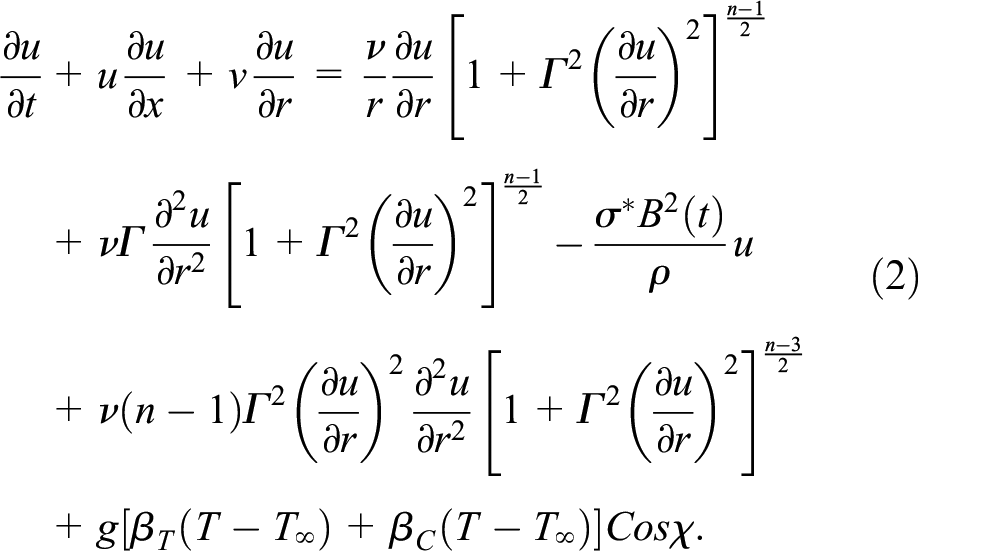
Momentum equation:
Energy equation:

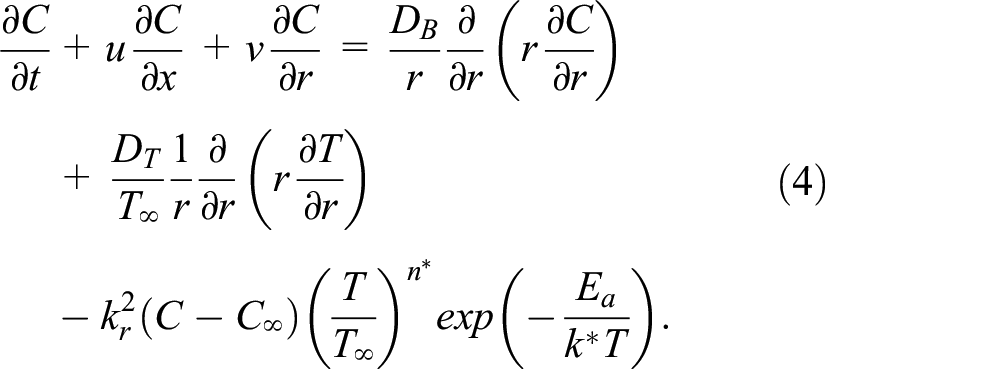
Concentration equation:
The physical realistic boundary conditions are


We have the similarity transformations

The stream function
By utilising equation (7) in equations (1)–(4) with associated boundary conditions mentioned in equations (5) and (6), we came know that equation (1) satisfied automatically and equations (2)–(4) take the following form


and transformed boundary conditions are:


Here, the local Weissenberg number

The skin friction and heat and mass transport coefficients are given by:

where the wall shear stress

The dimensionless surface drag, heat and mass transfer rates takes the form:

where
Solution methodology
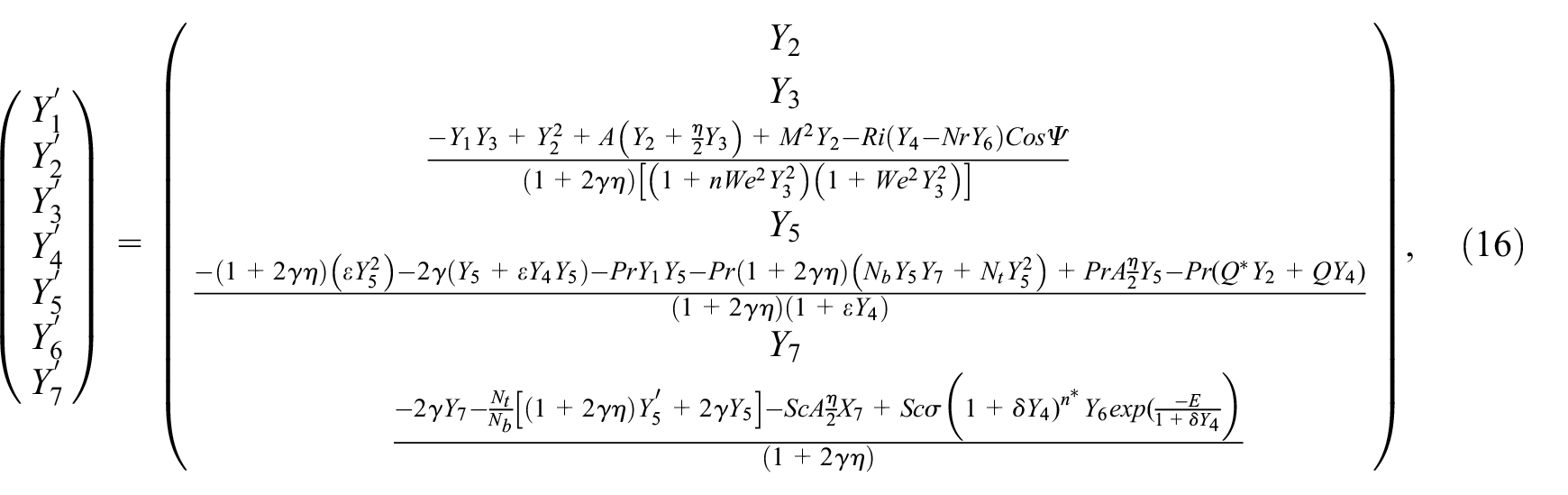
The set of self-similar equations (8)–(10) along with assisting boundary conditions (11) and (12) has been tackled numerically through bvp4c method. The final system is reduced into set of first order ordinary differential equations and alters into initial value problem as 27

with initial conditions:

Validation of numerical code
To inspect the accuracy of numerical bvp4c scheme, the values of pertinent scales of skin friction coefficient

Results and discussion
The exact solutions of nonlinear ordinary differential equations (8)–(10) with corresponding boundary conditions (11) and (12) cannot be obtain due the presence of highly non linear terms. We have employed the numerical scheme bvp4c to overcome this problem and solved the differential equations numerically. We analysed the impact of several physical constraints present in the model against flow

Illustration of
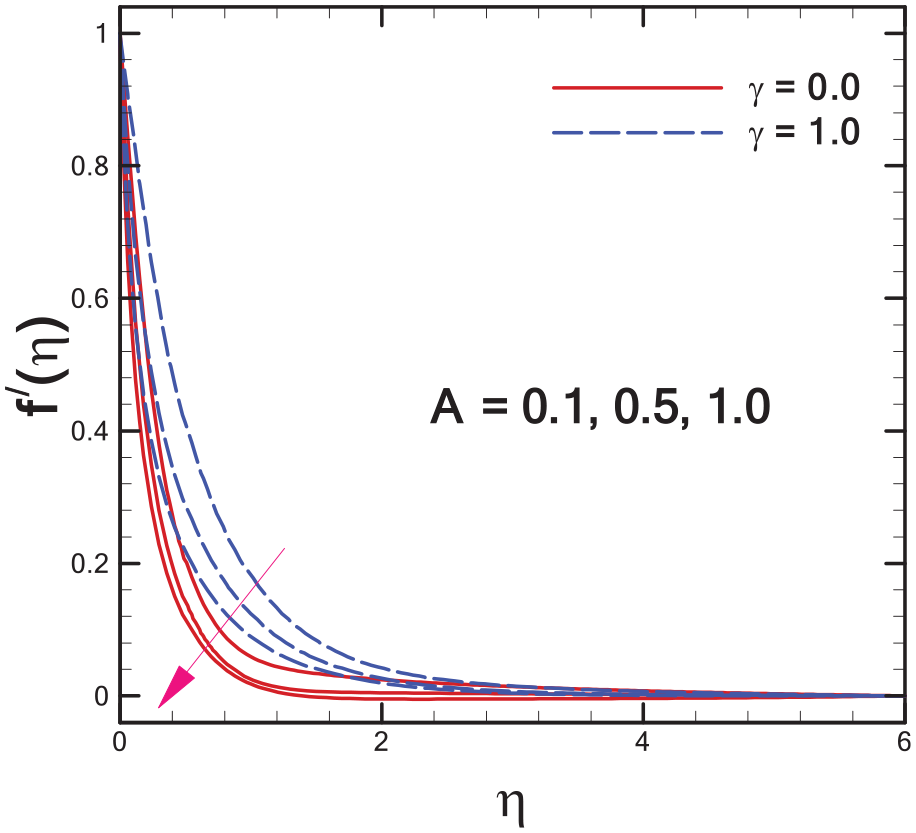
Illustration of

Illustration of

Illustration of

Illustration of

Illustration of

Illustration of
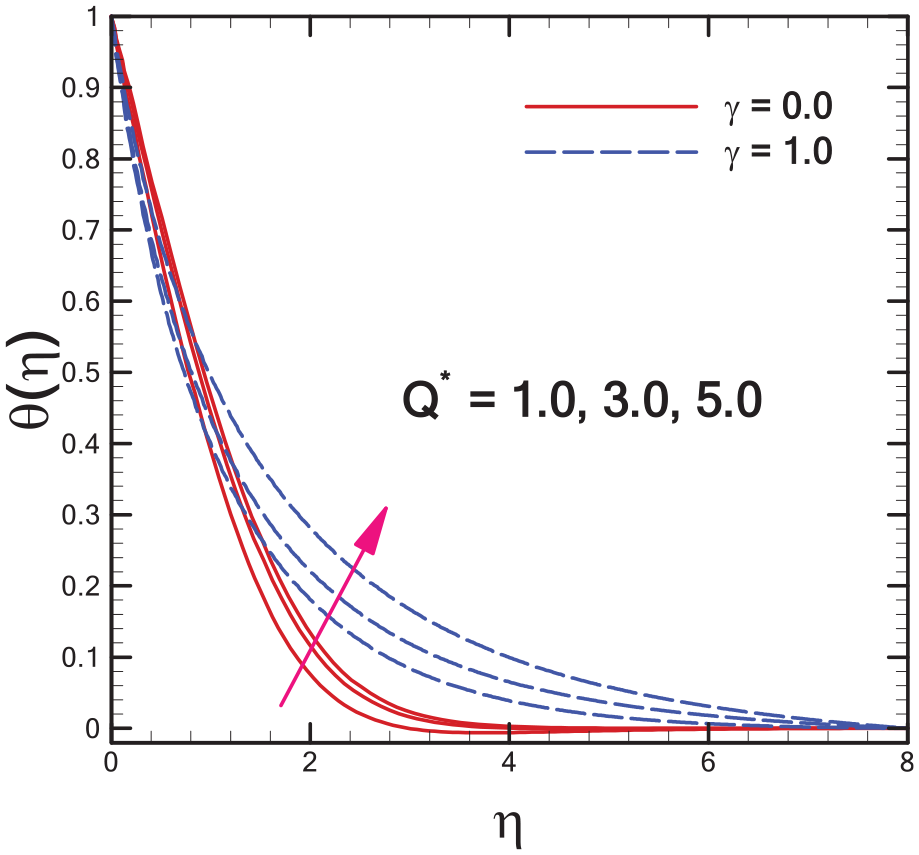
Illustration of
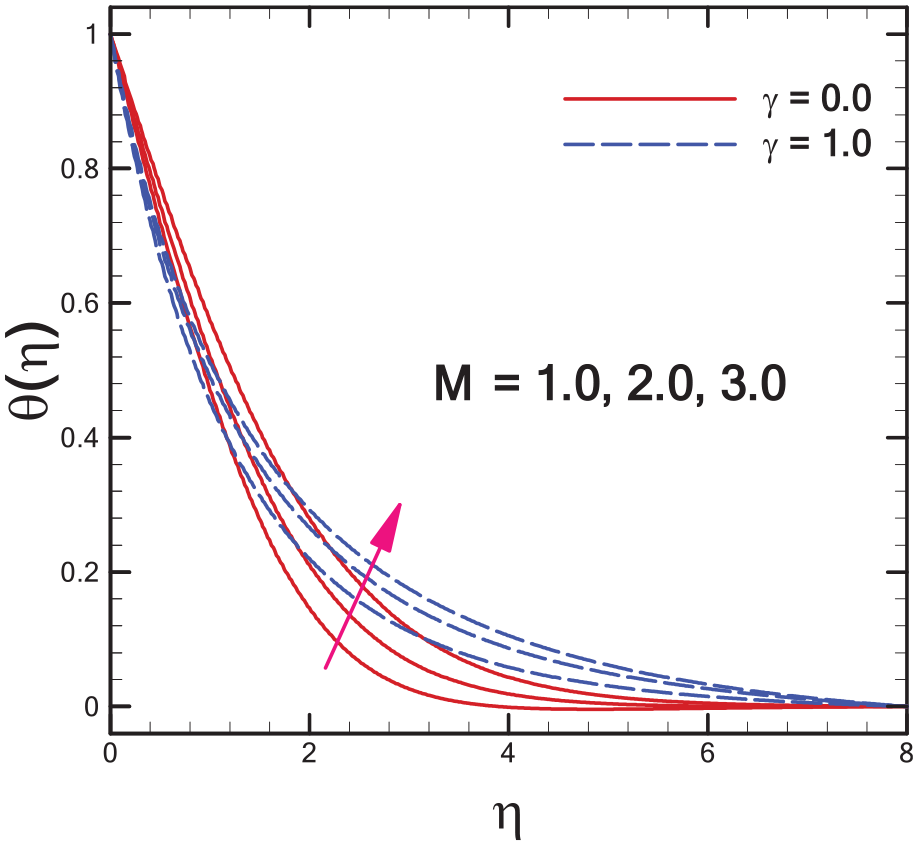
Illustration of
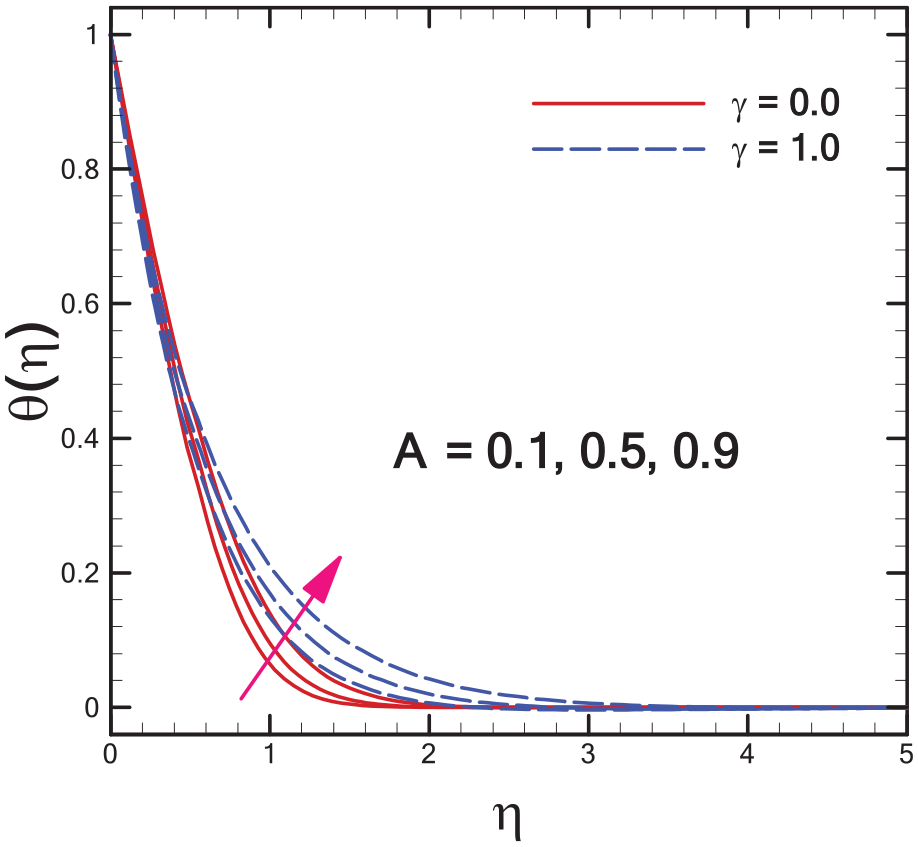
Illustration of

Illustration of

Illustration of

Illustration of

Illustration of

Illustration of

Illustration of

Illustration of

Illustration of
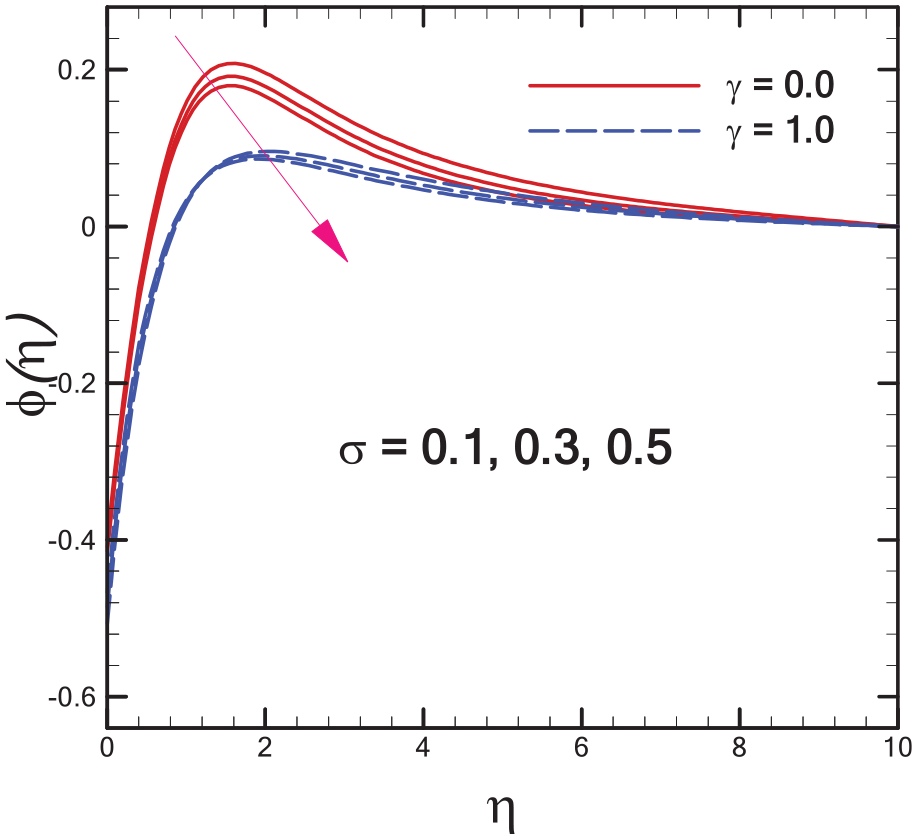
Illustration of

Illustration of
Flow features of Carreau nanofluid
Figures 2 to 6 illustrate the impact of
Thermal features of Carreau nanofluid
Figures 7 to 15 are being sketched to inspect the thermal feature for different values of
Solutal features of Carreau nanofluid
Figure 16 highlights the influence of fitted rate constant
Behaviour of skin friction and Nusselt number profiles
The computation of numerous physical quantities like,
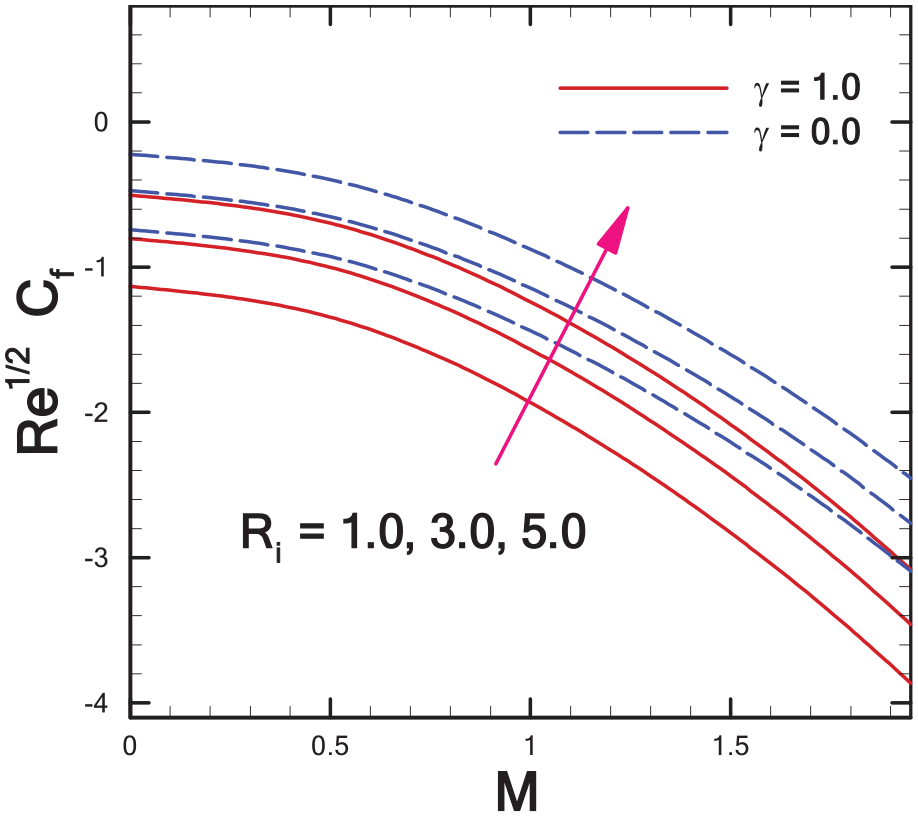
Illustration

Illustration

Illustration

Illustration
Concluding remarks
The notable features of current article are mentioned below
It is noticed that the solutal curves depreciate for escalating scales of activation energy constraint.
An augmentation in the constraint of temperature difference leads to decline the solutal rate of nanoparticles.
A significant enhancement in the skin friction coefficient is detected for varying magnitude of Weissenberg number.
The thermal contours of nanofluid expose the ascending nature for growing magnitude of thermal conductivity constraint.
The coefficient of skin friction depicts enhancing nature of curves for developing magnitude of buoyancy force parameter while it exposes the opposite trend for varying scales of Weissenberg number.
A significant development is presumed in the rate of heat transport at the wall against the progressive values of Prandtl number and thermophoresis force constraint.
The solutal rate of nanoparticles reports the ascending nature for larger estimation of activation energy constraint.
Footnotes
Appendix
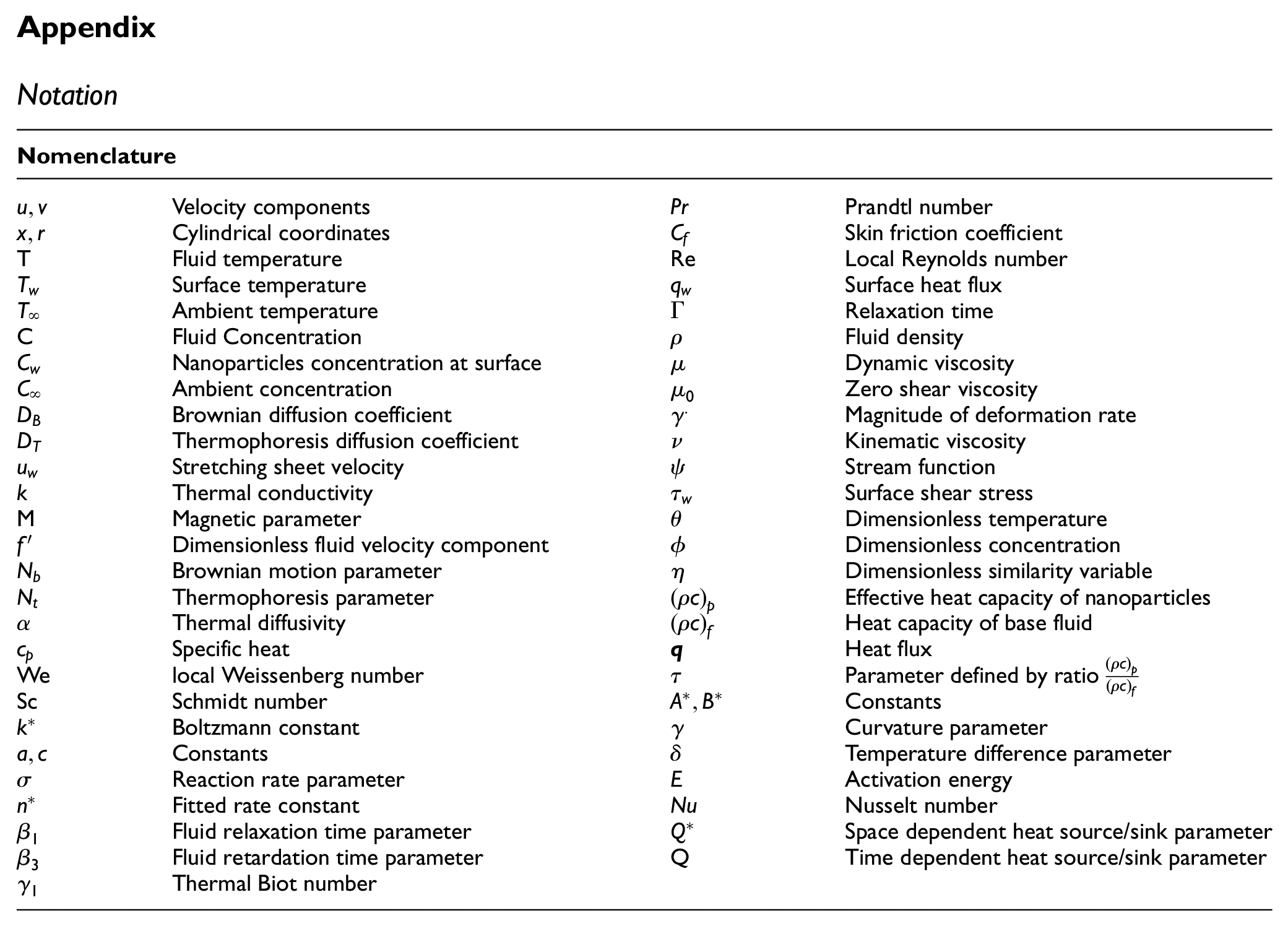
Notation
| Nomenclature | |||
|---|---|---|---|
| Velocity components | Prandtl number | ||
| Cylindrical coordinates | Skin friction coefficient | ||
| T | Fluid temperature | Re | Local Reynolds number |
| Surface temperature | Surface heat flux | ||
| Ambient temperature | Relaxation time | ||
| C | Fluid Concentration | Fluid density | |
| Nanoparticles concentration at surface | Dynamic viscosity | ||
| Ambient concentration | Zero shear viscosity | ||
| Brownian diffusion coefficient | Magnitude of deformation rate | ||
| Thermophoresis diffusion coefficient | Kinematic viscosity | ||
| Stretching sheet velocity | Stream function | ||
| Thermal conductivity | Surface shear stress | ||
| M | Magnetic parameter | Dimensionless temperature | |
| Dimensionless fluid velocity component | Dimensionless concentration | ||
| Brownian motion parameter | Dimensionless similarity variable | ||
| Thermophoresis parameter | Effective heat capacity of nanoparticles | ||
| Thermal diffusivity | Heat capacity of base fluid | ||
| Specific heat | Heat flux | ||
| We | local Weissenberg number | Parameter defined by ratio | |
| Sc | Schmidt number | Constants | |
| Boltzmann constant | Curvature parameter | ||
| Constants | Temperature difference parameter | ||
| Reaction rate parameter | Activation energy | ||
| Fitted rate constant | Nusselt number | ||
| Fluid relaxation time parameter | Space dependent heat source/sink parameter | ||
| Fluid retardation time parameter | Q | Time dependent heat source/sink parameter | |
| Thermal Biot number | |||
Handling Editor: James Baldwin
Authors’ contribution
Zahoor Iqbal: Formulated the mathematical model. Masood Khan: Developed the code for numerical solutions. Aamir Hamid: Analyse the whole problem. Awais Ahmed: Help in physical discussion of the outcomes.
Declaration of conflicting interests
The author(s) declared no potential conflicts of interest with respect to the research, authorship and/or publication of this article.
Funding
The author(s) received no financial support for the research, authorship and/or publication of this article.
