



Abstract
In automotive fluids, hydraulic, gear, and bearing oils, as well as in applications operating in extremely high or cold temperatures, PAO is widely employed. In present work, we have made an attempt to develop a mathematical model to discuss the flow of magnetized
Keywords
Introduction
Lubricants usually include additives and might be based on mineral, synthetic, or vegetable oils. To lessen friction and wear, they are utilized as low-shear-resistance coatings between affecting surfaces. In addition to enhancing opposition to corrosion temperature and oxidation, the major goal of additives is to boost the performance and longevity of lubricants. Synthetic lubricants which have the ability to maintain their features at high temperatures without decomposing or combusting or experiencing chemical degradation have been developed in recent years in response to the need for high performance lubricants in engineering fields, primarily in space and the automotive industry.1–6 Polyalphaolefins (PAOs) are among the synthetic lubricants which have gained more attention because of their intrinsic attributes such as wide operating temperature range, thermal stability and better oxidation, low viscosity, biodegradability, lower volatility, and high viscosity indices. PAOs have become new standard as a lubricant; according to the consumer reports,
Magneto hydrodynamics (MHD) is the study of magnetic effects and the behavior of electrically conducting fluids. The fundamental theory underlying MHD holds that magnetic fields cause currents to pass through conductive fluids that are in motion. With the use of MHD, researchers have discovered a method for solving some of the issues encountered in engineering. Plasma confinement, nuclear reactor cooling with liquid metal, and electromagnetic casting are a few of these issues. MHD issues can arise in a wide range of circumstances, such as when forecasting space weather, controlling turbulent oscillations in semiconductor melt during crystal development, and measuring beverage flow rates in the food business. The studies19–27 explain the flow of magnetized fluids over diverse geometries. Khan et al.
28
investigated second grade fluid’s thin film flow over a stretching sheet in porous medium along with heat transfer. The effects of heat source/sink on transfer of heat captured the attention of many researchers. Hsiao
29
analyzed MHD flow of viscoelastic fluid across a stretchable sheet with non-uniform heat source/sink. Ramesh et al.
30
have examined MHD flow across an inclined surface embedded in an incompressible fluid with the effect of non-uniform heat source/sink. Ramandevi et al.
31
discussed combined effects of viscous dissipation and non-uniform heat sink/source on MHD flow of the fluid. Sulochana et al.
32
examined the impact of non-uniform heat sink or source in
A thorough review of the literature reveals that no study is yet done to examine the flow characteristics and heat transference rate in the flow of magnetized
Mathematical formulation
In current work, a mixed convective flow of magnetized

Flow geometry.
Governing equations
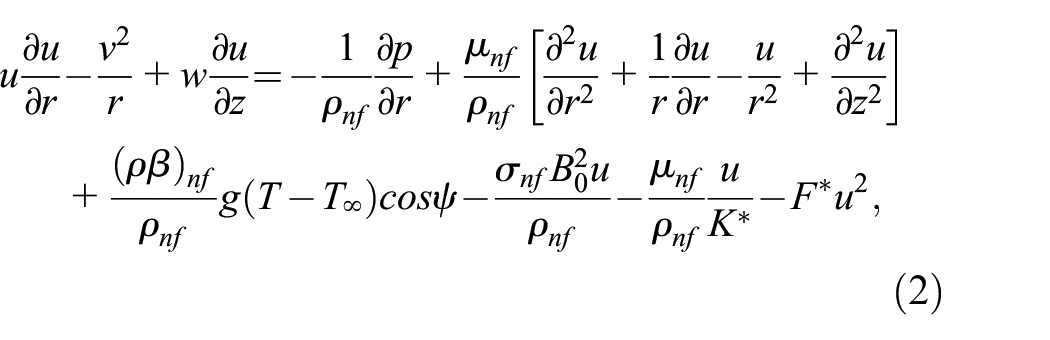
The flow phenomenon is expressed in this problem in the following ways40,41:



The conditions at the boundary for present problem are 42 :

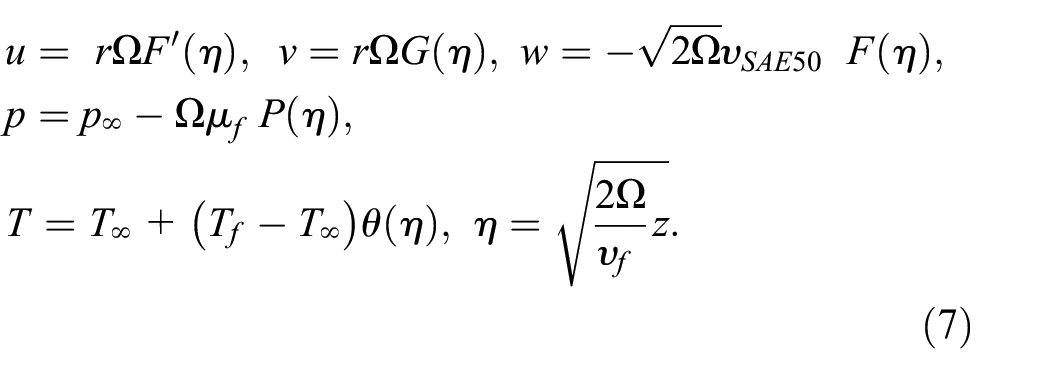
The following transformations are required for the current problem 43
Where

where,
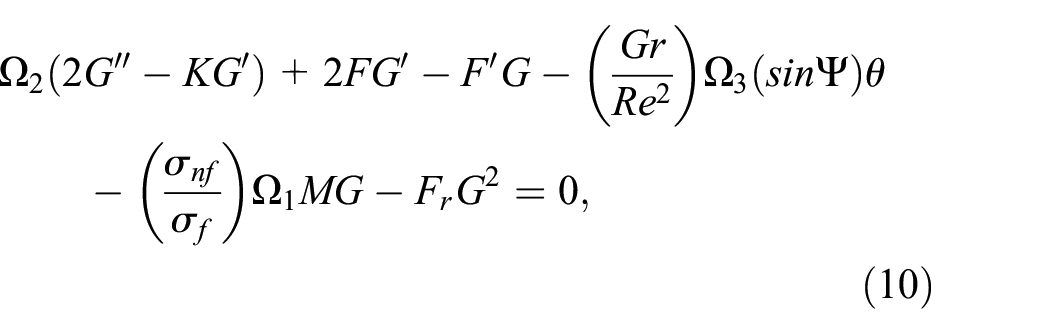
Equations (2)–(6) take the following form by using equations (7) and (8).


The boundary conditions are transformed as

where

We have made the following substitutions

Physical parameters
The engineering interest quantities such as circumferential wall shear stress
At surface, the drag force is represented as


The skin friction coefficient is then given as

The local skim friction in non-dimensional form is written as

The required torque to rotate a disk of radius

The rate of heat transfer, can be determined as

where,

Solution methodology
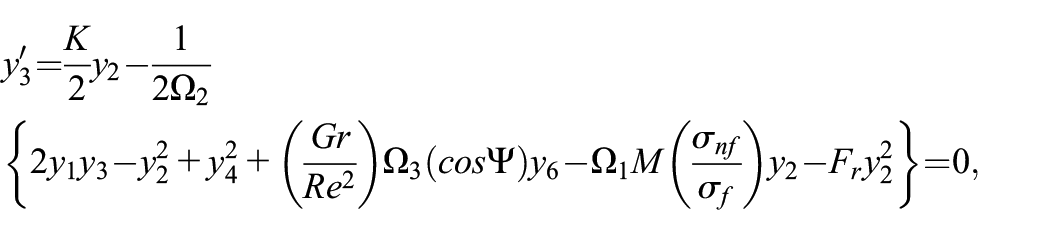
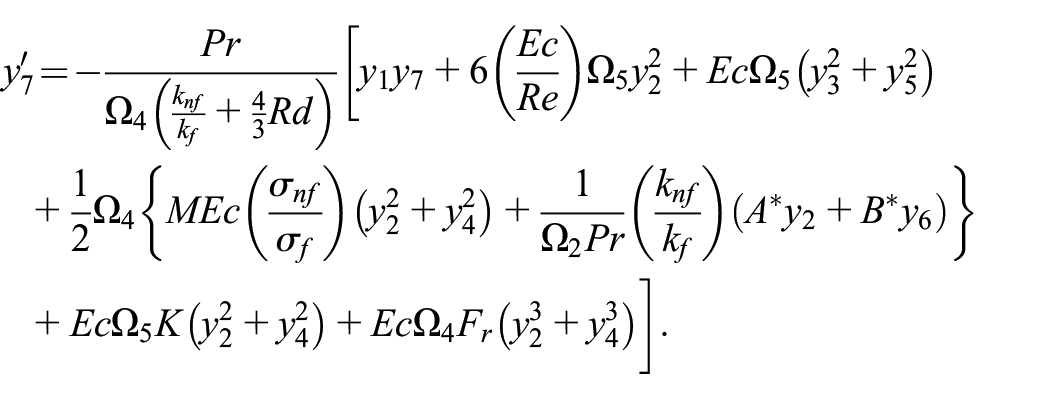
The governing PDEs are transformed to ODEs with the introduction of appropriate similarity quantities. The resulting ODEs given in equations (9)−(11) along-with BCs given in equation (12), are solved numerically with MATLAB bvp-4c solver. We make use of following substitutions,


The higher order equations are reduced to first order equations along with the initial conditions.


Results and discussion
In order to make a strong understanding of the model, the solutions for velocity and temperature profiles are assembled numerically via MATLAB built-in bvp-4c solver and illustrated graphically. The relations for predicting thermo-physical properties of nanofluids are given in Table 1. The numerical values of thermo-physical properties of base lubricant (PAO) and nanoparticles
Thermo-physical aspects of nanolubricant.

The features of


Effects of

Effects of
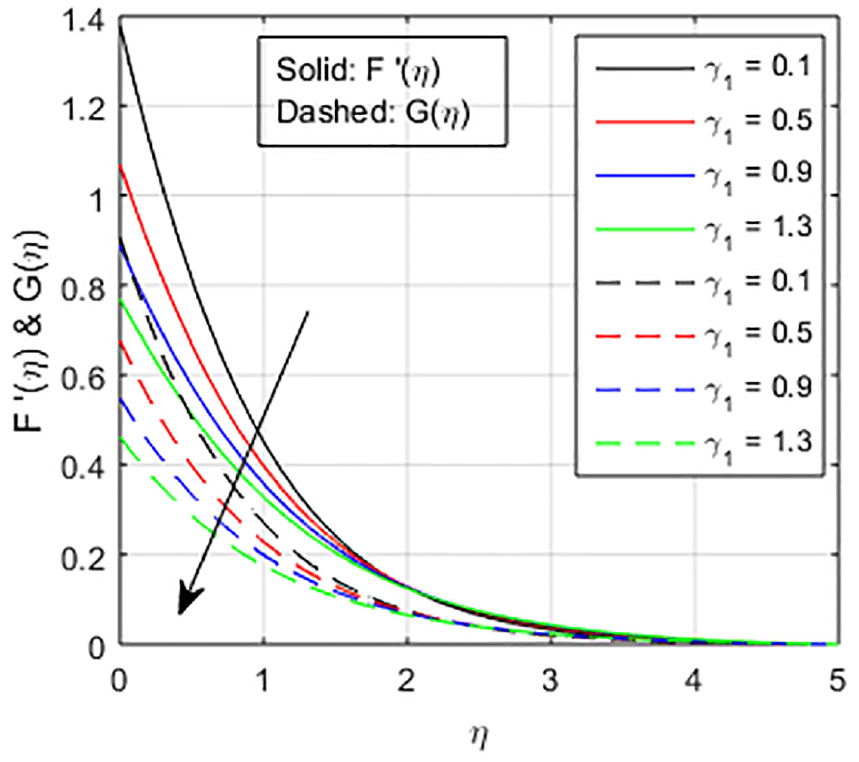
Effects of

Effects of

Impact of

Impact of

Impact of

Impact of
The comparison of present computational results of Skin friction with Nayak et al., 16 while additional assumptions are omitted.

Effects of different parameters on Nusselt number.

Concluding remarks
In this work, an attempt is made to develop a mathematical model to discuss the flow of magnetized
The enhancing values of velocity slip parameter decrease the tangential and radial velocities of the nanolubricant
The growing values of Grashof number oppose the flow of nanolubricant along tangential direction but support the radial flow.
With an escalation in inertial parameter, the movement of
The temperature of the nanolubricant
The non-uniform heat source/sink parameters play a vital role in controlling heat transmission phenomenon.
The temperature of the nanolubricant
The growing values of Eckert number, radiation parameter, and non-uniform heat source parameters tend to increase the value of Nusselt number.
The value of Nusselt number drops with rising values of Biot number and non-uniform heat sink parameters.
Footnotes
Appendix
Handling Editor: Chenhui Liang
Declaration of conflicting interests
The author(s) declared no potential conflicts of interest with respect to the research, authorship, and/or publication of this article.
Funding
The author(s) received no financial support for the research, authorship, and/or publication of this article.
