




Abstract
Current investigation scrutinizes the magnetohydrodynamic (MHD) natural convection flow of micropolar ferrofluid across an isoflux sphere with the impacts of thermal radiation and partial slip. Cobalt-nanoparticles with kerosene as the base fluid are considered. The governing partial differential conservation equations and convenient boundary conditions are rendered into a nondimensional form. The finite difference method (FDM) is then applied to determine the solution of a collection of resultant equations. The outcomes obtained by FDM have also compared with cited investigation. Illustrations describing influences of prominent parameters which provides physical interpretations of velocity, angular velocity, and temperature fields as well as the skin friction coefficient and Nusselt number are examined in detail with the help of graphical representations. This investigation determined that the skin-friction coefficient and heat transport rate reduced along with augmentation in the magnetic force and micropolar parameter, while opposite performance is adhered with elevating in the thermal radiation. Moreover, the boosted nanoparticle volume fraction reduced the skin friction coefficient and improved the Nusselt number.
Introduction
In the past few decades, the investigation of nanoparticles attained enormous significance because of its applications in the area of technological industry and biological science like as nano drug delivery, biomedical sciences, electromechanical systems, solar absorption, industrial cooling, and much more. The expression nanofluid was innovated by Choi 1 which refers to engineering colloids that consists of nanoparticles scattered in a base fluid for enhancing the thermal conductivity. Nanofluid is normally applied in order to improve the heat transmission rate of the base liquid. It is a combined nano-sized particle (1–100 nm) which is suspended inside the base liquid. The nanofluid is normally produced of metals, carbides, oxides, and nano-metals. The base fluid is in common, water, blood, ethylene glycol, and so on. Eastman et al. 2 performed an investigation that thermal conductivity is increased as copper nanoparticles are added up into a base fluid (water). In addition, they explored that the thermal conductivity improved by raising the copper nanoparticles into the traditional liquid. Buongiorno 3 debated in his consideration that there are many mechanisms, which are significant to promote the thermal conductivity of the base fluid. Khan et al. 4 studied the mass flux qualifications in the diffusion of nanoparticles with thermal radiation impact. Hayat et al. 5 implemented the suspension of water-based nanoparticles encouraged by a rotating disk with variable thickness. Tlili et al. 6 investigated the heat transport and nanofluid flow across a radiated stretching cylinder in a porous medium. Maleki et al. 7 studied the impact of thermal radiation on nanofluid flow and heat transport along with a permeable plate. Various investigators have worked to augment the characteristics of nanofluids flow.8–13
Magneto-nanofluids (ferrofluids) have a vast use in areas like as magneto-optical fabric floating isolation, wavelength sensors, nonlinear optical devices, optical fibers, hypoxia, pharmacology, optic stimulators, and so on. The magneto-nanofluid has the features of both magnetics and liquids. Each utilized, magnetic strength inspires the reconstructs the concentration and dissolved particles within the fluid regime that highly affects the flow emulation of the heat transmission. Magneto-nanofluids are efficient in driving the particles through tissues via magnets up the blood flow, which is due to the verity that the magnetic nanoparticles have been scrutinized to be more viscid to tissue cells than the non-malignant cell kinds. These particles expend more energy than the micro-particulates in reversing present magnetic strengths possible in humans like as in cancer medication. Eid 14 ascertained the MHD mixed convection flow of two-phase chemically reacting nano-fluid pattern. Rashad 15 explored the magneto-slip of nanofluid flow on a radiated wedge. Sandeep et al. 16 scrutinized the magneto-nanoparticles by representing fully-accurate numerical exploration. Mishra et al. 17 explored the rheology of nanoliquid to perform the thermo-diffusion features in stretchable surface. Many researchers have examined this particulars study in the view of various elements and, including the magneto-nanofluids flow, for example, see Refs.18–26
During the last decade, the requirement to model and shape the liquid that comprises rotating microconstituents have given enchantment to the micropolar liquid theory. The fluids that couple the particle rotatory movement and macroscopic velocity distribution are famous as micropolar liquids. Such liquids are synthetic of indeclinable elements that are enfold in a viscous or sticky conduit. Models of such liquids are blood flow, ferrofluids, and bubbly liquid. The industrial applications of these liquids are lubricant fluids, biological structures, and polymer solutions. The concept of micropolar fluid model is primarily coined by Eringen.27,28 Later, diverse considerations are performed concentrating on this fundamental non-Newtonian fluid. Ahuja 29 supposed from his experimental research that the improvement in heat transmission may be due to the nanoparticles rotation about their own pivot due to the shear stress impact, and therefore a three-dimensional hydrodynamic boundary layer was also noticed. The rotating micro-constituents’ impacts in nanofluids should be addressed to realize the fluid flow conduct in a preferable way and then the micropolar theory demonstrates the variation between numerical and experimental observations. However, a new type of nanofluids as micropolar fluid has been demonstrate by many investigators. Bourantas and Loukopoulos 30 analyzed the magneto-natural convection flow of micropolar nanofluid driven by inside a square cavity. Bourantas and Loukopoulos 31 have numerically modeled the natural convective flow of micropolar nanoliquids. They explored that the microrotations in general decrease overall heat transmission from the heated side and should not hence be ignored. Rashad et al. 32 explained the mixed convective flow of micropolar nanofluid through a cylinder in a porous media. Shah et al. 33 discussed the thermal behavior by magnetic strength on micropolar nanofluid flow between two rotating parallel plates. Rashad et al. 34 investigated the micropolar nanofluid flow by unsteady mixed convective through a stretchable surface. Khan et al. 35 analyzed the magneto-natural convection flow of polar nanoliquid past a truncated radiative cone.
The survey of the above-mentioned literature designates that considerable study is available that reports the notions, about the nanoparticles flow, by applying a diversity of geometrical presumptions. However, to the best of our knowledge, no study far is reported for kerosene carrying Cobalt micropolar nano-particles through isoflux sphere. The main objective of the investigation in hand is to explore numerically the magneto-micropolar ferroliquid flow across the isoflux sphere by natural convective with impacts thermal radiation and partial slip. The finite difference method (FDM) is applied in this investigation to solve the modeled problem. Plots are graphed and exhibited in detail for several causes of embedding parameters by taking into consideration the temperature, velocity, angular velocity, skin friction factor, and Nusselt number.
Problem formulation
Suppose the problem of steady laminar 2D natural convection flow of magneto-micropolar ferrofluid through an isoflux sphere. The ferrofluid is collected from Cobalt nanoparticle associated with a base fluid (kerosene). Flow model is developed by addressing the influence of thermal radiation and slip boundary conditions. The graphical sight of the investigation and the flow model are revealed in Figure 1. A uniform magnetic field is also utilized in the direction normal to the surface. The sphere surface is kept at a constant heat flux



Flow model.
Subjected to the corresponding boundary conditions (see Rashad 15 and Huang and Chen 36 ):


Where

where βR and σ1 stand for the mean absorption coefficient and Stefan-Boltzmann constant. As carried out by Raptis, 39 the fluid-phase temperature variations within the flow are approached to be adequately small so that T 4 may be obvious as a linear function of temperature. This is created by extending T 4 in a Taylor series on the free-stream temperature T∞ and removing higher-order terms to yield;

Utilizing equations (6) and (7) in the last term of equation (4), we obtain

In the current investigation, the following thermophysical relations are utilized; see Tiwari and Das 40 formulation;


Here subscripts “s,”“f,” and “ff” stand for the magnetic nanoparticle (Cobalt), base fluid (kerosene) and ferrofluid, respectively. ϕ stands for nanoparticles volume fraction. The efficient thermal and physical properties of ferrofluid have been presented in Table 1. Also, the spin-gradient nanofluid viscid

Where,
Thermophysical properties of kerosene and cobalt. 26

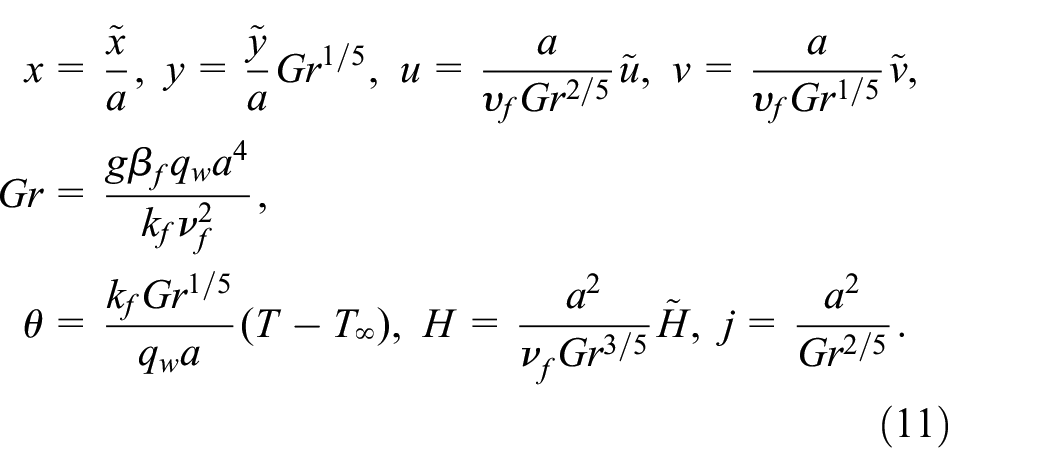
Using equation (11) in equations (1)–(8), we have following equations:

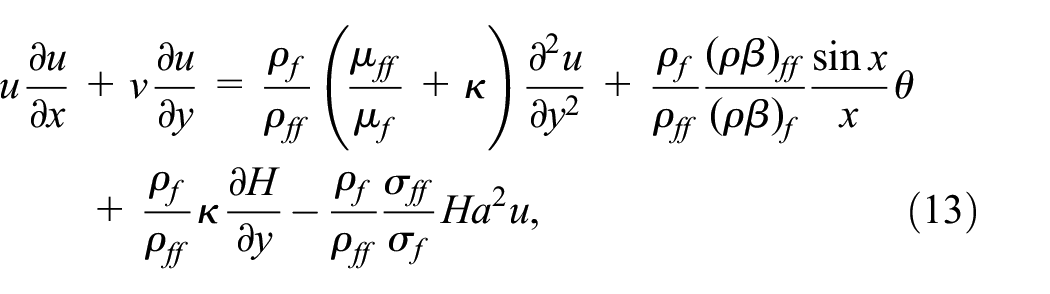


and


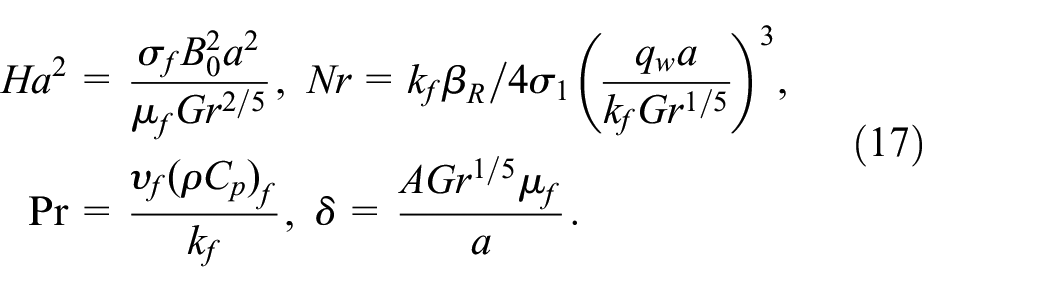
where Ha stands for Hartmann number, Nr stands for radiation parameter, Pr signifies the Prandtl number and δ signifies the slip parameter which are given respectively as;
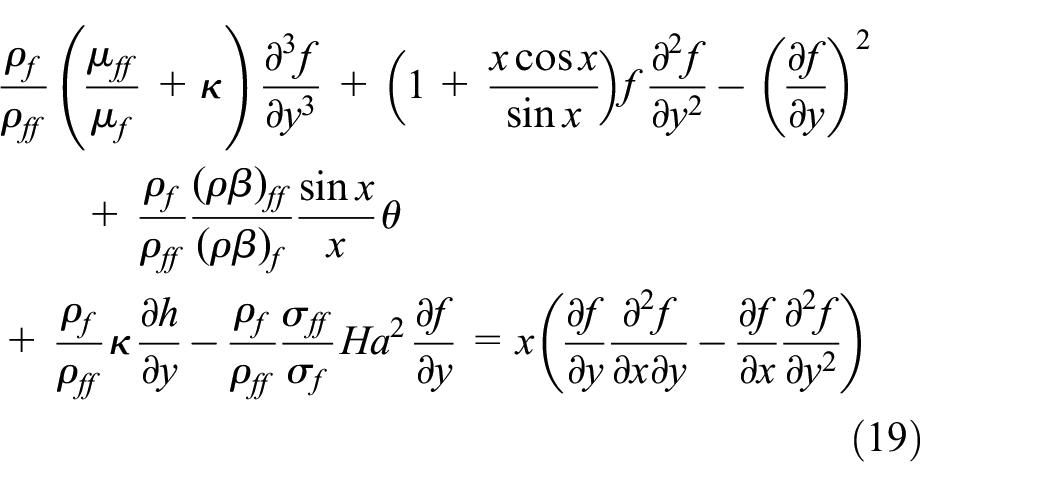
To get the solutions to equations (13)–(15) utilizing equation (17), the following functions are introduced

Where ψ stands for the stream function which is given by


and

Important entities namely drag friction Cf(x) and local Nusselt number Nu(x) are determined for physical interest as follows;


Numerical method
The non-linear, non-similar partial differential equations (19)–(21) are solved numerically with the boundary conditions (22) using a finite difference method provided by Gorla et al. 41 The main steps used in this method are summarized below:
- At the boundary layer edge, the boundary conditions are replaced by
- The domain of interest
- The partial derivatives with respect to
- Based on successive substitution, two iteration loops are used since the equations are non-linear.
- The value of x is fixed in each inner iteration loop, and the governing equations (19)–(21) are solved in the
- The value of
The accuracy of this numerical method was validated by comparing the present results with the results reported by Huang and Chen, 36 Yih, 37 and Chamkha and Al-Mudhaf, 38 in the absence of magnetic field, and thermal radiation and partial slip effects. Tables 2 and 3 present the results of these various comparisons. The present results are found in an excellent agreement with the existing results.
Comparison of
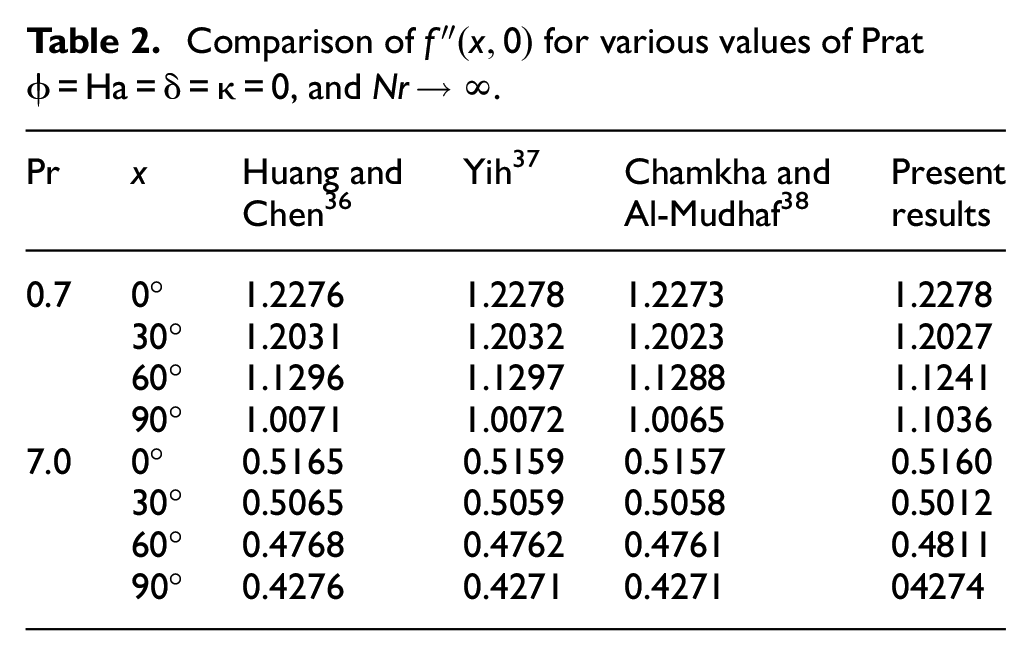
Comparison of

Results and discussions
The numerical investigation are reported to explore the magneto-natural convective flow of micropolar Cobalt-kerosene ferrofluid adjacent an isoflux sphere in presence of partial slip and radiation impacts. To visualize the physical consequences of pertinent parameters such as micropolar parameter κ, radiation parameter Nr, dimensionless coordinate x, velocity slip parameter δ, Hartmann number Ha, and solid volume fraction of ferrofluid ϕ, several plots are prepared for the distribution of velocity, angular velocity, temperature, local skin friction coefficient, and Nusselt number.
Figures 2 to 4 are contrived to exhibit the impact of Hartmann number Ha on dimensionless velocity

Effects of solid volume fraction of ferroparticles and magnetic field on dimensionless velocity at different positions along sphere: (a) at x=0 and (b) x=0.85.

Effects of solid volume fraction of ferroparticles ϕ and magnetic field Ha on dimensionless temperature at different positions along sphere: (a) at x=0 and (b) x=0.85.

Effects of solid volume fraction of ferroparticles ϕ and magnetic field Ha on dimensionless angular velocity at different positions along sphere: (a) at x=0 and (b) x=0.85.
Figures 5 to 7 indicate the behaviors of the velocity slip parameter δ and micropolar parameter κ on the dimensionless velocity

Effects of velocity slip parameter δ and micropolar parameter κ on dimensionless velocity at different positions along sphere: (a) at x=0 and (b) x=0.85.

Effects of velocity slip parameter δ and micropolar parameter κ on dimensionless temperature at different positions along sphere: (a) at x=0 and (b) x=0.85.

Effects of velocity slip parameter δ and micropolar parameter κ on dimensionless angular velocity at different positions along sphere: (a) at x=0 and (b) x=0.85.
Figures 8 and 9 examine the variation of local skin friction

Effects of solid volume fraction of ferroparticles ϕ, magnetic field Ha, and slip parameter δ on skin friction at different positions along sphere: (a) at x=0 and (b) x=0.85.

Variation of Nusselt number with effects of solid volume fraction of ferroparticles ϕ, magnetic field Ha, and slip parameter δ at different positions along sphere: (a) at x=0 and (b) x=0.85.
Figures 10 and 11 explain the consequences of the skin friction local skin friction

Variation of skin friction with radiation parameter Nr and micropolar parameter κ at different positions along sphere: (a) at x=0 and (b) x=0.85.

Variation of Nusselt number with radiation parameter Nr and micropolar parameter κ for different micropolar ferrofluids at different positions along sphere: (a) at x=0 and (b) x=0.85.
Conclusions
This investigation reflects the influence of thermal radiation on magneto-natural convection flow of micropolar ferrofluid past an isoflux sphere with the impact of velocity slip. Cobalt-nanoparticles with kerosene based-ferrofluid are considered. Non-dimensional factors were exploited to transmute the governing PDEs into non-similar form. The transmuted model subject to analogous BCs was then solved numerically with the help of finite difference method. The influences of prominent parameters on velocity, angular velocity and temperature fields as well as the skin friction coefficient and Nusselt number are visualized and analyzed through graphs. The main achieved results are as follows:
- Both skin friction coefficient and Nusselt number reduce with upsurging in the micropolar parameter.
- Magnetic force contributes to the dwindling skin friction coefficient and heat transport rate ever-growing. Similar performance is adhered with elevating in the micropolar parameter.
- Boosted nanoparticles volume fraction reduces the surface shear stress, and enhances the heat transfer rate.
- Both the skin-friction coefficient and heat transport rate show a considerable improvement in the presence of thermal radiation.
Footnotes
Appendix
Handling Editor: James Baldwin
Declaration of conflicting interests
The author(s) declared no potential conflicts of interest with respect to the research, authorship, and/or publication of this article.
Funding
The author(s) disclosed receipt of the following financial support for the research, authorship, and/or publication of this article: This work was supported by the Deanship of Scientific Research at Prince Sattam bin Abdulaziz University under the research project No. 2020/01/16413.

Availability of data
The data that support the findings of this study are available from the corresponding author upon reasonable request.