In this article, we present a comprehensive analysis of the flow and heat transfer characteristics of a fully developed incompressible, electrically conducting, and radiatively active fluid flow in micro-channel in the presence of transverse magnetic field. The Navier–Stokes and energy governing equations for magnetohydrodynamic flow, including thermal radiation and rarefaction effects, are considered to examine the wall properties (friction and heat transfer) and the flow properties (temperature and velocity). Two rarefaction effects of velocity slip and temperature jump at the wall are modeled as the product of characteristic slip/jump length and the first derivatives of velocity and temperature, respectively. Since the natural convection of magnetohydrodynamic flow in channel is resulted from the competition between deriving forces by pressure gradient, temperature gradient, and magnetic field, its flow and heat transfer characteristics should be understood systematically. First, we obtain the system parameters representing thermal radiation, buoyancy, magnetic field, temperature difference, velocity slip length, and temperature jump length through the non-dimensionalization process, and then their influences are rigorously evaluated by solving the governing equations numerically using Runge–Kutta algorithm with shooting method.
Natural convection of magnetohydrodynamic (MHD) flow in vertical channels has been extensively studied for the last three decades.1–16 Osterle and Young1 first discussed the effect of viscous dissipation and applied magnetic field for the fully developed natural convection for a fluid between two heated walls. They derived an analytic solution with negligible viscous and electrical dissipation. Poots2 included the heat source and Joule heating. Fan et al.3 introduced a uniform heat flux at the wall for this system and analyzed it with finite difference formulation. Soundalgekar and Haldavnekar4 studied various aspects of the natural convection with non-perfect thermally conducting plates. Yang and Yu5 numerically investigated the entrance problem of convective MHD channel flow between two parallel plates subjected simultaneously to an axial temperature gradient and a pressure gradient. Wu and Cheng6 examined the onset of instability in the thermal entrance region of the system. Javeri7,8 investigated the combined influence of Hall effect, ion slip and the temperature boundary condition of the third kind on the MHD heat transfer by employing the Galerkin–Kantorovich method of variational calculus. The existence and uniqueness of solutions to the governing equations for natural convection of MHD flow were discussed by Meir.9 Attia and Kotb10 focused on the effect of wall motion with giving upper plate a constant velocity while the lower plate is kept stationary. Umavathi and colleagues11,12 compared the solutions from perturbation series method and finite difference technique. The effect of Joule heating and viscous dissipation in the flow is thoroughly investigated by Barletta and colleagues.13,14 Singh et al.15 identified the unsteady characteristics of the flow. Another kind of the integral transform solution for low-magnetic MHD flow and heat transfer in the entrance region of a channel was proposed by Lima and Rêgo.16
Recently, the devices are miniaturized to enhance the performance, minimum energy consumption, size reduction, and so on. For the correct analysis of the natural convection MHD flow in vertical micro-channel requires the proper consideration of rarefaction effects at the wall, which appears as velocity slip and temperature jump.17–24 Bocquet and Barrat18 present that both the velocity slip and the temperature jump can be modeled as the product of their first derivatives and the characteristic slip/jump length
Considering all the above, the purpose of this study is to investigate the natural convection of MHD flow in micro-channel with thermal radiation and rarefaction effects of velocity slip and temperature jump. The thermal radiation is also included because it could play a significant role in natural convection either in high temperature environment25–28 or with highly radiatively active medium.28–30 This article is organized as follows: in the next section, we will have brief summary of the governing equations and boundary conditions, which are also available in the reference by Abdollahzadeh Jamalabadi et al.,31 then it will be followed by a comprehensive investigation about the natural convection of MHD flow in micro-channel by varying the series of system parameters such as radiation parameter, ; Grashof number, Gr; Hartmann number, Ha; thermal parameter, ; velocity slip length, ; and temperature jump length, . The heat transfer and wall friction at the wall will be presented with the Nusselt number, Nu, and the friction coefficient, . All the discussion will be summarized in the “Conclusion” section.
Governing equations
As shown in Figure 1, a fully developed incompressible, electrically conducting, and radiatively active fluid confined by two planar plates under transverse magnetic field, B, is considered in this study. Two walls have different temperatures as at and at , and the right wall is hotter than the left . The difference in temperature induces a natural convection in the channel. The width of channel, , is assumed to be sufficiently small, so that the velocity slip and temperature jump are observable at the walls. Then, the velocity profile, , of this system can be described with the following equation2,4
where u is the fluid velocity in vertical y-direction, is the fluid density at reference temperature defined as , is the viscosity at , is the thermal the thermal expansion coefficient, and is the electrical conductivity. In the above equation, the buoyancy force is modeled with Boussinesq approximation.32 If the optical thickness of the medium is sufficiently large, the temperature profile inside the channel can be obtained from the following equation with Rosseland approximation26,31
where T is the medium temperature, k is the thermal conductivity, is the Stefan–Boltzmann constant, and is the absorption coefficient of the medium. As stated above, the velocity–slip boundary conditions are imposed at and
where is the velocity slip length. The temperature boundary conditions at wall consist of heat flux conservation and temperature jump relation
where is the temperature jump length. The velocity slip length and the temperature jump length are originated from the tangential momentum accommodation coefficient, , and the thermal accommodation coefficient, , respectively. They are defined as17
where and stand for the tangential momentum of incoming and reflected molecules, respectively, and is the tangential momentum of re-emitted molecules, corresponding to that of the surface ( for stationary surfaces), and
where and denote the energy flux of incoming and reflected molecules, respectively, and denotes the energy flux corresponding to the surface temperature.
Schematic illustration of vertical channel containing fully developed mixed convection fluid flow under magnetic field.
Now, the above equations can be non-dimensionalized by introducing the following dimensionless variables
and
with
Then, the governing equations (3) and (4) are non-dimensionalized as
In the above equations, the radiation parameter, ; the Grashof number, Gr; the Reynolds number, Re; and the Hartmann number, Ha, are the non-dimensionalized parameters representing the magnitude of the thermal radiation, the buoyancy force, the ratio of inertia to medium viscosity, and the strength of magnetic field, respectively. They are defined as
and
The temperature parameter, , defined as
represents the inverse of the temperature difference. The dimensionless forms of boundary conditions are shown as
The velocity slip length and the temperature slip length are also non-dimensionalized as
In addition, the friction and heat transfer characteristics at the wall are quantified with the skin friction coefficient and the Nusselt number
Results and discussion
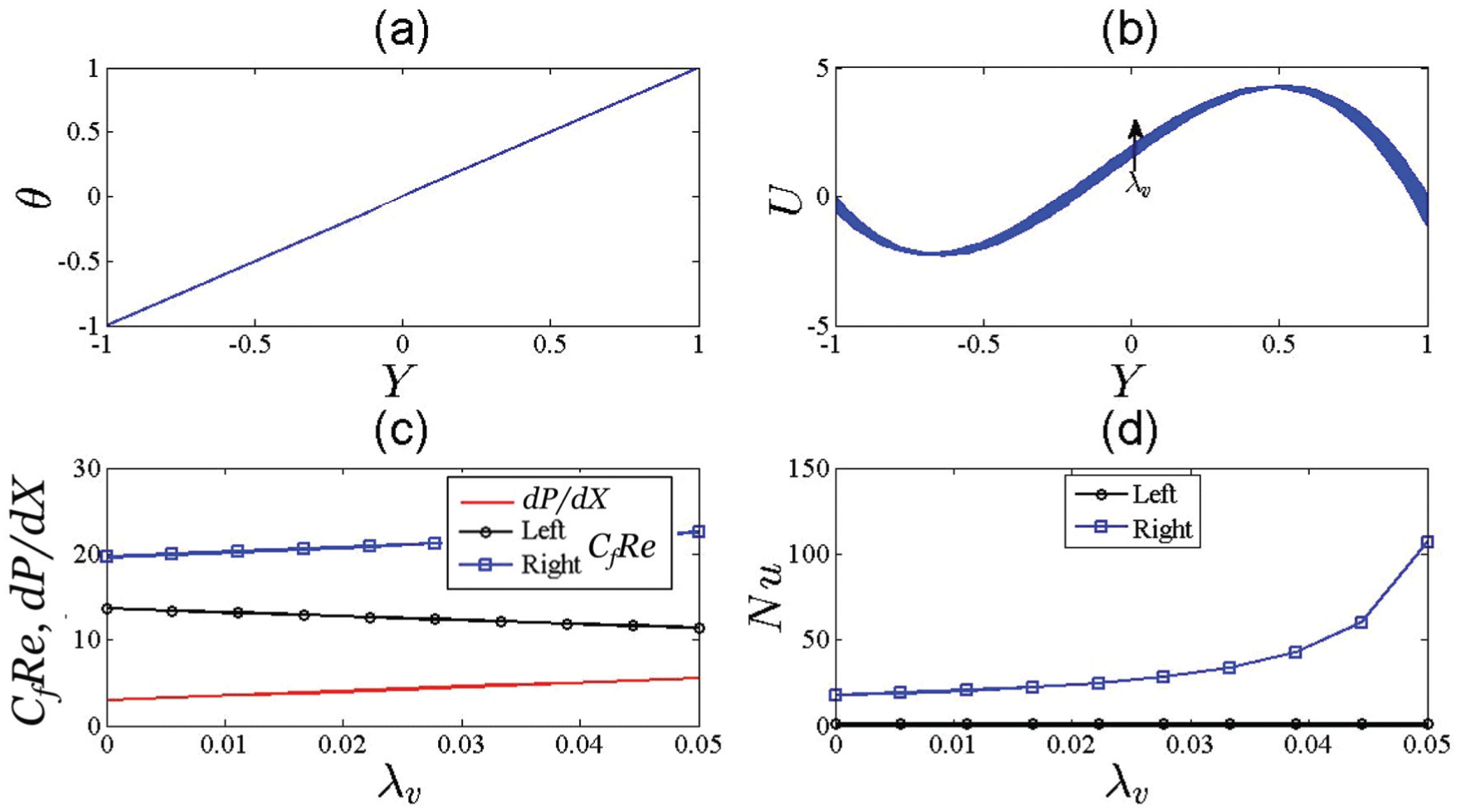
In Figures 2–7, the flow and heat transfer characteristics of the system in Figure 1 are comprehensively examined by varying the major system parameters of , , Ha, and , and the degree of rarefaction is represented by and . The non-dimensionalized governing equations (17) and (18) were numerically solved by employing the Runge–Kutta–Fehlberg method33 with subject to the boundary conditions of equations (24)–(27).
Effect of thermal radiation parameter, , on (a) dimensionless temperature, (b) dimensionless velocity, (c) wall friction coefficients and pressure gradient, and (d) Nusselt numbers.
Effect of on (a) dimensionless temperature, (b) dimensionless velocity, (c) wall friction coefficients and pressure gradient, and (d) Nusselt numbers.
Effect of Ha on (a) dimensionless temperature, (b) dimensionless velocity, (c) wall friction coefficients and pressure gradient, and (d) Nusselt numbers.
Effect of thermal parameter, on (a) dimensionless temperature, (b) dimensionless velocity, (c) wall friction coefficients and pressure gradient, and (d) Nusselt numbers.
Velocity slip effect on (a) dimensionless temperature, (b) dimensionless velocity, (c) wall friction coefficients and pressure gradient, and (d) Nusselt numbers.
Temperature slip effect on (a) dimensionless temperature, (b) dimensionless velocity, (c) wall friction coefficients and pressure gradient, and (d) Nusselt numbers.
Figure 2 presents the effect of thermal radiation parameter, Rd, on heat and fluid flow characteristics in the channel, while the other parameters are fixed as , , , , and . Without the radiation effect , the temperature profile appears linear as shown in Figure 2(a). With increase in the radiation number from 10−4 to 10−2, the medium temperature gradually approaches to the temperature at hot right boundary, while the slope in temperature becomes steeper near the cold left wall. Figure 2(b) displays a typical sinusoidal velocity profile in the natural convection. The left side has downward flow velocity, whereas the fluid moves upward in the right side . With the increase in , the magnitudes of peak values are all reduced because the temperature gradient across the channel becomes smaller (see Figure 2(a)). Figure 2(c) illustrates the effect of thermal radiation on the wall friction and pressure gradient. As increases, the wall friction coefficient gradually decreases at both walls, while the pressure gradient increases dramatically. For small , the wall friction is found larger at the right hot wall than at the left cold wall, while for large , the friction at the left wall is larger than the value at the right wall. It is because the larger temperature gradient at the left wall with large (see Figure 2(a)) induces the larger velocity gradient there. The Nusselt number profile with is plotted in Figure 2(d). For small , both Nus increase gradually in proportion to . However, when , a sudden increase is observed at the left wall due to larger temperature gradient.
The effect of natural convection, that is, buoyancy force, which is represented by Gr/Re, is illustrated in Figure 3. Gr/Re varies from 1 to 30, while other parameters are fixed as , , , , and . As shown in Figure 3(a) and (b), the velocity profiles are significantly influenced by Gr/Re, whereas the temperature profiles are insensitive to the change of Gr/Re, since the temperature difference causes the buoyancy force but the reverse is not true. The increase in buoyancy effect induces a larger velocity, which gives rise to the augmentation of the local peaks in velocity profile (see Figure 3(b)). When Gr/Re is small (Gr/Re = 1), the buoyancy effect becomes negligible and the velocity distribution appears as parabola which is the profile in fully developed condition. However, even with Gr/Re = 1, the velocity is still a little larger in the left side of the channel due to the buoyancy. The effect of Gr/Re on the wall friction coefficient and pressure gradient is illustrated in Figure 3(c). At the right hot wall, the monotonically increases in proportion to Gr/Re, while at the left wall, decreases first with the increase in Gr/Re and then increases with further increase in Gr/Re. It can be explained with velocity profiles in Figure 3(b). In the left side of channel , the sign of velocity is reversed (from negative to positive) as Gr/Re increases, while in the right side the velocity is always positive. Therefore, at the left wall the magnitude of dU/dY decreases initially as Gr/Re increases (U is negative) and then increases as Gr/Re further increases (U is positive). However, the pressure gradient is independent of Gr/Re. Finally, the effect of Gr/Re on the convective heat flux, represented as Nu, is shown in Figure 3(d). As Gr/Re increases, Nu increases at the right wall because the velocity becomes more positive, whereas Nu decreases at the left well because the velocity becomes more negative.
Also in Figure 3, the temperature and velocity profiles across channel are recovered to the conventional linear profile (conduction dominant) and parabolic distribution (Poiseuille flow), respectively, when the thermal radiation and the rarefaction effects are tiny along with mild natural convection (, , , )—this is a kind of limiting case. It confirms the accuracy and verifies the computations in this study.
The influence of Ha, representing the magnetic field strength, is revealed in Figure 4. The Hartmann number, Ha, varies from 0 to 15, while the other parameters are fixed as , , , , and . According to equations (3) and (4), the temperature is not affected by the magnetic field as shown in Figure 4(a). However, the effect of Ha on the velocity is significant: the initial sinusoidal velocity profile becomes flat as the magnetic field is intensified (see Figure 4(b)) because the magnetic field generates a resistive force against the fluid flow. The effect of Ha on the wall friction and pressure gradient is depicted in Figure 4(c). As Ha increases, both the left and right wall friction coefficients decrease initially, reach minimum, and then increase. Also, increases rapidly with Ha because the Lorentz force provoked by the magnetic field induces the resistive flow against the natural convection. The effects of Ha on the left and right Nus are compared in Figure 4(d). When Ha is small, the friction is found greater at the right wall than at the left wall. However, as Ha increases, and approach to a single value of 2.5 rapidly.
The effect of thermal parameter, , representing the temperature difference, is shown in Figure 5. In the figure, varies from 0.1 to 5, while the other parameters are fixed as , , , , and . As seen in Figure 5(a), control the overall medium temperature: increases in proportion to . The responses of to are similar to those to (see Figure 2(a)): the degree of increment is gradually reduced as approaching to the hot wall. Since the velocity in natural convection is mostly determined by the temperature distribution, the velocity profile in Figure 5(b) is also similar to the curve in Figure 2(b): With the increase in , the peak values are reduced while maintaining the sinusoidal shape in velocity profile, which indicates that the natural convection is weakened as increases and the temperature gradient across the channel is reduced. The effect of on the pressure gradient and wall friction is illustrated in Figure 5(c). With the increase in , the wall frictions are reduced in overall. However, the degree of reduction is different depending on the wall temperature (more reduction at the hot wall), therefore for , whereas for . Figure 5(c) presents that after a slight decrease for , the pressure gradient increases dramatically. Similar to Figure 2(d), the Nusselt number increases in proportion to (see Figure 5(d)).
The effect of velocity slip, represented by the non-dimensionalized slip length, , is observed in Figure 6. The non-dimensionalized slip length, , varies from 0 to 0.05, while the other parameters are fixed as , , , , and . The velocity slip affects the flow velocity only (see Figure 6(b)), while the temperature profile does not change regardless of the change in (see Figure 6(a)). When , the velocity diminishes to zero at both walls, that is, no slip condition in conventional fluid mechanics. The increase in causes the fluid near wall to move downward (minus Y-direction). It can be explained with Figure 6(c) describing the response of pressure gradient to the slip length. In Figure 6(c), the pressure gradient increases with the increase in the slip length, which gives rise to the strengthened downward fluid motion in X-direction. Such effect of pressure gradient appears mainly near the wall because in the middle region away from the wall, the buoyancy is dominated over the pressure-induced deriving force. Then, the pressure effect enhances the velocity gradient at wall that is related with the wall friction. With the increase in velocity slip, the friction is reduced at the left wall, while the wall friction at the right wall increases. Such different behavior of wall friction is caused by the opposite flow direction at each wall ( for , while for ): in the left side of the channel, the entire fluid motion is enhanced by the downward velocity near the wall due to the increased and the velocity gradient decreases with resulting in the augmentation in at the left wall. However, in the right side the medium flow flows in the opposite direction to that of the slip-induced velocity at the wall and weakens the velocity peak in the right side and hence at the right wall is reduced. In Figure 6(d), Nu at the right wall dramatically increases when , while the Nu at the left wall remains almost same as the value at .
The effect of temperature slip is observed in Figure 7. varies from 0 to 0.05, while the other parameters are fixed as , , , , and . With the increase in , the temperature profile shifts upward according to the presence of temperature jump at the boundaries, that is, the temperature difference is kept same. Figure 7(b) illustrates the sinusoidal velocity profile, which is robust against such change because the fluid motion in natural convection is affected by the temperature difference, not by the temperature itself. The effect of temperature jump on the wall friction and pressure gradient is presented in Figure 7(c). Regardless of the change in , there is no meaningful change in the properties except small decrease in the pressure gradient. Moreover, the trends in Nusselt number profiles are almost identical with those in profiles (see Figure 7(d)).
The system in Figure 1 is found in various solar energy applications such as the solar collectors28 and thermo-syphon solar water heaters.29 Therefore, the observations in this study are expected to be a key knowledge in designing the miniaturized solar energy absorbers, because all the non-dimensionalized parameters here are the major design parameters for that purpose.
Conclusion
In this study, we thoroughly investigated the laminar natural convection of highly radiatively active MHD flow in vertical micro-channel including the rarefaction effects represented as velocity slip and temperature jump. The different temperatures are assigned on both walls, and the governing equations were non-dimensionalized by providing the diverse parameters (, , Ha, , , and ), which characterizes the physical phenomena in the flow. The findings in this study can be summarized as follows:
As either or increases, the medium temperature follows rapidly the hot wall temperature;
influences the velocity profile only;
As becomes large the velocity profile is changed from parabola to the sinusoidal shape due to buoyancy: the fluid in hot side moves faster than in the cold side;
As Ha increases, the sinusoidal velocity profile becomes flat: The magnetic field acts as a resistive force against the fluid flow in natural convection;
As increases, the magnitude of peak values in velocity profile is reduced and it is also observed for the case with Rd;
significantly alters the trend of and Nu, while does not influence the flow dynamics much;
The pressure gradient decreases with the increase in , Ha, , and , while it increases with the increase in and ;
The friction coefficient, , increases with the increase in , while it decreases with the increase in and .
Footnotes
Academic Editor: Ishak Hashim
Declaration of conflicting interests
The author(s) declared no potential conflicts of interest with respect to the research, authorship, and/or publication of this article.
Funding
The author(s) disclosed receipt of the following financial support for the research, authorship, and/or publication of this article: This work was supported by the Power Generation & Electricity Delivery Core Technology Program of the Korea Institute of Energy Technology Evaluation and Planning (KETEP), granted financial resource from the Ministry of Trade, Industry & Energy, Republic of Korea (No. 20131020102330).
References
1.
OsterleJFYoungFJ.Natural convection between heated vertical plates in a horizontal magnetic field. J Fluid Mech1961; 4: 512–518.
2.
PootsG.Laminar natural convection flow in magneto-hydrodynamics. Int J Heat Mass Tran1961; 3: l–25.
3.
FanLTHwangCLKnieperPJ. Heat transfer on magnetohydrodynamic flow in the entrance region of a flat duct. ZAMP1967; 18: 826–844.
4.
SoundalgekarVMHaldavnekarDD.MHD free convective flow in a vertical channel. Acta Mech1973; 16: 77–91.
5.
YangHKYuCP.Combined forced and free convection MHD channel flow in entrance region. Int J Heat Mass Tran1974; 17: 681–691.
6.
WuRSChengKC.Thermal instability of Hartmann flow in the thermal entrance region of horizontal parallel-plate channels heated from below. Int J Heat Mass Tran1977; 19: 1343–1350.
7.
JaveriV.Combined influence of Hall effect, ion slip and temperature boundary condition of third kind on MHD channel flow heat transfer. Appl Sci Res1977; 33: 11–22.
8.
JaveriV.Magnetohydrodynamic channel flow heat transfer for temperature boundary condition of the third kind. Int J Heat Mass Tran1977; 20: 543–547.
9.
MeirAJ.Thermally coupled magnetohydrodynamics flow. Appl Math Comput1994; 65: 79–94.
10.
AttiaHAKotbNA.MHD flow between two with heat transfer parallel plates. Acta Mech1996; 117: 215–220.
11.
UmavathiJC.A note on magnetoconvection in a vertical enclosure. Int J Nonlinear Mech1996; 31: 371–376.
12.
UmavathiJCMalashettyMS.Magnetohydrodynamic mixed convection in a vertical channel. Int J Nonlinear Mech2005; 40: 91–101.
13.
BarlettaACelliMMagyarE. Buoyant MHD flows in a vertical channel: the levitation regime. Heat Mass Transfer2008; 44: 1005–1013.
14.
BarlettaACelliM.Mixed convection MHD flow in a vertical channel: effects of Joule heating and viscous dissipation. Int J Heat Mass Tran2008; 51: 6110–6117.
15.
SinghRKSinghAKSachetiNC. On hydromagnetic free convection in the presence of induced magnetic field. Heat Mass Transfer2010; 46: 523–529.
16.
LimaJARêgoMGO. On the integral transform solution of low-magnetic MHD flow and heat transfer in the entrance region of a channel. Int J Nonlinear Mech2013; 50: 25–39.
17.
KarniadakisGBeskokA.Micro flows: fundamentals and simulation. New York: Springer, 2002.
18.
BocquetLBarratJL.Flow boundary conditions from nano- to micro-scales. Soft Matter2007; 3: 685–693.
19.
SunJWangWWangHS.Dependence between velocity slip and temperature jump in shear flows. J Chem Phys2013; 138: 234703.
20.
HuangPBreuerKS.Direct measurement of slip length in electrolyte solutions. Phys Fluids2007; 19: 028104.
21.
UlmanellaUHoCM.Molecular effects on boundary condition in micro/nanoliquid flows. Phys Fluids2008; 20: 1–9.
22.
ThompsonPATroianSM.A general boundary condition for liquid flow at solid surfaces. Phys Fluids1997; 389: 360–362.
23.
GavrilaGGodehusenKWenigerC. Time-resolved X-ray absorption spectroscopy of infrared-laser-induced temperature jumps in liquid water. Appl Phys A: Mater2009; 96: 11–18.
24.
BarratJLChiaruttiniF.Kapitza resistance at the liquidsolid interface. Mol Phys2003; 101: 1605–1610.
25.
YamadaY.Combined radiation and free convection heat transfer in a vertical channel with arbitrary wall emissivities. Int J Heat Mass Tran1988; 31: 429–440.
LiRBousettaMChénierE. Effect of surface radiation on natural convective flows and onset of flow reversal in asymmetrically heated vertical channels. Int J Therm Sci2013; 65: 9–27.
28.
HorvathJAWebbRN.Experimental study of radiation absorption by microchannels of varying aspect ratios. Sol Energy2011; 85: 1035–1040.
29.
HossainMSSaidurRFayazH. Review on solar water heater collector and thermal energy performance of circulating pipe. Renew Sust Energ Rev2011; 15: 3801–3812.
30.
TaylorRAPhelanPEOtanicarTP. Nanofluid optical property characterization: towards efficient direct absorption solar collectors. Nanoscale Res Lett2011; 6: 225.
31.
Abdollahzadeh JamalabadiMYParkJHLeeCY.Optimal design of MHD mixed convection flow in a vertical channel with slip boundary conditions and thermal radiation effects by using entropy generation minimization method. Entropy2015; 17: 866–881.
32.
KaysWMCrawfordME.Convective heat and mass transfer. 3rd ed.New York: McGraw-Hill, 1993.