The steady incompressible slip flow with convective heat transport under the impact of a variable magnetic field has been taken into an account over a revolving disk. The temperature dependent viscosity, density, and thermal conductivity has been scrutinized. The obtained system of nonlinear differential equations governing the induced magnetic field, steady flow, and heat transmission has put down in polar cylindrical coordinates. The subsequent arrangement of nonlinear PDEs are subside into dimensionless system of ordinary equations, while making use of similarity abstraction. The modeled equations are tackled through Homotopy Analysis Method (HAM). The skin fraction coefficient, heat transmission rate, and Nusselt number (skin effects coefficient) are deliberated. From the results, It can be perceived that the slip factor effectively controls the heat and the flow characteristics. The influence of dimensionless numbers such as Batcheler number and magnetic strength and are explored and shown graphically. Further the out-turn of Prandtl number, relative temperature difference, suction parameter, and slip factor on the temperature fields and velocity profile are discussed.
Many engineers, physicists, and mathematician are taking interest in the study of rotating flows, due to its computational, theoretical, experimental consequences. There are several examples of fluid flow in rotating system, one of which is gas turbine, in which for long life of blades and disks of turbines are acquired high thermal effectiveness. The engine compressed air to keep it cool. A catastrophic failure occurred with small amount of air, while much air is enhances the consumption rate of fuel and produces in engine. In short, little increase in the cooling process causes a huge savings of energy, but it requires an awareness about the principle of rotating flows system and the development toward the appropriate equation.
Rotating, whirling, and Swirling flow has innumerable applications in real sciences. Von Karman1 was the pioneer to study the rotating disk flow. He investigated the nature of flow over a spinning disk and interpret the resulting system of differential equations via using most suitable integral procedure. Following the foot steps of Von Karman, Cochran2 uses a Taylor series near the disk and obtain more accurate results. Benton3 dealed with the same problem for time dependent case and improve the Cochran’s solutions. Millsaps and Polhausen4 studied the heat transfer problem and investigated the behavior of flow for (Prandtl number) between 05 and 10. Later, Sparrow and Greeg5 neglected the dissipation in the heat equation and extended the range for . The nature of Eyring-Powell nanoliquid flow over spinning disk with several entities effects, such as magnetic field and slip flow was analyzed.6 Hafeez et al.7 highlighted the mass and heat tranport mechanism by adopting Cattaneo–Christov theory and explored stagnation point flow of Oldroyd-B liquid over a revolving disk.8 addressed the Cattaneo–Christov heat flux model in revolving axi-symmetric flow between the gap of two spining disks. Shuaib et al.9 scrutinized the non-integer behavior of viscous fluid with mass and heat transmission over spinning disk, using Caputo approach. The viscous fluid flow with radiative heat flux under the Soret and Dufour effect, additionally with heat and mass transmission over rotating disk was studied by Shah et al.10
The suction/blowing and its effect on the rotating flow Sparrow et al.,11 Suart12 and Kuiken13 considered the physical phenomena for their finding. They found that suction diminish both azimuthal and radial velocity component but rises the axial flow at infinity toward the disk. The laminar steady convective flow with variable nature was studied by Maleque and Sattar.14 In their investigation they perceived that for constant values of Prandtl number and suction entity effectively enhances the momentum boundary layer.
It has been illustrated that near the wall slip velocity is a function of velocity gradient. Even for gaseous liquid flow a velocity just greater than zero can be abosbed near the wall, due to this reason, the classical concept of no slip condition will no longer be utilize. Thus, a slip flow model more precisely express the non equilibrium near the surface. A partial slip can may occur on a moving and stationary boundary, when the fluid is particulate like emulsions, foams, polymer, and suspensions solution. Sparrow has employed a linear slip flow conditions of Newtonian fluid to study the flow due to revoloving of a porous disk surface. A substantial reduction in torque then occurred as a result of slip surface. Miklavcic and Wang15 has further investiagetd Sparrow’s problem and pointe out that for grood surfacesthe the slip condition may be used. Magnetohydrodynamic MHD slip flow with heat transmission over a spinning surfaace was reviewed by Ozkol and Arikoglu.16 It has been observed that both the magnetic flux and slip factor decline with the velocity and causes the thickness of the thermal layer. Osalusi et al.17 investigated thermal diffusion and Soret impact on MHD slip flow over a revolving disk. Rahman18 made further advancement and examined the convective MHD slip flow on the surface of porous spininning disk with changeable flow properties. In his numerical outcomes he shows that significantly the slip factor controls the heat transmmision and flow nature19 investigate the Buongiorno model for nanoliquid flow with partial slip impact over a revolving disk. He conclude that the momentum transport and boundary layer thickness reduces due to the slip effect. Mustafa and Tabassum20 numerically treated the Reiner Rivlin (non-Newtonian) fluid for heat transmission and slip flow over rotating disk. Oyelakin et al.21 revealed the effect of the velocity slip in a tangent hyperbolic nanoliquid on the flow and heat transfer features.
Magnetic impacts on lubricating fluids have acquire considerable interest due to its roles in practical applications. Such as, its increasing demand in high-temperature lurbicating bearings. Experimentaly it has been find out that the human joints are positively affected by the external application of magnetic fields. If this effect is suitably designed, it can accelerates bone growth and simultaneously enhances the load carrying transffering capacity with the demoation of friction. Due to such verstile application of MHD, number of researcher scrutinized the fluid flow with variable and constant magnetic upshot.22–25 An unsteady three-dimensional MHD flow of nanoliquid is investigated by Rauf et al.26 as a result of rotation of infinite disc with periodic oscillation dependent on time. A numerical evaluation of the Casson liquid MHD stream over a deformable porous substrate with slip conditions is studied by Murthy.27 The key focus of28 is to fundamentally illustrate the heat transport and flow characteristics of water based nanoliquid with the mutual impact of suction, MHD, and Joule heating. Tlili et al.29 scrutinized a 3D MHD flow of hybrid nanoliquid through a stretched plane with slip effects.
The intention of this work is to highlight the behavior of an incompressible viscous fluid with an angular velocity on free surface of a revolving disk under the effects of magnetic field. Besides this heat transfer and momentum equations also deliberated. The flow nature has been analyzed with the influence of the interest parameters like suction parameter , magnetic force and and Batchelor number . The numerical results has been obtained via using BVPh2 package. In the coming segment the problem is formulated with detail steps, analyzed, and discussed.
Mathematical formulation of the problem
The hydro magnetic steady laminar flow with thermal radiation effects over an infinite spinning disk has studied. The fluid is assumed to be infinite in the direction. At the center of the disk is considered. The velocity terms are respectively taken in the direction of . Suppose with the angular speed , the disk of radius , is revolving. The temperature is kept uniform at the surface of the disk. The disk is supposed under the impact of an induced external magnetic field H with the azimuthal, axial, and radial components:
Here and decify the magnetic permeability of out side and inside the disk and , are the non dimensional term use to make , and dimensionless respectively. For liquid , where is the free surface permeability.30
On the basis of Jayaraj31 and Sattar and Maleque,14 we consider that density , thermal conductivity coefficient and viscosity are the functions of temperature and follow:
Here, is the viscosity, is the thermal conductivity and is the density of the surrounding fluid respectively.
In view of above assumptions, the flow equations will be continuity, momentum, energy, and magnetic field.
For range , we will replace no-slip boundary conditions with the following equation:
Where , and are represent the free path, target velocity, and target momentum accommodation. The no-slip conditions is valid for range . Therefore surface velocity is zero. The no-slip and slip regimes of Knudsen number, which lies between are illustrated. The boundary conditions are rebound as:
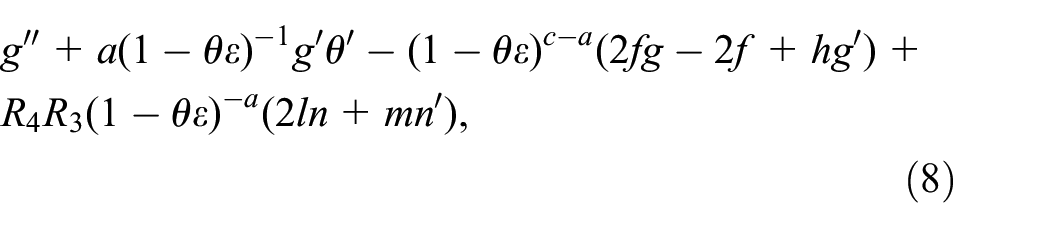
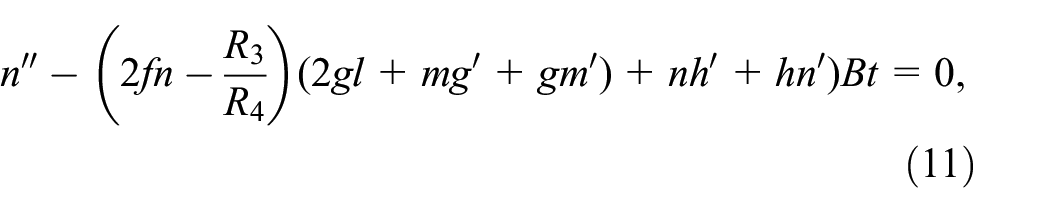
here , , , , , and are function having dimension. By interpreting these terms in continuity, momentum energy, and magnetic equation, we get:
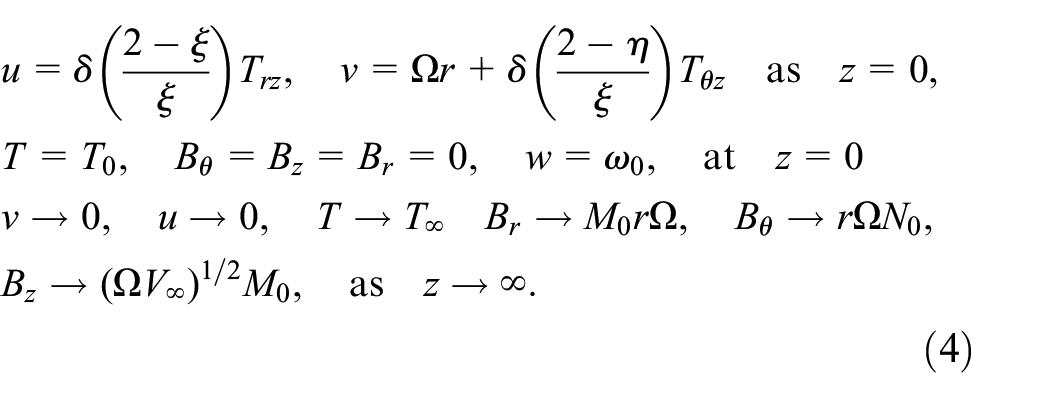
The reform conditions are:
where , are dimensionless constant for magnetic strength in and directions, is the Batchelor number, is the Prandtl number, is the slip parameter, is the relative temperature difference parameter and is the suction parameter.
Error analysis
To ensure the reliability of our problem upto minimum scale of residual errors, we made first the error analysis for the HAM solution. For the purpose, Figure 1, Tables 1 to 3 are plotted. Table 1 highlights the average squared residual error of different approximations. The error can be reduced by increasing the number of approximation, and it can be clearly from tables and figures. Figures 2 and 3 demonstrate the average squared residual error at distinguish orders of approximation. It can also be perceived that the average squared residual errors and total averaged squared errors are diminishing as the number of approximation increases.
Geometrical representation of the flow over a radially stretching rotating disk.
Individual averaged squared residual errors.
1
1.57249
4.04572
3.16049
2
3.83958
4.01522
1.98007
3
1.01188
3.99754
1.23623
4
2.88582
3.98769
7.7990
5
8.84965
3.98258
5.13199
6
2.86133
3.98039
3.75889
7
9.33172
3.98005
3.41613
8
2.76257
3.98106
4.33833
9
5.28152
3.98333
7.96415
10
1.00398
3.98741
1.90375
Individual averaged squared residual errors using optimal values of different parameters.
Residual error for the Azimuthal, radial, and Axial velocity via order of approximation.
Residual error for heat transfer and magnetic against different order of approximation.
Results and discussion
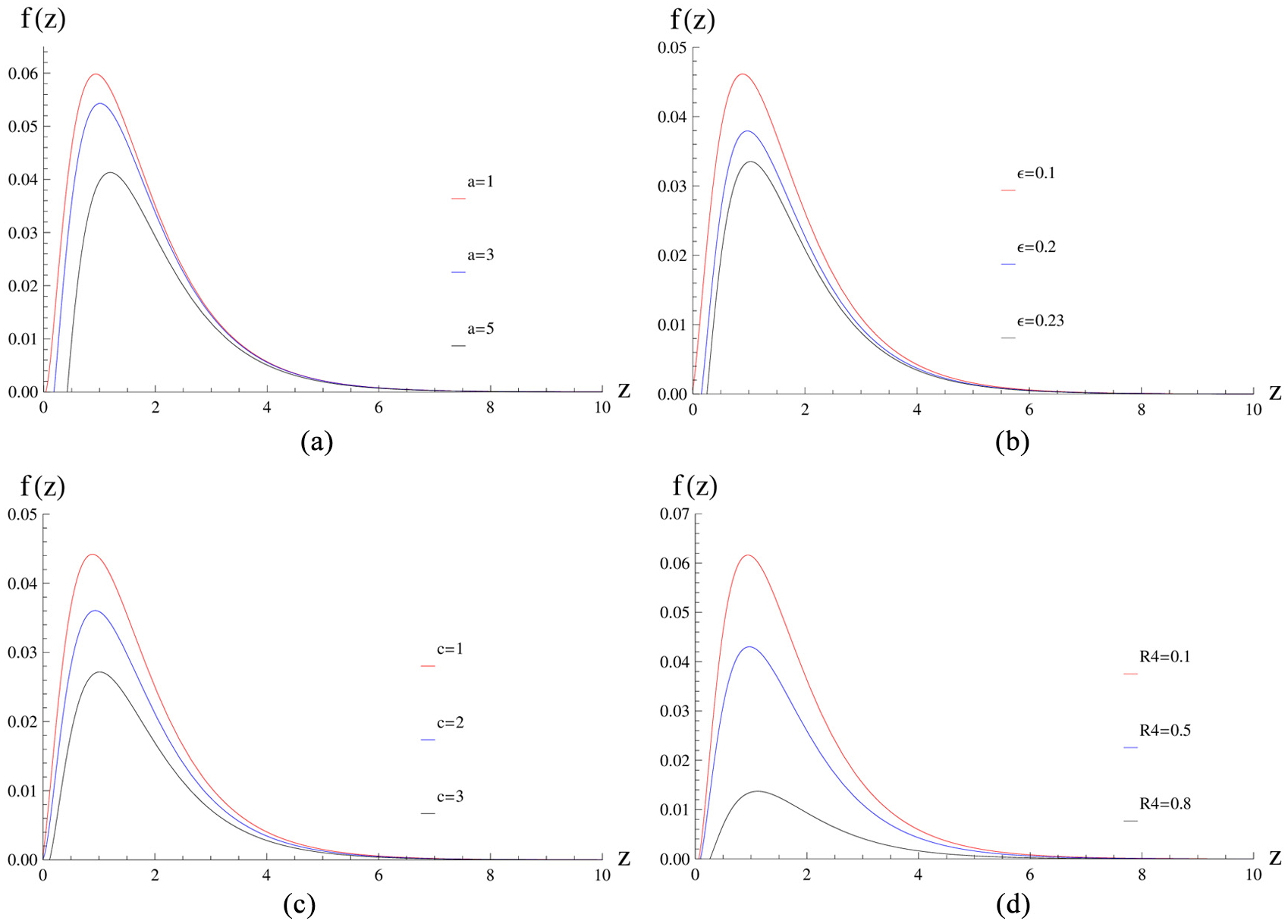
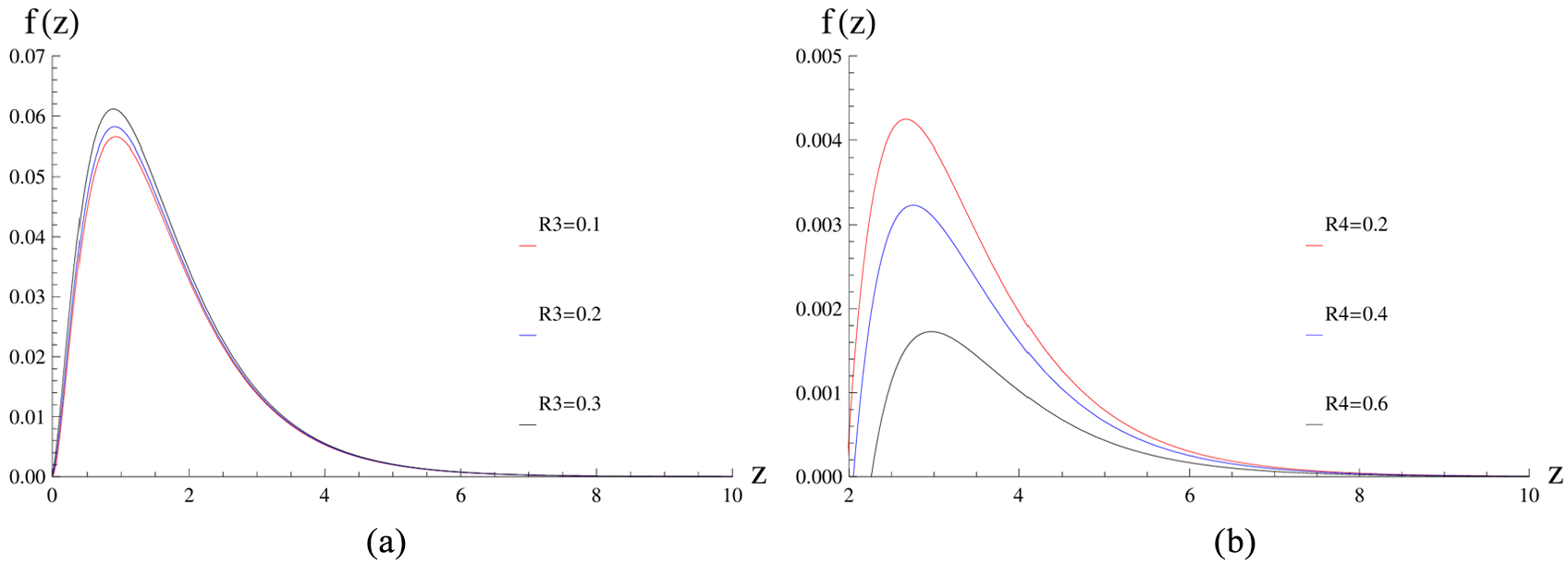
The dimensionless system of differential equations with boundary conditions equation (13) are solved via HAM method, for different values of the physical entities that is, Bachelor number , rotational Reynolds numbers and , slip parameter and Prandtl number . The intention of this work is to explore the nature of fluid velocities, mass, and temperature transfer in the presence of magnetic field. For the purpose Figures 4 to 9 are drawn using distinguish physical framework such as, , , , , , , , , and .
The upshot of on axial and azimuthal magnetic strength.
The upshot of , , and on radial velocity .
The upshot of and on Radial velocity .
The upshot of and on azimuthal and axial velocity .
The upshot of , , and on azimuthal and axial velocity .
The upshot of and on temperature profile .
Figure 4(a) to (d) are sketched, in order to revealed the out-turn on axial and azimuthal and velocity profiles. It is observed that, due to a very small variation in the magnitude of both type of velocity profiles decline, illustrated in Figure 4(a) and (c). on the other hand, for integral credit of , it give rises in axial and azimuthal and velocity, Figure 4(b) and (d).
Figure 5(a) to (d) demonstrate that a growing credit of arbitrary entity , , and turn-down rapidly the radial boundary layer. From Figure 5(b), it can be concluded that the positive variation of slip parameter that is , do not causes the rotation of fluid. Because for some range of , the flow posses some potential, as a result no motion produced in the fluid. In simple words, the centrifugal force will expel the fluid that attach to it. while the flow in axial direction will come forward to compensate for this expelled fluid. But improving the slip on of the disk surface shrink the amount of fluid that attach to it, eventually the rotating disk efficiency reduced and is incompetent to transfer its momentum to the particles of the fluid.
For the rising credit of the , the radial velocity decreases, it can be noticed from Figure 6(a) and (b). This dragging effects is called Lorentz force, which is only generated due to the magnetic force, and having tendency to diminished the flow at the disk. From Figure 6(a), the radial velocity enhances with the growing values of Reynolds number .
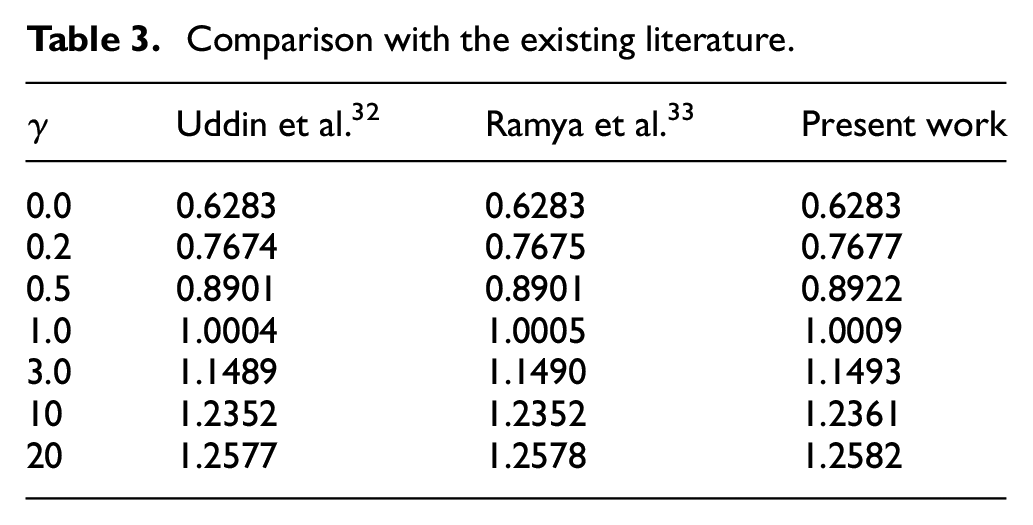
From Figure 7(a) to (d) an improvement in the credit of and results in an enhancement in the tangential and axial and velocity components. The accumulation of the rotational Reynolds numbers and , decline and incline the azimuthal velocity respectively, Figure 8(a) and (b). The variation of temperature for and are scrutinized in Figure 9(a) and (b). It can be summarized that, when these entities are enhances, the temperature is also improve. The purpose of these entities is to provide a comparison between the variable property and constant property solutions. The outcomes of Figure 9(a) elucidate that the dimensionless temperature enhances with the rising values of , but its increaseing rate is very small, which confirming Maleque and Sattar13 that the thermal boundary layer does not change with . The temperature profile behavior against the Prandtl number has been shown in Figure 9(b). Tables 3 and 4 show the comparison of the present work with the existing literature, which show best settlement.
The numerical comparison for and with the existing literature.
In this article, steady incompressible convective heat transmission slip flow over a spinning disk has been taken into an account. The out-turn of a variable magnetic field is considered. The subsequent arrangement of nonlinear partial differential equations has been tackled through Homotopy analysis method. Moreover the following conclusion can be drawn:
It is perceived that for greater value of slip entity that is , the revolving disk doesn’t cause rotation of fluid particles.
The retarding effect known as “Lorentz force” which is generated due to the induction of magnetic upshot, has the tendency to decrease the fluid velocity around the disk surface.
In other words, magnetic strength can be employ to control the turbulence of the fluid motion.
The small increment in the magnitude of magnetic Batchlor number , causes the reduction in axial and azimuthal velocity profiles, But for integral credit of Batchlor number , it give rises to both the velocity profiles respectively.
The enhancement in slip parameter rises the fluid temperature, while it reduces with the positive credit of Prandtl number .
The growing values of the diminish, while incline the azimuthal velocity.
Footnotes
Handling editor: James Baldwin
Declaration of conflicting interests
The author(s) declared no potential conflicts of interest with respect to the research, authorship, and/or publication of this article.
Funding
The author(s) disclosed receipt of the following financial support for the research, authorship, and/or publication of this article: The work of this paper is financially supported by the Higher Education Commission of Pakistan under the project proposal No. 10859/NRPU/R&D/HEC; entitled “Electroviscous effect on microfluidics/nanofluidics over a rotating disc under a variable magnetic field”. The supports are gratefully acknowledged.
ORCID iDs
Muhammad Shuaib
Rehan Ali Shah
Muhammad Bilal
References
1.
Von KarmanT. Uber laminar and turbulent Reibung. Z Angew Math Mech1921; 1: 233–255.
2.
CochranWG.The flow due to a rotating disk. Math Proc Cambridge Philos Soc1934; 30: 365–375.
3.
BentonER.On the flow due to a rotating disk. J Fluid Mech1966; 24: 781–800.
4.
MillsapsKPolhausenK.Heat transfer by laminar flow from a rotating plate. J Aeronaut Sci1952; 19: 120–126.
5.
SparrowEMGreggJL.Heat transfer from a rotating disk to fluids of any Prandtl number. J Heat Transfer1959; 81: 249–251.
6.
GholiniaMHosseinzadehKMehrzadiH, et al. Investigation of MHD Eyring–Powell fluid flow over a rotating disk under effect of homogeneous–heterogeneous reactions. Case Stud Therm Eng2019; 13: 100356.
7.
HafeezAKhanMAhmedJ.Flow of Oldroyd-B fluid over a rotating disk with Cattaneo–Christov theory for heat and mass fluxes. Comput Methods Programs Biomed2020; 191: 105374.
8.
AhmedJKhanMAhmadL.Effectiveness of homogeneous–heterogeneous reactions in Maxwell fluid flow between two spiraling disks with improved heat conduction features. J Therm Anal Calorim2020; 139: 3185–3195.
9.
ShuaibMBilalMKhanMA, et al. Fractional analysis of viscous fluid flow with heat and mass transfer over a flexible rotating disk. Comput Model Eng Sci2020; 123: 377–400.
10.
ShahRAShuaibMKhanA.Dufour and Soret effect on heat and mass transfer with radiative heat flux in a viscous liquid over a rotating disk. Eur Phys J Plus2017; 132: 342.
11.
SparrowEMBeaversGSHungLY.Flow about a porous-surface rotating disk. Int J Heat Mass Transf1971; 14: 993–996.
12.
StuartJT.On the effect of uniform suction on the steady flow due to a rotating disk. Q J Mech Appl Math1954; 7: 446–457.
13.
KuikenHK.The effect of normal blowing on the flow near a rotating disk of infinite extent. J Fluid Mech1971; 47: 789–798.
14.
MalequeKASattarMA.Steady laminar convective flow with variable properties due to a porous rotating disk. J Heat Transfer2005; 127: 1406–1409.
15.
MiklavcicMWangCY.The flow due to a rough rotating disk. Z Angew Math Phys2004; 55: 235–246.
16.
ArikogluAOzkolI.On the MHD and slip flow over a rotating disk with heat transfer. Int J Numer Methods Heat Fluid Flow2006; 28: 172–184.
17.
OsalusiESideJHarrisR.Thermal-diffusion and diffusion-thermo effects on combined heat and mass transfer of a steady MHD convective and slip flow due to a rotating disk with viscous dissipation and ohmic heating. Int J Heat Mass Transf2008; 35: 908–915.
18.
RahmanMM.Convective hydromagnetic slip flow with variable properties due to a porous rotating disk. Sultan Qaboos Univ J Sci2010; 15: 55–79.
19.
MustafaM.MHD nanofluid flow over a rotating disk with partial slip effects: Buongiorno model. Int J Heat Mass Transf2017; 108: 1910–1916.
20.
TabassumMMustafaM.A numerical treatment for partial slip flow and heat transferof non-Newtonian Reiner-Rivlin fluid due to rotating disk. Int J Heat Mass Transf2018; 123: 979–987.
21.
OyelakinSLalramneihmawiiPCMondalS, et al. Thermophysical analysis of three-dimensional magnetohydrodynamic flow of a tangent hyperbolic nanofluid. Eng Rep2020; 2: e12144.
22.
KatagiriM.The effect of Hall current on the MHD boundary layer flow past a semi-infinite plate. J Phys Soc Jpn1969; 27: 1051–1059.
23.
HossainMA.Effect of Hall current in unsteady hydromagnetic free convection flow near an infinite vertical porous plate. J Phys Soc Jpn1986; 55: 2183–2190.
24.
RashidiMMFreidoonimehrNMomoniatE, et al. Study of nonlinear MHD tribological squeeze film at generalized magnetic reynolds numbers using DTM. PLoS One2015; 10: e0135004.
25.
ElshekhSSAbd ElhadyMKIbrahimFN.Fluid film squeezed between two rotating disks in the presence of a magnetic field. Int J Eng Sci1996; 34: 1183–1195.
26.
RaufAAbbasZShehzadSA.Interactions of active and passive control of nanoparticles on radiative magnetohydrodynamics flow of nanofluid over oscillatory rotating disk in porous medium. J Nanofluids2019; 8: 1385–1396.
27.
MurthyMK.Numerical investigation on magnetohydrodynamics flow of Casson fluid over a deformable porous layer with slip conditions. Indian J Phys2020; 94: 2023–2032.
28.
Khashi’ieNSArifinNMNazarR, et al. Pop. Magnetohydrodynamics (MHD) axisymmetric flow and heat transfer of a hybrid nanofluid past a radially permeable stretching/shrinking sheet with joule heating. Chin J Phys2020; 64: 251–263.
29.
TliliINabweyHAAshwinkumarGP, et al. 3-D magnetohydrodynamic AA7072-AA7075/methanol hybrid nanofluid flow above an uneven thickness surface with slip effect. Sci Rep2020; 10: 1–13.
JayarajS.Thermophoresis in laminar flow over cold inclined plates with variable properties. Heat Mass Transfer1995; 40: 167–174.
32.
UddinMJBégOAAminN.Hydromagnetic transport phenomena from a stretching or shrinking non-linear nano material sheet with navier slip and convective heating: a model for bio-nano-materials processing. J Magn Magn Mater2014; 368: 252–261.
33.
RamyaDRajuRSRaoJA, et al. Effects of velocity and thermal wall slip on magnetohydrodynamics (MHD) boundary layer viscous flow and heat transfer of a nanofluid over a non-linearly-stretching sheet: a numerical study. Propul Power Res2018; 7: 182–195.