The current investigation deals with entropy analysis for radiative flow of nanomaterials between two heated rotating disks. Titanium ( and ) and Graphene oxides are taken as nanoparticles. Water () is used as a conventional base liquid. Dissipation and radiation effects are incorporated in energy equation. Rotating disks have different angular velocities. Both disks have different stretching rates. Attention is focused for statistical declaration and probable error. Physical feature of entropy analysis is studied through thermodynamics second law. Nonlinear partial system (PDEs) is reduced to ordinary one (ODEs). Homotopy analysis technique (HAM) is used for convergent series solution. Features of sundry variables on entropy optimization, temperature, Bejan number, and velocity are discussed for both nanoparticles ( and ). Computational outcomes for velocity gradient and Nusselt number are addressed through tabulated values. For larger Reynold number the radial and axial velocities are decreased. Temperature is augmented for against higher Eckert number and radiation parameter. Bejan number and entropy rate are augmented versus radiation parameter. Bejan number and Entropy rate have opposite trend via Reynold number. Statistical declaration and probable error are deliberated via Tables.
Nanoliquids are integrated through engineered colloidal suspended nano-size solid (1–100 nm) particles in base liquid (water, ethylene glycol, and oil). Nanomaterials have potential applications in industry, medicine, engineering and heat transfer technology. The commonly utilized nanoparticles consist of metals/CNTs, titania, stably suspended oxides, silica improvised thermo physical characteristics of base fluids. Obviously solid has more thermal conductivity in comparison to fluid. Transport rate of nanoparticles can develop augmentation of thermal conductivities. Due to this peculiarity characteristic the nanomaterials have wide range applications in microelectronics, nuclear plants, chemical engineering process, medical instruments, solar collectors, fabrication of medicines heat exchangers, and discourse of cancer and heat pipes. Titanium dioxide nanoparticles are similar to perfect semiconductors for photocatalysis. Titanium dioxide have cheaper coast, much safer and with high accuracy. Choi and Estman1 initiated the concept of nanomaterials. According to his study, addition of tiny particles into base liquid result in nanomaterial. Zangooee et al.2 investigated the hydromagnetic nanoparticles flow between two rotating disks. Joule heating and radiation in energy equation are accounted. Ghadikolaei et al.3 studied Carreau nanofluid by considering of ethylene glycol. Rotating cone and non-linear thermal radiation are taken. Ijaz Khan et al.4 discussed entropy analysis in hydromagnetic nanomaterials flow with homogeneous and heterogeneous reactions. The nanomaterials with are taken. Madaki et al.5 studied unsteady squeezing nanofluid flow between two parallel plates. Heat generation/absorption and thermal radiation are present. Ganesh Kumar et al.6 explored hydromagnetic in nanomaterials fluid flow through convergent/divergent channel. Here Joule heating and Darcy-Forchheimer effects are examined. Thermal and entropy analyses for radiative flow of nanomaterials with melting effect in flow by a stretching surface is illustrated by Khan et al.7 Heat transfer analysis in hydromagnetic flow of hybrid (Ag) nanomaterials past a slender cylinder is studied by Patil and Kulkarni.8 Khan et al.9 reported thermal analysis for time-dependent flow of hybrid nanomaterial over a stretching sheet. Some recent studies regarding this topic are mentioned in Refs.10–25
Recently many studies have been made about the applications and irreversibilities rates of the second law of thermo-dynamics. In heat energy, the concept of irreversibility is very frequently used due to the measure of irreversibilities of heat policy. Many researchers have made contributions. Irreversibility is key feature of physical action in nature. Initially Bejan26,27 described the concept of irreversibilty analysis in convective flow with heat transfer problems. Mliki and Abbassi28 studied hydromagnetic flow hybrid nanomaterials with entropy analysis in an incinerator shaped cavity. Numerical outcomes of heat transfer analysis in hybrid (silver-water) nanoliquid with entropy rate in an annulus fin are investigated by Shahsavar et al.29 Few studies about entropy optimization have been discussed by Refs.30–40
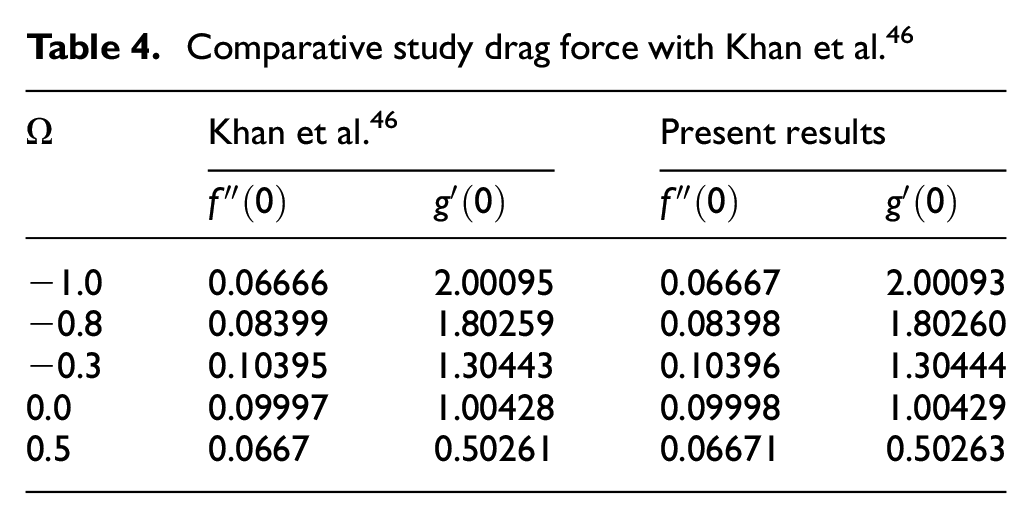
This investigation examines flow of Titanium oxide and Graphene oxide nanoparticles base fluid flow with irreversibility. Heat transfer associated to viscous dissipation and thermal radiation is examined. Attempt is focused to statistical declaration and probable error. Computations for entropy rate are presented. Skin friction coefficient and Nusselt number for both disks (upper and lower) are computed with probable error and statistical declaration. Homotopic procedure41–45 is adopted for the computations. Comparative studies are also presented through Table 4. The key findings of influential parameters are summarized.
Problem statement
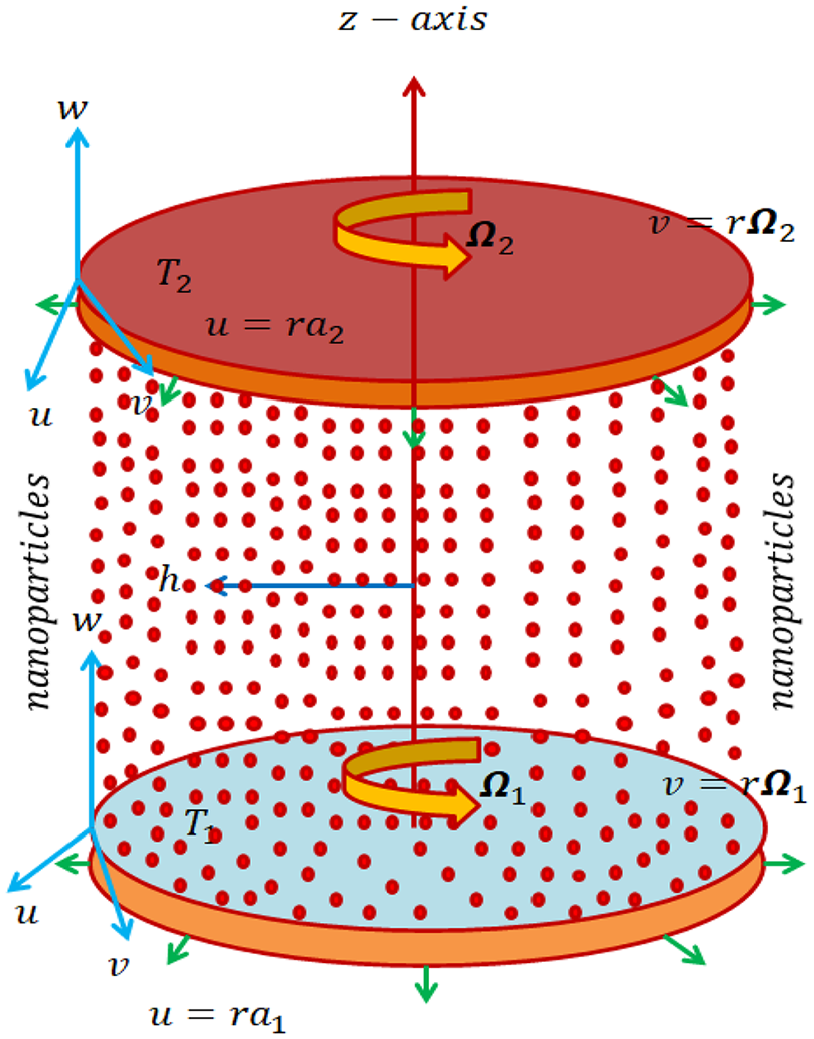
We investigate axisymmetric boundary layer flow in presence of titanium oxide and Graphene oxide Water is taken as a base material. Viscous dissipation is present. The stretching disks are rotating with different angular velocities. The lower and upper disks rotates with and namely. Both disks have different temperature. The upper and lower disks have temperatures and respectively. Flow sketch is highlighted in Figure 1.
Flow sketch.
The components of velocity (, , ) are
with
In above expression fluid temperature are cylindrical coordinates, density, pressure, is kinematic viscosity, thermal conductivity, Stefan-Boltzman constant, mean absorption coefficient, and the stretching rates for lower and upper disks, dynamic viscosity, and heat capacitance. Nanofluid properties can be put in mathematical form as
where is for nanofluid, is for nanoparticles volume fraction, and for base fluid.
Taking
one has
In above expressions indicate, Reynold number (), stretching parameters , Prandtl number , rotational parameter , Eckert number , Brinkman number , thermal radiation , and dimensionless constant . Mathematically we have
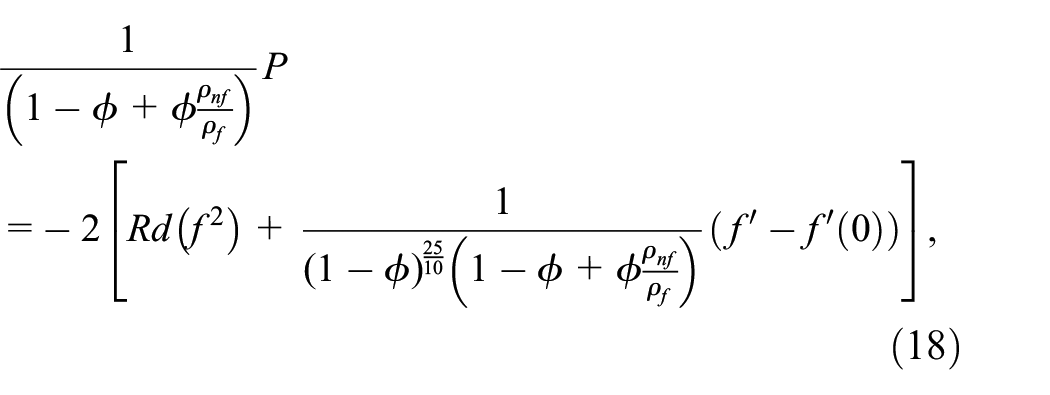
After differentiation of equation (10) with respect to we obtain
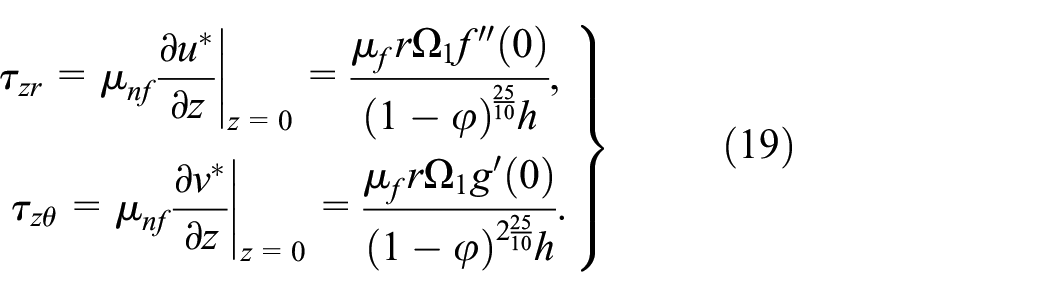
In radial and tangential directions, the shear stress at lower disk satisfies
Total shear stress satisfies
In dimensionless form
where is local Reynolds number.
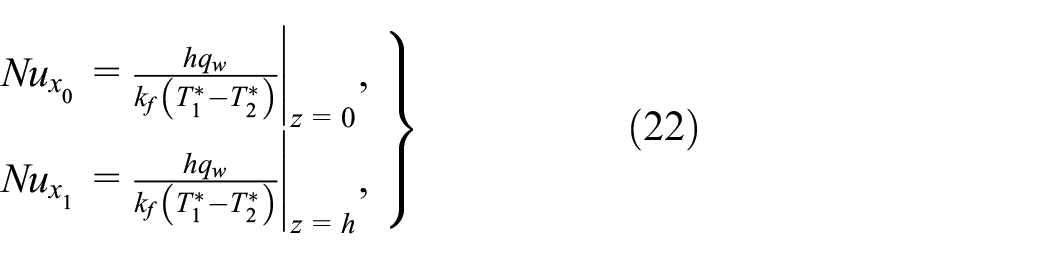
Rates of heat transfer
Here
where heat flux satisfies
Nusselt number in dimensionless form
Entropy modeling
We have
we have
Dimensionless version is
where , and denote respectively the temperature difference variable, Brinkman number, and entropy. These parameters are
Bejan number is
Homotopy analysis solution
The initial guesses and operators satisfy
The properties satisfied by the above operators are
in which are the constants.
Series solution
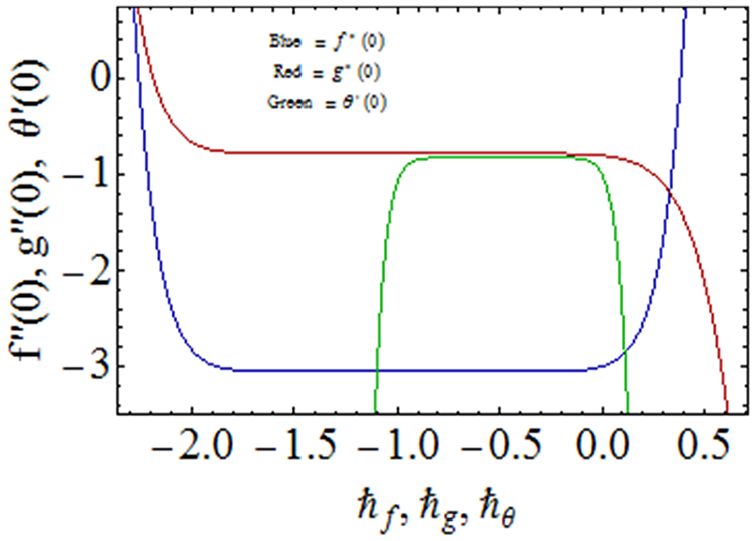
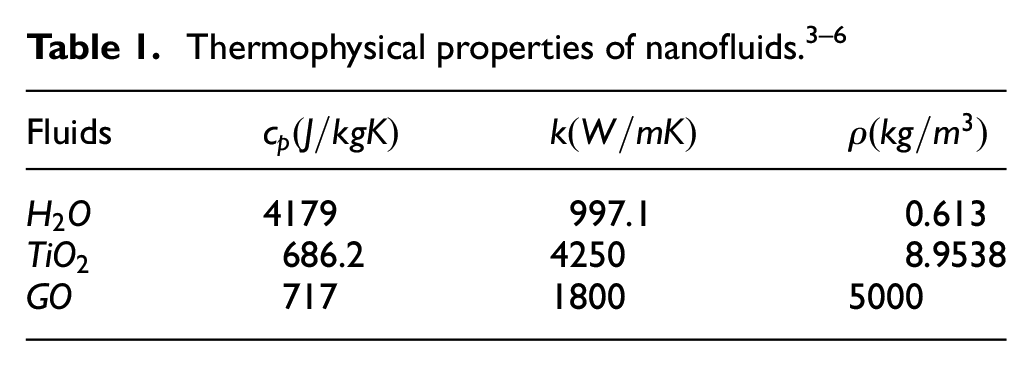
The auxiliary parameters , and have key role in adjustment and convergence control of homotopic series solutions. Thus for iteration are displayed. Figures 2 and 3 are displayed to show the for lower and upper disk. Auxiliary parameter regarding , , and for water based nanofluid satisfy , and . However for the water base nanofluid and Table 1 and 2 are constructed for the series solutions convergence upto sixth digits. Table 2 shows that , , and for nanofluid converge at , and iterations respectively. Table 3 is prepared for water base nanofluid. It indicates that , , and converge at , , , and iterations is find.
This section consists of predictions of velocity, temperature, entropy generation, Bejan number, skin friction, Nusselt number, statistical declaration, and probable error with variation of physical parameters (, , , , , , , , ).
Velocity
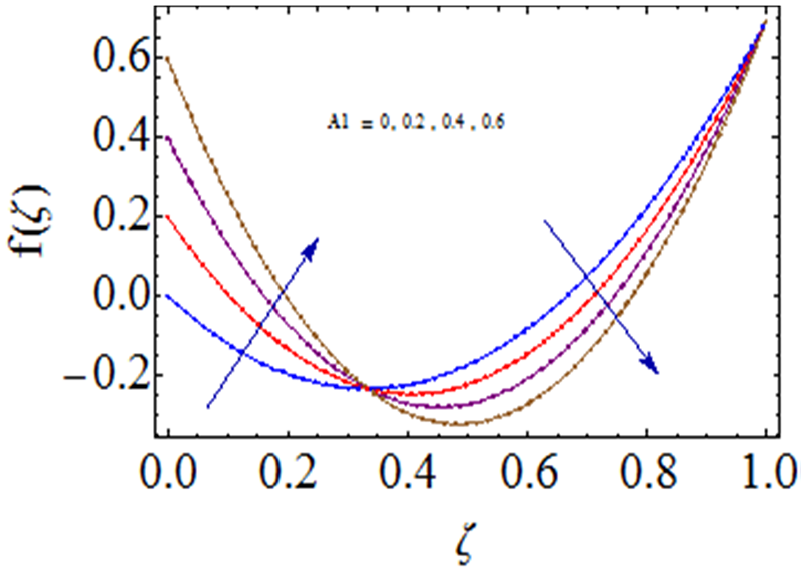
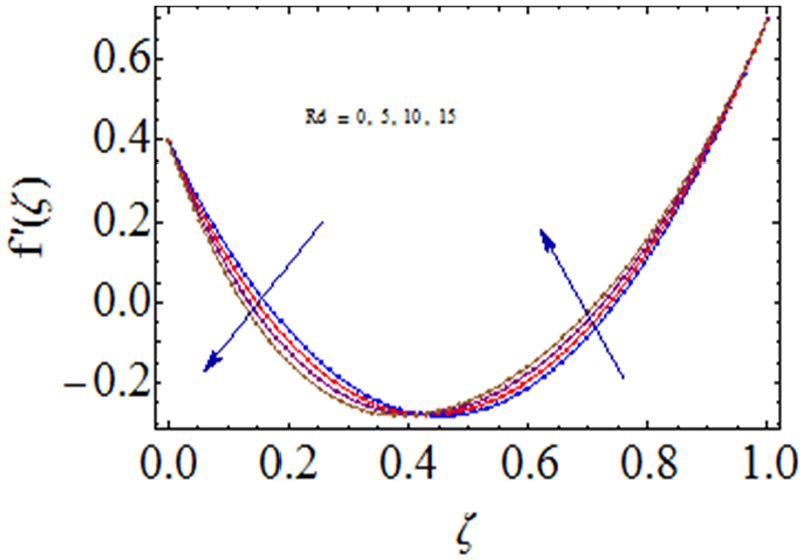
Figures 4–10 represented the impact of axial velocity radial velocity , and tangential velocity with respect to various influential variables. Figures 4 and 5 accomplish features of on axial and radial velocity It is noted from Figure 4 that axial velocity is an increasing function of lower disk stretched parameter . Radial velocity with respect to is shown in Figure 5. Initially upsurges for higher and then it decreases when approaches to maximum range. Figures 6 and 7 are portrayed for the salient features of on axial and radial . Clearly the axial velocity decays versus larger . Physically the viscosity increases versus higher and consequently axial velocity decays (see Figure 6). Dual behavior of versus higher is guaranteed in Figure 7. Physically, at lower disk the viscosity is increase at the surface and this factor slowly decrease when the fluid goes to the upper disk surface. In Figure 8 we have noticed that the higher value of variable in result axial velocity decline while in Figure 9 radial velocity has dual behave present. Here increasing behavior of tangential velocity is noticed for larger upper disk stretched parameter. Increasing impact of on tangential velocity is reported in Figure 10.
via .
via .
via .
via .
via .
via .
via .
Temperature
Figures 11–13 are portrayed to discuss the behavior of flow variables (, , , , , , , , , ) on temperature. Titanium dioxide and graphene oxide cases are considered. Figure 11 depicted for impact of on temperature field. Clearly higher momentum diffusivity reduces thermal conductivity and consequently temperature field decays versus larger Figures 12 and 13 are drawn for Brinkman and thermal radiation aspects on . A monotic increase for both parameters.
via .
via .
via .
Entropy analysis
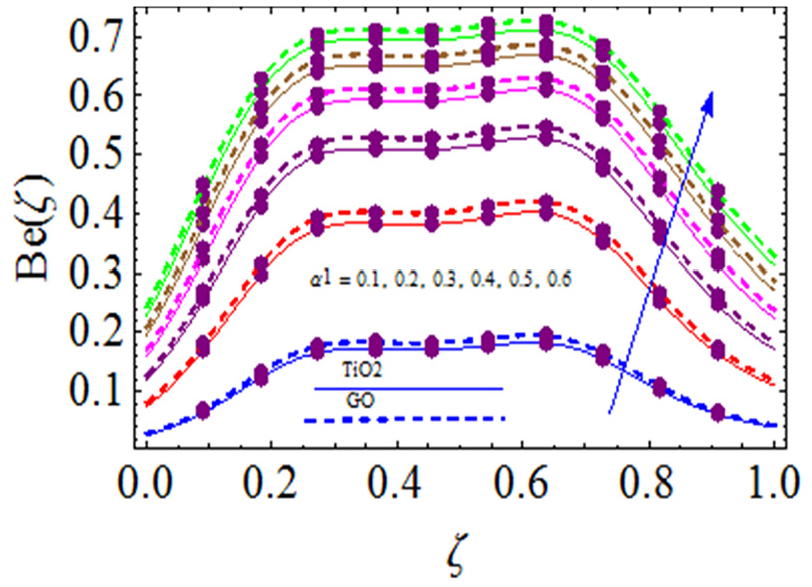
Figures 14–19 are depicted to show effects of sundry variables (, , , , , , , , , ) on entropy generation and Bejan in presence of outcomes. Figures 14 and 15 elucidate behavior of on entropy generation and Bejan number. Dual behavior is noticed against higher Brinkman number on entropy and Bejan number. Through Figure 14 the irreversibility increases versus higher Brinkman while Bejan number is reduced (see Figure 15). Behavior of temperature difference ratio parameter on entropy generation and Bejan number is depicted in Figures 16 and 17. Here and are enhanced versus higher It is noticed that behavior of dominates than Impact of radiation on and is shown in Figures 18 and 19. In fact for higher the inside source of energy increases and consequently kinetic energy of the particle enhances. Diffusion enhances inside the particles and so both and are increased.
via .
via .
via .
via .
via .
via .
Physical quantities
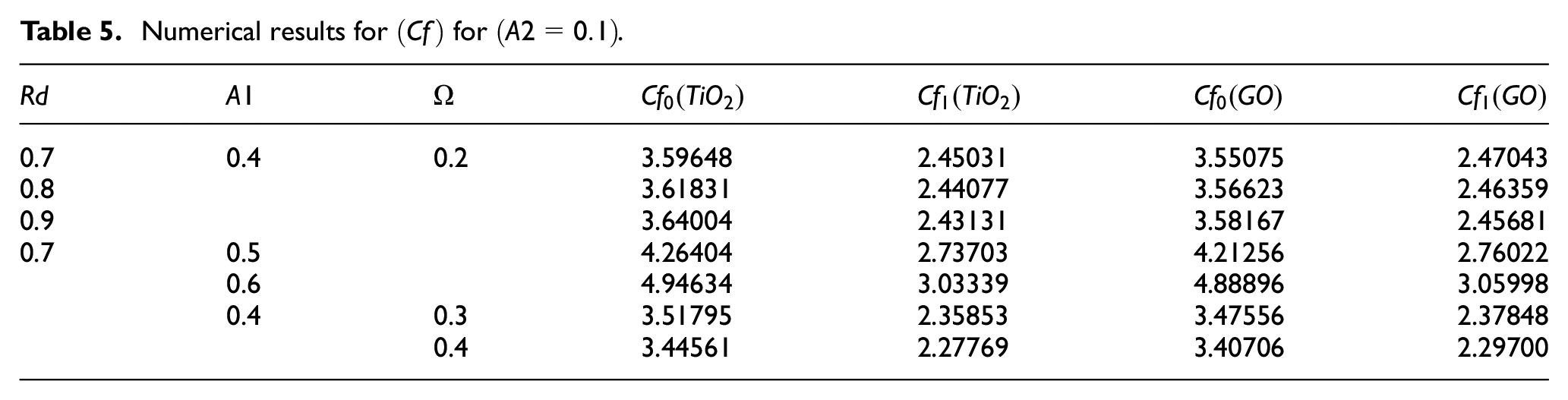
Tables 5 and 6 display the influence of physical variable (, , , , , , , , , ) on skin friction for and . Outcomes of skin frictions for lower disk rise against higher and However satisfies of for skin friction at lower disk is reverse. It is noticed that impact of in case of is more than . Further the skin frictions at lower and upper disks for and cases have opposite impact. Tables 7 and 8 are prepared for behaviors of Reynold number, Brinkman and thermal radiation on for both disks in and cases. It is examined that is increased via and . Magnitude of against reduces at lower disk and it enhances for upper disk.
Numerical results for for .
0.7
0.4
0.2
3.59648
2.45031
3.55075
2.47043
0.8
3.61831
2.44077
3.56623
2.46359
0.9
3.64004
2.43131
3.58167
2.45681
0.7
0.5
4.26404
2.73703
4.21256
2.76022
0.6
4.94634
3.03339
4.88896
3.05998
0.4
0.3
3.51795
2.35853
3.47556
2.37848
0.4
3.44561
2.27769
3.40706
2.29700
Skin friction for .
0.7
5.17681
5.73496
5.15071
5.74329
0.8
5.18917
5.73089
5.15957
5.74050
0.9
5.20142
5.72676
5.16838
5.73769
0.7
0.5
5.87370
6.06751
5.84121
6.07783
0.6
6.57660
6.39928
6.53740
6.41212
0.4
0.3
5.12428
5.69224
5.10036
5.70151
0.4
5.07600
5.65758
5.05471
5.66692
Nusselt number for
0.4
03
0.52140
2.93525
0.68312
3.10698
0.5
0.62232
3.03512
0.78387
3.20688
0.6
0.72316
3.13500
0.88454
3.30679
0.4
0.36128
3.03639
0.52404
3.20870
05
0.20115
3.13752
0.36460
3.31042
0.3
0.8
0.53388
2.92426
0.69572
3.09705
0.9
0.54631
2.91349
0.70831
3.08726
Nusselt number for .
0.4
03
0.7
−0.92499
5.76586
−0.75516
5.90276
0.5
−0.82288
5.86225
−0.65350
5.99994
0.6
−0.72098
5.95897
−0.55199
6.09736
0.4
0.4
−1.21589
6.12943
−1.04538
6.26515
0.5
−1.50679
6.49300
−1.33559
6.62754
0.3
0.8
−0.93251
5.79810
−0.76130
5.93087
0.9
−0.94020
5.83075
−0.76755
5.95926
Statistical approach
Tables 5–8 illustrate skin friction and Nusselt number for both disk when and . The cases of Tables 9 and 10 derived correlation coefficient. Value of correlation coefficient is between to .
Estimations of for skin friction.
0.98843627
0.98771116
0.98651511
0.98708052
0.99868174
0.99499446
0.99325752
0.98346188
0.90727518
0.91346672
0.89891190
0.91505640
0.9881422
0.98757785
0.98665327
0.98712756
0.99871652
0.99493677
0.99329760
0.98352614
0.90769355
0.91369010
0.89898741
0.91510807
Estimation of for Nusselt number.
0.99892488
−0.91658012
0.97798424
0.97269360
0.67345954
−0.99992035
0.96397847
0.97233535
0.99157676
−0.98885052
0.98645150
0.98835317
0.99610348
−0.90025687
0.97751026
0.97326646
0.77368407
−0.99948974
0.96342578
0.97189186
0.99068097
−0.98884708
0.98656496
0.98818905
Probable error
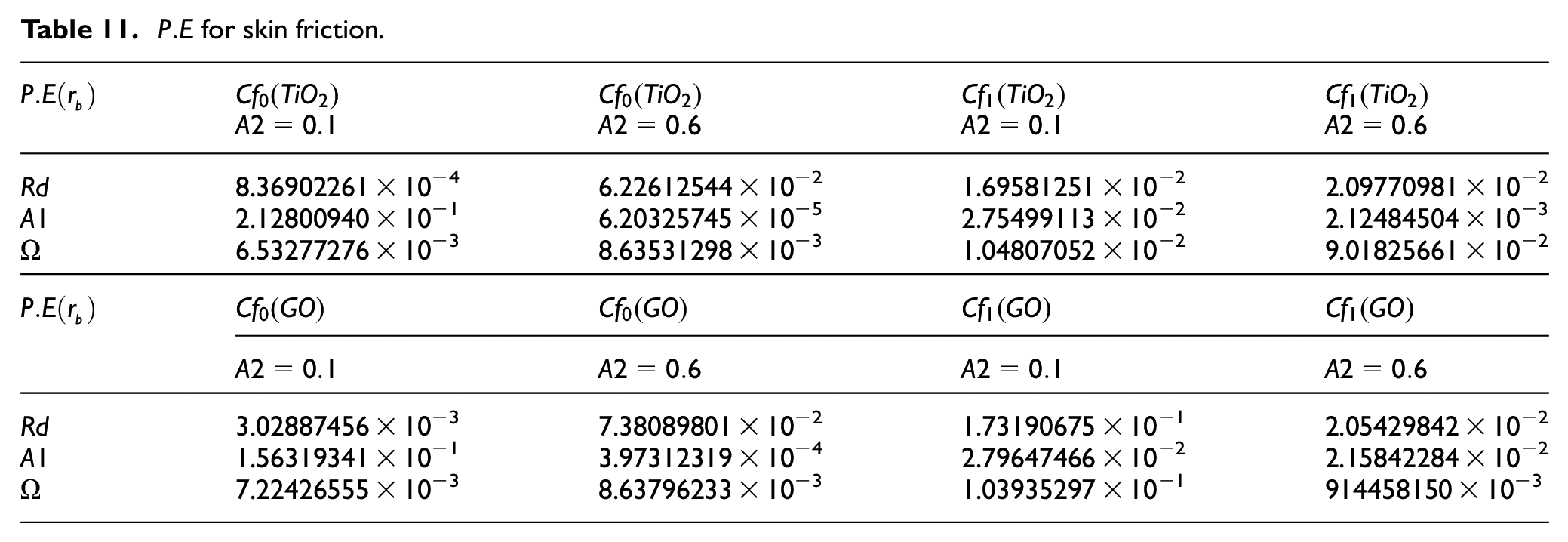
Tables 11 and 12 illustrate and . Probable is the function of . Theme of is to inspect the correct and exactness of approximations of correlation coefficient. By Saleh and Sundar40 the probable error satisfies
for skin friction.
8.36902261 × 10⁻⁴
6.22612544 × 10⁻²
1.69581251 × 10⁻²
2.09770981 × 10⁻²
2.12800940 × 10⁻¹
6.20325745 × 10⁻⁵
2.75499113 × 10⁻²
2.12484504 × 10⁻³
6.53277276 × 10⁻³
8.63531298 × 10⁻³
1.04807052 × 10⁻²
9.01825661 × 10⁻²
3.02887456 × 10⁻³
7.38089801 × 10⁻²
1.73190675 × 10⁻¹
2.05429842 × 10⁻²
1.56319341 × 10⁻¹
3.97312319 × 10⁻⁴
2.79647466 × 10⁻²
2.15842284 × 10⁻²
7.22426555 × 10⁻³
8.63796233 × 10⁻³
1.03935297 × 10⁻¹
914458150 × 10−3
Estimation of for Nusselt number.
8.36902261 × 10⁻⁴
6.22612544 × 10⁻²
1.69581251 × 10⁻²
2.09770981 × 10⁻²
2.12800940 × 10⁻¹
6.20325745 × 10⁻⁵
2.75499113 × 10⁻²
2.12484504 × 10⁻³
6.53277276 × 10⁻³
8.63531298 × 10⁻³
1.04807052 × 10⁻²
9.01825661 × 10⁻²
3.02887456 × 10⁻³
7.38089801 × 10⁻²
1.73190675 × 10⁻¹
2.05429842 × 10⁻²
1.56319341 × 10⁻¹
3.97312319 × 10⁻⁴
2.79647466 × 10⁻²
2.15842284 × 10⁻²
7.22426555 × 10⁻³
8.63796233 × 10⁻³
1.03935297 × 10⁻¹
914458150 × 10−3
Above equation denoted for observation number and utilized value is . We use Here mean and stand for standard deviation.
Finally
Statistical result
Tables 13 and 14 examined numerical results of for and for both disks. Result is computed and compared all simulations of
Numerical results of for
110.386954
103.835167
94.567767
98.734915
973.332147
255.862539
189.783065
76.988562
013.173717
014.166655
12.0251624
14.444892
107.287557
102.711387
95.55343
99.098096
999.725108
252.939912
190.921823
77.291418
13.236625
14.20513512
12.034684
14.454115
Values of for Nusselt number.
1193.598018
−014.721517
57.6705405
46.3693116
03.1647395
−16119.2786
34.9902567
45.760296
151.784976
−114.512412
94.1207181
19.5947047
328.8691758
−012.1971428
05.644127
47.377073
004.9493816
−02515.62736
34.451439
45.027871
137.132413
−114.4768919
09.492107
108.062797
Conclusions
Main finding of present analysis are given below.
A decrement in radial and axial velocity components is seen through Reynold number.
A intensification in velocity is noted for rotation variable.
An amplification in temperature is observed through radiation and Brinkman number.
Larger estimation of Prandtl number diminishes the thermal field.
An intensification in Bejan and entropy number is noticed for radiation variable.
A decrement in Bejan number is noted through Brinkman number, while opposite effect holds for entropy.
Higher approximation of thermal ratio variable has similar behavior on Bejan and entropy numbers.
Footnotes
Acknowledgements
Financial support of Pakistan Academy of Sciences through Higher Education Commission (HEC) of Pakistan is gratefully acknowledged.
Handling Editor: Chenhui Liang
Declaration of conflicting interests
The author(s) declared no potential conflicts of interest with respect to the research, authorship, and/or publication of this article.
Funding
The author(s) received no financial support for the research, authorship, and/or publication of this article.
ORCID iD
Sohail A Khan
References
1.
ChoiSUSEstmanJ. Enhancing thermal conductivity of fluids with nanoparticles. ASME FED2001; 231: 718–720.
2.
ZangooeeMRHosseinzadehKGanjiDD.Hydrothermal analysis of MHD nanofluid (TiO2-GO) flow between two radiative stretchable rotating disks using AGM. Case Stud Therm Eng2019; 14: 100460.
3.
GhadikolaeiSSHosseinzadehKGanjiDD.Investigation on ethylene glycol-water mixture fluid suspend by hybrid nanoparticles (TiO2-CuO) over rotating cone with considering nanoparticles shape factor. J Mol Liq2018; 272: 226–236.
4.
Ijaz KhanMKhanSAHayatT, et al. Entropy optimization analysis in MHD nanomaterials (TiO2-GO) flow with homogeneous and heterogeneous reactions. Comput Methods Programs Biomed2020; 184: 105111.
5.
MadakiAGRoslanRRusimanMS, et al. Analytical and numerical solutions of squeezing unsteady Cu and TiO2nanofluid flow in the presence of thermal radiation and heat generation/absorption. Alex Eng J2018; 57: 1033–1040.
6.
Ganesh KumarKShehzadSAAmbreenT, et al. Heat transfer augmentation in water-based TiO2 nanoparticles through a converging/diverging channel by considering Darcy-Forchheimer porosity. Revista Mexicana de Física2019; 65: 373–381.
7.
KhanSAHayatTAlsaediA, et al. Melting heat transportation in radiative flow of nanomaterials with irreversibility analysis. Renew Sustain Energ Rev2021; 140.
8.
PatilPMKulkarniM.Analysis of MHD mixed convection in a Ag-TiO2 hybrid nanofluid flow past a slender cylinder. Chin J Phys2021; 73: 406–419.
9.
KhanUWainiIIshakA, et al. Unsteady hybrid nanofluid flow over a radially permeable shrinking/stretching surface. J Mol Liq2021; 331.
10.
KrishnaMVAhammadNAChamkhaAJ.Radiative MHD flow of Casson hybrid nanofluid over an infinite exponentially accelerated vertical porous surface. Case Stud Therm Eng2021; 27.
11.
HayatTShahFKhanMI, et al. Entropy analysis for comparative study of effective prandtl number and without effective prandtl number via γAl2O3-H2O and γAl2O3-C2H6O2 nanoparticles. J Mol Liq2018; 266: 814–823.
12.
ShehzadSHayatTAlsaediA.Three-dimensional MHD flow of Casson fluid in porous medium with heat generation. J Appl Fluid Mech2016; 9: 215–223.
13.
DasSSSatapathyADasJK, et al. Mass transfer effects on MHD flow and heat transfer past a vertical porous plate through a porous medium under oscillatory suction and heat source. Int J Heat Mass Transf2009; 52: 5962–5969.
14.
HayatTUllahHAhmadB, et al. Heat transfer analysis in convective flow of Jeffrey nanofluid by vertical stretchable cylinder. Int Commun Heat Mass Transf2021; 120.
15.
TurkyilmazogluM.Flow and heat simultaneously induced by two stretchable rotating disks. Phys Fluids2016; 28: 043601–043611.
16.
YeQZhangYWeiJ.A comprehensive review of pulsating flow on heat transfer enhancement. Appl Therm Eng2021; 196.
17.
HayatTKhanMKhanMI, et al. Electromagneto squeezing rotational flow of carbon (C)-water (H2O) kerosene oil nanofluid past a Riga plate: a numerical study. PLoS One2017; 12: e0180976.
18.
AliAAkhtarJAnjumHJ, et al. 3D nanofluid flow over exponentially expanding surface of Oldroyd-B fluid. Ain Shams Eng J2021; 12: 3939–3946.
19.
HayatTShinwariWKhanSA, et al. Entropy optimized dissipative flow of Newtonian nanoliquid by a curved stretching surface. Case Stud Therm Eng2021; 27.
20.
MazaheriNBahiraeiMRaziS.Two-phase analysis of nanofluid flow within an innovative four-layer microchannel heat exchanger: focusing on energy efficiency principle. Powder Technol2021; 383: 484–497.
21.
Abu ArqubOAL-SmadiMMomaniS, et al. Numerical solutions of fuzzy differential equations using reproducing kernel Hilbert space method. Soft Comput2016; 20: 3283–3302.
22.
Abu ArqubO. Computational algorithm for solving singular Fredholm time-fractional partial integrodifferential equations with error estimates. J Appl Math Comput2019; 59: 227–243.
23.
MomaniSAbu ArqubOMaayahB, et al. A reliable algorithm for solving linear and nonlinear Schrodinger equations. Appl Comput Math2018; 17: 151–160.
24.
El-AjouAAbu ArqubOMomaniS, et al. A novel expansion iterative method for solving linear partial differential equations of fractional order. Appl Math Comput2015; 257: 119–133.
25.
ArqubOAAl-SmadiMMomaniS, et al. Application of reproducing kernel algorithm for solving second-order, two-point fuzzy boundary value problems. Soft Comput2017; 21: 7191–7206.
26.
BejanA.Second law analysis in heat transfer. Energy1980; 5: 720–732.
27.
BejanA.Entropy generation minimization: the new thermodynamics of finite-size devices and finite-time processes. J Appl Phys1996; 79: 1191–1218.
28.
MlikiBAbbassiMA.Entropy generation of MHD natural convection heat transfer in a heated incinerator using hybrid-nanoliquid. Propulsion Power Res2021; 10: 143–154.
29.
ShahsavarARashidiMYıldızÇ, et al. Natural convection and entropy generation of Ag-water nanofluid in a finned horizontal annulus: a particular focus on the impact of fin numbers. Int Commun Heat Mass Transf2021; 125.
30.
KhanMIAhmad KhanSHayatT, et al. Entropy generation in radiative flow of ree-eyring fluid due to due rotating disks. Int J Numer Methods Heat Fluid Flow2019; 29: 2057–2079.
31.
AghakhaniSPordanjaniAHAfrandM, et al. Natural convective heat transfer and entropy generation of alumina/water nanofluid in a tilted enclosure with an elliptic constant temperature: applying magnetic field and radiation effects. Int J Mech Sci2020; 174.
32.
Amniyeh VatanparastMHossainpourSKeyhani-AslA, et al. Numerical investigation of total entropy generation in a rectangular channel with staggered semi-porous fins. Int Commun Heat Mass Transf2020; 111.
33.
ZhangZLouCLiZ, et al. Evaluation of radiative entropy generation in a high temperature system including H2O, CO2 and soot with non-gray wall. J Quant Spectrosc Radiat Transf2020; 253.
34.
JiangYZhouX.Heat transfer and entropy generation analysis of nanofluids thermocapillary convection around a bubble in a cavity. Int Commun Heat Mass Transf2019; 105: 37–45.
35.
HayatTKhanMIQayyumS, et al. Entropy generation in flow with silver and copper nanoparticles. Colloids Surf A Physicochem Eng Asp2018; 539: 335–346.
36.
HuminicGHuminicA.Entropy generation of nanofluid and hybrid nanofluid flow in thermal systems: a review. J Mol Liq2020; 302.
37.
KumarATripathiRSinghR, et al. Simultaneous effects of nonlinear thermal radiation and joule heating on the flow of Williamson nanofluid with entropy generation. Phys A Stat Mech Appl2020; 551.
38.
KhanSAHayatTIjaz KhanM, et al. Salient features of Dufour and Soret effect in radiative MHD flow of viscous fluid by a rotating cone with entropy generation. Int J Hydrogen Energy2020; 45: 14552–14564.
39.
VijaybabuTR.Influence of porous circular cylinder on MHD double-diffusive natural convection and entropy generation. Int J Mech Sci2021; 206.
40.
SalehBSundarLS.Entropy generation and exergy efficiency analysis of ethylene glycol-water based nanodiamond + Fe3O4 hybrid nanofluids in a circular tube. Powder Technol2021; 380: 430–442.
41.
LiaoS.An optimal homotopy-analysis approach for strongly nonlinear differential equations. Commun Nonlinear Sci Numer Simul2010; 15: 2003–2016.
42.
SheikholeslamiMHatamiMGanjiDD.Micropolar fluid flow and heat transfer in a permeable channel using analytical method. J Mol Liq2014; 194: 30–36.
43.
SuiJZhengLZhangX, et al. Mixed convection heat transfer in power law fluids over a moving conveyor along an inclined plate. Int J Heat Mass Transf2015; 85: 1023–1033.
44.
HayatTKhanMIFarooqM, et al. Impact of Cattaneo–Christov heat flux model in flow of variable thermal conductivity fluid over a variable thicked surface. Int J Heat Mass Transf2016; 99: 702–710.
45.
HanSZhengLLiC, et al. Coupled flow and heat transfer in viscoelastic fluid with Cattaneo–Christov heat flux model. Appl Math Lett2014; 38: 87–93.
46.
KhanMIKadrySChuY, et al. Modeling and numerical analysis of nanoliquid (titanium oxide, graphene oxide) flow viscous fluid with second order velocity slip and entropy generation. Chin J Chem Eng2021; 31: 17–25.