



Abstract
Numerically, natural convection heat transfer of nanofluids in a two-dimensional tilt square enclosure was investigated, with a partial heat source embedded on the bottom wall subject to a fixed heat flux. The remaining portions of the horizontal bottom wall are assumed to be adiabatic, while the upper horizontal wall and the vertical ones are supposed to be at a relatively low temperature. Using the finite volume method and the SIMPLER algorithm, the governing equations have been discretized and solved. Simulations have been carried out for more than one nanoparticle and base fluid, a range of Rayleigh numbers (
Introduction
Free convection fluid flow heat transfer in the confined enclosure has received considerable theoretical, experimental, and numerical attention for its ability to solve many natural phenomena and industrial applications. Through a literature review, we found that natural convection in enclosures in various forms has received great attention until now, following the Benard’s experiments and Rayleigh’s theoretical analysis.1–3 Changing the thermal properties, boundary conditions in addition to the geometric characteristics experimentally and numerically have been the work of many research extensively in horizontal and inclined enclosures. The transient natural convection heat transfer in inclined rectangular heated from below, the inclination effect for two different aspects and fixed Rayleigh number values on the mean Nusselt number have been experimentally well explained. 4 Natural convection in a tilted square cavity with two heated adjacent walls is numerically studied, 5 for different values of the Rayleigh number and tilt angles. The effect of the two parameters on the flow, the temperature distribution, and the Nusselt number behavior across the enclosure are discussed. The transient natural convection in tilted rectangular cavities experimentally and numerically for a large Rayleigh number has been inspected. The results provided new correlations between Nusselt and Rayleigh numbers. 6 While the effect of the tilt angle on the natural convection in a cavity with a corner heater has been discussed. 7 The four characteristics of the natural convection flow behaviors in cavities distinguished in the steady state regime according to the values of Rayleigh number and aspect ratio have been presented. 8
Thermal fluids have a major role in many heat industrial applications, but the weak thermal conductivity of those fluids like water and oils prevented from having a good heat transport yield. Improving its performance and compactness is still the aim of much scientific research in engineering applications. Usually known that solid thermal conductivity is greater than the fluid one, for a cite, the copper thermal conductivity compared to water and engine oil is higher great 700 and 3000 times, respectively. Using solid particles in the thermal fluid is the latest newer mechanism to enhance heat transfer. New technical axes grow up recently to solve the daily faced problems, based on nanoparticles. These terms, which have become common in recent years, are still complex. On the other hand, nanoparticles today represent a major technological and economic challenge. They allow very promising innovations in many fundamental areas such as health, energy industry. Enhancing the thermo-physic properties of the fluids involved in the industry (e.g. cooling systems, refrigerators, solar thermal collectors, …) by adding particles is not new, but to use a nanoparticle have the potential to significantly minimize the corrosion and sedimentation problems encountered with larger size particles. They called them nanofluids.
A nanofluid is a designed colloid by dispersion nanoparticles (typically; the diameter is less than 100 nm) in the base fluid to improve certain properties. This term was introduced 9 for thermal applications and remains commonly used to designate this type of suspension. Since then, considerable research and studies have been done to assess nanofluid thermal conductivity. Results proved that nanofluids thermal conductivity improves the heat transfer compared to the base fluid alone. It found that the effective thermal conductivity and viscosity of the nanofluids are substantially higher than the values of the base fluids by an experimental and theoretical study. 10 Thermal conductivity and viscosity experiments were conducted in temperatures (20°C–60°C) and solid volume fractions (0.3%–1.5%) with Al 2O3-nanoparticles dispersed in three different base fluids. Their results prove that thermal conductivity increases with solid volume fraction and temperatures, But the viscosity reflects its behavior with temperature. 11 Similarly, the thermal conductivity, viscosity, and also their potential use in applications have been estimated. 12 The thermal characteristics of (Cu-TiO2) hybrid nanofluid with those of a non-hybrid (Cu and TiO2) nanofluid were scrutinized and compared. Also, various factors that affect thermal conductivity were studied. They found that the thermal conductivity increased according to the solid volume percentage, exhibiting an improvement of 9.8%. 13
Heat exchangers of thermal systems require high thermal conductivity for thermal fluid, this required fluids with high thermal conductivity. Is expected that dispersing nanoparticles in the base fluid increases their thermophysical properties and thus greatly enhances heat transfer. According to Choi and Eastman,
9
nanofluids have attracted widespread interest in the last two decades, as evidenced by the massive increasing research. A majority of works adopt water as base fluid that was often tested at a reference temperature. Investigating numerically the natural convection using the finite volume method to solve the governing equations in rectangular enclosures filled with nanofluids partially heated. Calculations were performed according to the control parameters (
Experimental and numerical investigation of tilt angle effect on natural convective heat transfer of nanofluids in the closed inclined enclosure is so limited. Tilt angle is one of the geometric control parameters which has a wide concentration in studies, for their enormous influence on the dynamic and thermal performance. A numerically the results of natural convection in a tilted enclosure for nanofluid with two walls kept at different temperatures were presented. Results show that the pertinent parameters have improved the heat transfer performances using nanofluid, also the tilt angle has an impact on the performance too. 15 Numerically, the convective heat transfer flow in a two-dimensional tilted square cavity for Cu-water nanofluid was discussed. Its notables that nanofluid enhances the heat transfer, where it is important for low Rayleigh numbers and low tilt angle equal to 90°. 16 The details of the observed numerical results are reported, to envision the heat transfer in an inclined nonuniformly heated cavity. Simulations were performed for a range of Rayleigh numbers, tilt angle, and volume fraction. 17 The natural convection of nanofluid in a square cavity has been studied numerically. The Rayleigh number, tilt angle, and solid volume fraction effect on the behavior were examined. The results found that the tilt angle can be considered as a characteristic control parameter. 18
Technological progress has led to changing the electronic components size to a smaller scale and lighter weight, which makes cooling it always a big challenge. The early interest in nanofluids by researchers was the possibility of using these fluids for cooling purposes, primarily from a technological viewpoint. As the high thermal conductivity can be considered an encouraging step of the cooling capabilities of such fluids, it is also important to understand the dynamics flow and the heat transfer theories as well as the convective behavior of nanofluids. The major studies cited considered the problem of natural convection of pure thermal fluids and nanofluids in a two-dimensional tilted cavity, but addressing the problem in an enclosure with a constant heat source has not been sufficiently analyzed. The most objective of the study is to examine numerically the natural convective heat transfer of a nanofluid in a tilted square cavity with under boundary conditions using the mathematical nanofluid model proposed. Four different nanoparticles (Cu, Ag, Al 2O3, and TiO2) and two base fluids (water (H2O) and ethylene glycol (C2H6O2)) are verified the performance of the natural convection. The validity of the obtained results were done with previous results and the effect of the Rayleigh number, solid volume fraction, the length and location of heat source and the tilt angle on flow, and thermal fields are researched.
Analysis model
The two-dimensional model considered is represented in Figure 1. We considered a square cavity with dimension

Problem description.
Mathematical modeling
The equations which govern the problem in the stationary case are based on mass, momentum, energy laws, and thermo-physical models of nanofluids. The buoyancy forces are taken into account applying the Boussinesq approximation. According to the assumptions literature, the dimensional equations can be written as 21 :
Conservation of mass equation

Conservation of x-momentum equation
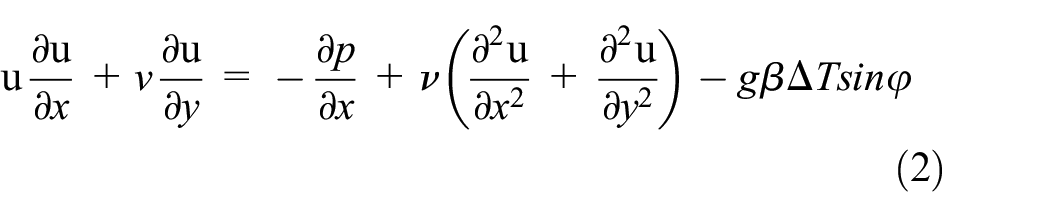
Conservation of y-momentum equation

Conservation of energy equation

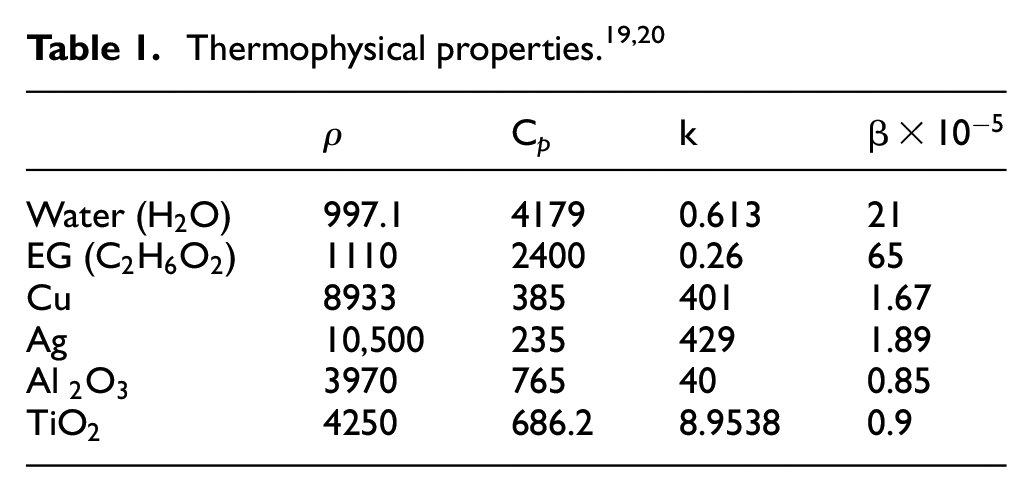
Nanoparticles are well spread inside the base fluid. Applying this assumption makes the particle concentration uniform across all the cavity hence the thermo-physical properties of nanofluids can be estimated using some known theoretical formulas. The given correlations as follows in Table 2 are to estimate the density, thermal diffusivity, specific heat, thermal expansion coefficient, viscosity, and thermal conductivity values of the nanofluid.
Grid independence values (Water–Cu, B = 0.4, D = 0.5, ϕ = 10%, Ra =

Density 22

thermal diffusivity

heat capacity 23

Thermal expansion coefficient

Viscosity 24

Thermal conductivity 25

The studied system is subject for the boundary conditions listed below:





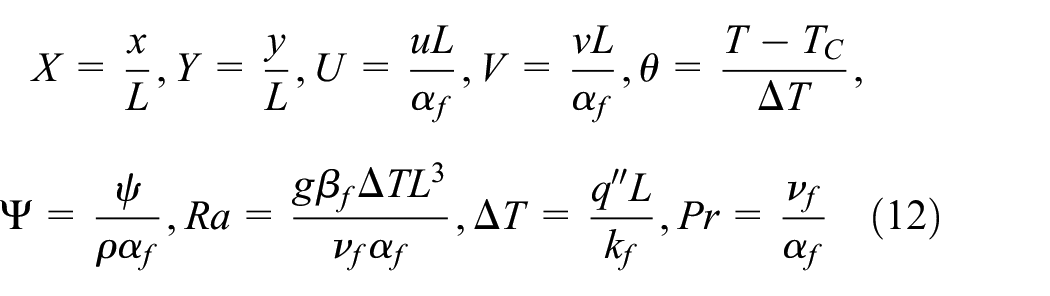
The following dimensionless parameters used in this presentation work as a control parameter or to plot profiles and field maps are introduced:
The ratio of convective heat flux to pure diffusion heat flux defined as the rate of heat transfer and the dimensionless local (
The (


The integration of the local Nusselt number (

Numerical model
The set system equations above (1–4) together with the initial and boundary conditions (11a–11e) are numerically discretized using the finite-volume method (FVM) formulation presented by Patankar
26
on an uniform structured quadrilateral grid. From the physical viewpoint, the method (FVM) is based on the spatial integration of the conservation equations through control volumes. Converting the governing equations to algebraic equations. The coupling between the continuity and momentum equations is satisfied using the semi-implicit method for the pressure-linked equations (SIMPLE) algorithm. The convective terms of the discretized equations were treated with a Second Order Upwind scheme. Considering the convergence of the numerical results, the under relaxation method is employed and the criterion on one time step is established as
The numerical study was proceeded in a CFD commercial code. The grid-independence resolution was examined in order to select the appropriate grid density. An uniform grid sizes were used for all regions in x and y directions. Table 2 displays the grid independence results across from the average Nusselt number and the maximal temperature in the heater source for different mesh combinations are shown. Judging from the uniform grid (
Validation
As a whole scientific work, the validate of the employed method and check the code is necessary. Results for natural convection in an nanofluid-filled square cavity were obtained and compared with the Aminossadati and Ghasemi 27 results. The comparison between the two numerical results obtained is shown in Table 3.
Results validation with Aminossadati and Ghasemi
27
(B = 0.4, D = 0.5, and

To get more precise results, the results obtained are compared and displayed for the four types of the used nanofluids, a considerable range of the Rayleigh number and different solid volume fractions. Figure 2 shows the variation of the average Nusselt number with the volume fraction with different Rayleigh numbers. Very excellent agreement between the results obtained with the previously published results can be observed.

Average Nusselt number variation as a function to solid volume fraction and Rayleigh numbers for different nanofluids (D = 0.5, B = 0.4), (a) present work and (b) Aminossadati and Ghasemi 27 results.
Results
This section portrays the numerical simulation results of the streamline and isotherm contours of the nanofluid flow, the local and average heat transfer rate, and the maximum temperature profiles of the heater wall-part for the proposed physical parameters. These parameters are the Rayleigh number (103
Tilt angle effect
In this part of the results, the heater source is located in the middle of the bottom wall (D = 0.5) and length (B = 0.4) in a cavity with Cu–water nanofluid-filled.
To analyze the impact of the tilt angle on the heat transfer. Figure 3 illustrates the impressive effect of the tilt angle (

Streamlines (a) and isotherms (b) for cavity-filled with nanofluid (
Figure 4(a) and (b) presents the horizontal and vertical velocities profiles via the middle-axis of the cavity affected by the Rayleigh number at a fixed inclination angle, respectively. Obviously, the magnitude velocity for vertical and horizontal absolute values increases with increasing Rayleigh number, caused by the strong buoyancy flow. In both profiles, the values are smaller than near the walls. Moreover, the high velocity is associated with the nanoparticles added into the base fluid.

Velocity profiles via the midsection of the enclosure as function to Rayleigh number (Cu–water nanofluid,
Figure 5 are prepared to present the impact of the tilt angle. The figure includes streamlines and isotherms (upper and lower, respectively) for the nanofluid,

Streamlines (upper) and isotherms (lower) the cavity-filled with nanofluid (
It seems interesting that at
Figure 6(a) and (b) plots the velocity profiles (horizontal (left) and vertical (right), respectively) as a function of the inclination angle at Rayleigh number

Velocity profiles via the midsection of the enclosure as function to tilt angles (Cu–water nanofluid,
The effect of the orientation angle of the cavity can be treated on the fluid flow pattern by plotting the Nusselt number (Nu and Nu
m
). Figure 7(a) shows charts of the local Nusselt number via the heater source for some cavity’s tilt angles at Ra =

(a) Nu via the heater wall-part at various tilt angles (Ra = 105, D = 0.5, B = 0.4, and
The cavity is tilting upward with each tilt angle and the heater source loses its horizontal shape, this facilitated the convective behavior of the fluid induced by the floating forces. Figure 7(b) displays the
The
For weak Rayleigh numbers (
For the first high Rayleigh number (
For Ra = 106, an inverse behavior occurs and presents its effects on the
Heater wall effects
This section examines the effect of the length of the heater wall part and its position relative to the vertical symmetry axis, for Cu–water nanofluid (
The

Dimensionless temperature (a) and average Nusselt number (b) for the cavity-filled with nanofluid (Cu–water,
Effect of nanoparticles type and base fluids
Nanoparticles type (Cu, Ag, Al 2O3, and TiO2) dispersing in base fluids (water (H2O) and ethylene glycol (C2H6O2)) are treated. The heater wall-part placed in the middle for length B = 0.4 for this section of the study. Figure 9(a) and (b) demonstrates the influence of nanoparticles type and base fluids on Nusselt number (Nu
m
) for Rayleigh number, tilt angle suggestion (
The effect of cavity tilt angle on Nu m is depicted. A linear effect on the average Nusselt number reflects the growth of the tilt angle. It is also observed that the rise of tilt angle leads the Nu m along the solid volume fraction axis in the growth direction with nanoparticle type and base fluid. Where the buoyant flows become stronger with the range of Rayleigh number growth.
It is fully noted that the Nu m increases approximately monotonically with solid volume fraction for all nanofluids in terms of Rayleigh’s number with the water base fluid. Furthermore, it is more monotonous when using ethylene glycol. Especially for low Rayleigh numbers, as a result of the weak convection in this regime. Notable that the Nu m curves are more same and more closely related to all the nanoparticles.
Average Nusselt number values grow up when ethylene glycol is used as a base fluid compared to water in all proposed tilt angles. In both cases of the base fluid, the average Nusselt number reaches their great values at the tilt angle (
Nu
m
as a function of the solid volume fraction keep the growth behavior in the range of Rayleigh number. For weak Rayleigh number (Ra = 103, 104), Nu
m
values at first are identical for the tilt angle (
For high Rayleigh numbers (105 and 106), the growing up of Nu
m
values are manifest for all nanoparticle type and both base fluids. At Ra =

Nu m at the heater wall-part as function of Rayleigh numbers, solid volume fraction, and tilt angles for different nanofluids (D = 0.5, B = 0.4). (a) Water and (b) ethylene glycol.
Conclusion
The numerical steady-state of natural convection heat transfer, in tilted cavity partially heated by the bottom wall, tested with more than one nanofluid has been explored. The fluid flow, thermal, and heat transfer rate performance of pertinent parameters such as various tilt angles, range of Rayleigh number, solid volume fraction, heater wall-part length and location, type of nanofluid, and base fluid have been analyzed. The simulation analysis results hint at the following.
Modified thermal physical properties of basic fluids which related to the solid volume nanoparticles adding; strongly effective on the dynamic and thermal behavior such as heat transfer rate (local and mean Nusselt number). Especially for nanoparticles with high thermal conductivity (Cu and Ag), with an increment rate (between 10% and 70%) according to the nanoparticle types used and the Rayleigh numbers. Therefore, the rise in the mean Nusselt number expresses an improvement in heat transfer characteristics.
An optimum tilt angle value that results in the maximum mean Nusselt number is found for two basic fluids (water and ethylene glycol) with all nanoparticles. It is found that the highest heat transfer is formed from 30° to 60° while it declining for 90° angle at varying rates for all Rayleigh numbers. This can be interpreted that convection is influenced by the higher tilt angle rather than the solid volume fraction (or viscosity). Therefore, there is an improvement in the mean heat transfer characteristics.
Two models of heat transfer appeared in the Rayleigh numbers range, the conduction heat transfer where it is dominant for low Rayleigh numbers. The same thermal and dynamic patterns happen for several tilt angles and solid volume fractions. Whereas, for higher Rayleigh numbers, the convective heat transfer is dominating. Considerable changes in the fluid flow and temperature behavior are appeared as in Nusselt number from the zero tilt angle (
Regardless of the pertinent parameters giving the best heat transfer and improving it using just a pure fluid (such as water), inserting the nanoparticles with a weak volume fraction offers the largest heat transfer gain in an enclosure. It is presupposed that using a basic fluid with high viscosity contrasts with buoyancy forces, thus reduces the heat transfer rate. Nevertheless, it is shown that using ethylene glycol as a base fluid that has high viscosity has a different reflection. Compared to the nanofluid in the fluid (water), the ethylene glycol increases
Footnotes
Appendix
Handling Editor: Chenhui Liang
Declaration of conflicting interests
The author(s) declared no potential conflicts of interest with respect to the research, authorship, and/or publication of this article.
Funding
The author(s) received no financial support for the research, authorship, and/or publication of this article.
