



Abstract
This study shows a new approach to heat water in a residential environment. An electromagnetic heating method is proposed. A steel bar inside a pipeline filled with water is heated by five arrangements of a copper coil which incites the steel bar by electromagnetic induction. Consequently, numerical simulation and experimental evaluation are compared. The outcomes evaluated two different scenarios: steady water and a water flow of 0.16 kg/s. Three rods demonstrated that current induction of 20 A at the surface of the steel bar heats at 157°C. Also, the maximum value reached is 58°C. Heating the water upon for those conditions, the proposed tankless instantaneous water heater (TIWH) reaches a temperature of 41.01°C with one rod but only reaches 37.92°C with three rods in a series configuration, in a parallel configuration, the maximum temperature reached was 28.73°C.
Introduction
A water heating system is defined as a device that transfers energy by heating water, regulating the water flow process, and operation temperature, among others. 1 In Mexico, this consumption represents around 27.2%, 2 followed by Canada, approximately 22%, 3 and the United States of America, almost 17.7%. 4 The energy used to warm water on devices is addressed in different ways. However, the most common way to heat water is by burning fuel, including carbon, gas, wood, or similar.
Almost 75.34% of households consume fossil fuels in Mexico, and just 13.69% use solar energy. 5 Compared to Canada, reducing the use of fossil fuels by 59% followed by a 35% electricity use, showing a tendency to adopt green energies in the last years. 3 In the United States of America, only 23.4% of water heaters are fossil fuel, 45.6% are entirely electrical. 4 To select water heating equipment is necessary to be aware of different factors. Values like hot water consumption (gallons per day), distribution system, quality of water (carbonate hardness and alkalinity), installation constraints (i.e. space, closeness with the energy source outlet, ventilation, among others), and fuel-type availability on the residence are significance factors. 4
American Society of Plumbing Engineers (ASPE) suggests that waste of water until it reaches a comfortable temperature (110°F or 43.3°C) on the fixture will not be more than three cups of volume (around 1 l of water) in 30 s. 6 On his own, Hoeschele et al. 7 point out that hot water consumption per person per day is around 15–20 gallons, and the average use of 30–45 min/day. Klein and Sherman 8 suggest that waste of water can be reduced by locating water heating sources close to end-users, minimizing the drop pressure, and optimizing the velocity. Bennett et al. 9 mention that solar water heating systems must consider parameters like snow coverage, wind velocity, and solar radiance per square meter for the design. Cost-effectiveness has been dramatically influenced by introducing into the market new types of water heaters.
On the other hand, electromagnetic heating induction is commonly used for heating methods like drum ovens, drying machines, industrial heaters, and heat treatments. 10 The principle function is to heat metals workpieces placed inside a copper coil powered by high alternating currents. Those alternate currents create Eddy currents in the metal workpieces, increasing the temperature by Joule’s effect. 11 Heating by electromagnetic induction is taking popularity mainly in the industry due it decreases traditional heating sources disadvantages as low efficiency and high energy consumption, pollution, fuel storage, and rising environmental temperature. 12
Many attempts have been made in order to use electromagnetic heating induction as a technique to heat water. For example, 13 points out a stainless steel pipe with three coils of copper wrapped around it. The importance of this research is about the electronic device used to sense, control, and power the coils to maintain a stable temperature of the water around 0.5 l/min. This work only uses one heating stage and reports that the high frequency is an issue on the control stage. Another example of the feasibility of the electromagnetic heating induction used to warm water is described in Ahmed Sherwali and Dunford. 14 In this paper, the authors report a feasibility study about induction heating of water for underground applications. They summarized that an induction coil with a magnetic core is preferred over an air-core because it lowers the power requirements for the same heat rate generated. Other energy balance works that show the efficiency of this kind of system are shown in Korepanov et al. 15 This work only shows the energy balance for one stage of heating.
Thus, this paper shows the design of an instantaneous tankless water heater (TIWH) powered by electromagnetic heating induction. Also, the evaluation of five design parameters is used to propose an optimal configuration for residential use. The evaluation includes the design of the pipe length, the electromagnetic induction heater source, the evaluation of the heating element performance, and the electromagnetic heating induction values of two proposed configurations to heat water. Finally, the capacitor-inductor tank (CL) design is used in the Mazzilli Zero Voltage Flyback circuitry.
Design heating model
Traditional water heating systems have many disadvantages, like low efficiency and high energy consumption, air pollution, fuel storage, and rising environmental temperature. In addition, ferromagnetic materials generated Eddy currents inside the workpiece, transforming into Ohmic heat losses. 16
One way to reduce this effect is through electromagnetic heating induction by applying an alternating current. Figure 1 shows an idealized model of the instantaneous tankless water heater (TIWH).

Electromagnetic water heating induction diagram. Diameters are graphically represented by D, Din, Drod. The different lengths of the pipe are represented by lp, lc, Wg and stp Main parts of Electromagnetic water heating are PVC tube, mild-steel rod and water.
The arrangement wraps a copper conductor around a non-ferromagnetic tube to create a coil. This coil heats a rod metal inside the tub through the electromagnetic heating induction process. The coil is supplied by high frequencies alternating current. The heat generated is used to warm water through a PVC tube. Thus, equation (1) computes the minimal length of the pipe lp, which is related to the maximum water wasted volume Vww mentioned by American-Society-of-Plumbing-Engineers. 6

Din and Drod represent the diameter of the internal pipe and the diameter of the rod. The specific heat value Cp that represents the thermal energy required to increase the temperature used to estimate the required power workpiece Wwp is given by:

mw is water drawn mass, Cp is the value of specific water heat (4180 J/kg °C), Tin is the inlet water temperature, and Tf is the set point average value of temperature (110°F or 43.3°C), and t is the required heat time (10 and 60 s). Figure 1(d) represents the external diameter of the non-ferromagnetic tube, Wg represents the wire gauge, STP represents the distance between each wire turn, and lc represents coil length, which also estimates the distance of the wire the metal workpiece heated by the inductor. On the other hand, equation (3) estimates the inductance value given by the wire gauge Wg. The value is given in micro-Henries (μH)

Where μ0 represents the magnetic vacuum permeability (4π × 107 Tm/A), N represents the number of turns around the tube to form the coil, lc represents the longitude of the coil, and S represents the cross-section of the coil (not the wire). Equation (4) is used to estimate the inductor resistance Lwh as a parameter of the wire gauge Wg; the value is given by ohms (Ω).

Where N represents the number of spires and σ c represents the copper wire conductivity (5.96 × 10⁷ Ω−1 m−1), and Wg represents the cross-section diameter of the wire. The skin effect δ is the behavior that forces a current to flow into a specific metal pattern piece and is defined by equation (5)

Where f is the oscillation frequency, one way to modify the skin effect is by modifying the frequency of oscillation of the current applied.
In order to evaluate the skin effect on the tankless instantaneous water heater (TIWH), Figure 2 presents the Mazzilli Zero Voltage (MZV) flyback circuit. The circuit is driven by two MOSFET model IRFP-250N (Q1) and (Q2), two Zener diodes model 1N4742A (Z1) and (Z2), and two diodes model 1N4006 (D1) and (D2). The MVZ circuit is driven by the (LC) tank, which frequency is computed by equation (6)

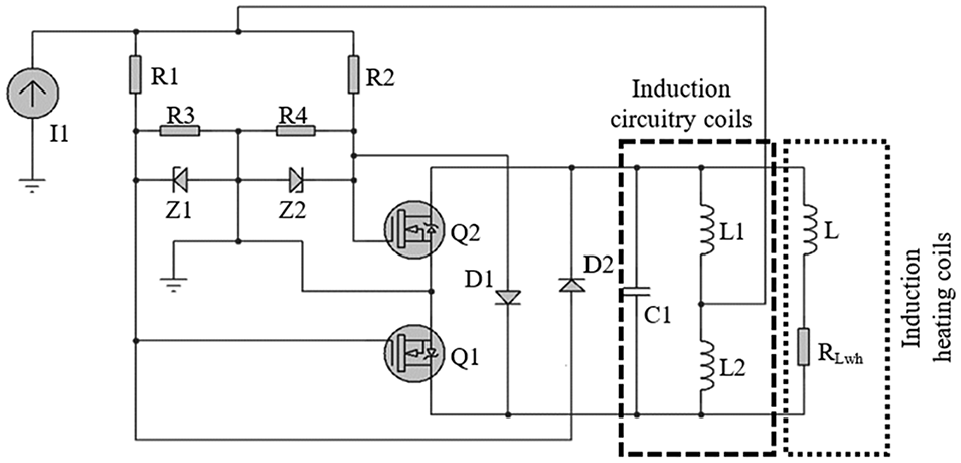
Electromagnetic water heating induction electrical diagram.
The circuit evaluates the frequency f as a parameter of the LC oscillator tank and the heating length area.
Experimental copper coil inductance model
The tankless instantaneous water heater (TIWH) proposed design is obtained by idealizing the pipe length lp enough to contain around three cups of minimal waste of water before reaching 43.3°C. This parameter is computed by using equation (1). The obtained values for 8 ounces and 24 ounces of wasted water, as is pointed out by the ASPE in the Plumbing engineering design handbook, are summarized in Table 1. Also, the proposed design considers two possible configurations of pipe diameter; the first diameter D is equal to ½″ and 1″. The proposed rod used on this evaluation was a mild stainless rod of Drod equal to ¼″.
Minimal pipe length.
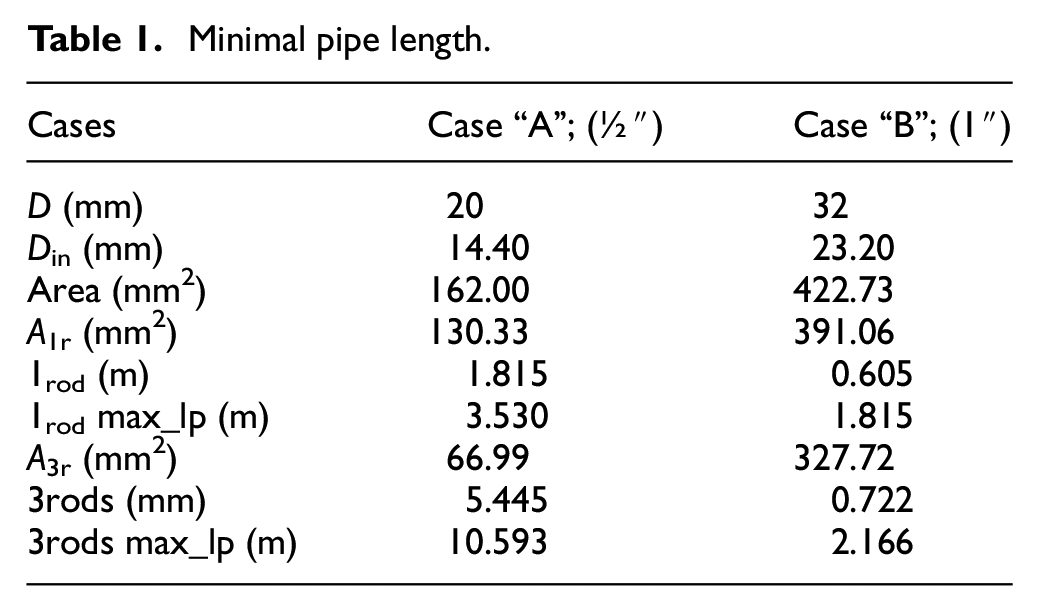
Case “A” for 1 rod has minimal value for a waste of water, and Case “B” for 3 rod has maximum value for a waste of water. Once is computed the pipe length; another parameter of the design is evaluated in two scenarios of water heating; by heating in series and parallel shown in Figure 3.

Tankless instantaneous water heater (TIWH): (a) series configuration, (b) parallel configuration, and (c) coil wrapped around the pipe on the heating areas.
Figure 3(a) and (b) show that both configurations are composed of five sections similar to coil length. Each length subsection is 300 mm, and the total length is 1.7 m ± 0.2 m depending on parallel (eight tubes of 0.05 m) or series (four tubes of 0.05 m). The inductance Lwh is described by inductor length definition Lc. The proposed length of the inductor Lc is 100 mm. Using the hardware sell on local storages, 10 coils of the described length were manufactured using copper wire with wire gauge Wg = 1.15 mm. Thus, the coil will have 51 turns; the calculated coil inductance Lwh by using equation (3) is 47.3 μH. The manufactured coil is shown in Figure 4. In order to measure the total coil inductance, the circuit was used in Figure 4(b). Then, by an average of the 10 coils made, the Lwh is rounded up to 50 μH.
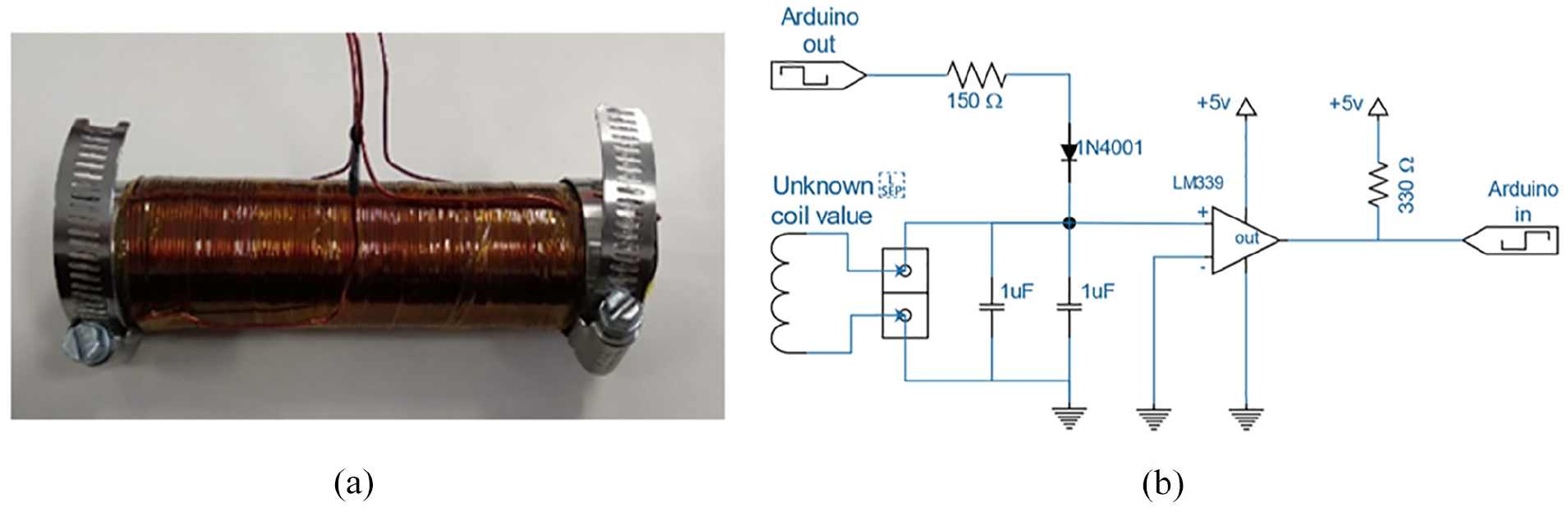
Design of the copper coil inductance: (a) coil of 20 mm mounted over the PVC tube of ½″ and (b) electromagnetic water heating induction electrical diagram.
In Figure 2, the inductances L1 and L2 are proposed as the same value of the coil Lwh. Thus, it was used two toroid coils of 25 μH to create an oscillator tank. Then, the C1 value is computed for 10–30 kHz. The computed values are shown in Table 2. Finally, the period of oscillation was measured at the drain of the Q1 and Q2 MOSFET transistor.
Parameters of LC resonate tank of MVZ circuit.

Table 2 presents five different values to evaluate the optimal combination of capacitors test-bed available on commercial values. A change in frequency of oscillation has an impact on the rate of heating induction. Therefore, it was simulated the electromagnetic heating induction of one rod at five frequency values, evaluating the temperature reached by a current from 5–30 A.
Figure 5 presents a compilation of the heating of one rod using electromagnetic heating induction. The rod reaches a uniform heating area in all simulations, and it extends around 10–50 mm out of the coil. On the other hand, by evaluating the simulation results, the skin effect of the induction heating can be negligible due to the size of the rod. Figure 6 presents the temperature values reached in the middle of the rod when the frequency range from 5 to 30 kHz at 25 A is changed.

Comparative of electromagnetic heating induction of one rod at different values of a source of current: (a) 5 A, (b) 10 A, (c) 15 A, (d) 20 A, (e) 25 A, and (f) 30 A.
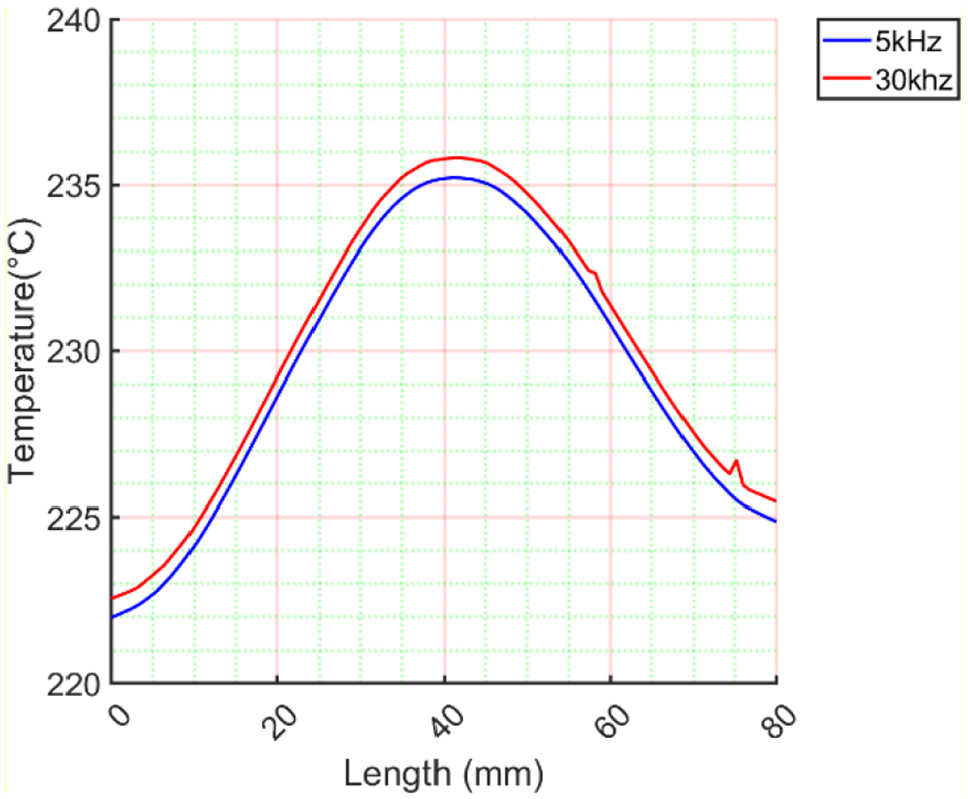
Comparative of electromagnetic heating induction at 25 A and different oscillating frequencies.
In Figure 6, it can be determined that the skin effect does not modify the reached temperature of the rod.
Finally, the temperature was evaluated reached by the two configurations of rods (Case “a” one rod, Case “b” two rods). It is outstanding that temperature performance drops for three rods compared with one rod at the same current applied on the same coil configuration. Figure 7 shows the comparative values obtained for both rod configurations.

Comparative of electromagnetic heating induction at 25 A and different oscillating frequencies.
Numerical simulation
Using the previous results, two flow water simulations were run in a serial and parallel configuration. The parameters of the simulation are listed next
•
o Case I:
o Case II:
o Case III:
o Case IV:
o
o
o
o
In addition, to validate the numerical results reported in this work, a mesh analysis was performed. It was run 120 simulations varying the number of hexahedral elements from 2400 elements to 436,800 elements. For simplicity, the mesh analysis shown in Figure 8, was referred as case IV parallel configuration. The subsequent results were performed by using 200,000 elements that represents a convergence value of 70% as is shown in the curve fitting of Figure 8

Experimental test running static flow conditions: (a) top view of the experiment, (b) electronic circuit, and (c) numerical simulation.
The simulation of the parallel configuration is shown in Figure 9. This Figure is presented a close view of how the water is heated. In most cases simulated, the mass inlet flow does not allow to reach a constant temperature in the entire cross-section of the pipe. Another finding was that in the last simulation, the maximum temperature reached at the end of the pipe was only 24.5°C. The results for the simulation at Case I and Case IV are presented in Figure 10. The results are obtained in the cross-section of the pipe around section A (first stage of heating) and section E (last stage of heating). In both cases, the temperature profile slightly increases against the first stage of heating, concluding that serial configuration is not optimal for electromagnetic heating.

Profile of temperatures reached in case IV at Parallel configuration with a close view of different sections after the heating process.

The temperature reached in parallel configuration: (a) case I and (b) case IV.
Conversely, Figure 11 presents the flow simulation of the electromagnetic heating water in the serial configuration. Contrary to parallel configuration, the heating process was consistent and almost completely stable all along the pipe length

Profile of temperatures reached in case IV at serial configuration with a close view of different sections after the heating process.
The results for the simulation at Case I and Case IV are presented in Figure 12. The results are obtained in the cross-section of the pipe around section A (first stage of heating) and section E (last stage of heating). In both cases, the temperature profile has constant increases against the previous heating stage, concluding that serial configuration is optimal for electromagnetic heating. Another exciting region of interest is the small end after the stage of heating. This section was initially designed to extract the rod when the tankless instantaneous water heater needs maintenance, but incorporating this section improves the water heating, as is shown in the close view of each section in Figure 11. It appears that this section works as a mini-well allowing to retain the water and increase the rate of energy interchange.

The temperature reached in serial configuration: (a) case i and (b) case iv.
Results
The configuration performance proposed was evaluated as follows, a first run of the experiment and simulation of the environment of the water container heated at around 157°C at 30 kHz was done. Figure 13(a) shows the coil and the rod view from upside running a similar test at 25 A and 30 kHz. Figure 13(b) shows the MVZ circuit modified to attach different configurations of capacitors and inductance to test the previous computed and simulated conditions. Finally, Figure 13(c) presents the numerical results of the same boundary conditions. This experiment was run 16 times in order to test all the conditions previously simulated.

Experimental test running static flow conditions: (a) top view of the experiment, (b) electronic circuit, and (c) numerical simulation.
Finally, the serial and parallel configuration is evaluating the current necessary to heat the heating element at different temperatures (Th1 = 55°C, Th2 = 97°C, Th3 = 157°C, and Th4 = 235°C). These results are shown in Figure 14. Those are directly related to the current source used to power the Mazzilli Zero Voltage (MZV) flyback circuit to evaluate the reach range of temperature reported as minimum comfortable (35°C) to comfortable (44°C).

Comparative of electromagnetic heating induction dependent on series or parallel configuration.
Discussions
This work presents a design methodology for a tankless instantaneous water heater (TIWH) manufactured using local hardware and the electromagnetic heating technique as a water heating source. This device only consumes 376 W/l. Moreover, it wastes eight ounces of water per minute to reach a stable temperature. On the other hand, the proposed configuration needs minor manufacturing consideration on commercial prototypes due to the overheating of the coil when the device is turn on for more than 5 min. This minor consideration will be reduced in future versions by introducing a water reflow that decreases this value under safe conditions.
Conclusions
The proposed design uses the Mazzilli Zero Voltage flyback circuit as the core of the electronic device and evaluates different possibilities to heat water through low-cost components available in local storage that cost around 6 USD. The entire device cost is around 110 USD. An important parameter found was the skin effect on the mild steel rod. The parameter’s value has no fundamental importance on the heating transfer from electromagnetic induction to water heating, as is shown in Figure 6. In addition, the comparative of one rod versus three rods depends on the stages of heating. The rods’ contact area decreases the size of the pipe’s effective area but increases the temperature reached, as shown in Figure 7. However, when this value is compared against Figure 14, the quantity of the material can be decreased, and the power consumption used to achieve similar water heating results. The essential value then is the current versus temperature graph (Figure 13). In this Figure, the optimal values are reached at 20 A, but it has similar behavior for one or three rods as heating elements. The contradiction in using the three rods configuration is that pressure drops due to the limited space for water flow. On this way, the most optimal configuration is the one rod in series configuration at 20 A and 15 kHz. In the Experimental test, the time to heat up a volume of three cups of water was less than 1 min. This is an achievement planned at the beginning of the design. A complication of the proposed design is the copper wire heating. The simulations only look to heat the metal rods to a specific temperature, but when the experimental test was run, the copper wire heats up when the heater was on for more than 5 min. This is a complication because the average time of the bath is around 15 min. This complication needs to be evaluated and solved to make this prototype a commercial one in future developments. Another interesting finding is the proposed configuration in the MZV circuit because the electromagnetic heating induction has no critical influence on the value used to heat the rods, allowing a wide range of a tank of capacitors in the circuit to low the power dissipated by each component.
Footnotes
Handling Editor: James Baldwin
Declaration of conflicting interests
The author(s) declared no potential conflicts of interest with respect to the research, authorship, and/or publication of this article.
Funding
The author(s) disclosed receipt of the following financial support for the research, authorship, and/or publication of this article: The authors wish to gratefully acknowledge Consejo Nacional de Ciencia y Tecnologia (CONACyT) and Secretaria de Energía (SENER) for the support of the project “Ingeniería y Ciencia aplicada al sector energético del semidesierto del Norte del país clave 266492” for the support of the postdoctoral contract allowing a period at Instituto Politécnico Nacional through the Centro Interdisciplinario de Investigación para el Desarrollo Integral Regional Unidad Durango in the Y. 2018–2019.” Also, the support project 20120282 as well as an EDI grant, all by SIP/IPN.
