



Abstract
In this paper, flapwise and edgewise vibrations of a horizontal axis wind turbine (HAWT) blade are studied. Rayleigh-Ritz method is used in which; orthogonal mode functions of the Euler-Bernoulli beam having fixed-free boundary are introduced into the Lagrange function and then the dynamic equations are derived. Effect of gravity, pitch angle, centrifugal stiffening, and rotary inertia are considered. Nondimensional equations are obtained by defining nondimensional parameters like; natural frequency, blade rotation, slenderness ratio, and simple pendulum frequency. The stiffness term of the natural frequency has two speed dependent elements and it is shown that, for small pitch angles, flapwise natural frequencies of the blade are increased by the increasing blade speed while the edgewise natural frequencies of the blade are decreased with the increasing blade speed. Pitch angle values ranging from 0° to 15° has negligible effect on the nondimensional natural frequencies of the blade up to the nondimensional blade speed of 4. Since the natural frequencies are the function of the blade speed, rotor critical speeds should be calculated with Campbell diagrams. Vibrational response of the blade tip to the gravity is dominant and much greater than that of the wind speed in the edgewise and flapwise vibration.
Introduction
The size of wind turbines is increasing because of the efficiency of the power production, but with the increasing blade lengths and weights, vibration problem is also becoming important and challenging. Wind turbine blade vibration is a serious problem not only because it will reduce the life of blade but also it can pass some unexpected frequencies to the tower, which will cause tower to vibrate. Ju and Sun 1 developed a model for wind turbine flapwise vibration to reduce the pitch angle caused vibrations in flapwise direction, Lagrange’s method is used to model the blade and the input shaping method is used to reduce the residual vibrations caused by the change of pitch angle input. Karimi and Moradi 2 developed a nonlinear kinematic model of the wind turbine blade using Hamilton’s principle, this model is simplified to three modal equations, two in flapwise direction, and one in edgewise direction and solved analytically using the multiple scales perturbation method. Jin et al. 3 studied a quasi-three-dimensional solution for the dynamic behaviors of the rotating functionally graded material (FGM) beams which are assumed to have a metallic core covered with two ceramic faces. Jokar et al. 4 studied the dynamic modeling and free vibration analysis of horizontal axis wind turbine (HAWT) blades in the flap-wise direction while taking into account the influences of gravity force, centrifugal force, and the blade rotary inertia. Zhang et al. 5 studied the large-scale offshore wind turbine blades, developed the governing equations in fluid domain and the motion equations in structural domain with geometric nonlinearities, the fluid structure interactions (FSI) were simulated by using ANSYS. Liu et al. 6 studied the influence of blade vibrations on the aerodynamic loads, the dynamic stall characteristics of an S809 airfoil undergoing various types of motion were investigated using computational fluid dynamics (CFD) techniques and simulation results indicated that the in-plane and out-of-plane translational motions of the airfoil affect the aerodynamic forces significantly. Liu 7 analyzed the random wind caused vibration for the blade–cabin–tower coupling system. Li et al. 8 studied the mode coupling among axial extension, flapwise vibration, edgewise vibration and torsion for the slender blade which is mounted on rigid hub and subjected to unsteady aerodynamic force. Chaves Júnior et al. 9 used the collocation method for the evaluation of bending, torsional, and longitudinal vibrations of wind turbine structures, effects of the elastic supports, rotary and torsional inertia, geometric nonlinearity produced by the nacelle and water added mass are evaluated in different model approximations. Xi et al. 10 used a semi-analytical model of the aerodynamic damping for horizontal axis wind turbines and the results indicated that the uncoupled analysis method employing this aerodynamic damping model can accurately predict the dynamic response of horizontal axis wind turbines excited by a combined wind and earthquake loading. Al-Hadad et al. 11 investigated the effects of transient loadings resulting from a rapid mass reduction event from the rotating blade as well as an impacting mass onto the wind turbine blade, leading to transient vibration and unbalance within the turbine system. Zuo et al. 12 presented at their work a state-of-the-art review of the current vibration control techniques and their applications to wind turbines. Xie and Aly 13 introduced widely used control strategies in engineering structures and also their applications to suppress the adverse vibrations of the structural components of wind turbines. Staino et al. 14 summaries the challenging issues related to structural control of wind turbines due to mechanical vibration and proposes a new blade design with active controllers for controlling edgewise vibrations. Zhang et al. 15 proposed tuned liquid dampers (TLD) which utilize the sloshing motion of the fluid to suppress structural vibrations in rotating wind turbine blades. Fitzgerald and Basu 16 designed and implemented a new active control strategy which is a cable connected active tuned mass damper (CCATMD) to control the in-plane vibration of large wind turbine blades. Chen et al. 17 proposed a new semi-active fuzzy control strategy for controlling edgewise vibrations of wind turbine blades under extreme wind by using magnetorheological (MR) dampers mounted inside the blades.
In this paper, the vibration of a horizontal axis wind turbine (HAWT) blade edgewise and flapwise vibration is studied. Rayleigh-Ritz method is used in which the assumed orthogonal mode functions are introduced into the Lagrange function than the dynamic equations are derived for the first three modes of the blade. Effect of gravity, pitch angle, centrifugal stiffening, and rotary inertia is considered. Nondimensional equations are obtained defining nondimensional natural frequency, nondimensional blade speed, slenderness ratio, and simple pendulum frequency which appears as a gravity effect. Flapwise and edgewise natural frequencies are studied with respect to the slenderness ratio, blade pitch angle, blade speed, and gravity. Vibrational response of the blade under gravity and wind speed is also shown for the NREL-5MW type wind turbine blade.
Formulation
Figure 1 shows the cross-section of an airfoil in the inertial

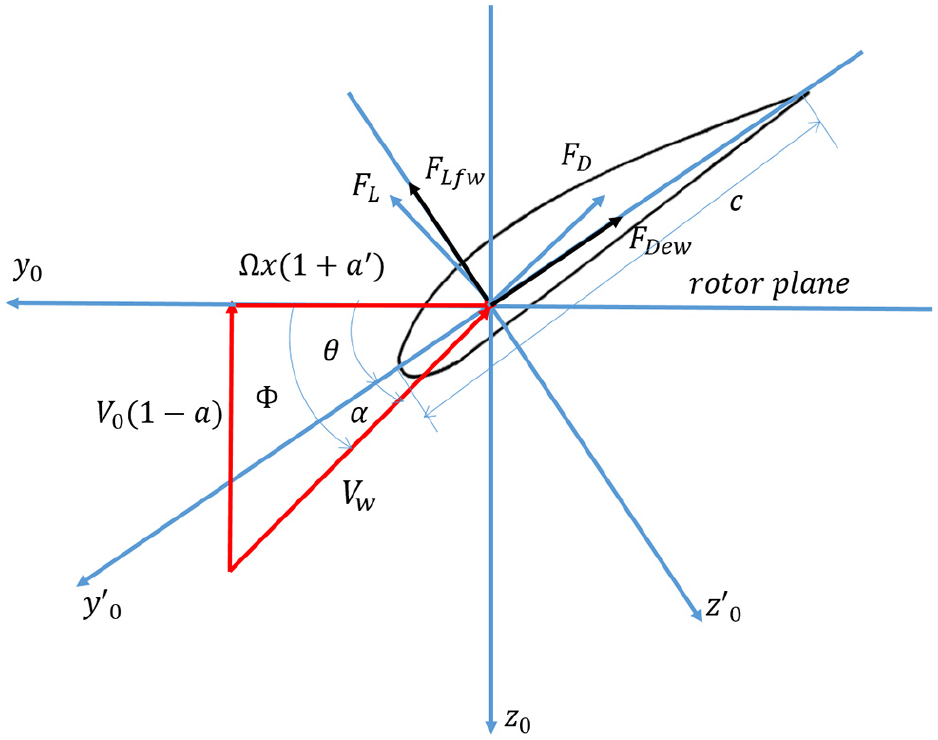
Cross sectional view of the blade.

Flapwise vibration of the blade.
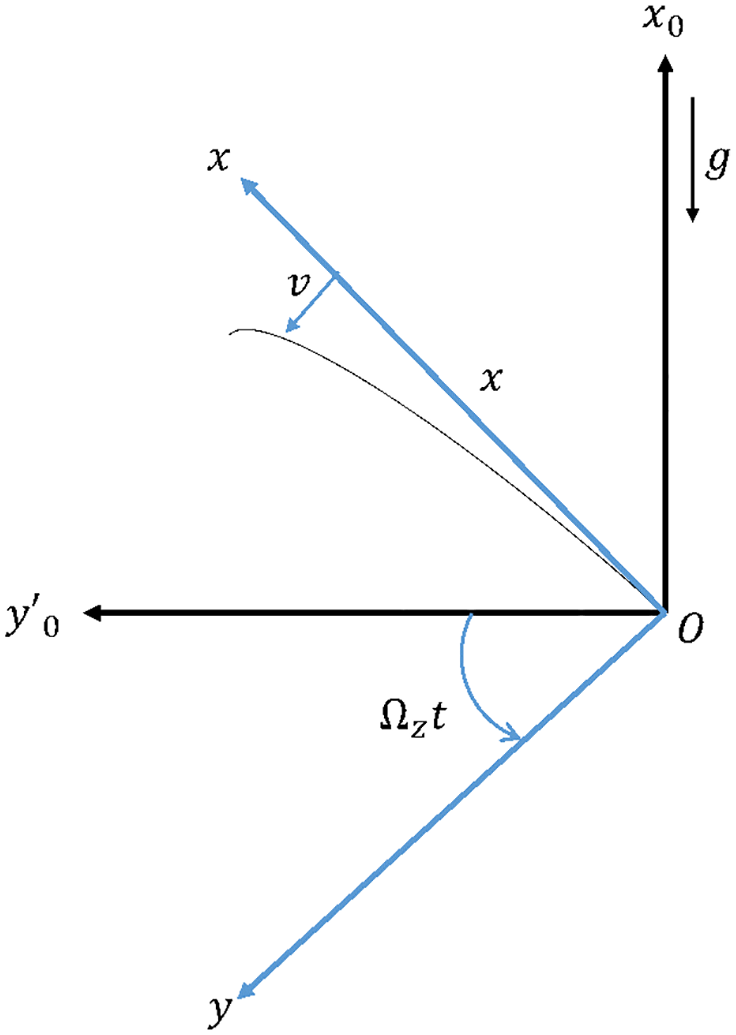
Edgewise vibration of the blade.
Potential energy is;

Rayleigh dissipation function is;

Here, in these equations,

The velocity of the differential element with respect the inertial frame can be calculated as


We assume that the cross section and the area moment of inertia is decreasing linearly from the root to the tip of the blade, so the following functions are assumed;


Here
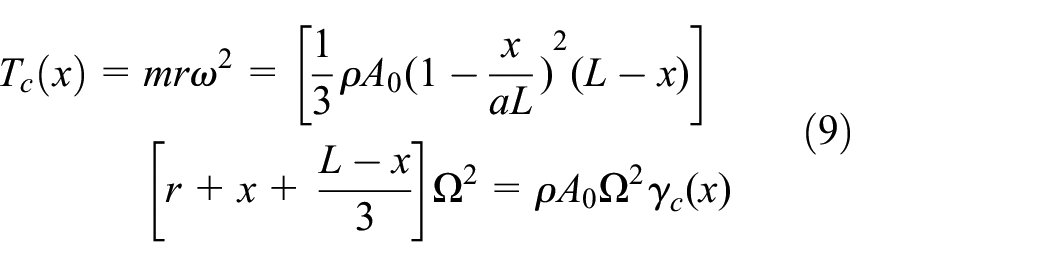

Wind turbine blade under centrifugal tension.
The tension created by the gravity can be calculated as shown in Figure 5 as;


Wind turbine blade under gravity.
Since the blade is rotating, gravitational tension changes, it is added to the centrifugal tension while the blade is vertical down, and subtracted while the blade is in the vertical up position. Total tension on the blade is;

To obtain the dynamic equations, Rayleigh-Ritz approach is used, in which assumed mode functions are put into the kinetic energy and potential energy equations of the Lagrange function and Lagrange equations are used to obtain the dynamic equations of the system with respect to the generalized coordinates. Since the nonrotating wind turbine blade can be assumed as the Euler-Bernoulli beam having fixed-free boundary conditions, sum of the orthogonal modes of the Euler-Bernoulli beam can be used as a solution 18 ;

Here

Natural frequencies of the Euler-Bernoulli beam having fixed-free boundary condition are given as 18 ;

We can also define nondimensional natural frequencies of flapwise and edgewise vibration as;


The first five nondimensional natural frequencies are;
When the assumed solution of equation (12) put in the equations (1)–(3) we will obtain the following equations;
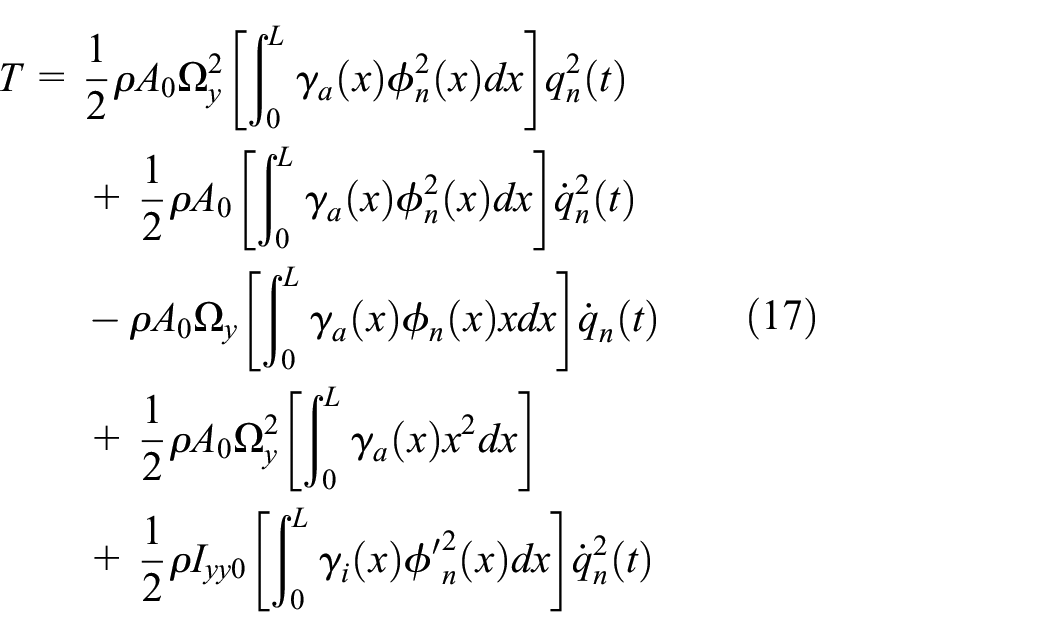


Lagrange equations are used to derive the dynamic equations of the wind turbine blade;

For each mode, the following equations will be obtained;


the natural frequency in the flapwise direction, after introducing nondimensional terms, is;


Nondimensional terms are;


Here,


Wind load on the blade is given as 19 ;


Now we can write the components of the forcing functions given in equation (32) in nondimensional form as;
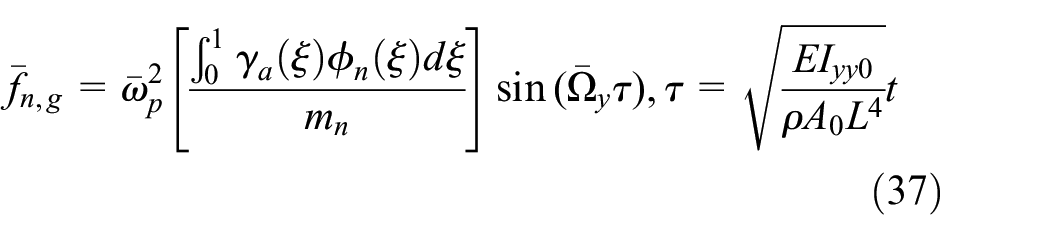


Here

Results and discussion
Figure 6 shows the nondimensional first natural frequency of the blade with respect to the slenderness ratio for three values of the shape factor a of 1, 2, and

Nondimensional first natural frequencies of the Rayleigh beam for different a values with respect to the slenderness ratio

Nondimensional second natural frequencies of the Rayleigh beam for different a values with respect to the slenderness ratio

Nondimensional third natural frequencies of the Rayleigh beam for different a values with respect to the slenderness ratio

Nondimensional first flapwise natural frequency of the rotating blade for three different slenderness ratios.

Nondimensional first edgewise natural frequency of the rotating blade for three different slenderness ratios.
In the equation (24) which is the stiffness equation, second term and third term depends on the blade rotation. Second term is the tension created by the centrifugal force, third term is the inertial force created by the blade rotation component of the flapwise vibration plane. Flapwise vibration plane is the xz plane and rotates with
As can be seen in the equation (24), the effect of weight on the tension of the blade is cyclic and changes with the rotation. The effect of this cyclic tension value on the natural frequency is small, that is why its maximum value is used for all natural frequency calculations. Table 1 shows the maximum and minimum values of the first five natural frequencies during one cycle.
Flapwise vibration natural frequency fluctuation in one cycle because of the weight (

Since the natural frequencies are the function of blade speed, Campbell diagram is used in the Figures 9 and 10 to find the critical speeds. Critical speeds for the flapwise and edgewise vibrations for three different slenderness ratios are tabulated in Table 2.
Nondimensional critical speeds in flapwise and edgewise vibrations.

Figures 11 and 12 are showing the effect of pitch angle on the first natural frequency of the blade. In these plots
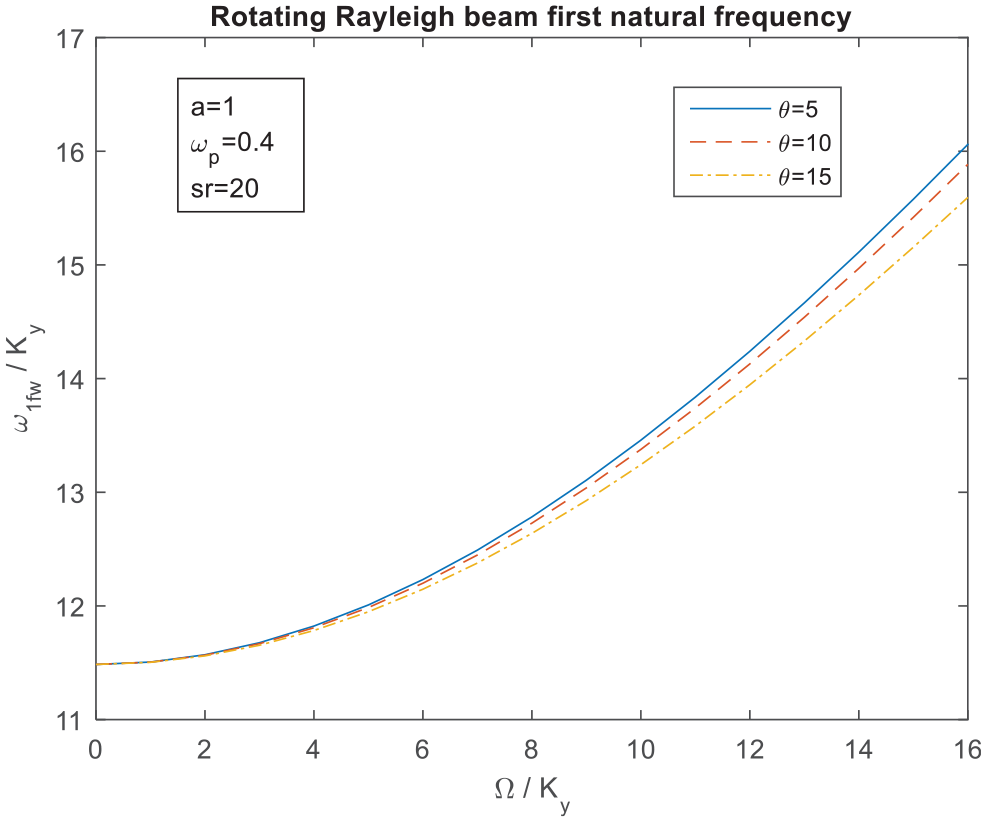
Flapwise first natural frequency changes with respect to the pitch angle.
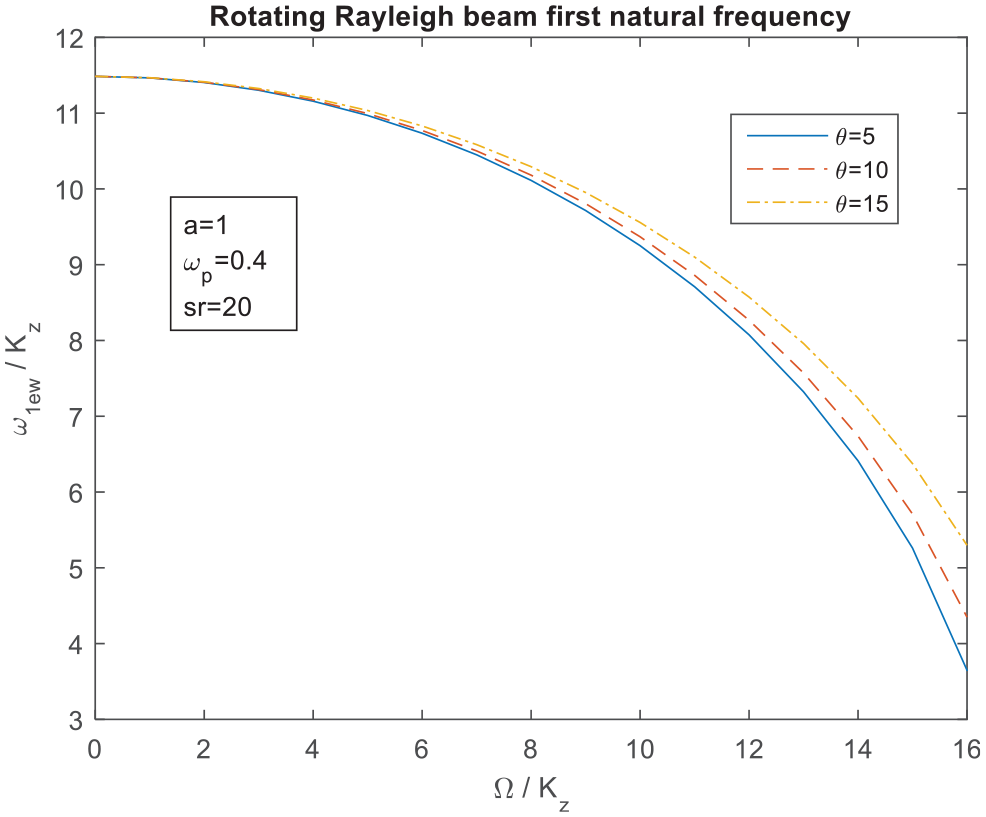
Edgewise first natural frequency changes with respect to the pitch angle.
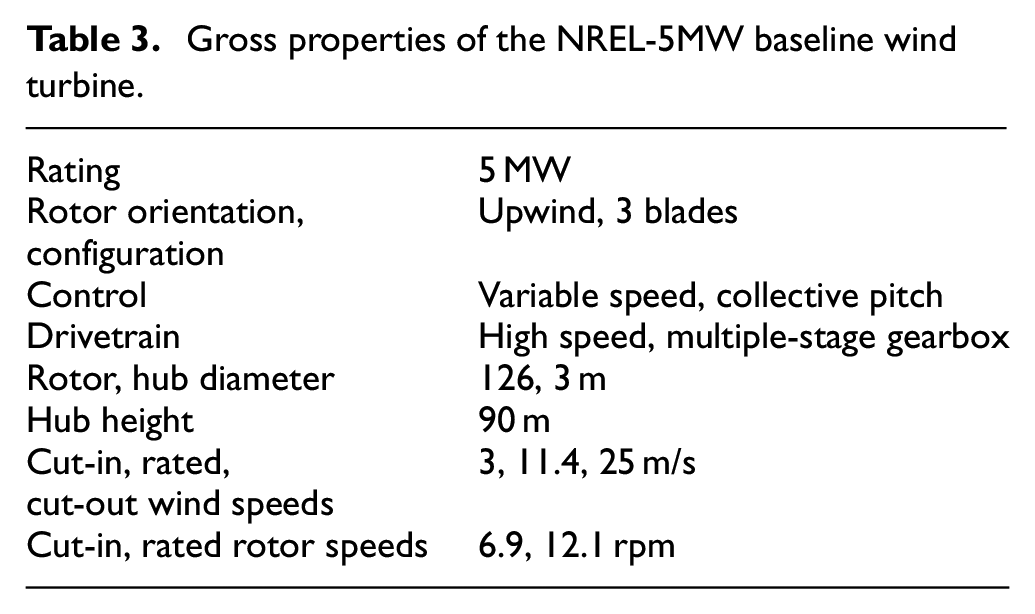
Natural frequencies and the blade tip vibrations because of the weight and wind load is also calculated for the example NREL-5MW horizontal axis wind turbine. The values are tabulated at the Table 3 according to the properties table given in Jonkman et al.,
20
airfoil starts at the length 11.7 m until 63 m. In calculations, blade length is assumed as L = 51.3 m and the root length is r = 11.7 m. Blade mass density
Gross properties of the NREL-5MW baseline wind turbine.

Blade mass density plotted values and the line equation after curve fitting.

Blade flapwise stiffness plotted values and forth degree curve equation after curve fitting.

Blade edgewise stiffness plotted values and quadratic curve equation after curve fitting.
Modal natural frequencies calculated and given in Resor. 21

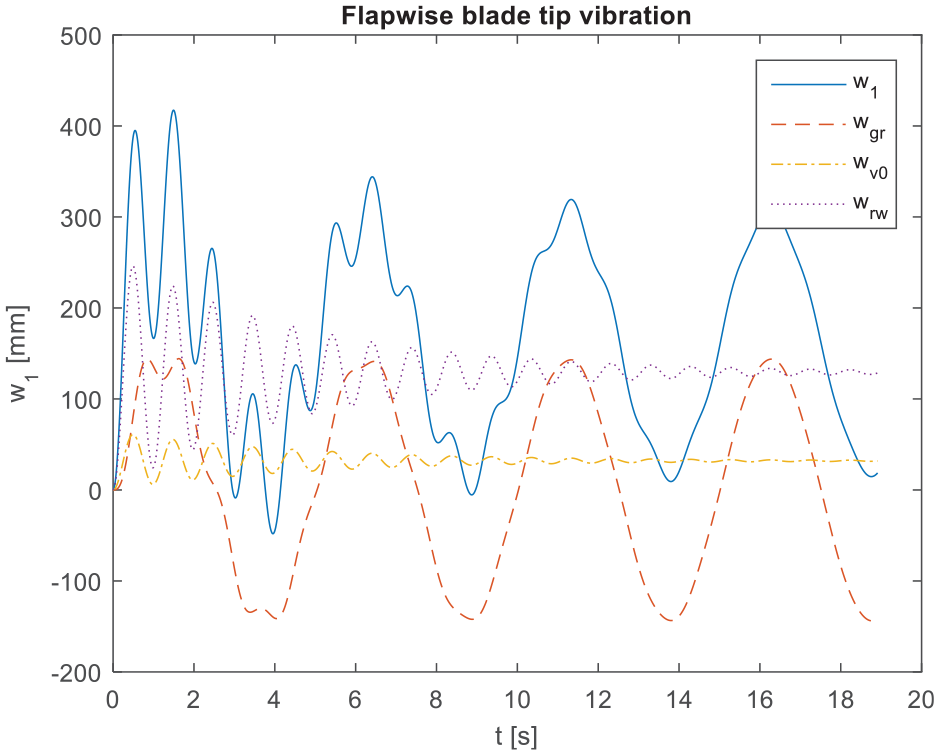
Blade tip deflections because of the wind load and gravity is also calculated. Inflow wind speed of

Flapwise blade tip vibration for only the first mode and for the sum of the first three modes.
Edgewise blade tip vibration for only the first mode and for the sum of the first three modes.

Flapwise blade tip vibration and its three components.

Edgewise blade tip vibration and its three components.
Conclusions
Horizontal axis wind turbine blade edgewise and flapwise vibrations are studied. Rayleigh-Ritz method is used in which the orthogonal mode functions of the Euler-Bernoulli beam of having fixed-free boundary are introduced into the Lagrange function and then the dynamic equations are derived. Varying cross section and stiffness are assumed. Effect of gravity, pitch angle, centrifugal stiffening and rotary inertia on the blade vibrations are studied. Nondimensional equations are obtained defining nondimensional natural frequency, nondimensional blade rotation, slenderness ratio, and simple pendulum frequency. Flapwise and edgewise natural frequencies are calculated with respect to the slenderness ratio, blade pitch angle, blade speed and gravity. Until the slenderness ratio of 20, rotary inertia is effective and blade can be treated as Rayleigh beam but currently used wind turbine blades have much greater slenderness ratio than 20 that is why they can be treated as Euler-Bernoulli beam. The stiffness term of the natural frequency has two blade speed dependent elements. One is the inertial force created in the vibrational plane, the other is the centrifugal force created tension on the blade. For small pitch angles, in the flapwise vibration, the effect of the inertial force is smaller than the effect of the centrifugal force tension that is why the natural frequency increases with the increasing blade speed but for the edgewise vibration, the effect of the inertial force is greater than the effect of the centrifugal force tension, that is why the edgewise natural frequency decreases with the increasing blade speed. The effect of the change of pitch angle from 0° to 15° on the flapwise and edgewise natural frequencies are negligible up to the nondimensional blade speed of 4. Since the natural frequencies are the function of the blade speed, 1X rotor critical speed should be obtained from the Campbell diagram. Gravity adds to the tension created by the centrifugal force and also cyclic, but its effect on the natural frequencies are negligibly small (0.4% for the first natural frequency, much smaller for others). The blade tip vibrational response under the gravity and wind speed is studied for the NREL-5MW type wind turbine blade as an example. In the flapwise blade tip vibrations, gravitational and rotational effects are much greater than the effect of inflow wind while in the edgewise vibration gravitational effect is dominant and much more than the effect of rotation and inflow wind.
Combined modeling of the HAWT system including the tower vibration, blade inertia effect, the effect of footing geometry, foundation properties, rocking and translational flexibilities of the foundation can be further and more realistic study of the subject.
Footnotes
Handling Editor: Zheng Li
Declaration of conflicting interests
The author(s) declared no potential conflicts of interest with respect to the research, authorship, and/or publication of this article.
Funding
The author(s) received no financial support for the research, authorship, and/or publication of this article.
