



Abstract
This paper is organized to study the heat and mass transfer analyses by considering the motion of cilia for Newtonian, Pseudo-plastic, and Dilatant fluids through a horizontally inclined channel in the presence of metachronal waves and variable liquid properties. A non-Newtonian Rabinowitsch model is used to study the flow of peristalsis through ciliated walls. The slip and convective boundary conditions at the channel walls are taken into account. The mathematical model is developed in the form of complex nonlinear partial differential equations then transformed into simplified form by using the definition of low-Reynolds number with lubrication theory. The analytical solution is obtained by using the perturbation method due to its low computational cost and good accuracy. The graphical outcome is based on the behavior of certain physical parameters on velocity, temperature, and concentration profiles for all three types of fluid. A symbolic software named MATHEMATICA 12.0 is used to find the analytical expression and construct the graphical behavior of all profiles that are taken under discussion. The important results in this study depict that the velocity profile tends to increase in the central region of the channel for Newtonian and Pseudo-plastic fluids and decreases for Dilatant fluid while a reverse behavior is observed near the channel walls. A smaller wavelength causes the wavenumber to accelerate and it tends to decelerate for a larger wavelength. The current study will help to understand the use of the complex rheological behavior of biological fluids in engineering and medical science.
Keywords
Introduction
Peristalsis is a natural phenomenon that is often observed in the biological system and aids in the movement of various physiological fluids. The propagation of waves through this mechanism exhibits contractions and expansions of the area along the boundary of the channel filled with certain fluid in this regard. The vasomotion of small blood vessels, the movement of urine from the kidney to the ureter, the transit of the ovum via the fallopian tubes, and other biological processes involving fluid motion are all applications of peristalsis in biological systems. A large-scale work has been conducted by many researchers by taking inspiration from various findings on peristaltic flow phenomena. Vaidya et al. 1 investigated the flow of peristalsis using the non-Newtonian Rabinowitsch model having convective boundary conditions in the presence of an inclined porous channel by considering variable liquid properties. Their results illustrated that the rheological features and behavior of Newtonian and non-Newtonian fluids (Dilatant and Pseudo-plastic fluids) can be easily adopted in the presence of convective boundary conditions and variable liquid properties. Mohamed Agoor et al. 2 studied the flow of peristalsis on a non-Newtonian Sisko fluid model by taking the impact of heat transfer through ciliated walls. They resolved the non-linearity in the differential equations using the perturbation method and graphical discussion carried out using different physical parameters. Sadaf and Nadeem 3 examined the influence of both viscous dissipation and convective condition in a tube for peristaltic flow of a non-Newtonian fluid. Their results declared that because of less wall resistance the parameters of wall tension, mass characterizing, and wall damping tends to increase the velocity profile for Newtonian and Pseudo-plastic fluids while a decreasing behavior on velocity was observed for Dilatant fluid. Imran et al. 4 analyzed the mechanism of peristalsis for the Rabinowitsch model to study the impact of ions slip and hall effect. The mathematical formulation was established by using the methodology of perturbation for non-linear equations under the long wavelength and low Reynold number assumption. A rise in velocity profile is observed by increasing the values of stiffness parameter, rigidity parameter, and wall damping parameter whereas temperature profile behaved opposite for these parameters. Bhatti and Zeeshan 5 investigated the peristaltic flow of the Casson fluid model to analyzed the heat and mass transfer effect on fluid suspension of particles under slip conditions. The governing equations given in the fluid and particulate phase were solved analytically and they obtained their exact solution for velocity, temperature, and concentration profiles that are plotted by considering different parameters. From the past few years, researchers work on the flow of peristalsis for different non-Newtonian models and visualize their geometry via graphs by using certain physical parameters.6–10
Several physiological and biological systems use cilia motion. Cilia are complex, tiny appendage structures that emerge from the arterial wall. Cilia, with a regular length of 10 mm, may bend easily and so aid in a variety of complex transport systems. Unlike flagella, which normally arise in nature as solo structures or groups, they generally occur in the form of high-density arrays. Their existence is observed in plants, cells, organs in physiological systems, and marine species and have whip-like motions. Fluid dynamics experts are interested in the ciliated transportation problem because it has many vicious and geometric properties of hydrodynamics that are accessible to mathematical formulation. Ramesh et al. 11 briefly investigate the flow of MHD physiological fluids like blood through ciliated channel walls in the presence of metachronal waves. The formulation is carried out under long wavelength and low Reynolds number assumption having non-slip boundary conditions. From the results, it is clear that axial velocity increases in the core region by increasing the values of wavenumber. Trapping of the bolus is also observed in the analysis. Bhatti et al. 12 addressed the cilia motion in the presence of MHD through the porous channel by taking metachronal waves. Conclusions depict that the fluid velocity decreases with the impact of the magnetic environment. Akbar et al. 13 developed a model based on the study of metachronal waves produced by the beating of cilia for a non-Newtonian fluid of physiology with the force of the micropolar peristaltic flow. The channel is considered to be oscillatory having flexible walls. In Newtonian fluids, an inverse connection between the increase in pressure and the rate of flow is calculated. The research has implications for hemodynamics in small blood vessels as well as microfluidic technologies. Saleem et al. 14 work on the peristaltic flow of a non-Newtonian fluid model in a tube having cilia effect at walls. They obtained the exact solution of governing equations in a curvilinear coordinate system under the use of lubrication theory. They concluded that by increasing the curvature parameter the geometry was converted into a straight channel result in establishing a symmetry at the center of the channel. Several other authors used the concept of cilia to examine the flow phenomena under various non-Newtonian fluid models.15–20
When the viscosity and thermal conductivity change then it is essential to study the thermophysical features of the fluid as observed in peristalsis, however, these qualities cannot be used for isotropic fluids. The use of biological and classical fluids is encouraged by the characteristics of both viscous and thermal variation. Divya et al. 21 investigated the dynamics of viscous and thermal variation for the non-Newtonian Jeffery model by using a system of peristalsis. They concluded that an increase in the size of the bolus can be observed as the fluid flow accelerates due to a rise in the viscosity variation. The rise in thermal conductivity variation enhanced the temperature profile in their work. Ajibade and Tafida 22 analyzed the influence of both liquid properties’ variation for a certain fluid flow through a vertical channel. The numerical solution for velocity and temperature was based on the technique of perturbation. As the viscosity of the fluid increases, the fluid velocity falls. With an increase in thermal conductivity, both fluid temperature and velocity decrease. The impacts of the combination of both viscosity and thermal conductivity variation for a Casson fluid model in a non-Darcy porous medium were studied by Gbadeyan et al. 23 The analysis was based on the slip and convective boundary conditions for a vertical fluid flow. They declared that with rising levels of variable liquid properties, the velocity profile increases while the heat transfer and volume fraction for nanoparticles tend to drop. The number of investigations performed by the authors by taking the variable properties can be seen in refs.24–27
The research efforts related to the movement of non-Newtonian fluids and the solution of highly non-linear equations have progressed significantly during the previous few decades. The non-Newtonian fluid is one of the most common types of fluid, with a nonlinear relationship between the rate of deformation and shear stress. To determine the behavior of all present non-Newtonian fluids, no model occurs that can be termed as a general constitutive model in this regard. As a result, a variety of constitutive models have been developed to demonstrate their use in various disciplines of science and engineering. The demonstration of various complicated rheological characteristics and the non-linear relationship between the rate of shear stress and strain is illustrated via the Rabinowitsch fluid model. For a non-linear parameter ϕ, the Rabinowitsch fluid acts in different way reflecting a Newtonian fluid for ϕ = 0, Dilatant fluid (shear-thickening) for ϕ < 0, and Pseudo-plastic fluid (shear thinning) for ϕ > 0. Chu et al. 28 work on the Rabinowitsch fluid model under the source of thermal radiation and heat generation/absorption by using the convective condition. They obtained the exact solution for velocity through Maple and the solution for energy equation through numerical method scheme. The effect of velocity and temperature under various physical parameters is illustrated through graphs. Imran et al. 29 came out with the idea of chemical reaction on Rabinowitsch fluid model by using the mechanism of peristalsis under the influence of variable liquid properties. They computed the governing equations of momentum, energy, and concentration using a lubrication approach to find the behavior of certain physical parameters on the non-Newtonian fluid model by considering wall tension and damping features. Rajashekhar et al. 30 obtained the analytical conclusions for the Rabinowitsch fluid model in the presence of homogeneous and heterogeneous catalysis by taking the effect of variable liquid properties in an inclined channel. The solution for governing equations was obtained by using the technique of lubrication for velocity, temperature, and concentration profiles, and their graphical results were portrayed under certain physical parameters. Chu et al. 31 examined the peristalsis of the non-Newtonian Rabinowitsch model to reduce the production of entropy in a horizontally inclined channel. They graphically displayed the entropy production for both constant and variable liquid properties to obtained better outcomes of the analysis. During the comparison between both constant and variation in liquid properties, they concluded that the highest value of entropy was obtained for variable viscosity and thermal conductivity to reduce entropy generation.
The conducting system of tissues, the transfer of heat due to convection from the pores of membranes, radiation between condition and its surface, the mechanism of vasodilation, and feeding preparation are some of the applications of the peristalsis with the effect of heat and mass transfer in biology, medicine, and industry. The process of oxygenation and dialysis have been studied using the method of peristalsis with the transfer of heat. Knowing the rheological characteristics of biological fluids relies heavily on mass transfer in most of these mechanisms. Mass transfer is important in understanding the process of water purification (RO), separation of the membrane, impurity diffusion in chemicals, and classical distillation in most industrial applications. To revive these, several experts have looked into the peristaltic component by studying heat and mass fluxes. Tamizharasi et al. 32 studied the impact of heat and mass transfer on the peristaltic flow of a non-Newtonian fluid model through a channel having a magnetic effect. They simplified the governing equations under the use of lubrication theory. Their conclusion shows that, by increasing the chemical reaction and Brownian diffusion parameter the profile for mass transfer decreases while it shows an opposite trend with the rise in the parameter of thermophoresis. A consideration of the Sisko fluid model for peristaltic flow under the influence of heat and mass transfer by taking a porous medium was investigated by Asghar et al. 33 As the permeability of porous media increases the size of the bolus through the esophagus tends to decrease. The article investigated by Chen et al. 34 based on the specific study approach to explain the minimization of entropy propagation by thermodynamic equilibrium achieved by the mechanism of heat and mass transfer in association with the unsaturated form of incoming moist air. They established the mathematical modeling using the finite difference method which was based on the conservation of heat and mass. The impact of heat and mass transfer on an unstable annular sheet of liquid flowing axially in the medium of gas was investigated by Qian et al. 35 by using a temporally linear analysis of instability. The findings reveal that the rate of wave growth is accelerated by heat and mass transfer, especially at low wavenumbers.
The goal of this work is based on the brief study of peristalsis of a non-Newtonian Rabinowitsch fluid model 36 under the impact of variable liquid properties and metachronal waves via a convective porous channel having ciliated walls. The main objective is to examine the behavior of momentum, heat, and mass profiles both analytically and also through graphs by considering three different fluidic types namely Newtonian, Dilatant (shear-thickening), and Pseudo-plastic (shear thinning) fluids. A numerical software named Wolfram MATHEMATICA 12.0 is used to obtain the analytical solution and a technique of perturbation is applied to find the solution for the nonlinear equation for heat transfer. To examine the behavior of Newtonian, shear thickening, and shear-thinning fluids on velocity, temperature, and concentration profiles, various physical parameters are taken into account.
Mathematical formulation and development
The peristaltic flow of an incompressible non-Newtonian Rabinowitsch fluid model generated by the sinusoidal waves having wavelength (λ) moving with wave speed (c) governed the given flow problem. The propagation of fluid occurs in a porous channel with ciliated inner walls and is inclined at an angle (γ) with the horizontal surface. The impact of convective conditions and variable liquid properties are taken into account. For the given flow problem we are considering the Cartesian coordinates


The schematic diagram for blood transport through a horizontally inclined channel.
The formation of the metachronal waves having a certain dynamical appearance is presented as


where


Citing equations (2) and (3) in above equations (4) and (5), which provides the required forms for the velocity


The governing equations in two-dimensional form for the mechanism of peristalsis in a Cartesian coordinate system can be written as 1
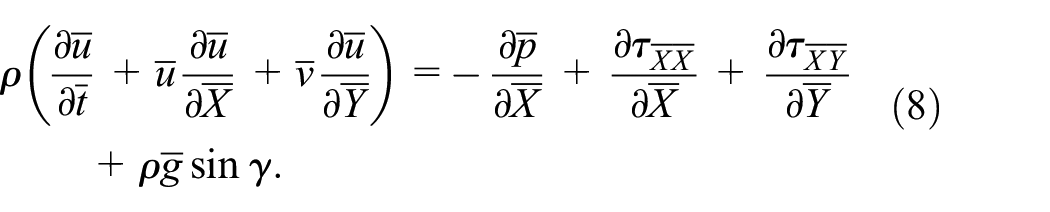

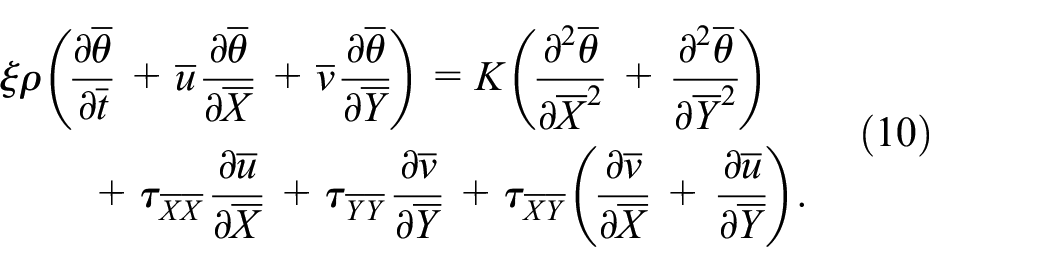
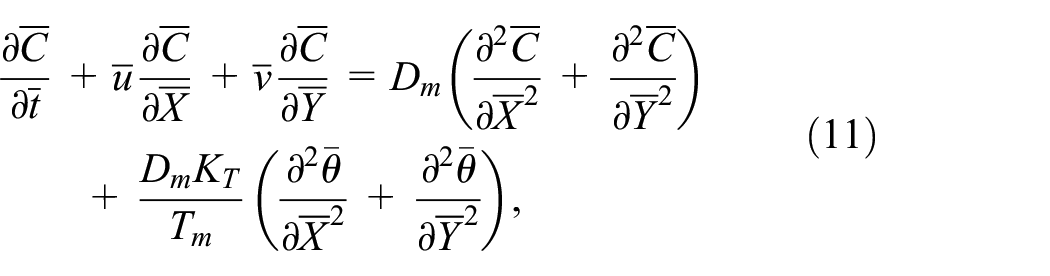
where,
The stress tensor for the given investigation is 1

Where ϕ represents the Pseudo-plasticity coefficient,

Now, we define dimensionless parameters for given flow problem:
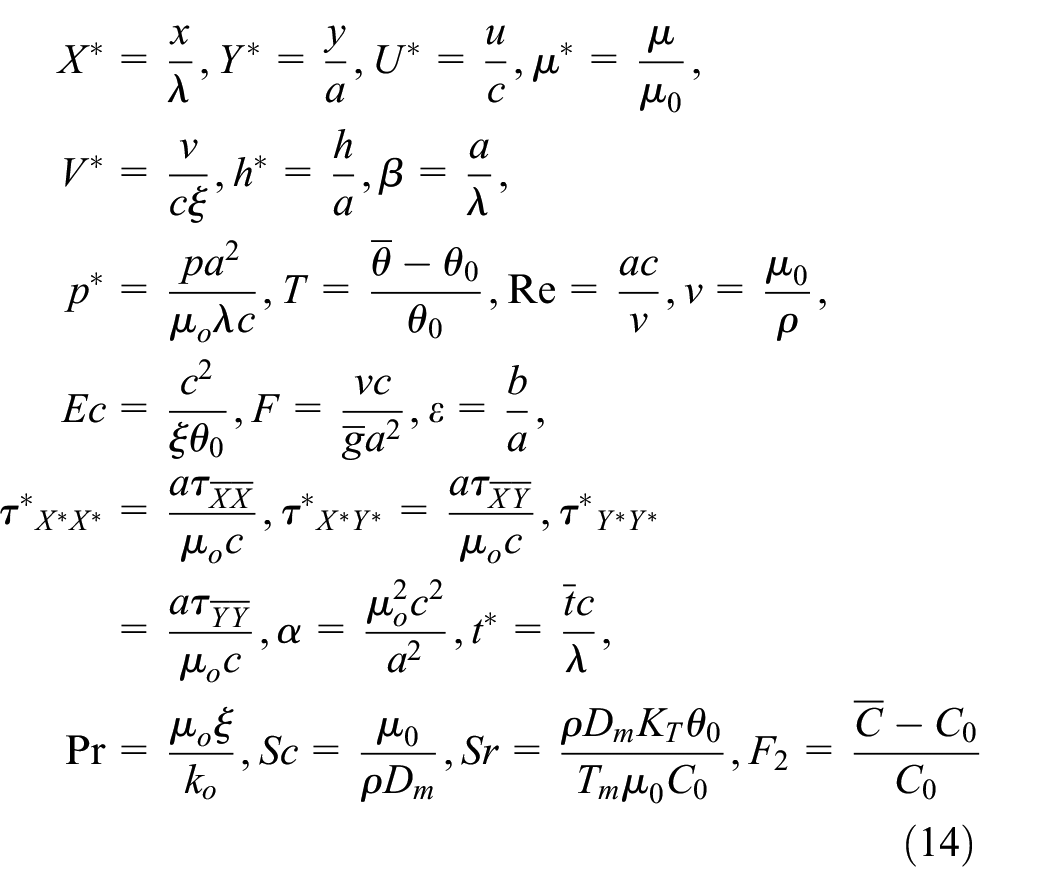
By using the assumption of long wavelength approximation with low Reynolds number; equations (8)–(12) after dropping the asterisks takes the following form



The related boundary conditions in non-dimensional form are



The fluid’s viscosity changes across the channel walls and is given by 1

where,
To consider the variable thermal conductivity, we use the following relation 1

where
Analytical solutions
Solution for velocity
The analytical solution for velocity is obtained by using equations (15)–(17) by taking into account the corresponding boundary conditions from equations (20) and (21). So, the solution takes the following form

Solution for heat transfer through the method of perturbation
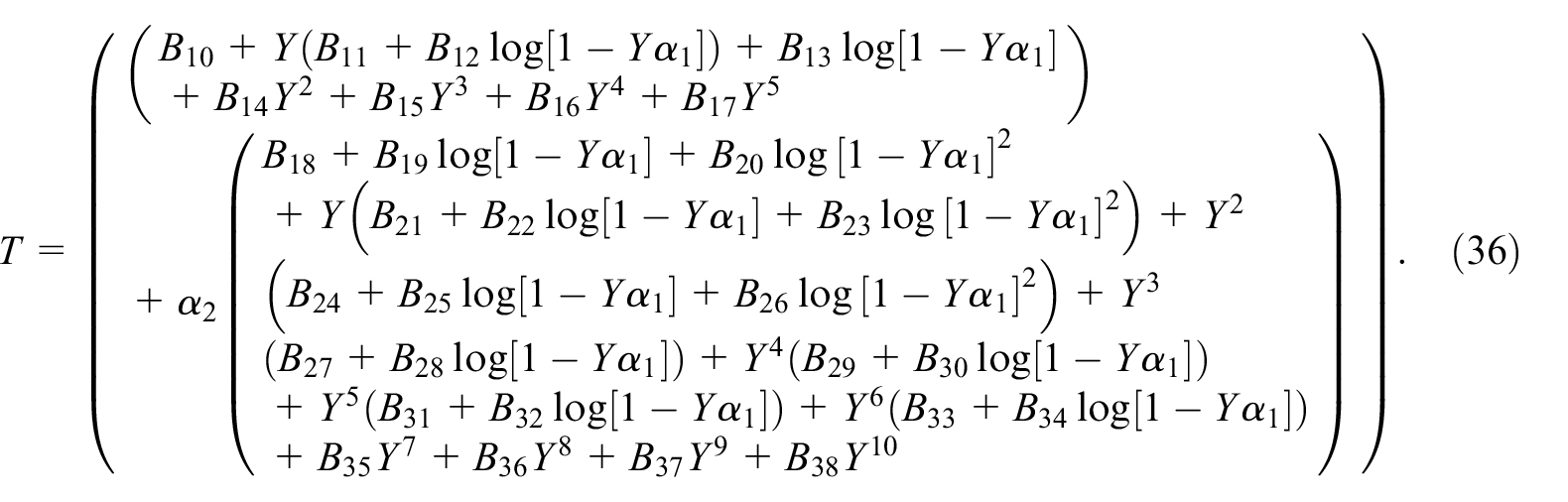
Due to non-linearity in the preceding equation (18), an exact solution is not attainable. To find an analytical expression of temperature, we apply the perturbation approach37–42 in this view. The solution for temperature via perturbed technique is obtained using the equation given below







The final form of the equation for temperature after obtaining the solution of the above zeroth and first-order equations is written as
Solution for concentration
By using the equation (19) and boundary conditions given in equations (24) and (25), the general solution for the equation of concentration is written as

Solution validation
To validate our results, the comparison part is added here. For this, we have compared our obtained solution with the previously published data. Figure 2 is constructed velocity and temperature profiles to show the comparison of our results and results presented by Vaidya et al. 43 for the limiting case. In Vaidya et al., 43 the authors discussed the peristaltic flow of the Rabinowitsch fluid model under the effects of variable properties in the titled channel while in our investigation we highlighted the impact of variable liquid properties of the Rabinowitsch fluid model in ciliated walls of the porous inclined channel with mass transfer. In Figure 2, the dotted lines indicate the results of Vaidya et al. 43 while the solid lines show the current results which observed the good agreement between both results.

Comparison between our solution (
Graphical results and discussion
This section is based on the graphical study of various physical parameters to examine the behavior of velocity, temperature, and concentration profiles. Graphical discussion is carried out in the presence of three types of a fluid namely Newtonian fluid
Velocity profiles
Figures 3 to 6, explain the influence on axial velocity profile for various emerging parameters that include variable viscosity

Velocity profile via variable viscosity parameter

Velocity profile via wave number

Velocity profile via Darcy number (Da).
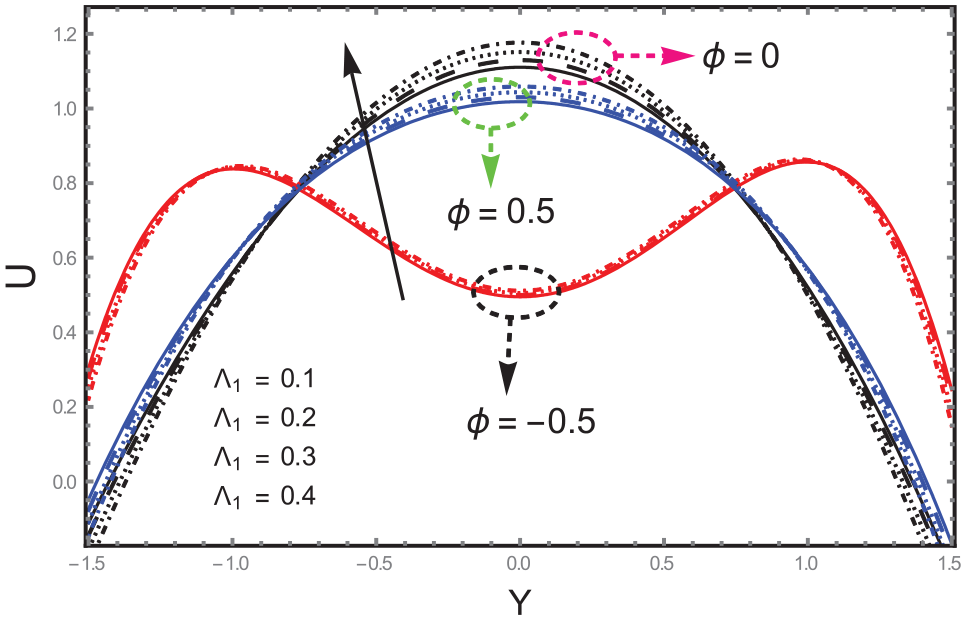
Velocity profile via slip parameter
Temperature profiles
Figures 7 and 8, explain the emerging effects of velocity slip parameter
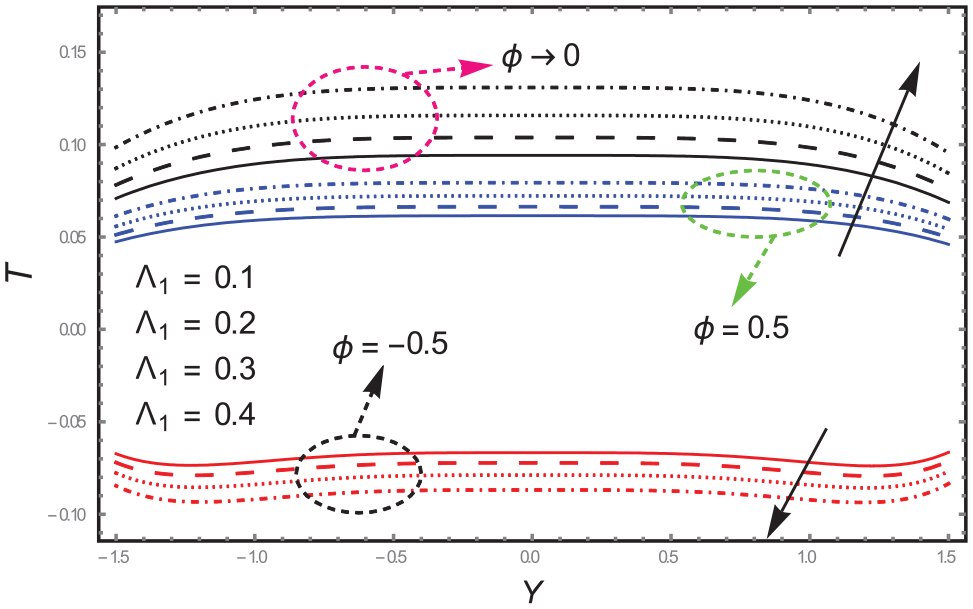
Temperature profile via slip parameter

Temperature profile via cilia length parameter
Concentration profiles
Figures 9 and 10 illustrate the behavior of Soret number (Sr) and Schmidt number (Sc) on profile for mass transfer. The value of concentration profile decreases for Newtonian, Pseudo-plastic fluid but it surges for Dilatant fluid by increasing the values of Sr and Sc as clearly illustrated in Figures 9 and 10 respectively. From all the figures illustrated above, an opposite behavior for all physical parameters is seen in comparison to the heat transfer profile. Its logical reason is that there is an inverse relationship between temperature and concentration so an opposing behavior is expected from the physical point of view. Furthermore, the mass transfer profile shows that particulate matter in the fluid is more concentrated along the channel’s edge than in the center. All these behaviors of sundry parameters are presented for the value of

Concentration profile via Soret number (Sr).

Concentration profile via Schmidt number (Sc).
Conclusions
This article is based on the comprehensive study of peristaltic flow by considering a non-Newtonian Rabinowitsch model in the presence of a channel having ciliated walls. The flow is induced by metachronal waves under the influence of heat and mass transfer. The analytical and graphical framework for velocity perturbed temperature, and concentration is done through numerical software Wolfram MATHEMATICA. The graphical solution is visualized for three different types of fluids that are Newtonian, Dilatant, and Pseudo-plastic fluids. The main key points of the current article can be summarized as:
The effect on velocity profile shows an increasing behavior for variable viscosity, velocity slip parameter, and wavenumber while it tends to decrease for Darcy number at the peak point of the channel.
A rise in temperature graph is observed for Newtonian and Pseudo-plastic fluids while it shows a decreasing behavior for Dilatant fluid by considering certain fluidic parameters.
There exists an inverse relationship between mass and heat transfer so both show a contrasting behavior.
The rising values of parameters are responsible for decreasing trends in the concentration profile in the case of Newtonian and shear-thinning fluids while Dilatant fluid shows an increasing trend.
The role of
Footnotes
Appendix
Handling Editor: Chenhui Liang
Declaration of conflicting interests
The author(s) declared no potential conflicts of interest with respect to the research, authorship, and/or publication of this article.
Funding
The author(s) disclosed receipt of the following financial support for the research, authorship, and/or publication of this article: The authors extend their appreciation to the Deanship of Scientific Research at King Khalid University for funding this work through the research groups program under Grant No. RGP.1/183/42.
