



Abstract
In this study, a new computing model by developing the strength of feed-forward neural networks with Levenberg-Marquardt Method (NN-BLMM) based backpropagation is used to find the solution of nonlinear system obtained from the governing equations of unsteady squeezing flow of Heat and Mass transfer behaviour between parallel plates. The governing partial differential equations (PDEs) for unsteady squeezing flow of Heat and Mass transfer of viscous fluid are converting into ordinary differential equations (ODEs) with the help of a similarity transformation. A dataset for the proposed NN-BLMM is generated for different scenarios of the proposed model by variation of various embedding parameters squeeze Sq, Prandtl number Pr, Eckert number Ec, Schmidt number Sc and chemical-reaction-parameter
Introduction
The unsteady squeezed flow between parallel plates is of great interest in hydromechanical machines. It has various applications in daily life, such as polymer handling, compression and injection models. The pioneering work was done by Stefan 1 to study squeezing flow under lubrication approximation. The steady Newtonian flow between two parallel plates was studied by Ran et al. 2 and Mustafa et al., 3 and an exact solution is obtained. Khan et al. 4 developed analytical solutions for the squeezing flow with entropy generation and velocity slip influence. Domain 5 found an effective analytical solution to the turbulent squeezing flow of nanoparticles using a Duan-Rach technique. Hayat et al. 6 studied the squeezed flow past a Riga plate. This experiment with doubly stratified fluid was studied by Ahmad et al. 7 Hayat et al. 8 and Ahmad et al. 9 considered the Darcy effect and thermal radiation effects on the squeezing flow. The heat and mass transfer study is of great interest due to its broad applications in science and engineering such as fluid dynamic devices, polymer manufacturing, lubrication method, chemical manufacturing machinery, fog forming and dissipation, crop loss due to melting, food preparation and refining. The heat transfer (H.T.) occurs in condensation and evaporation, such as the vapour is used for evaporation in a chemical plant. Mass transfer (M.T.) includes the evaporation in a pond, blood purification in the liver. The H.T. influence on squeezing flows was studied by Duwairi. 10 Mahmood et al. 11 studied the H.T. in the squeezing flow with a porous medium. Vafai studied magnetohydrodynamics (MHD) effect on the H.T. and M.T. of squeezed flow. 12 The effects of the suction/injection and stagnation point flow on H.T. and M.T. squeezing flow was presented by Tsai et al. and Muhamin et al.5,6 The H.T. and M.T. behaviour is studied at different nanofluid flow with certain conditions.13–23
Several numerical methods have displayed a great perspective to solve the differential equations (D.E.s), such as collocation method (CM), 24 Optimal Homotopy Asymptotic Method (OHAM),25,26 Multistage Optimal Homotopy Asymptotic Method (MOHAM), 27 Adomian Decomposition Method (ADM), 28 Homotopy Analysis Method (HAM),29,30 Homotopy Perturbation Method (HPM), 31 Variational Iteration Method (VIM). 32 These methods solved the D.E.s with some limitations and advantages when compared to some other methods. However, the Artificial Intelligence (A.I.) based numerical solver using soft computing looks promising for further research for D.E.s. The AI-based numerical techniques have been used for the solutions of D.E.s such as Van-der-Pol oscillatory nonlinear systems, nonlinear optics model, electrically conducting solids, nonlinear transport design, combustion-theory, mathematical Design of Carbon-nanotubes, astrophysics, circuit-theory, atomic-physics, lively heartbeat Design, HIV design, energy, wind-power and financial Design.33–50 According to the literature survey, no research has applied A.I. techniques through NN-BLMM to solve the unsteady squeezed flow with heat and mass transfer. So the purpose of this study to use the NN-BLMS in the heat and mass transfer of the squeezing flow, which is considered an essential item for industrial and engineering applications.
The critical aspect of the proposed computing paradigm is given as
Ø A new application based on Artificial Intelligence-based computing using neural network backpropagated with Levenberg-Marquard is implemented to study the MHD boundary layer flow with a stretching sheet.
Ø The dataset for the NN-BLMS is generated for variations of Deborah and Magnetic parameters through the OHAM.
Ø The governing equations are transformed from a set of PDEs into ODE by using a similarity transformation.
Ø The processing of NN-BLMS means training, testing and validation in the boundary layer flow model for different scenarios to obtain the approximate solution and comparison with reference results.
Ø The convergence analysis based on the mean square, error histogram and regression plots are employed to ensure the performance of NN-BLMS for the detailed analysis of the boundary layer flow model.
The Mathematical modelling of the unsteady squeezing flow of Heat and Mass transfer behaviour between parallel plates model has been presented in Section II. The method for analysing unsteady squeezing flow of Heat and Mass transfer behaviour between parallel plates has been discussed in section III. The numerical and graphical results with discussion and comparison for the unsteady squeezing flow of Heat and Mass transfer behaviour between parallel plates through proposed technique NN-BLMM with numerical reference results are given in section IV. Finally, concluding remarks for the study on the proposed methodology for unsteady squeezing flow of Heat and Mass transfer behaviour between parallel plates is presented in section V.
Mathematical modelling of the flow problem
Consider the unsteady two-dimensional squeezing flow of an incompressible viscous flow between the infinite parallel plates with heat and mass transfer. The plates are placed at a distance
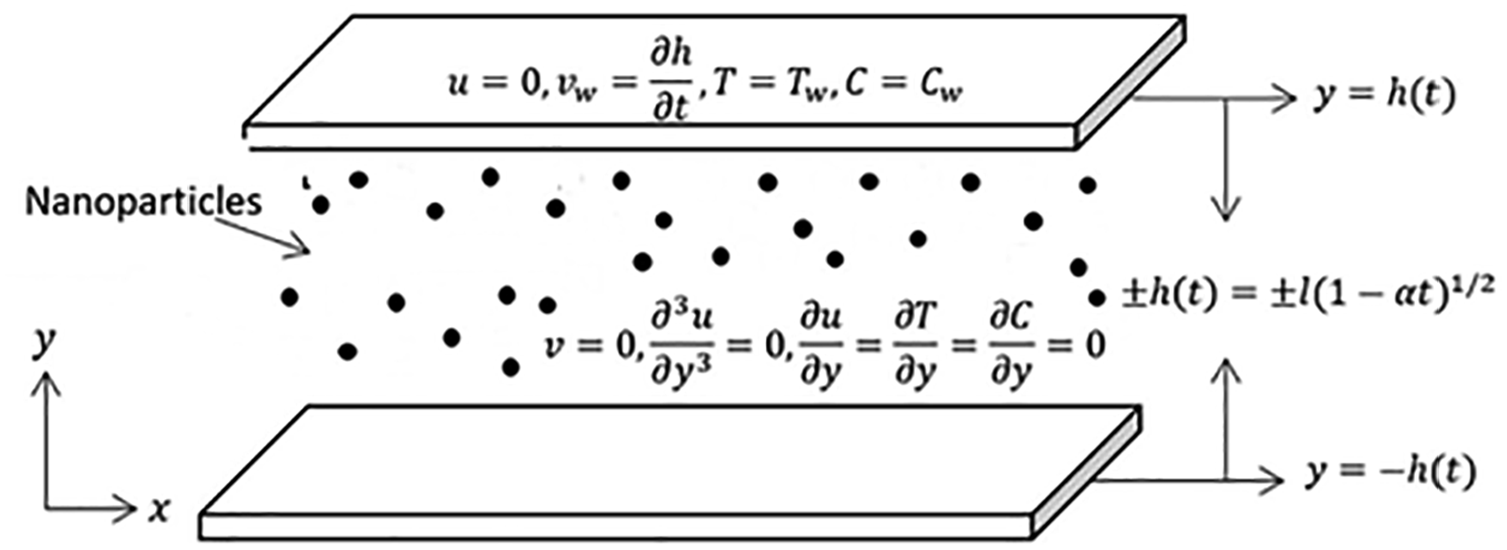
The geometry of flow problem.
The fundamental governing equations for mass, momentum, energy and heat transfer for the problem under consideration are given as3,7



In equations (1)–(5)
The boundary conditions imposed are 3

Using the transformation as given in equation (6)3,7
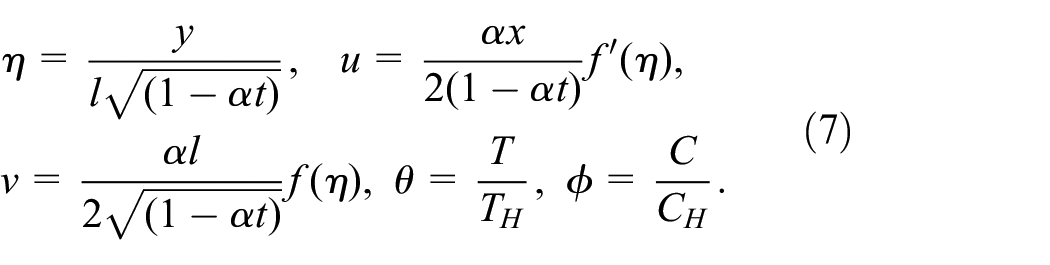
Using equation (6) into equations (1)–(6), we obtained the following system of equations


and
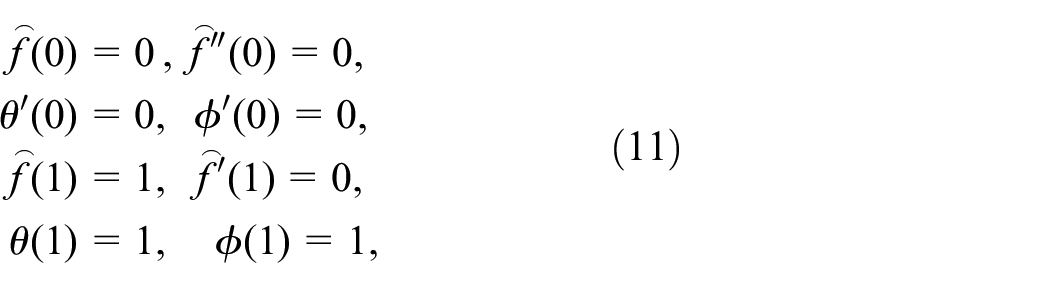
Prandtl Pr, squeeze S, Eckert Ec and Schmidt number Sc and γ is the chemical reaction parameter. The above systems of ODEs are solved by the OHAM and neural network of the Levenberg Marquardt Approach, shown in section III.
Solution procedure
The proposed soft computing infrastructure based on NN-BLMS provided in the two neural representations, as shown in Figure 2. The proposed model depends on the framework of the fitting tool ‘nftool’ which is available in the neural networks toolbox in Matlab. The numerical attempt based on NN-BLMM is presented for unsteady squeezing flow of Heat and Mass transfer behaviour between parallel plates given in equations (8)–(11). The proposed NN-BLMM is performed for four scenarios by variation of parameters S, Pr, Ec, γ, Sc with different cases for each scenario, as shown in Table 1. A summary of the proposed NN-BLMM workflow is presented in Figure 4. The supervised neural network in the NN-BLMM is used to obtain the output to get a more accurate calculation repeatedly. The interval’s step size is considered 1/100 between the interval [0, 1] created by using the OHAM25,26 for the solution of ODEs in Mathematica. We select 80% of data used for T.R. while the 10%, 10%, are used for V.L. and T.S. Training information is used to determine the estimated answer based on the mean square error MSE. Validation data is used to design N.N., and test data measures the efficacy of impartial given. The structure of the proposed NN-BLMM consists of hidden, and output layer is given in Figure 3.

A structure of a single neural model.
Parameters with three variations for unsteady squeezing flow of heat and mass transfer behaviour between parallel plates.

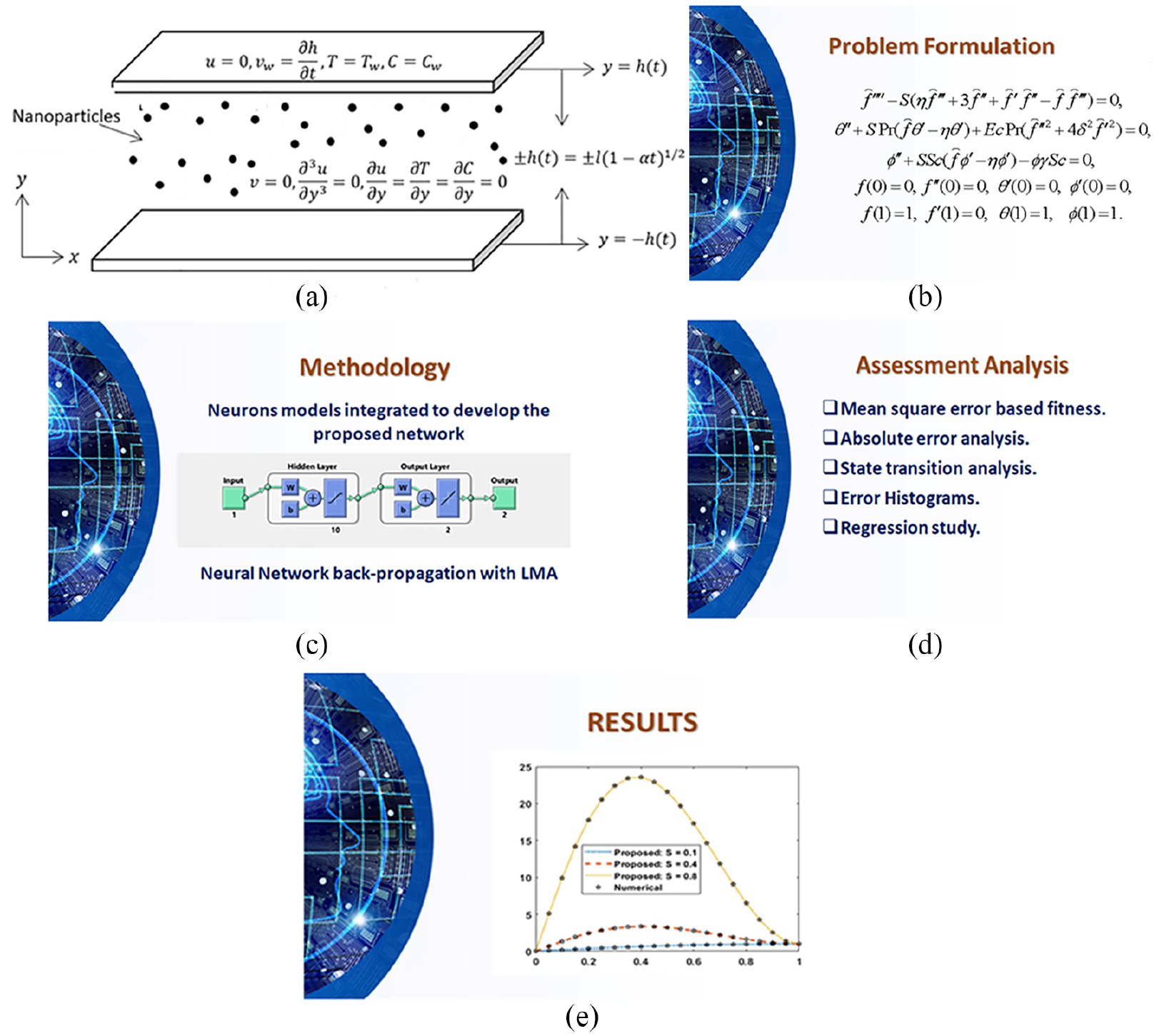
(a–e) Phase configuration of the planned NN-BLMM for unsteady squeezing flow of heat and mass transfer behaviour between parallel plates.
Analysis of the results
Solving unsteady squeezing flow of Heat and Mass transfer behaviour between parallel plates model using similarity transformation and required OHAM solves ODEs to get numbering data for

(a–e) Performance outcomes of NN-BLMM for Case (1–3) of parameters (1–5) Unsteady squeezing flow of Heat and Mass transfer behavior between parallel plates.
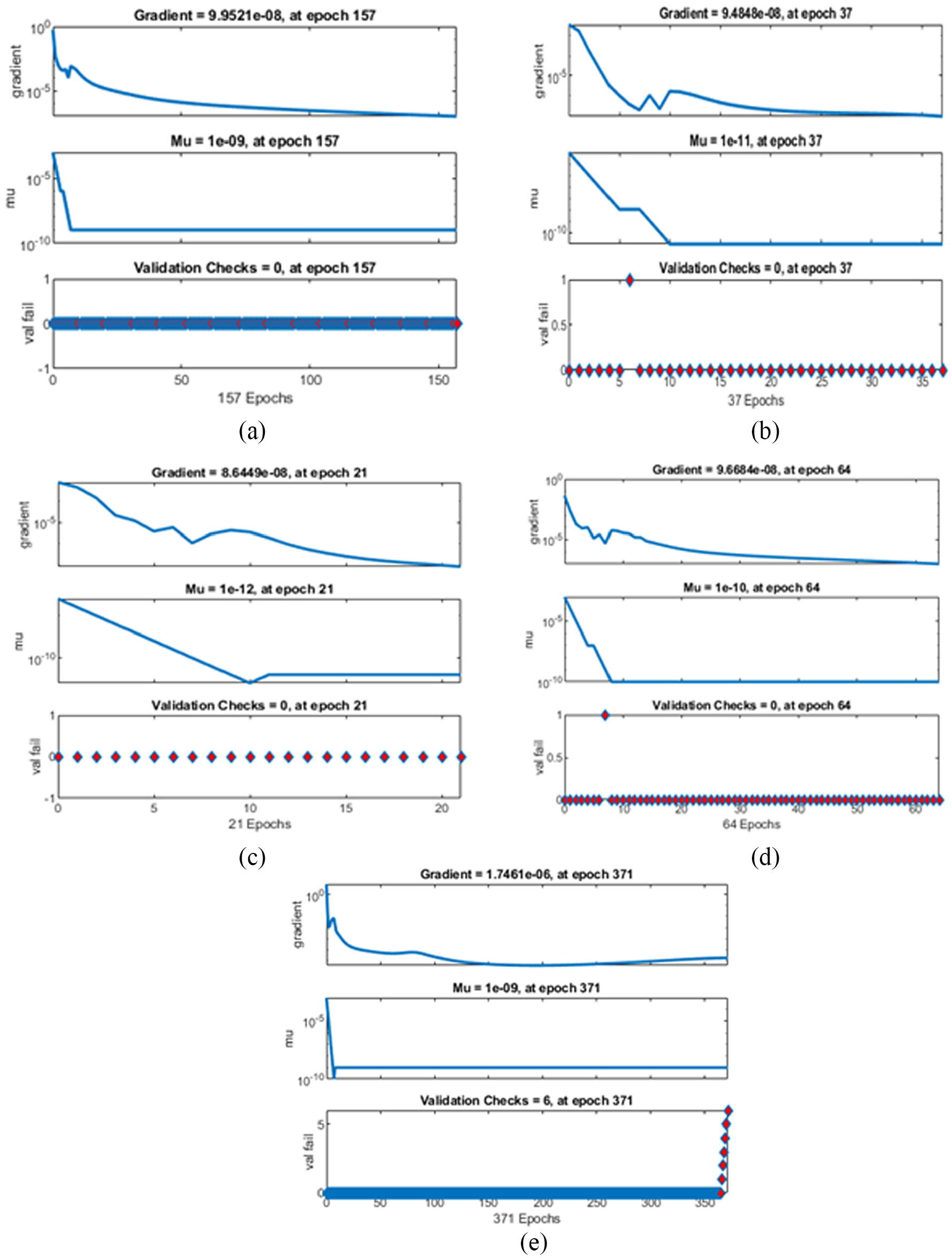
(a–e) State transition outcomes of NN-BLMM of parameters (1–5) of unsteady squeezing flow of Heat and Mass transfer behavior between parallel plates.
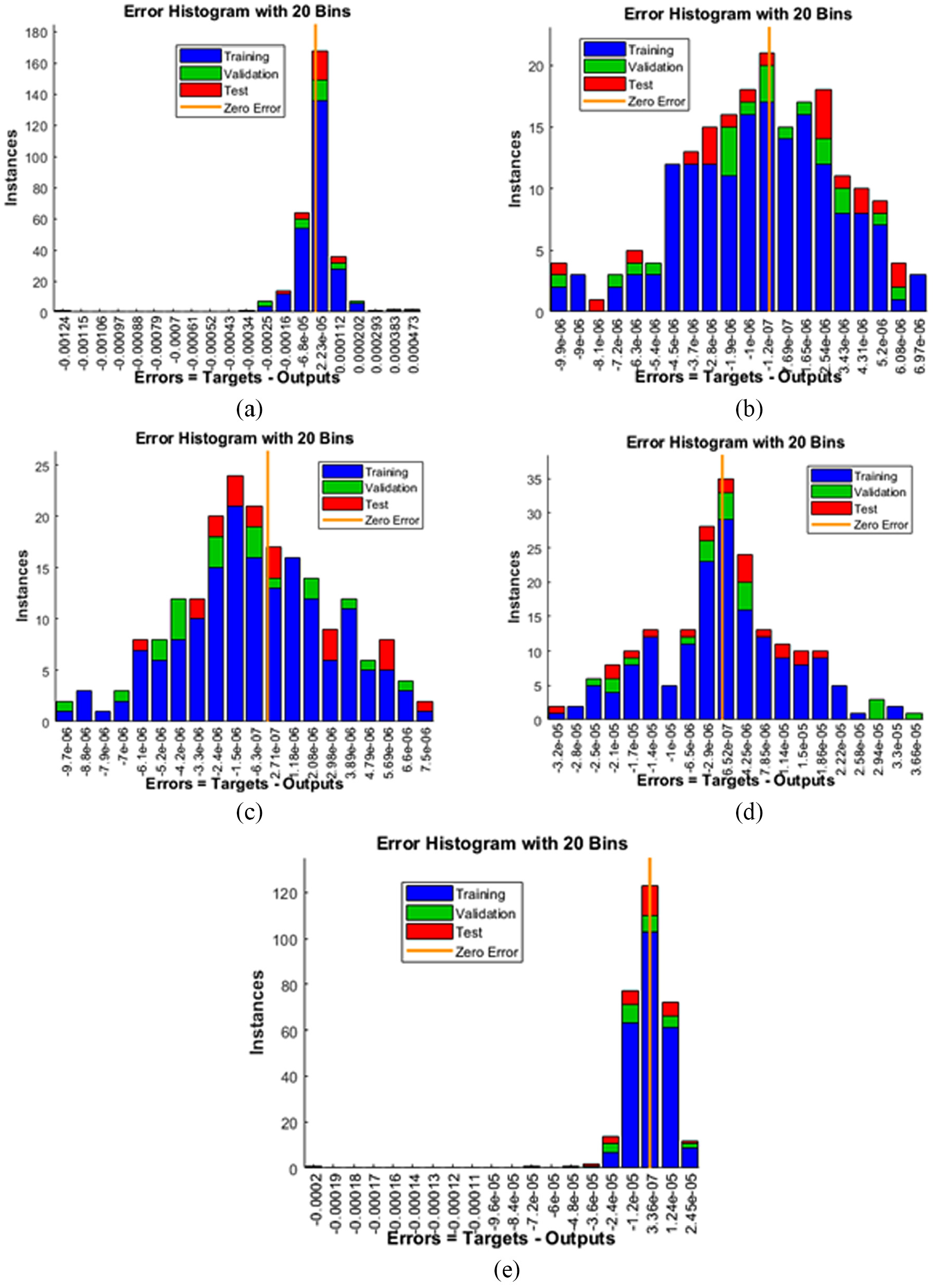
(a–e) Error histogram of NN-BLMM for parameters (1–5) of unsteady squeezing flow of Heat and Mass transfer behavior between parallel plates.

Assessment of NN-BLMM outcomes with reference solution of parameters (1–5) unsteady squeezing flow of Heat and Mass transfer behavior between parallel plates.

(a)–(e) Regression plots of NN-BLMM outcomes of parameters (1–5) unsteady squeezing flow of Heat and Mass transfer behaviour between parallel plates.

(a–h) Numerical outcomes of squeeze number S and its error graph in

Numerical outcomes of Prandtl number Pr and its error graph in

Numerical outcomes of Eckert number Ec and its error graph in of

Numerical outcomes of chemical reaction parameter

Numerical outcomes of Schmidt number Sc and its error graph in
Results of NN-BLMM for all scenarios of unsteady squeezing flow of heat and mass transfer behaviour between parallel plates.

Comparison of results of OHAM and NN-BLMM along with absolute errors.

Conclusions
Using Levenberg-Marquard Method with backpropagation neural networks, an advanced artificial intelligence based intelligent computing platform is provided to find a mathematical model solution describing chemical reactions and activation energy dynamics on the unsteady squeezing heat and mass transfer between two parallel plates. The equations obtained from the mathematical formulation of the flow problem are solved by OHAM progress the NN-BLMM combinations of various physical parameter. For NN-BLMM, 80%, 10% of the orientation data were used as practice, testing and validation. The near consistency between the application layer and the step 10-07 to 10-05 reference results verifies the system’s accuracy. This factor has been further confirmed by a graphical and numerical analysis of convergence graphs of MSE error-histograms and regression dynamics.
Ø On increasing S, the velocity distribution increases while the temperature and concentration profiles decrease.
Ø On increasing Pr and Ec, thermal boundary-layer thickness and contraction profile are observed to reduce.
Ø The effects Pr on
Ø The effects of Sc on concentration gives significant enhancement in Sc is found to lead to the poorer diffusivity of molecules and the thinner boundary layer thickness.
Ø NN-BLMM is simple in applicability.
Ø NN-BLMM has better P.F. as compared to other numerical methods.
Ø NN-BLMM minimizes the absolute error.
Ø The correctness of NN-BLMM is authenticated by MSC, E.H., R.G., A.E., F.T., P.F., T.S., T.R.
Ø NN-BLMM uses 80%, 10% and 10% of the reference data as a T.R., T.S. and V.L.
New areas of interconnected AI-based intelligent systems will be conducted to solve the issues of fluid mechanics successfully.
Footnotes
Handling Editor: James Baldwin
Declaration of conflicting interests
The author(s) declared no potential conflicts of interest with respect to the research, authorship, and/or publication of this article.
Funding
The author(s) received no financial support for the research, authorship, and/or publication of this article.
