



Abstract
Attenuation of vibration transmitted from a single-axle tractor to a human hand results in a better operating environment, enhanced production performance, and decreased user pain. The purpose of this work was to attenuate the hand-transmitted vibration of a single axle tractor using a vibration damper made from a rubber compound. After the damper was installed, the vibration measurements were done for the second and third gears and compared to the undamped vibration. When the vibration measured with the second gear after the rubber dampers were mounted was compared to the vibration measured before application of damping, the upright, forward, and lateral directions of vibration showed 42%, 39%, and 46% reductions, respectively. In the third gear, the decrement was 46%, 29%, and 50% in the upright, forward, and lateral directions, respectively. The latency periods after application of the vibration damping show an increment of 2.55–4.76 years with second gear, and from 2.2 to 4.17 years with third gear. This reflects an increase of 89% and 90% with second and third gears respectively.
Introduction
Power tools can transmit vibration to the hands and arms, and this has several effects on the body, including possible damage to the nerves and blood vessels. The hand-arm vibration syndrome can be caused by long-term vibration exposure. Vibration White Fingers (VWF), neurosensory symptoms and affliction in the hands such as numbness, tingling, decreased grip strength, and decreased manual dexterity, are the most common symptoms. 1 Operation of vibratory tools can lead to excessive gripping force2,3; this causes the muscles to tighten, resulting in increased vibration transmitted to the hands and arms, and thereby increasing the likelihood of injury. 4 The vibration total value (ahv) was derived using measured and frequency-weighted RMS acceleration values in the x-, y-, and z-axes, labeled as ahwx, ahwy, and ahwz, respectively, using equation (1).5,6

To facilitate comparisons between daily exposures of different durations, the daily vibration exposures are expressed in terms of an 8-h energy-equivalent frequency-weighted vibration total value, ahv, as shown in equation (2). For convenience ahv, is given the short-hand notation of A(8)5,6:

Where T = complete regular length of the vibration sensitivity, called “period of triggering,”
T 0 = the reference time is 8 h.
The ISO 5349 standard 5 contains a method to estimate the vibration exposure that can lead to finger blanching in trial groups using tools. The equation used for the estimation of the figure blanching produced in 10% of persons exposed to vibration is 5 :

Where Dy = latency period in years,
A(8) = 8-h energy-equivalent frequency-weighted vibration total value, m/s2.
International occupational exposure limits require an average tool acceleration of fewer than 5 m/s2 over an 8-h shift, with an action value of 2.5 m/s2 (the level at which additional precautions and surveillance should be taken). 7 Lowering the levels of hand-arm transmitted vibration will result in reduced noise, an improved work environment, higher production efficiency, reduction in an operator’s discomfort, and extension of the useful life of single-axle tractors. 8
Anti-vibration gloves are often used to reduce sensitivity to hand-transmitted sensations caused by hand-held tools. However, anti-vibration gloves do not significantly reduce vibration transmission at frequencies below 25 Hz at the palm and below 160 Hz at the fingers.9–11 A traditional anti-vibration glove can even induce minor vibration amplification at low frequencies.9–11
Recent advances in polymeric materials have greatly enhanced their application for damping treatment. Damping is a method to dissipate a viscous, viscoelastic, or structural mechanism of the energy of a vibrating structure. By transforming the vibration energy of external excitation into other types of energy, dampers reduce the vibration magnitude.
The conversion of mechanical energy of viscoelastic materials into heat when deformed is enabled by their long chain molecules; they are usually polymers that can be shaped into a wide variety of different forms that yield different material properties based on the frequency of action and temperature of the ambient environment.12–14
Transmission of vibration energy from one body to another can be reduced by vibration isolation mounts that provide a resilient connection between the parts. Vibration reduction can be increased by adding damping materials that convert a portion of resonant vibration amplitude into low-grade heat.15–17
Materials that show both viscous and elastic behaviour are called viscoelastic materials. Pure elasticity would mean a perfect transfer of energy for which all the energy contained in the material during loading is recovered when the load is removed. These elastic materials have an in-phase stress-stress relationship.
On the other hand, the pure viscous material does not recover all the energy accumulated during loading until the load has been removed. 18 Viscoelastic material dissipates energy as heat. The phase difference between stress and strain is an indicator of the value of material attenuation; this phase difference cannot exceed 90°. The larger the phase angle, the more effective a material is at damping out vibration. 19
Viscoelastic materials can also be used for vibration reduction in the handle grip of walking tractors. Ragni et al. 20 applied rubber sleeves to the handles of an Italian-produced single-axle tractor and found that the handle vibration was decreased by 35%. Tewari and Dewangan, 21 used isolators made of elastomeric material to reduce hand-transmitted vibration in a walking tractor. Yap et al. 22 evaluated the reduction of vibration using a combination of handle grips and engine mount rubber, and this showed a 59.29% vibration reduction in hand tractors. Lu et al. 27 designed and developed a rubber insulation device based on vibration transmissibility analysis, a vibration-absorption mechanism, and a critical vibration management path to minimize the vibration of the power tiller handle.
Natural Rubber (NR) is now used in a wide range of applications, such as friction insulators, owing to its good mechanical properties of tensile strength, tear strength, and wear resistance. Owing to their high loss factor (tan-δ) rubber materials are commonly used to track machine noise and vibration; hence, current research focuses on rubber loss factors to improve its damping properties. 24 Installations of rubber isolators are effective vibration control mechanisms due to rubber’s resistance to oxidation and weather, and good thermal stability. 25 The objective of this work was to attenuate the handle vibration of a single axle tractor using a rubber compound.
Materials and methods
Vibration damper installation
Vibration dampers for the isolation of engine vibration from the handle of the tractor were manufactured from a rubber compound with a diameter of 80 mm, a thickness of 25 mm, and an inner diameter of 13 mm. Four vibration dampers were mounted on a tractor at the Melkasa Agricultural Research Center laboratory. The upper and lower parts of the damper were supported by sheet metal with a thickness of 2 mm and a diameter of 80 mm (Figure 1).

Rubber compound vibration damper.
The handle of a single axle tractor is connected to the tractor frame, and engine vibration is transferred directly to the handle through the frame. Since the handle is free at one end, engine vibration is transmitted to the handle tip. To decrease vibration transmission to the operator, damper installation was between the engine and the frame (Figure 2).

Rubber compound vibration damper installation.
Humidity and temperature measurement
Temperature and humidity were measured during the study using a Nicety(R) Large Digital Temperature Humidity Meter – Hygrometer and Thermometer TH-812 with the following measurement range specifications: 5%–99% relative humidity and Temperature range of −10°C–60°C (Figure 3).
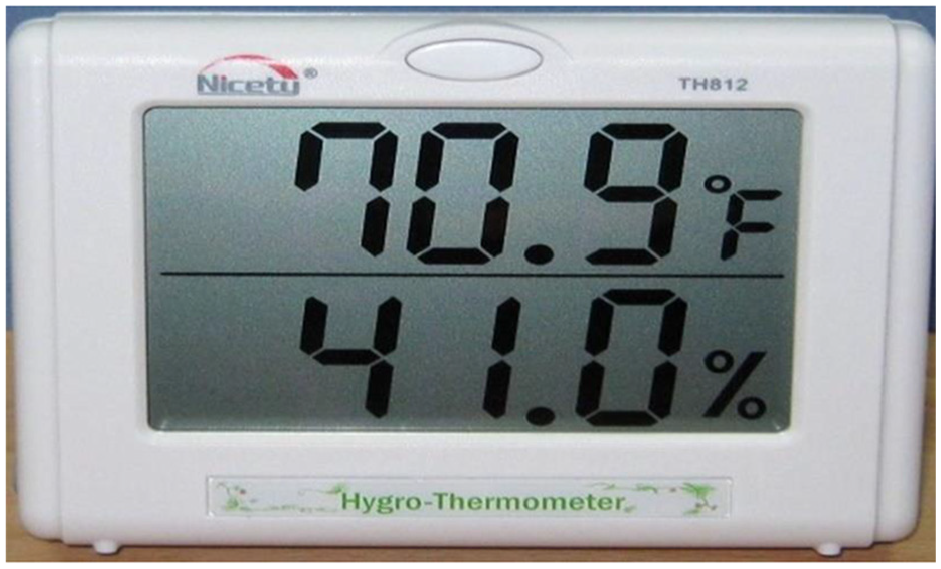
Large digital temperature humidity meter – hygrometer and thermometer (© 2010 Carsten Franke).
The full range of humidity and temperature values were measured before and after the experiment. The humidity level was found to lie between 38% and 71%, and the air temperature ranged between 27°C and 35°C.
Personnel
The mean and standard deviation of anthropometric results for age, height, weight, and body mass index (BMI) of the seven single axle tractor operators in this study were 25.57 ± 3 years, 1.70 ± 0.08 m, 55.29 ± 4 kg, and 19.15 ± 1 kg/m2, respectively.
Handle vibration measurement
The single axle tractor was driven in second and third gears while the handle vibration was measured using a vibration meter model VM-6380 vibration meter Tester (M&A Instruments, Arcadia, CA) fitted with a 3-axis piezoelectric accelerometer vibration sensor that measured vibration in three directions (Figure 4).
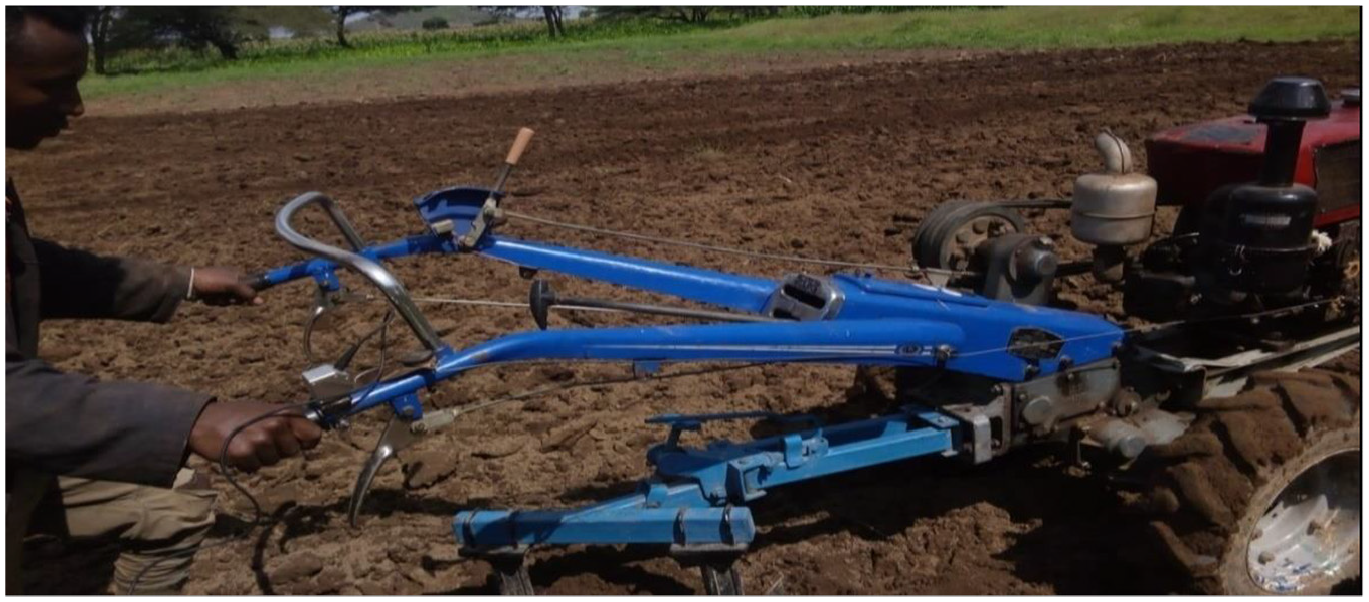
Vibration measurement of single axle tractor during field work.
The vibration measurements were conducted for approximately 15–20 min for each operator. This operation was repeated four times for each operator during the working day of the tractor, both before and after vibration damper installation. Vibration magnitude was recorded at the tractor handle along the x (vertical), y (forward), and z (transverse) axes. The y- and z-directions were modified from those defined in ISO 5349 5 because the handle on this particular tractor model was rotated by 90° compared to that used in ISO 5349. 5
The measured and calculated damped vibrations were compared to the undamped vibration with identical ground conditions, tractor forward rpm, soil moisture quality, for the same tractor operators. Data were collected for both second and third gear operations. The measured details of the vibration total value, the regular exposure, and the latency time of the damped vibration were also analyzed and compared with the pre-damper data used.
Statistical tests
To establish the significance of the effects of gear ratios, a general linear model for analysis of variance (ANOVA) was utilized. ANOVA analysis was also done to evaluate the significance of the covariates on the dependent variables using MATLAB 2019a, and differences were judged significant at the p < 0.05 level.
Results
Vibration evaluation of tractor – second gear
The average measured handle vibration with a second gear operation of seven operators before and after vibration damper installation is summarized in Table 1. The mean measured acceleration at the handle of a single axle tractor before vibration damping installation was 18 ± 7 m/s2, 11 ± 5 m/s2, and 17 ± 9 m/s2 respectively in vertical, forward, and lateral directions. After installation of the vibration damper, measured values were reduced to 10±4 m/s2, 7±4 m/s2, and 9±3 m/s2 respectively in vertical, forward, and lateral directions.
Handle vibration with the second gear.

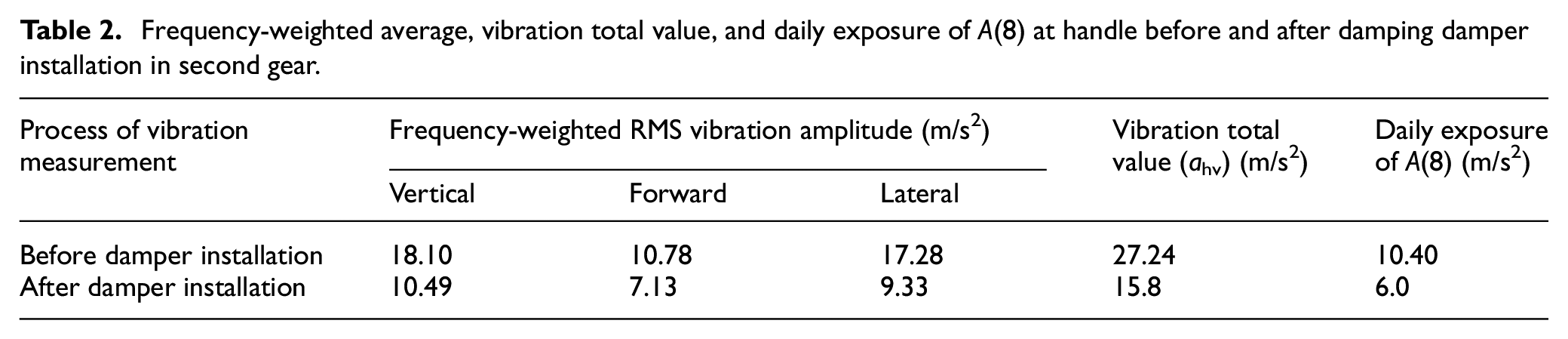
The vibration total value ahv using equation (1) and vibration daily exposure A(8) in m/s2 (calculated using equation (2)) at the handlebar of the single axle tractor with second gear is shown in Table 2. The mean calculated vibration total values of second gear before and after damper installation were 27 and 16 m/s2 respectively. The mean calculated vibration daily exposure A(8) levels corresponding to second gear before and after damper installation were 10 and 6 m/s2 respectively.
Frequency-weighted average, vibration total value, and daily exposure of A(8) at handle before and after damping damper installation in second gear.
ANOVA was utilized to compare the exposure of A(8) of a single axle tractor with second gear operations before and after vibration dampening for statistical significance. The results show a very significant difference between the vibration exposure of A(8) before and after damping with second gear operations, with a very small p-value (p < 0.05) (Table 3).
ANOVA Table of the daily exposure of A(8) of second gear operations before and after damping.

Vibration evaluation of tractor – third gear
The average measured handle vibration with third gear operation of seven operators before and after vibration damper installation is summarized in Table 4. The mean measured acceleration at the handlebar of the single-axle tractor before installation of vibration damping with third gear operation was 23 ± 3 m/s2, 11 ± 2 m/s2, and 21 ± 2 m/s2 respectively in vertical, forward, and lateral directions. After installation of the vibration damper, measured values were reduced to 12 ± 1 m/s2, 8 ± 1 m/s2, and 10 ± 1 m/s2 respectively in the vertical, forward, and lateral directions.
Third gear vibration before and after damper installation.

As shown in Table 5, the mean calculated vibration total values ahv for third gear before and after damper installation were 33 and 18 m/s2 respectively, whereas vibration daily exposures A(8) were 13 and 7 m/s2 respectively.
Frequency-weighted average, vibration total, and daily exposure of A(8) at the handle with third gear before and after damper installation.

The exposure of A(8) of a single axle tractor with third gear operations before and after vibration dampening was assessed for statistical significance using ANOVA. There is a significant difference between second and third gear operations, as indicated by the data, with a relatively small p-value (p < 0.05) (Table 6).
ANOVA Table of the daily exposure of A(8) of third gear operations before and after damping.

Before damping, the exposure of A(8) for a single-axle tractor operator with second and third gear operations was tested for statistical significance using ANOVA. As shown in the results, there is a significant difference between the second and third gear operations, with the p-value very small (p < 0.05) (Table 7).
ANOVA Table of the daily exposure of A(8) of second and third gear operations before vibration damping.

According to the findings, working in third gear has a bigger impact on the health of single axle tractor operators than working in second gear.
Discussion
Evaluation of tractor vibration with second and third gears
The vibration at the handlebar of a single axle tractor for second gear operation was compared before and after vibration insulator installation (Figure 5), under similar operating conditions.

Handle vibration of tractor before and after damper installation.
The mean vibration intensity of the handle on all three axes before and after the vibration damper installation is substantially different (p < 0.05), as seen in Figure 5. The vertical, forward, and lateral axes, respectively, show 42%, 34%, and 46% declines. The lateral direction shows the most reduction in vibration, while the forward direction shows the least.
After the damper was installed, the vibration average value and frequency sensitivity A(8) data were compared to the vibration data before the damper was installed (Figure 6).

Vibration total value and daily exposure before and after damping with the second gear.
As seen in Figure 6, a 42% reduction was observed in both vibration total value and A(8) daily exposure with second gear operation of the tractor, due to installation of a damper system. These results are comparable to those of Chaturvedi et al., 26 who developed three intervention methods for vibration reduction in transport and tilling with a cultivator. In the tilling mode with a cultivator, they observed reductions in total vibration of 30.6%, 23.5%, and 20.9% for their three intervention methods.
The handlebar vibration of a single axle tractor for third gear operation was compared before and after vibration insulator installation (Figure 7), under similar operating conditions.
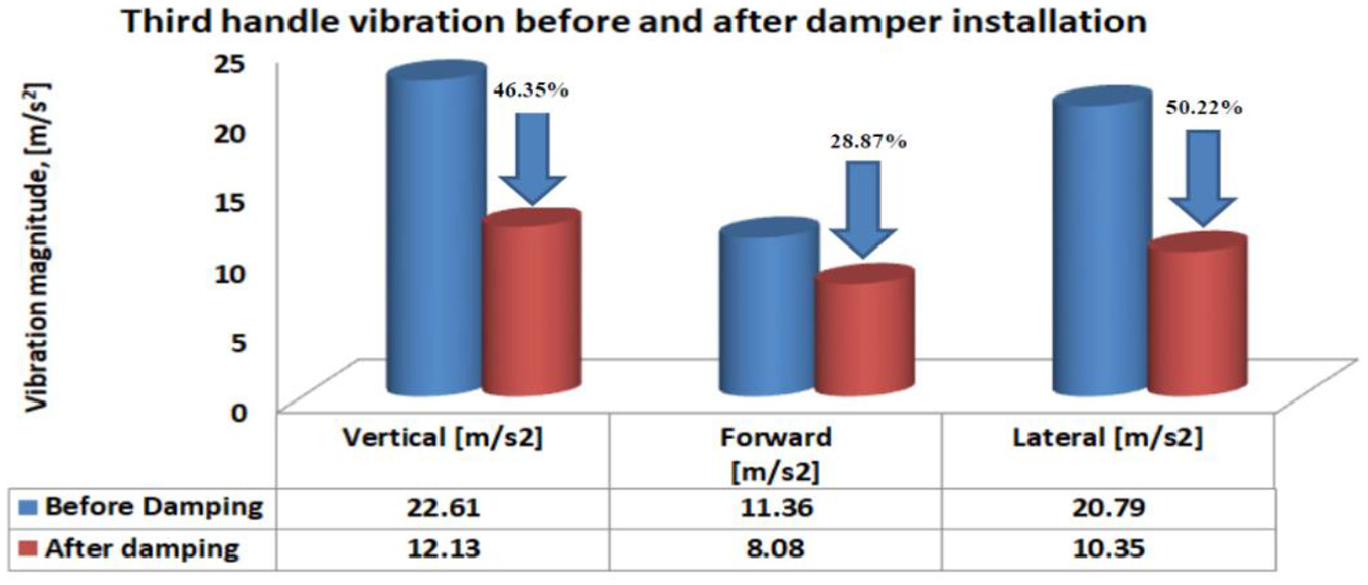
Handle vibration of tractor before and after damper installation.
There is a major change in the mean vibration amplitude of the handle on all three axes before and after the vibration damper installation, as seen in Figure 7. In the vertical, forward, and lateral directions, declines of 46%, 29%, and 50%, respectively, were observed. Vibration is decreased more in the lateral direction and least in the forward direction.
The vibration overall value and daily exposure A(8) data were 45% and 46% lower, respectively, after the damper installation than before the damper installation (Figure 8).
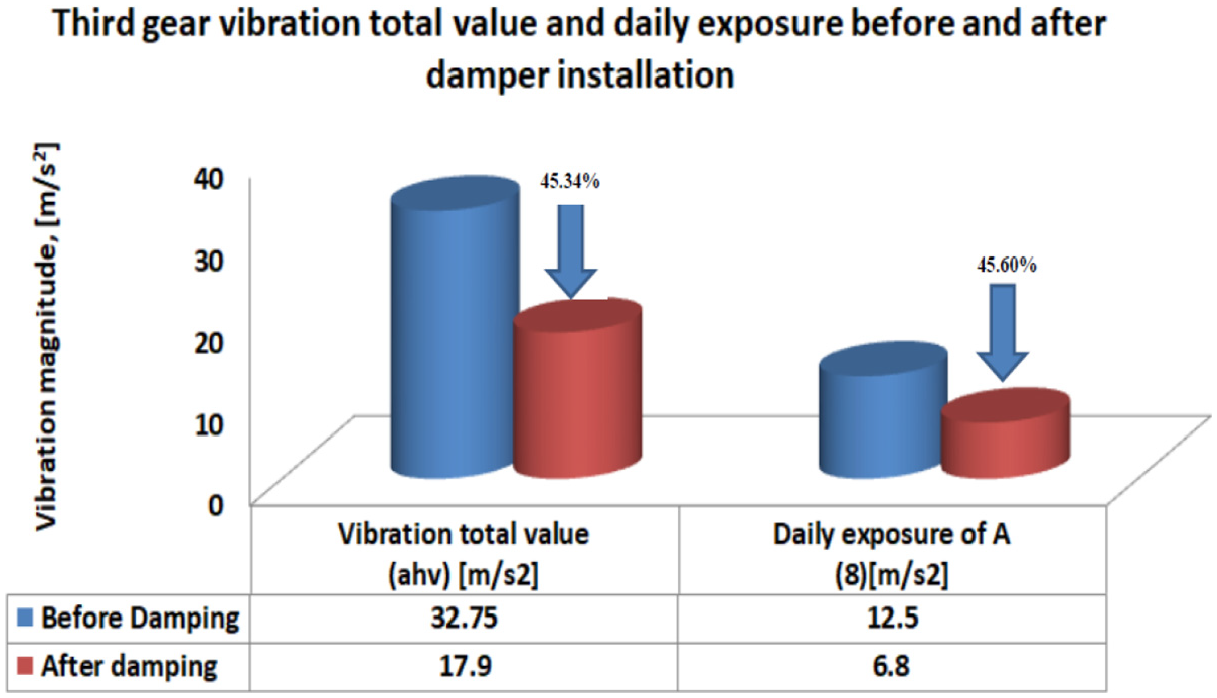
Vibration total value and daily exposure of single axle tractor before and after damping with third gear.
These findings can be compared to those of Chaturvedi et al. 26 who studied several intervention methods to minimize vibration transmitted to power tiller operators. 27 Vibration reductions of up to 70% were accomplished using “sheet and bush style” dampers mounted between the frame and the handlebar. Yap et al. 22 measured the reduction in vibration using a combination of handle grips and rubber engine mounts. They achieved vibration reductions of 55% and 59% for gasoline and diesel engines, respectively. Lu et al. 23 engineered and prototyped rubber vibration isolation systems to decrease the vibration of the power tiller handle, and observed that the amplitude of the acceleration on the handle decreased by 40%.
Evaluation of vibration exposure of tractor operators with second and third gears
From the “vibration total value” data of Table 2 corresponding to second gear operation before and after damper installation, the vibration exposure was determined according to the Control of Vibration at Work Regulations that are based on the 2002 EU Physical Agents (Vibration) Directive. 28 Equations (2) and (3) were used to measure the overall vibration value and daily exposure of A(8) in m/s2 (3). Using the Hand-Arm Vibration Exposure Calculator developed by the Health and Safety Executive, 29 the vibration daily exposure of A(8) was determined from the cumulative value of vibration and the period of exposure (Figure 9).
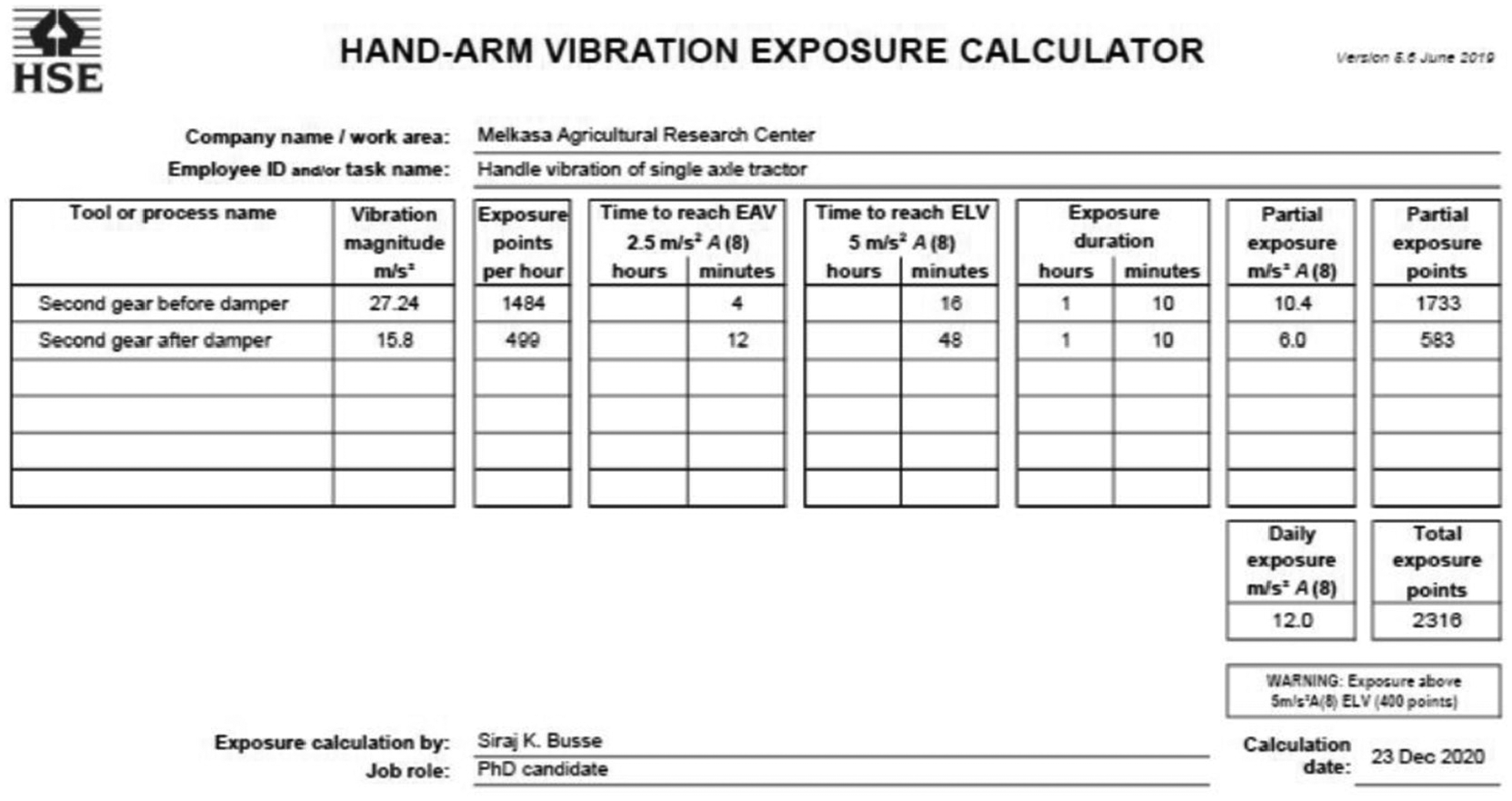
Calculation of hand-arm vibration sensitivity for proposed Monitoring of Vibration at Work Legislation 29 in second gear.
Time to reach the EAV of 2.5 m/s2 of A(8) would increase from 4 to 12 min, and the ELV of 5 m/s2 of A(8) would increase from 15 to 48 min, due to the installation of the damper system for second gear operation. The Measured Daily Exposure decreases from 10.8 to 6.0 m/s2 of A(8); it is noted that this is still significantly above the Action Maximum Value of 5 m/s2. The Total Exposure points have also decreased from 1870 to 587 because of damper installation.
From the “vibration total value” data of Table 5 corresponding to third gear operation before and after damper installation, the vibration exposure was determined according to the Control of Vibration at Work Regulations that are based on the 2002 EU Physical Agents (Vibration) Directive. 28 The overall vibration value and daily exposure of A(8) in m/s2 were determined using equations (2) and (3). The vibration daily exposure of A(8) was measured using the Hand-Arm Vibration Exposure Calculator developed by the Health and Safety Executive, 29 based on the cumulative value of vibration and the duration of exposure (Figure 10).

Hand-arm vibration exposure calculators for proposed Control of Vibration at Work Regulations 29 with third gear.
Time to reach the EAV of 2.5 m/s2 of A(8) would increase from 3 to 9 min, and the ELV of 5 m/s2 of A(8) would increase from 11 to 37 min, due to the installation of the damper system for third gear operation. The Calculated Daily Exposure decreases from 13 to 7 m/s2 of A(8); it is noted that this is still significantly above the Action Maximum Value of 5 m/s2. The Total Exposure points have also decreased from 2465 to 748 because of damper installation; this is still well above the limit of 400 points.
Evaluation of the latency period of tractor operators with second and third gears
The latency period is an estimate of the time for physiological symptoms to start to appear in the population of operators exposed to the tractor vibrations. For the second gear of tractor operation, installation of the damper causes the vibration total value magnitude to decrease from 27 to 16 m/s2, and the latency period for hand-arm vibration syndrome to appear to increase from 2.6 to 4.8 years. For the third gear of tractor operation, installation of the damper causes the vibration total value magnitude to decrease from 33 to 18 m/s2, and the latency period for hand-arm vibration syndrome to appear to increase from 2.2 to 4.2 years. These results are illustrated in Figure 11; in the second and third gears of tractor operation, the damping mechanism decreased vibration at the handle by 42% and 45%, respectively. This vibration reduction led to an increase in the latency period of 89% and 90% for the second and third gear operation, respectively.

Latency period of single axle tractor operators with second and third gears operations.
These results can be compared with those of other researchers. Ying et al. 30 tested the anti-vibration system used to regulate the grip of a walking tractor according to ISO 5349 (1986) requirements. They found that the frequency-weighted acceleration had decreased by 41%, and the latency time before neurovascular hand disorders were visible had been extended from 1.417 to 3.309 years by the installation of a damper system. According to ISO 5349 (1986), Dong 31 observed that the frequency-weighted acceleration in the direction of most extreme vibration on the handles of a walking tractor decreased by 56%, and the latency time of everyday sensitivity to handling vibration increased by 126%. Sam and Kathirvel 32 found that the time it takes for the 10% of the population who are exposed to hand-arm vibration to develop neuro-vascular disorders of the hands was extended from 5 to 9 years after the anti-vibration system was developed (prolonged by 80%).
Four Regression Learner Models were used to test the relationship between the latency period and the total vibration value. In all models, it was observed that the latency time decreases as the vibration total value increases. A cubic model was found to provide the best fit for relating the latency period (y) in years to the total vibration value (x) in m/s2:

Where, a1 = −0.01244
a 2 = 0.39895
a 3 = −4.4603
a 4 = 9.905
The norms of residuals of these coefficients are 0.23617 and R-sq. = 0.96. Results are graphed in Figure 12, the “calculated” data were determined from equation (4); the “predicted” values were calculated by the MATLAB regression learner; the “cubic” data are from the fitted curve.
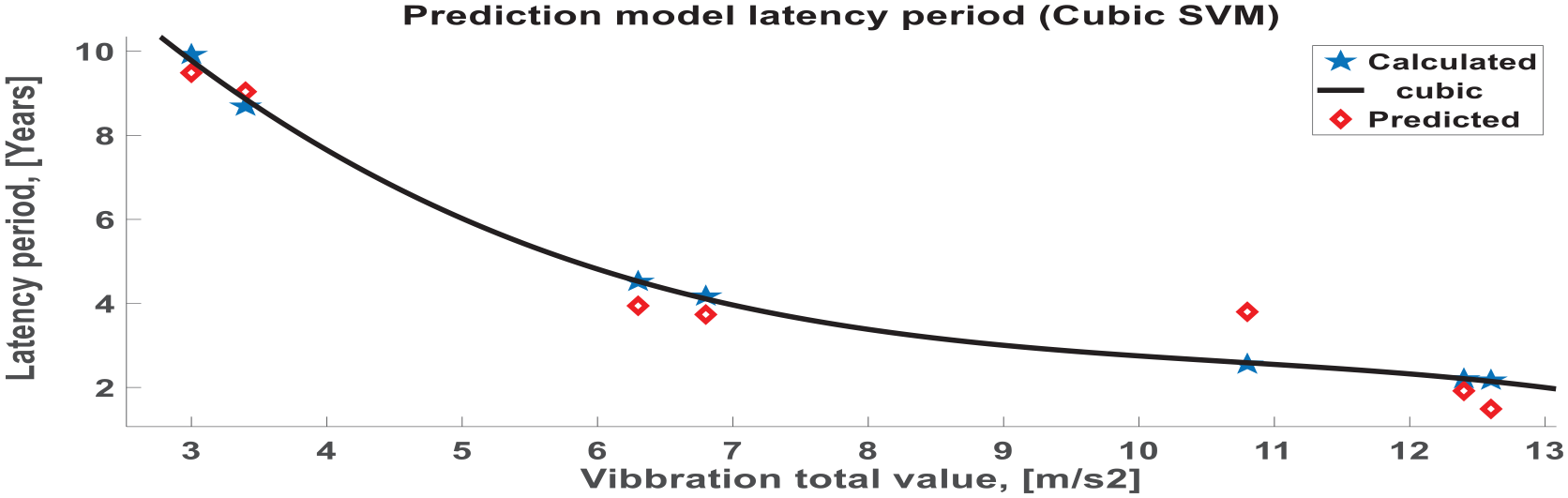
Relationship between latency periods and handle vibration.
Conclusion
Vibration dampers made of a rubber compound were provided by Horizontal Addis Tire PLC and installed to isolate the engine vibration from the chassis and handle of a single-axle tractor. The vibration amplitude showed a decrease of 42%, 39%, and 46% respectively in the vertical, forward, and lateral directions after damper installation during operation of the second gear. There were also reductions of 42% in both vibration total value and A(8) daily exposure, while the latency period at which the hand-arm vibration syndrome becomes apparent increased from 2.6 to 4.8 years duration.
With third gear operation, decreases of 46%, 29%, and 50% in mean vibration amplitude were observed in the vertical, forward, and lateral directions respectively following installation of a damping system; the average vibration total value and daily exposure A(8) decreased by 45% and 46% respectively. The damping system in third gear also caused the latency period at which the hand-arm vibration syndrome becomes apparent to be prolonged from 2.2 to 4.2 years, and the time to reach the EAV of 2.5 m/s2 of A(8) to increase from 3 to 9 min, and ELV of 5 m/s2 of A(8) to increase from 11 to 37 min. In addition, the Calculated Daily Exposure decreased from 13 to 7 m/s2 of A(8), which is still well above the Action Limit Value (5 m/s2). The Total Exposure points were also decreased from 2465 to 748 from installation of the damping system in third gear, but this lower value is still well above the limit of 400 points.
Footnotes
Handling Editor: James Baldwin
Declaration of conflicting interests
The author(s) declared no potential conflicts of interest with respect to the research, authorship, and/or publication of this article.
Funding
The author(s) received no financial support for the research, authorship, and/or publication of this article.
