



Abstract
In the study of boundary layer regions, it is in practice to dimensionalize the governing system and grouping variables together into dimensionless quantities in order to curtail the total number of variables. In similar flow phenomenon the physical parameters do not vary along the streamwise direction. However in non-similar flows the physical quantities change in the streamwise direction. In non-similar flows we are forced to non-dimensionalize the governing equations through non-similarity transformations. The forced flow of Oldroyd-B fluid is initiated as a result of stretching of a surface at an exponential rate. Flows over stretching surfaces are important because of their applications in extrusion processes. The forthright purpose of this study is to consider the non-similar aspects of forced convection from flat heated surface subjected to external viscoelastic fluid flow, described by the freely growing boundary layers enclosed by a region that involves without velocity and temperature gradients. The governing system of nonlinear partial differential equations (PDE’s) is transformed into dimensionless form by proposing new non-similar transformations. The dimensionless partial differential system is solved by using local non-similarity via bvp4c. Thermal transport analysis is conducted for distinct values of dimensionless numbers. It is revealed that heat shifting process expanded by the increase in the numerical values of Prandtl number and relaxation time. The dimensionless convective heat transfer coefficient results revealed that it is declining by expanding relaxation time constant
Keywords
Introduction
The analysis of boundary layer regions has attained an increasing interest and greatest importance in the theory of fluid mechanics in view of its popular applications. The boundary layer conception was inaugurated by Ludwig Prandtl in 1904. An assumption was made for two regions of fluid where viscosity consequences boosted inner part and insignificant for outer path of the boundary. At the continuous operating rigid sheet, a flow of two-dimensional, Newtonian fluid was examined by Sakiadis. 1 He took initiative of the boundary layer flow, which later on developed a huge interest in researchers working in this discipline. Crane 2 expanded the theory of Sakiadis. 1 He exhibited the exact solution of quiescent fluid above an unwavering expanding sheet. The stagnation location in flow above an expanding sheet has been considered by Chiam, 3 where he inspected particular flow configuration.
The analysis of non-Newtonian fluids is on the ruling edge in research during last few decades because of its warm welcome in technological and scientific applications as compared to Newtonian fluids. There are many items such as food products (alcoholic beverages, ketchup, ice cream, yogurt and mayonnaise, etc.), chemical products (tooth pastes, paints, pharmaceutical chemicals, cosmetics, shampoos, etc.), and biological stuffs (blood, syrups, synovial fluid and vaccine, etc.) where Newtonian’s law of viscosity is not implemented, so they are distinguished as the non-Newtonian fluids. 4 The industrial fluids differ in nature from viscous fluids due to their distinct characteristics, for example dying of paper and textiles plastic manufacturing, movement of biological fluids, and blade coating. The description of these materials is much more elaborated, due to this reason it is very difficult to compose a single constitutive relationship which assume the properties of such items. For non-Newtonian fluids, a lot of constitutive relations have been created to find their adequate conduct. Non-Newtonian fluids are organized as integral, rate, and differential. 5 Oldroyd-B fluid falls in the category of rate type non-Newtonian fluid. This category interprets the relaxation and retardation time consequences. Tanner, 6 Waters and King 7 were the founders, they obtained exact solutions for Oldroyd-B fluids. Vieru et al. 8 studied the flow of generic visco-elastic Oldroyd-B fluid for continuously accelerating plate. Fetecau et al. 9 deliberated energetic balance for Rayleigh-Stokes problem of Oldroyd-B fluid. Unsteady helical flow of Oldroyd-B fluid presented by Jamil et al. 10 Three-dimensional convective flow of Oldroyd-B fluid over expanding sheet was explored by Hayat et al. 11 Ramzan et al. 12 examined heating effects for three dimensional flow of Oldroyd-B fluid. Hayat et al. 13 presented analysis for flow of Oldroyd-B fluid based on homogeneous-heterogeneous response and Cattaneo-Christov heat flux. Mixed convective three-dimensional radiative flow of Oldroyd-B fluid studied by Shehzad et al. 14 Zheng et al. 15 exhibited MHD flow of Oldroyd-B fluids with slip consequences.
The combination of polymer and metal sheets develop the stretching surface through polymer extrusion process. 4 Flow over stretching sheets have secured prominent value in the investigations of boundary layers because of their promising implementations in scientific, engineering medical, and industrial fields such as crystal extension, glass industry, hot rippling, silicon wafer process, polymer physics, space vehicles, paper manufacturing, spinning of fibers, and continuous casting of metals. Exponential stretching in surfaces is defined as expansion in surfaces at an exponential rate. 16 It is a way to deal with flow or heat shifting by using distinct exteriors such that thermal transport over continuously expanding surfaces at an exponential rate, MHD boundary layer flow of nano-fluids above an exponentially expanding permeable surface and flow above an exponential expansion of sheet through porous medium. This field has drawn attention of many researchers and a significant progress is made in recent past. Convective heat transfer in fluid motion due to exponential stretching of surface is very important as it has influential role in most of the real life phenomenons. Some real world applications are manufacturing industry which includes artificial fibers, metal spinning, wire drawing, liquid films in condensation procedure, crystal growing, cable coating metallurgy, and polymers. Since Crane 17 studied on the flows above expanding sheet, many scholars are involved in analyzing such tasks under distinct features. Magyari and Keller 18 accomplished task by investigating thermo-physical features of viscous fluid above an exponentially stretch sheet. They utilized numerical and analytical techniques to illuminate the exponential alteration in temperature distribution. Sahoo and Poncet 19 exhibited the influences of flow and heat sensation through utilization of partial slip boundary constraint above an exponential expanding sheet. Diverse assumptions on exponentially expanding sheet under distinct physical situations were spotted by Elbashbeshy, 20 Partha et al., 21 Mabood et al., 22 and El-Aziz. 23
Several problems in boundary-layer flow and heat transfer are non-similar. Non-similar modeling is very powerful tool. If we compare similar models versus non-similar models we will come to a conclusion that only a limited number of boundary layer equations can be tackled through similarity transformations. However a vast majority of boundary layer equations involving exponentially stretching surfaces, Darcy-Forchheimer models, non-Newtonian fluids such as Powell-Eyring fluid, Sisko fluid, Williamson fluid, Prandtl fluid, Burgers fluid, Casson fluid, etc. can only be tackled through appropriate use of non-similarity transformations. Theoretically and practically non-similar boundary layer studies are more important because of their vast applications. Three causes of non-similarities were considered by Sparrow and Yu 24 that is spatial variations in the free-stream velocity, transverse curvature, and surface mass transfer (suction/injection of fluid at surface). It may occur due to variation in wall temperature, variable wall thickness, buoyancy force effect, and inclination angle effects. The non-similarity of boundary layer can also arise from more than one factor. In-spite of this fact still very few publications in the field of non-similar flows exist as compared to similar flows. The non-similar PDE’s can be calculated by using the following methods which are implicit finite difference technique, homotopy analysis method. 24 and local non-similarity technique via suitable analytical and numerical method. 25
In this proposed non-similar model of Oldroyd-B fluid, local non-similarity along second level of truncation via bvp4c is employed to get numerical solutions. In the method of local similarity (first level truncation), PDE’s obtained after transformation have both similar and non-similar terms. Assuming the non-similarity part of the equation very small and neglecting these terms PDE’s become ODE’s. The main drawback of local similarity technique is that it neglects important non-similar expressions. The outcomes calculated by local similarity procedure cannot be precise. To overcome this drawback Minkowycz and Sparrow 27 presented a new method called local non-similarity (second level truncation) technique for obtaining solution for non-similar terms which are not zero. Later non-similar flows were studied by Massoudi. 28 Cui et al. 31 exhibited non-similar flow for mixed convective flows of viscous fluids with nanoparticles.
In the method of local non-similarity the physical co-ordinates
Mathematical formulation
The external forced flow of an incompressible, Oldroyd-B fluid is considered. Two-dimensional flow is produced by stretching of a sheet at an exponential rate in horizontal direction in Figure 1. The governing convection equations are modeled without incorporating the presence of viscous dissipation and thermal radiation effects.



Physical configuration.
In this model,

Here consider the non-similar flow by introducing new parameters

Now by using chain-rule for connecting the parameters in (
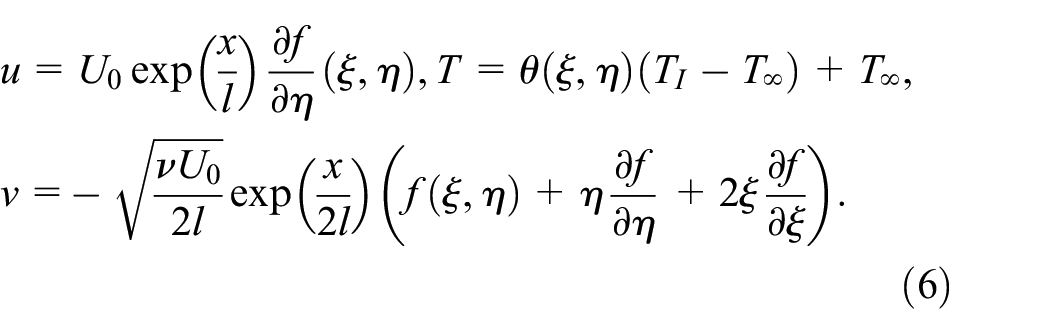
Substitution of (6) in (1)–(3) we get the following momentum, energy, and nano-particle volume fraction equations as


where dimensionless relaxation time constant

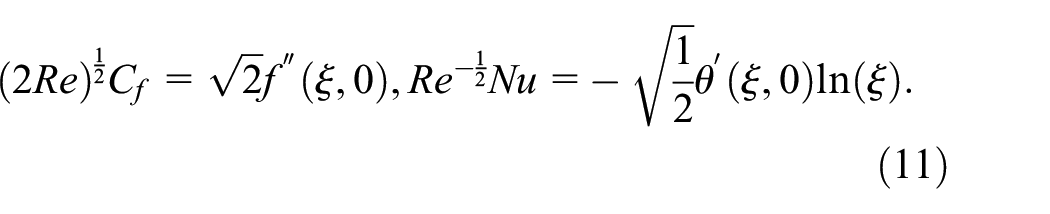
The proportion between convective heat shifting to a conductive heat transfer of fluid bring up to Nusselt number

Dimensionless presentation mentioned below;
To interpret several non-similar boundary layer problems many researchers utilize the local non-similarity technique.31,32 The local similarity principle is usually assumed for consequences of non-similar boundary layer. With the help of local non-similar technique, we have approximated non-similar PDE’s through ODE’s. A technique for finding locally non-similar boundary layer is discussed and demonstrated in detail by Farooq et al.33,34
Results and discussion
The prime purpose of this section is to express the outcomes for dimensionless parameters of velocity

Graph of

Graph of
Figure 3 shows the consequences of retardation time
Figure 4 illustrates the distribution of velocity profile

Graph of
Figure 5 portray the impact of Prandtl number, by raising Prandtl number, temperature profile reduced. It is because of bigger Prandtl number, diffusion of energy will be lesser. Hence, enhancing Prandtl number concluded a powerful reduction in temperature figure of fluid which becomes reason for thinner boundary layer.

Graph of
Figures 6 and 7 are plotted for the effects of

Graph of

Graph of
Figure 7 clearly exhibits the influences of
Table 1 shows the range table for distinct parameters. Table 2 exhibits the comparison of heat transfer coefficient for various values of
The range of distinct parameters for a stable solution.


Comparison of local similar and non-similar

Conclusion
In this research the important outcomes are as follows:
The velocity portrait increases for greater
The influences of
For large values of Prandtl number, the temperature and thermal boundary surface width reduces.
The dissimilarity of
Nusselt number expanded for greater
Footnotes
Handling Editor: James Baldwin
Declaration of conflicting interests
The author(s) declared no potential conflicts of interest with respect to the research, authorship, and/or publication of this article.
Funding
The author(s) received no financial support for the research, authorship, and/or publication of this article.
