This research work describes the investigation of a magnetohydrodynamic flow of Williamson nanofluid over an exponentially porous stretching surface considering two cases of heat transfer i.e., prescribed exponential order surface temperature (PEST), and prescribed exponential order heat flux (PEHF). As a result of this infestation, a mathematical model of the problem based on conservation of linear momentum and law of conservation of mass and energy is developed. Whereas governing nonlinear partial differential equations (PDEs) are converted to nonlinear ordinary differential equations (ODEs). Subsequently, the velocity, concentration, and temperature profiles are developed by using the method of similarity transformation. Furthermore, the effects of various physical parameters of engineering interests are demonstrated graphically. It is highlighted that both the magnetic parameter and Williamson parameter causes to reduce the boundary layer thickness.
Numerical and experimental study of nanofluids has gained the attention of researchers considering the importance and practicality.1,2 The nanofluids, which are composed of nano-sized particles fairly homogenously appended in the base fluid, have been demonstrated to improve fluid properties significantly.3–5 The nano-sized particles, suspended in the fluid, have the ability to augment the thermo-physical properties of the conventional base fluid.6–10 Conventionally, the size distribution of nanoparticles rests closely in the proximity of the size of the base fluid molecules. Therefore, the nanoparticles stay suspended in the base fluid homogenously for a very long time period without settling or coagulation. Usually, the nanomaterials used for this purpose are carbon nanotubes, metal oxides, nanosized polymers, and nanosized clays.
The idea is principally based on enhancing the thermal properties of the base fluid by producing a nanofluid by enhancing overall thermal conductivity. Various nanofluids having the unique property of increasing the rate of heat transfer in a fluid are being used in many engineering processes like cooling of the vehicle engine, air conditioning cooling, cooling of electronic devices, cooling of power plants, etc. Dey et al.11 presented a review on nanofluids in which they elaborated one-step and two-step methods of preparation of fluids. In his work, several methods of increasing the stability of nanofluids and discussed their thermo-physical properties like thermal conductivity, the effect on viscosity, etc. were also reported. The idea was propagated by Choi and Eastman12 based on the fact that the metallic nanoparticles have higher thermal conductivity as compared to the liquid. For example, at room temperature, the thermal conductivity of copper is 700 times higher than water; therefore, the addition of conductive nanoparticles into fluid can enhance heat transfer rate as compared to the rate of heat transfer by conventional fluids alone. Masuda et al.13 in their research work described a rise in the thermal conductivity of base fluid by dispersal of ultra-fine particles. Wang et al.14 also presented his experimental work, based on the same principle, for the enhancement of thermal conductivity of nanofluid compared to the base fluid. They observed a reverse relationship exists between the thermal conductivity of nanofluid and the size of the particles. It was noted that on reducing the particle size, the thermal conductivity of a mixture of fluid is increased.
Magnetohydrodynamics plays a significant role in the domain of fluid dynamics where magnetic fields are considered vital. The term magnetohydrodynamics was coined by Swedish Physicist Noble Laurate Hannes Alfven. MHD flow of heat and mass transfer over a stretching surface has practical applications in the field of glass fiber production, polymer technology, and metallurgy. MHD demonstrates a dynamic role in nanofluid flow and heat transfer. Akbar et al.15 recently investigated the MHD flow of nanofluid due to stretching/shrinking surface with slip effect. Many other researchers have discussed the MHD flow of nanofluids and presented practical solutions.16–21 Nadeem and Hussain22 considered Williamson fluid over an exponentially stretching surface and examined heat transfer. Waheed23 has discussed mixed convective heat transfer in rectangular enclosures driven by a continuously moving horizontal plate.
The investigation of boundary layer flow over a stretching sheet has gained attention owing to its broad utilization in designing applications. Sakiadis24 investigated the boundary layer flow over a moving solid with predictable constant speed. Crane25 recently extended his work over a linearly stretching sheet. Lately, many researchers have studied the impact of various physical phenomena in practical applications such as the effect of heat and mass transfer during suction and injection in the presence of magnetic field considering such flows on account of stretching surfaces. Gupta and Gupta26 presented the stretching plate subject to suction and injection phenomenon. Tsou et al.27 presented heat and boundary layer flow over a stretching plate with variable thermal conductivity analysis. The viscous flow over a stretching surface with quadratic stretching was discussed by Kumaran and Ramanaiah.28 Ali29 presented the thermal boundary layer on account of the power law stretching. By considering the exponential stretching, the heat transfer flow of viscous fluid was studied by Elbashbeshy.30 Ahmed et al.31 investigated 3D Maxwell nanofluid over stretching sheet. They presented that the longitudinal velocity component becomes higher in the presence of mixed convection parameter and buoyancy parameter. Chu et al.32 studied the transportation of heat and mass transport in hydromagnetic stagnation point flow of Carreau nanomaterial. Rasool and Shafiq33 explored the features of thermally enhanced chemically reactive radiative Powell–Eyring nanofluid flow via Darcy medium over non-linearly stretching surface affected by a transverse magnetic field and convective boundary conditions. Although many researchers have considered fluid flows over stretching sheets linearly and/or non-linearly; however, the study is presented in this work is novel in nature.
The objective of this work is to elaborate the MHD flow of Williamson nanofluid over an exponentially stretching surface. This study particularly emphasizes the heat transfer analysis of Williamson nanofluid where the sheet stretches exponentially which is not addressed so far. Two instances of heat transfer, PEST and PEHF are also discussed. Since governing equations that describe the flow are complex in nature; therefore, analytical solutions are highly unlikely to be obtained satisfactorily. Considering this limitation, we attempted here to solve these equations numerically. Governing highly nonlinear PDEs are reduced into nonlinear ODEs by the assistance of a suitable similarity transformation and subsequently, solving it with the help of bvp4c code. There are seven parameters involved in resulting ODEs and their effects have been demonstrated graphically. The graphical results show that boundary layer thickness is decreasing with the increase of magnetic field and Williamson parameter It is also seen that thermal boundary layer thickness is achieved little later than the momentum boundary layer.
Problem description
Here we have considered steady incompressible MHD Williamson nanofluid flow in two dimensions over a stretching plate. It is assumed that the plate is stretched along -axis with the exponentially varying velocity and direction is taken perpendicular to the plate. The adjustable transverse magnetic field is subjected in a direction perpendicular to the flow. The velocity, temperature, and nanoparticle concentration of the fluid near the surface is taken to be , and respectively. The governing equations for the model considered are given by Nadeem and Hussain34
Schematic representation of boundary layer flow
The accompanying boundary conditions are
The thermal boundary conditions for PEST and PEHF cases are
The following similarity transformation is used to solve the governing equations
PEST Case:
PEHF Case:
Using the above transformations, in equation (2) with the boundary equation given in equation (5) the governing equation takes the following form
where, , .
where is the suction and is the injection parameter; is the dimensionless Williamson fluid parameter and represents the magnetic parameter.
Some important physical quantities are the local skin friction coefficient , local Nusselt number , and the local Sherwood number , which are defined as
The numerical solution of magnetohydrodynamics Williamson nanofluid across an exponentially stretching surface is examined here. The impact of physical parameters that is Williamson fluid parameter , suction/injection parameter , Magnetic parameter , thermophoretic parameter , and Brownian motion parameter on flow and Prandtl number , Schmidt number , heat and mass transfer characteristic has been investigated. The system of ODEs obtained in equations (10) to (13) are solved by using the MATLAB function bvp4c. In order to certify the code, developed in MATLAB, we obtain the results for the skin friction coefficient when for distinct values of and , keeping other parameters fixed which are shown in Table 1. These outcomes are reliable and found in agreement with the results reported by Nadeem and Hussain.22
Comparison of for different values of and , by fixing .
In Tables 2 to 4, the effects on the , , and for several effective parameters are shown. equation (13) shows the dimensionless mathematical form of skin friction. As we increase the value of , the skin friction coefficient, local Nusselt number, and local Sherwood number decrease because greater values of with more relaxation time offer more resistance to fluid motion. As we raise the value of suction/injection parameter , the skin friction coefficient, local Nusselt number, and local Sherwood number decrease because the fluid flow is caused only by the stretching sheet. When we increase , it means an increase in porosity of the stretching sheet which produces the resistivity on the fluid flow. As we raise the value of , the skin friction coefficient increases, whereas the local Nusselt number and local Sherwood number decrease because of Lorentz force which restrict fluid motion. Prandtl number is the ratio of momentum diffusivity to nanofluid thermal diffusivity. As we increase , local Nusselt number increases whereas local Sherwood number decreases. An escalation in the value of , causes a decrease in the local Nusselt number whereas an increase in the local Sherwood number. As we increase the value of , both local Nusselt number and local Sherwood number decreases. Schmidt number , is the ratio of momentum diffusivity to Brownian diffusivity. As we increase , the local Nusselt number decreases whereas the local Sherwood increases.
Values of , for different values of , , and by fixing of , , and .
Variation in for various values of , , , , , and .
0.5
Variation in for various values of , , , , , and .
0.5
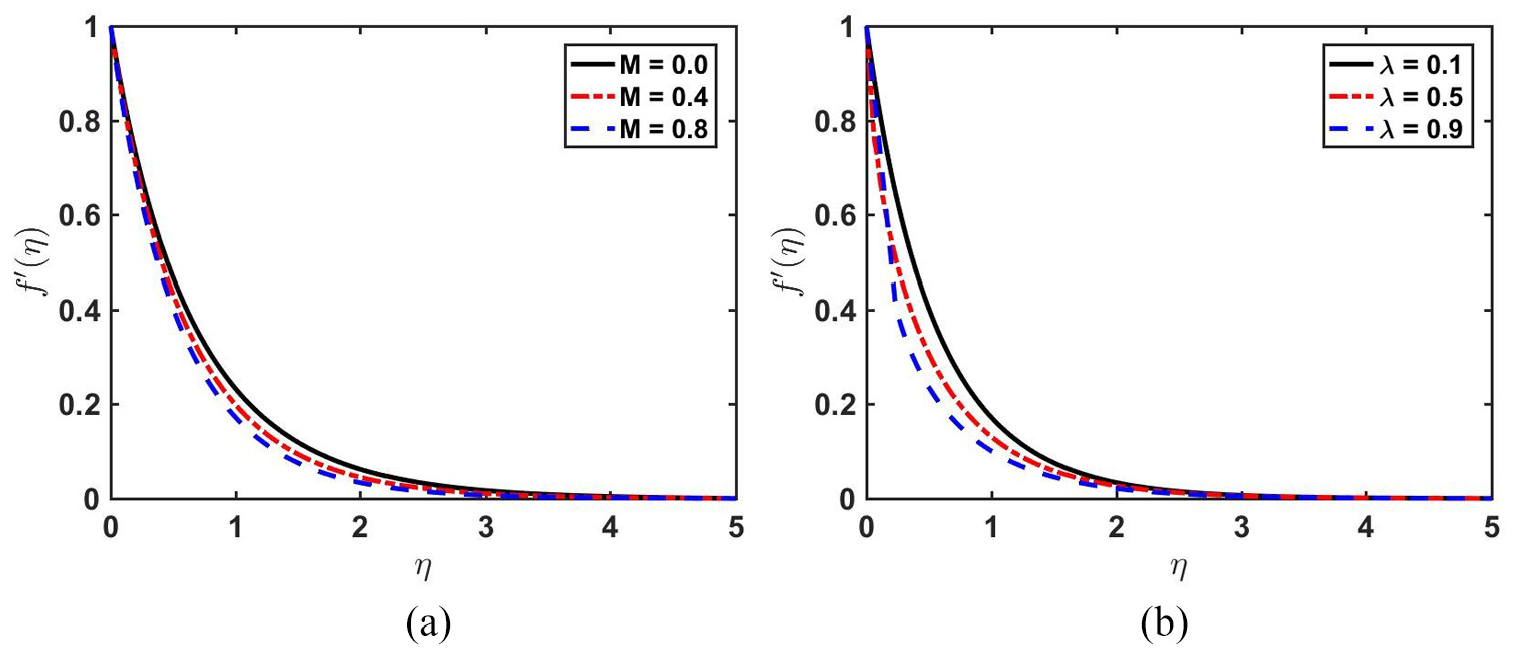
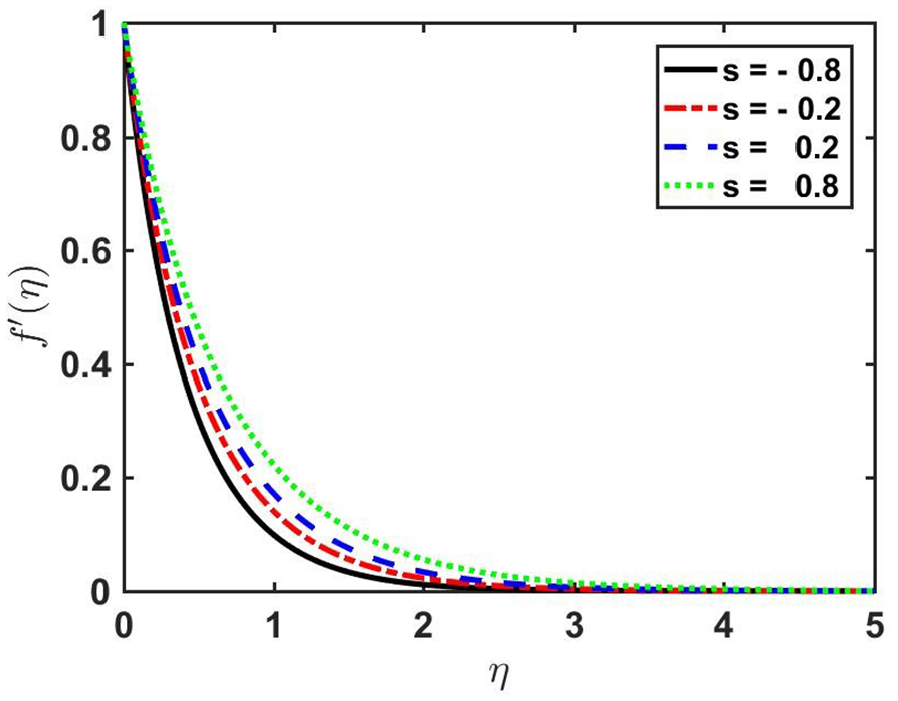
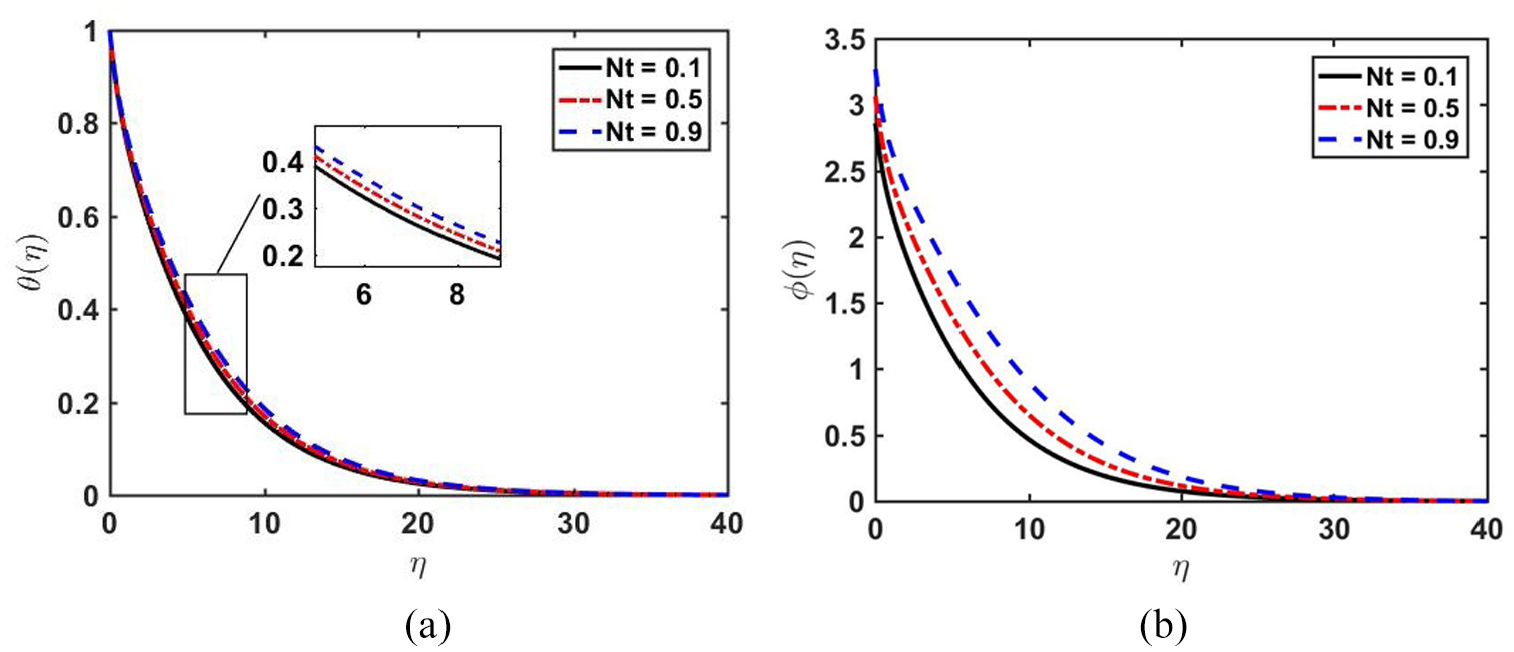
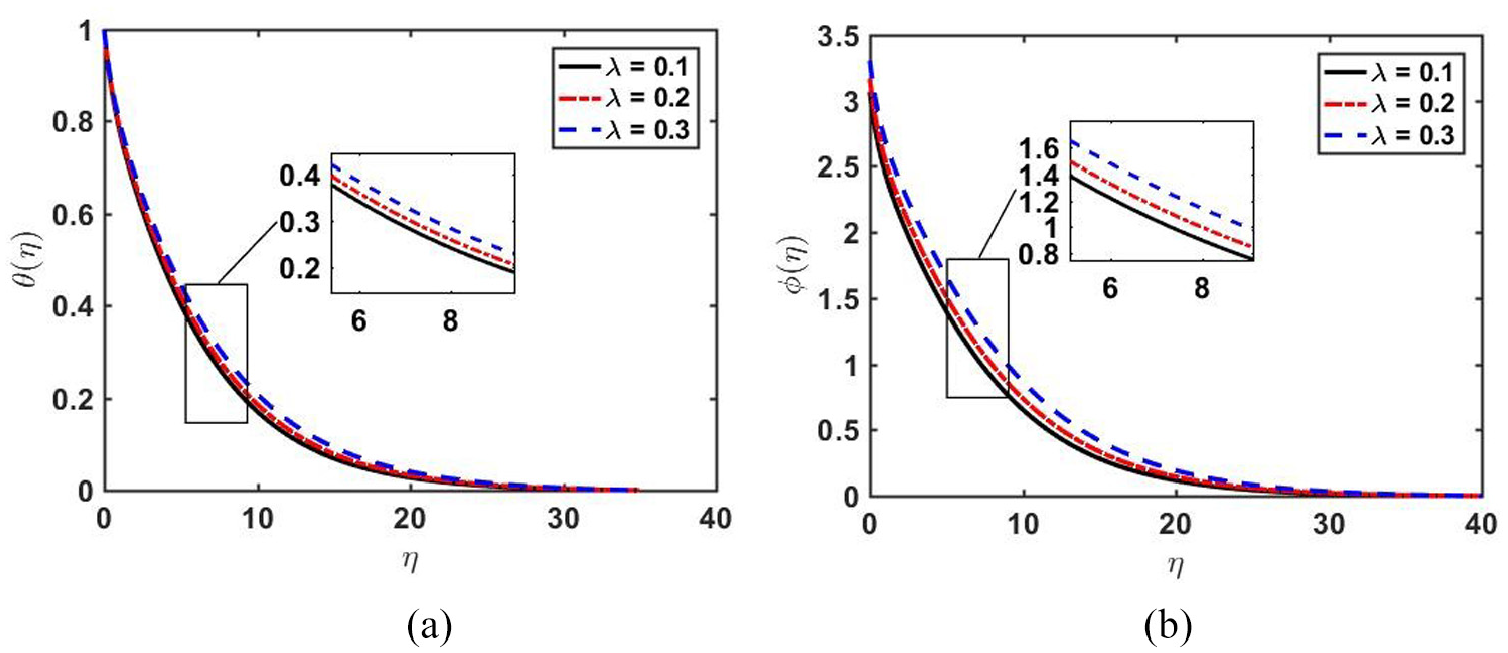
Figures 1 and 2 displays the effect of velocity profile versus which depends on and . Figure 1(a) illustrates that the increment in magnetic parameter , causes velocity profile to decrease because of retarding force which is responsible for the decrease in velocity. Figure 1(b) shows the effect of showing the similar effect as before that is velocity profile decreases with an escalation in the values of . Moreover, higher values of and reduce boundary layer thickness. Figure 2 shows the effect of on the velocity profile. It is evident from this figure that the velocity profile settles at higher values on raising . Figure 3 shows temperature profile for various values of . The PEST and PEHF cases represent the direct relationship between Brownian motion parameter and temperature profile as shown in Figure 3(a) and (b). The thermal boundary layer for both the PEST and PEHF cases is also increased. Figure 4(a) and (b) reveal the similar influence of the on for PEST and PEHF cases, respectively. It happens because the strong temperature gradient forces particles in the fluid to move in the direction of decreasing temperature. For higher values of Prandtl number , the temperature shows a decreasing behavior for both manifestations of PEST and PEHF as can be seen from Figure 5. It is due to the decrease in thermal diffusivity because the Prandtl number and thermal diffusivity have inverse relationship with each other. And Figure 6 describe the impact of on a temperature profile for both instances of heat transform considered and increasing influence of on temperature profile is observed. Figure 7(a) and (b) depicts the impact of on a temperature profile for PEST and PEHF case respectively. The escalation in temperature is observed as λ increases. Moreover, momentum boundary layer thickness has increasing impact of both and . Figure 8 illustrate the effect of suction/injection parameter on temperature profile. An increase in results in rise in temperature for both PEST (Figure 8(a)) and PEHF (Figure 8(b)) cases. Consequently, thermal boundary layer thickness becomes large.
Velocity profile versus by fixing : (a) for different values of and (b) for different values of .
Velocity profile versus by fixing for various values of and for various values of
Temperature profile versus by fixing : (a) for various values of (PEST Case) and (b) for various values of (PEHF Case).
Temperature profile versus by fixing : (a) for various values of (PEST Case) and (b) for various values of (PEHF Case).
Temperature profile versus by fixing : (a) for various values of (PEST Case) and (b) for various values of (PEHF Case).
Temperature profile versus by fixing : (a) for various values of M (PEST Case) and (b) for various values of (PEHF Case).
Temperature profile versus by fixing : (a) for various values of (PEST Case) and (b) for various values of (PEHF Case).
Temperature profile versus by fixing : (a) for various values of (PEST Case) and (b) for various values of (PEHF Case).
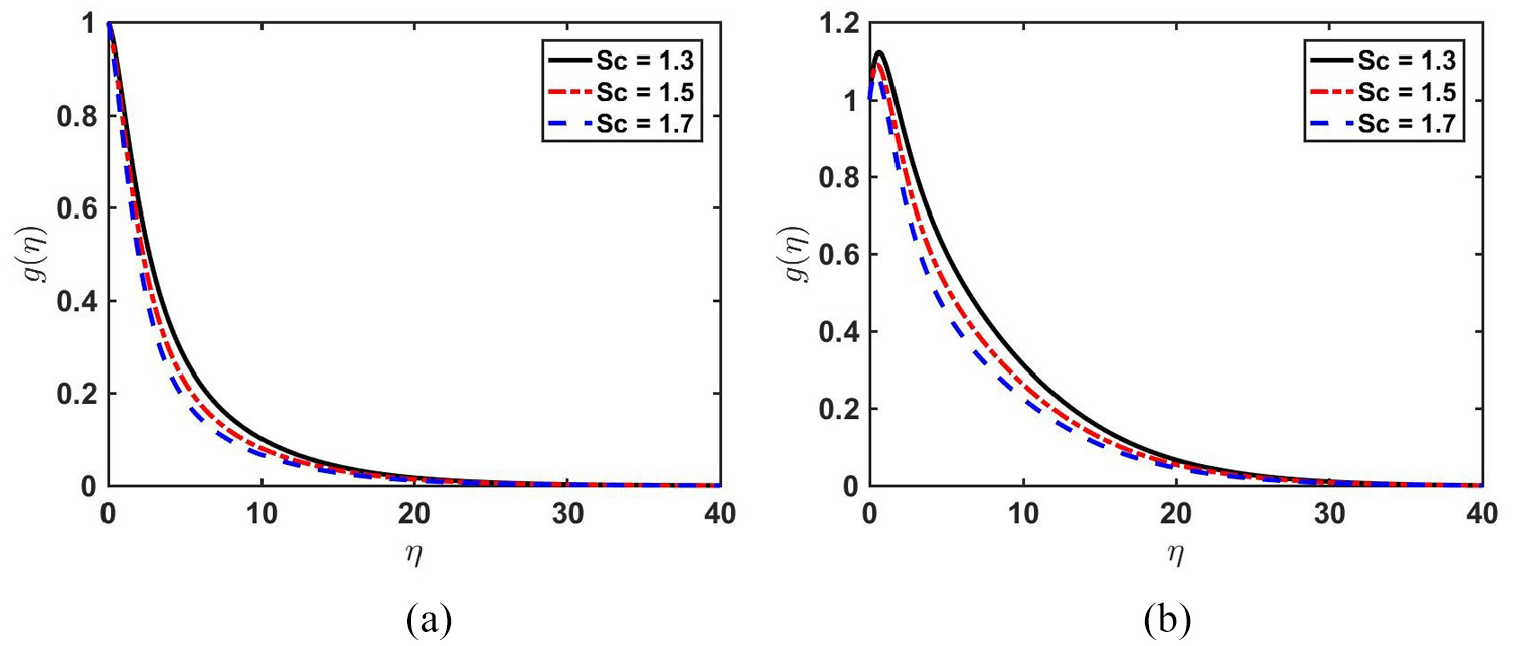
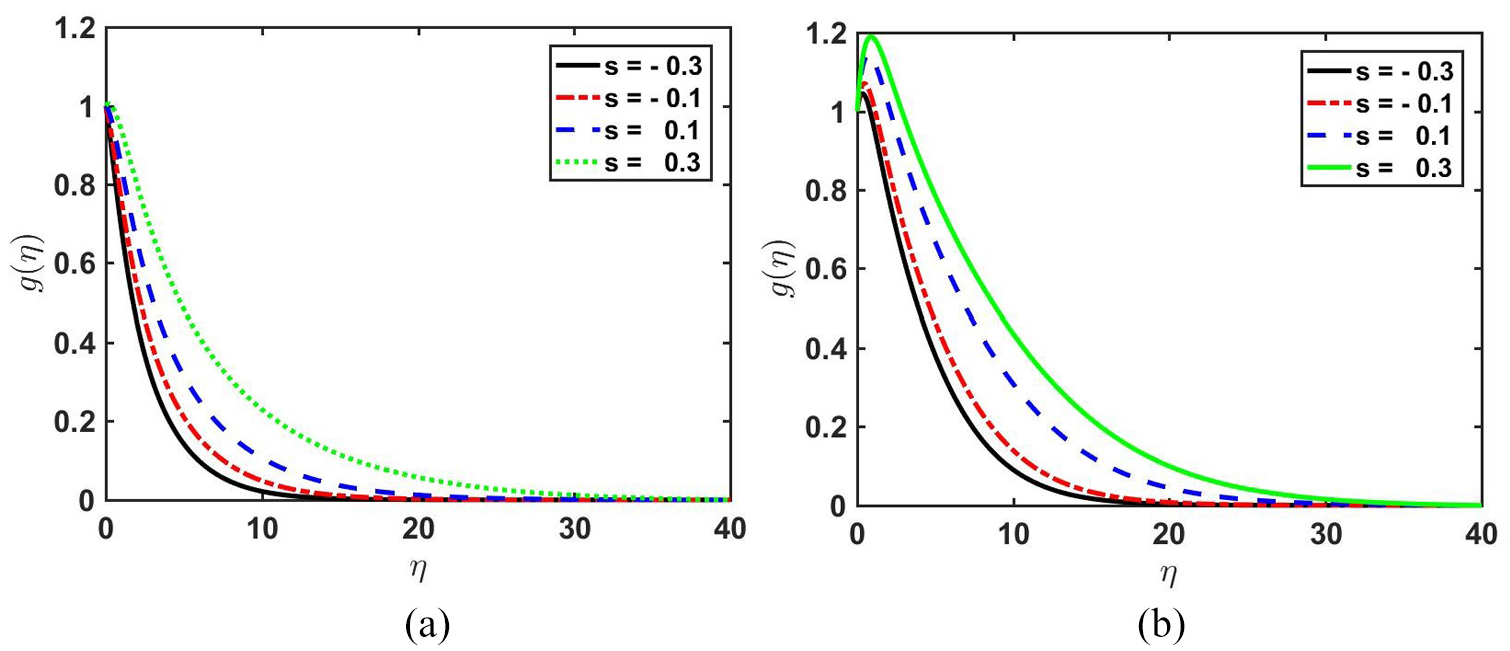
Figure 9(a) and (b) shows that concentration increases by increasing the magnetic parameter for both PEST and PEHF case. has adverse effect on concentration profile which is displayed by Figure 10(a) and (b). In Figure 11(a) and (b), we represent the behavior of Brownian motion parameter for PEST and PEHF cases respectively. Hypothetically, the enhanced thermal conductivity of nanofluid is primarily due to Brownian motion which produces macromixing. By increasing the , it reduces the nanofluid concentration. Figures 12 and 13 depict the effects of and on concentration profile for PEST and PEHF cases, respectively. It is depicted that there is rise in concentration values by increasing the thermophoretic parameter and suction/injection parameter for both cases.
Concentration profile versus by fixing : (a) for various values of (PEST Case) and (b) for various values of (PEHF Case).
Concentration profile versus by fixing : (a) for various values of (PEST Case) and (b) for various values of (PEHF Case).
Concentration profile versus by fixing : (a) for various values of (PEST Case) and (b) for various values of (PEHF Case).
Concentration profile versus by fixing : (a) for various values of (PEST Case) and (b) for various values of (PEHF Case).
Concentration profile versus by fixing : (a) for various values of (PEST Case) and (b) for various values of (PEHF Case).
Conclusion
The following main remarks can be concluded from the results of the current investigation.
Skin friction coefficient reduces by raising the value of Williamson parameter and suction/injection parameter , whereas it increases on increasing magnetic parameter .
Wall temperature gradient increases on an increasing Prandtl number , whereas it decreases for an increase in Williamson parameter , suction/injection parameter , magnetic parameter , Brownian motion parameter , thermophoresis parameter and Schmidt number .
increases by raising the values of Brownian motion parameter and Schmidt number whereas it decreases by an increase in Williamson parameter , suction/injection parameter , magnetic parameter , Prandtl number and thermophoresis parameter .
Velocity profile settles at lower values for increasing Williamson parameter and magnetic parameter , whereas it settles at higher values for increasing suction/injection parameter .
for both PEST and PEHF cases have similar behavior on , suction/injection parameter , magnetic parameter , Brownian motion parameter , thermophoresis parameter and Prandtl number .
Concentration profile elevates on raising magnetic parameter , suction/injection parameter and whereas it drops down for higher values of and Schmidt number .
Footnotes
Appendix
Handling Editor: James Baldwin
Declaration of conflicting interests
The author(s) declared no potential conflicts of interest with respect to the research, authorship, and/or publication of this article.
Funding
The author(s) received no financial support for the research, authorship, and/or publication of this article.
ORCID iD
Tanvir Akbar
References
1.
WongKVDe LeonO.Applications of nanofluids: current and future. Adv Mech Eng2010; 2: 519659.
2.
WangXQMujumdarAS.Heat transfer characteristics of nanofluids: a review. Int J Therm Sci2007; 46(1): 1–19.
3.
WangXQMujumdarAS.A review on nanofluids - Part I: Theoretical and numerical investigations. Brazilian J Chem Eng2008; 25(4): 613–630.
4.
DasLHabibKSaidurR,et al. Improved thermophysical properties and energy efficiency of aqueous ionic liquid/mxene nanofluid in a hybrid pv/t solar system. Nanomaterials2020; 10(7): 1–26.
5.
LiYZhouJTungS,et al. A review on development of nanofluid preparation and characterization. Powder Technol2009; 196(2): 89–101.
6.
AhmadHMKamalMSMurtazaM,et al. Improving the drilling fluid properties using nanoparticles and water-soluble polymers. In: proceedings of the SPE Kingdom of Saudia Arabia annual technical symposium and exhibition, Dammam, Saudia Arabia, 24–27 April 2017, pp.106–124.
7.
LyuZAsadiAAlarifiIM,et al. Thermal and fluid dynamics performance of MWCNT-water nanofluid based on thermophysical properties: an experimental and theoretical study. Sci Rep2020; 10(1): 1–14.
8.
GiwaSOSharifpurMGoodarziM,et al. Influence of base fluid, temperature, and concentration on the thermophysical properties of hybrid nanofluids of alumina–ferrofluid: experimental data, modeling through enhanced ANN, ANFIS, and curve fitting. J Therm Anal Calorim2021; 143(6): 4149–4167.
9.
JangSPChoiSUS. Role of Brownian motion in the enhanced thermal conductivity of nanofluids. Appl Phys Lett2004; 84(21): 4316–4318.
10.
XuanYLiQ.Heat transfer enhancement of nanofluids. Int J Heat Fluid Flow2000; 21(1): 58–64.
11.
DeyDKumarPSamantarayS.A review of nanofluid preparation, stability, and thermo-physical properties. Heat Transf Asian Res2017; 46(8): 1413–1442.
12.
ChoiSUSEastmanJA. Enhancing thermal conductivity of fluids with nanoparticles. Am Soc Mech Eng Fluids Eng Div FED1995; 231(March): 99–105.
13.
MasudaHEbataATeramaeK,et al. Alteration of thermal conductivity and viscosity of liquid by dispersing ultra-fine particles. Dispersion of Al2O3, SiO2 and TiO2 ultra-fine particles. Netsu Bussei1993; 7(4): 227–233.
AkbarTBatoolSNawazR,et al. Magnetohydrodynamics flow of nanofluid due to stretching/shrinking surface with slip effect. Adv Mech Eng2017; 9(12): 1–11.
16.
BrownNMLaiFC.Correlations for combined heat and mass transfer from an open cavity in a horizontal channel. Int Commun Heat Mass Transf2005; 32(8): 1000–1008.
KhudheyerAF.MHD mixed convection in double lid-driven differentially heated trapezoidal cavity. Int J Appl Innov Eng Manag2015; 4(2): 100–107.
19.
RoyGNguyenCTLajoiePR.Numerical investigation of laminar flow and heat transfer in a radial flow cooling system with the use of nanofluids. Superlattices Microstruct2004; 35(3–6): 497–511.
20.
KefayatiGRGorji-BandpyMSajjadiH,et al. Lattice Boltzmann simulation of MHD mixed convection in a lid-driven square cavity with linearly heated wall. Sci Iran2012; 19(4): 1053–1065.
21.
AhmedSEMansourMAHusseinAK,et al. Mixed convection from a discrete heat source in enclosures with two adjacent moving walls and filled with micropolar nanofluids. Eng Sci Technol Int J2016; 19(1): 364–376.
22.
NadeemSHussainST.Heat transfer analysis of Williamson fluid over exponentially stretching surface. Appl Math Mech (Engl Ed) 2014; 35(4): 489–502.
23.
WaheedMA.Mixed convective heat transfer in rectangular enclosures driven by a continuously moving horizontal plate. Int J Heat Mass Transf2009; 52(21–22): 5055–5063.
24.
SakiadisBC. Boundary-layer behavior on continuous solid surfaces: I. Boundary-layer equations for two-dimensional and axisymmetric flow. AIChE J1961; 7(1): 26–28.
25.
CraneLJ.Flow past a stretching plate. J Appl Math Phys1970; 21: 645–647.
26.
GuptaPSGuptaAS.Heat and mass transfer on a stretching sheet. Can J Chem Eng1977; 55: 744–746.
27.
TsouFKSparrowEMGoldsteinRJ.Flow and heat transfer in the boundary layer on a continuous moving surface. Int J Heat Mass Transf1967; 10(2): 219–235.
28.
KumaranVRamanaiahG.A note on the flow over a stretching sheet. Acta Mech1996; 116: 229–233.
29.
AliME.On thermal boundary layer on a power-law stretched surface with suction or injection. Int J Heat Fluid Flow1995; 16(4): 280–290.
30.
ElbashbeshyEMA. Heat transfer over an exponentially stretching continuous surface with suction. Arch Mech2001; 53(6): 643–651.
31.
AhmedAKhanMAhmedJ,et al. Mixed convective 3D flow of Maxwell nanofluid induced by stretching sheet: application of Cattaneo-Christov theory. Proc Inst Mech Eng Part C J Mech Eng Sci2020: 1–10.
32.
ChuYMRehmanMIUKhanMI,et al. Transportation of heat and mass transport in hydromagnetic stagnation point flow of Carreau nanomaterial: dual simulations through Runge-Kutta Fehlberg technique. Int Commun Heat Mass Transf2020; 118: 104858.
33.
RasoolGShafiqA.Numerical exploration of the features of thermally enhanced chemically reactive radiative Powell–Eyring nanofluid flow via Darcy medium over non-linearly stretching surface affected by a transverse magnetic field and convective boundary conditions. Appl Nanosci. Epub ahead of print 28November2020. DOI: 10.1007/s13204-020-01625-2.
34.
NadeemSHussainST.Flow and heat transfer analysis of Williamson nanofluid. Appl Nanosci2014; 4(8): 1005–1012.