



Abstract
Inherent imprecisions present in the basic parameters of cellular honeycomb cores, such as the cell angle, the material properties, and the geometric parameters, need to be considered in the analysis and design to meet the high-performance requirements. In this paper, imprecisions associated with the basic parameters of honeycomb cores are considered. Non-probabilistic models for the in-plane elastic properties of hexagonal honeycomb cores are developed in which the imprecisely defined input and response parameters are represented by only their mean values and variations without the requirement of knowing the probability density distributions of the imprecise parameters as is required for probabilistic methods. Thus, the proposed models predict not only the nominal values of the in-plane elastic properties but also their variations from the respective mean values. The applicability of the proposed models is demonstrated by considering the analysis of the in-plane elastic properties of a honeycomb core made of aluminum 5052-H-32 in which the core material properties are defined by their mean values and variations. The results show that realistic variations of the in-plane elastic properties are obtained using the proposed non-probabilistic models. The sensitivity of the in-plane elastic properties to the imprecisions present in each basic parameter is also investigated.
Introduction
Cellular materials are widely used as cores in sandwich structures due to their distinct characteristics such as having an extra lightweight and high stiffness and strength values. These characteristics have led designers to use cellular materials in many engineering applications, such as aerospace and automotive structural applications, that require high performance and reliability. Hexagonal honeycomb, balsa, foam, and corrugated cores are typical cellular materials that can be used as cores in sandwich structures. Hexagonal honeycombs, which epitomize two-dimensional cellular materials, are commonly used as cores because of their low weight, high bending strength, and flexural rigidity. In recent decades, many closed-form deterministic analytical models have been developed to determine the mechanical properties of hexagonal honeycomb cores.1–3 The dynamic and failure of honeycomb core sandwich panels with high-velocity impact were studied by Sun et al. 4 using experimental and numerical methods. Zhang et al. 5 conducted an experimental study to investigate the mechanical behavior of hexagonal honeycombs under quasi-static combined compression-shear loading. Ha et al. 6 proposed a new honeycomb, known as bio-inspired honeycomb, and studied the geometrical configurations on the energy absorption of bio-inspired honeycomb sandwich panels. He et al. 7 presented a comprehensive study using numerical, experimental, and theoretical method on the residual flexural properties honeycomb core sandwich panels that are subjected to low-velocity impact. Sun et al. 8 investigated the influences of some structural parameters, such as face sheet thickness, wall and cell geometries, on the behavior of honeycomb cores sandwich panels subjected to low-velocity impact. However, hexagonal honeycomb cores exhibit disorders in the geometries and properties of materials from which the cores are made. For example, the material properties of the core material, cell angle, and geometry are inherently subjected to irregularities and imprecisions during the formation and manufacturing of cores. Thus, using the available deterministic models for mechanical properties cannot assure the high performance and reliability of hexagonal honeycombs because the inherent scatter in the basic parameters is neglected. The variabilities associated with engineering system responses with stringent design requirements need to be known in order to achieve a desirable performance. Hence, variations must be considered when determining the response of hexagonal honeycomb cores so that improved and more realistic response representations can be obtained.
Several studies have considered the variabilities associated with cellular materials; however, these have often been in terms of their stochastic/probabilistic nature. Zhu et al. 9 studied the effects of irregularities in the cell size and shape of foams on their elastic properties by developing models for the finite element analysis of random Voronoi foams. Hohe and Becker 10 and Hohe and Bechmann 11 presented a numerical analysis using stochastic procedures to investigate the effective mechanical properties of two-dimensional cellular materials taking into account the presence of microstructural irregularities. Flores et al. 12 developed a multi-scale finite element method using the Gaussian process emulator to study the stochastic mechanical response of structures with honeycomb cores. The probabilistic distribution of the residual strength of impacted sandwich structures with honeycomb cores was estimated by Kim et al. 13 in which the mean and variance values of the original properties were used in the probabilistic analysis. Parsi et al. 14 developed a probabilistic model for predicting the dynamic contact force of honeycomb structures subjected to impacts at low velocities. Probabilistic methods have also been used in analysis and design in many engineering fields, such as vibrations,15–18 fracture mechanics,19–22 computational fluid mechanics,23,24 and structural stability.25,26
A stochastic/probabilistic analysis represents each imprecise parameter as a random variable that follows a specific probability distribution. In real-life applications, the full probabilistic information of imprecise quantities is not readily available, which leads to unknown probability density distributions for the imprecisely defined quantities. Thus, an exact stochastic/probabilistic analysis becomes unpractical in the absence of exact probability density distributions of each imprecisely defined parameter, as in most engineering applications. However, due to readily available maximum and minimum values, mean values, and variations are commonly used parameters to represent the imprecisions associated with quantities that are subjected to imprecision. Several non-probabilistic methods have been proposed to model imprecisions associated with engineering systems where the probability density distributions of imprecise parameters are not needed.27–33 Recently, universal grey mathematics has been used in many studies to quantify imprecisions associated with engineering systems.34–38 These studies have shown that universal grey mathematics has the ability to realistically quantify imprecisions with less computational effort and without overestimating variations in response parameters. Universal grey mathematics only requires the mean values and the corresponding variations of imprecisely defined parameters to model imprecisions in imprecise systems. The superiority of this method lies in the satisfaction of the distributive property, which leads to the realistic quantification of imprecisions in the response parameters without overestimation.
This work presents the modeling and analysis of the in-plane elastic properties of hexagonal honeycomb cores when the basic quantities are defined in terms of mean values and variations. Non-probabilistic models are presented based on universal grey mathematics for the modeling of imprecisions in the response quantities. Unlike probabilistic models, which require the probability distribution density of imprecise parameters to be exactly known, the proposed models can express the in-plane elastic properties of a hexagonal honeycomb core in terms of their mean values and variations with the knowledge of only the mean values and variations of the basic input quantities. Additionally, a sensitivity analysis is performed in which the influence of the variation of each basic variable on the variations of the response quantities is investigated.
In-plane elastic properties of cellular hexagonal honeycomb cores
Several approaches are available in the literature to estimate the elastic properties of cellular honeycomb cores, however, without considering variabilities in the imprecise parameters.1–3 The present study is based on the analytical expressions proposed by Gibson and Ashby
2
for the in-plane elastic properties of a cellular honeycomb core, namely, the in-plane Young’s moduli

Geometries of a unit cell in directions 1 and 2.
Thus, when the basic parameters are described in their mean values only (deterministic form), the in-plane elastic properties of a honeycomb core are given by:


However, the aforementioned expressions do not consider the inherent imprecisions in the basic quantities, namely, the wall length l, wall height h, wall thickness t, cell angle
Imprecise models for in-plane elastic properties of a honeycomb core
Universal grey mathematics is used to predict the in-plane elastic properties of a honeycomb core in the presence of imprecise basic parameters. The arithmetic operations associated with the universal grey number theory are presented by Rao and Liu
39
where each imprecise quantity X is represented by its extreme values; the lower bound
The basic input quantities are defined in terms of their mean values and the percent variations. Consequently, the response quantities of a honeycomb core are also represented by their mean values and percent variations. In this work, the imprecise parameter X is represented in the form

where
Let X and Y be imprecise parameters that are defined in terms of their mean value m and percent variation

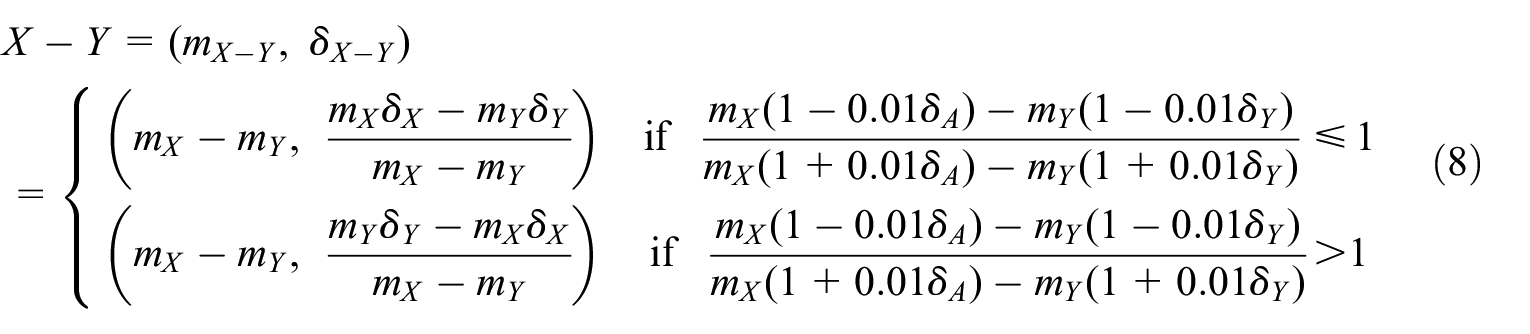


The imprecise forms of the models associated with the in-plane elastic properties of a hexagonal honeycomb core can be derived using the basic arithmetic operations defined in equations (7)–(10) in conjunction with the analytical deterministic expressions given in equations (1)–(5). The nature of the arithmetic operations (equations (7)–(10)) and the conditions associated with the subtraction and division operations (equations (8) and (10)) lead to several and long expressions depending on the nature of the desired in-plane elastic model. For example, depending on the numerical values of the mean values and the respective percent variations of the basic quantities, the derivation of the imprecise form of the Young’s modulus of a honeycomb core in direction 1
Enter the mean values and percent variations of all basic parameters.
Call (function E1), (function E2), (function G12), (function v12), or (function v21) to calculate the desired property.
Use (function addition), (function subtraction), (function multiplication), and (function division) to perform each arithmetic operation present in each of the formulas defined in equations (1)–(5).
To illustrate the process, the computations of the mean value and the percent variation of the Young’s modulus in direction 2,
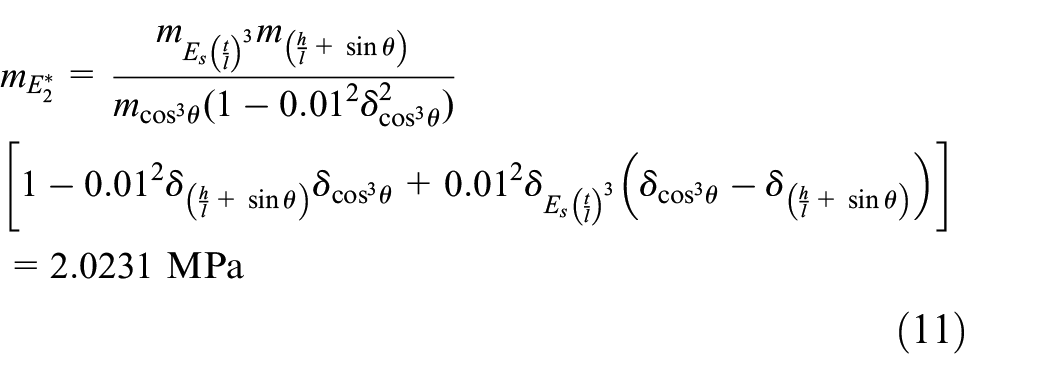

where


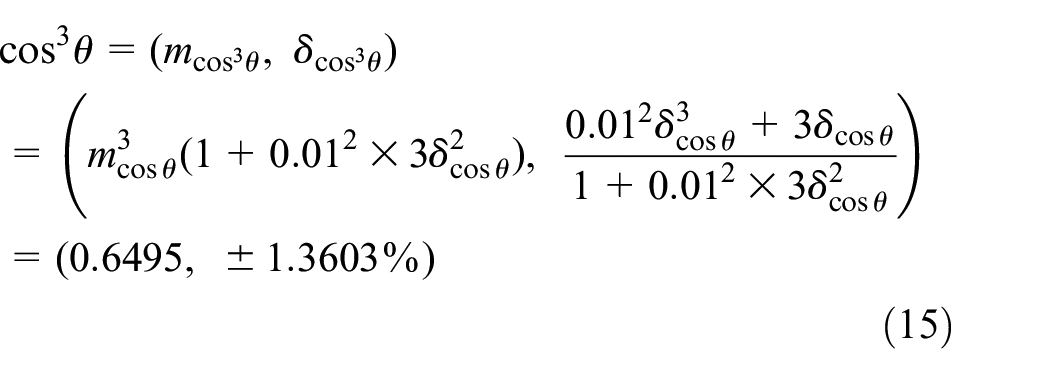


Similarly, the mean values and the percent variations of the other in-plane elastic properties of a hexagonal honeycomb core,
Numerical example
The analysis of a hexagonal honeycomb core made of aluminum 5052-H-32
40
is considered to demonstrate the applicability of the proposed imprecise models of the in-plane elastic properties. The analysis is performed using the basic input quantities shown in Table 1 in which three different
Basic input parameters in terms of mean values and variations.

Tables 2 to 5 present the results obtained for the in-plane elastic properties of a hexagonal honeycomb core considering five cases of imprecisely defined input parameters. The results show that the Young’s modulus in direction 2,
In-plane elastic properties in terms of mean values and variations for

In-plane elastic properties using combinatorial method in terms of mean values and variations for

In-plane elastic properties in terms of mean values and variations for

In-plane elastic properties in terms of mean values and variations for
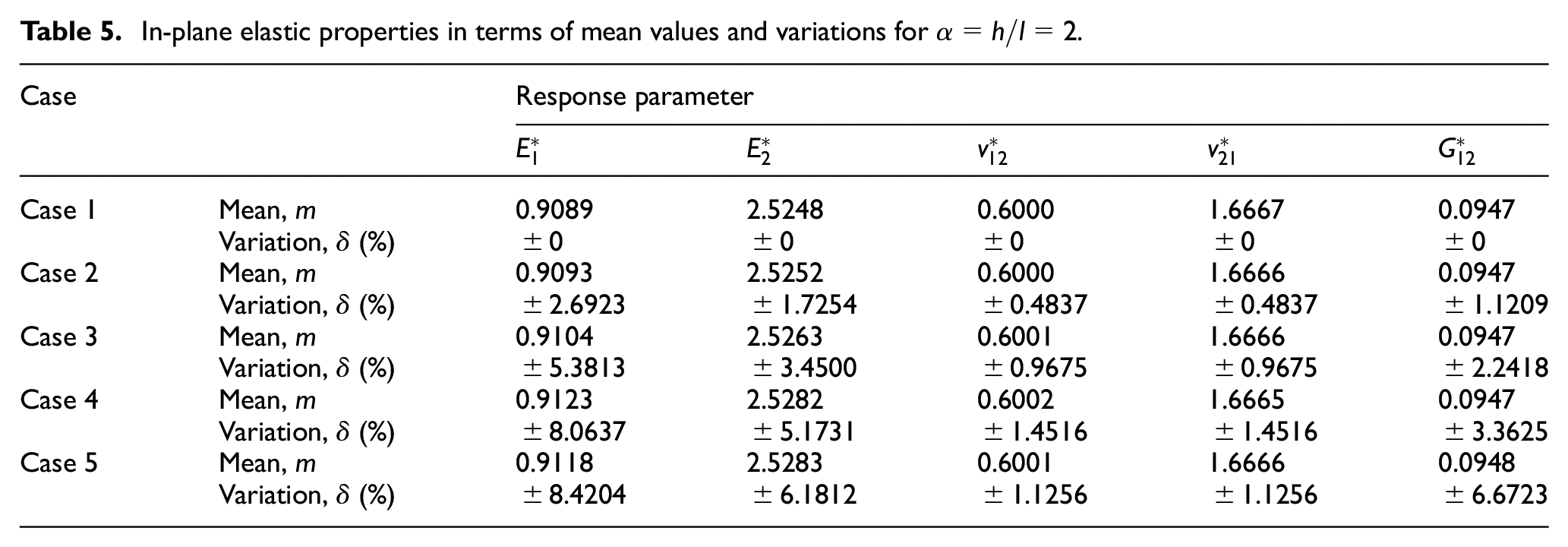
Figure 2 shows the sensitivities of the in-plane elastic properties, where

Sensitivities of in-plane elastic properties to the basic parameters.
Figures 3 to 6 show the behavior of the variations associated with the in-plane elastic properties for different values of cell angle

Variations in

Variations in

Variations in

Variations in
Conclusion
This work, for the first time, introduces the modeling and analysis of imprecisions in the in-plane elastic properties of a hexagonal honeycomb core with imprecisely defined parameters without the requirement of knowing the exact probability distributions of the imprecise parameters as is required for probabilistic approaches. The proposed models are non-probabilistic and can express the in-plane elastic properties in terms of only mean values and percent variations when the basic parameters are available in the form of mean values and percent variations. The variations predicted by the proposed models were found to be realistic and acceptable compared to the imprecisions present in the basic variables. Also, the present results secure sharper and more realistic variations compared to the ones predicted by the combinatorial method. One of the advantages of the proposed models, which cannot be achieved when imprecisions are not considered, is the performance of a sensitivity analysis. This analysis determined the influence of the variations present in each basic variable on the variations of the in-plane elastic properties.
Footnotes
Appendix
Handling editor: James Baldwin
Declaration of conflicting interests
The author declared no potential conflicts of interest with respect to the research, authorship, and/or publication of this article.
Funding
The author received no financial support for the research, authorship, and/or publication of this article.
