This research work explores the thermal and mass transport phenomena for a time-dependent Maxwell fluid flow in the presence of Cattaneo–Christov concept. The Maxwell fluid flow is analyzed through a stretching cylinder and sheet. Brownian motion, non-uniform heat source/sink, thermophoresis, and variable thermal conductivity are operated in this study. A theoretical analysis of the modeled system of equations is explored with the help of HAM. Impacts of fixed constraints on velocity, thermal, and concentration functions are offered graphically. It is concluded that the velocity profile heightens quickly for Newtonian fluid equated to non-Newtonian fluid (Maxwell) via curvature parameter while the temperature and concentration distributions increase quickly for non-Newtonian fluid as equated to the Newtonian fluid via curvature parameter. The presence of Maxwell and magnetic parameters increases the size of the trapping bolus.
Owing to the various uses throughout the fields of engineering and manufacturing equipment including insulation of nuclear reactors, heat exchangers, refrigerators, polymer processes, and plastics extrusion, research teams are now putting an excessive amount of focus on mass and heat transfer observation. The basic mathematical associations of Fourier’s and Fick’s principles are being used to explain the process of mass and heat transfer rate throughout a particular channel due to concentration and temperature variations, respectively. Computational and experimental investigations are achieved to study the characteristics of fluid flow and thermal transmission over the cylinder. Na and Pop1 examined thermal performance in viscous flow field across a flowing cylinder in the trajectory and reverse of free flow. Kumari and Nath2 studied a magnetohydrodynamic (MHD) time-dependent stagnation point viscous fluid flow. Toh et al.3 introduce numerical analysis to the Newtonian fluid flow and thermal transmission system in micro-channels. According to this analysis, when the Reynolds number is low, the viscosity of liquid declines, and thermal energy increases. The analysis of Oldroyd-B nanofluid over an extending surface with Cattaneo–Christov theory (CCT) was presented by Khan et al.4 The numerical investigation of incompressible Eyring-Powell nanofluid through a bi-directional extending sheet with CCT was offered by Wubshet.5 The stagnation point of the time-dependent incompressible Maxwell fluid flow was introduced by Moshkin et al.6 The special effects of Hall current on MHD flow of dusty fluid through a stretching surface were investigated by Gireesha et al.7 The incompressible Maxwell fluid flow through a bi-directional extending surface with convective conditions was presented by Mahanthesh et al.8 Consequences of Joule heating and Hall current viscous dissipative flows of nanofluid were Mahanthesh et al.9,10 The Maxwell fluid flow with homogeneous-heterogeneous reactions (HHR) and CCT between spiraling disks was presented by Ahmed et al.11 The MHD and electrically conducting the mixed convective flow of Maxwell fluid with CCT over a spreading surface was evaluated by Saleem et al.12 Mixed convection in MHD flow of nanofluid with nonlinear thermal conduction was investigated by Ellahi et al.13 The Hall Effect on the convective flow of micropolar fluid with CCT was investigated by Shah et al.14 In another article, Shah et al.15 analyzed the MHD second-grade thin film flow with CCT over a time-dependent stretching sheet. The carbon nanotubes nanofluid between rotating disks with CCT was introduced by Bhattacharyya et al.16
Researchers got interests in non-Newtonian fluids due to their diverse uses in the field of engineering to analyze the transportation thermal and solutal behaviors. To define the behaviors of various non-Newtonian fluids, researchers recommend different models. Furthermore, various numerical and analytical techniques are applied to solve highly nonlinear and complicated constitutive equations of different models. The buoyancy effect on MHD Oldroyd-B, Jeffrey, and Maxwell nanofluids through cone with variable properties were presented by Raju et al.17 The Maxwell and Carreau nanofluids with different physical phenomena were offered by Hsiao.18,19 Ahmed et al.20 offered the Maxwell nanofluid flow with a thermal sink/source over a rotating disk. Shah et al.21 presented the thermal conduction in a Casson ferrofluid through an extending surface. The MHD and viscous dissipative flow of micropolar nanofluid through an extending sheet was analyzed by Hsiao.22 The MHD Maxwell fluid through an extending surface was considered by Abel et al.23 The Oldroyd-B nanofluid flow with mass and thermal stratification conditions was inspected by Waqas et al.24 The Oldroyd-B fluid flow with CCT and HHR under the impact of nonlinear thermal conduction was studied by Irfan et al.25 The MHD Williamson nanofluid flow through a nonlinear extending plate was presented by Dawar et al.26 The MHD non-Newtonian nanofluid flow through two dissimilar geometries with Joule heating was presented by Dawar et al.27 The MHD Jeffrey fluid flow with Hall and ion slip influences inspected by Krishna.28 Khader and Sharma.29 analyzed the radiative flow of micropolar fluid with a magnetic effect over a stretching sheet. The MHD flow of Casson fluid with heating influence was presented by Tassaddiq et al.30 Further related studies are mentioned in Abel et al.,31 Waqas et al.,32 Irfan et al.,33 Rajagopal,34 and Alamri et al.35
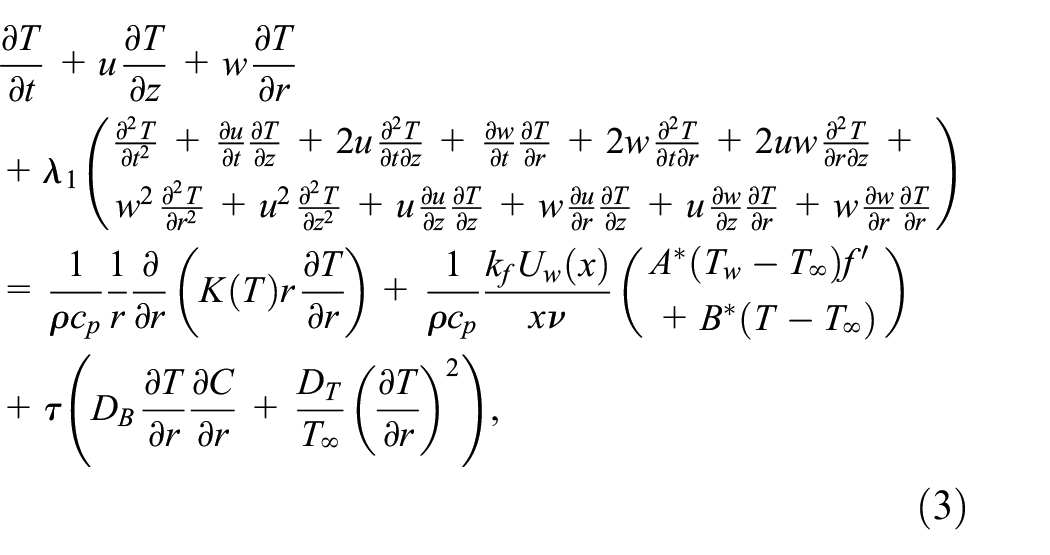
In light of the overhead declared studies, we anticipated the analytical study of time-dependent non-Newtonian Maxwell fluid with Cattaneo–Christov theory through an extending cylinder. The non-uniform heat source/sink, variable thermal conductivity, Brownian motion, and thermophoresis phenomena are operated. Section 2 represents the mathematical modeling of the proposed study. Section 3 deals with the analytical solution of the present model. Section 4 grants the results and physical discussion on the embedded parameter. Section 5 displays the concluding remarks of the present analysis.
Problem formulation
The Maxwell fluid flow through a stretching cylinder of radius is considered here. A magnetic field of strength is applied normal to the fluid flow. The variable properties are taken into account to analyze the heat transmission of the fluid flow. Cattaneo–Christov theory, thermophoresis, and Brownian motion are also utilized. Assume that and are the components of velocity along and directions correspondingly. is the axis of cylinder where is normal to as described in Figure 1. Furthermore, it is also assumed that is the unsteady stretching velocity of cylinder where are positive constants , , and are the temperature, surface temperature, and free stream temperature. , , and are the concentration, surface concentration, and free stream concentration. According to all these assumptions, the leading equations are34,35:
where is the relaxation time, is the kinematic viscosity, is the density, is the specific heat, and are the thermal and concentration relaxation times respectively, and are diffusion coefficients of Brownian motion and thermophoresis, is the variable thermal conductivity where is the free stream conductivity, is the small conductivity parameter, and is the dimensionless temperature parameter, and are the heat generation parameters, and are the heat absorption parameters.
Geometrical representation of the flow problem.
The similarity transformations are defined by:
Using (6), (2)–(5) are reduced as:
with transformed boundary conditions:
Here, the unsteadiness parameter is indicated by , magnetic parameter is demarcated by , curvature parameter is denoted by , Maxwell parameter is signified by , Prandtl number is indicated by , thermal and mass relaxation times parameters are represented by and respectively, Lewis number is indicated by , Brownian motion parameter is denoted by , thermophoresis parameter is signified by .
The skin friction, local Nusselt number, and Sherwood number are defined as:
HAM solution
The linear operators and initial guesses are defined as:
The variation in velocity , temperature , and concentration functions of the Maxwell fluid due to embedded parameters is the fundamental theme of this analysis. The values of relatable factor are taken as , , , , , , , and for the fluid flow profiles. Impacts of embedded constraints on the flow profiles are offered with the help of Figures 2 to 22. Furthermore, in the present analysis the Maxwell fluid flow is treated through cylinder () and sheet ().
Variation in via when , , , , , , , and .
Variation in via when , , , , , , , and .
Variation in via when , , , , ,, , and .
Variation in via when , , , , , , and .
Variation in via when , , , , , , and .
Variation in via when , , , , , , and .
Variation in via when , , , , , , and .
Variation in via when , , , , , , and .
Variation in via when , , , , , , , and .
Variation in via when , , , , , , and .
Variation in via when , , , , , , and .
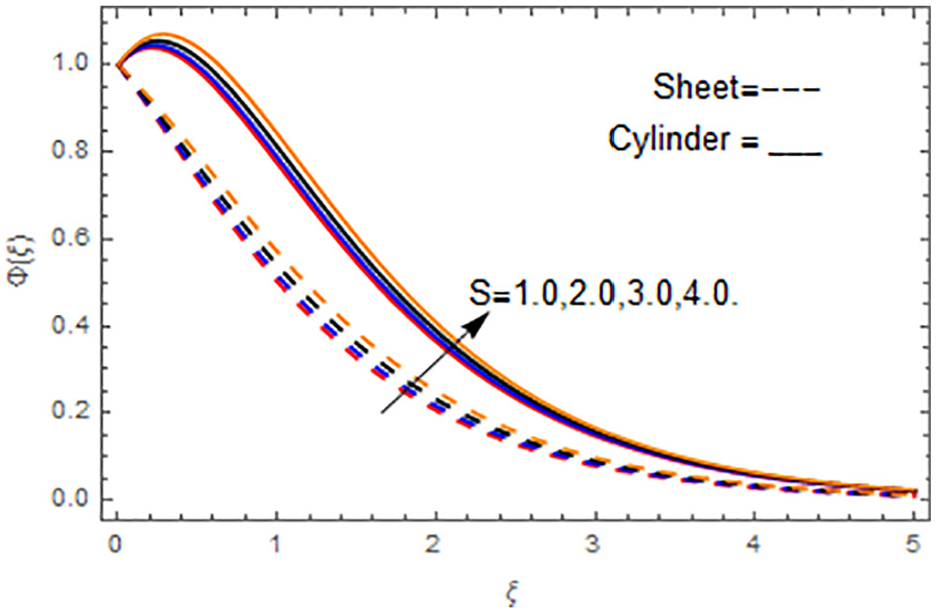
Variation in via when , , , , , , and .
Variation in via when , , , , , , and .
Variation in via when , , , , , , and .
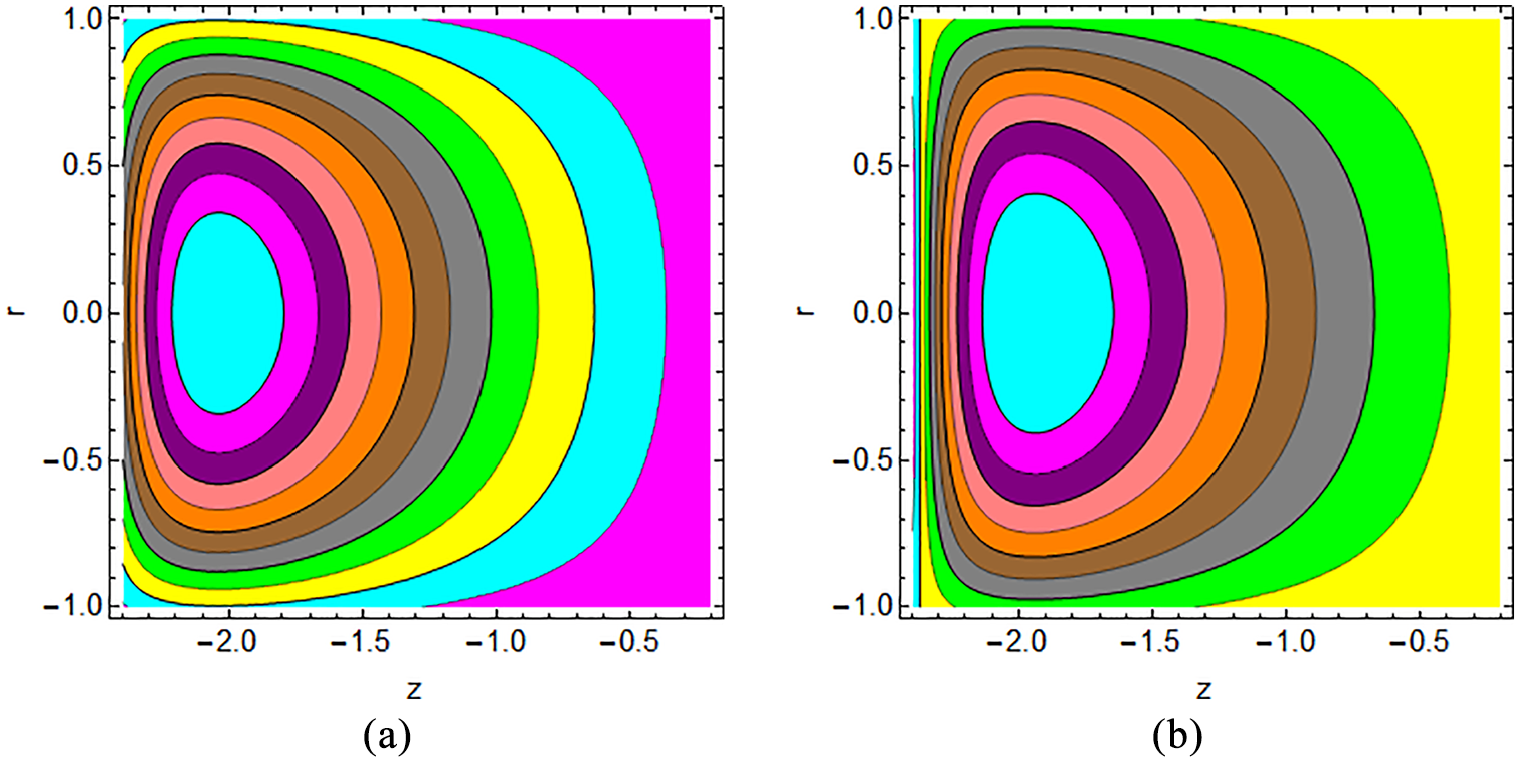
(a, b) Streamlines for the fluid flow in the absence and presence of Maxwell parameter.
(a, b) Streamlines for the Maxwell fluid flow in the absence and presence of magnetic parameter.
Sketch of residual error for different values of through sheet when , , , , , , , and .
Sketch of residual error for different values of through cylinder when , , , , , , , and .
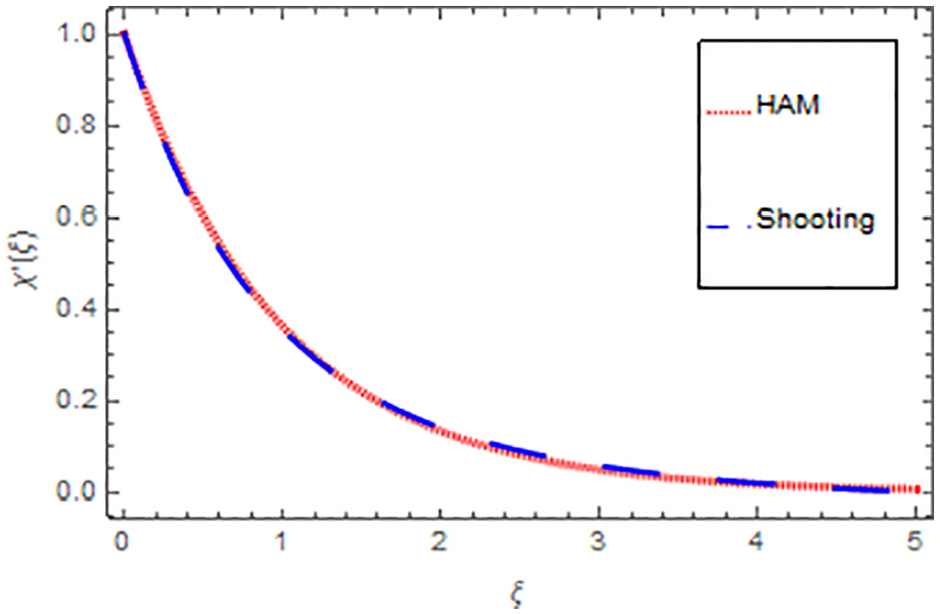
Contrast between HAM and shooting techniques for .
Contrast between HAM and shooting techniques for .
Contrast between HAM and shooting techniques for .
Figures 2 to 4 display the variation in , , and due to curvature parameter . Increasing curvature parameter heightens the Maxwell fluid flow profiles. Actually, the radius of the cylinder reduces with greater curvature parameter which reduces the impact of boundary in the Maxwell fluid flow. Thus, the velocity profile heightens. A similar impact of curvature parameter on temperature and concentration profiles is depicted. Furthermore, the influence of curvature parameter on Newtonian and non-Newtonian (Maxwell) fluid flows is compared. The increasing impression of on is greater for Newtonian fluid equated to non-Newtonian (Maxwell) fluid while a contrary conduct is observed on thermal and concentration profiles. Here, the Maxwell parameter plays an important role for Newtonian and non-Newtonian fluids. Physically, with the increasing Maxwell parameter, the fluid behaves like a solid which consequently increases the non-Newtonian fluid velocity while diminishes the thermal and mass transport. Thus, the greater impact on is depicted for Newtonian fluid associated to non-Newtonian (Maxwell) fluid while this behavior is opposite for and of Newtonian and non-Newtonian (Maxwell) fluids. Figures 5 to 7 display the variation in , , and due to unsteadiness parameter . reduces while and increase with the higher . Physically, has direct relation with positive constant . The increasing heightens the unsteadiness parameter which consequently increases the stretching rate of the sheet and cylinder. Thus, the velocity reduces with higher unsteadiness parameter. However, this impact is reverse on thermal and concentration profiles. The stretching rate of the sheet and cylinder increase the thermal and mass profiles of the fluid flow. Figure 8 signifies the consequence of Maxwell parameter on . Greater reduces . Physically, with the increasing Maxwell parameter the fluid behaves like a solid which consequently increases . Figure 9 signifies the influence of magnetic parameter on . Higher reduces . Physically, the Lorentz force produces by applying in normal direction to the fluid flow. This Lorentz force creates resistance to the fluid flow which declines the motion of fluid particles. Thus, reduces with greater . Figures 10 and 11 depict the variation in temperature profile via heat generation ( and ) and absorption parameters ( and ). In the existence of heat generation parameters, the thermal boundary layer gains additional energy which leads the temperature to escalate. Thus, the temperature profile rises with higher heat generation. However, the absorption parameters absorb the heat energy from the boundary layer which result a gradual decrease in the fluid flow temperature. From these figures, we have seen a rapid increase for the case of heat generation while this impact is slow for the case of absorption. Figure 12 shows the variation in due to Prandtl number . The higher diminishes the temperature of the fluid flow. Physically, the higher declines the thermal diffusivity of the fluid which consequently reduces the fluid temperature which demonstrates thinning in the boundary layer. Thus, the thermal profile declines with higher Prandtl number. In addition, due to the increase in thermal conductivity there can be overrun throughout the thermal boundary layer at sometimes. This consequence can be mitigated by using a heat sink to regulate the temperature. Figures 13 and 14 show the variation in and due to thermal and solutal relaxation times factors respectively. Here, and reduce with higher values of and respectively. In CCT, the instantaneous transmission of thermal waver control by relaxation time parameters requires additional time for the transportation of mass and heat. Thus, the thermal and mass profiles reduce with greater values of and . Figure 15 shows the change in concentration profile via Lewis number . The concentration profile reduces with greater . Actually, the higher values of reduce the thermal diffusivity and increase the Brownian diffusivity of the fluid which results reduction in . Thus, the increasing moderates . Figure 16(a) and (b) shows the streamlines for fluid flow in the absence and presence of Maxwell parameter . It is observed from the figures that the size of trapping bolus intensifies in the presence of whereas the size of trapping bolus reduces in the absence of . Figure 17(a) and (b) shows the streamlines for the fluid flow in the absence and presence of magnetic parameter . It is observed from the figures that the size of trapping bolus increases in the presence of whereas the size of the trapping bolus reduces in the absence of . Figures 18 and 19 show the sketches of residual error for different values of through a sheet and cylinder. The residual error for sheet converges after and the residual error for cylinder converges after . Thus, we have concluded that the residual error converges quickly for cylinder as compared to sheet. Figures 20 to 22 indicate the assessment of HAM and shooting techniques for , , and respectively. Here, both the techniques have quit close agreement.
Table 1 displays the numerical estimations of for increasing when . The increasing values of Maxwell parameter increases . Furthermore, it is also established from the comparison of numerical values that the present model is valid. Table 2 displays the numerical values of for cylinder and sheet via different embedded factors when . The higher , , , and reduce whereas the higher increases . Furthermore, these effects are greater for cylinder as compared to the sheet. Table 3 displays the numerical estimations of for cylinder and sheet via different embedded factors when . The higher , , and reduce whereas the higher increases . Furthermore, these effects are greater for cylinder as compared to the sheet.
The MHD flow of Maxwell fluid with variable thermal conductivity and non-uniform heat source/sink through a stretching cylinder is analyzed here. A magnetic field is applied normal to the fluid flow. The Cattaneo–Christov theory is taken for heat and mass transmission utilization. Final remarks are recorded underneath:
An increasing conduct is testified for velocity, thermal, and mass profiles via curvature parameter.
The increasing impression of curvature parameter on velocity profile is higher for Newtonian fluid (Maxwell) as compared to non-Newtonian fluid while a contrary conduct is observed on thermal and concentration profiles.
The velocity profile reduces while the thermal and concentration profiles increase with the higher unsteadiness parameter.
The increasing Maxwell and magnetic parameters declines the velocity profile.
The greater heat generation and heat absorption heighten the thermal profile while the escalating Prandtl number and thermal relaxation time factor reduce the thermal profile.
The higher mass relaxation and Lewis number reduce the concentration profile.
The presence of Maxwell and magnetic parameters increase the size of trapping bolus.
Footnotes
Handling editor: James Baldwin
Author contributions
Saeed Islam: Conceptualization, methodology, formal analysis, and software, resources. Abdullah Dawar: Conceptualization, investigation, writing original draft, preparation, methodology, and software. Zahir Shah: Writing review and editing, software, visualization, writing review and editing, and validation. Adnan Tariq: Writing review and editing, software, visualization, writing review and editing, and validation.
Declaration of conflicting interests
The author(s) declared no potential conflicts of interest with respect to the research, authorship, and/or publication of this article.
Funding
The author(s) received no financial support for the research, authorship, and/or publication of this article.
ORCID iDs
Abdullah Dawar
Zahir Shah
Data availability
The data that support the findings of this study are available from the corresponding author upon reasonable request.
References
1.
NaTYPopI. Flow and heat transfer over a longitudinal circular cylinder moving in parallel or reversely to a free stream. Acta Mech1996; 118: 185–195.
2.
KumariMNathG. Unsteady flow and heat transfer of a viscous fluid in the stagnation region of a three-dimensional body with a magnetic field. Int J Eng Sci2002; 40: 411–432.
3.
TohKCChenXYChaiJC. Numerical computation of fluid flow and heat transfer in microchannels. Int J Heat Mass Transf2002; 45: 5133–5141.
4.
KhanWAIrfanMKhanA. An improved heat conduction and mass diffusion models for rotating flow of an Oldroyd-B fluid. Results Phys2017; 7: 3583–358.
5.
IbrahimW. Three dimensional rotating flow of Powell–Eyring nanofluid with non-Fourier’s heat flux and non-Fick’s mass flux theory. Results Phys2018; 8: 569–577.
6.
MoshkinNPPukhnachevVVBozhkovYD. On the unsteady, stagnation point flow of a Maxwell fluid in 2D. Int J Non-Linear Mech2019; 116: 32–38.
7.
GireeshaBJMahantheshBThammannaGT, et al. Hall effects on dusty nanofluid two-phase transient flow past a stretching sheet using KVL model. J Mol Liq2018; 256: 139–147.
8.
MahantheshBGireeshaBJThammannaGT, et al. Nonlinear convection in nano Maxwell fluid with nonlinear thermal radiation: a three-dimensional study. Alex Eng J2018; 57(3): 1927–1935.
9.
MahantheshBShashikumarNSGireeshaBJ, et al. Effectiveness of Hall current and exponential heat source on unsteady heat transport of dusty TiO2–EO nanoliquid with nonlinear radiative heat. J Comput Des Eng2019; 6(4): 551–561.
10.
MahantheshBShehzadSAAmbreenT, et al. Significance of Joule heating and viscous heating on heat transport of MoS2-Ag hybrid nanofluid past an isothermal wedge. J Therm Anal Calorim2020; 143: 1221–1229.
11.
AhmedJKhanMAhmadL. Effectiveness of homogeneous heterogeneous reactions in Maxwell fluid flow between two spiraling disks with improved heat conduction features. J Therm Anal Calorim2020; 139: 3185–3195.
12.
SaleemSAwaisMNadeemS, et al. Theoretical analysis of upper-convected Maxwell fluid flow with Cattaneo–Christov heat flux model. Chin J Phys2017; 55: 15–25.
13.
EllahiRZeeshanAShehzadN, et al. Structural impact of kerosene-Al2O3 nanoliquid on MHD Poiseuille flow with variable thermal conductivity: application of cooling process. J Mol Liq2018; 264: 607–615.
14.
ShahZShutaywiMDawarA, et al. Impact of Cattaneo-Christov heat flux on non-isothermal convective micropolar fluid flow in a Hall MHD generator system. J Mater Res Technol2020; 9(3): 5452–5462.
15.
ShahZAlzahraniOEDawarA, et al. Entropy generation in MHD second-grade nanofluid thin film flow containing CNTs with Cattaneo-Christov heat flux model past an unsteady stretching sheet. Appl Sci2020; 10: 2720.
16.
BhattacharyyaASethGSKumarR. Simulation of Cattaneo–Christov heat flux on the flow of single and multi-walled carbon nanotubes between two stretchable coaxial rotating disks. J Therm Anal Calorim2020; 139: 1655–1670.
17.
RajuCSKSandeepNMalvandibA. Free convective heat and mass transfer of MHD non-Newtonian nanofluids over a cone in the presence of non-uniform heat source/sink. J Mol Liq2016; 221: 108–115.
18.
HsiaoKL. Combined electrical MHD heat transfer thermal extrusion system using Maxwell fluid with radiative and viscous dissipation effects. Appl Therm Eng2017; 112: 1281–1288.
19.
HsiaoKL. To promote radiation electrical MHD activation energy thermal extrusion manufacturing system efficiency by using Carreau–Nanofluid with parameters control method. Energy2017; 130: 486–499.
20.
AhmedJKhanMAhmadL. Stagnation point flow of Maxwell nanofluid over a permeable rotating disk with heat source/sink. J Mol Liq2019; 287: 110853.
21.
ShahZDawarAKhanI, et al. Cattaneo-Christov model for electrical magnetite micropoler Casson ferrofluid over a stretching/shrinking sheet using effective thermal conductivity model. Case Stud Therm Eng2019; 13: 100352.
22.
HsiaoKL. Micropolar nanofluid flow with MHD and viscous dissipation effects towards a stretching sheet with multimedia feature. Int J Heat Mass Transf2017; 112: 983–990.
23.
AbelMSTawadeJVNandeppanavarMM. MHD flow and heat transfer for the upper-convected Maxwell fluid over a stretching sheet. Meccanica2012; 47: 385–393.
24.
WaqasMKhanMIHayatT, et al. Stratified flow of an Oldroyd-B nanoliquid with heat generation. Results Phys2017; 7: 2489–2496.
25.
IrfanMKhanMKhanWA. Impact of homogeneous-heterogeneous reactions and non-Fourier heat flux theory in Oldroyd-B fluid with variable conductivity. J Braz Soc Mech Sci Eng2019; 40: 108.
26.
DawarAShahZIslamS. Mathematical modeling and study of MHD flow of Williamson nanofluid over a nonlinear stretching plate with activation energy. Heat Transfer2020; 50(3): 2558−2570.
27.
DawarAShahZTassaddiqA, et al. A convective flow of Williamson nanofluid through cone and wedge with non-isothermal and non-isosolutal conditions: a revised Buongiorno model. Case Stud Therm Eng2021; 24: 100869.
28.
KrishnaMV. Hall and ion slip impacts on unsteady MHD free convective rotating flow of Jeffrey fluid with ramped wall temperature. Int Commun Heat Mass Transfer2020; 119: 104927.
29.
KhaderMMSharmaRP. Evaluating the unsteady MHD micropolar fluid flow past stretching/shirking sheet with heat source and thermal radiation: implementing fourth order predictor–corrector FDM. Math Comput Simul2021; 181: 333−350.
30.
TassaddiqAKhanISooppyNK, et al. MHD flow of a generalized Casson fluid with Newtonian heating: a fractional model with Mittag–Leffler memory, Alex Eng J2020; 59: 3049−3059.
31.
AbelMSTawadeJVNandeppanavarMM. MHD flow and heat transfer for the upper-convected Maxwell fluid over a stretching sheet. Meccanica2012; 47: 385–393.
32.
WaqasMKhanMIHayatT, et al. Stratified flow of an Oldroyd-B nanoliquid with heat generation. Results Phys2017; 7: 2489–2496.
33.
IrfanMKhanMKhanWA. Impact of homogeneous-heterogeneous reactions and non-Fourier heat flux theory in Oldroyd-B fluid with variable conductivity. J Braz Soc Mech Sci Eng2019; 40: 521.
34.
RajagopalKR. A note on novel generalizations of the Maxwell fluid model. Int J Non-Linear Mech2012; 47(1): 72–76.
35.
AlamriSZKhanAAAzeezM, et al. Effects of mass transfer on MHD second grade fluid towards stretching cylinder: a novel perspective of Cattaneo–Christov heat flux model. Phys Lett A2019; 383: 276–281.
36.
LiaoSJ. Beyond perturbation: introduction to homotopy analysis method. Boca Raton: Chapman and Hall/CRC Press, 2003.
37.
LiaoSJ. On the homotopy analysis method for nonlinear problems. Appl Math Comput2004; 147: 499e513.
38.
LiaoSJ. Notes on the homotopy analysis method: some definitions and theorems. Commun Nonlinear Sci Numer Simul2009; 14: 983e997.