In recent work, the Jeffrey liquid with uniform dust particles in a symmetric channel is studied. Moving sinusoidal wave is executed on the walls of the channel, which generates peristaltic transport in the fluid. The governing equations for fluid and dust particles have been formulated using stream function. Perturbation method is used to get analytical solution of the problem by using small wave number. Graphical analysis has been carried out for stream function and velocity of fluid and dust particles. Effects of different parameters such as curvature k, relaxation time , wave number and retardation time are debated through graphs for both dust particles and fluid. The noteworthy outcomes are fluid velocity, pressure gradient in the region and bolus size increases by increasing
Peristaltic pumping is the motion of a fluid by travelling waves executed on the walls of a channel or tube. Peristaltic flow has extensive applications in numerous industries and physiological processes. The phenomena of peristalsis is applied to drive the biological fluid from one organ to another, for example, the chyme motion in the digestive system and the motion of blood in vessels. Peristaltic pumping is applied in biomedical devices in particularly the heart-lung machine. Peristaltic pumps are used in paint industry and petroleum. In nuclear industry, the peristaltic motion of toxic liquid is used to prevent environment from contamination. Latham1 is recognized as pioneer who investigated peristaltic fluid motion experimentally. Fung and Yih2 gave the mathematical model on the laboratory frame of reference. A comprehensive review of the previous literature regarding peristalsis is explained by Jaffrin and Shapiro.3 Srivastava4 studied couple-stress fluid with peristalsis. Alokaily et al.5 carried out numerical analysis of peristaltic flow of fluid in tubes of uniform radius as well as linearly decreasing radius. Many researchers6–10 studied the peristaltic flow of fluids under various situations. Hayat et al.11 deliberated peristaltic flow in curved channel with Dufour and Soret effects. Kothandapani and Prakash12 studied peristaltic propulsion of non-Newtonian fluids with transverse magnetic field. In addition, analysis of sinusoidal flow of Maxwell and Johnson–Segalman fluids have been carried by Hayat et al.13 with slip and Kothandapani et al.14 without slip conditions.
The fluid flow incorporated with solid particles has wide applications in engineering problems concerning dust collection, performance of solid fuel rock nozzles, powder technology, sedimentation, guided missiles, acoustics, batch settling, nuclear reactor cooling and paint spraying etc. Saffman’s15 considered blood as binary system and constructed dusty fluid model. Gupta and Gupta16 has analyzed the flow of the dusty gas with time dependent pressure gradient. Unsteady viscous fluid flow with dust particles uniformly distributed has been analyzed by Gireesha et al.17 by considering rectangular channel. Recently, a study on dusty gas has been carried out by Yin et al.18 Khan and Tariq19 studied the wall properties effect on the dusty Walter’s B fluid. Later they extended this study and investigated the impact of Walter’s B fluid in an inclined asymmetric passage with magnetic field induced in Tariq et al.20 Khan and Tariq21 has studied the dusty second-grade fluid in a porous medium with slip conditions at the boundaries. Turkyilmazoglu22 studied influence of heat transfer on dusty fluid with isothermal surfaces.
Since in reality, all physiological conduits and blood vessels are curved in nature therefore the study of fluid flow in curved channel is of great significance. The initial study of fluid flow in smooth curved channel was presented by Dean.23 Reid24 studies pressure gradient effect on viscous flow between two concentric cylinders. Sato et al.25 studied two dimensional peristaltic flow of viscous fluid in curved channel. Okechi and Asghar26 analyzed flow in wavy curved channel under pressure force. Rashid et al.27 examined the peristaltic movement of Williamson fluid in curved channel with induced magnetic field. Hayat et al.28 studied the consequence of magnetic field on peristaltic motion of Suttre by fluid in curved configuration.
However, Peristaltic flow of dusty Jeffrey fluid has not been studied in curved channel. The present research aims to examine the Jeffrey fluid containing the uniform solid particles with curved boundaries. The nonlinear equations modeled and solved with perturbation method. For both solid particles and fluid, the velocity field and stream function are calculated. The influence of numerous parameters on the solid particles and the fluid are explained through graphs.
Formulation of the problem
We consider flow of an incompressible Jeffrey fluid having uniform dust particles, whose number density N is considered as a constant. A two-dimensional curved channel of width 2a is taken. The radial and axial components are and . The radial velocities of fluid and dust particles are and while and are axial velocities, respectively. The walls are geometrically described by
where s the resistance co-efficient and m the mass of the dust particles.
The laboratory frame and the wave frame coordinates are associated by the following transformation, see Figure 1
Introducing the following stream functions and dimensionless quantities
Where Re the Reynolds number, A and B are non-dimensional parameters, the wave number, k curvature and the retardation time
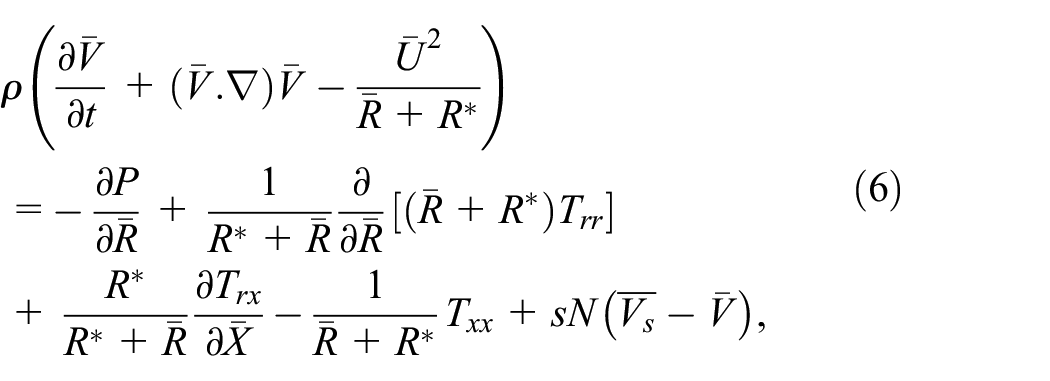
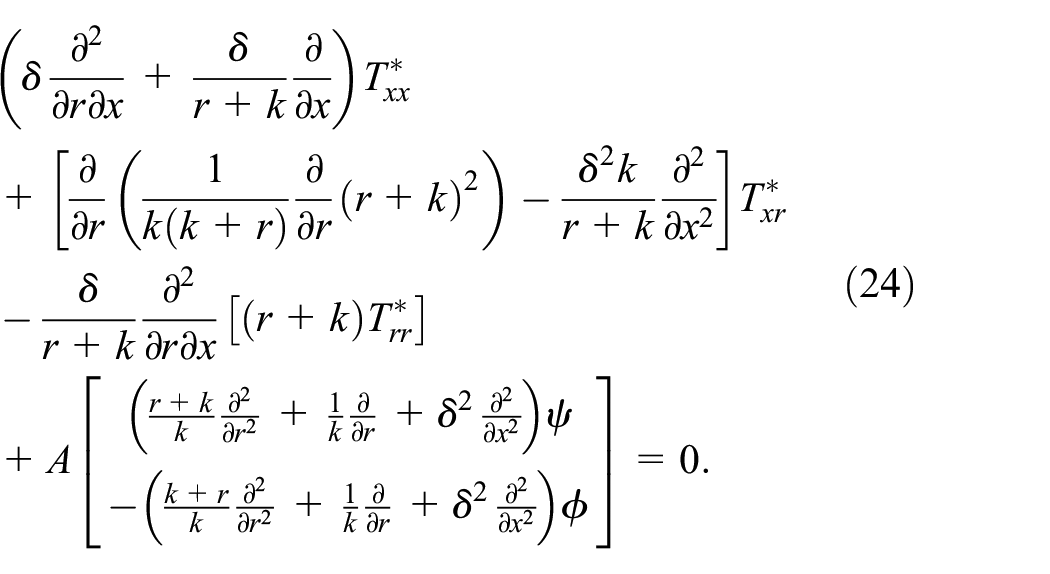
After using above quantities, the governing equations thus become as:
For fluid flow
For solid particles
The compatibility equations for solid particles and fluid are
where
The walls in dimensionless form are
The time mean flow rate in dimensionless form is represented by F.
where
The time mean flow rate for dust particles in dimensionless form is represented by E.
It is related with , the dimensionless time flow with in the fixed frame as
Geometry.
Method of solution
For low Reynolds number and small wave number, the momentum equation (16) for fluid particles becomes
Perturbation method has been utilized to find the solution of the problem. The stream functions and , E and F are expanded in terms of as
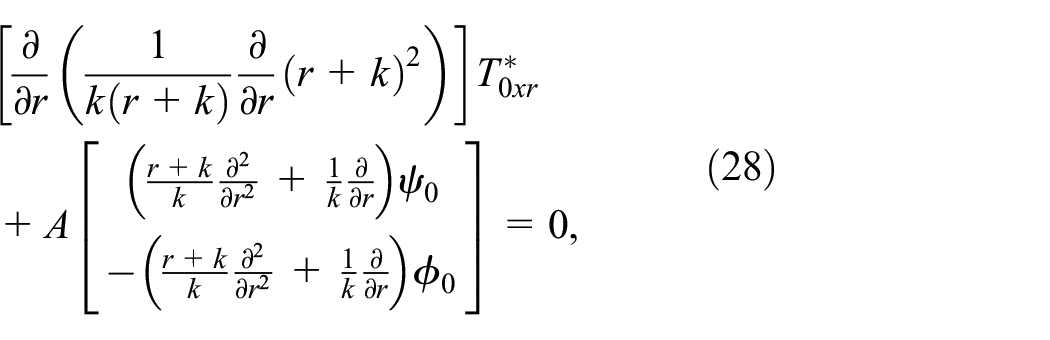
Zeroth order system (for
where
along with the boundary conditions
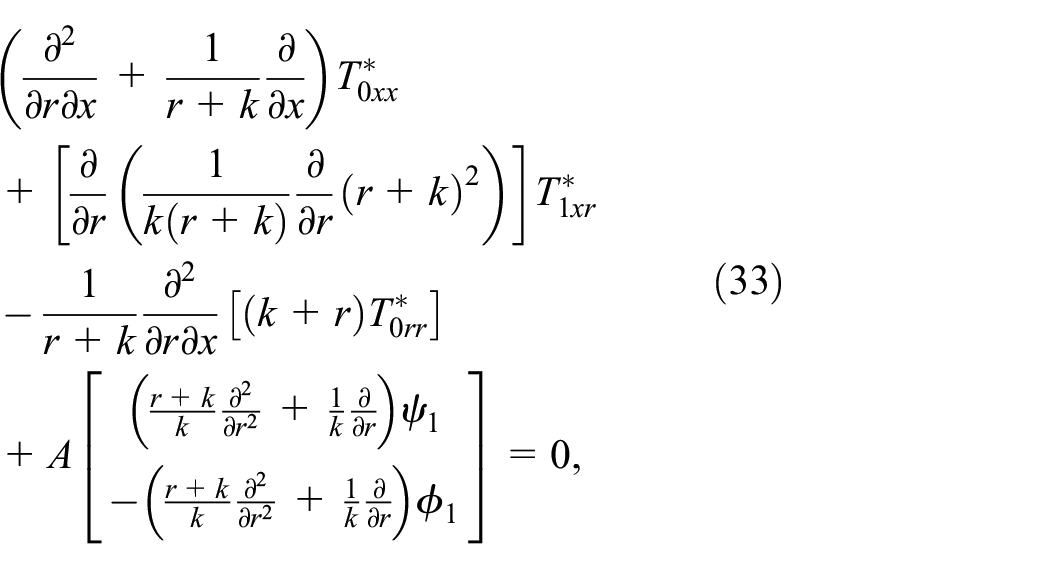
First-order system
where
along with the boundary conditions
The solution of above system of equations are calculated by applying DSolver in Mathematica.
Results and discussions
Graphical demonstration of various parameters on velocity profile and stream functions will be discussed in this section. The establishment of an internally circulating bolus of fluid by closed stream lines is called trapping and this is pushed along with the peristaltic wave. In the Figures 2 to 4 streamline graphs have been drawn for different values of curvature retardation time and wavenumber and behavior of bolus has been discussed. In Figure 2, streamline graphs are drawn for different values of k. This figure indicates that bolus moves toward left by increasing curvature k of the channel. Figure 3 shows that size of bolus increases as wave number increases. Effect of retardation time can be seen in Figure 4. It is shown that significant increase in retardation time and bolus moves toward left.
Streamline presentation for fluid for: (a) k = 4, (b) k = 10, and (c) k = 20 with
Streamline presentation for fluid for: (a) δ = 0.02, (b) δ = 0.06, and (c) δ = 0.09 with
Streamline presentation for fluid for: (a) α = 1, (b) α = 60, and (c) α = 90 with δ = 0.09, k = 4, a = 0.2, φ = 0.2, A = 0.2, B = 0.1, = 0.4.
Impact of curvature relaxation time , retardation time and wavenumber on fluid velocity can be seen in Figure 5. In Figure 5(a), velocity profile is plotted for different values of retardation time . It is depicted that velocity increases by increasing . In Figure 5(b), fluid velocity graph is plotted for different values of relaxation time . It is observed that by increasing relaxation time , fluid velocity decreases. This specifies more time is required by the fluid particles to derive back to the equilibrium condition from perturbed condition. In Figure 5(c), velocity graph is presented for varying values of wavenumber . It portrays the enhanced behavior of velocity by increasing . In Figure 5(d), velocity graph is drawn for variation of curvature k. It indicates that fluid velocity is decays by increasing curvature of channel. Velocity rises for straight channel in contrast with curved channel.
Impact of curvature relaxation time and retardation time on particle velocity can be observed in Figure 6. In Figure 6(a), dust particle velocity graph is plotted for different values of retardation time . It is observed that by increasing , particle velocity decreases. In Figure 6(b), velocity graph is presented for varying values of curvature k. It portrays the decreasing behavior of velocity by increasing curvature of the channel. In Figure 6(c), velocity profile for dust particles is drawn for variation of relaxation time . It depicts that velocity declines by increasing .
The fluid velocity with:
The particle velocity with:
Graphs of pressure gradient versus x are shown in Figure 7 for different values of wavenumber , relaxation time and retardation time . In Figure 7(a), pressure gradient graphs are drawn for different values of wave number . Graphs of pressure gradient are plotted for various values of retardation time in Figure 7(b). Influence of relaxation time on pressure gradient is graphically demonstrated in Figure 7(c).The pressure gradient is increases as relaxation time increases. The pressure gradient as produced by the peristaltic motion of the walls is closely associated to the azimuthal normal stress and shear stress which are both controlled by fluid’s elasticity (see Eq. 13).
Pressure gradient with:
Conclusions
Analysis of peristaltic motion of dusty fluid has been carried out. Jeffrey fluid model has been considered with curved boundary walls. Impacts of various parameters on stream function, fluid velocity and particle velocity has been discussed graphically. Significant features of current analysis are:
Size of bolus increases by increasing wave number.
Significant increase in retardation time moves bolus toward left.
Bolus moves toward left by increasing curvature.
Fluid velocity decays by increasing curvature parameters, relaxation time.
Particle velocity decays as retardation time, relaxation time and curvature increase.
Pressure gradient enhances by increasing relaxation time.
Footnotes
Handling editor: James Baldwin
Declaration of conflicting interests
The author(s) declared no potential conflicts of interest with respect to the research, authorship, and/or publication of this article.
Funding
The author(s) received no financial support for the research, authorship, and/or publication of this article.
ORCID iD
Ambreen Afsar Khan
References
1.
LathamTW.Fluid motions in a peristaltic pump. MSc Thesis, Massachusetts Institute of Technology, Cambridge, MA, 1966.
JaffrinMYShapiroAH.Peristaltic pumping. Ann Rev Fluid Mech1971; 3: 13–37.
4.
SrivastavaLM.Peristaltic transport of a couple-stress fluid. Rheol Acta1986; 25: 638–641.
5.
AlokailySFeiglKTannerFX, et al. Numerical simulations of the transport of Newtonian and non-Newtonian fluids via peristaltic motion. Appl Rheol2018; 28: 1–5.
RajuKKDevanathanR.Peristaltic motion of a non-Newtonian fluid. Rheol Acta1972; 11: 170–178.
8.
RadhakrishnamacharyaG.Long wavelength approximation to peristaltic motion of a power law fluid. Rheol Acta1982; 21: 30–35.
9.
MishraMRaoAR. Peristaltic transport of a Newtonian fluid in an asymmetric channel, Z. Angew. Math Phys2003; 54: 532–550.
10.
EllahiRHussainF.Simultaneous effects of MHD and partial slip on peristaltic flow of Jeffery fluid in a rectangular duct. J Magn Magn Mater2015; 393: 284–292.
11.
HayatTNaheedBYasminH, et al. Peristaltic flow of Williamson fluid in a convected walls channel with Soret and Dufour effects. Int J Biomath2015; 9: 1650012.
12.
KothandapaniMPrakashJ.The peristaltic transport of Carreau nanofluids under effect of a magnetic field in a tapered asymmetric channel application of the cancer therapy. J Mech Med Biol2015; 15:1550030.
13.
HayatTHinaSAwatifaA.Slip effects on peristaltic transport of a Maxwell fluid with heat and mass transfer. J Mech Med Biol2012; 12: 1250001.
14.
KothandapaniMPrakashJPushparajV.Nonlinear peristaltic motion of a Johnson–Segalman fluid in a tapered asymmetric channel. Alex Eng J2016; 55: 1607–1618.
15.
SaffmanPG.On the stability of laminar flow of a dusty gas. J Fluid Mech1962; 13: 120–128.
16.
GuptaRKGuptaSC.Flow of a dustry gas through a channel with arbitrary time varying pressure gradient. Z Angew Math Phys1976; 27: 119–125.
17.
GireeshaBJBagewadiCSPrasannakumarBC.Pulsatile flow of an unsteady dusty fluid through rectangular channel. Commun Nonlinear Sci Numer Simul2009; 14: 2103–2110.
18.
YinJDingJLuoX.Numerical study on dusty shock reflection over a double wedge. Phys Fluids2018; 30: 013304.
19.
KhanAATariqH.Influence of wall properties on the peristaltic flow of a dusty Walter’s B fluid. J Braz Soc Mech Sci Eng2018; 40: 368.
20.
TariqHKhanAAZamanA.Peristaltically wavy motion on dusty Walter’s B fluid with inclined magnetic field and heat transfer. Arab J Sci Eng2019; 44: 7799–7808.
21.
KhanAATariqH.Peristaltic flow of second-grade dusty fluid through a porous medium in an asymmetric channel. J Porous Media2020; 23: 883–905.
22.
TurkyilmazogluM.Magnetohydrodynamic two-phase dusty fluid flow and heat model over deforming isothermal surfaces. Phys Fluids2017; 29: 013302.
23.
DeanWR.Fluid motion in a curved channel. Proc Math Phys Character1928; 121: 402–420.
24.
ReidWH.On the stability of viscous flow in a curved channel. Proc Math Phys Sci1958; 244: 186–198.
25.
SatoHKawaiTFujitaT, et al. Two-dimensional peristaltic flow in curved channels. Trans Jpn Soc Mech Eng B2000; 643: 39–45.
26.
OkechiNFAsgharS.Fluid motion in a corrugated curved channel. Eur Phys J Plus2019; 134: 165.
27.
RashidMAnsarKNadeemS.Effects of induced magnetic field for peristaltic flow of Williamson fluid in a curved channel. Physica A2020; 17: 123979.
28.
HayatTAlsaadiFRafiqM, et al. On effects of thermal radiation and radial magnetic field for peristalsis of sutterby liquid in a curved channel with wall properties. Chin J Phys2017; 55: 2005–2024.
29.
HayatTZahirHTanveerA, et al. Soret and Dufour effects on MHD peristaltic transport of Jeffrey fluid in a curved channel with convective boundary conditions. PLoS One2017; 12: e0164854.
30.
KhanAA.Peristaltic movement of a dusty fluid in a curved configuration with mass transfer. Punjab Univ J Math2021; 53: 55–71.