



Abstract
Ball valve is an important control component in the pipeline transportation system. It is widely used in pipeline transportation systems to control the pressure and flow parameters of the conveying medium. Based on the user-defined UDF technology and the standard k-
Introduction
Valve is an important control element in pipeline transportation system. By changing the flow section and direction of medium flow, the opening and closing, reversing and regulating flow rate of fluid medium path are carried out, so as to control the pressure, flow rate, and temperature of the medium. Ball valves are widely used in aerospace, water conservancy engineering, petrochemical, environmental protection engineering, and other pipeline transportation systems because of their compact structure, small fluid resistance, large flow capacity, easy operation and maintenance, and wide application conditions. 1 Ball valves came out in the 1950s, with the rapid development of science and technology and the continuous improvement of production technology and product structure, in a short period of 40 years, they have rapidly developed into a major type of valves. Ball valves in the pipeline are mainly used to cut off, distribute, and change the direction of media flow, it only needs 90° of rotation operation and a small moment of rotation to close tightly. Because of the sudden opening and closing or working at different openings, the ball valve will prevent the flow medium, cause the change of flow field structure and produce complex vortices, which will not only aggravate the flow loss, but also accompanied by severe impact and vibration. This kind of impact and vibration often lead to the deformation and fatigue failure of the valve body, and then affect the control and adjustment accuracy. In serious cases, it may cause the instability of the whole working system. Therefore, the research on the opening and closing mode of ball valve is of great significance to improve the performance of ball valve.
In recent years, with the development of computational fluid dynamics (CFD) and computer technology, scholars at home and abroad have done a lot of research work on the internal flow and structural optimization design of valves. However, in the process of research, the relationship between valve opening, force, flow noise and flow parameters in the process of variable working conditions, and variable speed opening and closing is ignored in the design work. Cui et al.
2
based on the finite volume method and standard k-
Through literature review, it can be found that the researchers used CFD technology to carry out numerical simulation research on various valves. However, few scholars have studied the transient control law of flow characteristics of ball valves and the influence of internal flow field. Current research mainly focuses on the uniform motion of electric actuators. Therefore, the influence of variable speed control law of electric actuator on the performance of ball valve is studied by numerical simulation. The research results can provide theoretical basis and guidance for the design and application of variable speed opening and closing of the pipeline ball valve.
Numerical simulation method
Mathematical modeling of flow
The flow field in the present investigation is incompressible inside the ball valve. Based on the three-dimensional unsteady Navier-Stokes governing equation and the computational fluid dynamics (CFD) software FLUENT, the three-dimensional flow field of the ball valve in the process of variable speed opening and closing is numerically simulated. The governing equations to be solved are as follow.19–22
(1) Continuity equation:

(2) Momentum equation:

where, μl and μt represent molecular diffusivity (kinematic viscosity) and turbulent diffusivity, respectively. ρ is the fluid density, p represents the fluid pressure, and
Because the flow is a very complex three-dimensional turbulent flow inside the ball valve, the turbulent model is solved by standard k-
(3) Turbulent kinetic energy equation (k):

(4) Turbulent dissipation rate equation (
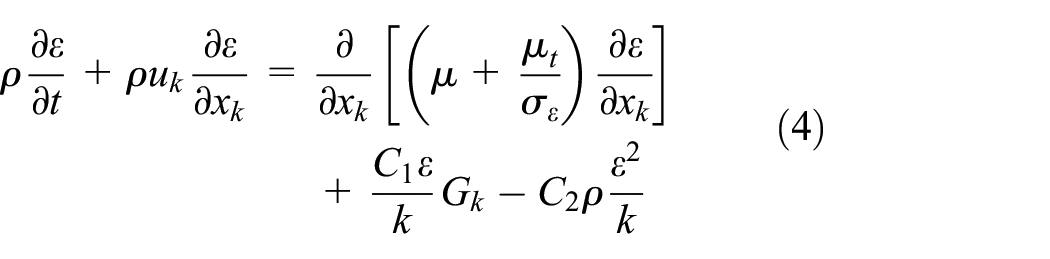
The turbulent energy and dissipation rate generating terms Gk and Gε in the equation are calculated as follows:

In the formula,

Geometrical model
In this paper, a pipeline ball valve with a diameter of d = 50 mm is used as the research object. When ball rotation of angle ball valve (

(a) The structure of the ball valve and (b) three-dimensional computational mesh of the ball valve pipeline system.
Grid generation
In this paper, the diameter of the pipeline is d = 50 mm. Therefore, there is 5d mm in length in the upstream before the valve center and 10d mm in length in the downstream after the valve center, so that the full development of the turbulence. The calculating method specified in the Chinese National Standard “Valves-Test method of flow coefficient and flow resistance coefficient (GB/T 30832-2014)” is used for ball valve upstream and downstream pipeline extension. In addition, relevant references 2 are also referred. The total unit number of the grid (Table 1) is about 1,057,554, as showed in Figure 1(b).
Grid information for ball valve of three-dimensional flow field model.

In this paper, the grid unrelated verification is carried out, and the supplemental materials are as follows. When the opening is 20°and the variable speed is 18, 23, and 34 s, the grids of about 500,000, 1,050,000, and 2,700,000 are carried out respectively. By calculating the resistance coefficient (Table 2), the grid of about 1,500,000 is finally selected for numerical simulation.
Mesh independence verification.

Boundary condition
The inlet and outlet boundary condition are set as pressure inlet and pressure outlet, respectively. The inlet pressure boundary condition was 17.04 kPa and the outlet pressure boundary condition was 15.31 kPa. There are three pairs of interface surfaces during the movement of the ball valve spool, which are the interface between the ball valve spool and the upstream of the pipeline, the interface between the ball valve spool and the downstream of the pipeline, and the interface between the ball valve and the clearance. The temperature used in this paper is 298 K, about 24°C. The temperature range specified in the Chinese National Standard “Test Method for valve flow coefficient and flow resistance coefficient (GB/T 30832-2014)” is adopted. In addition, it is also used in some literature. The convergence residual is 10−5. Considering the possibility of the actuator’s motion law, a representative motion law of the first order function is selected here, and it accelerates and closes in the first half of time and slows down and closes in the second half. Its motion equation is as follows:
(1)

(2)

(3)

where, w is the implementation of the speed of the organization, rad/s; t is the time, s.
The speed control of the ball valve movement process, through the UDF programming process to achieve transient numerical simulation. Figure 2 is the curve function. This function is obtained by MATLAB fitting.

The curve function of the implementation of the speed of the organization: (a) 18 s variable speed motion, (b) 23 s variable speed motion, and (c) 34 s variable speed motion.
Results and discussion
Flow coefficient of ball valve
Flow coefficient is a dimensionless quantity, it reflects the flow capacity of the valve. It is an important parameter for valve design. Flow coefficient KV 24 as follows:

where qv is the total flow rate across the valve (m3/h), ρ is the fluid density (kg/m3), and ΔP is the measured pressure drop (bar).
In order to facilitate the analysis, the relative flow coefficient is obtained by normalizing the flow coefficient under the condition of full opening valve (KV/KVmax). The results are shown in Figure 3. It can be seen from Figure 3 that under the three shifting execution rules, as the opening degree of the ball valve increases, the flow coefficient curve of the ball valve shows a gradually increasing trend; when the ball valve opening degree is 10°–30°, the ball valve is in three kinds. The flow coefficient is basically the same during the shifting execution regular motion; when the ball valve opening is greater than 30°, the flow coefficient curve of the ball valve 18 and 34 s during the shifting movement process is not much different, but it is higher than the flow coefficient value of the ball valve 23 s during the shifting movement process. When the opening degree of the ball valve is greater than 30°, the form of the curve function of the ball valve shifting motion will have a great influence on the flow coefficient of the ball valve. The ball valve 18 s has the highest flow coefficient curve during the shifting motion of the ball valve, which indicates the time of the ball valve movement process. The faster the ball valve is, the greater the flow capacity. However, when the ball valve opening degree is 10°–30°, the ball valve flow coefficient curve is enlarged, and the flow coefficient of the ball valve is not exactly the same under the three shifting execution rules. The research results of the whole ball valve shifting motion process show that by designing the curve function of the ball valve actuator movement process with different structural forms, different types of ball valve flow coefficient curves can be obtained, which makes the ball valve as a flow regulating valve more widely used.

Flow coefficients of the ball valve under different variable speed motion.
Resistance coefficient of ball valve
Resistance coefficient

where, ΔP is the inlet and outlet section pressure loss of ball valve, kPa; ρ is the density of the water; V is the average flow rate of the water in the pipeline.
Figure 4 is the resistance coefficient curve of ball valve under three kinds of variable speed execution laws and different opening degrees. It can be seen from Figure 4 that under the three variable speed execution laws, with the increase of ball valve opening, the resistance coefficient of ball valve decreases; when the ball valve opening is 20°–90°, the resistance coefficient of ball valve is basically the same in the three variable speed execution laws; when the ball valve opening is 10°–20°, the resistance number difference of ball valve is the largest; when the ball valve opening is less than 20°, the ball valve changes speed for 18 s that the value of resistance coefficient is the lowest, the highest in 23 s, the middle in 34 s; when the opening of ball valve is 60°–90°, the curve of resistance coefficient is enlarged locally, and the value of resistance coefficient is the highest in 23 s. These studies show that the ball valve has the largest flow resistance and the worst flow capacity in the process of 23 s variable speed movement, which is corresponding to the change of flow coefficient in the process of three kinds of variable speed movement. The research results of the whole resistance coefficient curve show once again that by designing the curve function of the movement process of the ball valve actuator with different structural forms, the resistance coefficient curve of different forms can be obtained, which makes the ball valve as a flow regulating valve more widely used. At the same time, the research and analysis show that the resistance coefficient of ball valve changes dramatically under small opening. By shortening the movement time of ball valve, the flow resistance of ball valve under small opening can be reduced to a certain extent, and the flow capacity of ball valve can be increased.

Resistance coefficient of the ball valve under different variable speed motion.
Pressure drop of the ball valve at inlet and outlet
Figure 5 is the pressure difference curve of inlet and outlet pipelines under three variable speed execution laws and different opening angles of ball valves. In order to facilitate the analysis, the pressure difference value under the minimum opening of the valve is taken as the basis for normalization(ΔP/ΔPmax). It can be seen from Figure 5 that under the three shift execution rules, the pressure difference of the ball valve decreases with the increase of the opening degree of the ball valve; when the ball valve opening degree is 10°–50°, the ball valve performs the regular motion process in three kinds of shifting. The medium pressure difference is basically the same; when the ball valve opening degree is 50°–90°, the pressure difference of the ball valve is large; when the ball valve opening degree is 50°–80°, the pressure difference of the ball valve 18 s the shifting movement process is the smallest, and the pressure difference of the 23 s shifting movement process is maximum, the pressure difference of the 34 s shifting motion process is centered. This is consistent with the change of the flow coefficient of the ball valve during the three shifting execution regular motions. When the ball valve opening degree is 10°–20°, the pressure difference curve is partially enlarged, and the pressure difference during the 23 s shifting movement process is the largest, which is consistent with the change of the resistance coefficient of the ball valve during the three shifting execution regular motion.
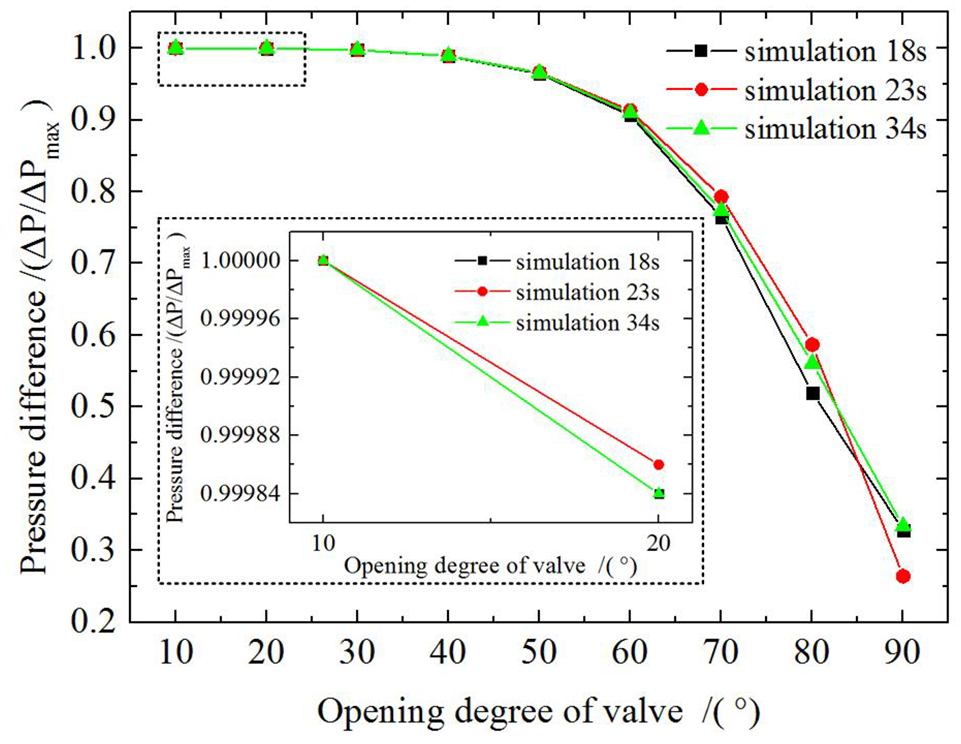
Pressure drop of the ball valve under different variable speed motion.
Analysis of internal flow field of ball valve
In order to analyze the characteristics of the internal flow field of ball valve from full opening to closing under the law of variable speed movement, combined with the analysis in 3.1, 3.2, and 3.3, this paper analyzes the pressure distribution, velocity distribution, and velocity streamline distribution of the internal flow field of ball valve when the opening angle of ball valve is 20°, 50°, and 70°. According to the static pressure of the ball valve and the analysis method of the valve in the relevant references, the flow field characteristics of the ball valve in the XOY central section (z = 0 mm) and XOZ central section (y = 0 mm) are mainly analyzed in the research process.
Pressure distribution
Figure 6(a) to (c) show the pressure distribution of the internal flow field of the ball valve when the ball valve opening degrees are 20°, 50°, and 70°, respectively, under the law of shifting motion. It can be seen from Figure 6(a) to (c) that (1) In the process of three kinds of variable-speed movement, under the different opening of the ball valve, when the fluid passes through the valve core of the ball valve, high-pressure jet will be produced; at the same time, obvious pressure drop will be produced. (2) In the process of three kinds of variable-speed movement, the pressure distribution nephogram of the pipeline before and after the ball valve is obviously different under the different opening of the ball valve, which shows that the different flow coefficient, resistance coefficient, and pressure drop are related to the different pressure distribution in the pipeline before and after the ball valve. (3) When the opening of the ball valve is 20°–50°, the influence of the law of variable speed movement on the pressure field distribution of the ball valve mainly occurs in the downstream pipeline of the ball valve. (4) When the opening of the ball valve is 70°, the influence of the law of variable speed movement on the pressure field distribution of the ball valve mainly occurs at the valve core of the ball valve and in the downstream pipeline of the ball valve. (5) Regardless of the closing process of the ball valve and the motion law of the electric actuator, the pressure distribution of the ball valve varies greatly under different opening.

(a) Pressure distribution of ball valve at XOY section with 20° opening under variable speed movement, (b) pressure distribution of ball valve at XOY section with 50° opening under variable speed movement, and (c) pressure distribution of ball valve at XOY section with 70° opening under variable speed movement.
Figure 7(a) to (c) are pressure distribution diagrams of the XOZ cross section of the internal flow field of the ball valve when the ball valve opening degrees are 20°, 50°, and 70°, respectively, under the law of shifting motion. From Figure 7(a) to (c), it can be seen that (1) In the process of three kinds of variable-speed movement, the pressure distribution of XOZ section is quite different under different opening of ball valve. (2) When the opening of the ball valve is 20°, the distribution of the low-pressure area is the smallest under the 18 s variable-speed motion law of the ball valve, the middle under the 23 s variable-speed motion law of the ball valve, and the largest under the 34 s motion law of the low-pressure area, which shows that the shorter the variable-speed closing time of the ball valve, the smaller the low-pressure area of the XOZ section under the small opening, the smaller the energy loss; at the same time, it is also found that under the 34 s variable-speed motion law of the ball valve. The pressure distribution of XOZ section of ball valve is symmetrical, which shows that the longer the closing time of ball valve is, the more uniform the pressure distribution of XOZ section of ball valve is. This study shows that under the condition of small opening, the closing time of ball valve has an important influence on the change characteristics of flow coefficient and resistance coefficient. The faster the closing time is, the smaller the low pressure area of the XOZ section of the ball valve is, the larger the flow coefficient and the smaller the resistance coefficient of the ball valve are; however, the longer the closing time is, the symmetrical distribution of the pressure nephogram of the XOZ section of the ball valve will be formed, which can increase the flow coefficient of the ball valve under the small opening and reduce the resistance coefficient. (3) When the opening of the ball valve is 50°, the pressure nephogram of the XOZ section of the ball valve is completely symmetrical under the laws of 18 and 23 s variable-speed movement; under the laws of 34 s variable-speed movement, the pressure nephogram of the XOZ section of the ball valve is basically symmetrical. (4)At a ball valve opening of 70°, the pressure cloud diagram of the XOZ section of the ball valve is symmetrically distributed under the 23 s variable-speed movement of the ball valve; under the 18 and 34 s variable-speed movement of the ball valve, the pressure cloud diagram of the XOZ section of the ball valve has a symmetrical high pressure distribution and a low pressure distribution does not appear symmetrical; These studies show that, under the same opening degree, after the pressure distribution of the XOZ cross section of the ball valve symmetrically exceeds the critical symmetrical opening degree, the value of the flow coefficient characteristic and the resistance coefficient characteristic of the ball valve will be determined by the time required for the ball valve’s variable speed movement; The shorter the time required for variable speed movement to the same opening, the larger the flow coefficient and the smaller the resistance coefficient of the ball valve.

(a) Pressure distribution of ball valve at XOZ section with 20° opening under variable speed motion, (b) pressure distribution of ball valve at XOZ section with 50° opening under variable speed motion, and (c) pressure distribution of ball valve at XOZ section with 70° opening under variable speed motion.
Velocity distribution
Figure 8(a) to (c) show the velocity cloud distribution of the internal flow field of the ball valve when the ball valve opening degrees are 20°, 50°, and 70°, respectively, under the law of shifting motion. It can be seen from Figure 8(a) to (c) that (1) at the 20° opening degree of the ball valve, the velocity distribution in the upstream pipeline and the downstream pipeline of the ball valve is basically the same under three kinds of variable speed motion laws, but at the valve core of the ball valve, the velocity distribution in the ball valve is quite different; the low-speed distribution area inside the 23 s movement ball valve spool is the largest, the low-speed distribution area inside the 34 s movement ball valve spool is centered, and the low speed distribution area inside the 18 s movement ball valve spool is smallest; These research phenomena show that the influence of different movement rules on the flow coefficient and resistance coefficient of ball valve is caused by the change of internal velocity distribution of ball valve spool caused by the change of movement rules of ball valve. (2) When the opening of the ball valve is 50°, the velocity field distribution in the upstream pipe, the downstream pipe and the valve core of the ball valve is quite different under three kinds of variable-speed motion laws; the distribution area of low velocity of upstream and downstream pipes of ball valve with 23 s motion law is the largest, that of upstream and downstream pipes of ball valve with 34 s motion law is the middle, and that of upstream and downstream pipes of ball valve with 18 s motion law is the smallest; at the valve core of ball valve, the low speed distribution area in the valve core with 23 s motion law is the largest, and the low speed distribution area in the valve core with 18 and 34 s motion law is basically the same; these research phenomena show that the influence of different motion laws on the flow coefficient and resistance coefficient of ball valve is determined by the low velocity distribution areas of upstream and downstream pipes and valve core of ball valve when the ball valve is in a large opening. However, the low velocity distribution area of the valve core plays the most important role in the flow coefficient and resistance coefficient of the ball valve. (3) When the opening of the ball valve is 70°, the velocity field distribution in the upstream pipe, the downstream pipe and the valve core of the ball valve basically changes little under the three variable-speed motion laws, but the low velocity distribution area in the upstream pipe of the ball valve is the largest under the 23S motion law, which shows that when the ball valve is in a large opening, the influence of the opening and closing law of variable speed movement on the flow coefficient and resistance coefficient of the ball valve is related to the low speed distribution area of the upstream pipeline. (4) Under the three laws of variable speed movement, high-speed jet will be produced at the valve core of the ball valve under all opening degrees, which shows that the opening degree of the ball valve is of great significance to the flow control of the ball valve. However, by modifying the motion law of the electric actuator of the ball valve, the flow regulating range of the ball valve can be expanded, and the flow field distribution of the ball valve has little influence. In this way, only the motion law of the ball valve needs to be optimized within a reasonable range, the purpose of pipeline flow control can be achieved, the inconvenience caused by replacing the valve can be reduced, and the economic cost can be saved.

(a) Velocity distribution of ball valve at XOY section with 20° opening under variable speed motion, (b) velocity distribution of ball valve at XOY section with 50° opening under variable speed motion, and (c) velocity distribution of ball valve at XOY section with 70° opening under variable speed motion.
Figure 9(a) to (c) are velocity distribution diagrams of the XOZ cross section of the internal flow field of the ball valve when the ball valve opening degrees are 20°, 50°, and 70°, respectively, under the shifting motion law. It can be seen from Figure 9(a) to (c) that (1) When the ball valve is opened at 20°, under the 23 s variable speed motion rule, the low speed distribution area inside the XOZ section of the ball valve core is the largest, and the more obvious the distribution is at the bottom of the ball valve core. The low-speed area distribution on the cross section changes, which affects the flow coefficient and resistance coefficient of the ball valve. (2) When the ball valve is opened at 50°, the speed distribution inside the XOZ section of the ball valve is approximately symmetrical under the three kinds of variable-speed movement laws. At the 18 s variable-speed movement rule, the low-speed distribution area inside the XOZ section of the ball valve core is the smallest. At this time, the flow coefficient of the ball valve is the largest and the resistance coefficient is the smallest. This again shows that the law of variable-speed movement can cause the distribution of low-speed areas on the XOZ section of the ball valve to change, thereby affecting the flow coefficient and resistance coefficient of the ball valve. (3) When the opening of the ball valve is 70°, the velocity distribution in the XOZ section of the ball valve core presents symmetrical distribution in the 23 s variable-speed motion law; under the 18 and 34 s variable-speed motion law, the velocity distribution in the XOZ section of the ball valve core has no symmetry, the flow coefficient is the largest, and the resistance coefficient is the smallest, which once again shows that the variable-speed motion law can cause the velocity distribution in the XOZ section of the ball valve, and affect the flow coefficient and resistance coefficient of ball valve.

(a) Velocity distribution of ball valve at XOZ section with 20° opening under variable speed motion, (b) velocity distribution of ball valve at XOZ section with 50° opening under variable speed motion, and (c) velocity distribution of ball valve at XOZ section with 70° opening under variable speed motion.
Velocity streamline distribution
Through the study of the pressure distribution and velocity distribution of three kinds of variable-speed motion, we find that under the same opening, the variable-speed motion has a greater impact on the flow field distribution on the XOZ section of the ball valve, and a smaller impact on the flow field distribution on the XOY section. Therefore, this paper only analyzes the velocity streamline on the XOZ section. Figure 10(a) to (c), respectively, are the velocity profiles of the XOZ section of the internal flow field of the ball valve when the opening of the ball valve is 20°, 50°, and 70° under the law of variable speed movement. From Figure 10(a) to (c), it can be seen that (1) When the opening of the ball valve is 20°, the symmetry of the vortex formed by the velocity streamline of the XOZ section of the ball valve is the best and the number of the vortex is less under the 18 s variable speed motion law; under the 23 s variable speed motion law, the symmetry of the vortex formed by the velocity streamline of the XOZ section of the ball valve is poor, and the vortex formed has a large vortex, a relatively large vortex, and a bottom vortex without a center; In 34 s variable speed motion law, the number of vortices formed by velocity streamline of XOZ section of ball valve is the most, there is a large vortices, a relatively large vortices, and a small vortices; It is found that the closing motion law of ball valve affects the velocity streamline distribution of XOZ section, the scale and number of velocity vortices, thus affecting the flow coefficient and resistance coefficient of ball valve. The research shows that the shorter the closing time of ball valve is, the better the symmetry of velocity streamline distribution of XOZ section and the number of vortices are less, the smaller the energy loss of ball valve, the larger the flow coefficient of ball valve, the smaller the resistance coefficient. (2) When the opening of the ball valve is 50°, the velocity streamline distribution of the XOZ section of the ball valve has good symmetry under three kinds of variable-speed movements, and the vortex is generated in the low-speed area, and the larger the low-speed area is, the larger the influence range of the vortex is; (3) When the opening of the ball valve is 70°, the vortex symmetry formed by the velocity streamline of XOZ section of the ball valve is the best and the distribution of the low velocity area is the largest under the rule of 23 s variable speed movement, and the vortex symmetry formed by the velocity streamline of XOZ section of the ball valve is the worst under the rule of 18 and 34 s movement, but the vortex scale is small under the rule of 18 s movement; These studies show that the influence of ball valve motion law on the flow coefficient and resistance coefficient of ball valve is related to the low speed area distribution and eddy current scale of XOZ section of ball valve; The research also shows that the shorter the closing time of the ball valve, the smaller the low speed area formed by the velocity streamline distribution of the XOZ section of the ball valve, the smaller the eddy current scale, the smaller the energy loss of the ball valve, the larger the flow coefficient of the ball valve, and the smaller the resistance coefficient.

(a) Velocity streamline distribution of ball valve at XOZ section with 20° opening under variable speed motion law, (b) velocity streamline distribution of ball valve at XOZ section with 50° opening under variable speed motion law, and (c) velocity streamline distribution of ball valve at XOZ section with 70° opening under variable speed motion law.
Conclusions
Based on the user-defined UDF technology and the standard k-
Under the three kinds of shifting motion rules, as the opening degree of the ball valve increases, the flow coefficient of the ball valve increases, and the resistance coefficient decreases; at the opening degree of 10°–30°, the ball valve performs the regular motion during the three shifting exercises. The flow coefficient is basically the same; when the opening degree is greater than 30°, the curve function of the ball valve shifting motion process will have a great influence on the flow coefficient of the ball valve; when the opening degree is 20°–90°, the ball valve is in the three shifting execution rules. The resistance coefficient is basically the same during the movement; when the opening is 10°–20°, the resistance of the ball valve is the most different; when the opening is less than 20°, the resistance coefficient of the ball valve 18 s during the shifting movement is the smallest, and the resistance coefficient value the 23 s shifting process is the largest, and the resistance coefficient value of the 34 s shifting motion process is centered. The research results of the whole ball valve shifting motion process show that different types of ball valve flow coefficient and resistance can be obtained by designing the curve function of the ball valve actuator motion process with different structural forms. The coefficient curve makes the ball valve more widely used as a flow regulating valve.
Under the three kinds of shifting motion laws, the pressure difference of the ball valve decreases with the increase of the opening degree of the ball valve; when the opening degree is 10°–50°, the pressure difference of the ball valve is basically the same during the three kinds of shifting regular motion. When the opening degree is 50°–90°, the pressure difference of the ball valve is large; when the opening degree is greater than 50°, the pressure difference of the ball valve 18 s during the shifting movement is the smallest, the pressure difference of the 23 s shifting movement process is the largest, and the shifting movement process of the 34 s is the maximum. The pressure difference is centered, which is consistent with the change of the flow coefficient of the ball valve during the three variable-execution regular motions. At the opening degree of 10°–20°, the pressure difference curve is partially enlarged, and the pressure difference during the 23 s shifting motion is the largest, which is consistent with the change of the resistance coefficient of the ball valve during the three shifting execution regular motions.
Under the three kinds of variable speed motion laws, the flow field of XOY section of ball valve changes little, and that of XOZ section of ball valve changes greatly; the influence of ball valve motion law on the flow coefficient and resistance coefficient of ball valve is related to the low speed area distribution and eddy current size of XOZ section of ball valve; by modifying the motion law of electric actuator of ball valve, the flow regulation range of ball valve can be expanded. In this way, it only needs to optimize the movement law of ball valve in a reasonable range, which can achieve the purpose of pipeline flow control, reduce the inconvenience of valve replacement, and save the economic cost.
Footnotes
Handling Editor: James Baldwin
Declaration of conflicting interests
The author(s) declared no potential conflicts of interest with respect to the research, authorship, and/or publication of this article.
Funding
The author(s) disclosed receipt of the following financial support for the research, authorship, and/or publication of this article: This research was financially supported by the National Natural Science Foundation of China (51876193, 51906222), the Zhejiang Provincial Key Research and Development Program Project (2021C03133), and the open Research Subject of Key Laboratory of Fluid and Power Machinery (Xihua University), Ministry of Education (szjj2019-014). These supports are gratefully acknowledged. The authors also thank the Zhejiang Provincial Key Laboratory of Fluid Transmission Technology for the experimental technical supports.
