



Abstract

Methanol showed promising results as an alternative to gasoline fuel. However, there exists a research gap for the effect of oxygenated fuel on lubricant oil deterioration along-with engine performance and emissions. This study aims the very topic. The characteristics of SI engine were evaluated for two different loads and nine different engine speeds. The lubricant oil samples were taken out from engine oil sump after 100 h of engine operations using gasoline (G) and M12 sequentially. The brake power of M12 was observed higher in comparison with G. The maximum BTE of 23.69% was observed for M12 on lower load and 2800 rpm. On average, the 6.05% and 6.31% decrease in HC emissions were observed using M12 in comparison with G at lower and higher load respectively. M12 produced 32.52% higher NOx emissions than that of G at lower load. The reduction in kinematic viscosities at 40°C of lubricant oil were found 11.61% and 18.78% for M12 and G respectively. TAN, specific gravity, flash point and ash content of lubricant oil were observed 10.23%, 0.079%, 5.81% and 0.97% higher for M12 respectively. The lubricant oil composition could be developed in future for such fuels which may prolong its life cycle.
Keywords
Introduction
The quest of luxurious lifestyle and rapidly increasing population mainly responsible for increase in consumption of fossil fuels. According to estimates, the total global population is expanding at a constant rate of 83.1 million per year. 1 A major source of meeting population energy demand is petroleum fuels. Therefore, the overall global primary energy consumption in 2015 comprised of 85.6% fossil fuel, 4.7% nuclear power and 9.7% renewable energy. 1 Conventional carbon-based fuels have been considered as primary resources of energy for many decades. However, they produce many harmful pollutants mainly CO, HC and NOX that may damage the environment. The concentration of these pollutants has been increased significantly in the atmosphere which has disturbed its natural balance and has changed the climate conditions.2,3 This climate change is now considered as the most challenging issue globally because of its severe effects on life and environment.4,5 This adverse climate change mainly due to emissions from vehicles and compelling the whole world to make strong policies for the control of exhaust emissions from vehicles as transport sector is majorly responsible for deterioration of an environment.6,7 These policy pacts embrace UN framework convention held in 1992, Kyoto protocol held in 1998, Copenhagen accord held in 2009, Doha amendment in 2012 and Paris agreement in 2015. 8 It is estimated that 95% of energy used in vehicles worldwide fulfilled by fossil fuels and the contribution of transport sector in deteriorating air quality is approximated up to 60%–80% of toxic environmental emissions. 9
The immense increase in utilization of fossil fuels not only responsible for their depletion but also responsible for environmental pollution and abrupt climate changes.10,11 In the European Union, 31% of the total energy consumed by transport sector and is mainly responsible for 18% particulate matter (PM) emissions, 39% NOx emissions, 36% CO emissions and 25% CO2 emissions. 12 According to EIA, the entire global energy utilization is estimated to be increased by 56% in 2040 as compared to the year 2010. 13 Almost 11 billion tons of petroleum based products are utilized annually and responsible for severe consequences on environmental pollution and human health. 14 During 2012 to 2013, the crude oil utilization have been increased at rate of 1.4% and this utilization is increasing continuously. 15 The worldwide liquid fuel requirement by transport sector is presently assessed approximately 50 million oil-equivalent barrels per day. 16 The remaining life span of total recognized petroleum resources is determined such that they will deplete within 50 years if they continue to be consumed at present rate. 17 However, higher depletion rate of fossil fuel sources, fluctuation in the fuel prices and alarming environmental threats are the utmost concerns to look for alternative fuels. 18 Industrialized nations confront dual challenge of rising carbon emissions as well as depletion of fossil fuels.19,20 Spark ignition (SI) engines are less efficient than compression ignition (CI) engine due to their ability to operate at lower compression ratio. 21 The compression ratio in SI engine is constrained by knocking tendency which can be improved by enhancing octane rating of fuel. Methanol demonstrated promising attributes in this manner because it exhibits naturally augmented octane number in contrast with gasoline which permits SI engine charged with methanol blended gasoline fuel to run at higher compression ratio which ultimately results higher thermal efficiency.15,22,23
Methanol provides various other benefits which highlight methanol as an appealing fuel to be utilized as substitute of fossil fuels. The major benefit is its lower cost even in terms of equivalence energy because methanol requires lesser number of refining operations as compared to gasoline. It has been estimated that the methanol can be produced at cost of $350 U.S. per ton in China and its production cost is approximately 50% lesser than the production cost of petroleum fuels. 24 Methanol can be produced from hydrogenation of carbon monoxide, steam reforming of natural gas which responsible for formation of synthesis gas (mixture of CO and hydrogen), destructive distillation of wood and biomass. The other benefit is lower vehicular exhaust emissions when fuelled with methanol-gasoline fuel blends, as methanol exhibits lower boiling point (65°C) which may help in easy combustion of fuel during power stroke inside the engine. The more oxygen content of methanol (50% by volume), lower boiling point, faster flame propagation speed, as well as its simpler chemical composition lead to lower CO and HC emissions in contrast with gasoline.24–26 It is feasible to use methanol-gasoline fuel blends instead of using methanol alone because pure methanol might be responsible for cold-start issue owing to its higher latent heat of vaporization, 27 and generate more NOx emissions under lean working circumstances. 28 Moreover, lower heating values and lower (A/F)stoic of methanol augment fuel consumption of engine. The higher latent heat of vaporization of methanol cools down the air at inlet of engine which enhances volumetric efficiency and brake power.27,29
Balki et al. 30 conducted comparative study between methanol and gasoline on 196cc four stroke single cylinder SI engine. The obtained results revealed that torque and BSFC were increased by 4.7% and 84% in contrast to gasoline respectively. The maximum combustion efficiency of 99.51% was achieved at 2800 rpm, which was 0.51% more than gasoline. The NOx, CO and HC emissions for methanol trimmed down by 49%, 22.6% and 21.6% respectively. However, CO2 emissions augmented by 4.4% in contrast to gasoline. Divakar Shetty and Antony 31 examined the impact of methanol blended gasoline fuel on four stroke SI engine performance and its exhaust emissions. The obtained results revealed that engine power augmented by 13% for methanol blended fuel. M30 produced 18% more brake thermal efficiency than gasoline. Agarwal et al. 32 concluded that BSFC for methanol-gasoline fuel blends more than gasoline. Gravalos et al. 33 also obtained similar results. M.V. Mallikarjun and Mamilla. 34 studied the effect of 3%, 5%, 10% and 15% methanol blends at altering loads condition. It was found that brake thermal efficiency and indicated thermal efficiency augmented while CO and HC substantially reduced but CO2 and NOx marginally augmented. Altun et al. 35 examined effect of 10% methanol in 90% unleaded gasoline (M10) as blend on performance of SI engine. They achieved 13% decline in HC emissions, 10.6% decline in CO emission and increased CO2 emission when M10 fuel blend used in engine. Abu-Zaid et al. 36 studied that how different methanol-gasoline fuel blends affect SI engine performance. They observed best results in case of M15 (15% methanol and 85% gasoline) including higher power output along with lower BSFC when engine fuelled with M15 fuel blend. Farkade and Pathre 37 found that NOx in case of methanol blended gasoline fuel higher than pure gasoline because of higher adiabatic flame temperature and more percentage of oxygen. The augmented oxygen content responsible for improved combustion.
Prasad et al. 38 performed experiment on single cylinder engine at wide open throttle condition. They fuelled engine with methanol blended fuel at maintained 14° BTDC ignition timing for three varying compression ratios (8, 9 and 10). As compression ratios increased from 8 to 10 than methanol blended fuel demonstrated improved combustion efficiency via incrementing peak pressure and net heat release value by 27.5% and 30% respectively. Also, 25% increase in BTE and 19% reduction in BSFC were found. However, NOx, CO and HC emissions decreased between 30% and 40%. Yontar 39 employed hydrogen to mend properties of gasoline and then compared the results of ethanol and methyl tert-butyl ether (MTBE) with simple gasoline and gasoline-hydrogen mixture. The BSFC for ethanol was 29.61% higher than that for gasoline. The BSFC for G98H2 was approximately 9.24% lower than that for gasoline. The ethanol produced 3.11% higher BTE than that of gasoline. The G98H2 produced 1.42% higher BTE than gasoline. The HC formation ranges between 81–101 ppm for gasoline, 80–97 ppm for MTBE, 77–93 ppm for ethanol and 73–92 ppm for G98H2.
Yontar 40 used gasoline, ethanol, methyl tert-butyl ether (MTBE) and a gasoline–ethanol blend (E85) to test their impact on engine performance. The torque in case of E85 was 3.34% higher than for gasoline. BSFC for E85 was 30.63% higher than that of MTBE at the minimum BSFC point. The BTE for E85 and ethanol were overall 9.56% and 10.27% higher than that of gasoline respectively. HC emission in case of gasoline was 4.94% and 3.53% higher in comparison with ethanol and E85. Radzali et al. 41 studied the impact of methanol-gasoline fuel blends and ambient pressure on flame propagation and exhaust emission. As the percentage of methanol increased from 0% to 15% in gasoline to form blend, then the flame propagation area increased which improved burn rate. The improved combustion resulted higher CO2 emission while NO2, CO and HC were lowered. As the ambient pressure increased, the combustion was also improved due to more flame propagation speed. Iliev 42 employed five different percentages of methanol in gasoline for fuel blends like M5, M10, M20, M30 and M50. The results showed that brake power increased when blends from M5 to M2O were used, but brake power decreased when blends from M30 to M50 were used. The BSFC for all blends were higher than that for gasoline. CO and HC emission decreased for methanol blended fuels. The NOx emission raised when methanol percentage increase in gasoline. But the NOx emission was lowered for M50 as compared to gasoline.
It has been approximated that 28% of total energy derived from the petroleum fuel is dissipated as frictional force inside an engine and transmission of vehicles. 43 In addition, the aerodynamic drag consumes about 10% of the fuel energy, depending on the speed of car. The frictional losses reflected as rise in fuel consumption and related cost. A detailed analysis of passenger car shows that frictional losses in combustion engine can account up to 60% of total fuel energy for normal driving conditions. 44 It has been approximated that 11% of total annual energy in USA can be conserved in just four significant zones like transportation, turbo machinery, industrial processes and power generation via tribological advancements. 45 For example, tribological advancements in vehicles can conserve approximately 18.6% of total annual energy of USA which utilized by cars and equivalent to 14.3 billion US$ per annum. 46 Usman and Hayat 47 compared the performance, emissions and lubricant oil deterioration for liquified petroleum gas (LPG) and petrol on bike engine. They inferred that deterioration of lubricant oil due to gasoline and LPG fuels has raised the values for emissions (HC, CO2, NOx, CO). Likewise, they 48 charged compressed natural gas (CNG) and Hi-octane gasoline into SI engine and in consequence, the deteriorated lubricant oil lead towards more exhalation of pollutants into environment. Numerous factors like lubricant oil composition, temperature and engine operating states played significant role in fuel consumption. 49 Increase in viscosity of utilized lubricant oil is responsible for oxidation or contamination. 50 Lubricant oil deterioration is primarily dependent on ambient environment, temperature with in engine and total engine running hours. 51
The prospects of lubricant oil deterioration have been broadly canvassed for petrol, LPG, diesel, CNG and biodiesel. However, a benchmark has yet to be established for SI engines fuelled with methanol blended gasoline fuel. The novel aspect is highlighted through this research which is the determination of the effect of alternative fuels on lubricant oil. So that essential steps should be taken to avoid the adverse effects of these alternative fuels on lubricant oils. Through proper examination of the impact of alcoholic fuels on lubricant oil, such additives for lubricant oil could be developed in future which may prolong their deterioration rate. This research will also provide new research areas in the field of material sciences to work on such materials which are not reactive to methanol blended fuel. So that engine cylinder could be made of such materials which will reduce the wear and tear inside the engine. Moreover, such coatings of composite materials could be developed for existing metallurgy of an engine which will improve compatibility with methanol blended fuels. Therefore, engine performance and engine life will be ultimately improved. The operating temperature and physicochemical characteristics of the methanol blended gasoline fuel are not similar in contrast with pure gasoline fuel, which intimate significant comparative lubricant oil deterioration in SI engine charged with Hi-octane methanol-gasoline fuel blend (M12) and gasoline fuel (G). In the light of previous research, it was found that methanol blends ranging from 10% to 15% methanol proportion in gasoline performed better than other blends.35,36,52 In the current research work, engine performance and environmental emissions are recorded at various engine speeds and loads for M12 and gasoline. Subsequently, a comparative evaluation is carried out after engine operations for 100 h fuelled with M12 and gasoline on the basis of lubricant oil deterioration.
Methodology
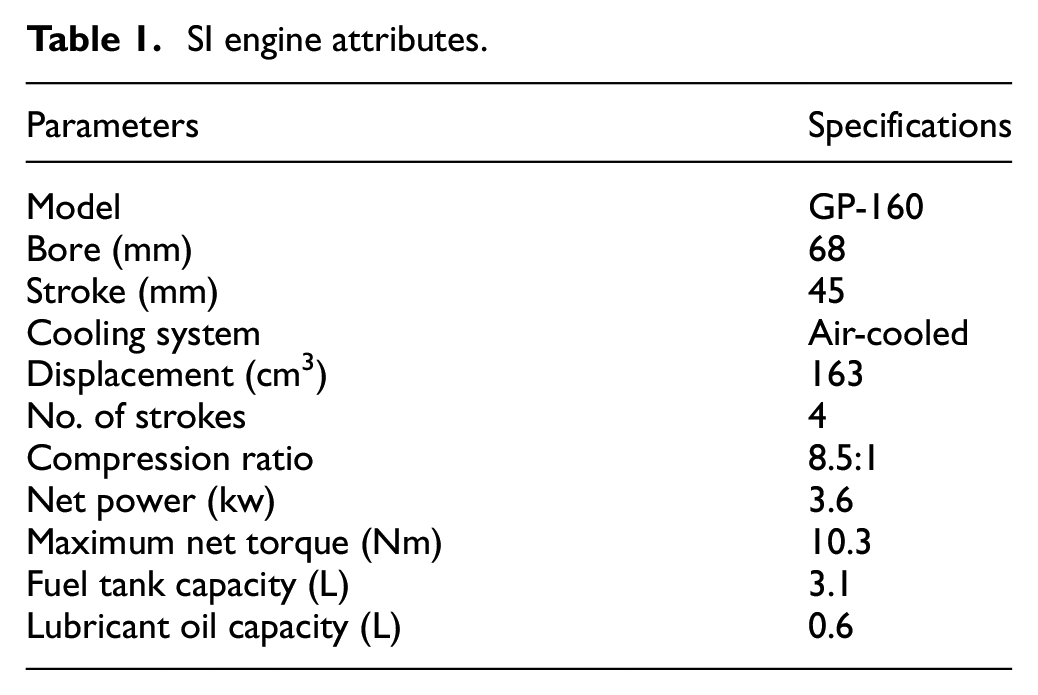
A commercially available 163cc SI engine was utilized in experimentation. The detailed specifications of the SI engine are displayed in Table 1. The schematic illustration of experimental setup can be observed from Figure 1. In order to record performance characteristics, engine seals were properly inspected and air filters were changed to avoid any inconvenience. SI engine was connected with water brake dynamometer (DYNOMITE) through shaft. The strain gauge was coupled with torque arm in longitudinal direction to sense torque, both were attached with dynamometer. The torque was inspected by altering engine speed according to SAE J1349 standard. The output parameters were noted with help of DYNO-MAX 2010 software. The water was supplied to housing of dynamometer using water pump in order to apply load on engine. Then, the settings of water pump were adjusted through load control valve in order to deliver water at two pressures 20psi and 40psi inside the housing of dynamometer. The housing of dynamometer comprised of small toroidal pockets such that these toroidal pockets were driven by engine. The water when smacked and whipped around these pockets then the shear forces in water act tangential to housing radius and served as load on engine. In this way torque, speed, mass of fuel supplied and emissions were recorded corresponding to applied loads.
SI engine attributes.

Experimental illustration.
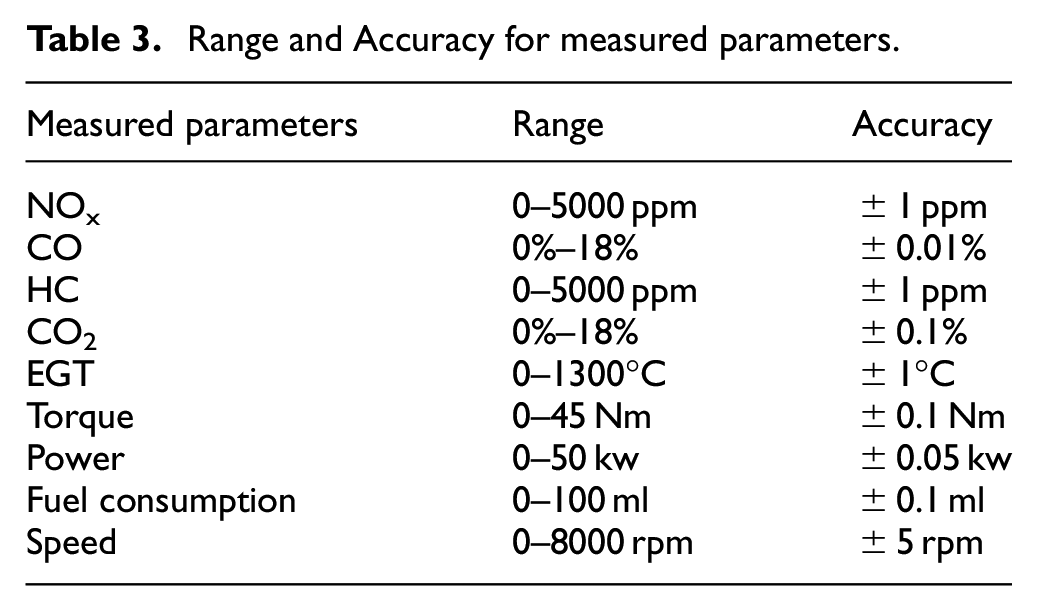
Two distinct fuel samples were examined through experimentation. Base gasoline having octane rating (92) was acquired from the Pakistan State Oil (PSO). Methanol having 99.9% purity was acquired from Merck chemicals. Methanol blended with gasoline in accordance with 12% methanol by volume and 88% gasoline by volume with help of cylindrical flask prior to the experiment after assuring homogenous mixing of two fuels. The physicochemical properties of both methanol and gasoline fuel are displayed in Table 2. Both gasoline (G) and methanol-gasoline fuel blend (M12) were supplied to carburetor of the engine through calibrated transparent cylinder, with a resolution of 1% of complete reading. The measurement range and accuracy of dynamometer and transparent calibrated cylinder are clearly mentioned in Table 3. A K-type thermocouple was inserted into exhaust pipe of engine to measure EGT. An exhaust gas analyser (EMS-5002) was used to record HC (ppm), CO (%), CO2 (%) and NOx (ppm) emissions. The probe of EMS-5002 was introduced into exhaust pipe for 1 min at certain rpm for the sake of measurement of steady-state exhaust emissions. The measurement range and accuracy of K-type thermocouple and EMS-5002 with reference to respective emissions are clearly mentioned in Table 3.
Physicochemical attributes of fuels.

Range and Accuracy for measured parameters.
The physicochemical properties of SAE 20W-40 lubricant oil are displayed in Table 4. The specific grade lubricant oil was used in engine as per recommendation of engine manufacturer. In order to ascertain lubricant oil deterioration, engine was set to fixed speed (2800 rpm) under lower loading condition for 100 h. After 100 h of engine running, lubricant oil was extracted from engine and its physicochemical properties were checked for both gasoline (G) and M12 subsequently. The testing scheme used in this study for recording performance characteristics, emissions and lubricant oil deterioration in SI engine is presented in Table 5.
Physicochemical parameters of lubricant oil sample.

Design of experiment.

Results and discussion
Both gasoline and M12 fuels were employed in 163cc SI engine to ascertain performance, lubricant oil deterioration and emission characteristics. The detailed discussion on these three aspects enlisted below:
Effect on engine performance
The five performance parameters of engine including torque, brake power, BSFC, BTE and EGT are briefly explained in this section.
Torque
Figure 2(a) indicates the trends of torque for both gasoline and M12 at two different loads and varying engine speeds. With an increase in engine rpm, there was an increase in engine torque for both fuels until certain rpm. As the engine rpm further increased, the engine torque dropped down. It can be observed that engine torque was higher for M12 than gasoline at both higher and lower loads. At higher loading condition, the peak torque of 7.12 and 7.43 Nm produced by gasoline and M12 respectively when engine speed reached at 2500 rpm. At lower loading condition, the peak torque of 6.31 and 6.67 Nm produced by gasoline and M12 respectively when engine speed reached at 2800 rpm. Figure 2(b) indicates average torque for gasoline and M12 at two different loads. The average torque for gasoline and M12 at 20psi load was 4.74 and 5.08 Nm respectively. Similarly, the average torque for gasoline and M12 at 40psi load was 5.98 and 6.40 Nm respectively. The torque for M12 at lower and higher load was 7.28% and 7.01% more than gasoline respectively. On average, M12 at 40psi load produced 26% more torque than M12 at 20psi load. Torque is turning force generated by engine crankshaft which defines engine ability to do more work. The higher torque for methanol blended gasoline fuel determines the effective conversion of methanol blended fuel to useful work through improved combustion. Methanol exhibits higher oxygen content, faster propagation of laminar flame and improved isometric effect.53–55 The fast propagation of laminar flame results improved combustion prior to any loss from cylinder walls. The higher-octane rating of methanol also contributes towards combustion stability inside an engine. As hydrogen and oxygen exhibits higher energy structure and higher flame temperature upon burning. Therefore, higher hydrogen to carbon ratio and higher oxygen content results more pressure buildup during combustion inside an engine. 40 These above-mentioned factors are mainly responsible for improved combustion and higher torque when methanol blended fuel used. The higher torque developed by methanol blended gasoline fuel in comparison with gasoline coincides with the findings of Balki et al. 30 Although, pure methanol exhibits lower heating value and has tendency to produce lower torque than gasoline but in the current study, methanol was used as an oxygenated additive in gasoline to boost laminar flame propagation, anti-knocking capability and improve combustion characteristics. 53 The lower torque at lower engine speed was due to weak explosions produced by fuel burning. With an increase in engine rpm, the explosions resulted from fuel burning became intense. These intense explosions mainly responsible for augmented torque. As the engine speed further increased from optimum limit, the torque began to drop down because engine faced breathing issues and air flow losses.
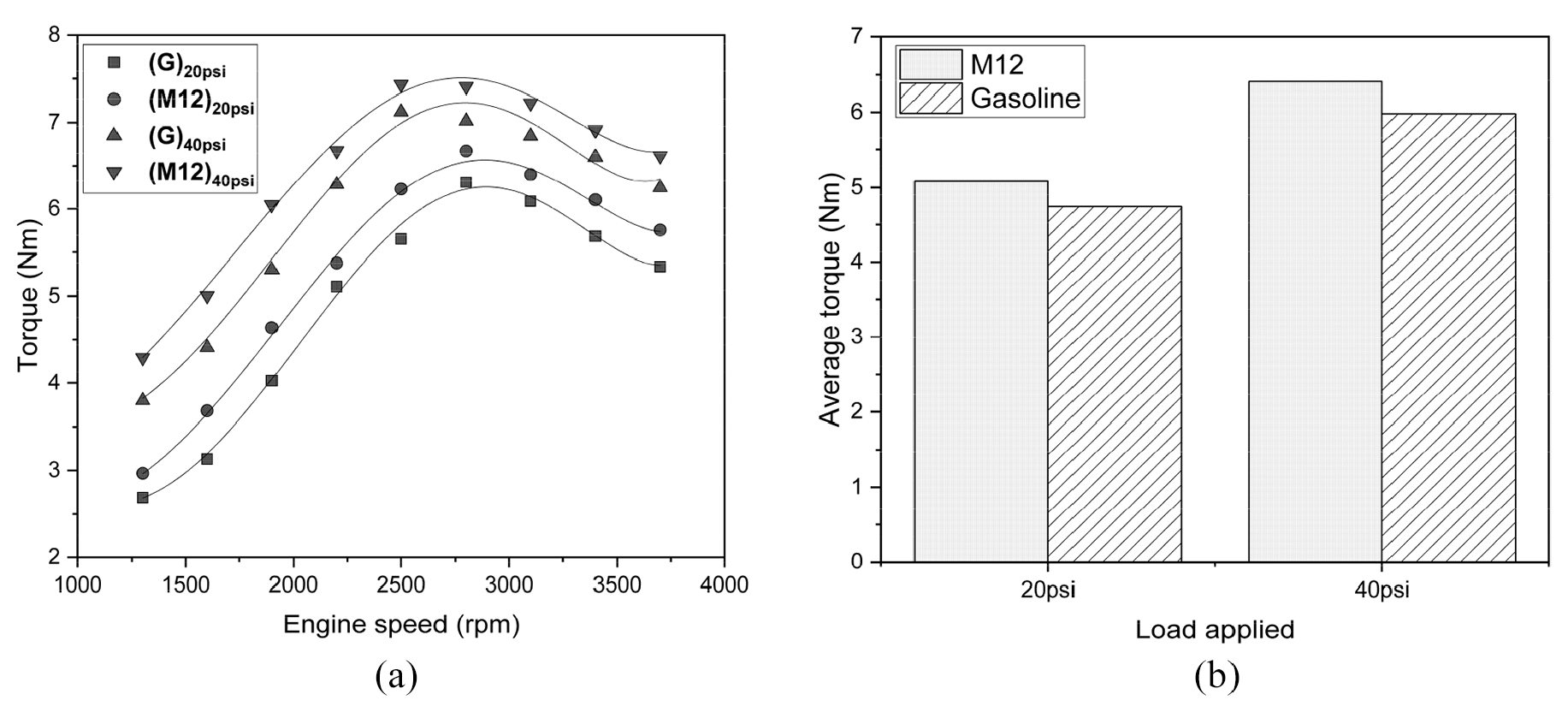
(a) Torque for different fuels at varying engine speeds and loads and (b) average torque for different fuels at varying engine speeds and loads.
Brake power
Engine brake power depends on torque and engine speed. As the engine speed increases, the engine brake power also increases. Figure 3(a) indicates the trends of brake power for both gasoline and M12 at two different loads and varying engine speeds. With an increase in engine rpm, the general increasing trend was obtained for brake power produced by both the fuels. It can be observed that brake power was higher for M12 in comparison with gasoline at both loads and all engine speeds. At higher loading condition and 3700 rpm, the peak brake power of 2.42 and 2.56 kw produced by gasoline and M12 respectively. Figure 3(b) indicates average brake power for gasoline and M12 at two different loads. The average brake power for gasoline and M12 at 20psi load was observed 1.31 and 1.39 kw respectively. Similarly, the average brake power for gasoline and M12 at 40psi load was 1.63 and 1.74 kw respectively. M12 produced 6.69% and 6.41% higher brake power than gasoline at lower and higher load respectively. On average, M12 at 40psi load produced 24.37% more power than M12 at 20psi load. The higher brake power produced in case of M12 can be credited to naturally higher-octane rating and oxygen content in methanol. The naturally boosted octane number inculcate antiknock characteristics inside fuel which mainly reduce friction and ultimately enhance power output. 38 The higher latent heat of vaporization for methanol cools down the incoming air. Consequently, it increases the charge density, power output and volumetric efficiency.27,29 Additionally, the higher laminar flame speed and higher oxygen content of methanol in contrast with gasoline aids to accomplish combustion process prior to any loss from walls of chamber. 56 The higher brake power finding for methanol blended fuel presented in current study coincides well with previous research.31,36

(a) Brake power for different fuels at varying engine speeds and loads and (b) average brake power for different fuels at varying engine speeds and loads.
Brake specific fuel consumption (BSFC)
Both the fuels show similar trend of BSFC variation with respect to different loads and varying engine speeds (see Figure 4(a)). Firstly, BSFC declines than it rises with an increment in engine speed. In order to overcome inertial effects, more fuel was consumed at the beginning to make engine in running condition. The heat loss from cylinder walls of engine was greater at lower engine speed which prompted higher fuel consumption to compensate such losses. BSFC gradually decreased as the engine speed increased and then from range of 2500 to 2800 rpm, the BSFC continued to increase. The lowest BSFC for specific speed range indicates the combustion near to stoichiometric condition. The BSFC augmented for higher engine speeds in order to meet higher power requirement. Figure 4(b) indicates average BSFC for gasoline and M12 at two different loads. The average BSFC for gasoline and M12 at 20psi load was 0.43 and 0.45 kg/kwh respectively. Similarly, the average BSFC for gasoline and M12 at 40psi load was 0.47 and 0.49 kg/kwh respectively. The BSFC of M12 was 3.68% and 3.61% more than gasoline respectively under 20psi and 40psi load. On average, M12 at 40psi load consumed 8.86% more than M12 at 20psi load and these results are in accordance with previous research.32,33 It can be credited to more fuel utilization for meeting higher power requirement at higher load. Additionally, lower heating values and lower air to fuel ratio of methanol are responsible for higher BSFC in case methanol blended gasoline fuel.36,57

(a) Brake specific fuel consumption for different fuels at varying engine speeds and loads and (b) average brake specific fuel consumption for different fuels at varying engine speeds and loads.
Brake thermal efficiency (BTE)
Figure 5(a) indicates the trends of BTE for both gasoline and M12 at two different loads and varying engine speeds. BTE connotes proportion of brake power generated by an engine corresponding to input energy of fuel. The general trend of BTE demonstrated by both fuels shown in Figure 5(a) reveals that BTE first increased to peak value, then the BTE finally dropped down. Figure 5(b) indicates the average BTE for both fuels at lower and higher load. On average, the BTE for M12 at 40psi load was 1.68% lower than the BTE of M12 at 20 psi load because of more fuel consumption for generating higher power at 40psi load. The second law of thermodynamics postulates that engine efficiency increments when heat losses from engine to surroundings decrement. Moreover, BTE is inversely proportional to the BSFC and heating value, 58 any decrement in heat loss and lower heating value could enhance the efficiency. Higher latent heat of vaporization in case of methanol helps in heat absorption from cylinder walls during compression stroke. Therefore, lower work requires to compress air-fuel mixture and ultimately boosts BTE. 59 Higher propagation speed of laminar flame in case of methanol results expeditious combustion heat liberation process prior to any major losses from cylinder walls and improved isometric effect. 54 The higher burnt gas capacity and lower heat losses in case of methanol because it acquires 49% more triatomic molecules in combustion products for same amount of heat release in contrast with gasoline. 54 In the light of above mentioned factors, it can be clearly seen that methanol blended fuel can produce more BTE in comparison with gasoline. The highest 21.44% BTE was achieved for M12 under 40psi load at 2500rpm and the highest 23.69% BTE was achieved for M12 under 20psi load at 2800 rpm. It can also be clearly observed that there was some optimum range of speed when the fuel conversion efficiency to useful work was at peak and fuel consumption was at least level. After optimum range, the BTE started to decline because of more losses and higher power requirement at higher engine speeds. The more power to fuel consumption ratio in case of M12 responsible for higher BTE and this higher BTE for methanol-gasoline fuel blend matched with findings of Mallikarjun and Mamilla. 34

(a) Brake thermal efficiency for different fuels at varying engine speeds and loads and (b) average brake thermal efficiency for different fuels at varying engine speeds and loads.
Exhaust gas temperature (EGT)
The visible difference in EGT for both gasoline and M12 at two distinct loads and varying engine speeds can be observed in Figure 6(a). The continual increasing general trend of EGT was obtained for both fuels over entire engine speed range. The peak EGTs of 405°C and 443°C were produced by M12 at lower and higher loads respectively. Figure 6(b) indicates average EGT for gasoline and M12 at two different loads. The average EGT for gasoline and M12 at 20 psi load was 243°C and 302.89°C respectively. Similarly, the average EGT at 40 psi load for gasoline and M12 was 289.78°C and 338.78°C respectively. The EGT of M12 was found 24.65% and 16.91% more than gasoline respectively under 20psi and 40psi load. EGT helps in understanding about the quality of combustion and the interpretation of development of exhaust emissions. 60 The higher EGT indicates effective burning of fuel inside engine cylinder when methanol blended fuel used inside engine. There is mixed literature against the trend of EGT for methanol blended fuels. It might be increased because of higher oxygen content of methanol,57,61 or decreased due to higher latent heat of vaporization of methanol.62,63 In the present study, the EGT in case of M12 at 40psi load was found 11.85% more than M12 at 20 psi load because engine required more methanol blended gasoline fuel for producing more power resulted from the combustion of fuel. It can be explicitly observed that EGT for M12 was higher than gasoline due to lower heating value which mainly responsible for more fuel injection into cylinder. As the higher EGT resulted due to availability of higher oxygen content in methanol blended fuel which ultimately responsible for improved combustion through effective burning of fuel. EGT increased with an increment in engine speed due to burning of more fuel for meeting higher power requirement.

(a) Exhaust gas temperature for different fuels at varying loads and rpm of engine and (b) average exhaust gas temperature for different fuels at varying engine speeds and loads.
Effect on exhaust emissions
The four emission parameters of engine including CO, CO2, HC and NOx are briefly explained in this section.
CO emission
Figure 7(a) indicates the variation of CO emission for both gasoline and M12. The general rising trend of CO emissions along with engine speed can be observed from Figure 7(a). It was because of the movement of engine parts at higher inertia and insufficient mixing between air and fuel molecules. Additionally, an evacuation of larger proportion of fuel particles after incomplete reaction with oxygen responsible for rising CO emissions. The average CO emission in case of M12 at 20psi and 40psi load was 9.46% and 9.77% lower than gasoline respectively (see Figure 7(b)). However, M12 at 20psi load produced 19.86% lower CO emission than M12 at 40psi load, which means improved combustion at lower load. As, the main reason for CO emission is incomplete combustion. Methanol comprised of about 44% carbon while gasoline comprised of about 86% carbon. 54 There is no carbon to carbon bond in chemical structure of methanol molecule, which is very distinctive from other hydrocarbons, this attribute restricts the formation of incomplete resultants. 64 Therefore, gasoline produced more CO emission during combustion as compared to methanol blended fuel. The higher oxygen content in methanol blended gasoline fuel is responsible for oxidation of CO to CO2 and ultimately results improved combustion. This can be considered as ‘pre-mixed oxygen effect’ which make the reaction go to a more complete state.26,34,37 Moreover, higher latent heat of vaporization of methanol is responsible for augmented volumetric efficiency and it assures more homogeneous mixture due to higher molecular diffusivity, higher flammability limit and better combustion when methanol blended fuel used in engine. 65

(a) CO emissions for different fuels at varying engine speeds and loads and (b) average CO emissions for different fuels at varying engine speeds and loads.
CO2 emission
The variation in CO2 emission for both conventional and methanol blended gasoline fuel with respect to engine speed and loads can be seen in Figure 8(a). The CO2 emission first increased and then finally dropped down after attaining peak. CO2 emission decreased at higher engine speeds after optimum range because of insufficient time available for air and fuel mixing and reduction in brake thermal efficiency. Figure 8(b) indicates average CO2 emissions for both gasoline and M12 at two different loads. The average CO2 emission for M12 at 20psi and 40psi load was 2.61% and 2.80% higher than gasoline respectively. However, M12 at 20psi load produced 5.26% higher CO2 emission than M12 at 40psi load which indicates better combustion in case of M12 at 20psi load. The higher CO2 emission in case of methanol blended gasoline fuel is in accordance with previous research.34,35 Methanol usually disintegrates inside the chamber which aids quick burning of air-fuel mixture and enhances laminar flame speed when used as fuel. Methanol composed of carbon, hydrogen and oxygen, the attractive attribute of methanol as fuel is that both carbon and hydrogen react with oxygen during burning of fuel to produce carbon dioxide and water. Both carbon dioxide and water are the ideal products of fuel burning. 66 CO2 is the product of complete combustion, As CO2 is directly linked with brake thermal efficiency. For efficient burning of fuel, the CO2 emission would be higher. Otherwise, CO2 would be lowered for less effective burning of fuel and consequently CO emission would be higher. The presence of oxygen content in methanol consequently promotes lean burning and improves combustion by transforming CO to CO2.27,58
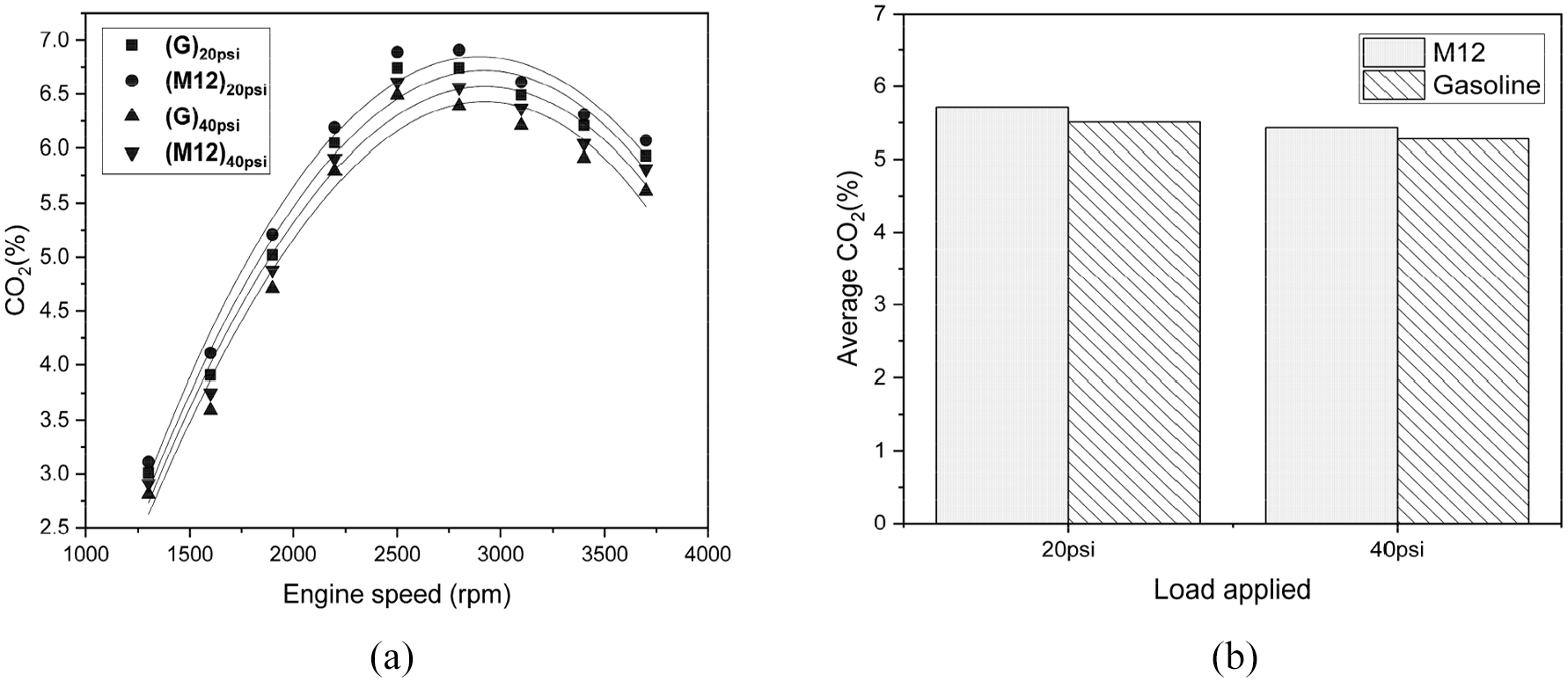
(a) CO2 emissions for different fuels at varying engine speeds and loads and (b) average CO2 emissions for different fuels at varying engine speeds and loads.
HC emission
Figure 9(a) indicates the trends of HC emission for both gasoline and M12 at two different loads and varying engine speeds. The general decreasing trend of HC emission was demonstrated by both the fuels for continuous increment in engine speed. It can be reasoned out that the general declining trend of HC emission along with engine speed because higher combustion temperature inside cylinder allowed rapid fuel combustion with lower flame quenching to cylinder walls and adsorption or desorption in oil film. Figure 9(b) describes the average HC emission contents for both the fuels at two different loads. The average HC emission in case of M12 at 20psi and 40psi load was 6.05% and 6.31% lower than gasoline respectively. However, M12 at 20psi load produced 11.85% less HC emission than M12 at 40psi load. HC emission is consequence of incomplete combustion and evaporation of unburned fuel to atmosphere. The major factors that contributes for HC emission are exhaust valve leakage, fuel condition during cold start and warmup, engine misfire and unburned fuel accumulation in crevices, oil films and deposits. 67 M12 produced relatively lower HC emission than gasoline due to lower carbon to hydrogen ratio. Moreover, higher diffusivity, lower ignition energy and shorter flame quenching distance of hydrogen commences combustion adjacent to cylinder walls which provides adequate activation energy for combustion of hydrocarbon fuel. 68 HC emission signifies power loss which would ultimately affect brake thermal efficiency. It is also responsible for ozone pollution and photochemical smog. The lower HC emission for methanol blended gasoline fuel showed improved combustion as compared to gasoline and this finding coincides with the findings of Shayan and Farkade.25,37 The oxidation of hydrocarbon fuel in post flame because of blending with oxygenated fuel considered to be primary reason for lower production of HC emission. 69 The oxygen in methanol provides clean combustion because oxygen react with hydrogen to produce H2O and react with carbon to produce CO2. 60 As, there is less affinity of reaction between hydrogen and carbon which results lower HC emission.
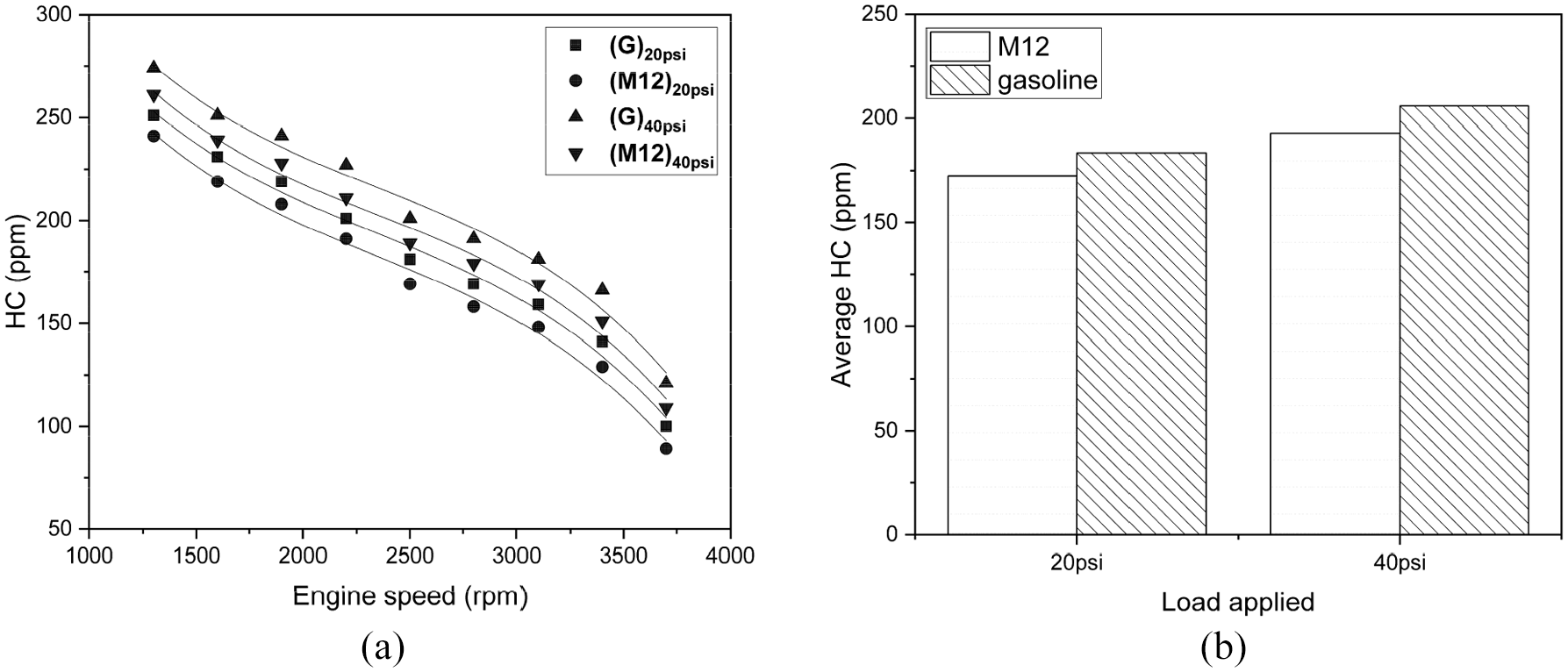
(a) HC emissions for different fuels at varying engine speeds and loads and (b) average HC emissions for different fuels at varying engine speeds and loads.
NOx emission
Figure 10(a) describes the formation of NOx emission for M12 and gasoline at various loads and engine speeds. The general increasing trend of NOx along with engine speed demonstrated by both the fuels. An augmentation in engine speed responsible for increased fuel consumption to generate more brake power and higher EGT resulted from burning of more fuel. The average NOx emission in case of M12 at both loads was higher than gasoline (see Figure 10(b)). On average, NOx emission produced by M12 at 20psi and 40psi load was 32.52% and 27.58% higher than gasoline respectively. However, M12 at 20psi load produced 12.89% less NOx emission than M12 at 40psi load because of more fuel consumption and higher EGT. Higher combustion temperature and availability of oxygen inside cylinder responsible for augmented NOx emission. 60 The higher NOx emission can be reasoned out the dissociation of diatomic nitrogen molecule to highly reactive monoatomic nitrogen. The oxygen in the air-fuel mixture reacts with monoatomic nitrogen to produce NOx emissions. EGT helps in understanding about the quality of combustion and the interpretation of development of exhaust emissions. 60 The lower heating value of methanol blended gasoline fuel is the core reason for more fuel injection into cylinder. Consequently, a higher EGT was generated due to the burning of more oxygenated fuel. The higher temperature inside an engine cylinder indicated by higher EGT catalyses the reaction between monoatomic nitrogen and oxygen, consequently higher NOx produced in case of methanol blended fuel.
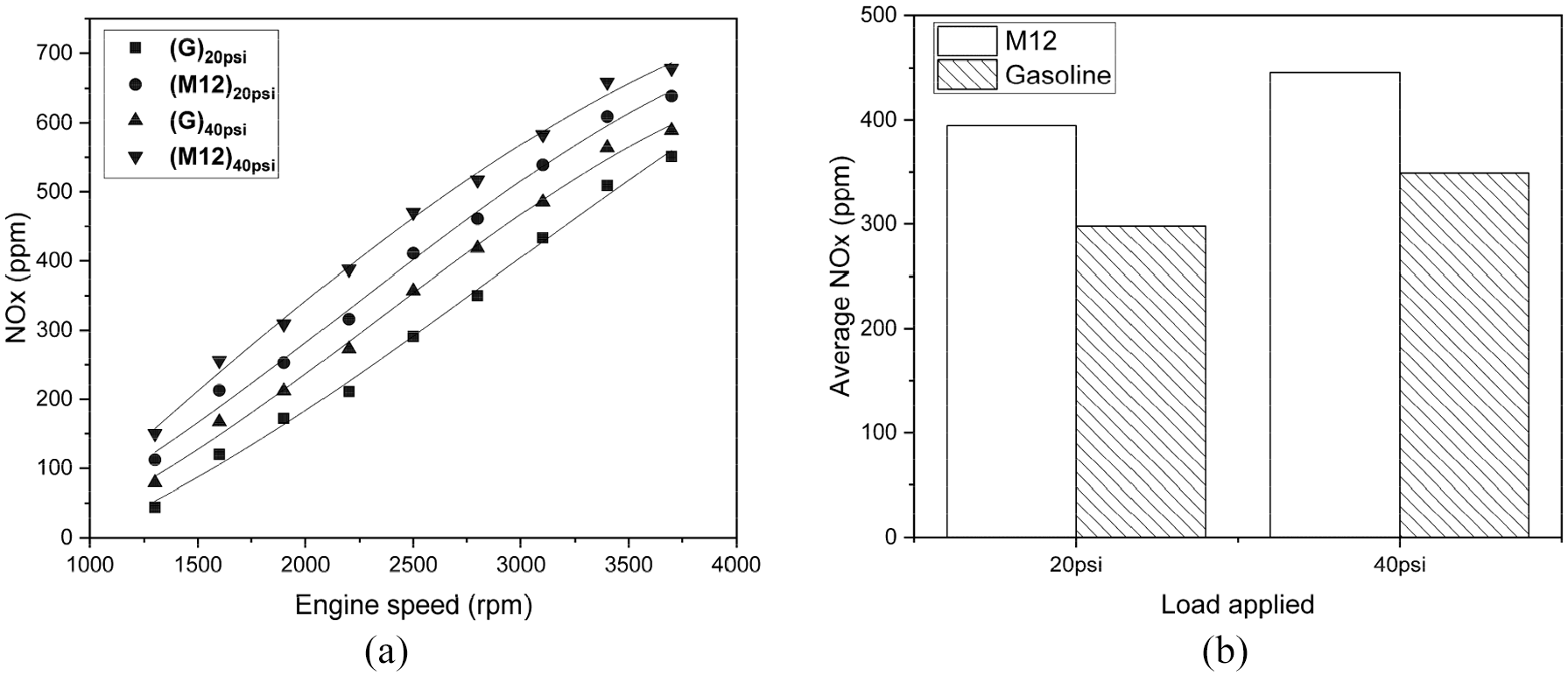
(a) NOx emissions for different fuels at varying engine speeds and loads and (b) average NOx emissions for different fuels at varying engine speeds and loads.
Effect on lubricant oil deterioration
The immense research has been carried out to examine the effect of these alternative fuel on engine performance and exhaust emission, but none of the research has been carried out before to examine the effect of these alternative fuels on physicochemical characteristics of lubricant oils. Lubricant oil usually deteriorated because of engine running time, exterior and interior temperature of an engine. As, the lubricant oil plays very significant role in the effective engine performance. Therefore, an effort has been made through current research work by investigating the impact of methanol blended fuel and gasoline fuel on lubricant oil attributes. The comparison then made between lubricant oil attributes when it ran on 100 h for both methanol blended fuel and gasoline subsequently. This is the novel aspect of the current research that it emphasizes the importance of lubricant oil and present comprehensive study including all three parameters like engine performance, emissions and lubricant oil deterioration. The percentage variation in physicochemical properties of lubricant oil running on M12 and gasoline in contrast to fresh lubricant oil sample is shown in Figure 11. The kinematic viscosity of lubricant oil was evaluated at 40°C and 100°C using ASTM D445 standard procedure. The (KV)40°C of used lubricant oil in case of gasoline and M12 was declined by 18.78% and 11.61% respectively in comparison with fresh lubricant oil. Similarly, the (KV)100°C of lubricant oil that ran on gasoline and M12 was declined by 9.62% and 7.77% respectively. The kinematic viscosity of deteriorated lubricant oil decreased due to fuel dilution and molecular breakdown of lubricant oil. 47 The (KV)40°C and (KV)100°C in case of M12 were 8.82% and 4.57% higher than gasoline. This less decline in kinematic viscosity for methanol-gasoline fuel blend (M12) due to the mixing of sludges, wear particles and oxides.

Percentage variation in lubricant oil properties for gasoline and M12 with respect to fresh lubricant oil sample as reference line.
Total acid number (TAN) points towards the amount of acids present in the lubricant oil. TAN was evaluated for deteriorated and fresh lubricant oil by following ASTM D974 standard. The deteriorated lubricant oil for gasoline and M12 showed 19.12% and 31.31% increase in TAN respectively. However, M12 showed 10.23% higher TAN as compared to gasoline for engine running on 100 h. The higher increase in TAN for M12 can be credited to acidic nature of methanol. TAN is proportional to the oxidation of lubricant oil and it is also responsible for changing chemical composition and physicochemical properties of lubricant oil. 70 Flash point is minimal threshold temperature at which the vapours of lubricant oil will instantly combust once provided with an ignition source. ASTM D92 standard was followed to measure the flash point of lubricant oils. Both gasoline and M12 showed reduction of 14% and 9% in flash point of deteriorated lubricant oil respectively. Subsequently, a higher decline of 5.81% in flash point was noticed for gasoline in comparison with M12. The fuel dilution was found to be core reason for more decrease in flash point. The flash point directly impacts the upper operating limit of a lubricant oil, which reflects the fire safety of the oil application. The application of lubricant oil with this parameter being too low represents a danger during storage, distribution and operation which can contribute to a malfunction or burning of the elements of system, where the lubricant oil is used.
ASTM D1298 standard was opted for the determination of specific gravity of lubricant oil deteriorated by gasoline and M12 subsequently. The specific gravity of lubricant oil in case of gasoline and M12 fuel was increased by 0.78% and 0.86% as compared to fresh lubricant oil. Specific gravity changes due to the contamination, sludges and oxides in lubricant oil during its operations. An increase in the number of aromatic compounds in lubricant oil result rise in the specific gravity. The specific gravity of lubricant oil in case of M12 was 0.079% higher than gasoline. This was due to more density and specific gravity of methanol. Moreover, acidic sludges and oxides would increase specific gravity. Ash is the parameter to assess the purity of lubricant oil. It shows the solid waste that remained after complete combustion of lubricant oil. 71 Ash content refers to non-combustible substances that remained as ash after combustion of fuel. These substances might be atmospheric dust, wear debris, sludges and thermally decomposed particles. The ash content was evaluated for lubricant oil deteriorated by gasoline and M12 subsequently using ASTM D482 standard procedure. The ash content of lubricant oil in case of gasoline and M12 was increased by 1.96% and 2.94% in comparison with fresh lubricant oil. The ash content in lubricant oil for M12 was 0.97% higher than from gasoline. The higher EGT could also be responsible for more wear and tear inside the engine, so that worn particles could be mixed with lubricant oil and could also deteriorate the lubricant oil early through breakdown of lubricant oil molecules. The lubricant oil in case of M12 possessed more ash content in contrast with lubricant oil that ran on gasoline due to contaminants, sediments and wear debris as methanol exhibits corrosive nature. The examination of variation in lubricant oil attributes due to methanol blended fuel and gasoline will pave the way to change the composition of lubricant oil in such a way that the lubricant oil deterioration could be prolonged. Moreover, such coatings or material for inside walls of engine cylinder could be developed that may reduce wear and tear.
Conclusion
An effort has been made to study the impact of two different fuels (gasoline and M12) on engine performance and emissions along with their impact on lubricant oil deterioration through experimentation. The findings of this research study are listed below:
The torque for M12 at lower and higher load was 7.28% and 7.01% higher than gasoline respectively. Similarly, the brake power for M12 at lower and higher load was 6.69% and 6.41% higher than gasoline respectively. The BSFC of M12 was 3.68% and 3.61% greater than gasoline at lower and higher load respectively.
The highest 21.44% BTE was achieved for M12 under 40psi load at 2500 rpm and the highest 23.69% BTE was achieved for M12 under 20psi load at 2800 rpm. At higher loading condition, BTE was lower because more fuel was consumed to produce more power. The EGT of M12 was 24.65% and 16.91% higher than gasoline at lower and higher load respectively.
The CO emission for M12 at lower and higher load was 9.46% and 9.77% lower than gasoline respectively. Similarly, the CO2 emission for M12 at lower and higher load was 2.61% and 2.80% greater than gasoline respectively.
The HC emission for M12 at lower and higher load was 6.05% and 6.31% lower than gasoline respectively. However, the NOx emission for M12 at lower and higher load was 32.52% and 27.58% higher than gasoline respectively.
The (KV)40°C and (KV)100°C of lubricant oil in case of M12 were 8.82% and 4.57% greater than lubricant oil that ran on gasoline respectively. TAN, specific gravity, flash point and ash content of lubricant oil that ran on M12 were 10.23%, 0.079%, 5.81% and 0.97% greater than lubricant oil that ran on gasoline respectively.
It can be inferred that deterioration rate of lubricant oil is higher when M12 used as fuel in contrast with gasoline for 100 h running of an engine. But M12 is well suited for environmental emissions (CO and HC) and performance (power, torque and BTE) of an engine. The variation in physicochemical properties of lubricant oil could pave the way for the development of such additives in future which may prolong the deterioration rate of lubricant oil. Moreover, such coatings for existing metallurgy of engine or new materials for engine and its auxiliaries need to be developed that resist wear or tear when methanol blended fuel used. This will reduce wear and tear inside engine, so that wear debris could not mix with lubricant oil and its deterioration rate could be slow down. Moreover, less wear and tear inside an engine will increase its life and performance.
Supplemental Material
sj-pdf-1-ade-10.1177_16878140211025213 – Supplemental material for Experimental evaluation of methanol-gasoline fuel blend on performance, emissions and lubricant oil deterioration in SI engine
Supplemental material, sj-pdf-1-ade-10.1177_16878140211025213 for Experimental evaluation of methanol-gasoline fuel blend on performance, emissions and lubricant oil deterioration in SI engine by Muhammad Ali Ijaz Malik, Muhammad Usman, Nasir Hayat, Syed Wasim Hassan Zubair, Rehmat Bashir and Ehtasham Ahmed in Advances in Mechanical Engineering
Footnotes
Appendix
Handling editor: James Baldwin
Declaration of conflicting interests
The author(s) declared no potential conflicts of interest with respect to the research, authorship, and/or publication of this article.
Funding
The author(s) received no financial support for the research, authorship, and/or publication of this article.

References
Supplementary Material
Please find the following supplemental material available below.
For Open Access articles published under a Creative Commons License, all supplemental material carries the same license as the article it is associated with.
For non-Open Access articles published, all supplemental material carries a non-exclusive license, and permission requests for re-use of supplemental material or any part of supplemental material shall be sent directly to the copyright owner as specified in the copyright notice associated with the article.
