



Abstract
The energy transport for hybrid nanofluids flow through non-parallel surfaces with converging/diverging nature is becoming important engineering topics because of its occurrence in biomedicine, cavity flow model and flow through canals, etc. Therefore, this work attempted to study the momentum and heat transport for MHD Jeffery-Hamel flow of hybrid nanofluids through converging/diverging surfaces. This analysis further evaluates the heat transport features subject to thermal radiation and nanoparticles shape factor impacts. A mathematical formulation under single phase nanofluid model with modified thermophysical properties has been carried out. The leading equations are transmuted into dimensionless form with the implementation of appropriate scaling parameters. The collocated numerical procedure coded in MATLAB is employed to acquire the numerical solutions for governing coupled non-linear differential problem. Multiple branches (first and second) are simulated for flow and temperature fields with varying values of involved physical parameters in case of convergent channel. The studies revealed that there is a significant rise in fluid velocity for higher magnetic parameter in case of divergent channel. The findings reveal that the skin-friction coefficient (drag) significantly reduces with higher Reynolds number. In addition, the heat transfer rate enhances with channel angle as well as nanoparticles volume fraction in upper branches.
Keywords
Introduction
In the contemporary generation of technology, innovation and science, the study of nanofluids has secured a miraculous consideration because they have unlimited spectrum of utilizations in almost all fields of science and technology. Accordingly, the nanofluids are being used in numerous fields, for example in biomedicine, fuel cells, hybrid-power engines, domestic refrigerator, chiller, polymer coating, aerospace technology, nuclear systems cooling, thermal storage, engine cooling, etc. Various investigations have proven that this new class of fluids acquires intensified thermo-physical properties, like, thermal conductivity, thermal diffusivity, convective heat transfer coefficients and viscosity in comparison to the base liquids. A stable and uniform suspension of ultra-fine solid particles (mostly of metals and their oxides) in base liquids, is termed as nanofluid. Choi 1 is truly considered as a pioneer who introduced the term ‘nanofluid’ in the year 1995. In this investigation, he debated that the thermal transport properties of base liquids in the presence of nanoparticles have increased dramatically. The most significant point is the ultra-fine size of these nanoparticles which ranges from 1 to 100 nanometre, in this way nanofluids look like to perform more alike a single-stage liquid than a solid-liquid amalgamation. Eastman et al. 2 have predicted an enhancement about (60%) of thermal conductivity of nanofluid for Al2O3, CuO and Cu nanoparticles for different base fluid and taking only (5%) volume frication of nanoparticles. In regard of these characteristic, many researchers have shown their interest to examine different features of nanofluids flow along with their heat transport analysis. Later, the enhanced heat exchange properties of nanofluids were addressed by Buongiorno 3 by considering Brownian motion and thermophoresis slip mechanics. In another study, Tiwari and Das 4 proposed a different model to analyse the nanofluids heat transport characteristics by considering the fraction of the solid volume. Kuznetsov and Nield 5 establishes an analytical solution for natural convection flow of nanofluid over a vertical plat with two slip mechanisms. A comprehensive review concerning nanofluids flow and heat transport is given by several researchers, see references.6–10
Very recently, another innovative class of heat transfer fluid recognized as ‘hybrid nanofluid’ acts as a heat transporter in heat transfer applications. Hybrid nanofluids are processed by the amalgamation of two or more distinct nanoparticles into a base fluid. It is assumed that hybrid nanofluids can increase or changed the thermal conductivity and heat transfer execution. Engineers, researchers and scientists are paying a lot of attention to hybrid nanofluid because of its wide range of commercial, scientific and technological applications, for instance, microfluidics, medical lubrication, transportation, acoustics, naval structures and solar heating and many more. Theoretical and numerical studies about hybrid nanofluid flow and heat transfer analysis have been conducted over the recent years to better understand their rheological and heat transfer properties. The pioneer work studying thermo-physical transport properties of hybrid nanofluids was prepared by Jana et al. 11 Some reviews on the applications, preparation and thermophysical properties of hybrid nanofluids have been conducted by Sarkarn et al. 12 and Akilu et al. 13 Recently, Devi and Devi 14 revised the thermophysical correlations for hybrid nanofluids and applied them to stretching flow problems, along with Tiwari and Das’s single phase nanofluid mathematical model. Mackolil and Mahanthesh 15 discussed the radiative heat transport analysis for Cu − Al2O3 − H2O hybrid nanofluid flow past a vertical flat plate. Some other remarkable studies describing the hybrid nanofluid heat transport phenomenon with their applications is mentioned in works of Mayson and Mahanthesh, 16 Ashlin and Mahanthesh, 17 Thriveni and Mahanthesh,18,19 and Mahanthesh et al. 20
Recently the topic of thermal radiations seems quite interesting field of research. The reasons behind this valuable attraction are that the radiative effect has a pivotal role in the fields of space technology, geophysics, polymer industry and engineering. In industry the radiative heat transport plays a key role in regulating heat transfer because the standard of final product directly relates with heat controlling factors. Moreover, heat transfer process in the presence of non-linear radiations has central role in renewable systems and in the investigation and warm recuperation of oil. Many researchers have focused their attention on thermal radiation effect since it has a wide range of physical, manufacturing and engineering applications. In this regard, mixed convection flow of nanofluid past a vertical wedge in the existence of thermal radiation was investigated by Chamkha et al. 21 Later, Khan et al. 22 reported a three-dimensional flow of Burgers nanofluid with heat transport analysis by considering non-linear thermal radiation and convective boundary conditions. Alam et al. 23 investigated the entropy generation during radiative heat transfer analysis in a thin viscous nanofluid flow through a parallel channel within porous media. Waqas et al. 24 elaborated the influence of nonlinear radiation on stretching flow of ferrofluids with magnetic dipole. Some other related works can be found in the studies.25–27
After a careful review of above literatures, we have decided to present a numerical study which will focus on the following issues related to Jeffery-Hamel flow of hybrid nanofluids:
The first one is to model the momentum and heat transport equations for molybdenum disulfide
The impacts of non-linear thermal radiation and shape factor effects of nanoparticles are incorporated to investigate the flow phenomenon.
The second novel objective is seeking branches (multiple solutions) for flow and heat transport fields in case of convergent channel.
At last, the physical illustration of obtained numerical solutions for various key parameters with the help of graphical results.
Mathematical formulation and flow configuration
Description of physical problem
At present, a steady incompressible flow of an electrically conducting hybrid nanofluids flowing in the channel formed with converging/diverging nature is considered. The flow is due to the presence of a source or sink between walls restricting the flow which intersect an angle of

A
Governing flow equations
The momentum and energy transport within porous media are modelled using above mentioned assumptions and basic conservation laws as follows30,31:


In the above expressions, p denotes fluid pressure,

where
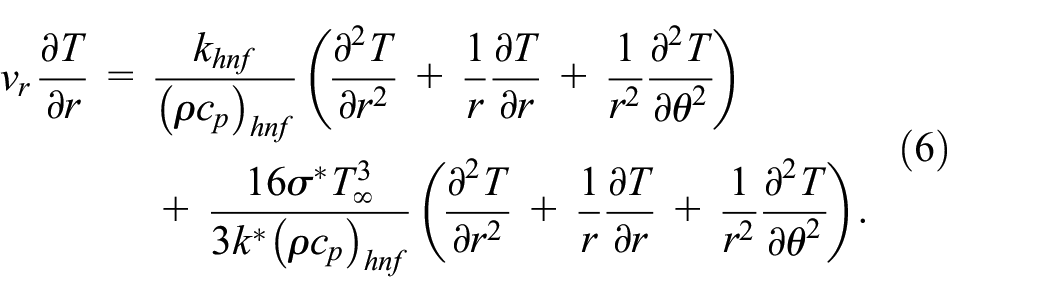
Substituting equations (5) into (4), the energy equation subject to thermal radiation takes the form:
Boundary conditions
The momentum and energy transport are added by the following boundary conditions 31 :


Thermo-physical properties of hybrid nanofluids
In the present study, the thermophysical properties of water and hybrid nanofluids with platelet, spherical and brick nanoparticles


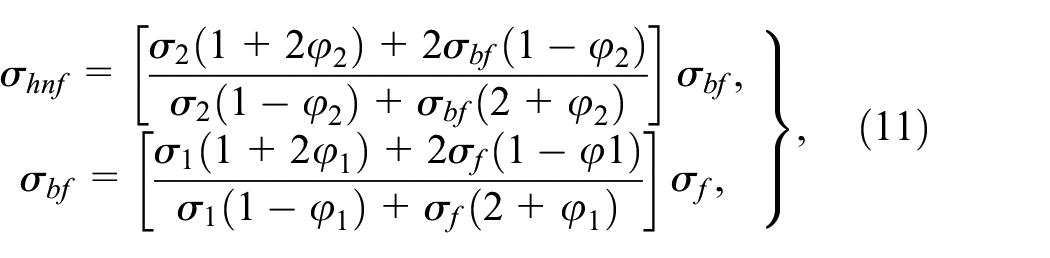


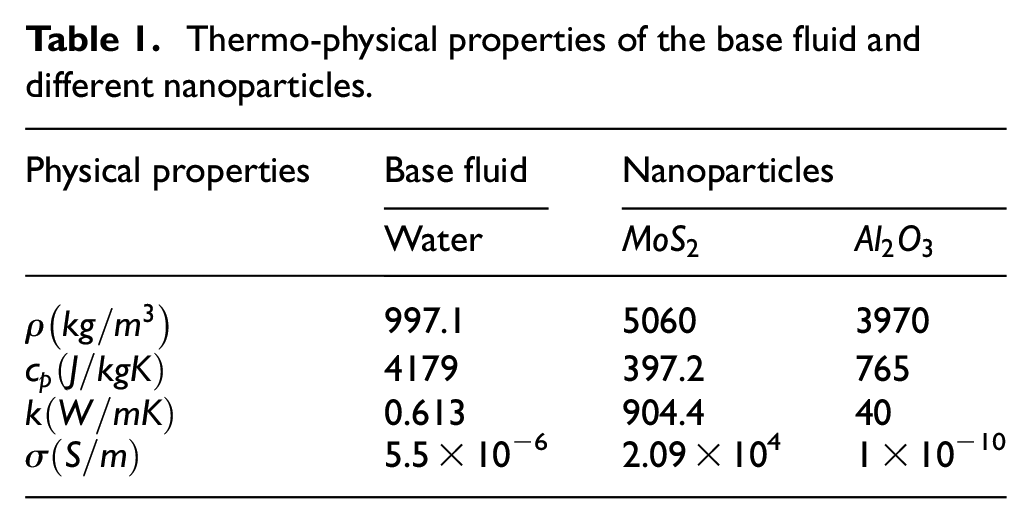
The numerical values of water
Thermo-physical properties of the base fluid and different nanoparticles.
Non-dimensional analysis
To make the prevailing system dimensionless, we introduce the following dimensionless parameters. 30

where U represents the centreline velocity.
Eliminating pressure term from equations (2) and (3) and incorporating equation (14), subsequent system of governing ordinary differential equations become:


with boundary constraints


where,

The physical parameters governing the flow and heat transport phenomena are listed as follows:
The Reynolds number
Engineering quantities
The skin-friction coefficient at the wall of the channel is represented by the mathematical expression

The Nusselt number has been computed at the wall of the channel which measures the heat transfer rate, and it is given by

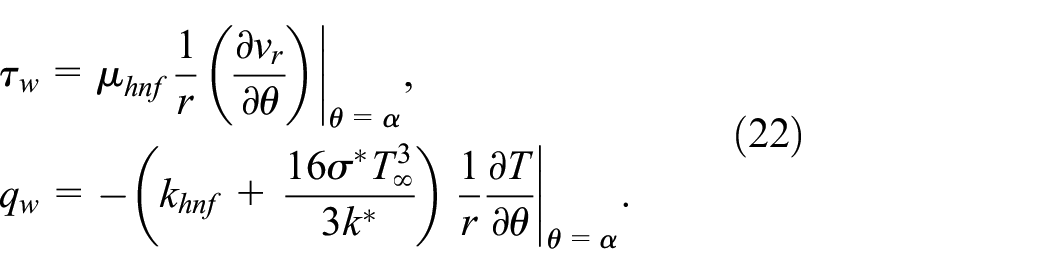
In equations (20) and (21), the wall shear stress and heat flux are defined by the relation
Computational scheme
In this work, a numerical technique based on finite difference scheme, namely, bvp4c solver in MATLAB is implemented for numerical simulations. Therefore, the two-dimensional flow and heat transport equations governing the current model (equations (15) and (16)) with auxiliary boundary conditions (equations (17) and (18)) are numerically tacked with the said technique. The most fundamental step of this procedure is to transmute the given higher order boundary value problem into of the boundary value problems of order one. For this purpose, we introduce the new variables



The bvp4c routine is executed by giving suitable values to involved physical parameters and appropriate initial guesses at the mesh points. As, the multiple branches (upper and lower solutions) exist for our problem, we need two good initial guesses in this routine which fulfil all the boundary conditions.
Results and validation
Code validation
The comparison of simulated results in terms of skin-friction coefficient
Comparison of the results of present study and existing works for various values of

Discussion
In this section, we provide the numerical outcomes in the form of non-dimensional velocity and temperature profiles of hybrid nanofluids by taking different variation in involved physical parameters, like, magnetic parameter
Velocity fields
Figure 2(a) and

Performance of magnetic parameter M on velocity variation

Performance of shrinking parameter

Performance of Reynolds number
Temperature fields
The dimensionless temperature distributions

Performance of porosity parameter K on temperature variation

Performance of shrinking parameter
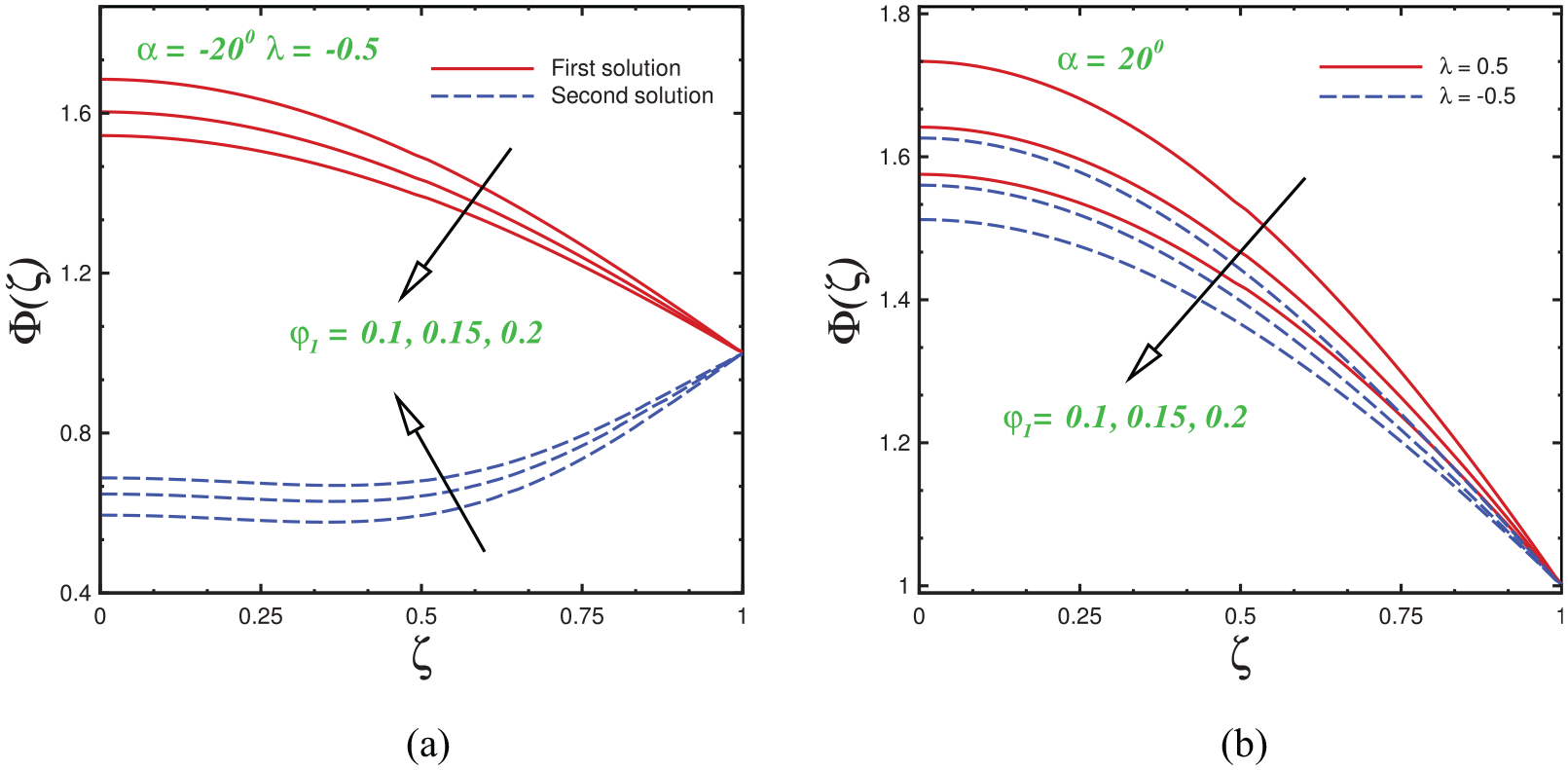
Performance of

Performance of

Performance of radiation parameter

Performance of shape factor parameter m on temperature variation
Engineering quantities
The computational outcomes for the coefficient of skin-friction

Combined performance of

Combined performance of
Conclusions
This theoretical and computational analysis is concerned with MHD Jeffery-Hamel flow of
It is perceived that the coefficient of skin-friction enhances with higher nanoparticles volume fraction in upper solution.
Increasing the magnetic field strength has rising influence on the rate of heat transfer for upper solutions.
The Reynolds number provides a clear description of flow and heat transfer mechanism. Hence, an increase in Reynolds number leads to an enhancement in both first and second solutions of velocity field for convergent channel, while quite opposite is true for divergent channel.
One the other hand, the progressing values of Reynolds number reduced the temperature profiles in both solutions.
An investigation of thermal characteristics of hybrid nanofluids, we noticed more enhancement in temperature profiles with greater stretching or shrinking parameter for both solutions.
Footnotes
Acknowledgements
Authors would like to express their sincere thanks to the reviewers for their detailed reading, precious proposals and comments that help us in improving this work.
Handling Editor: James Baldwin
Declaration of conflicting interests
The author(s) declared no potential conflicts of interest with respect to the research, authorship, and/or publication of this article.
Funding
The author(s) received no financial support for the research, authorship, and/or publication of this article.
