




Abstract
The optimization of forced ventilation in tunnel construction becomes the key problem to improve the construction environment and energy saving. The influence of main factors on the flow field is considered for orthogonal experimental design and optimization, which includes the distance between the air duct outlet and the tunnel face, the bench length, the bench height, and the position of the air duct. Thus, the TOPSIS theory was adopted for the optimization method and improvement, and a series of CFD simulations were applied to analyze optimal solutions. The results show that the improved TOPSIS theory with entropy weight method and analytic hierarchy process could effectively solve the optimization problem of forced ventilation in tunnel construction. Based on this optimization principle, a case was analyzed, and the optimized ventilation parameters are obtained to improve ventilation efficiency and save energy. In the optimization scheme, the flow field in the tunnel is stable and the wind is strong enough to ventilate. Besides, there is none huge vortex, which might disrupt the stable flow field and reduce energy efficiency. It could improve the ventilation efficiency and stability, save time and cost, and bring considerable economic and social benefits to the tunnel construction.
Introduction
In recent years, tunnel construction in China has been developing steadily. With the rapid development of China’s economy and society, the green and healthy working environment of various industries have attracted more and more attention from workers, and it is same to tunnel construction. But, the tunnel construction environment is relatively harsh. And all kinds of machinery working at the same time, so that some disadvantages such as dust, noise, high temperature to the workers brought a great physical and mental test. So the ventilation during construction could ensure not only the oxygen supply of construction workers and machinery equipment, but also the suitable temperature and low concentration of dust, which is of great significance for the development of tunnel green construction technology. The bench cut method is widely used in tunnel construction because of its strong applicability and high economy, which is generally divided into two or three benches. In order to reduce the effect of benches, the length of benches is generally set up for the up and down position of the bench, which depends on the tunnel size and surrounding rock. In addition, forced ventilation efficiency will also have influence on the bench length.
In general, most scholars perform the research on the tunnel ventilation through Computational Fluid Dynamics (CFD) numerical simulation, theoretical analysis, and model test. Mirhedayatian et al. 1 presented a new approach for ranking the alternatives in fuzzy Analytic Hierarchy Process (AHP), and used the proposed approach for selecting the best tunnel ventilation system. Wang et al. 2 conducted numerical simulation research on the Tunnel Boring Machine(TBM) construction ventilation tunnel. Kurnia et al. 3 and Zhou et al. 4 carried out the study for the control of dust. Wang et al. 5 researched the diffusion mechanism of gas leakage through small holes, and simulated and analyzed the influencing factors. Liu et al. 6 researched the dust migration characteristics in the ventilation system of long-duct forced and short-duct exhaust under the condition that the forced ventilation outlet are at different distances from the tunnel working face, so as to provide guidance for the control of the tunnel dust. Liu et al. 7 designed a Tunnel Ventilation Intelligent Control(TVIC) system based on the Radial Basis Function Neural Network(RBFNN). Mi et al. 8 adopted Fire Dynamics Simulator(FDS) to investigate the different combinational modes of ventilation systems, fire-proof doors, and sprinklers during fires in utility tunnel. Niu et al. 9 studied the influence of the distance between the air duct and the tunnel face and the diameter of the air duct on the flow field through numerical simulation for a specific project, and obtained the optimal combination which is suitable for the project. Chang et al. 10 researched the ventilation and diffusion of harmful gases during tunnel construction under the influence of factors such as cross-sectional area and air velocity through numerical simulation, and obtained the function of pollutant distribution and construction ventilation time.
Above all, many researchers have been working on the forced ventilation during tunnel construction with the bench cut method. However, because of the particularity of the limited space in tunnel, the bench cut method still needs more in-depth research on the efficiency of the ventilation and the stability of tunnel construction. Further, the flow field during ventilation could significantly have reflect on the airflow direction, wind speed, eddy current around working areas of the tunnel. Therefore, the effects of main factors on the flow field are considered for orthogonal experimental design and optimization, which includes the distance between the air duct outlet and the tunnel face, the bench length, the bench height and the position of the air duct. Moreover, the Technique for Order Preference by Similarity to an Ideal Solution (TOPSIS) is adopted for the optimization method and improvement, and a series of Computational Fluid Dynamics (CFD) simulations with Fluent are applied to analyze optimal solutions. Thus, through a case study, the optimal scheme and parameters would be solved, so as to obtain an effective method to improve the ventilation efficiency with the bench method.
Optimization principle of forced ventilation
The TOPSIS method was first proposed by Hwang and Yoon. 11 The basic idea of TOPSIS method is to accurately calculate the difference between each evaluation scheme and the optimal one based on the original data. Thus, the improved TOPSIS theory with entropy weight method and analytic hierarchy process could adopt to solve the optimization problem, which replace the general subjective weight method with the entropy weight method and the analytic hierarchy process.
Improved TOPSIS Theory
Index normalization
The original data in the evaluation index are analyzed, and the evaluation index is distinguished into the minuscule index, the intermediate index, and the interval index.
Minuscule index, which is expected to be as small as possible.

Intermediate index, which is expected to take the middle value of appropriate ones.

Interval index, which represents that the expected value of a certain interval is the best.

Construct the forward initialization matrix
Assuming that there are n objects to be evaluated and m evaluation indexes, the data that have been normalized by indexes are combined into a matrix to form the normalized matrix

Normalize the normalized matrix
Normalized matrix

Determine the optimal solution and the worst solution
The optimal scheme Z+ is constituted by the maximum value of each column in Z:

The worst scheme Z− consists of the minimum value of each column in Z:

Calculate the proximity of each evaluation object to the optimal and the worst scheme


where
Determine the optimal scheme and the worst scheme

where the closer the formula Ci is to 1, the better the evaluation object is. (
Combinatorial weighting method
It is very important to determine the calculation weight of each evaluation index in a scientific and reasonable way during the comparative analysis of the optimal ventilation scheme of tunnel compression, which will directly affect the accuracy and effectiveness of the final prediction results. Among them, the commonly used methods are subjective weighting method and objective weighting method. In order to avoid subjective factors separately or single objective factors to have influence on the prediction of the optimal solution, leading to the final result appearing deviation, we should consider subjective and objective factors. The combined weighting method is adopted. The subjective weighting method adopts the analytic hierarchy process and the objective weighting method adopts the entropy weight method. 12
The entropy weight method determines the objective weight
Entropy weight method 13 is an objective weighting method. The basic principle of entropy weight method is to determine the weight according to the magnitude transferred by the variability of each index, which in turn reflects the relative intensity of competition among indexes. Different evaluation index difference and the effective information contained will be different. The smaller the variation degree of evaluation index is, the less information the data can provide, and so the lower the weight obtained will be.
(1) Construct the normalized matrix
From the above, it can be seen that the normalized matrix X is as follows:

(2) Normalize the normalized matrix
The normalized matrix can be obtained from the above Z

The weights of each index are calculated as follows

(3) Calculate the information entropy of each evaluation index

(4) Assign index weights

U
j is the difference coefficient of the calculated index, which can be calculated as
Analytic hierarchy process determines the subjective weight
Analytic hierarchy process14,15 is a subjective weighting method. It mainly decomposes the object-related influencing factors, establishes a hierarchical structure according to the mutual relations among factors and compares multiple factors in pairs and quantifies qualitative problems, which improves the rationality and effectiveness of decision-making to some extent.
(1) Determine the hierarchical relationship among the influencing factors and establish the system hierarchy.
(2) Construct judgment matrix.
The judgment matrix is assumed to be R. According to Table 1, the judgment matrix can be obtained by pair comparison of each evaluation index.

(3) The maximum eigenvalue of judgment matrix R was obtained and the consistency test was carried out.
Importance level table.

Consistency Index (CI):

Consistency Ratio (CR):

RI can be obtained by looking up Table 2
(4) Weight calculation
Mean random consistency index RI.

The weights are calculated by arithmetic mean method, geometric mean and eigenvalue method. In order to avoid the large deviation of the results obtained by a single method and ensure the rationality and scientificity of the calculation weight, this paper adopts three methods to calculate the weight of the evaluation index respectively, and finally determines the calculation result of the weight calculated by the eigenvalue method after comprehensive analysis. The result is
The evaluation indexes are combined with weights
Entropy weight method is based on the influence factors of evaluation objects that can provide information to determine the difference of the weight, reflecting mainly the information of objective data. And analytic hierarchy process is mainly based on subjective experience to determine the weight of evaluators. Thus combining the subjective and objective weights can be combination weights, achieving the unity of the subjective and objective. Combined with the combined weight formula in Li et al., 12 the formula is as follows:

Project overview
The Jinjing tunnel is located in the Ningquan section of the Xingquan Railway, which is a single-track railway tunnel. The total length of the tunnel is 7292 m. There is an inclined shaft in the middle of the tunnel, which intersects with the normal line at DK237 + 000. The tunnel in this section is divided into three working areas, which are the tunnel entrance working area, the inclined shaft working area, and the tunnel entrance exit working area respectively. The tunnel excavation is carried out by the bench cut method and the full face method, and the ventilation method adopt the forced ventilation. And the diameter of the air duct 1.8 m. The ventilation schematic diagram of tunnel construction is shown in Figure 1.
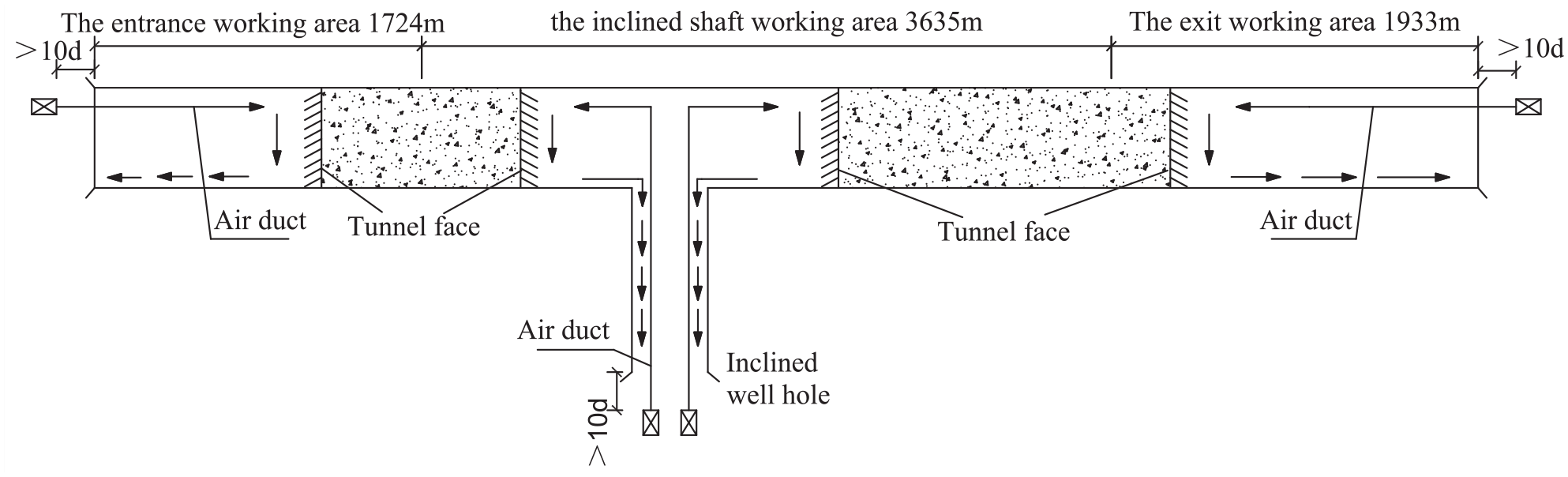
Tunnel construction ventilation diagram.
The bench cut method was adopted in the export work area DK240 + 820-DK 241 + 260 section, whose surrounding rock is IV and V. The section form of the tunnel and the location of the air duct in the bench cut method construction section are shown in Figure 2.

Section form of tunnel and layout of air duct.
Orthogonal experimental design and model calculation
Orthogonal experimental design
Under the same engineering geological condition, different air ducts and different bench sizes have different effects on the ventilation field of tunnel construction. We can learn from the Niu et al. 9 that the influence of the distance between the air duct outlet and the tunnel face on the ventilation field is studied. In the Chang et al., 10 the forced ventilation system used in tunnels was studied in terms of the position of the air duct and other factors. At the same time, according to the characteristics of the construction tunnel with the step method, the step size also changes with the different conditions of tunnel surrounding rock. The influence of main factors on the flow field is considered for orthogonal experimental design and optimization, which includes the distance between the air duct outlet and the tunnel face L1, the bench length L2, the bench height L3, and the position of the air duct P. Then, the flow direction, wind speed at limited space with the bench cut method and the existence of eddy currents at some positions was analyzed. To find out the optimal parameters combination of the tunnel ventilation, so the L16 (44) orthogonal experiment was designed. The main factors and levels are shown in Table 3. P1 represents that the air duct is located in the vault; P2 represents that the air duct is located on the side wall; P3 represents that the air duct is located near the bottom of the upper bench; P4 represents that the location of air duct is located at the corner of arch waist. The specific location of air duct is shown in Figure 2.
Main factors and levels.

CFD Validation
In CFD simulation calculation, different setting parameters in the model will generally result in different calculation results. Sometimes the deviation is large, or even no result can be obtained. In order to ensure the reliability of the results of CFD simulations, the ventilation for construction at the entrance area of the tunnel was taken as a case study, and the results of numerical simulation are compared with the field measurement. And then the relevant parameters of the numerical simulation were adjusted until the error of the numerical simulation calculation value is less than 5% of the measured value. Then the adjusted parameters of the numerical analysis and simulations were applied.
The required air volume within the length calculated by the numerical model is 1753 m3/min, the diameter of the air duct is 1.8 m, and the outlet velocity of the air duct is 11.48 m/s. The wind speed monitoring points are arranged from the tunnel face per 10 m, and numerical simulation is carried out by Fluent. According to numerical calculation, the Reynolds number of airflow in the cave reaches 107, which is bigger than the critical Reynolds number. Therefore, airflow in the cave is regarded as turbulence. The computing model is selected as k-epsilon model. The boundary condition was set as the outlet of the duct was the velocity inlet, the inlet of the tunnel was set as the pressure outlet, and the other walls were set as the non-energy exchange wall. At the same time, monitoring points were set up in the numerical model at the corresponding positions away from the tunnel face. The comparison between the field measured wind speed and the numerical simulation wind speed is shown in Figure 3.
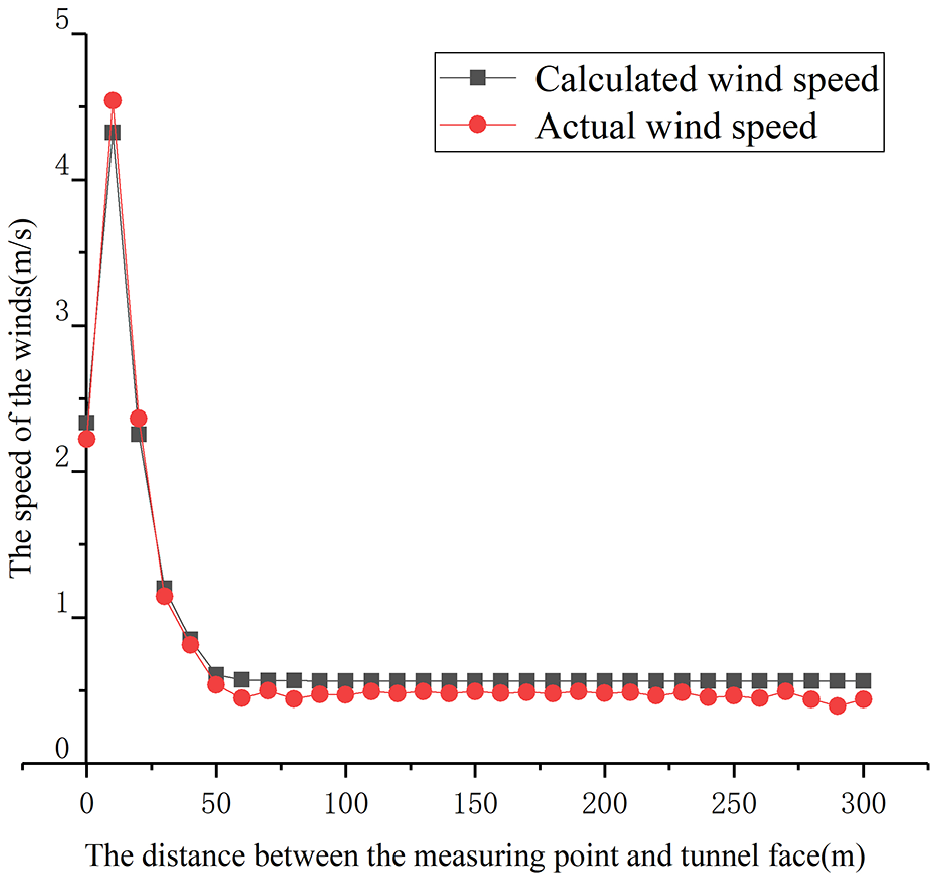
Comparison of field measured wind speed and numerical simulation.
It can be seen from Figure 3 that, wind speed peak appears at the cross section of the duct outlet, and the wind speed decreases along the path after the peak. When the distance from the tunnel face is more than 60 m, the wind speed in the tunnel tends to be stable, and the numerical deviation between the measured wind speed and the numerical simulation wind speed is very small, less than 5% of the measured wind speed. Therefore, it is feasible to use the numerical simulation method to research and analyze the airflow field.
CFD Numerical Model
Model establishment
Considering the tunnel size at the exit section of Jinjing tunnel, the length of 90 m at the section away from the tunnel exit is selected as the research object. Meanwhile, The Integrated Computer Engineering and Manufacturing code for Computational Fluid Dynamics (ICEM CFD) was used for 3D tunnel modeling and grid division, and Fluent was used to perform the CFD simulations. The numerical calculation model is shown in Figure 4.

Numerical calculation model.
Model assumption and parameter setting
(1) Basic hypothesis
① The gas is considered incompressible.
② Mechanical disturbance and personnel disturbance of flow field is ignored.
③ The wall surface of the tunnel is smooth.
(2) Model parameters
The Reynolds number of airflow in the tunnel reaches 107, which is larger than the critical Reynolds number. Therefore, the airflow in the hole is regarded as turbulence, and the computational model is chosen as k - epsilon model. According to the Railway Tunnel Construction Standard (TB10204-2002), 16 it can be obtained from the calculation of respiration, smoke dilution, exhaust dilution of mechanical internal combustion engine and air duct loss of 100 m in the tunnel that the required air volume in the calculated length is 1753 m3/min in the numerical model. The diameter of the air duct is 1.8 m, and the wind speed at the outlet of the air duct is 11.48 m/s, which can be obtained from the relationship between the required air volume and the cross-sectional area. The boundary conditions were set as the duct outlet as the velocity inlet, the tunnel inlet as the pressure outlet, and the other walls were set as the energy-free exchange wall.
Experimental scheme and results
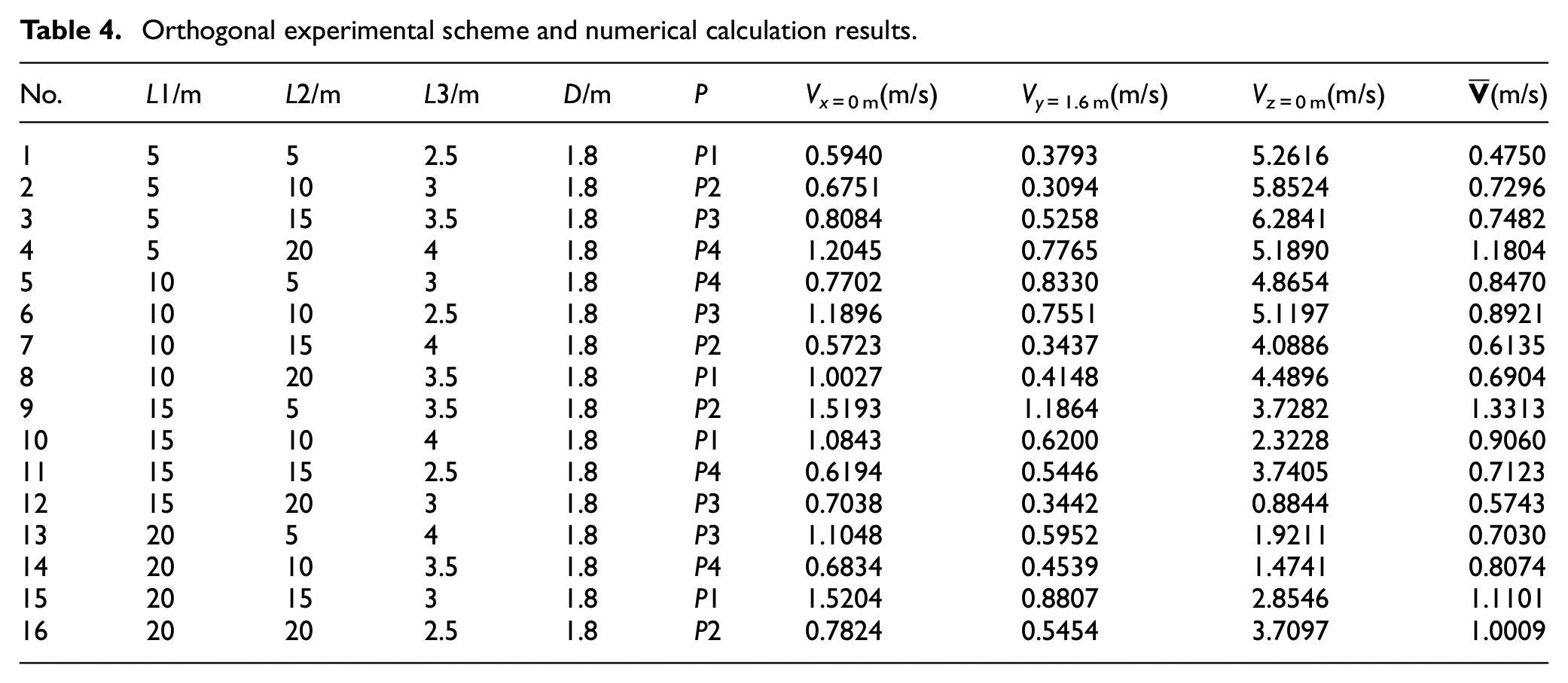
The ventilation field can significantly reflect the airflow direction, wind speed and eddy current at some positions of the tunnel with bench cut method. According to the orthogonal experiment design scheme, the Fluent was used to carry on the numerical simulation. The average velocity of the x
Orthogonal experimental scheme and numerical calculation results.
Data Processing
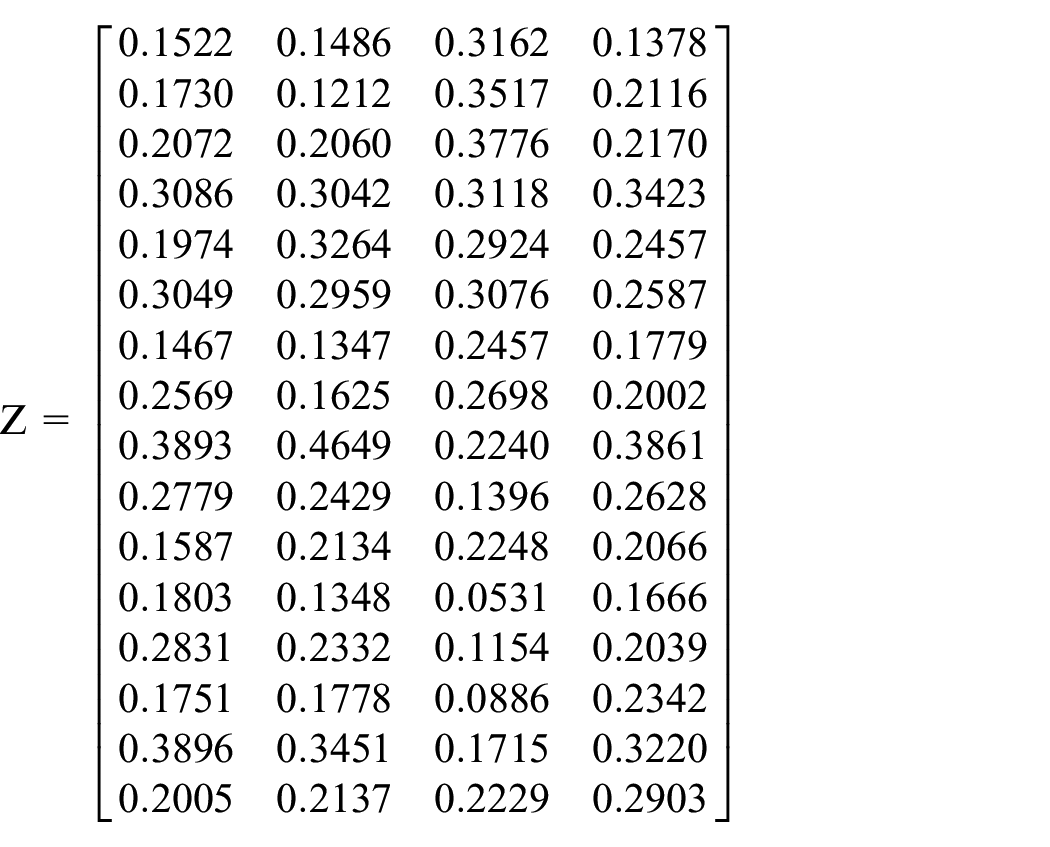
The calculation results in Table 4 are used as the original data, and the data is optimized by the analytic hierarchy process, entropy weight method, and TOPSIS. Since the average velocity in the tunnel is a forward indicator, there is no need for the forward treatment, and the standardized matrix Z can be calculated as follows:
Objective weight
According to Equations (9) - (11), the objective weight can be calculated as follows:

Subjective weight
According to Table 1, an experienced expert from the construction unit was invited to give the expert rating and another expert from the supervision unit is invited to check. The weight of each factor was obtained from the rating result. The judgment matrix of analytic hierarchy process is constructed as follows:

The maximum eigenvalue of matrix R is

Combined weight
According to Equation (14), the combined weight can be calculated as follows:

Scheme score based on TOPSIS
According to Equations (4) - (8), the corresponding scores under each working condition can be calculated. The final calculation result is as follows:

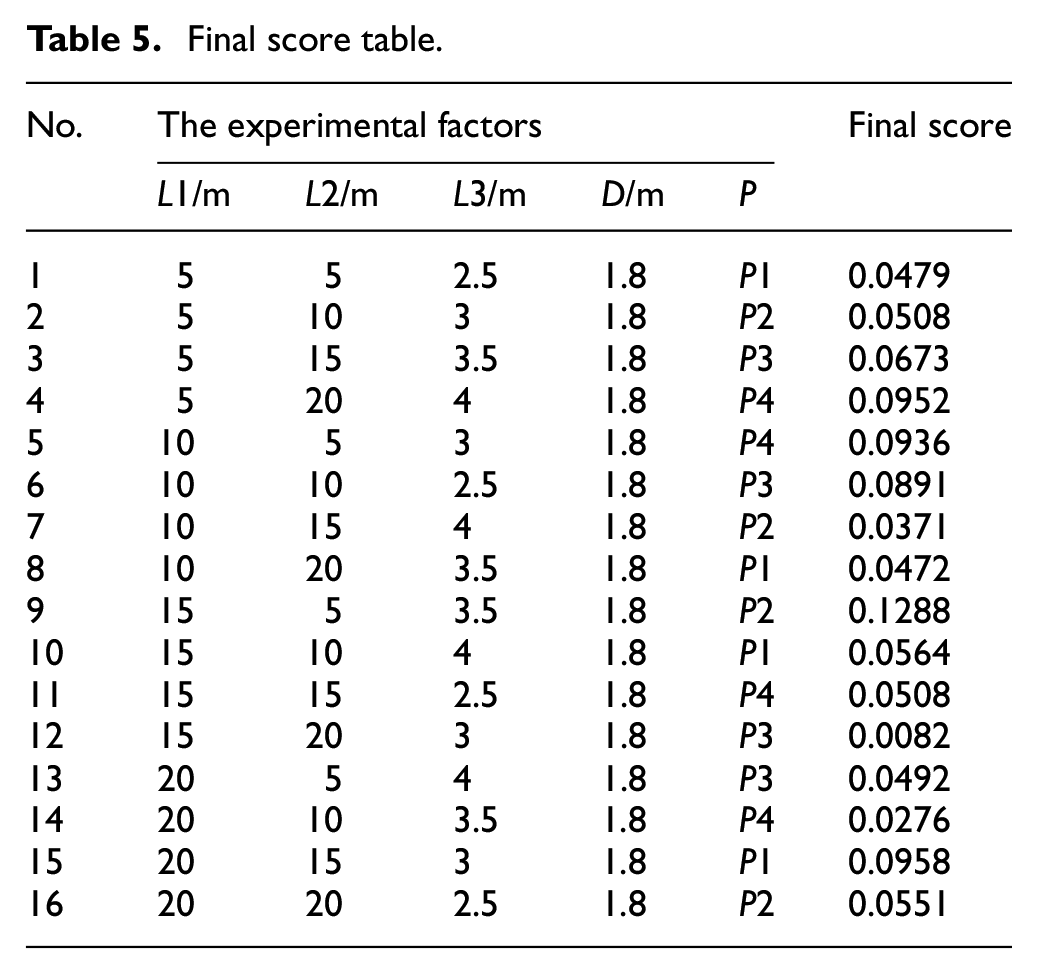
The matrix C reflects the closeness of each evaluation object to the optimal scheme. The closer the value is to 1, the better the evaluation object is. In conclusion, the final score of the orthogonal experiment under each working condition is shown in Table 5. From the Table 5, the working condition 12 is the worst design scheme in the orthogonal experiment, and the final score of the design scheme is 0.0082. The working condition 9 is the optimal design scheme obtained in the orthogonal experiment, whose final score is 0.1288. In this case, the distance between the air duct outlet and the tunnel face of the upper bench is L1
Final score table.
Results modification and tunnel ventilation optimization design
In order to avoid the limitation of the results obtained based on the improved TOPSIS theory and better to optimize the design scheme more scientifically and rationally, the specific ventilation fields were analyzed and compared in four working conditions with high scores on the basis of the above results. And the results of tunnel ventilation optimization design were revised by using mathematical theory.
Analysis of forced ventilation flow field in tunnel construction by bench cut method
According to the Table 5, the working condition 9, 15, 4, and 5 are the four conditions with high scores in turn. In the working condition 9, L1
From the Figure 5, due to space limitations, the peak wind speed in both the working conditions 9 and 15 appeared at L2. Subsequently, the wind speed increased along with the distance from the tunnel face and tended to be stable at a certain distance from the tunnel face. In both operating the conditions 4 and 5, the wind speed was small along with the increase of distance from the tunnel face and tended to be stable at 55 m from the tunnel face. However, in the working conditions 9, the wind speed in the cave was significantly higher than that in other operating conditions after 25 m from the tunnel face. In the construction site, in order to discharge dust, waste gas and smoke from cannon as soon as possible, improve ventilation efficiency, reduce construction ventilation time, and save time and economic cost, it is advisable to choose the working condition 9.

Relationship between average iso-surface velocity and distance from the tunnel face.
As shown in the Figure 6, the flow field in the working condition 9 is relatively uniform. The jet can be fully developed without eddy currents affecting the flow field. From the Figure 7, the overall flow field of the working condition 15 is relatively uniform. The jet can be fully developed, and there is no eddy current that can affect the flow field. In the Figures 8 and 9, the jet was not fully developed in both the working conditions 4 and 5, and the upper bench length in working conditions 4 was too long, and the Settings of L1, L2, and L3 were unreasonable.
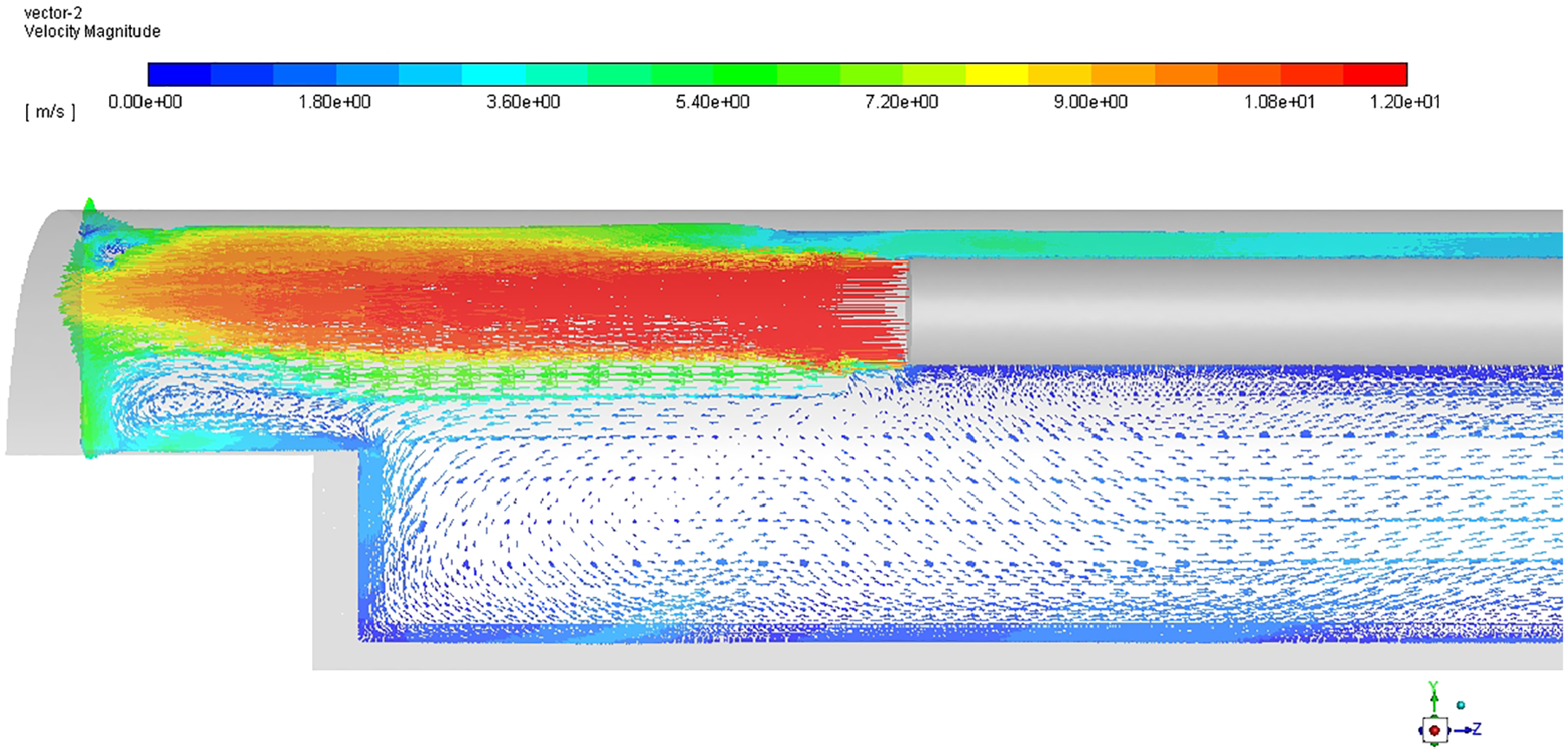
Velocity vector diagram of x = 1.5 in the working condition 9.

Velocity vector diagram of x = 0 in the working condition 15.

Velocity vector graph of x = 2.25 in the working condition 4.

Velocity vector diagram of x = 2.25 in the working condition 5.
Above all, the setting of forced ventilation parameters with bench cut method in working condition 9 is relatively reasonable. The flow field is uniform, the jet flow is fully developed, and there is no eddy currents that can affect the flow field. Besides, the wind speed in the tunnel is high, the air circulation is fast, and the waste gas in the tunnel can be discharged quickly, which is suitable for practical engineering application.
Optimized tunnel ventilation design
Based on the improved TOPSIS theory, the 16 working conditions of orthogonal experimental design were researched and analyzed. The flow field analysis was carried out in several groups of working conditions with high scores, and the flow field in each working condition was checked. Finally, the optimized design scheme was determined as shown in Table 6:
Optimization design scheme.

P2 represents the air duct is located on the side wall.
Discussion
In this paper, we use orthogonal experimental design to study the influence of the distance between the air duct outlet and the tunnel face L1, the bench length L2, the bench height L3, and the position of the air duct P on the forced ventilation field of tunnel construction by step method, and get the optimal construction ventilation scheme. AHP, EW, and TOPSIS are applied to the data processing. Through this research, we obtain some important results, but there are still much to discuss.
Discussion on CFD numerical simulation calculation
Although we have considered four influencing factors in the orthogonal experimental design, the influence of the air duct diameter on the flow field is not fully considered. In the construction ventilation, the influence of wall roughness and mechanical equipment is ignored, and the influence of wall roughness and construction equipment on flow field should be fully considered in the future research, so that the numerical simulation results are more in line with the reality. On the one hand, because model grid number is larger and the flow field changes is only in a limited range, a distance of 90 m from the tunnel face is taken as the research object. On the other hand, to better reflect the characteristics of flow field, the number of planes intercepted in this paper is still limited, and only three representative planes are selected. More indicators that can reflect the characteristics of the flow field should be explored in the future research.
Discussion on ventilation efficiency of original scheme and optimal scheme
The result of the optimal scheme is better than that of the original design in many aspects. In the optimization scheme, the wind speed in the tunnel is larger. The average velocity Vx
The comparison between the original scheme and the optimal scheme.

Conclusions
The Jinjing tunnel of Xingquan Railway is taken as a typical case study. And the distance between the air duct outlet and the tunnel face, the bench length, the bench height, the position of the air duct and the flow field of the tunnel ventilation with the bench cut method is researched through orthogonal experimental design. The improved TOPSIS theory is performed for data analysis to obtain the optimized working condition, and then the flow field is checked to determine the final optimization scheme, which provides certain reference for the improvement of tunnel construction ventilation scheme. The following conclusions can be drawn from the research and analysis above.
The tunnel entrance area was taken as a validation case, and the CFD simulation results are compared with the field measurement to determine whether is feasible to perform the CFD simulations to research and analyze the tunnel ventilation flow field. The result shows that the CFD simulations results are reliable.
The entropy weight method is used to objectively reflect the data information, and the analytic hierarchy process is adopted to subjectively judge. The combined weights obtained are more reasonable, scientific, and reliable. Combined with the TOPSIS theory, the ventilation flow field data in the tunnel is scientifically and processed to optimize reasonably. The determination of the scheme is also reliable, which has reference significance for the optimization of the similar type of tunnel ventilation project.
Through the analysis and processing of data by the relevant mathematical theory and the verification of the flow field in the tunnel, the specific optimization plan is determined, which is the distance L1
In the optimization scheme, the flow field in the tunnel is stable, the wind speed is high, and there is no vortex that can affect the flow field. It can improve the ventilation efficiency, enhance the tunnel stability to a certain extent, save time and cost, and bring considerable economic and social benefits to the project.
Footnotes
Acknowledgements
The authors would like to express the appreciation and thanks to the managers and China Tieshiju Civil Engineering Group Co., Ltd.
Handling Editor: James Baldwin
Declaration of conflicting interests
The author(s) declared no potential conflicts of interest with respect to the research, authorship, and/or publication of this article.
Funding
The author(s) disclosed receipt of the following financial support for the research, authorship, and/or publication of this article: This research was funded by the Natural Science Foundation of China (51478118), the Guangxi Science and Technology Plan Projects (AD18126011), and the China Scholarship Council.

Data availability
The data used to support the findings of this study are included within the manuscript.