



Abstract
In this paper, 3D roll tensioning elastoplastic model was built by finite element method and the research object was a common circular saw blade body with hole, slot, and scraper structure. The theoretical calculation results show that there are areas dominated by tangential compressive stress near slot and scraper of roll tensioned saw blade body, which is not the expected result. It is proved that residual stress of saw blade body can be regulated by combining roll tensioning and local plastic compression process in this paper. The theoretical calculation results show that the outer edge of saw blade body near slot and scraper becomes area dominated by tangential tensile stress after the improved tensioning process. The improved tensioning process has little effect on stiffness and waist strength of circular saw blade.
Introduction
Wood cutting process and cutting tools are important research directions in the field of wood science and technology. In the process of wood sawing, the cutting temperature accumulates on saw blade body, and it is impossible to take coolant lubrication as the cutting process of metal and stone. Therefore, roll tensioning is necessary for saw blade body, which is used to counteract adverse effects of cutting heat.
Dynamic characteristics and residual stress of tensioned circular saw blade was studied by some researchers. Most of them assume that the saw blade body is an ideal disc structure. Based on the assumption that the saw blade body is an ideal disc structure, the evolution law of dynamic characteristics and residual stress in saw blade body has been studied systematically. The natural frequency of roll tensioned circular saw blade was tested by Kuratani and Oda 1 and calculated by Cristóvão et al. 2 The effect of tensioning way on natural frequency of circular saw blade was researched by Zhang et al. 3 Gospodaric et al. 4 proposed an electromagnetic method which can reduce the vibration of saw blade. Szymani and Mote5,6 built a theoretical model for roll tensioning process and got the residual stress of saw blade body. A finite element model for roll tensioning process was established by Nicoletti et al., 7 Heisel et al., 8 and Merhar et al. 9 The influence of material properties of saw blade body on residual stress field of roll tensioned saw blade body was studied by Li and Zhang 10 based on finite element method (FEM). Generation and regulation mechanism of residual stress field of circular saw blade after multi-spot pressure tensioning was analyzed by Li et al.11–13 Theoretical analysis model of laser shock tensioning process was built by Li and Zhang14–16 based on laser shock wave theory. Laser energy, spot diameter and impact zone distribution have great effect on residual stress field.
Structure of circular saw blade body shows a diversified development trend. Circular saw blade is no longer an ideal ring structure. Nowadays, circular saw blade is mostly composed of circular holes, wire slots, scrapers, and other structures, as shown in Figure 1. To a certain extent, these structures are helpful to release cutting heat, discharge chip, and reduce noise. However, in the actual use process, these circular saw blades still have the phenomenon of dynamic instability. And, in theory, when structure of saw blade body is changed, its residual stress field is bound to change, even if the roll tensioning process parameters do not change.
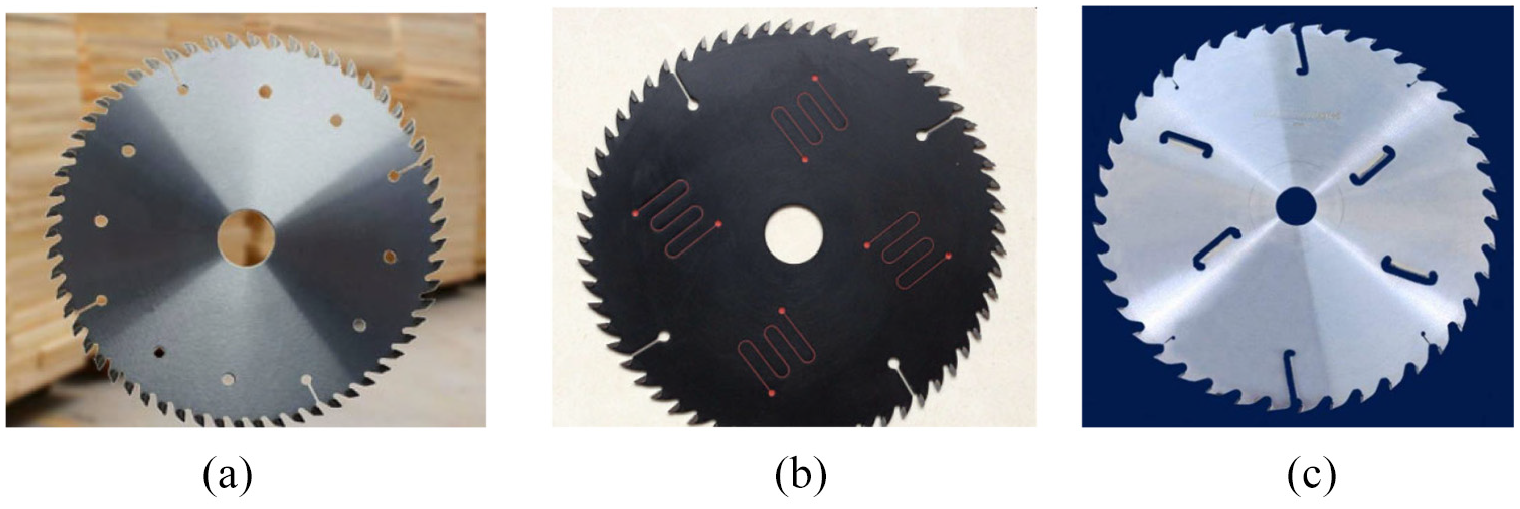
Common structure of circular saw blade body: (a) circular hole, (b) slot, and (c) scraper.
Nowadays, circular saw blade body is no longer an ideal axisymmetric structure. However, for these saw blade with different structure, enterprises still adopts roll tensioning process in order to form tangential tensile stress for saw blade body. The residual stress formation mechanism of circular saw blade with non ideal disc structure after tensioning process is a scientific and technological problem.
In this paper, a common circular saw blade with hole, slot and scraper was the object of study. An tensioning method for the saw blade body by combining roll tensioning and local plastic compression process was built by finite element method. The theoretical analysis process was introduced in this paper. For circular saw blade with hole, slot and scraper structure, this paper provides a new idea for the optimization and adjustment of tensioning process.
Materials and methods
A three-dimensional (3D) roll tensioning elastoplastic model was built by finite element method, which referred to the previous research results.8–10 Previous studies had proved the accuracy of finite element method. The 3D model was shown in Figure 2 and the roll was analytical rigid body. Circular saw blade body was made by 65 Mn steel. Its Elastic modulus is 210 GPa, with Poisson’s ratio 0.3 and Yield strength 780 MPa. Downward loading force of roll was 10 kN. 3D 8-node reduced integration element was selected. Elements in rolling region were set dense, as shown in Figure 2.

3D elastoplastic model of roll tensioning process.
Results and discussion
The residual stress is balanced, non-uniform stress. The plastic deformation of metal is an important cause of residual stress. Roll tensioning process is essentially a plastic deformation process of circular saw blade. Therefore, circular saw blade will generate residual stress field after tensioning process.
In Figure 3, tangential stress of saw blade body after roll tensioning was obtained. In the area near slot and scraper, there are areas dominated by tangential compressive stress, as shown in Figure 3. Because of slot and scraper, there are gaps at the outer edge of saw blade body. Therefore, tangential tensile stress of saw blade body after roll tensioning process is dissipated near slot and scraper structure. In the outer edge area where saw blade body is connected completely, there are areas dominated by tangential tensile stress. This shows that the integrity of the outer edge of saw blade body is easier to produce tension state after roll tensioning process.
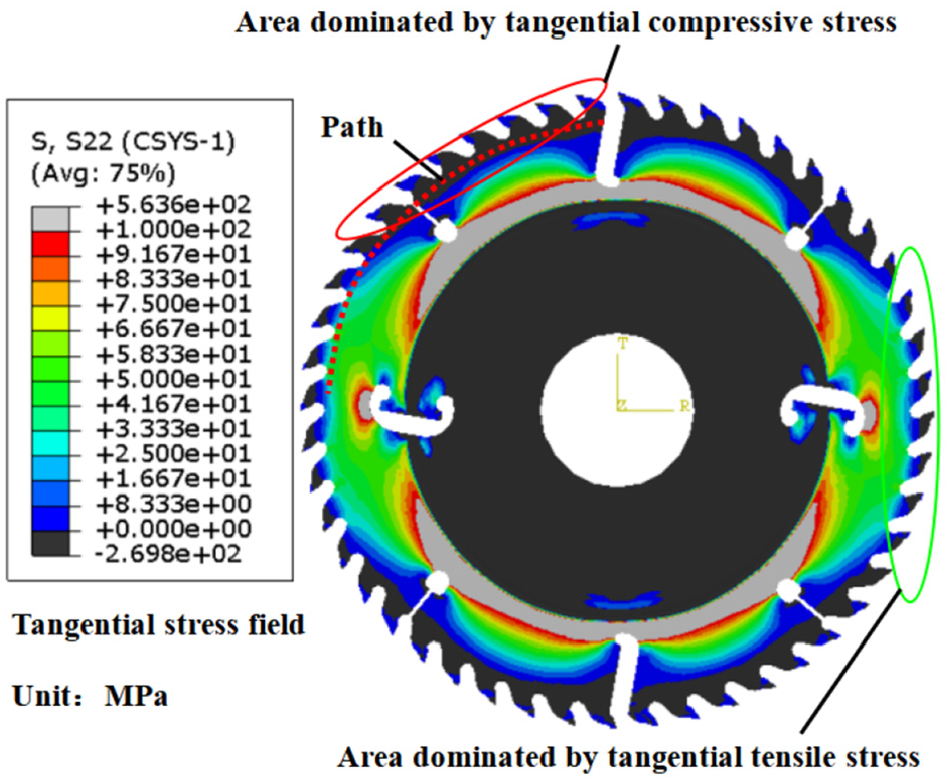
Tangential stress of roll tensioned saw blade body.
Roll tensioning is used to form tangential tensile stress on the outer edge of saw blade body. The tangential tensile stress on the outer edge of saw blade body can counteract adverse effect caused by cutting thermal stress and improve dynamic stability of saw blade body. The slot and scraper structure can also improve dynamic stability of saw blade body. However, there are areas dominated by tangential compressive stress in the area near slot and scraper structure after roll tensioning process. This means that saw blade body has two states of tension and relaxation at the same time during cutting process. It needs to be improved for making the outer edge of saw blade body as tight as possible. Regardless of the structure of saw blade body, the best effect is that the outer edge of saw blade body becomes area dominated by tangential tensile stress after roll tensioning process.
In Figure 4, a tensioning method combining roll tensioning and local plastic compression process for saw blade body was proposed and tried. Spherical indenter of Figure 5 was used to form local plastic compression zone near slot and scraper. It is used to change the residual stress state of the area near slot and scraper of saw blade body after roll tensioning. Spherical indenter loading displacement was 0.06 mm. 3D elastoplastic model of local plastic compression process was built in this paper by finite element method, which referred to the previous research results.11–13 Local plastic compression zone and roll tensioning plastic zone worked together to change the tangential stress field of saw blade body.

An improved tensioning method for saw blade body.

Spherical indenter.
Tangential stress formed by the improved tensioning method was shown in Figure 6. Area dominated by tangential compressive stress shown in Figure 3 is changed to area dominated by tangential tensile stress. If the local plastic compression zone is distributed near other slots and scrapers, the outer edge of the saw blade in this paper could become area dominated by tangential tensile stress. As shown in Figures 3 and 6, tangential stresses in the area marked by the green circle have little difference, because the effects of the four local plastic compression zones are only reflected in local area.
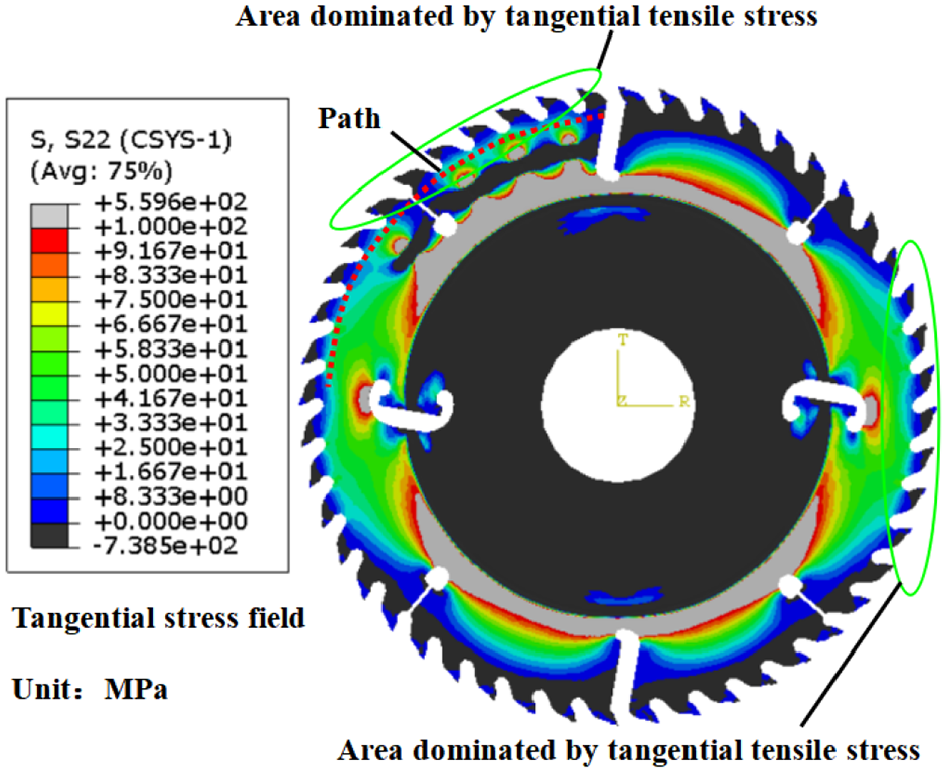
Tangential stress of saw blade body formed by the improved tensioning method.
Tangential stress at the outer edge of saw blade body is important for counteracting cutting thermal stress. The tensioning method in Figure 4 is only for the adjustment of local regional stress field. This area is the area marked by the red circle in Figure 3. Therefore, tangential stress in the red path of Figures 3 and 6 were compared, as shown in Figure 7. On the outer edge of saw blade body, due to local plastic compression, the tangential compressive stress area changes into tangential tensile stress area. On the outer edge of saw blade body, the area originally under tangential tensile stress is still under tangential tensile stress, and the value has not decreased significantly.

Tangential stress on outer edge of saw blade body formed by the two tensioning method.
Theoretical calculation results of Figures 6 and 7 prove that the combination of roll tensioning process and local plastic compression can realize that the saw blade body outer edge becomes area dominated by tangential tensile stress after tensioning process.
As shown in Figure 6, the stress field of the area near the four local plastic compression zones changes significantly. Therefore, several locations near the four local plastic compression zones were selected to analyze their stiffness and waist strength, as shown in Figure 8. The displacement of the loading point is 2 mm when waist strength of saw blade body is studied. If the stiffness and waist strength of the nine points in Figure 8 change little, it will show that the negative impact of the new tensioning way can be ignored.

Analysis position of stiffness and waist strength.
As shown in Figures 9 and 10, the stiffness and waist strength in the same position of saw blade body changes little. Therefore, the combination of roll tensioning process and local plastic compression can optimize the tangential stress distribution on the outer edge of saw blade body, with no other effects.

Contrast of stiffness of saw blade body after the two tensioning process.

Contrast of waist strength of saw blade body after the two tensioning process.
Conclusion
In this paper, the roll tensioning process of a common circular saw blade with hole, slot, and scraper was studied. At the outer edge of roll tensioned saw blade body, there are areas dominated by tangential compressive stress near slot and scraper. It needs to be improved for roll tensioning process.
An tensioning method which combines roll tensioning and local plastic compression process was proposed. The area near slot and scraper is compressed by spherical indenter. The outer edge of circular saw blade becomes area dominated by tangential tensile stress after the improved tensioning process. The tensioning process has little effect on stiffness and waist strength of circular saw blade.
Footnotes
Acknowledgements
We gratefully acknowledge the financial support of Fundamental Research Funds for the Central Nonprofit Research Institution of CAF No. CAFYBB2019QB006.
Handling Editor: James Baldwin
Author contributions
Bo Li put forward the research idea and was a major contributor in writing the manuscript. Yuan An did modeling and simulation work.
Declaration of conflicting interests
The author(s) declared no potential conflicts of interest with respect to the research, authorship, and/or publication of this article.
Funding
The author(s) disclosed receipt of the following financial support for the research, authorship, and/or publication of this article: This work was supported by Fundamental Research Funds for the Central Nonprofit Research Institution of CAF No. CAFYBB2019QB006.

Availability of data and materials
Data generated in this study are not available.